Evaluation of Directed Diffusion Protocol for
Mobile Sensor Networks
K.E.Kannammal, Associate Professor, Department of Computer Science and Engineering,
Sri Shakthi Institute of Engineering and Technology, Coimbatore
Dr.T.Purusothaman, Assistant Professor, Department of Computer Science and Engineering,
Government College of Technology, Coimbatore
Abstract:- Recent technological advances have enabled distributed information gathering from a given region by deploying a large number of networked tiny microsensors which are low power devices equipped with programmable computing, multiple sensing and communication capability thus forms Wireless Sensor networks. Directed Diffusion is a data centric routing protocol in Wireless Sensor Networks (WSN). It is a reactive protocol which creates routes based on needs. Sensed data’s are stored in attribute value pairs. A Sink request data by sending interests. The interest messages are flooding through the network and are added to each node’s interest cache. The data that match the interests are sent towards the sink. However, there is very little research addressing the impact of mobility on this class of routing protocols. In this paper, we address the behavior of a Directed Diffusion routing under different scenarios.
Keywords— Directed diffusion, Drain rate, Power Consumption, Wireless Sensor Networks. 1. INTRODUCTION
Wireless sensor networks are information gathering paradigm based on the collective efforts of many small wireless sensor nodes. The sensor nodes, which are intended to be physically small and inexpensive, are equipped with one or more sensors, a short-range radio transceiver, a small micro-controller, and a power supply in the form of a battery or mechanisms that try to scavenge energy from the environment. Sensor network deployments are envisioned to be done in large scales, where each network consists of hundreds or even thousands of sensor nodes [1]. In such deployment, human configuration of each sensor node is usually not feasible and therefore self-configuration of the sensor nodes is important. Energy efficiency is also critical, especially in situations where it is not possible to replace sensor node batteries. In commercial sensor network installations, e.g., intelligent buildings, battery replacement is typically no option as the systems should allow maintenance-free operation.Most sensor network applications aim at monitoring or detection of phenomena. Examples include office building environment control, wildlife habitat monitoring, and forest fire detection. For such applications, the sensor networks cannot operate in complete isolation; there must be a way for a monitoring entity to gain access to the data produced by the sensor network. By connecting the sensor network to an existing network infrastructure such as the global Internet, a local-area network, or a private intranet, remote access to the sensor network can be achieved. The sensor network architecture is shown in figure 1.
Traditional routing protocols defined for wireless ad-hoc networks are not well suited for wireless sensor networks due to the following reasons [2]:
Sensor networks are data centric. Traditional networks usually request data from a specific node, but sensor networks request data based on certain attributes such as "which area has temperature > 100°F?''
In traditional wired and wireless networks, each node is given a unique id, which is used for routing. This cannot be effectively used in sensor networks because being data centric they do not require routing to and from specific nodes.
Adjacent nodes may have similar data. So instead of sending data separately from each node to the requesting node, it is desirable to aggregate similar data before sending it.
Figure 1. The sensor network
Thus, sensor networks need protocols which are application specific, data-centric, capable of aggregating data and minimizing energy consumption [3,9,11].
The organization of the paper is as follows. Section 2 discusses the mobile sensor networks. Section 3 discusses features of the Directed diffusion protocol. Section 4 presents the mobility models used in this analysis. The simulation results are presented in section 5. Based on the analysis, section 6 presents the conclusions.
2. MOBILE SENSOR NETWORKS
Mobile sensor networks are sensor networks in which nodes can move under their own control or under the control of the environment [4]. Mobile networked systems combine the most advanced concepts in perception, communication, and control to create computational systems capable of interacting in meaningful ways with the physical environment, thus extending the individual capabilities of each network component and network user to encompass a much wider area and range of data. A key difference between a mobile sensor network and a static sensor network is how information is distributed over the network. Under static nodes, a new task or data can be flooded across the network in a very predictable way. Under mobility this kind of flooding is more complex. Under natural mobility this depends on the mobility model of the nodes in the system.
3. DIRECTED DIFFUSION
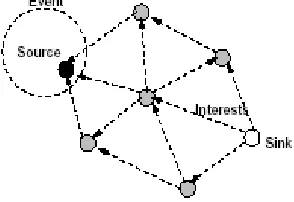
Directed Diffusion is a data-centric routing algorithm for sensor networks. Its key features are named attribute-value pairs and path reinforcement[12]. Directed diffusion is a reactive routing protocol which creates paths based on need, not ahead of time. Sensed data is stored in attribute-value pairs. When a node known as a sink node wants information about a particular attribute, it broadcasts interest messages to its neighbors. These interest messages are flooding through the network and are added to each node's interest cache. Each interest record in this cache has one or more gradients which correspond to neighbor nodes that transmitted the interest. The gradient also stores the rate at which data is desired, the duration of the interest, and a timestamp. When a node generates data that matches an interest in its cache, it sends the data back to the source along the gradients. Intuitively, the data is drawn to the sink through the gradients.
The sink node may reinforce the shortest path (i.e., the one with the fastest response) by sending an interest with a higher data rate along that path. Intermediate nodes propagate the reinforcement by examining a local cache of recently sent data messages. The data cache also prevents loops in data delivery. Slower data paths may be sent negative reinforcement, i.e. interest messages with a slow data rate to save network bandwidth. If a sink wants to continue receiving data it must periodically reinforce the path to update the timestamp and duration in the gradients. Directed diffusion is significantly different from IP-style communication[5] where nodes are identified by their end points, and inter-node communication is layered on an end-to-end delivery service provided within the network.
Interest Propagation
towards the neighbor from which the interest was received, with the specified event data rate. If there exists an interest entry, but no gradient for the sender of the interest, the node adds a gradient with the specified value. It also updates the entries timestamp and duration fields appropriately. Finally, if there exists both an entry and a gradient, the node simply updates the timestamp and duration fields. The interest propagation is shown in figure 2..
Figure 2. The Interest Propagation
Figure 3 shows the gradients established in the case where interests are flooded through a sensor field. Notice that every pair of neighboring nodes establishes a gradient towards each other. This is a crucial consequence of local interactions. When a node receives an interest from its neighbor, it has no way of knowing whether that interest was in response to one it sent out earlier, or is an identical interest from another sink on the "other side" of that neighbor. Such two-way gradients can cause a node to receive one copy of low data rate events from each of its neighbors. In sensor network, a gradient specifies both a data rate and a direction in which to send events. More generally, a gradient specifies a value and a direction. The directed diffusion paradigm gives the designer the freedom to attach different semantics to gradient values.
Data Propagation
A sensor node that detects a target searches its interest cache for a matching interest entry. In this case, a matching entry is one whose rect encompasses the sensor location, and the type of the entry matches the detected target type. When it finds one, it computes the highest requested event rate among all its outgoing gradients. The node tasks its sensor subsystem to generate event samples at this highest data rate. The source then sends to each neighbor for whom it has a gradient. The source then sends to each neighbor for whom it has a gradient.
This data message is, in effect, unicast individually to the relevant neighbors. A node that receives a data message from its neighbors attempts to find a matching interest entry in its cache. The matching rule is as described in the previous paragraph. If no match exists, the data message is silently dropped. If a match exists, the node checks the data cache associated with the matching interest entry[6].
This cache keeps track of recently seen data items. It has several potential uses, one of which is loop prevention. By examining its data cache, a node can determine the data rate of received events. To re-send a received data message, a node needs to examine the matching interest entries gradient list. If all gradients have a data rate that is greater than or equal to the rate of incoming events, the node may simply send the received data message to the appropriate neighbors.
Reinforcement
Once sources detect a matching target, they send low-rate events, possibly along multiple paths, towards the sink. After the sink starts receiving these low data rate events, it reinforces one particular neighbor in order to "draw down" higher quality events. To reinforce this neighbor, the sink re-sends the original interest message but with a smaller interval .When the neighboring node receives this interest, it notices that it already has a gradient towards this neighbor. Furthermore, it notices that the sender’s interest specifies a higher data rate than before. If this new data rate is also higher than that of any existing gradient, the node must also reinforce at least one neighbor.
The node uses its data cache for this purpose. For example, this node might choose that neighbor from whom it first received the latest event matching the interest. Alternatively, it might choose all neighbors from which new events were recently received Through this sequence of local interactions, a path is established from source to sink transmission for high data rate events as shown in figure 4.. The Reinforcement process Reinforce one of the neighbor after receiving initial data.
Figure 4. The Data Reinforcement
4. MOBILITYMODEL
In the performance evaluation of a protocol for a wireless sensor network, the protocol should be tested under realistic conditions including, a sensible transmission range, and limited buffer space for the storage of messages, representative data traffic models, and realistic movements of the mobile users.
The Random Waypoint Mobility Model
The random way point model is the most commonly used mobility model in research community. In the current Network Simulator (NS-2) distribution, the implementation of this mobility model is as follows: at every instant, a node randomly chooses a destination and moves towards it with a velocity chosen randomly from [0, Vmax], where V max is the maximum allowable velocity for every mobile node. After reaching the destination, the node stops for a duration defined by the ‘pause time’ parameter. After this duration, it again chooses a random destination and most cases repeat the whole process again until the simulation ends. The random way point model is provides by the
setdest tool in the standard NS-2 distribution 5.EVALUATION
We have used the directed diffusion code in NS-2 implemented by USC/ISI [7] and mobility extensions that were implemented by the CMU Monarch project. For our simulations, we used a sensor network comprising of 30 nodes which are randomly dispersed on 800m x 800m field. Movement patterns were generated based on random way point model [8] for each value of pause time 0 to 50 and speed 2. The initial energy of all nodes is 40 Joules. For our experiments, we use a load of 1 sinks to varying no of sources and 1 source to varying number of sinks. The parameters chosen for simulation in NS2 in shown in the table 1. NS2 it is an open source discrete event simulator and it was developed at the University of California at Berkeley and the Virtual Inter Network Testbed (VINT).
Parameter Value Simulation Time 100 sec
No of nodes 30
Pause time 0,10,20,30,40,50 sec Environmental size 800 x 800m
Speed 2 m/s
Mobilty Model Random Way Point
Figure 4.Power consumption variations - one Figure 5.Power consumption variations - one source with increasing number of sinks sink with increasing number of sources.
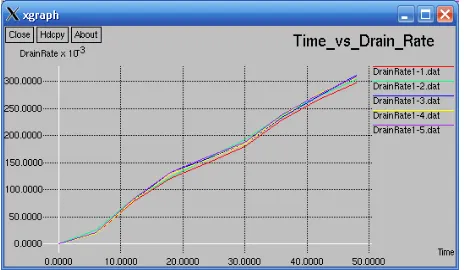
Figure 6.Drain Rate - one source
Figure 7. Drain Rate variations - one sink
with increasing number of sinks with increasing number of sources
Figure 8 .Network load -one source WITH Figure 9.Network load- one sink with
increasing number of sinks increasing number of source nodes.
Power Consumption:
Drain Rate:
As shown in Figure 6 and 7 shows the relative drain rate of the mobile nodes with varying number of source/sink nodes. It has been observed that the drain rate increases as the number of sink node increases.
Network load
Network load variations with respect to number of sinks can be another point of interest. As shown in figure 8 and 9 the network load varies in Directed Diffusion routing as the source and sink node number increases.
6. CONCLUSION
Directed Diffusion is a reactive protocol which creates route based on need and the sensed data’s are stored in attribute value pairs. In this paper, we analyzed the performance of Directed diffusion routing with increasing number of sources and sinks. Our simulation result shows that varying number of sources/sinks are influences the performance of the routing protocol. The various evaluation studies on this routing protocol concluded to the following .The number of sources and sinks with mobility in a directed diffusion scenario affects the power consumption, drain rate of the nodes as well as the network load. We, continuing the work on this area to get the optimized version of routing protocols well suited for mobile wireless sensor networks.
REFERENCES
[1] I.F.Akyildiz,W.Su,Y.Sankarasubramaniam and E.Cayirci, “A Survey on Sensor Networks”, IEEE Communication Magazine , Volume: 40 Issue: 8, pp.102-114, August 2002.
[2] Manjeshwar, A.; Agrawal, D.P."TEEN: a routing protocol for enhanced efficiency in wireless sensor networks", Parallel and Distributed Processing symposium., Proceedings 15th International Volume, Issue , Apr 2001 Page(s):2009 – 2015
[3] Wendi Rabiner Heinzelman, Anantha Chandrakasan and Hari Balakrishnan “ Energy –Efficient Communication protocol for wireless sensor Networks” Proc. 33rd Hawaii Int'l. Conf. Sys. Sci., Jan. 2000.
[4] Ankur Choksi, Richard P. Martin, Badri Nath and Rahul Pupala, “Mobility Support for Diffusion-based Ad-Hoc Sensor Networks”, Department of Computer Science, Rutgers University, Piscataway, NJ, Technical Report DCS, April 2002
[5] C. Intanagonwiwat, R. Govindan, and D. Estrin, “Directed Diffusion: A Scalable and Robust Communication Paradigm for Sensor Networks,” in Proceedings of the ACM/IEEE International Conference on MobileComputing and Networking (Mobicom ’00), Boston, USA, 2000. “
[6] Philip Sitton and Kenan Casey, "Directed Diffusion Report", COMP6360 [7] "Ns-2 network simulator," http://www.isi.edu/nsnam/ns/, 1998.
[8] "Cmu monarch extensions to ns-2," http://www.monarch.cs.cmu.edu/cmu-ns.html,1999.
[9] Marc Greis' Tutorial for the UCB/LBNL/VINT Network Simulator "ns"
[10] S. john, “Wireless Sensor Networks,” Department Of Computer Science, University Of Virginia, June 19, 2006.
[11] T. P.Lambrou and C. G. Pamayiotou, “Collaborative Area Monitoring Using Wireless Sensor Networks with Stationary and Mobile Nodes,” EURASIP Journal on Advances in Signal Processing ,Volume 2009, Mar 2009.