BEEF PRODUCTION: POTENTIAL AND OUTPUT
IN MID-CANTERBURY
S. D.
W
ALKERField Officer,
N.Z.
Sheep and Beef Cattle Survey,
Lincoln College
W. R.
LOBBSuperintendent, Winchmore Irrigation Research Station,
Ashburton
INTRODUCTION
C
LIMATEand pasture production in mid-Canterbury have
been discussed by Rickard (1968). Under “dryland”
farm-ing conditions, pasture
of some 110 to 130 ays when production is very low
B
reduction is-limited by (1) winters
and (2) dry periods of variable incidence and duration
during the remainder of the year. These latter not only
restrict output every year but also result in a large
“be-tween years ’ variation in annual pasture production.
How-ever, adequate irrigation eliminates the dry periods and
results in pasture production characterized by :
(1) A higher annual production of some 9,000 to 10,000
lb D.M. per acre.
(2) A very low variability between years.
(3) Well-spread production within the growing season.
(4) A.ff;;gr;ately half of total growth occurring after
.
For the livestock farmer, the implications of these changes
are very great.
The pattern of irrigated pasture reduction was shown
to coincide more closely with the eed requirements of a
P
beef-breeding herd than with those of a prime-lamb ewe
flock. However, as more calves become available from
in-creased cow herds in the foothills and high country, and
these are augmented by calves bred on dairy farms, it
seems probable that beef production on the easier country
will become concentrated on finishing, rather than on
breeding. This paper outlines experimental work into
finishing beef cattle at Winchmore Irrigation Research
Station and considers the potential for beef
productionin mid-Canterbury in the light of the results obtained.
BEEF PRODUCTION
EXPERIMENTAL
MEAT PRODUCTION TRIAL
Over four seasons from 1957-8, a meat production trial at Winchmore Irrigation Research Station compared out-put from three self-contained farmlets. One of these car-ried a breeding flock and produced lamb only; the second produced chiller beef from weaner calves purchased in the autumn and sold before their second winter; while the third unit was stocked with both ewes and cattle and approximately half its production was lamb and the rest beef.
All forty acres of each farmlet were in pasture and the stock were wintered on autumn-saved pasture and meadow hay. Stocking rates were 7 to 7.5 ewes/acre, 1.1 to 1.2 weaner steers/acre and
3.5
to 4 ewes plus 0.5 steers/acre on the respective treatments. A summary of four years' production is given in Table 1.TABLE 1: MEAN MEAT PRODUCTION (Ib per acre)
---~---~----
-~---Treatment Lamb Bee/' Total
Sheep only 240 240
Cattle only 275 275
Sheep ~nd cattle 150 150 300
- - - -
--~---*Beef production is net, estimated carcass weights of calves at purchase having been subtracted.
The results suggest that systems of meat production which include beef are likely to produce more, rather than less, meat per acre, with maximum output when both lamb and beef are produced.
Other features shown by the trial were:
(1) During spring and summer, the "beef only" farmlet was seriously understocked but it was difficult to pro-vide sufficient feed of adequate quality for wintering. Excess hay was made in each season.
(2) This understocking led to deterioration of the swards. Cocksfoot increased in dominance; as time passed it became rank and tufty and suppressed clover growth to a marked extent. Observations suggested that this deterioration adversely affected the performance of
the cattle. .
and the cattle restricted if necessary; and in late summer the dry ewes required less feed, leaving greater scope for the cattle.
(4) Under the conditions of this trial, sheep were
nece~
sary to control pastures for cattle; but cattle were not needed for this purpose on the sheep only unit.(5) Meadow hay and autumn-saved pasture, of a quality and quantity suitable for wintering ewes, was not always adequate to winter all the weaner calves.
(6) Failure of weaners to progress satisfactorily during the winter was the major stock problem. This is illus-strated in Table 2.
TABLE 2: DAILY LIVEWEIGHT GAIN (Ib per head)
Season
Winter Summer .... '
1958-9
0.3 .... 1.9
1959-60
1.1
1.6
1960-1
0.5 1.5
Many of the weaners showed no obvious disease symp-toms other than failure to make adequate gains, but in most seasons some 10 to 20% appeared unthrifty with profuse scouring and harsh, ragged coats. Parasitism seemed a possible cause. Lice were found to be present and were controlled by standard treatment. But this did not correct the problem; nor did the administration of copper, selenium or the anthelmintics then available.
WINTERING TRIALS
In an attempt to improve winter feeding, paddock trials were started incorporating swedes and lucerne hay. Four seasons' results are averaged in Table 3.
TABLE 3: WINTER f.EEDS: MEAN LlVEWEIGHT GAIN
Autumn-saved pasture Swedes
Meadow hay Lucerne hay
lb/day
1.2 1.4 1.2 1.45
S.E. of Treatment Means
BEEF PRODUCTION 97
Swedes appeared to be a little better than autumn-saved pasture but, with crops of 30 to 35 tons (8,500 to 9,500 Ib D.M.) per acre, the likely improvement was not con-sidered sufficient to compensate for the additional costs and the loss of grazing involved. Moreover, for some unknown reason, pastures established after swedes were slow to attain full production. .
Lucerne hay appeared to be slightly superior to meadow hay, but this has not been followed up. Lucerne for grazing as well as hay could have possibilities, provided bloat is not a problem. Suitable cereal and/or grass drilled into the stand could well improve winter feeding.
Observations suggested that the young steers were seriously affected by the low temperature and/or cold winds experienced. As a consequence, some small indoor feeding trials were carried out. One compared indoor feeding on good to average meadow hay fed ad lib. with and without limited amounts of concentrates. The con-centrates used were a 10: 1 mixture of milled barley and linseed-based nuts fed at 1 Ib/IOO Ib liveweight/day. There were eight animals in each treatment and the results are summarized in Table 4.
TABLE 4:· INDOOR FEEDING: DAILY LIVEWEIGHT GAIN (lb per head)
---.---~
Hay
Hay
+
ConcentratesWinter
1.2 1.8
Summer Annual
1.9 1.5
1.7 1.7
The data suggest that wintering in an open-fronted barn on good meadow hay could be satisfactory, economical, and require relatively little labour.
Treatments of a second trial are set out in Table 5. Results are given in Table 6.
TABLE 5: WINTER FEEDS AND SHELTER-TREATMENTS
Treatment
1
2
3
Feeds
Swedes plus hay
Hay and limited concen-trates*
As for Treatment 2
Shelter
Paddock
Pen well sheltered by hedges allowing 0.1 acre/beast. As· for Treatment 2 but with access to open-fronted shed.
TABLE 6: FEEDS AND SHELTER: MEAN LIVEWEIGHT GAIN (lb)
Treatment
1
2 ... . 3 ... .
Winter
89 183 185
Summer
342 246 236
Total
431 429 421
This trial, like that outlined immediately above, shows a strong "compensatory" growth effect. It also demonstrates that wintering in a well-sheltered pen is quite satisfactory without additional shelter. Under such conditions, feeding of limited amounts of concentrates could be economical and allow sufficient weaners to be. wintered to permit higher summer stocking. It seems possible that the amounts of concentrates might be further reduced.
SUMMER STOCKING TRIALS
In the meat production trial, a stocking rate of 1.1 to 1.2 beasts per acre was too low on the all-beef unit. In recent years a series of summer stocking trials has been started to determine the optimum rate. In the first of these, stocking rates of 1.5 and 2.1 beasts per acre were compared. On each treatment the animals rotationally grazed three paddocks. Results are given in Table 7.
TABLE 7: SUMMER STOCKING 1966-67: LIVEWEIGHT GAIN (lb)
Beasts/Acre
1.5 2.1
Head/Day
1.75 1.6
Head/ Period Acre/ Period*
296 271
-445 570
., 167 days: from September 28, 1966 to March 15, 1967, when the , first draft was taken. As the final draft was not taken until June 8, 1967, total gain per acre for the season would exceed the figures given.
The data show a negligible difference in gain per animal but a marked increase in gain per acre with the increased stocking rate. . ..
In the following season a second trial was conducted by J. F. Rudman (pers. comm.), using stocking rates of 2.0 and 2.5 beasts per acre. In this trial, the cattle rotationally grazed nine paddocks on each treatment. Table 8 shows the results. .
Data from these two trials indicate that summer stock-. ing in excess of those in the early trial are possible with
BEEF PRODUCTION 99
TABLE 8: SUMMER STOCKING 1967-68: LIVEWEIGHT GAIN (Ib)
Beastsl Acre
2.0
2.5
HeadlDay
1.60
1.55
HeadlPeriod*
268 259
* 169 days: October 17, 1967 to April 13, 1968.
OUTPUT AND POTENTIAL
Acre I Period*
536
648
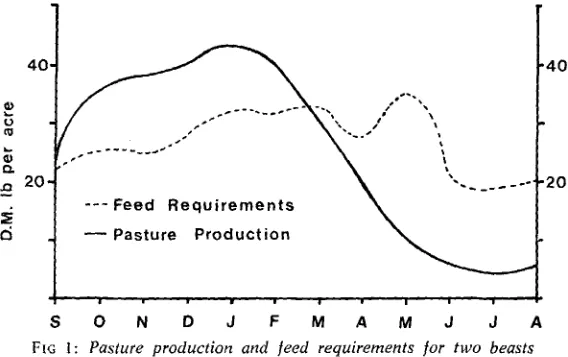
The trials reviewed have shown that a high level of beef production is possible on irrigated pasture in mid-Canterbury. The problems of wintering sufficient weaners have not been solved in full; but the trials have suggested several possible alternatives that should not be too expen-sive_ Which of these is adopted will depend on the stocking rate, the pattern of farm management, and the personal preferences of the farmer- They have shown, too, that summer stocking can be at a much higher rate than those commonly employed. The optimum rate has not yet been determined but Fig. 1 shows means monthly pasture pro-duction and feed requirements at a stocking rate per acre of two weaner steers purchased in late March and finished before their second winter- Feed requirements per animal were calculated from the tables of Coop (1965) and Mor-rison (1961); monthly numbers were estimated from times of disposal on the Winchmore trials.
"-(I)
Q,
40
.,._ ---- __ J"
... '"
/' ,
I \
-'
.
\\
\
.
40
.0 20 ... ... __ --- 20
--- Feed Requirements
- Pasture Production
s
o
N o J F M A M J J AFIG I: Pasture production and feed requirements for two beasts per acre (lb D.!vI. per day).
-From the graph it would seem that two beasts per acre is near attainment if all techniques are exploited to the full. On the animal side this means buying well-grown heavy weaners and drafting regularly as the cattle reach slaughter weight. Great care should also be taken to see that animals showing signs of "lumpiness," which indi-cates excess fat, are sold immediately. Adding weight to
these animals uses much feed and results only in an undesirable carcass. Wintering should aim at good but not excessive gains; and the provision of shelter is most essential. In addition to good paddock shelter, some addi-tional provision for winter, in the form of either pens or sheds, would be desirable. Even if a more conservative stocking rate of 1.75 beasts per acre were assumed, this type of management would produce upwards of 400 lb net beef per acre.
But what of the future? Using cattle, whether of the traditional breeds or of dairy origin, with greater potential for liveweight gains, it will be possible to draft earlier and at lighter weights, if necessary. This will reduce the pressure on autumn feed supplies and allow a better start for the weaners and greater provision of autumn-saved pasture for winter. This will permit high stocking rates and an even higher potential output. Nor must the influ-ence of the modern demand f01;: a lean carcass be forgotten. Results to date have been achieved while producing
ani-mals of ., chiller" type, with a good "fat cover" . The nutrients used in the production of this fat would have produced a much greater quantity of lean meat. Consider-ing all these factors, it seems that there is potential for an output well beyond the 400 lb postulated above. That this is not too impractical is shown by the fact that one farmer in the area is already producing over 500 lb beef per acre
(Reeves, 1967).
BEEF PRODUCTION 101
Indications are that, while production per acre is at a fairly low level, beef alone will be less profitable than sheep only. Indeed, if figures from the meat production trial are taken, it was only in the 1967-8 season that gross margin from beef exceeded that from sheep. The prices of weaners in autumn 1968 suggest that this may not hold for the coming season. But when beef production is at a high level, estimates suggest that its profitability relative to lamb plus wool is much improved. This paper has shown that pasture production on irrigated areas of mid-Canterbury is very well suited to just such levels of output. Moreover, the findings reviewed will be applic-able to a degree to the easier foothills, downlands and western plains of mid- and South Canterbury, wherever rainfall is adequate for good summer pasture produc-tion. When all these areas and the high levels of output possible are considered, it will be seen that the potential for beef production in this part of New Zealand is very great. The techniques to obtain this increase are known; how far the potential will be realized will depend largely on how rewarding it will be; that is, on its profitability to the individual farmer.
REFERENCES Coop., I. E., 1965: N.Z. Agric. Sci., 1 (3): 13-8.
Morrison, F. B. 1961: Feeds and Feeding. Abridged, 9th Ed. Morrison Publishing Co., Clinton: 658-9
Reeves, S. D. 1967: Proc. 17th Lincoln Call. Fmrs' Can!: 97. Rickard. D. S., 1968: Proc. N.Z. Grassl. Ass., 30: 81-93.
DISCUSSION
To a question regarding the accuracy of the data on stock requirements, Walker replied that they were the best available and the technique did give a standard for comparison. The problem of relating pasture measurements to animal requirements was very great.
A lax rotational grazing system was employed. The meat production figures given were based on freezing works' data.
In reply to a query concerning the use of modern anthelmintic drugs, Walker replied that the trials were carried out before the newer drugs were released. '