Libraries: The Models, Languages, and
Architecture of DIAS
M. Koubarakis, T. Koutris, C. Tryfonopoulos, and P. Raftopoulou Dept. of Electronic and Computer Engineering
Technical University of Crete 73100 Chania,Crete,Greece
{manolis,koutris,trifon,rautop,}@intelligence.tuc.gr www.intelligence.tuc.gr/˜manolis
Abstract. This paper presents DIAS,a distributed alert service for dig-ital libraries,currently under development in project DIET. We first discuss the models and languages for expressing user profiles and notifi-cations. Then we present the data structures,algorithms and protocols that underly the peer-to-peer agent architecture of DIAS.
1 Introduction
Users of modern digital libraries can keep themselves up-to-date by searching and browsing their favourite collections, or more conveniently by resorting to an
alert service. Recently, the participants of project HERMES [15] have argued very convincingly that an alert service which integrates information from a wide variety of information providers can be indispensable to users. It relieves them from the tedious and cumbersome task of searching and browsing, or even from subscribing to individual alert services such as Springer Link Alert1 or Elsevier Contents Direct2.
In this paper, we discuss the models, languages and architecture of DIAS, a Distributed Information Alert System currently under development in the context of the European project DIET [24,27,18]. DIAS adopts the basic ideas of project HERMES [15] and extends them in various interesting ways.
Our main technical contributions can be summarized as follows. First, we introduce the peer-to-peer (P2P) agent architecture of DIAS which has been inspired by the event dissemination system SIENA [6]. We also discuss the re-quirements imposed by this architecture on the data models and languages to This work was carried out as part of the DIET (Decentralised Information Eco-systems Technologies) project (IST-1999-10088),within the Universal Information Ecosystems initiative of the Information Society Technology Programme of the Eu-ropean Union.
1 http://link.springer.de/alert 2 http://www.elsevier.nl
M. Agosti and C. Thanos (Eds.): ECDL 2002, LNCS 2458, pp. 527–542, 2002. c
be used for specifying user profiles/queries and notifications.3 Then we develop formally the data modelsWP,AWP andAWPS, and their corresponding lan-guages for specifying queries and notifications. Data modelWP is only briefly presented and more details can be found in [19,20]. WP is based on free text and its query language is based on the boolean model with proximity operators. The concepts of WP extend the traditional concept of proximity in IR [2,8,9] in a significant way, and utilize it in a query language targeted at information alert for distributed digital libraries. Data modelAWP is based onattributesor
fields with finite-length strings as values. Its query language is an extension of the query language of data modelWP. Our work onAWP complements recent proposals for querying textual information in distributed event-based systems [6,4] by using linguistically motivated concepts such asword and not arbitrary strings. This makes AWP very appropriate in information alert systems for digital libraries4. Finally, the model AWPS extends AWP by introducing a “similarity” operator in the style of modern IR, based on the vector space model [2]. The novelty of our work in this area is the move to query languages much more expressive than the one used in the information dissemination system SIFT [29] where documents and queries are represented by free text. The similarity concept ofAWPSis essentially the similarity concept pioneered by IR systems [2], database systems with IR influences (e.g., WHIRL [11]) and more recently by the XML query language ELIXIR [10]. We note that both WHIRL and ELIXIR target information retrieval and integration applications, and pay no attention to information dissemination and the concepts/functionality needed in such ap-plications. The first presentation of modelAWPSis the one given in this paper and [21].
In the second part of our paper, we present the detailed protocols and al-gorithms of our architecture and discuss its implementation in the context of project DIET [24,27,18]. Contrary to project HERMES [15], we develop a dis-tributed information alert service from scratch based on the ideas of SIENA [6] and do not rely on any pre-existing message-oriented middleware.
The rest of the paper is organised as follows. Section 2 introduces the DIAS architecture, and discusses the requirements for data models and languages to be used in this context. Section 3 presents data model WP and its semantics. Then Sections 4 and 5 build on this foundation and develops the same machin-ery for data models AWP and AWPS. Section 6 discusses some interesting details of the DIAS architecture and implementation. Finally, Section 7 gives our conclusions and discusses future work.
3 In this paper,the termsqueryandprofilewill be used interchangeably. We are in an
information alert setting where a profile is simply along-standing query.
4 Also,for other commercial systems where similar models are supported already for
end-agent
middle agent middle
agent
middle
agent middle
agent resource
agent
resource agent
notification
notification profile
notification
profile notification
end-agent
information provider
information provider
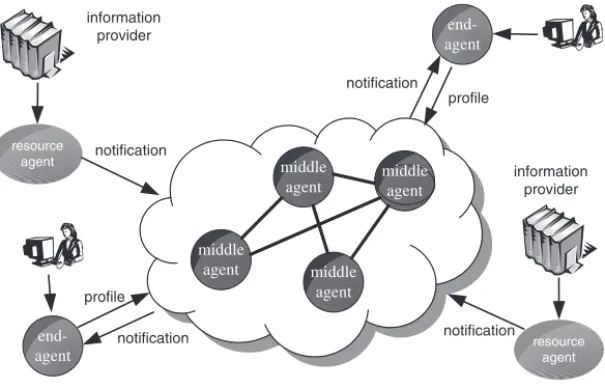
Fig. 1.The architecture of DIAS
2 DIAS: Architecture and Requirements
A high level viewof DIAS is shown in Figure 1. Resource agents integrate a number of information providers to produce streams of notifications that are send to somemiddle-agent(s).Resource agents are similar in functionality to observers as defined in project HERMES [15]. Users utilize theirpersonal agents to post profiles to some middle-agent(s). The P2P network of middle-agents is the “glue” that makes sure that published notifications arrive at interested subscribers. To achieve this, middle-agents forward posted profiles to other middle-agents using an appropriate P2P protocol. In this way, matching of a profile with a notification can take place at a middle-agent that is as close as possible to the origin of the incoming notification. Profile forwarding can be done in a sophisticated way to minimize network traffic e.g., no profiles that are less general than one that has already been processed are actually forwarded.
Most of the concepts of the architecture sketched above have been explicit (or sometimes implicit) in the agent literature for some time (especially, the lit-erature on KQML and subsequent multi-agent systems based on it [16]. Unfortu-nately the emphasis in most of these systems is on a single central middle-agent, making the issues that would arise in a distributed setting difficult to appreciate. In our opinion, the best presentation of these concepts available in the literature can be found in [6] where the distributed event dissemination system SIENA is presented.5 Some core ideas of SIENA have been adopted by DIAS as we will explain in Section 6.
5 SIENA does not use terminology from the area of agent systems but the connection
From the beginning, the design of DIAS has proceeded in aprincipled and
formal way. With this motivation and the above architecture in mind, we now proceed to discuss our requirements for models and languages to be used in this setting:
1. Expressivity. The language for notifications and user profiles must be rich enough to satisfy the demands of users and capabilities of information providers.
2. Formality.The syntax and semantics of the proposed models and languages must be defined formally.
3. Computational efficiency. The following problems should be defined formally and algorithms must be provided for their efficient solution:
a) Thesatisfiability problem: Deciding whether a profile can be satisfied by any incoming notification at all. This functionality is necessary at each middle-agent.
b) Thesatisfaction(ormatching)problem: Deciding whether a notification satisfies (or matches) a profile.
c) Thefiltering problem: Given a database of profilesdband a notification n, find all profilesq∈dbthat matchn. This functionality is very crucial at each middle-agent and it is based on the availability of algorithms for the satisfaction problem. We expect deployed information alert systems to handle hundreds of thousands or millions of profiles.
d) The entailment or subsumption problem: Deciding whether a profile is more or less “general” than another. This functionality is crucial if we want to minimize profile forwarding as sketched above.
Previous research has shown that the above formal perspective is shared by other researchers in the area of information dissemination.6 Various papers proposing sophisticated filtering algorithms in the area of event dissemination have defined the syntax and semantics of their languages carefully [1,25,14]. The developers of the distributed event dissemination system SIENA in particular have carefully defined the syntax and semantics of their language for events and profiles, and have formalised the notions of satisfaction and entailment (called “covers” in [6]). The same has been done for a much more expressive language in [4] where only satisfaction and filtering have been considered. To the best of our knowledge, no work has been done so far on addressing the satisfiability problem.
In the rest of this paper, we concentrate on information alert in distributed digital libraries and define the modelsWP,AWP andAWPS that are suitable for this job. Then we discuss the architecture of DIAS and showhowthe theo-retical concepts discussed above become crucial for its efficient implementation.
6 However,to the best of our knowledge,no one has applied this formal perspective
3 Text Values and Word Patterns
The modelWP assumes that textual information is in the form offree textand can be queried byword patterns (hence the acronym for the model).
We assume the existence of a finitealphabetΣ. Awordis a finite non-empty sequence of letters fromΣ. We also assume the existence of a (finite or infinite) set of words called thevocabulary and denoted byV.
Definition 1. A text value s oflength nover vocabulary V is a total function
s:{1,2, . . . , n} → V.
In other words, a text value s is a finite sequence of words from the assumed vocabulary and s(i) gives thei-th element ofs. Text values can be used to rep-resent finite-length strings consisting of words separated by blanks. The length of a text values(i.e., its number of words) will be denoted by|s|.
We nowgive the definition of word-pattern. The definition is given recursively in three stages.
Definition 2. Let V be a vocabulary. A proximity-free word pattern over
vo-cabularyV is an expression generated by the grammar
W P →w | ¬W P |W P∧W P |W P ∨W P | (W P)
where terminal w represents a word ofV. A proximity-free word pattern will be calledpositive ifit does not contain the negation operator.
Example 1. In all the examples of this paper, our vocabulary will be the vo-cabulary of the English language and will be denoted by E. The following are proximity-free word patterns that might appear in queries of a user of an infor-mation alert system interested in articles on constraints:
constraint∧programming∧ ¬e-commerce, constraint∧(optimisation∨programming)
We nowintroduce a newclass of word patterns that allows us to capture the concepts oforderanddistancebetween words in a text document. We will assume the existence of a set of(distance) intervals I defined as follows:
I ={[l, u] : l, u∈N, l≥0 andl≤u} ∪ {[l,∞) : l∈Nandl≥0}
The symbols ∈ and ⊆will be used to denote membership and inclusion in an interval as usual.
The following definition uses intervals to impose lower and upper bounds on distances between word patterns.
Definition 3. LetV be a vocabulary. Aproximity word patternover vocabulary
V is an expression wp1≺i1 wp2≺i2· · · ≺in−1 wpn wherewp1, wp2, . . . , wpn are positive proximity-free word patterns over V and i1, i2, . . . , in−1 are intervals
from the set I. The symbols ≺i where i ∈ I are called proximity operators.
The number ofproximity-free word patterns in a proximity word pattern (i.e.,n
Example 2. The following are proximity word patterns:
constraint≺[0,0]programming, artificial≺[0,0]neural≺[0,0]networks, algorithms≺[0,3](satisfaction∨filtering), induced≺[0,∞)constraints
repairing≺[0,10]querying≺[0,10](inconsistent∧databases)
The proximity word patternwp1≺[l,u] wp2 stands for “word patternwp1 is
beforewp2 and is separated by wp2 by at least l and at most u words”. In the above example algorithms≺[0,3] satisfactiondenotes that the word “satisfac-tion” appears after word “algorithms” and at a distance of at least 0 and at most 3 words. The word pattern constraint ≺[0,0] programming denotes that the word “constraint” appears exactly before word “programming” so this is a way to encode the string “constraint programming”. We can also have arbitrarily long sequences of proximity operators with similar meaning (see the examples above). Note that proximity-free subformulas in proximity word-patterns can be more complex than just simple words (but negation is notallowed; this re-striction will be explained below). This makes proximity-word patterns a very expressive notation.
Definition 4. Let V be a vocabulary. A word pattern over vocabulary V is an
expression generated by the grammar
W P →P F W P |P W P |W P ∧W P | W P∨W P | (W P)
where non-terminalsP F W P andP W P represent proximity-free and proximity word patterns respectively. A word pattern will be calledpositiveifits proximity-free subformulas are positive.
Example 3. The following are word patterns of the most general kind we allow: applications∧(constraint≺[0,0]programming)∧ ¬e-commerce,
algorithms∧(complexity ≺[0,10](satisfaction∧filtering)), learning ∧((neural≺[0,0]networks)∨ (neuromorphic≺[0,0] systems))
It is not difficult to see nowhowto define what it means for a text values tosatisfya word patternwp(denoted bys|=wp). The exact definition is given in [19,20,21].
Example 4. Letsbe the following text value:
“Interaction of constraint programming and local search for optimisation problems” The text value ssatisfies the following word patterns:
local≺[0,0]search≺[0,5]optimisation (global∨local)≺[0,5]search≺[1,1]optimisation,
(constraint∧programming)≺[0,10]optimisation≺[0,0]problems The text value salso satisfies word pattern:
optimisation∧(constraint≺[0,0]programming)
Definition 5. Let wp1 andwp2 be word patterns. We will say that wp1 entails wp2 (denoted bywp1 |=wp2) iff for every text value s such that s |=wp1, we
have s|=wp2. If wp1|=wp2, we also say that wp2 subsumes wp1.
Example 5. The word patternconstraint∧programmingentailsprogramming. The word pattern learning∧(artificial ≺[0,0] neural≺[0,0] networks) entails the word pattern learning∧(neural ≺[0,0] networks)∧artificial. The word pattern algorithms subsumes the word pattern algorithms∧satisfaction∧ filtering. Similarly,satisfaction∨filteringsubsumesfiltering.
4 An Attribute-Based Data Model and Query Language
Nowthat we have studied the data modelWP,we are ready to define our second data model and query language. Data modelAWPis based onattributesorfields
with finite-length strings as values (in the acronym AWP, the letter Astands for “attribute”). Strings will be understood as sequences of words as formalized by the model WP presented earlier. Attributes can be used to encode textual information in a notification (e.g., author, title, abstract of a paper and so on).
AWP is somewhat restrictive since it offers a flat view of a notification, but it will suffice in many cases that arise in digital library environments. A similarly flat viewof a notification has successfully been adopted in project HERMES [15].
We start our formal development by defining the concepts of notification schema and notification. Throughout the rest of this paper we assume the ex-istence of a countably infinite set of attributes U called theattribute universe.
Definition 6. A notification schemaN is a pair(A,V)whereAis a subset of the attribute universe UandV is a vocabulary.
Example 6. An example of a notification schema for information alert in a digital library is
N = ({AUTHOR, TITLE, ABSTRACT},E).
Definition 7. Let N = (A,V)be a notification schema. A notificationn over schema N is a set ofattribute-value pairs(A, s)whereA∈ A,sis a text value overV, and there is at most one pair(A, s)for each attributeA∈ A.
Example 7. The following is a notification over the schema of Example 6:
{ (AUTHOR,“John Brown”),
(TITLE,“Interaction of constraint programming and local search for optimisation problems”), (ABSTRACT,“In this paper we show that
Notice thatonlytextual information is allowed in notifications as defined in this paper. In the DIAS implementation to be discussed in Section 6, we eventually plan to support other kinds of information (e.g., numerical, dates, etc.). However, at the moment, we concentrate only on textual information.
The syntax of our query language is given by the following recursive defini-tion.
Definition 8. Let N = (A,V) be a notification schema. A queryover N is a formula in any of the following forms:
1. AwpwhereA∈ Aandwpis apositiveword pattern overV. The formula
Awpcan be read as “Acontains word pattern wp”. 2. A=swhereA∈ Aandsis a text value over V.
3. ¬φwhereφis a query containing no proximity word patterns. 4. φ1∨φ2 whereφ1 andφ2 are queries.
5. φ1∧φ2 whereφ1 andφ2 are queries.
The queries in the first two of the above cases are calledatomic.
Example 8. The following are queries over the schema of Example 6: AUTHOR(John≺[0,2]Smith),
¬AUTHOR= “John Smith”∧
(TITLE(optimisation∧(constraint≺[0,2]programming)))
Let us nowdefine the semantics of the above query language in our informa-tion alert setting. We start by defining when a notificainforma-tion satisfies a query.
Definition 9. Let N be a notification schema, n a notification over N and φ
a query over N. The concept ofnotification n satisfying query φ (denoted by
n|=φ) is defined as follows:
1. Ifφ is ofthe formAwpthenn|=φiff there exists a pair (A, s)∈nand
s|=wp.
2. Ifφis ofthe form A=s thenn|=φ iff there exists a pair(A, s)∈n. 3. Ifφis ofthe form ¬φ1 thenn|=φiffn|=φ1.
4. Ifφis ofthe form φ1∧φ2 thenn|=φiffn|=φ1 andn|=φ2.
5. Ifφis ofthe form φ1∨φ2 thenn|=φiffn|=φ1 orn|=φ2.
Example 9. The first query of Example 8 is not satisfied by the notification of Example 7 while the second one is satisfied.
Finally we define entailment (conversely: subsumption) of two queries.
Definition 10. Let φ1 and φ2 be queries over schema N. Then φ1 entails φ2
(denoted byφ1|=φ2) iff every notificationnoverN that satisfiesφ1also satisfies φ2. Ifφ1 entails φ2 then we also say that φ2 subsumesφ1.
Example 10. The query
(AUTHOR John≺[0,1]Brown)∧(TITLE constraint∧programming) entails (equivalently: is subsumed by)TITLEprogramming.
5 Extending
AWP
with Similarity
Let us nowdefine our third data modelAWPSand its query language.AWPS
extendsAWP with the concept ofsimilaritybetween two text values (the letter
Sstands for similarity). The idea here is to have a “soft” alternative to the “hard” operator . This operator is very useful for queries such as “I am interested in papers written by John Brown” which can be written inAWP as
AUTHOR(John≺[0,0]Brown)
but it might not be very useful for queries “I am interested in papers about the use of local search techniques for the problem of test pattern optimisation”.
The desired functionality can be achieved by resorting to an important tool of modern IR: theweightof a word as defined in the Vector Space Model (VSM) [2,23,28]. In VSM, documents (text values in our terminology) are conceptually represented as vectors. If our vocabulary consists ofndistinct words then a text valuesis represented as ann-dimensional vector of the form (ω1, . . . , ωn) where ωiis the weight of thei-th word (the weight assigned to a non-existent word is 0). With a good weighting scheme, the VSM representation of a document can be a surprisingly good model of its semantic content in the sense that “similar” doc-uments have very close semantic content. This has been recently demonstrated by many successful IR systems [2] or database systems adopting ideas from IR (see for example, WHIRL [11]).7
In VSM, the weight of a word is computed using the heuristic of assign-ing higher weights to words that are frequent in a document andinfrequent in the collection of documents available. This heuristic is made concrete using the concepts of word frequency and the inverse document frequency defined below.
Definition 11. Let wi be a word in document dj ofa collection C. The term frequencyof wi indj (denoted bytfij) is equal to the number ofoccurrences of
wordwi indj. Thedocument frequencyofwordwi in the collectionC (denoted
by dfi) is equal to the number ofdocuments in C that contain wi. Theinverse document frequencyof wi is then given byidfi= df1i. Finally, the numbertfij· idfi will be called theweight ofwordwi in documentdj and will be denoted by ωij.
At this point we should stress that the concept of inverse document frequency assumes that there is acollectionof documents which is used in the calculation. In our alert scenarios we assume that for each attributeAthere is a collection of text valuesCAthat is used for calculating theidf values to be used in similarity computations involving attribute A (the details are given below). CA can be a collection of recently processed text values as suggested in [29,15].
7 Sometimes in IR systems (or systems adopting ideas from IR) wordstems,produced
by some stemming algorithm [26],are forming the vocabulary instead of words. Additionally,stopwords(e.g.,“the”) are eliminated from the vocabulary. These im-portant details have no consequence for the theoretical results of this paper,but it should be understood that our current implementation of the ideas of this section utilizes these standard techniques.
We are nowready to define the main newconcept inAWPS, the similarity of two text values. The similarity of two text valuessq andsd is defined as the cosine of the angle formed by their corresponding vectors:8
sim(sq, sd) = ssq·sd q · sd =
N
i=1wqi·wdi
N
i=1w2qi·
N
i=1wd2i
(1)
By this definition, similarity values are real numbers in the interval [0,1]. Let us nowproceed to give the syntax of the query language for AWPS. SinceAWPS extendsAWP, a query in the newmodel is given by Definition 8 with one more case for atomic queries:
– A∼kswhereA∈ A,sis a text value over V andkis a real number in the interval [0,1].
Example 11. The following are some queries in AWPS using the schema of Example 7:
TITLE∼0.6“Local search techniques for constraint optimisation problems”, (AUTHOR(John≺[0,2]Smith))∧
(TITLE∼0.9“Temporal constraint programming”),
TITLE∼0.9“Large Scale Telecommunication Network Optimisation” We nowgive the semantics of our query language, by defining when a doc-ument satisfies a query. Naturally, the definition of satisfaction inAWPS is as in Definition 9 with one additional case for the similarity operator:
– Ifφis of the formA ∼k sq thend|=φiff there exists a pair (A,sd)∈dand sim(sq, sd)≥k.
The reader should notice that the numberkin a similarity predicateA∼k s gives arelevance thresholdthat candidate text valuessshould exceed in order to satisfy the predicate. This notion of relevance threshold was first proposed in an information alert setting by [17] and later on adopted by [29]. The reader is asked to contrast this situation with the typical information retrieval setting where a ranked list of documents is returned as an answer to a user query. This is not a relevant scenario in an information alert system because very fewdocuments (or even a single one) enter the system at a time, and need to be forwarded to interested users (see the architecture sketched in Figure 1).
A lowsimilarity threshold in a predicateA∼ksmight result in many irrel-evant documents satisfying a query, whereas a high similarity threshold would result in very fewachieving satisfaction (or even no documents at all). In DIAS,
8 The IR literature gives us several very closely related ways to define the notions of
weight and similarity [2,23,28]. All of these weighting schemes come by the name of tf·idf weighting schemes. Generally a weighting scheme is calledtf·idf whenever it uses word frequency in a monotonically increasing way,and document frequency in a monotonically decreasing way.
users could start with a certain relevance threshold and then update it using rel-evance feedback techniques to achieve a better satisfaction of their information needs. Recent techniques from adaptive IR can be utilised here [7]. This update functionality has not been implemented in the current version of DIAS.
Example 12. The first query of Example 11 is likely to be satisfied by the doc-ument of Example 7 (of course, we cannot say for sure until we know the idf factors so that the exact weights can be calculated). The second query is not satisfied, since the author specified in the query does not match the document’s author. Moreover the third query is unlikely to be satisfied since the only com-mon word between the query and Example 7 is the word “optimisation”.
6 The Current DIAS Implementation: Details
In the previous sections of this paper, we have defined appropriate models and languages for expressing profiles and notifications in DIAS. For efficiency reasons, the current implementation of DIAS supports only profiles of the form ψ∧σ where
– ψis a conjunction of atomic queries ofAWP of the form A=sor Awp where every proximity formula in the word patternwpcontains only words as subformulas.
– σ is a conjunction of atomic similarity queries as defined in the model
AWPS.
The notion of notification supported currently in DIAS is as defined in Section 4.
The reasons for the above choices in the current DIAS implementation are as follows. In [13], we give precise bounds for the computational complexity of all problems defined in Section 2 for model AWP. Satisfaction can always be decided in polynomial time. For the complete query language ofAWP, the satis-fiability problem is NP-complete and the entailment problem is coNP-complete. Polynomial cases of these two problems have been identified and the most use-ful one is the conjunctive case adopted in DIAS. This theoretical analysis will appear in a forthcoming paper.
In the rest of this section we discuss the data structures, algorithms and protocols that regulate howDIAS agents work together so that all produced information is delivered to interested consumers. This is achieved with the com-bination of the following techniques: sophisticated forwarding of theAWP part of each subscription by utilizing appropriate networking algorithms [12] and a poset data structure, and very fast indexing techniques for detecting the set of profiles that match an incoming notification. Preliminary evaluation of these techniques by us (and previously by SIENA researchers [6,5]) lead us to believe that DIAS will be a robust and scalable system.
Forwarding the AWP Part ofa Subscription. DIAS follows the lead of SIENA [6,5] and forwards subscriptions using thereverse path forwarding algorithm of [12]. In DIAS this algorithm works as follows. Let us assume that at one end of the information chain, a personal agentA posts a profilep≡ψ∧σ to some middle-agentM (ψandσare as defined at the beginning of this section). Then, theAWP part ψof pis propagated through the middle-agent network so that a spanning tree that connects M to all other middle-agents is formed. More precisely, a middle-agentM forwards anAWPprofileψonly ifψis coming from a neighbor middle-agentN that is on theshortest pathconnecting the source of ψ with middle-agentM. If this condition is satisfied then M can forwardψ to all its neighbors except the one that originally forwardedψ toM.
The above algorithm requires that every middle-agentM knows the identity of the neighbor middle-agent that is the next node on the shortest path fromM to every other middle-agent in the network. To keep track of this information, ev-ery middle-agent maintains an appropriate routing table that associates asource
middle-agent to aneighbormiddle-agent and adistancewhich reflects the latency between nodes in the network. This routing table can be constructed using tradi-tional techniques such as the asynchronous distributed version of Bellman-Ford’s all-pairs shortest-path algorithm [3].
The Profile Poset. At each middle-agent, the propagation of a newly arrived
AWP profile ψ is implemented by treatingψ as a subscription to neighboring middle-agents. This propagation step is optimized (network traffic is minimized) by allowing it only towards those agents that have not received already a more general profile φ(i.e.,ψ|=φ). To achieve this, each agent maintains apartially ordered set(called theprofile poset) that keeps track of the subsumption relations among the AWP profiles posted to it.9 This is possible because the relation of subsumption inAWP (see Section 4) is reflexive, anti-symmetric and transitive i.e., a(weak) partial order[22].
AsAWP profiles arrive at a middle-agent from neighboring middle-agents, they are inserted into the local profile poset. If for two profiles ψ and φ of a given poset P, ψ |=φ, then φwill be an ancestor of ψ (and conversely ψ will be a descendant of φ) in P. Although the relations ancestor/descendant are transitive relations, the poset maintains only immediate ancestor/descendant relations. Figure 2 shows an example of a profile poset.
To facilitate the routing of subscriptions and notifications, every profile ψ in a poset is associated with two sets: a set of subscribers that contains the identities of other middle-agents that have subscribed with profile ψ, and a set offorwardeesthat contains the addresses of neighbor middle-agents where profile ψhas been forwarded.
The insertion of an AWP profile ψ in the poset of a middle-agent M is performed according to the following rules:
(AUTHOR John Smith) (TITLE programming)
(AUTHOR John Smith) (TITLE constraint programming) (ABSTRACT experimental results)
TITLE constraint programming
[0,0] [0,0]
(AUTHOR John Brown) (TITLE constraint programming)
[0,1]
(AUTHOR John Brown)
(TITLE (constraint programming) optimization)[0,1] [0,0]
Fig. 2.A profile poset
1. If a profile subscription φthat subsumesψ is already present in the poset, and has the sourceSof the profile among its subscribers, the insertion ends without updating the poset structure.
2. Ifψexists in the poset, andSis not among its subscribers,M simply inserts the current subscriberS in the set of subscribers ofψ.
3. If ψ does not exist in the poset, the two (possibly empty) sets f and f,
representing the immediate ancestors and the immediate descendants ofψ, are computed, andψis inserted as a newnode betweenf andf.
In the latter two cases, M also removesS from all the subscriptions in the poset that are subsumed byψ. If this process leaves a subscription with an empty set of subscribers then this subscription is removed from the poset.
After the poset is updated, M forwards ψ to all its neighbors except to those that M has already forwarded a profile that subsumes ψ (and of course except the neighbor that originally sent this profile to M). The complexity of this algorithm for inserting a profile in a poset is polynomial (the exact bound is given in [13]). Note that M could also forward the similarity partσ of a profile if an appropriate entailment relation had been defined for model AWPS. This is currently an open problem for us and similarity queries σparticipate only in filtering notifications as explained below.
Processing Notifications. If a resource agent R publishes a notification nthat matches an existing subscription ψ, n is routed towards the middle-agent M whereψoriginated by following thereverse pathdefined by the earlier propaga-tion ofψ. The poset structure discussed above can be used to solve this filtering problem and this is what it is done in SIENA [6]. We have not been satisfied by the performance of such poset structures for filtering and we follow a different approach. We use specialized filtering algorithms that utilize indices over the database of profiles at each middle-agent. When an incoming notificationn ar-rives, the index is used to retrieve all profiles satisfyingn and their subscribers rapidly. Scalable filtering algorithms of this kind that can deal with millions of
AWP profiles are discussed in [13] and will appear in a forthcoming paper.
7 Conclusions
In this paper we presented DIAS, a distributed alert service for digital libraries, currently under development in project DIET. We first discussed the models and languages for expressing user profiles and notifications culminating in the devel-opment of model AWPS. Then we presented the data structures, algorithms and protocols that underlie the P2P agent architecture of DIAS.AWPS is an expressive formal model especially targeted for information alert in distributed digital libraries. However, it is fair to say that in our quest for formality and expressive power, we have overlooked the issue of adaptation of user profiles and howthis would affect the design and algorithms of DIAS. In this area there is a lot of interesting IR research (e.g., see the work in the TREC filtering track10) but it is an open problem howsuch ideas can be used in distributed information alert systems such as DIAS.
Our current research concentrates on evaluating analytically and experimen-tally the current DIAS architecture and comparing it with other alternatives inspired by current research in P2P systems. In this way, we expect that the informal claims we made in Section 6 about scalability and robustness of DIAS will be substantiated.
Acknowledgements. This work was carried out as part of the DIET
(Decen-tralised Information Ecosystems Technologies) project (IST-1999-10088), within the Universal Information Ecosystems initiative of the Information Society Tech-nology Programme of the European Union. We would like to thank the other participants in the DIET project, from Departmento de Teoria de Senal y Co-municaciones, Universidad Carlos III de Madrid, the Intelligent Systems Lab-oratory, BTexact Technologies and the Intelligent and Simulation Systems De-partment, DFKI, for their comments and contributions. We would also like to thank the reviewers for their very constructive criticisms.
References
1. M. Altinel and M.J. Franklin. Efficient filtering of XML documents for selective dissemination of information. InProceedings of the 26th VLDB Conference,2000. 2. R. Baeza-Yates and B. Ribeiro-Neto. Modern Information Retrieval. Addison
Wesley,1999.
3. D. Bertsekas and R. Gallager. Data Networks. Prentice Hall,1987.
4. A. Campailla,S. Chaki,E. Clarke,S. Jha,and H. Veith. Efficent filtering in publish-subscribe systems using binary decision diagrams. In Proceedings of the 23rd International Conference on Software Engineering,Toronto,Ontario,Canada, 2001.
5. A. Carzaniga.Architectures for an Event Notification Service Scalable to Wide-area Networks. PhD thesis,Politecnico di Milano Italy,1998.
6. A. Carzaniga,D. S. Rosenblum,and A. L. Wolf. Achieving scalability and expres-siveness in an internet-scale event notification service. InProceedings of the 19th ACMSymposium on Principles of Distributed Computing (PODC’2000),pages 219–227,2000.
7. U. Cetintemel,M.J. Franklin,and C.L. Giles. Self-adaptive user profiles for large-scale data delivery. InICDE,pages 622–633,2000.
8. C.-C. K. Chang,H. Garcia-Molina,and A. Paepcke. Boolean Query Mapping across Heterogeneous Information Sources. IEEE Transactions on Knowledge and Data Engineering,8(4):515–521,1996.
9. C.-C. K. Chang,H. Garcia-Molina,and A. Paepcke. Predicate Rewriting for Trans-lating Boolean Queries in a Heterogeneous Information System.ACMTransactions on Information Systems,17(1):1–39,1999.
10. T. T. Chinenyanga and N. Kushmerick. Expressive retrieval from XML documents. InProceedings of SIGIR’01,September 2001.
11. William W. Cohen. WHIRL: A word-based information representation language.
Artificial Intelligence,118(1-2):163–196,2000.
12. Y. Dalal and R. Metcalfe. Reverse Path Forwarding of Broadcast Packets. Com-munications of the ACM,21(12):1040–1048,1978.
13. M. Koubarakis et. al. Project DIET Deliverable 7 (Information Brokering),De-cember 2001.
14. F. Fabret,H. A. Jacobsen,F. Llirbat,J. Pereira,K. A. Ross,and D. Shasha. Filtering algorithms and implementation for very fast publish/subscribe systems. InProceedings of ACMSIGMOD-2001,2001.
15. D. Faensen,L. Faulstich,H. Schweppe,A. Hinze,and A. Steidinger. Hermes – A Notification Service for Digital Libraries. InProceedings of the Joint ACM/IEEE Conference on Digital Libraries (JCDL’01), Roanoke, Virginia, USA,2001. 16. T. Finin,R. Fritzson,D. McKay,and R. McEntire. KQML as an Agent
Commu-nication Language. In N. Adam,B. Bhargava,and Y. Yesha,editors,Proceedings of the 3rd International Conference on Information and Knowledge Management (CIKM’94),pages 456–463,Gaithersburg,MD,USA,1994. ACM Press.
17. P.W. Foltz and S.T. Dumais. Personalised information delivery: An analysis of information filtering methods. Communications of the ACM,35(12):29–38,1992. 18. A. Galardo-Antolin,A. Navia-Vasquez,H.Y. Molina-Bulla,A.B.
Rodriquez-Gonzalez,F.J. Valvarde-Albacete,A.R. Figueiras-Vidal,T. Koutris,A. Xiruhaki, and M. Koubarakis. I-Gaia: an Information Processing Layer for the DIET Plat-form . In Proceedings of the 1st International Joint Conference on Autonomous Agents & Multiagent Systems (AAMAS 2002),September 15–19 2002.
19. M. Koubarakis. Boolean Queries with Proximity Operators for Information Dis-semination. Proceedings of the workshop on Foundations of Models and Languages for Information Integration (FMII-2001),Viterbo,Italy ,16-18 September,2001. In LNCS (forthcoming).
20. M. Koubarakis. Textual Information Dissemination in Distributed Event-Based Systems. Proceedings of the International Workshop on Distributed Event-Based systems (DEBS’02),July 2-3,2002,Vienna,Austria.
21. P. Raftopoulou M. Koubarakis,C. Tryfonopoulos and T. Koutris. Data models and languages for agent-based textual information dissemination. In Proceedings of the 6th International Workshop on Cooperative Information Agents(CIA2002), Madrid,Lecture Notes in Computer Science. Springer,2002. forthcoming. 22. Z. Manna and R. Waldinger. The Logical Basis of Computer Programming
,vol-ume 1. Addison Wesley,1985.
23. C.D. Manning and H. Sch¨utze. Foundations of Statistical Natural Language Pro-cessing. The MIT Press,Cambridge,Massachusetts,1999.
24. P. Marrow,M. Koubarakis,R.H. van Lengen,F. Valverde-Albacete,E. Bonsma, J. Cid-Suerio,A.R. Figueiras-Vidal,A. Gallardo-Antolin,C. Hoile,T. Koutris, H. Molina-Bulla,A. Navia-Vazquez,P. Raftopoulou,N. Skarmeas,C. Tryfonopou-los,F. Wang,and C. Xiruhaki. Agents in Decentralised Information Ecosystems: The DIET Approach. In M. Schroeder and K. Stathis,editors,Proceedings of the AISB’01 Symposium on Information Agents for Electronic Commerce, AISB’01 Convention,pages 109–117,University of York,United Kingdom,March 2001. 25. J. Pereira,F. Fabret,F. Llirbat,and D. Shasha. Efficient matching for web-based
publish/subscribe systems. InProceedings of COOPIS-2000,2000.
26. M.F. Porter. An Algorithm for Suffix Striping. Program,14(3):130–137,1980. 27. F. Wang. Self-organising Communities Formed by Middle Agents. InProceedings
of the 1st International Joint Conference on Autonomous Agents & Multiagent Systems (AAMAS 2002),September 15–19 2002.
28. I.H. Witten,A. Moffat,and T.C. Bell. Managing Gigabytes: Compressing and Indexing Documents and Images. Morgan Kauffman Publishing,San Francisco, 2nd edition,1999.
29. T.W. Yan and H. Garcia-Molina. The SIFT information dissemination system.