Comparison of Fusion Methods for Thermo-Visual
Surveillance Tracking
C. ´
O Conaire, N. E. O’Connor, E. Cooke, A. F. Smeaton
Adaptive Information Cluster,
Dublin City University,
Ireland.
Abstract -In this paper, we evaluate the appearance tracking performance of multiple fusion schemes that combine information from standard CCTV and ther-mal infrared spectrum video for the tracking of sur-veillance objects, such as people, faces, bicycles and vehicles. We show results on numerous real world multimodal surveillance sequences, tracking chal-lenging objects whose appearance changes rapidly. Based on these results we can determine the most promising fusion schemes.
Keywords: Tracking, Visible Spectrum, Thermal In-frared, Fusion, Surveillance.
1
Introduction
World events have ensured that security and surveil-lance have received much research attention in recent years. The desire to provide robust and accurate sur-veillance information has led to considerable research on methods to integrate information from different sen-sors. This has the potential to provide more robust systems by leveraging the combined benefits of using different modalities whilst compensating for failures in individual modalities.
In our work, we investigate the advantages of cap-turing thermal infrared video in parallel with standard visible spectrum CCTV, for tracking objects in sur-veillance scenarios using appearance models. These sources are intuitively complementary, since they cap-ture object information in emitted and reflected radi-ation, respectively. By utilising both complementary sources of data, we obtain improved robustness against camouflage, as foreground objects are less likely to be of a similar colourandtemperature to the background. Using multiple sources also provides additional fea-tures to assist the tracker in cluttered tracking envi-ronments. This paper evaluates various fusion schemes and similarity metrics for multi-modal tracking using appearance models. We evaluate tracking performance on real data using manually annotated ground truth.
This paper is organised as follows: In section 2, we provide a brief background literature review to contex-tualise our work. Section 3 describes the hardware we used to capture our test data and how the data from both cameras was aligned. The appearance model we
use for tracking is detailed in section 4, along with the similarity metrics we use. In section 5, we outline the different fusion schemes that we evaluated. We present results in section 6, comparing the tracking performance of the evaluated fusion schemes on real surveillance data, and finally give our conclusions and directions for future work in section 7.
2
Related work
In a review of video surveillance and sensor networks research [1], Cucchiara argues that the integration of video technology with sensors and other media streams will constitute the fundamental infrastructure for new generations of multimedia surveillance systems. Also reviewing surveillance research [2], Hu et al. conclude in their section on Future Developments in Surveil-lance that ‘Surveillance using multiple different sen-sors seems to be a very interesting subject. The main problem is how to make use of their respective merits and fuse information from such kinds of sensors’.
In the tracking literature, many approaches have been proposed to combine the information from mul-tiple sources, in order to provide more accurate and robust detection and tracking. Probabilistic methods are commonly used to fuse information sources. In [3], Bayesian probability theory is used to fuse the tracking information available from a suite of cues to track a person in 3D space. A Bayesian track-ing framework ustrack-ing particle filters is described in [4] for fusing colour cues with stereo or motion informa-tion. A Bayesian multi-object tracker is described in [5] that fuses binary information from foreground de-tection with colour tracking cues. Linear combina-tions of sources have also been widely used to fuse information from multiple sources. In [6], informa-tion from image segmentainforma-tion is fused with chamfer matching scores to robustly detect people in cluttered images. Lim and Kriegman [7] use a linear combina-tion of shape and appearance to track people in an indoor environment. Both [6] and [7] use fixed weight-ing for the data sources. In [8], the weightweight-ings for each tracking cue (colour and edge histograms) are adap-tively updated using the Bhattacharyya coefficients. Fumera and Roli [9] consider linear combinations of classifiers and conduct a theoretical analysis, as well as performing experiments on real data sets. Their
conclusions were that weighted average combinations usually only provide a marginal improvement over sim-ple averaging, even with optimal weights. Recently, in [10], Ensemble Tracking was introduced as a gen-eral tracking framework to combine information from multiple sources. An ensemble of linear classifiers are trained online in a least-squares manner, to distinguish between object and background pixel features. This allows any type of pixel data to be added to assist the tracking. Kruppa and Schiele [11] fuse information from multiple object models by determining a configu-ration that maximises the mutual information between the models. In [12], Torresan et al. describe a surveil-lance system that fuses standard visible spectrum and thermal infrared video to detect and track pedestrians. They link foreground regions in consecutive frames and do not model the appearances of tracked objects, there-fore their method requires many complex ad-hoc rules to account for the splitting and merging of foreground regions.
Occlusion handling is an important component in practical tracking algorithms for surveillance. In [13], all objects in the camera’s field of view are tracked; appearance models and linear velocity prediction are used to cater for situations where objects occlude one another. In [14], occlusion is handled using robust sta-tistics and occlusion is declared when over 15% of pix-els are determined to be outliers. We do not specifically tackle the occlusion problem here, as we feel it is out of scope of this paper that focuses on evaluating fusion methods for tracking.
In [14], Zhou et al. introduce an adaptive model for robust appearance tracking. Using image brightness values in their appearance model, results are shown on tracking the rear end of a car, a frontal face and an aer-ial view of a tank. The objects they tracked do not al-ter significantly in appearance, although the pose does change. The appearance model we adopt in this pa-per is inspired by [14], but with significant differences; including the ability to track non-rectangular patches, integrate information from background modelling algo-rithms and perform rapid initialisation. Additionally, we introduce an alternative similarity metric to match the model to the image.
3
Data capture and alignment
3.1
Hardware
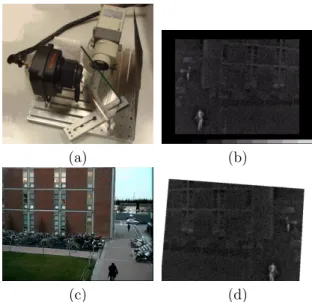
To obtain our raw video data, we use a Raytheon ControlIR 2000B thermal imaging video camera that is sensitive to wavelengths of 7µm-14µm, along with a Panasonic WV-CP470 colour video camera. The two cameras are synchronised (using gen-lock) to en-sure that they capture frames simultaneously. Both channels of analogue video output are captured and digitised by a Falcon Quattro multi-channel frame-grabber. Figure 1(a) shows the configuration of the visible and thermal cameras. A pane of thermally-reflective glass was used to act as a beam-splitter.
(a) (b)
(c) (d)
Figure 1: (a) Visible/Infrared camera rig, (b) Original infrared image, (c) Visible image, (d) Aligned infrared image
3.2
Frame alignment
To align pixels in the thermal and visible spectrum, we determine the optimum planar homography [15] and apply an image warping to all thermal infrared frames. This homography is determined by manually selecting many corresponding points in both modali-ties and computing the homography with least-squared error. There is no correlation between visible spec-trum brightness and thermal infrared brightness val-ues, so many of the automatic mutual-information based alignment methods [16][17] would not be appro-priate. An automatic alignment technique that can be used for images of very different modalities (such as thermal and visible images) is proposed in [18], and relies on the correlation between edge orientations in the modalities. Currently, no automatic method is re-quired, as only one warping needs to be computed for an entire sequence, but this could be a direction for fu-ture work. Figure 1(d) shows an example of an aligned infrared video frame.
4
Appearance model
4.1
Model description
The appearance model we use in this paper is inspired by [14] but we note here the significant differences. Firstly, we use a single multi-dimensional Gaussian for each pixel, and not a mixture of Gaussians. Sec-ondly, we introduce a per-pixel importance weighting, to track non-rectangular patches and to integrate infor-mation from background subtraction (or motion detec-tion) algorithms. We also use update equations based on expected sufficient statistics until enough samples are obtained to switch to the exponentially ‘forgetting’ equations, which allows faster adaptation at initialisa-tion time. Addiinitialisa-tionally, we introduce an alternative similarity metric to match the model to the image.
The appearance of the object being tracked is mod-elled as a rectangular grid ofdpixels, with each pixel modelled as having a Gaussian distribution. We de-note µ(j) ={µ1(j), µ2(j), ..., µk(j)} as the mean
vec-tor value of pixel j at time t, where k is the num-ber of features. For example, µ1(j) could correspond to the pixel’s mean brightness value and µ2(j) could correspond to the pixel’s mean edge magnitude. We further denote σ(j) = {σ1(j), σ2(j), ..., σk(j)} as the
diagonal covariance matrix. This assumes the pixel features are independent. This assumption may not hold for certain features, such as a pixel’s RGB colour components, but this can be overcome by switching to a less correlated colourspace (such as the CIE Lab colourspace) or by increasing the computational com-plexity and using a full covariance matrix. Addition-ally, we add a weighting factor for each pixel, I(j), where 0≤I(j)≤1. This weighting factor allows pix-els that belong to the background to be removed from the similarity computation, while emphasising track-able features. We denote our model asθ={µ, σ, I}.
4.2
Similarity measures
For a particular vector of pixel features, x, we can compute the probability that it matches the Gaussian model of model pixelj using:
P(x|θ(j)) =
k
Y
i=1
N(xi;µi(j), σi(j)2) (1)
whereN(x;µ, σ2) is a one dimensional normal density:
N(x;µ, σ2) = (2πσ2)1/2exp
µ
−1
2
(x−µ)2
σ2

(2) To compute the similarity between the model and a rectangular patch of d pixels (denoted X =
{x1, x2, ..., xd}), [14] assumed the pixels were
indepen-dent of each other and obtained the matching proba-bility as:
P(X|θ) =
d
Y
j=1
P(xj|θ(j)) (3)
Our pixel weighting factor can be incorporated by al-lowing it to represent the probability that the pixel belongs to the object (and not the background). The similarity measure then becomes:
S1(X|θ) =
d
Y
j=1
(I(j)P(Xj|θ(j)) + 1−I(j)) (4)
However, we found that this probability computation could be significantly affected by outliers, since a sin-gle bad pixel match could return a probability very close (or equal) to zero. Fortunately, the occlusion handling mechanism used in [14] provides robustness against outliers. The normal density of equation (1) is replaced by ˆN(x;µ, σ2):
DATA
DATA MODEL
DATA
DATA
DATA
MODEL
DATA
MODEL
MODEL
COMBINER
(a)GF M (b)CM
Figure 2: Fusion architectures
ˆ
N(x;µ, σ2) = (2πσ2)1/2exp
µ
−ρ(x−µ
σ )

(5) where
ρ(x) =
½
x2/2 if|x| ≤c
c|x| −c2/2 otherwise (6) In our experiments, as in the original paper, we set
c = 1.435, where c is an outlier threshold. Addition-ally, we define an alternative similarity measure, S2, which is the average probability of a pixel matching its corresponding model pixel, weighted by the pixel importance values.
S2(X) =
Pd
j=1I(j)P(Xj|θ(j))
Pd
j=1I(j)
(7)
4.3
Appearance model update
We update the model using expected sufficient statis-tics update equations then switch toL-recent window version after L updates, where L is a time constant that determines the update rate. The features for each pixel are updated independently using the following equations:
σ2
t+1=ασt2+ (1−α)(µt−x)2 (8)
µt+1=αµt+ (1−α)x (9)
It+1=αIt+ (1−α)f (10)
where xis the current feature value, f is the binary foreground value for this pixel, and
α= 1− 1
min(N, L) (11)
where N is the number of times the model has been updated. Additionally, we add resilience to noise by imposing the restriction that f is set to zero if the pixel is not adjacent to a pixel from the model whose importance value is greater than 1/L. For all our ex-periments, we setL= 20, as suggested in [13].
5
Fusion models
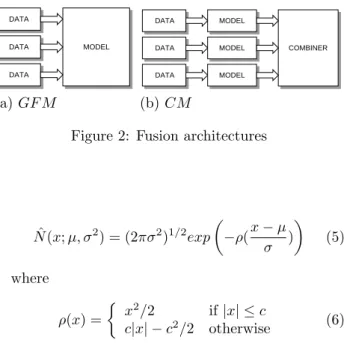
In this paper, we are concerned with evaluating the tracking performance of multiple different fusion schemes. Figure 2 shows the two fusion architectures that we utilise. In the first scheme, which we will refer
to as thegeneral fusion model, the fusion occurs at the pixel level, by using a single appearance model where each pixel is modelled as a k-dimensional Gaussian, wherekis the number of data sources (or features). In the second scheme, which we will refer to as a combi-nation of models, the fusion occurs at the model level, by using a separate appearance model (with k = 1) for each data source and combining their scores. We examine a number of different methods of score fusion at the model level.
5.1
General fusion model
In the general fusion model(GFM), a single appear-ance model (grid ofdpixels) is used, where each pixel is modelled as a k-dimensional Gaussian, where k is the number of data sources. Each pixel is assigned a single importance value that weights its importance in the overall similarity metric. In this framework, fusion happens at the pixel level, which is represented by the architecture in figure 2(a).
5.2
Model combination fusion methods
To perform fusion at the model level, illustrated in fig-ure 2(b), we use acombination module(CM) to fuse the similarity score from one or more appearance models. The following sections describe the various combina-tion strategies we evaluated.
5.2.1 Simple and weighted averaging
Saverage(X) = M
X
i=1
wiSi(X) (12)
where Si(X) is the similarity score between the ith
model and image patch X, and wi is the weight
as-signed to theithmodel (See subsection 5.2.4 for details
on how the weights are chosen). For simple averaging, the weights are fixed, withwi= M1 fori= 1..M, where
M is the number of models being combined. 5.2.2 Similarity score product
Sproduct(X) = M
Y
i=1
Si(X) (13)
If the similarity scores returned by each model can be thought of as probabilities, this combined similarity returns the probability of matching the image patch
X, using an assumption of independence. 5.2.3 Min and max score fusion
Smin(X) = min
i Si(X) (14)
Using the minimum operator, an image patch with the greatest similarity will be such that no model believes this to be a bad match. Thus, we chose the new model position as the one that gives the ‘least bad’ match.
Smax(X) = max
i Si(X) (15)
Swmax(X) = max
i w(i)Si(X) (16)
The maximum operator emphasises the score of a model that is very confident of finding a good match. We also use a weighted version of the maximum oper-ator. A weighted min fusion scheme would not make sense, as it would use the most unreliable model for matching.
5.2.4 Dynamic Weighting
The weights shown first in equation (12) and also used in equation (16), are initialised with wi = M1 for
i = 1..M. However, we also dynamically adapt the model weights based on how well the model discrimi-nates within the search space. If a model returns many good matches, it is less specific on the best object po-sition and its weight will be reduced. A model that re-turns one good match, corresponding to a sharp peak in the search space, will receive an increased weighting. More precisely, for each model, we take the maximum score returned over all search positions, and we divide it by the sum of scores returned by that model for all evaluated positions. This value,si for modeli, is used
to measure the model’s specificity. We first compute normalised values, ˆsi =si/
P
sp and then update the
weights as follows:
wi=αwi+ (1−α) ˆsi (17)
whereαis the update rate from equation (11).
5.3
Search strategies
Irrespective of the appearance model used, we adopt the same search strategy to locate the best match for the model in each frame, in all our experiments. We denote the object motion by an affine transformation [15] A = {a1, a2, a3, a4, tx, ty} where {tx, ty} are the
translation parameters and{a1, a2, a3, a4} are the de-formation parameters. For our experiments, the ob-jects we tracked were assumed to have negligible rota-tion, so we set two of the deformation parameters to zero, to only account for scale changes. In [14], particle filtering was used to search the transformation space to find the object in the current image. We adopt a deterministic approach, using coarse-to-fine gradient-ascent search of the transformation space, first adapt-ing the translation parameters to maximise the simi-larity score, then adapting the scale parameters. This allows a more precise sub-pixel object detection than using randomly generated particles, which assists the tracker to remain locked onto targets when their ap-pearance is changing.
6
Results
In this section, we evaluate the tracking performance of the fusion schemes that we described in the previous
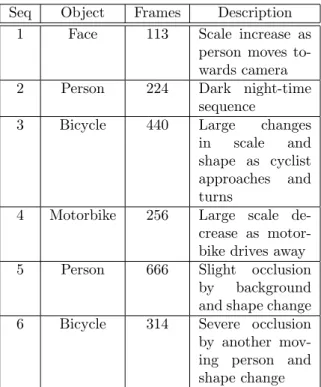
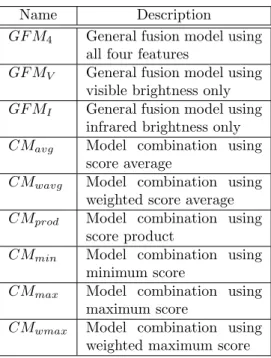
section, on six representative surveillance sequences. Details of the objects in the tracking sequences are given in table 1, whilst the notation for the trackers we used is described in table 2. The objects (along with their trajectories) are shown in figure 3.
In all our experiments, we used the background modelling algorithm described in [19], which is an im-proved version of the popular mixture of Gaussians model proposed by Stauffer and Grimson [20], pro-viding a shadow removal mechanism. The infrared background is modelled separately using the same al-gorithm, but treating the pixels as greyscale. We use bi-linear feature interpolation for sub-pixel matching, updating and tracking. Four features (k= 4) are used in our tracking experiments: visible brightness value, infrared brightness value, visible edge magnitude and infrared edge magnitude. Edges were computed us-ing the Sobel operator [21]. All trackers, except for
GF MV and GF MI use all four features. In our
gen-eral fusion model tracker,GF M4, only one importance value is used per pixel. This requires that the binary foreground maps from each modality be fused into one map, which is used in the model update stage. We use the method described in our previous work [22], using a pixel’s spatial support when there is modality disagreement.
To accurately judge the performance of the evalu-ated trackers, we manually annotevalu-ated all of our video test sequences, by marking a bounding box, in each frame, around the object we wished to track. Using this bounding box,R1, and the tracker’s returned po-sition,R2, we compute the tracker’s precision and re-call:
precision = O(R1, R2)
|R2| (18) recall = O(R1, R2)
|R1| (19)
where O(a, b) is the overlapping area of rectangles a
and b, and |R| denotes the area of the rectangle R. We determine that a tracker has failed if its precision or recall drops below 0.1 for at least three consecu-tive frames. The performance of each tracker on all of the sequences, using both similarity metrics is de-tailed in table 3. The figures denote the percentage of frames in which the object was successfully tracked, for each tracker for 2 different similarity metrics. The empty entries in the table indicate that trackersCMavg
and CMwavg were not evaluated with similarity
met-ric,S1. This is because the similarity values computed withS1are beyond the floating-point precision of stan-dard processors (since it is derived from the product of many probabilities). Other computations, such as multiplication forCMprod, can be achieved by adding
logarithm values. The cases where a tracker ‘fails’ after a large number of frames (e.g. 97%) are due to either the object becoming very small (only a few pixels in size) or because the object enters an area where the visible and infrared images do not fully overlap (hence the infrared values are unknown).
Table 1: Tracked Objects Seq Object Frames Description
1 Face 113 Scale increase as
person moves to-wards camera
2 Person 224 Dark night-time
sequence
3 Bicycle 440 Large changes
in scale and shape as cyclist approaches and turns
4 Motorbike 256 Large scale de-crease as motor-bike drives away
5 Person 666 Slight occlusion
by background and shape change 6 Bicycle 314 Severe occlusion by another mov-ing person and shape change
There are a number of conclusions that can be drawn from the figures in table 3. The best over-all tracker was CMprod which performed perfectly on
all six sequences with either similarity metric. As expected, the tracker using visible spectrum only,
GF MV, failed on the night-time sequence (Seq-2).
None of the sequences were particularly challenging for infrared, as the objects all had a strong signal com-pared to the background, thereforeGF MI fares quite
well. We found that the adaptive weighting of models does not seem to add additional tracking performance (note the near identical performance of trackersCMavg
andCMwavg, and trackersCMmaxandCMwmax). We
speculate that this is because our models already ac-count for noisy tracking by adapting the variance of the pixel models, giving lower scores for larger variances. Another explanation may be that the weightings were not strong enough, or were adapted too slowly. How-ever, the weights generated by the proposed algorithm may have other uses, such as determining areas where a sensor is weak. It could also have uses in classi-fication: for example, an object that has a weak in-frared weight is probably of the same temperature as the background and therefore unlikely to be a person. Additionally, the method could prove useful in situa-tions where one modality fails completely, such as when an infrared camera performs rapid automatic gain cor-rection. Investigating this possibility remains as fu-ture work. From the table, we also see that tracker
GF M4 failed in a number of cases. This is likely due to the fact that there is a single importance weighting per pixel, rather than a per-pixel-per-modality impor-tance. Therefore, incorrectly labelled foreground pixels caused by thehalo-effect in infrared could label visible background as ‘important’. Figure 4 shows an
exam-Table 3: Tracking Results
Seq-1 Seq-2 Seq-3 Seq-4 Seq-5 Seq-6
Tracker S1 S2 S1 S2 S1 S2 S1 S2 S1 S2 S1 S2
GF M4 64 100 100 69 100 100 84 92 100 94 60 100
GF MV 100 100 8 9 100 100 100 100 96 100 45 100
GF MI 100 100 100 100 100 42 91 76 95 34 100 37
CMavg 100 - 24 - 100 - 97 - 94 - 100
-CMwavg 100 - 24 - 100 - 97 - 100 - 100
-CMprod 100 100 100 100 100 100 100 100 100 100 100 100
CMmin 100 100 100 100 41 100 100 100 3 98 100 59
CMmax 100 100 8 9 100 42 91 76 95 34 100 37
CMwmax 100 100 8 9 100 42 91 76 95 34 100 37
Table 2: Tracker Descriptions
Name Description
GF M4 General fusion model using all four features
GF MV General fusion model using
visible brightness only
GF MI General fusion model using
infrared brightness only
CMavg Model combination using
score average
CMwavg Model combination using
weighted score average
CMprod Model combination using
score product
CMmin Model combination using
minimum score
CMmax Model combination using
maximum score
CMwmax Model combination using
weighted maximum score
ple of the GF M4 appearance model of the person in Seq-5, showing large variance in the leg pixels, due to the walking motion. It is difficult to evaluate the mer-its of the two similarity metrics we used, as neither shows a remarkable advantage over the other. How-ever, the metric we proposed is more computationally efficient, since it does not requires the calculation of logarithm values. In all sequences, except Seq-6 (using
S1), the CMmax and CMwmax trackers seem to
per-form only as well as the weakest of either GF MV or
GF MI. This suggests that maximum score selection is
a poor scheme for fusing data from appearance models for tracking. TheCMmin tracker fares quite well
over-all, but fails immediately at the start of Seq-5, when it locks onto the background due to the scores of the visible edge features. BothCMmaxandCMminchoose
one score, and exclude all others. Experimental results validate this as an unwise approach.
(a) Object 1 (b) Object 2
(c) Object 3 (d) Object 4
(e) Object 5 (f) Object 6 Figure 3: Tracked Objects listed in table 1
(a) (b) (c) (d) (e)
Figure 4: General fusion model of walking person from Seq-5: (a)-(d) Mean and variance of the four features we use for tracking, (e) Pixel importance weighting
7
Conclusions and future work
In this paper, we evaluated the appearance model tracking performance of multiple different fusion schemes, using manually annotated multi-modal sur-veillance video. The appearance model we used was based on an existing tracker but with notable improve-ments, including the ability to track non-rectangular patches, integrate information from background mod-elling algorithms and perform rapid initialisation. Ad-ditionally, we introduced an alternative similarity met-ric to match the appearance model to image patches.
There remain many avenues of future investigation. These include discovering the exact nature of the fail-ures in individual cases, as well as performing more comprehensive testing using different video sequences, especially using data that is challenging for infrared alone. A theoretical analysis of the product fusion
would be very useful, as it might further justify the tracking performance it achieved on our surveillance video.
One popular framework for data fusion that was not considered in the paper is the Transferable Be-lief Model [23]. It provides mechanisms to cater for doubt and uncertainty, which could be useful when there are multiple prominent peaks in the matching search space, or when one modality is missing (where the images from both modalities do not overlap). An-other similarity metric to evaluate in future work is to compute the median pixel matching probability. This would be more robust to outliers and shape changes, but with a greater computational burden. Another area of future work will examine whether it would be beneficial to switch between similarity metrics, as our results seem to indicate that they can be complemen-tary.
Acknowledgments
This material is based on works supported by Science Foundation Ireland under Grant No. 03/IN.3/I361 and sponsored by a scholarship from the Irish Research Council for Science, Engineering and Technology (IRC-SET): Funded by the National Development Plan. The authors would also like to express their gratitude to Mitsubishi Electric Research Labs (MERL) for their contribution to this work.
References
[1] R. Cucchiara. Multimedia surveillance systems. InVSSN 05: Proceedings of the third ACM international workshop on Video surveillance & sensor networks, New York, NY, USA, pages 3–10, 2005.
[2] W. Hu, T. Tan, L. Wang, and S. Maybank. A survey on visual surveillance of object motion and behaviors. IEEE Transactions on Systems, Man and Cybernetics, 34(3):334– 350, August 2004.
[3] G. Loy, L. Fletcher, N. Apostoloff, and A. Zelinsky. An adaptive fusion architecture for target tracking. InIEEE International Conference on Automatic Face and Gesture Recognition (FGR), 2002.
[4] P. P´erez, J. Vermaak, and A. Blake. Data fusion for visual tracking with particles.Proceedings of the IEEE, 92(3):495– 513, March 2004.
[5] K. Smith, D. Gatica-Perez, and J.-M. Odobez. Using par-ticles to track varying numbers of interacting people. In IEEE Conf. on Computer Vision and Pattern Recognition (CVPR), June 2005.
[6] B. Leibe, E. Seemann, and B. Schiele. Pedestrian detection in crowded scenes. In IEEE International Conference on Computer Vision and Pattern Recognition (CVPR), June 2005.
[7] J. Lim and D. Kriegman. Tracking humans using prior and learned representations of shape and appearance. InIEEE International Conference on Automatic Face and Gesture Recognition (FGR), pages 869–874, May 2004.
[8] K. She, G. Bebis, H. Gu, and R. Miller. Vehicle track-ing ustrack-ing on-line fusion of color and shape features. In IEEE International Conference on Intelligent Transporta-tion Systems, October 2004.
[9] G. Fumera and F. Roli. A theoretical and experimental analysis of linear combiners for multiple classifier systems. IEEE Transactions on Pattern Analysis and Machine In-telligence, 27(6):942–956, June 2005.
[10] S. Avidan. Ensemble tracking. In IEEE International Conference on Computer Vision and Pattern Recognition (CVPR), June 2005.
[11] H. Kruppa and B. Schiele. Hierarchical combination of ob-ject models using mutual information. InBMVC, 2001. [12] H. Torresan, B. Turgeon, C. Ibarra, P. H´ebert, and
X. Maldague. Advanced surveillance system: Combining video and thermal imagery for pedestrian detection. In Proc. of SPIE, Thermosense XXVI, volume 5405 ofSPIE, pages 506–515, April 2004.
[13] A. Senior, A. Hampapur, Y.-L. Tian, L. Brown, S. Pankanti, and R. Bolle. Appearance models for occlusion handling. In 2nd IEEE Int. Workshop on PETS, Kauai, Hawaii, USA, Dec 2001.
[14] S. Zhou, R. Chellappa, and B. Moghaddam. Appearance tracking using adaptive models in a particle filter. InProc. of 6th Asian Conference on Computer Vision (ACCV), Jan 2004.
[15] R. I. Hartley and A. Zisserman.Multiple View Geometry in Computer Vision. Cambridge University Press, 2nd edition, 2003.
[16] J.P.W. Pluim, J.B.A. Maintz, and M.A. Viergever. Mutual-information-based registration of medical images: a survey. IEEE Transactions on Medical Imaging, 22(8):986–1004, Aug 2003.
[17] P. A. Viola. Alignment by Maximization of Mutual Infor-mation. Phd thesis, Massachusetts Institute of Technology, Massachusetts (MA), USA, June 1995.
[18] M. Irani and P. Anandan. Robust multi-sensor image align-ment. InInternational Conference on Computer Vision, pages 959–966, 1998.
[19] P. KaewTraKulPong and R. Bowden. An improved adap-tive background mixture model for real-time tracking with shadow detection. In2nd European Workshop on Advanced Video-based Surveillance Systems, Kingston upon Thames, 2001.
[20] C. Stauffer and W.E.L. Grimson. Adaptive background mixture models for real-time tracking. InProceedings of CVPR99, pages II:246–252, 1999.
[21] W. E. Snyder and H. Qi. Machine Vision. Cambridge University Press, Jan 2004.
[22] C. ´O Conaire, N. O’Connor, E. Cooke, and A. Smeaton. De-tection thresholding using mutual information. InVISAPP: International Conference on Computer Vision Theory and Applications, Set´ubal, Portugal (to be published), Feb 2006. [23] P. Smets. The combination of evidence in the transferable belief model. IEEE Transactions on Pattern Analysis and Machine Intelligence, 12(5):447–458, 1990.