Emerging Science Journal
Vol. 4, No. 3, June, 2020
Activation Level and Probabilities of Electromagnetic
γ-transitions in the Reaction
77
Se(γ,γ’)
77m
Se
Viktor Zhaba
a*, Eduard Gohman
aa Department of Theoretical Physics, Uzhgorod National University, Uzhgorod, Ukraine
Abstract
The dependence of the absolute yield from energies for reaction (γ,γ’)m on the nucleus 77Se was
approximated by fit dependences (lines). Due to the visually detected fracture of the reaction yield, the energy interval 5.75-8.0 MeV is conventionally divided into two parts. For the transition step as one experimental point, the left part was approximated to 6.6 MeV, and the right part - from 6.26 MeV. There approximations were eight for both intervals. Given the features of the calculation and the minimum values for χ2, the "best" two fits are approximation dependences in the neighborhood of the intersection point x0 for the left and right arrays of energies. The energy for the activation
level (the intersection point for these functions) is Ea≈6.35 MeV. The scheme of electromagnetic γ-
transitions for nucleus 77Se are constructed and analyzed. Possible transitions to the isomeric level
from higher levels are indicated. Weiskopf model was used to estimate the values of the reduced probabilities of electric EJ- and magnetic MJ- transitions, the probabilities of transitions per unit time and half-life. The theoretical values of the half-lives T1/2 are compared with the experimental
data. Prospects for further use of the obtained results for topical problems of nuclear physics are discussed.
Keywords:
Activation Level; Reaction Yield; Fracture;
Probabilities of γ-transitions; Weiskopf Model.
Article History:
Received: 13 January 2020
Accepted: 04 May 2020
Published: 01 June 2020
1- Introduction
The main purpose of most papers on the study of reaction (γ,γ') with isomer formation was to obtain an energy dependence of the effective cross-section of the reaction in a relatively wide energy range at 8-25 MeV with a relatively large step of 0.5-1.0 MeV [1, 2]. Studies have shown that near the threshold of photonuclear reactions (γ,n) and (γ,p), the cross-section reaches a maximum, and in the region of the giant resonance it first decreases and then increases again. The second area of research is the measurement of yields for reactions (γ,γ') in the small energy range at 1.5-6.0 MeV, but in steps of 0.1-0.2 MeV. The points of deviation of the energy dependence of the yield from the monotonically increasing curve make it possible to determine the values of the individual activation levels or groups of levels, through which the isomers of the nucleus are populated.
In Bohinyuk et al. (2015), Zhaba and Holovchak (2017), Bohinyuk et al. (2015), Zhaba and Gohman (2018) and Gohman and Zhaba (2019) studies, the dependences of the absolute yield from energies for reaction (γ,γ’)m on the nuclei 77Se, 79Br, 89Y, 103Rh, 111Cd, 137Ba, 179Hf, 197Au and 199Hg were analyzed for the presence of such fractures [2-6]. The number of found activation levels in each of these (γ,γ’)m- reactions was ranges from one to three values.
Selenium is widely used. Example, it is necessary for agronomic biofortification of leafy vegetables grown with isotopically labelled selenium 77Se [7], for selenium isotope fractionation during adsorption by Fe, Mn and Al oxides [8], for selenium-isotopic signature toward mass-spectrometric identification and for enzyme activity assay [9], for search of ratios of cross sections of isomeric and ground states in 77, 79, 81, 83Se [10], for research of solid-state 77Se
*CONTACT:
DOI:http://dx.doi.org/10.28991/esj-2020-01220
nuclear magnetic resonance of organoselenium Compounds through cross polarization magic angle spinning method [11].
In this paper we use approach of the Bohinyuk et al. (2015) research [2] to find activation levels for the selenium nucleus. According to this approach, the reaction yield regions are broken down into pre- and post- fracture parts. They are then approximated by lines.
2- The Energy Dependence of the Yields for Reaction (γ,γ')
mDuring the period 1990-2010 years, at the accelerator as microtron M-10 of UzhNU thorough studies of the reaction А(γ,γ’)Аm were carried out on groups of averages and heavy nuclei. The experimental setup, the experimental procedure and the results of data processing have been described in detail in the papers reviews [2, 12-14]. Such studies covered the intermediate energy region at 5-10 MeV.
Data in Bohinyuk et al. (2015) study [2] presents the mean square errors for a series of 5-8 independent absolute measurements for the yield of reaction (γ,γ’) for nuclei 77Se, 79Br, 89Y, 103Rh and 111Cd. As can be seen, the monotonically increasing course of the curves is disturbed at some energy values. Therefore, these energy dependencies of the yields were analyzed for fractures, because the fracture points correspond to the energy of the activation level.
The characteristics for products of 77Se(γ,γ’)77mSe reaction (in particular the 77mSe isomers) are described in detail in Stone (2005), Tuli (2011) and Firestone et al. (1996) researches [15-17].
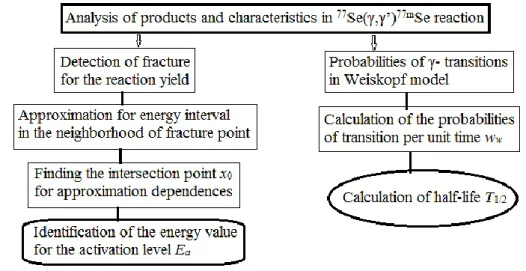
The flowchart of the scientific study in this paper is presented in Figure 1. The relevant elements of the flowchart will be considered further.
Figure 1. The flowchart of the scientific study.
The experimental data from Bohinyuk et al. (2015) [2] study for 77Se(γ,γ’)77mSe reaction were approximated by a line:
y
a
bx
(1)Due to the visually detected fracture of the reaction yield, the energy interval is conventionally divided into two parts, where 5.75 and 8.0 MeV are the extreme left and right points, respectively. The left part was approximated to 6.6 MeV, and the right part - from 6.26 MeV. The transition step is one experimental point. There were four steps for the left and right intervals, i.e. by four approximations (fits 1-4 and 5-8, respectively).
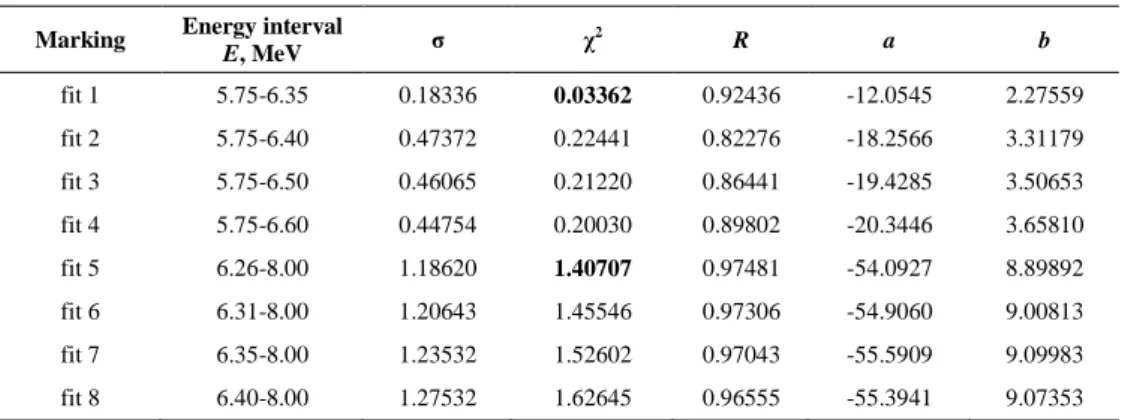
In Table 1 is shows the approximation results for a specific interval in the neighborhood of fracture point for the yield of reaction. The parameters a and b for lines are given. To evaluate the quality of the approximation, the following parameters are calculated:
1) Standard deviation of the fit:
2(exp) 1
( , )
N
i i i
y y a b
N P
2) χ2 per degree of freedom of function:
22 (exp)
1
1
( , )
ni i
i
y
y a b
N
P
(2)3) Correlation coefficient R.
The accuracy of the approximation is characterized by (2), where N is the number of points for the array yi of the
experimental data; y a bi( , ) is approximating function (1); a, b is parameters; P=2 is the number of parameters for
function (1).
In the end, the "best" or "worse" approximation can be estimated by comparing the correlation coefficient R (or value χ2), but the following two circumstances should be considered: 1) when approximating, we have different width of energy interval; 2) in all cases, the approximation is performed by one function (line).
Table 1. Parameters of approximate dependencies.
Marking Energy interval E, MeV σ χ2 R a b
fit 1 5.75-6.35 0.18336 0.03362 0.92436 -12.0545 2.27559 fit 2 5.75-6.40 0.47372 0.22441 0.82276 -18.2566 3.31179 fit 3 5.75-6.50 0.46065 0.21220 0.86441 -19.4285 3.50653 fit 4 5.75-6.60 0.44754 0.20030 0.89802 -20.3446 3.65810 fit 5 6.26-8.00 1.18620 1.40707 0.97481 -54.0927 8.89892 fit 6 6.31-8.00 1.20643 1.45546 0.97306 -54.9060 9.00813 fit 7 6.35-8.00 1.23532 1.52602 0.97043 -55.5909 9.09983 fit 8 6.40-8.00 1.27532 1.62645 0.96555 -55.3941 9.07353
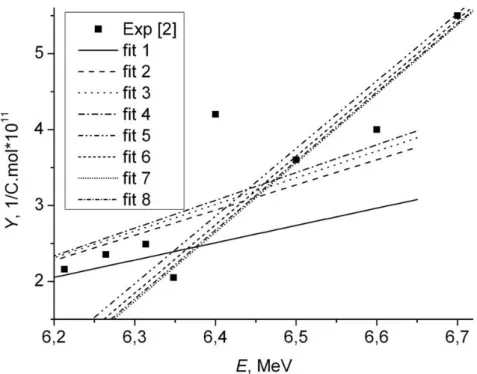
The visual representation of the obtained approximate dependences fits 1-8 is shown in Figure 2. A detailed examination in the neighborhood of the intersection point of these lines is given in Figure 3.
Using the values of the parameters a and b (Table 1) for the corresponding approximations, it is possible to determine the intersection points of fits 1-4 and 5-8 for the corresponding energy intervals of approximation. To do this, we use the solution of simple linear two equations:
0 0
i i j j
a
b x
a
b x
Where the indices i and j characterize fits 1-4 and 5-8 respectively. Numerical values of the intersection points x0 are shown in Table 2. As the analysis of the obtained values of x0 shows, the fracture of the experimental curve of yield is in the range ΔE=6.35-6.48 MeV. This value corresponds to the activation level Ea. In Bohinyuk et al. (2015) [2] study
Figure 3. Approximation dependences in the neighborhood of the intersection point.
Given the features of the calculation and the minimum values for χ2 (Table 1), the "best" approximations are fit 1 and fit 5 for the left and right arrays of energies respectively. Then the intersection point for these functions (Table 2) is placed at energy Ea≈6.35 MeV. This value is the energy of the activation level.
The values Ea for 77mSe as 6.32 MeV in Bohinyuk et al. (2015) [2] study and 6.35 MeV in this paper differ in magnitude 0.03 MeV. The difference between the obtained values is insignificant, although our value is refined and more precisely defined.
Table 2.Intersection points for approximate dependencies.
fit 5 fit 6 fit 7 fit 8
fit 1 6.34699 6.36484 6.37540 6.37966 fit 2 6.41404 6.43385 6.44554 6.45024 fit 3 6.42835 6.44857 6.46049 6.46529 fit 4 6.43947 6.46004 6.47215 6.47703
3-
The Electric and Magnetic γ-transitions
The probabilities of γ-transitions can be estimated approximately by the formulas [18]:
2
1
(
)
J
R
W EJ
;2 2
1
(
)
J
R
W MJ
(3)Where
c E
/
is the wavelength for the emitted or absorbed γ- quanta’s; J is multipolarity; EJ and MJ is the electric and magnetic γ- radiations with parity P=(-1)J and P=(-1)J+1 respectively; R is the radius of the emitter nucleus.Electromagnetic transitions from metastable levels to the isomeric level 77mSe are given in Gohman and Zhaba (2019) study [6], where additionally the ratio of the probability for γ- transitions is specified:
(
)
(
)
W EJ
W MJ
(4)In addition to the magnitudes of the probabilities of γ- transitions (3), it is possible to calculate the values of the reduced probability of γ- radiation in Weiskopf model. This values for electrical EJ- and magnetic MJ- transitions is written as [19, 20].
2
2 2
1
3
(
)
4
3
J w
B EJ
R e
J
2 / 3
(
)
0.307
(
)
w w
B MJ
A
B EJ
(6)At value B(EJ)=Bw(EJ) the probability of an electric transition per unit time is represented by the form [19, 20]:
2 1 2
2 21 1
2
4.4(
1)
3
(
)
10 [
],
3
197
(2
1)!!
J J wE
J
w EJ
R
s
J
J
J
(7)Where the radius of the nucleus R=r0 A1/3 is given in units of fm; A is the atomic mass; energy in units of MeV. The probability of γ- decay wγ determines the value of the half-life T1/2 of nucleus relatively to γ- radiation [19, 20]:
16 1 1/ 2
ln 2
0.693
4.57 10
[
]
(
)
T
s
w
w
eV
(8)Where
w
is the radiation width of the level. The half-life (8) is the time at which half of the initial number of excited nuclei will break up as a result of γ- transitions. In the presence of EJ- type electric transitions only, the half-life is determined by the following approximative expression (with energy in units of MeV):
22
-19
1/ 2 3 1/ 3 2
(2
1)!!
(1
/ 3)
1
(
)
0.3125
10
[ ]
1 1/
(6.1 10
)
JJ
J
T
EJ
s
J
E
A
E
(9)Given expression (6), in the presence of magnetic transitions of type MJ, the half-life is written as:
1/ 2
1/ 2 2 / 3
(
)
(
)
[ ]
0.307
T
EJ
T
MJ
s
A
(10)In Figure 4 shows a schematic representation of the electromagnetic transitions [17], that characterize of the nucleus 77Se. Possible transitions to the isomeric level from higher levels and transitions from isomeric levels to the ground state are indicated. In Figure 4 shows the spin and parity values of the state on the left and the energy of level (in keV) on the right.
Given the marking on Figure 4, the values of the probabilities of transition per unit time
w
w
ln 2 /
T
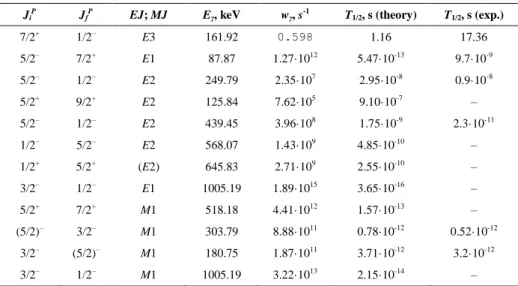
1/ 2 andhalf-lives (9), (10) of electrical and magnetic transitions respectively have been calculated in the approach of Weiskopf's theory. The results are shown in Table 3, where JiP, JfP are the full moment of the initial and final states; P is the parity
Table 3. Characteristics of electromagnetic transitions for 77Se.
JiP JfP EJ; MJ Eγ, keV wγ, s-1 T1/2, s (theory) T1/2, s (exp.)
7/2+ 1/2– E3 161.92 0.598 1.16 17.36 5/2– 7/2+ E1 87.87 1.27·1012 5.47·10-13 9.7·10-9
5/2– 1/2– E2 249.79 2.35·107 2.95·10-8 0.9·10-8
5/2+ 9/2+ E2 125.84 7.62·105 9.10·10-7 –
5/2– 1/2– E2 439.45 3.96·108 1.75·10-9 2.3·10-11
1/2– 5/2– E2 568.07 1.43·109 4.85·10-10 – 1/2+ 5/2+ (E2) 645.83 2.71·109 2.55·10-10 –
3/2– 1/2– E1 1005.19 1.89·1015 3.65·10-16 –
5/2+ 7/2+ M1 518.18 4.41·1012 1.57·10-13 –
(5/2)– 3/2– M1 303.79 8.88·1011 0.78·10-12 0.52·10-12
3/2– (5/2)– M1 180.75 1.87·1011 3.71·10-12 3.2·10-12 3/2– 1/2– M1 1005.19 3.22·1013 2.15·10-14 –
4- Conclusion
The dependence of the absolute yield from energies for the reaction (γ,γ’)m on the nucleus 77Se is analyzed. For this purpose, fit dependences were used as straight lines. Only one value for activation levels for this reaction in the energy range of 5.75-8.00 MeV is described. The energy for the activation level is Ea≈6.35 MeV.
The calculated values of the probabilities of transitions per unit time and half-life by Weiskopf model coincide with the experimental data in several orders of magnitude. Similar calculations of the values of the reduced probabilities of electric EJ- and magnetic MJ- transitions, the probabilities of transitions per unit time and half-life by Weiskopf model can be made for nuclides 89mY, 103mRh, 179mHf and others. It should be noted that the obtained probability values of electromagnetic γ-transitions can be useful for estimating the cross-sections of E1-E3 and M1-M2 excitation of atomic nuclei for low-energy isomeric states in the process of inelastic scattering of nonrelativistic electrons [21] (in the framework of the nonrelativistic plane wave Born approximation - PWBA method).
The obtained results for the activation level of 77mSe will expand our understanding of the mechanisms and laws of excitation of isomeric states of atomic nuclei, as well as can replenish the databases of nuclear data and constants and find practical applications in physics of nucleus, elementary particles and high energy physics. In perspective, the data obtained in this paper can be used to investigate the shell configurations of transitions from the ground state of nuclei to activation levels (as was done for the 109Ag, 115In, 111Cd nuclei in Sokolyuk (1998) [22] study), taking into account nuclear-physical data for isomers [15, 17]. They can also be used to analyze single-particle neutron or two-quasiparticle states and shape isomers [23] and in the development of gamma-ray laser on nuclear transitions [24].
5- Conflict of Interest
The author declares that there is no conflict of interests regarding the publication of this manuscript. In addition, the ethical issues, including plagiarism, informed consent, misconduct, data fabrication and/or falsification, double publication and/or submission, and redundancies have been completely observed by the authors.
6- References
[1] Gangrskij, Yu P., and V. M. Mazur. "Scattering of γ Rays by the Nuclei and Excitation of the Isomeric States." Fizika Ehlementarnykh Chastits i Atomnogo Yadra 33, no. 1 (2002): 158-200.
[2] Bohinyuk, V. S., V. I. Zhaba, A. M. Parlag, R. M. Plekan, and M. M. Pishta. “Investigation of isomeric States in the Reaction (γ,γ’)m
on Nuclei 77Se, 79Br, 89Y, 103Rh and 111Cd.” Scientific Herald of Uzhhorod University. Series Physics 37, no. 0 (July 1, 2015): 161–165. doi:10.24144/2415-8038.2015.37.161-165.
[3] Zhaba, V. I., and I. V. Holovchak. “Investigation of activation levels in the reaction (γ,γ’)m on medium and heavy nuclei.” 2017 Proceedings of International conference of young scientists and post-graduates “IEP-2017”. Institute of electron physics, Uzhhorod, Ukraine (May 2017): 135.
[4] Bohinyuk V. S., V. I. Zhaba, and A. M. Parlag. “Investigation of isomeric states in the reaction (γ,γ’)m on nuclei 77Se, 79Br, 89Y, 103Rh, 111Cd, 137Ba, 179Hf, 197Au and 199Hg.” Abstracts of the reports of XXII Annual Scientific Conference of Institute for Nuclear Research of the National Academy of Sciences of Ukraine, Kiev, Ukraine, p. 24–25 (2015).
[6] Gohman, Eduard, and Viktor Zhaba. “Activation levels and probabilities of electromagnetic γ- transitions in the reaction (γ,γ')m on averages and heavy nuclei.” 2019 Abstract Book for 62nd International Conference for Students of Physics and Natural Sciences «Open Readings 2019». Vilnius, Lithuania (March 2019):353.
[7] Ligowe, I.S., S.D. Young, E.L. Ander, V. Kabambe, A.D.C. Chilimba, E.H. Bailey, R.M. Lark, and P.C. Nalivata. “Agronomic Biofortification of Leafy Vegetables Grown in an Oxisol, Alfisol and Vertisol with Isotopically Labelled Selenium (77Se).” Geoderma 361 (March 2020): 114106. doi:10.1016/j.geoderma.2019.114106.
[8] Xu, Wenpo, Jian-Ming Zhu, Thomas M. Johnson, Xiangli Wang, Zhi-Qing Lin, Decan Tan, and Haibo Qin. “Selenium Isotope Fractionation During Adsorption by Fe, Mn and Al Oxides.” Geochimica et Cosmochimica Acta 272 (March 2020): 121–136. doi:10.1016/j.gca.2020.01.001.
[9] Hu, Junjie, Fei Liu, Nan Feng, and Huangxian Ju. “Selenium-Isotopic Signature Toward Mass Spectrometric Identification and Enzyme Activity Assay.” Analytica Chimica Acta 1064 (August 2019): 1–10. doi:10.1016/j.aca.2019.03.045.
[10] Dearmon, H. D., and K. S. Krane. “Neutron Capture Cross Sections of 74, 76, 78, 80, 82Se.” The European Physical Journal A 55, no. 8 (August 2019). doi:10.1140/epja/i2019-12821-4.
[11] Wei, Duo, Mengting Han, and Lei Yu. “Solid-State 77Se NMR of Organoselenium Compounds through Cross Polarization Magic Angle Spinning (CPMAS) Method.” Scientific Reports 7, no. 1 (July 25, 2017). doi:10.1038/s41598-017-06892-8. [12] Guthy, A. I., V. S. Bohinyuk, A. G. Okunev, A.P. Osipenko, A. M. Parlag, A. M. Fradkin, and I. V. Khimich. “Іntegral
Cross-Sections of the Reaction 77Se(γ,γ’) 77mSe, 111Cd(γ,γ’) 111mCd, 179Hf(γ,γ’) 179mHf.” Scientific Herald of Uzhhorod University.Series Physics 9, no. 0 (July 15, 2001): 50–55. doi:10.24144/2415-8038.2001.9.50-55.
[13] Bohinyuk, V. S., A. G. Okunyev, A. M. Parlag, M. T. Sabolchy, A. M. Fradkin, and I. V. Khimich. “Investigation of efficient cross-section of excitation of isomeric state of the 199mHg in the (γ,γ') and (γ,n) reactions.” Uzhgorod Univ. Scien. Herald. Ser. Phys. 16 (2004): 22–25. doi:10.24144/2415-8038.2004.16.22-25.
[14] Bokhinyuk V. S., O. G. Okunev, O. M. Parlag, M. T. Sabolchiy, and O. M. Fradkin. “Study of the 103Rh(γ,γ')103mRh reaction.” Uzhgorod Univ. Scien. Herald. Ser. Phys. 27 (2010): 29–33. doi:10.24144/2415-8038.2010.27.29-33.
[15] Stone, N.J. “Table of Nuclear Magnetic Dipole and Electric Quadrupole Moments.” Atomic Data and Nuclear Data Tables 90, no. 1 (May 2005): 75–176. doi:10.1016/j.adt.2005.04.001.
[16] Tuli, J. K. "Nuclear Wallet Cards, 8th edition." National Nuclear Data Center, Brookhaven National Laboratory, Upton, NY USA, October (2011).
[17] Firestone, R. B., S. Y. F. Chu, and Shirley V. S. “Table of Isotopes CD-ROM.” Eighth Edition, Version 1.0., California, 1996. [18] Varlamov, V. V., N. G. Goncharova, and B. S. Ishhanov. “Physics of nuclei and nuclear data banks: the Manual.” Univ. book,
Moscow (2010).
[19] Kadenko, I. M., and Plujko V.A. “The physics of the atomic nucleus and the particles: textbook.” 2nd edition, revised and supplemented. Electronic version, Kyiv (2019).
[20] Plujko, V. A. “Fundamentals of theory for nucleus and nuclear processes. Nuclear processes: the Manual.” PPC "Kyiv University", Kyiv (2003).
[21] Tkalya, E. V., E. V. Akhrameev, R. V. Arutyunayn, L. A. Bol’shov, and P. S. Kondratenko. “Cross Sections of Electron Excitation of Atomic Nuclei in Plasma.” Physical Review C 85, no. 4 (April 19, 2012). doi:10.1103/physrevc.85.044612. [22] Sokolyuk, I. V. “Structure of Activation Levels of the 10947Ag62, 11549In66, 11148Cd63.” Scientific Herald of Uzhhorod
University.Series Physics 3, no. 0 (December 31, 1998): 38–43. doi:10.24144/2415-8038.1998.3.38-43.
[23] Gangrsky, Yu. P., A. P.Tonchev, and N. P. Balabanov. “Excitation of Isomeric States in Photonuclear Reactions.” Physics of Elementary Particles and Atomic Nuclei 27, no. 4 (1996): 1043–1098.