Interdisciplinary Studio Pavilion [ISP] 2019 –
Silicalion
Theodore Powers
California Polytechnic State University San Luis Obispo, CA
The subject of this paper is an interdisciplinary project in which teams of two or three architecture, one construction management, and one architectural engineering student were tasked with working together to design a portable wine pavilion for the Wine History Project (WHP). The mission of the WHP is to preserve the history of wine culture and vineyards in San Luis Obispo County. Each team chose a theme of nature upon which to base their project’s design. The author’s team, Silicalion, used the Venus flower basket as inspiration for its design. The resulting design is a series of cells that form arches that enable the movement of people and the hanging of artifacts from the WHP’s collection. Unique problems were encountered when materials that weren’t available locally were needed for a mock-up model . A different set of problems were encountered as the team learned how to work together. In the end, a mock-up model was built and this model and its design were presented to the WHP and other interested parties.
Key Words: Interdisciplinary, Wine Pavilion, Construction Management, Architectural Engineering, Architecture, IPD
Background
The narrative of the WHP is a broad narrative of the viticulture environment: agriculture, land use, crop selection, the economic vitality of the county, and the relationships among the people who form the history of San Luis Obispo County. The purpose of the ISP 2019 project is to design a pavilion that will enable the public to experience a connection to that narrative. This studio will be an immersion in tectonic architecture which is defined as “the science or art of construction, both in relation to use and artistic design.”
Process
The Interdisciplinary Studio Pavilion 2019 was structured as a competition between interdisciplinary teams of students to design a suitable pavilion for the Wine History Project of San Luis Obispo (the “WHP”). Its curricula emphasized aesthetics; fabrication methods and techniques; ease of assembly, reassembly and transportability; and function.
course, students presented their work, including scaled mock-up models. WHP representatives selected the design (or designs) of one or more teams. This design (or designs) will survive to the build phase of the project. The build phase is outside of the scope of this senior project.
The ISP goals and objectives are listed in Table 1.
Table 1
ISP Goals and Objectives
Goal Description of Goal Description of Objectives
1 Incorporate WHP values a) establish a set of 3 to 5 value propositions through into the design, interviews with the WHP;
demonstrated by achieving b) gain WHP approval of these proposed value the listed objectives. propositions; and
c) demonstrate how the design addresses each value proposition.
2 Achieve an integrated a) establish team protocols for interdisciplinary design through participation;
interdisciplinary teaming, b) measure the team’s adherence to those protocols; demonstrated by achieving c) establish a list of design elements that required the listed objectives. interdisciplinary participation in their design; and
d) explain the interdisciplinary characteristics of each of those design elements.
3 Connect the user to the a) establish a suitable scale that enables users to connect design and the design to the with the pavilion through the exhibits mounted therein; site, demonstrated by b) express the defining narrative that connects the pavilion achieving the listed to the site; and
objectives. c) explain the specific features of the pavilion that advance that narrative.
4 Facilitate the user a) identify one or more elements of the user experience, and experience, demonstrated b) demonstrate how the pavilion facilitates those
by achieving the listed experiences. objectives.
5 Incorporate tectonic a) establish joinery of elements that enable easy knockdown portability into the design, and reassembly of the pavilion;
demonstrated by achieving b) specify durable connections that can withstand numerous the listed objectives: knockdown/reassembly cycles;
c) assure that all hardware is weather-resistant, (the use of non-corrosive metals and/or compatible metals is
encouraged); and
Deliverables
The team was tasked with collaborating and designing a project utilizing a concept from nature. The team consisted of 3 architects as well as a structural engineer that is split between 2 teams. The group chose the Venus flower basket, a small sea sponge on the sea floor that has interlocking structural members that provides it with flexibility while being the foundation for the species. The first deliverable from this was 50 models for 5 different categories that the team submitted to the professors for discussion.
After this, the team started making designs, turning them into mock-ups and presented them to the client, LPA, an Integrated Project Delivery (IPD) firm that the team met with in Irvine that mentored individual groups throughout the process, as well as various faculty. To clarify, Integrated Project Delivery is the collaborative effort of different disciplines in order to achieve both a design and building that is both functional and aesthetically pleasing. LPA was able to accomplish this through the collaboration of multiple different trades in the design process. The final deliverable for the class was a poster detailing everything about the design as well as a 2’ x 2’ minimum mock-up of a part of the project. As the construction manager, I was in charge of particular deliverables which included a detailed fabrication plan, identifying long lead items, and creating an operating manual for the pavilion. My scope also included understanding the manufacturing of both the module and the pavilion and how to transport the structure with the given labor force and trucks.
Fabrication Plan
Before starting the design, the team worked together in order to produce a list of building materials needed, as well as their cost and where to obtain them, as all the materials had to be sourced from locally. The team was given a $400 budget for the mock-up and hard deadlines for when these materials needed to be ordered. Other factors had to be taken into consideration such as man hours, safety, transportation and schedule.
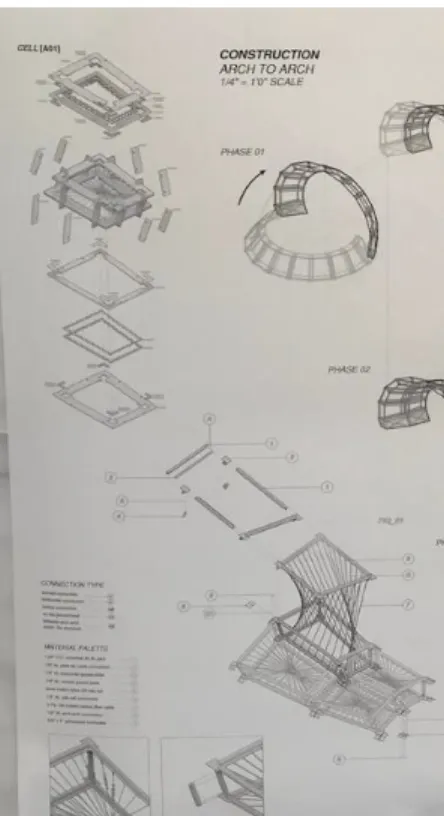
In addition to this fabrication plan was the actual mock-up of the module. Each team member contributed to the CNC process for the jig that was used, including welding pipes and plates together, cutting the pipe and plate to size, and programing the mill the cut out the wooden pieces. This allowed me to have a vision of the finished product and more accurately estimate required man hours as well as how to efficiently fabricate the jig. The learn-by-doing process allowed me to actually see and understand the building of this project much more so than if it were viewed on a computer screen. Figure 1 shows the various aspects for the fabrication plan.
Figure 1: Fabrication plan of jig and individual cell
Long Lead Items
The next deliverable was to discover and identify any long lead items for both the mock-ups and the pavilion itself. This was important as it changed much of what the group utilized to build the mock- up. The original design accounted for aluminum pipes, aluminum fasteners, and carbon fiber rope. However, all of these materials were too expensive and difficult to obtain in the right sizes and on time. In order to meet the requirements, the jig was fabricated with steel pipes, no fasteners (only built one cell instead of a group of 4 so fasteners weren’t necessary), and steel rope.
Operation Manual
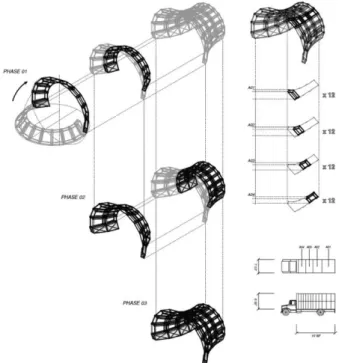
The final deliverable is the operation manual for the pavilion. The manual includes assembly drawings and connection details, transportation instructions, assembly and disassembly, maintenance and operating instructions, and a spare parts list. This includes the most of the deliverables as shown in Figure 2.
Figure 2: Diagram for transporting and setting up arches
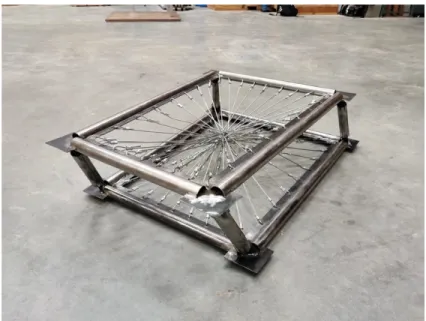
Figure 4: Fully constructed cell
Lessons Learned
There are several major lessons learned through the design and construction of the pavilion. The first lesson dealt with the IPD, Integrated Project Delivery, process and how it differed from the Design- Bid-Build process that is taught in the classroom and most companies utilize in many of their projects. The project itself showed what kind of leadership and teamwork is necessary in order for the team to prosper, as if there is no foundation for this, the team will often times be stuck in the mud and won’t get very far. This stems from the formation of the team, as the architects, structural engineers, and construction managers all have different roles and goals when it comes to any given project. Since we all have differing goals and skills, we will all have differing paths we will want to take. Even in any one given field, we all will want to take different paths to get to the same goals. In our classes they talk about IPD where all the teams come together and fight together as one from the beginning and the more you solve in the beginning, then better off the team is. However, this isn’t true as not everyone on the team is wanting to be there or have different goals and so you must establish common ground before the team is running efficiently.
The first part is the action in which you must learn that even though the construction manager has a certain scope and the architect has a different scope, they should still be involved with each other during the process. I had to learn to become more involved with the design process and really be able to draw and understand the mechanics of the designs of your architects and from that to give some sort of advice and application of their design shows that you are involved on their end. Then you need to share your scope and have the architects understand you unit pricing and estimates as well as constructability and really have them give you input on costs and transportation and to really understand on how things will come together.
The other part of the process is to come to a common goal and make a schedule because of this. This is somewhat similar to what is discussed in school with a process similar to pull planning. Everyone must write down the steps it will take to get to their goal and collaborate on the exact order things should be done in and how you can support each other here and there to speed up the process. Another major lesson learned was that, even though IPD is a collaborative effort, you must understand your skill set and really try to contribute with your skill set. As a construction manager, I don’t have a high skill set in design. However, I have skills in both estimating, scheduling, and the actual construction process. So, while we are a team, the construction manager must be involved in the design process from the beginning while still utilizing your skill sets to show off your expertise and not try to do something you really have no business doing. When involved in the design process, it is easy to just knock out many designs, choose one’s the team likes and then build off that. However, often times the architects who ultimately choose a design are often times biased and will lean towards designs that match their preferences. However, one thing that helped me a lot in this process was once I realized comparing my actual designs to the architects was kind of hopeless, I learned to add a rough takeoff and schedule into my designs and the designs of others. Then it led into the process of
constructability talks of certain designs we were more interested in, and really allowed me to give more valuable input and have the team desire the construction manager’s advice rather than before when I was solely trying to give design advice to the architect which wasn’t very valuable and recognized by them.
Then I learned some valuable lessons from the actual construction process. The first being when ordering materials, do your research early to understand cost and availability of certain materials because often times you time and price limit will vary even down to the deadline and this will allow you to have a rough estimate if you will actual be able to obtain the materials on time and under budget before you actually need to order it. This is most important when you are constructing
physically if you see someone not doing much. The first part is fairly straight forward as there will always be unknowns when it comes to the construction process, which a good schedule and estimate can cut down on the unknown variables. However, when these unknowns pop up, trying to be flexible and be quick on your feet can really help the team out.
The most important step, however, is to assign roles during this process. This will be important when the unknowns pop up as when you assign roles, the group will be working diligently during their designated times, however due to the way the schedule is made, certain people in group will wait on certain things to be finished and will have times when they aren’t busy. This will allow one to ask for help when the unknowns come up. But in order to get this help, you must physically ask and assign someone to help you, as some people would rather wait for someone else to finish than help their teammates. In order to do this, you must come up with assigned roles with a rough schedule to understand when people aren’t as busy and assign them to help you out when help is needed.
One of the last things I learned during this construction phase was that there isn’t just one way to get something done. We learned that even though the group had decided there was a certain process to constructing something or this was the most optimal way to schedule things, so many times we realized that things could be done more efficiently a certain way or that the actual the way we were doing something was way not as efficient than we had originally estimated. This allowed us to take a step back and figure out if the things that we were doing were efficient or even if it wasn’t efficient, how can we apply that not only for the future, but also does this affect us on any other steps that we have coming up during the actual construction process. When we learned to actually take a step back, we saw how flexible the schedule we made became, as we moved different activities up and down the schedule based on our observations and even changed certain activities for future building in order to cut down on our man hours and even materials used sometimes as we definitely over predicted and estimated after we had started building the module for ourselves.