• No results found

Broadband Telecommunications Benchmarking Study

N/A
N/A
Protected

Academic year: 2020

Share "Broadband Telecommunications Benchmarking Study"

Copied!
35
0
0

Loading.... (view fulltext now)

Full text

(1)

Broadband Telecommunications

Benchmarking Study

(2)

Table of Contents

Page

Executive Summary

i

1.0.

Background

and

Introduction 1

2.0.

The

Benchmarking

Methodology

1

3.0.

Telecommunications

Sector

Overview 1

4.0.

Overall Benchmark Results

2

5.0.

Sector-Specific

Broadband

Results

4

6.0.

Drivers

of

DSL

Rollout

and

Take-up

8

7.0.

Drivers of Fibre Optic Rollout and Take-up

12

8.0.

Government’s Broadband Initiative and International Fibre Developments

13

9.0.

Demand for Broadband

14

Appendices

Appendix 1: Typical Business Use of Broadband Glossary of Terms Used

Appendix 2: Price and Quality Competitiveness of Telecommunications Services

Appendix 3: Summary of Broadband Access Technologies

Appendix

4:

Rollout

of

DSL

in

Ireland

Appendix 5: DSL Growth Path

(3)

Executive Summary

I.

Introduction

The Forfás Telecommunications Benchmarking process assesses Ireland’s competitiveness relative to 21

countries1 with a particular focus on the broadband2 telecommunications requirements of the enterprise sector.

The principal objectives of the benchmarking process are to:

• determine best practice in the provision of broadband telecommunications in competitor countries,

• determine and analyse gaps between the provision of broadband telecommunications and tariffs for

enterprises based in Ireland relative to other countries: and,

• to form an agenda for action to improve Ireland’s competitiveness.

This report assesses developments since the last update report in November 2003 (published in January 2004) and builds on key policy recommendations. Appendix 6 provides a glossary of the technical terms used in the report.

II.

Key Metrics

Figure 1: International Leased Line Costs3

1. International Connectivity

Ireland has significant international capacity available to support current and future enterprise activity, and is served by a variety of routes and carriers (e.g., Eircom, EsatBT, NTL, Global Crossing, Cable & Wireless, Hibernia Atlantic etc.).

i 5 10 0 500000 1000000 1500000 2000000 2500000 3000000 3500000 4000000 Av er a ge A n n u al R en tal C h a rge ( U S $ /P PP) D enm ar k ( 2 ) Lux e m b our g ( 3 ) Ir el and ( 4 ) G e rm a n y (5 ) N e ther la n d s ( 6 ) E U A v e rage G reec e ( 7 ) B e lg iu m ( 9 ) A u s tri a (8 ) P o rt u gal ( 10) U K ( 11) F rance ( 12) It al y ( 1 3) S pai n ( 14)

OE C D N a tio n a l L e as e d L in e B a s ke t (E U 1 5) - Au g u st '04

M 1 0 2 0 6 4 k 2 M

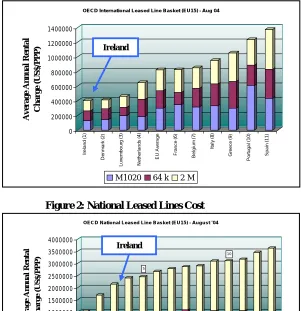
High levels of capacity and diversity in terms of carriers and landing areas has resulted in strong competition and very competitive prices. 0 200000 400000 600000 800000 1000000 1200000 1400000 Ave rage An n u al Re n tal Ch a rge ( U S $ /PPP) Ir el an d ( 1 ) D e nm ar k ( 2 ) Lu x e m b ou rg ( 3 ) Ne th e rl a n d s ( 4 ) EU A v e ra g e Fr a n ce ( 6 ) B e lg iu m ( 7 ) Ita ly ( 8 ) Gr e e c e ( 9 ) Por tug al ( 1 0 ) S p ai n ( 1 1)

OEC D International Leased Line B asket (EU 15) - Aug 04

M1020 64 k 2 M

Ireland

[image:3.595.258.559.335.646.2]

As can be seen in Figure 1, Ireland currently offers the lowest international leased line costs in the OECD.

Figure 2: National Leased Lines Cost

2. Regional Connectivity

Ireland

Ireland also has an extensive national fibre network with a range of players (e.g., eircom, EsatBT, ESB, Aurora, Cable and Wireless, etc).

As can be seen in Figure 2, national leased line costs compare well with the rest of the

OECD. Ireland currently lies in 3rd position,

three places ahead of the EU average.

1 The 21 countries are the EU-15, Canada, Japan, Korea, Hungary, the Czech Republic and the US.

2 The two key broadband technologies benchmarked are leased lines and Digital Subscriber Line (xDSL) technology which allows the provision of high speed services over the copper lines into businesses and homes. See Appendix 6 for a detailed glossary of technical terms used.

3

(4)
[image:4.595.61.538.79.343.2]

3. Overall Broadband Take-Up

Figure 3: Overall Broadband Take-Up

0% 5% 10% 15% 20% 25% 30% Korea

Denmark Netherlands Canada Japan Sw eden Belgium US France Finland Italy Austria Portugal Spain UK Germany Lux. Ireland Hungary Czech Republic Greece

DSL Cable FTTH

Note: FTTH – Fibre to the Home

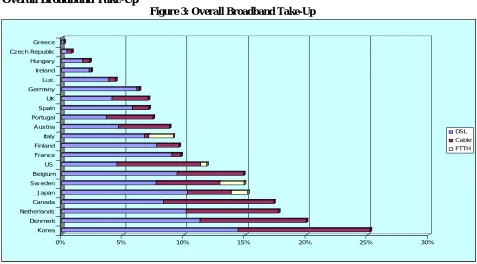
• Ireland has experienced rapid DSL growth since the last update report in November 2003 with DSL

take-up by population rising to over 2% (see Figure 3), which equates to 90,000 broadband connections4

(compared to 15,700 in November 2003).

• Ireland has also improved in terms of DSL coverage and it is estimated that coverage5 has increased to

81%.However, there are issues with line failures which operators plan to address in 2005.

• In terms of prices, the cost of basic DSL services have dramatically improved and Ireland is now amongst

the most competitive countries for residential and small business customers. However, other countries are in a position to offer a greater quality and choice of services, due to the level of competition.

Business broadband continues to grow with an estimated 30% of SMEs in Ireland now with a broadband

connection.

Despite these developments:

• Ireland continues to compare poorly for overall take-up of broadband (DSL, Cable, Fibre to the Home) as

illustrated in Figure 3. Since the last update report in November 2003, Ireland has slipped further behind both the average and leading countries within the comparator group.

• Norcontel6 estimate that compared to the average countries in the group (with 11% broadband take-up),

Ireland currently has a broadband deficit of 360,000 connections. In order to catch up by 2007, Ireland needs to install this deficit plus the additional growth other countries are expected to experience during that period, equivalent to another 370,000 lines, bringing the total to over 700,000 connections.

4

This number is likely to exceed 100,000 by the end of 2004.

5 Coverage data refers to the total number of lines that are DSL enabled.

ii

6

Forfás have commissioned Norcontel, a specialist telecommunications consultancy, to benchmark Ireland’s broadband

(5)

iii The key reasons for Ireland’s slippage and poor relative performance in relation to overall broadband take-up is:

1. The lack of real growth in competing technologies, especially cable, which is very strong in other

countries;

2. The lack of competition and innovation within the DSL market.

A number of recommendations are developed below aimed at addressing these issues.

III.

Priority Recommendations

1. Lack of Inter-Platform Competition

Incumbent telecommunications operators in all countries were originally reluctant to rollout DSL as it undercut the price of their current business services (e.g. ISDN, leased lines, and other premium services). The impetus which forced many of them to invest was serious competition from cable TV companies. Despite the large penetration of cable TV in Ireland, to date, the network operators haven’t had the level of funding required to meet the high costs of upgrading their networks to provide widespread broadband services.

Delivering broadband over wireless or radio is currently attracting a lot of attention in Ireland and it is becoming increasingly important to consider mechanisms to stimulate the development of alternative emerging technologies.

It is recommended that:

• The Department of Communications, Marine and Natural Resources work with the Local Authorities and

the Department of Environment, Heritage and Local Government to reduce the high charges involved in rolling out infrastructure by cable and telecoms operators;

• ComReg review broadband spectrum usage with the objective of encouraging operators to maximise the

use of spectrum resources when delivering broadband services. For example, ComReg should consider freeing up spectrum for WiMax technologies in order to increase the range and penetration of wireless services enabling them to be more competitive with DSL;

• The Department of Communications, Marine and Natural Resources should update the Wireless

Telegraphy Act (1926) as a matter of urgency to ensure regulatory certainty that allows for innovative access to spectrum and provides financial institutions with greater surety with regard to investing in companies in the wireless space.

2. Lack of Competition and Innovation within the DSL Market

In Ireland, it is increasingly likely that DSL will be the key platform for the delivery of broadband services to residential and SMEs in the medium term, unlike many other countries where there is strong competition between cable and DSL, and within the DSL market. Both local loop unbundling (LLU) and DSL resale provides telecommunications service providers the opportunity to offer broadband to the enterprise sector by using the incumbent’s network and thus boost competition in the DSL market. In Ireland, both options have had limited success to date and issues remain over (a) the cost of LLU and (b) the availability of collocation space:

(a) ComReg has recently indicated that the rental price for a local loop would be reduced. However, Ireland

will remain among the highest in Europe for unbundled line prices and these high prices will continue to curtail innovation in broadband. Since May 2004, BT in the UK have reduced the rental cost by nearly 50% and the installation cost by nearly 70%, resulting in a monthly amortised cost of €7.86. This has moved the UK from being one of the most expensive locations in Europe for unbundled lines to one of the cheapest. BT has stated this is due to the introduction of a new automated management system.

(b) In Ireland, service providers complain of the high ongoing cost of collocation in eircom exchanges, and

(6)

iv an alternative. An additional method of avoiding the need for eircom collocation is to use sub-loop unbundling. For both of these approaches a regulated unbundled product is required and ComReg would have to initiate a process to facilitate it.

It is recommended that:

• ComReg continue to put pressure on eircom to reduce their LLU charges further in order for other

companies to access local exchanges and provide innovative services;

• Operators, with the support of the Department of Communications, Marine and Natural Resources, formally

request ComReg to facilitate the development of remote collocation and sub-loop unbundling7 products.

IV.

Additional Recommendations

3. Governments Metropolitan Area Networks (MAN) Strategy

Construction of the first phase of the fibre MANs by Local Authorities is now reaching completion. In July 2004, the Government awarded the concession for management of the MANs to e-Net for a fifteen-year term. A number of networks have been taken over and are active. Some service providers have commented on the initial high cost of fibre from e-Net.

It is recommended that:

• The Department of Communications, Marine and Natural Resources monitor the take-up of dark fibre and

duct space on e-Net’s network, to determine if current price levels are dampening demand excessively, as part of the Department’s commitment to benchmark e-Net’s prices internationally;

• The Metropolitan Area Networks programme should be further developed by the Government and local

authorities by:

- Making additional funding available to expand the size of some of the constructed networks (e.g.

Cork/Ringaskiddy);

- Including and prioritising those centres of strategic importance to the Development Agencies and key

centres for development under the National Spatial Strategy (Shannon, Castlebar, Ennis, Killarney, Mallow, Tralee and Tuam).

4. Maximisation of Fibre Backbone Networks

Availability of dark fibre is critical for alternative providers to offer services on the incumbent’s network. With the completion of the ESB Telecom backbone network, there are now three major providers of backbone capacity on fibre infrastructure in Ireland: eircom, Esat BT and ESB Telecom, as well as a wide range of metropolitan providers.

It is recommended that the Department of Communications, Marine and Natural Resources work with:

• ESB-Telecom to expand its network further, particularly focusing on linking the Metropolitan Area

Networks and remaining NSS centres;

• Establish a competitive single national rate for national backbone access (over state owned networks). This

would facilitate uptake of broadband by businesses and consumers in the regions, as well as helping to attract foreign investment to the regions.

• Dublin City Council to ensure open access to the 170km fibre ducts within Dublin City.

7

(7)

v

5. Demand-Side Initiatives

Policies that promote infrastructure availability in isolation from the demand-driven applications that utilise this capacity run the risk of encouraging inefficient investment decisions by Government and the private sector in telecommunications. Much of the focus to date has been on the supply of broadband given Ireland’s current poor position in this context. Going forward, it is essential to ensure that support is given to promoting awareness and demand for broadband content and applications.

It is recommended that:

• The Government continue to support the recommendations of the Telecom Strategy Group in their interim

report of 2003 to increase demand for broadband services. Specifically, the recommendations to accelerate

the implementation of Government online servicesand to mandate ducting for new housing developments

should be implemented;

• As Government procurement contracts for telecommunications arise in 2005, greater consideration should

(8)

1

1.0.

Background and Introduction

In 1999, the National Competitiveness Council (NCC) identified the need for Forfás to establish a systematic process for benchmarking Ireland’s telecommunications competitiveness. Since then, Forfás has produced a series of periodic reports that benchmark the competitive provision, cost and quality of telecoms services to enterprises in Ireland against other countries with which Ireland competes.

The principal objectives of the benchmarking process are to:

• determine best practice in the provision of broadband telecommunications for the enterprise sector in

competitor countries; and,

• determine and analyse gaps between the provision of broadband telecommunications and tariffs for

enterprises based in Ireland relative to other countries and to form an agenda for action and improve Ireland’s competitiveness.

This report assesses developments in the broadband market since November 2003 and builds on key policy recommendations made to date in the Forfás benchmarking process.

2.0.

The Benchmarking Methodology

This report benchmarks Ireland’s broadband telecommunications infrastructure and levels of investment, service availability, tariffs, and the telecommunications regulatory environment against competitor and leading countries.

Currently, there are three main technologies used to deliver broadband services in the benchmark countries: Digital Subscriber Lines (DSL), cable modems and optical fibre. As part of this process, the following technologies are benchmarked:

DSL for small and medium sized companies;

• Developments across cable modems and a range of other potential broadband technologies, e.g.,

Broadband Fixed Wireless Access, Mobile, Satellite, etc, are monitored but these are not currently being developed in a meaningful way for businesses in Ireland (see Appendix 3). Ireland’s relative cost competitiveness for basic telephony services and mobile services are also monitored, and the results set out in Appendix 2;

Optical fibre connections for large companies, the public sector and those requiring very advanced

communications capabilities.

ISDN is not normally considered a broadband technology; however it can be used to substitute for DSL

where the service is not available in Ireland. However, since the monthly charge for the service varies with usage, it is an expensive alternative to DSL.

The benchmarking methodology was agreed with a Steering Group comprising members from the Department of Enterprise, Trade and Employment, the Department of Communications, Marine and Natural Resources, Forfás, IDA Ireland and Enterprise Ireland.

3.0.

Telecommunications Sector Overview

In Ireland, the September 2004 Quarterly Market Commentary from ComReg8, notes that:

• Total revenues for fixed, mobile and broadcasting markets now stands at an estimated €3.68 billion

per annum, which reflects an increase of approximately 4% since last year;

• The telecoms sector is estimated to account for approximately 3.3% of Irish GNP9;

• Internet penetration continues to grow in 2004 with Ireland’s residential penetration rate currently

standing at 46%10;

8 Data based on returns from licencees for the period April-June 2004.

9 Figure calculated using forecast GNP at market price (2003) by the ESRI.

(9)

2

• Irish mobile penetration rates now stands at 89%, an increase of 8% in the last 12 months, while

average revenue per mobile users remains amongst the highest in Europe (€47 per month compared to EU average of €31);

• Eircom’s fixed line market share remains at 80% - this figure has remained static for the last two

years;

• Approximately 24% of cable/MMDS11 subscribers have upgraded to digital compared to 15% in

September 2003. 33% of all households with a TV are now cable/MMDS or satellite digital subscribers;

• FRIACO12 take-up continues to grow and as of September 2004, there were approximately 85,000

subscribers.

4.0.

Overall Benchmark Results (DSL) – Take-Up and Coverage

[image:9.595.57.547.290.660.2]

Since DSL remains the principal delivery platform for broadband services, this section sets out Ireland’s relative performance among the benchmarked countries in terms of DSL coverage/availability and take-up/number of connections.

Table 1: DSL Take-up and Growth in Take-up, by Population and Businesses, 3rd Quarter 2003 – 3rd Quarter 2004

Ranked by DSL Take-up

Country

DSL Coverage

DSL Take-up by

population13

DSL Take-up by SMEs

DSL Take-up – ‘000 Connections

Growth in DSL

Take-up

% % % Q3

2003

Q3 2004

Q3 2003 – Q3 2004

%

1 Korea 90 14.41 59 6,424 6,752 5

2 Denmark 97 11.34 100 410 603 47

3 Japan 70 10.27 79 9,139 13,000 42

4 Netherlands 99 10.19 100 662 1,610 143

5 Belgium 100 9.47 100 750 970 29

6 France 89 9.03 28 2,337 5,337 128

7 Canada 90 8.32 69 1,941 2,535 31

8 Finland 70 7.75 100 286 400 40

9 Sweden 88 7.72 30 506 683 35

10 Italy 93 6.79 70 1,781 3,877 117

11 Germany 95 6.15 44 4,102 5,050 23

12 Spain 92 5.79 89 1,483 2,284 54

13 Austria 100 4.69 48 244 379 55

14 US 89 4.53 33 8,210 12,352 50

15 UK 86 4.11 38 1,437 2,447 70

16 Lux. 92 3.82 37 8 17 112

17 Portugal 65 3.66 66 102 365 257

18 Ireland 81 2.26 30 15 90 500

19 Hungary 60 1.73 20 80 175 119

20 Czech Republic 67 0.44 5 13 45 246

21 Greece 40 0.18 - 0.5 19 3,700

Sources: Norcontel, Point-Topic, Federal Communications Commission (FCC), Oftel.

11 Multipoint Microwave Distribution System.

12 Flat Rate Internet Access.

(10)

Ireland Table 1 above shows that Ireland currently ranks 18th in the comparator group of 21 countries in

terms of DSL take-up. Ireland has overtaken Hungary in the take-up of broadband services

since the last update report in November 2003. The current number of DSL lines installed by all

operators is estimated to be about 90,000 (compared to 15,700 in November 2003).

• DSL take-up is growing very rapidly in Ireland, albeit from a low base, and currently stands at

about 2.26%per capita. Korea remain the leading country in the comparator group at over 14%

per capita.

• Ireland ranks 15th in the comparator group of 21 countries in terms of DSL coverage, ahead of

Greece, Hungary, Portugal, the Czech Republic, Finland and Japan. Since the launch of DSL services in May 2002 by both eircom and Esat BT, DSL coverage has increased to approximately 81% today. This figure is expected to increase more slowly to reach over 90% by

the end of 200514.

• There has been some controversy in recent months regarding DSL line failures with conflicting

figures being presented. eircom have indicated that, on average, about 22% of their lines fail for a number of reasons. They plan to tackle this problem from early 2005 by launching a programme that will aim to address these faulty lines.

• Esat-BT currently provides the only significant competition to eircom for DSL. After installing

DSL in 40 exchanges with the support of NDP funding, Esat-BT’s rollout programme appears to have stalled due to the difficulty and cost of local loop unbundling and collocation.

• Business use of broadband is continuing to grow. Norcontel now estimate that 30% of SMEs in

[image:10.595.133.559.456.702.2]

Ireland have broadband, indicating a strong pent-up demand that is now starting to be addressed (The average of the comparator group currently stands at 58%).

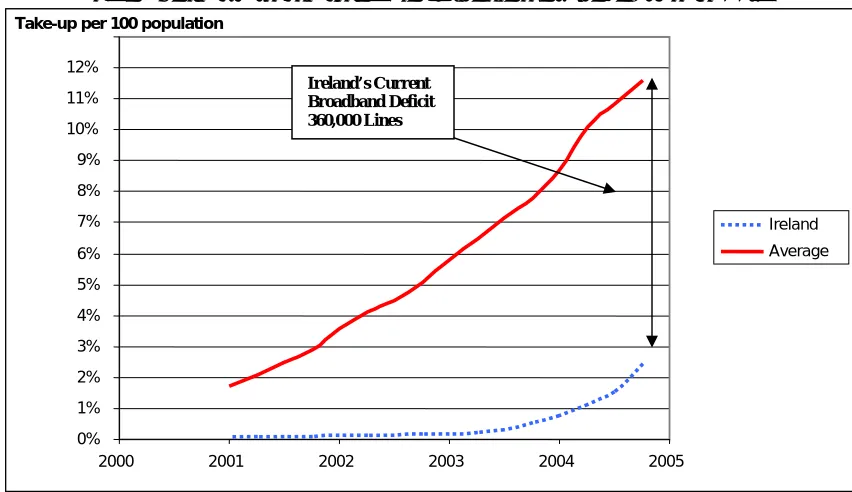
Figure 2 below illustrates the gap between Ireland’s overall broadband take-up (2.26%) and the

average take-up of the benchmark group (currently over 11%), expressed on a per capita basis. This gap, which widened greatly during the period 2001 to 2003, has stabilised and reduced slightly this year. However this gap is still over 9%, which corresponds to a deficit of some 360,000 broadband lines given Ireland’s population of four million.

Figure 2: Ireland’s broadband take-up versus the average of the benchmarking group

3

14 eircom have greatly accelerated their rollout of DSL and plan to install DSL capability in 236 exchanges by September 2005 reaching about 90% of customers (see Appendix 4 for rollout plans).

0% 1% 2% 3% 4% 5% 6% 7% 8% 9% 10% 11% 12%

2000 2001 2002 2003 2004 2005

Ireland

Average Take-up per 100 population

(11)

• In order to catch up with the average of the comparator group over the next three years, Ireland would have to install both the deficit 360,000 lines (which would bring our current 90,000 DSL connections up to 450,000), plus the additional percentage increase that other countries are expected to achieve in that period. This is estimated to be the equivalent of another 370,000 lines (over 9% growth in overall take-up) in the case of Ireland, bringing the total deficit to well over 700,000 new lines. Despite rapid progress in DSL take-up, there is a risk that Ireland’s position could start to deteriorate again in the next few years,

primarily due to the lack of inter-platform competition.

Overseas

Conclusions

• It may well be the case that Ireland will only begin to recover significant ground when

growth rates in other countries slow due to market saturation, possibly towards the end of the decade. However, by then the focus of attention is likely to have moved to the provision of broadband at much higher speeds, based on fibre networks.

• Korea remains the leading country, with DSL take-up by population close to 15% and 59%

of Korean businesses use DSL with telecommunications operators there servicing over 6.7

million DSL connections. Denmark and Japan rank 2nd and 3rd respectively and have begun

to close the gap on Korea. Both countries experienced between 40-50% growth in DSL take-up in the last 12 months.

• The Netherlands and France have also witnessed significant growth in DSL in the last 12

months with close to 10% of each countries’ population using DSL.

• Internationally, a substantial percentage of businesses are already using broadband.

• Business and residential use of broadband is booming worldwide, mainly driven by take-up

of DSL and cable modems. Table 1 shows Ireland has experienced strong DSL growth

rates (also see Appendix 5). However, as illustrated by Figure 3 in the executive summary,

Ireland continues to compare poorly in terms of overall broadband take-up and has slipped further behind the leading and comparator countries, particularly for cable modem services.

5.0.

Sector-Specific Broadband Results

This section benchmarks Ireland’s broadband price competitiveness for three different user categories: small,

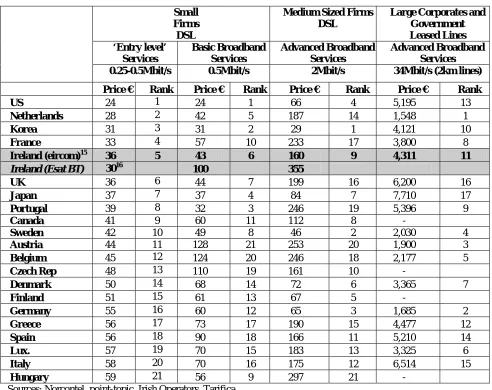
medium-sized, and large companies. Table 2 below sets out the current price of broadband services for each of

these user categories. In each case, the most appropriate technology to provide the required applications are benchmarked, that is, DSL for small and medium sized businesses, and fibre optic based high-speed leased lines for large corporates and Government. (see Appendix 1 for typical business uses of broadband).

5.1 Small Firms: Entry Level/Basic DSL Services

Introduction • Small firms are generally more risk adverse and tend to sample products before making

significant investments. With broadband, they can do this by purchasing entry level DSL (0.25-0.5Mbit/s) first. This is only suitable for SMEs with limited internet applications, but is critical to developing a mass market for broadband in Ireland. The price of entry level DSL provides a sound benchmark of the potential for mass-market growth.

Ireland

Entry Level DSL (0.25-0.5Mbit/s):

• There has been a dramatic reduction in the price of basic DSL services in Ireland since

2003. Ireland has moved from 18th among the 21 comparator countries and now ranks 5th in

terms of price competitiveness for ‘entry level’ DSL (see Table 2). This is a direct result of

the current push by eircom to reach its 100,000 DSL subscriber target by the end of 2004.

• eircom are currently offering a discounted rate with free installation, free rental and

equipment for subscribers who contract before the end of 2004. The benchmark prices in

Table 2 take short term discounts in Ireland and other comparator countries into account.

(12)
[image:12.595.52.544.87.477.2]

Table 2: Monthly Tariffs for DSL and Leased Lines, 3rd Quarter 2004

Sources: Norcontel, point-topic, Irish Operators, Tarifica. Small

Firms DSL

Medium Sized Firms DSL

Large Corporates and Government Leased Lines ‘Entry level’

Services

Basic Broadband Services

Advanced Broadband Services

Advanced Broadband Services

0.25-0.5Mbit/s 0.5Mbit/s 2Mbit/s 34Mbit/s (2km lines)

Price € Rank Price € Rank Price € Rank Price € Rank

US 24 1 24 1 66 4 5,195 13

Netherlands 28 2 42 5 187 14 1,548 1

Korea 31 3 31 2 29 1 4,121 10

France 33 4 57 10 233 17 3,800 8

Ireland (eircom)15 36 5 43 6 160 9 4,311 11

Ireland (Esat BT) 3016 100 355

UK 36 6 44 7 199 16 6,200 16

Japan 37 7 37 4 84 7 7,710 17

Portugal 39 8 32 3 246 19 5,396 9

Canada 41 9 60 11 112 8 -

Sweden 42 10 49 8 46 2 2,030 4

Austria 44 11 128 21 253 20 1,900 3

Belgium 45 12 124 20 246 18 2,177 5

Czech Rep 48 13 110 19 161 10 -

Denmark 50 14 68 14 72 6 3,365 7

Finland 51 15 61 13 67 5 -

Germany 55 16 60 12 65 3 1,685 2

Greece 56 17 73 17 190 15 4,477 12

Spain 56 18 90 18 166 11 5,210 14

Lux. 57 19 70 15 183 13 3,325 6

Italy 58 20 70 16 175 12 6,514 15

Hungary 59 21 56 9 297 21 -

• Esat-BT’s residential customers are now handled by the company’s subsidiary IOL

Broadband, whose entry level price is €39.99 with a self installation charge of €90 all including VAT.

Ireland

Overseas

Basic DSL (0.5Mbit/s):

• The price charged per month for basic DSL in Ireland has improved substantially since

November 2003 and currently stands at €43/month. Ireland now ranks 6th amongst the

comparator group, behind the US, Korea, Portugal, Japan and the Netherlands.

• The US have overtaken Korea as the most competitive market for ‘entry level’ and basic

DSL prices, charging €24 per month for both services.

5

15 Prices for eircom services are used to benchmark Ireland’s position since these services are more widely available than those of Esat BT.

(13)

6

Conclusions • Ireland’s entry level (€36) and basic (€43) DSL prices17 have considerably dropped since

November 2003. The current discount offers dramatically improve our competitiveness with countries in the comparator group. Ireland’s place in the benchmark table has improved from being among the most expensive to being among the cheapest for residential customers, and there have been substantial reductions for small business customers.

• Despite the substantial reductions in basic DSL prices in Ireland, other countries are in a

position to offer greater bandwidth for their entry level services. For example in Canada, Belgium and Korea, a 3Mbit/s service is now readily available at entry level prices.

• In Ireland, current DSL services offer bandwidth in the range 0.5 to 2Mbit/s. Existing DSL

lines are capable of being upgraded to 5Mbit/s without great difficulty and at relatively low cost using ADSL2 software, but with only limited coverage. Rollout is likely in 2005.

• Residential subscribers will use these higher bandwidths mainly for entertainment services.

For businesses, however, the availability of such higher bandwidths will be important to cope with increasing usage and more advanced applications.

5.2 Medium Sized Firms: Advanced DSL Services (2Mbit/s)

Introduction • Medium sized firms require higher levels of bandwidth so as to keep Internet access per

employee above minimum broadband levels and to support more advanced broadband applications. These can be delivered through more advanced ADSL at a speed of 2Mbit/s downstream.

Ireland • Ireland now ranks 9th among the comparator group with eircom’s charge for advanced

DSL, having dropped from €352 to €160 per month. Part of the reduction is due to the special offers currently available, but the largest part is as a result of the increase in bandwidth from a maximum of 1Mbit/s to 2Mbit/s. While one year ago two DSL lines were required to achieve the benchmark bit rate, now one line provides the required bandwidth, resulting in a very significant saving.

• Previous reports noted that Esat-BT have the capability to deliver symmetric DSL services

in the 40 exchanges where they have equipment installed. However, while they do offer the service and have sold some lines, no service has been heavily marketed.

Overseas

Conclusion

• Korea remain 1st for 2Mbit/s DSL services. Companies in Sweden, Germany and the US

have considerably reduced their prices since November 2003.

• Demand for advanced DSL in Ireland is expected to continue to increase over the next few

months. However, prices remain significantly higher than in the leading countries.

(14)

7

5.3 Large Corporates and Government (34Mbit/s – Fibre Optic)

Introduction • A large company or government organisation may require bandwidth in the range of 10 to

100 Mbit/s to ensure leading edge broadband services can be supported (e.g., video-conferencing and permanent video-streaming). In many cases, fibre to the building is required to support these services.

Ireland • Ireland has fallen two places from 9th to 11th in the comparator group for high capacity

leased lines as other countries have reduced their prices (see Table 2, p.5). The price of a 34Mbit/s service in Ireland remains significantly more expensive than the leading countries.

Overseas

Conclusion

• The Netherlands, Germany and Austria remain the leading countries in terms of advanced

services for large companies, with the Netherlands currently the cheapest at €1,548 for a 34 Mbit/s 2km line.

• Norcontel estimate that there are only approximately 850 fibre connections to end users in

Ireland. This is equivalent to a fibre take-up rate by businesses of 0.85%, which is relatively low by international standards (US - 8%, UK- 2.5%).

• A new broadband leased line has recently been proposed by eircom which will offer

(15)

8

6.0.

Drivers of DSL Rollout and Take-Up

There are a number of factors that have driven broadband development in best practice countries. These are summarised below. Developments in Ireland are also examined, and key recommendations are outlined.

6.1

PRICE OF DSL

International data indicates that a price of approximately €30-€40 per month is required if customers are to adopt DSL as a mass-market technology. Price variations (both up and down) are evident in many countries as broadband markets mature. However, the overall trend is a lowering of broadband costs.

• The average prices of high speed business services have fallen considerably over the

last 21 months, a reflection of growing confidence on the part of the incumbents that DSL will not damage existing leased line and other conventional revenue streams.

• DSL prices in Ireland have become much more conducive to mass take-up of

broadband. For example, eircom’s entry level DSL prices are currently between

15-20% cheaper than the average benchmark price for the same service18 (compared to

29% more expensive in November 2003).

• Although prices for basic broadband services have significantly dropped in recent

months, other countries are in a position to offer greater quality and choice of services at similar prices.

• Ireland continues to compare poorly for overall take-up of broadband (DSL, Cable,

FTTH) and since the last update report in November 2003, Ireland has slipped further behind both the average and leading countries within the comparator group.

• The key reasons for Ireland’s slippage and poor relative performance in relation to

overall broadband take-up is:

1. The lack of real growth in competing technologies, especially cable, which is very

strong in other countries;

2. The lack of competition and innovation within the DSL market.

18

(16)

6.2

COMPETITION FROM OTHER TECHNOLOGIES

• Incumbent telecommunications operators in many countries were originally

reluctant to rollout DSL as it undercut the price of their current business services (ISDN, leased lines, and other premium services). The impetus which forced many of them to invest was serious competition from cable TV companies.

• A study of OECD countries in 2001 indicated that success in promoting broadband

rollout is affected more by competition within technologies (e.g., DSL) and competition across technologies (DSL, Cable, Wireless) than the intensiveness of

the regulatory authorities19.

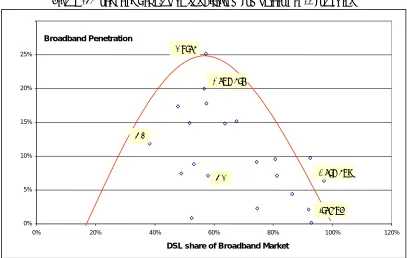
• Figure 3 shows the impact of inter-platform competition, that is, competition

[image:16.595.158.565.272.530.2]

between DSL and the other methods of delivering broadband such as Cable TV and fibre networks, based on the benchmark group of 21 countries. The graph shows the relationship between the general take-up of broadband and the level of competition in the market. The conclusion of this analysis is clear, that where competition is strongest, take-up of broadband is maximised.

Figure 3: Broadband Take-up versus Platform competition in 21 countries

Broadband Penetration

9

19Source: OECD, The Development of Broadband Access in OECD Countries, October 2001. 0%

5% 10% 15% 20% 25%

0% 20% 40% 60% 80% 100% 120%

DSL share of Broadband Market

Korea

Denmark

US

Germany UK

(17)

10

Ireland • According to ComReg, there were an estimated 5,400 cable broadband subscribers in

service at the end of the 3rd Quarter of 2004, up from 3,700 12 months earlier.

However, Ireland continues to rank relatively poorly for cable modem usage.

• Since March 2002, the Irish cable market has been open to competition due to NTL

and Chorus losing their exclusive license. This has cleared the way for one regional operator, Casey Cablevision, to offer a cable modem service to a small number of subscribers in Co. Waterford.

• Despite the large penetration of cable TV in Ireland to date, the network operators

haven’t had the level of funding required to upgrade their networks to provide a widespread broadband service. Therefore, cable is providing limited competition to the DSL market.

• NTL have recently announced a plan to invest €100m to make broadband services over

cable available to 100,000 homes in Dublin, Waterford and Galway by the end of 2004 and 450,000 homes by the end of 2006. If the company delivers on these plans, it should have a significant impact on the market. If inter-platform competition does not develop the prospects for broadband take up in Ireland will be severely impacted.

• Delivering broadband over wireless or radio is currently attracting a lot of attention in

Ireland.

Overseas • The market for broadband over cable continues to grow strongly in the US and

globally. Worldwide cable modem service subscriptions will climb from 32.8 million in 2003 to 69.4 million in 2008, according to market analysts IDC.

• Cable operators in many countries have taken a substantial share of the broadband

market from incumbent telecommunications operators and have played a key role in developing the overall broadband market in their respective country.

Recommendations It is recommended that:

The Department of Communications, Marine and Natural Resources work with

the Department of Environment, Heritage and Local Government and the Local Authorities to alleviate the high costs involved in rolling out infrastructure by cable and telecoms operators;

ComReg review broadband spectrum usage with the objective of encouraging

operators to maximise the use of spectrum resources when delivering broadband services. For example, ComReg should consider freeing up spectrum for WiMax technologies in order to increase the range and penetration of wireless services enabling them to be more competitive with DSL;

The Department of Communications, Marine and Natural Resources should

update the Wireless Telegraphy Act (1926) as a matter of urgency to ensure regulatory certainty that allows for innovative access to spectrum and provides financial institutions with greater surety with regard to investing in the wireless space.

6.3

LOCAL LOOP UNBUNDLING (LLU) AND COLLOCATION

(18)

11

Ireland • Local loop unbundling and collocation are essential to drive innovation in the DSL

market. To date, this approach has largely failed to work in Ireland, with Esat-BT’s rollout currently on hold since 2002. Despite this, there is now renewed interest in local loop unbundling, albeit from smaller operators, such as Leap Broadband and Smart Telecom.

• Leap Broadband have entered the local loop unbundling market to offer symmetric

DSL services. The company will offer services in about 40 exchanges, the same sites currently covered by Esat-BT and will use Esat-BT’s fibre access lines.

• Smart Telecom plan to roll out services in 60 towns, focusing on Dublin and on towns

with Metropolitan Area Networks which have a connection to the ESB-Telecom network. The company is starting with 20 sites in Dublin.

• ComReg has recently indicated that the rental price for a local loop would be reduced

from €16.81 to €14.65. However, Ireland will remain among the highest in Europe for unbundled line prices. High LLU prices will continue to curtail innovation in areas like broadband, voice over DSL and SDSL for business customers.

• In Ireland, service providers complain of the high ongoing cost and difficulties of

collocation in eircom exchanges, and have expressed interest in using the collocation centres in the local authority Metropolitan Area Networks as an alternative. An additional method of avoiding the need for eircom collocation is to use sub-loop unbundling. For both of these approaches a regulated unbundled product is required.

Overseas • Competition in the DSL market is limited world-wide, with the incumbent dominating

in all EU and US markets. However, there has been some improvement in the situation since then, as penetration of unbundled lines are showing an increase in some European markets. In Denmark, the Netherlands and Italy, the relative success of unbundling is clearly related to the low cost of unbundled lines.

• Since May 2004, BT in the UK have reduced the rental cost by nearly 50% and the

installation cost by nearly 70%, resulting in a monthly amortised cost of €7.86. This has moved the UK from being one of the most expensive locations in Europe for unbundled lines to one of the cheapest. BT has stated this is due to the introduction of a new automated management system.

Recommendations It is recommended that:

ComReg continue to put pressure on eircom to reduce their LLU charges further

in order for other companies to access local exchanges and provide innovative services;

Operators, with the support of the Department of Communications, Marine and

(19)

12 6.4

WHOLESALE DSL

• While the provision of unbundled local loops and the installation of equipment in an

incumbent’s premises by a new entrant is the ideal source of DSL market competition, a second avenue is possible, that is the resale of DSL services by a new entrant. Both options provide telcos the opportunity to offer broadband to the enterprise sector by using the incumbents network and thus boosting competition in the DSL market. A major disadvantage for competitors of using wholesale services rather than using unbundled local loops is the reduced opportunities for offering innovative technologies, hence it is difficult for them to develop the market and differentiate themselves from the incumbent on anything other than price.

Ireland • There have been some improvements in DSL resale in Ireland since 2003. eircom

currently offers bitstream access at a wholesale price of €20.10 per month. This represents a significant margin of 64% for new entrants from their cheapest retail offering.

• The number of resell DSL lines in Ireland is reported to have grown from 1,000 in

November 2003 to roughly 17,000 today, which represents 19% of total DSL lines.

Overseas • The UK has a strong DSL resale market. There are over 80 companies offering DSL

by reselling BT’s wholesale service in the UK, and they have captured almost 50% of the market.

Conclusion • Ideally, in Ireland, there should be a mixture of unbundling and resale, with service

providers choosing one or the other or a mixture depending on their market plans, existing infrastructure and the relative economics.

7.0.

Drivers of Fibre Optic Rollout and Take-Up

Fibre has been used as a core technology in backbone networks since the 1980s. The focus of investment is increasingly on metropolitan and access networks, where until now the costs of deploying fibre systems have prevented their widespread adoption. Lower equipment costs coupled with rising demand for broadband services are seeing fibre networks being implemented more extensively. Fibre also provides the most future-proof medium for delivery of high-bandwidth services.

With the completion of the ESB Telecom backbone network, there are now three major providers of backbone capacity on fibre infrastructure in Ireland: eircom, Esat BT and ESB Telecom. eircom has no plans to deploy additional fibre on the national backbone. Apart from completing a section from Carrick-on-Shannon to Sligo and extending to Letterkenny, Esat BT has no plans for further backbone rollout. The ESB Telecom network is a fibre wrap network, consisting of a Southern Loop and the Northern Loop, which together form a figure of 8 around the country serving major cities and towns.

7.1

AVAILABILITY OF DARK FIBRE

Availability of dark fibre is critical for alternative providers to offer services on the incumbent’s network.

Ireland • Among service providers there is strong support for the ESB Telecom’s network and

its low cost and high quality approach to renting dark fibre and transmission capacity. There is also general support for the expansion of this network from its current length of 1,300km. However, currently there is no plan for any expansion.

• Dublin City Council has approximately 170km of fibre network in the city under

(20)

13

Overseas • There are healthy dark fibre markets in many countries resulting in the availability of

dark fibre at competitive prices.

• In the US, the FCC’s recent announcement of a relaxation of the requirement for

fibre unbundling, has spurred announcements of major investments in fibre-to-the-home projects by several US operators. This is contrary to developments in Japan, where the Government has enforced dark fibre unbundling.

Recommendations It is recommended that the Department of Communications, Marine and Natural

Resources work with:

ESB-Telecom to expand its network further, particularly focusing on linking the

Metropolitan Area Networks and remaining NSS centres;

Dublin City Council to ensure open access to the 170km fibre ducts within

Dublin City;

Establish a competitive single national rate for national backbone access (over

state owned networks). This would facilitate uptake of broadband by businesses and consumers in the regions, as well as helping to attract foreign investment to the regions.

The Department of Communications, Marine and Natural Resources consider

the merits of opening access to eircom’s unused dark fibre. A review of the issue should be undertaken and include an analysis of the approaches of the Japanese and US Government.

8.0.

Government’s Broadband Initiative and International Fibre Developments

The construction of fibre MANs by Local Authorities in the first phase of the programme funded by the Department of Communications, Marine and Natural Resources is now reaching completion. In July 2004, the Government awarded the concession for management of the MANs to e-Net for a fifteen-year term. A number of networks have already been taken over starting with Ballina, Kiltamagh and Galway, and it is expected that the remaining towns where construction has been completed will be taken over before the end of the year.

Some customers are already receiving services using the MANs, including a number of wireless service providers. Operators have connected a significant number of business customers in Cork using a fibre ring leased on the MAN. Some service providers have commented on the cost of fibres from e-Net. e-Net have indicated that this cost reflects the fact that they must recover the capital cost of the networks and repay it to the Government. This seems at odds with the original intention whereby Government would fund 90% of the development of the MANs to encourage the take-up of broadband services by SMEs principally because the costs of broadband services provided by the incumbent eircom effectively meant that they were unavailable except to large corporate customers. The net effect of this may be a lower than expected use of the facilities by service providers and a reduction in the benefit of these projects to the regions.

(21)

14

Recommendations

It is recommended that:

The Department of Communications, Marine and Natural Resources monitor the

take-up of dark fibre and duct space on e-Net’s network, to determine if current price levels are dampening demand excessively, as part of the Department’s commitment to benchmark e-Net’s prices internationally;

A limited fibre deployment project serving businesses and consumers be instigated for

one of the Metropolitan Area Network towns, to provide an in-depth understanding of the planning, technical, commercial and content issues from this emerging platform;

The Local Authority Open Access Network programme should be further developed by

the Government and local authorities by:

- Making additional funding available to expand the size of some of the constructed

networks (e.g. Cork/Ringaskiddy);

- Increasing the number of overall networks:

Forfás and the Development Agencies support the construction of additional MANs in the following towns: Shannon, Castlebar, Ennis, Killarney, Mallow, Tralee and Tuam. These centres are of strategic importance to the Development Agencies and include key centres for development under the National Spatial Strategy. The inclusion of these centres in the Broadband Action Plan would significantly enhance the ability of the Development Agencies to support enterprise development and the regional agenda.

9.0.

Demand for Broadband

• Policies that promote infrastructure availability in isolation from the demand-driven

applications that utilise this capacity run the risk of encouraging inefficient investment decisions by Government and the private sector in telecommunications.

• Much of the focus to date has been on the supply of broadband given Ireland’s current poor

position in this context. Going forward, it will be necessary to ensure that support is also

given to promoting awareness and demand for broadband content and applications.

• A Telecoms Strategy Group was established in early 2003 with the aim of devising policies

for broadband delivery in Ireland. This Group comprised the main telecoms operators in

Ireland represented through the IBEC Telecoms and Internet Federation and ALTO20, and

representatives of the Departments of Communications, Marine and Natural Resources, Finance and An Taoiseach.

Recommendations

It is recommended that:

The recommendations of the Telecom Strategy Group in their interim report of 2003 to

increase demand for broadband services, should continue to be supported by Government. Specifically, the following recommendations should be prioritised:

- the implementation of Government online services should be accelerated by

prioritising the most frequently used and cost-effective government-citizen interactions;

- The Environment, Heritage and Local Government should make provisions for the

mandatory installation of ducting in all new housing developments.

As Government procurement contracts for telecommunications arise in 2005, greater

consideration should be given to procuring advanced services from a range of telecoms providers in order to promote broadband demand, the rollout of infrastructure and competition in the telecoms market.

20

(22)
(23)

Appendix 1 - Typical Business Use of Broadband

Small Firms: Basic Broadband Services

Medium Sized Firms: Advanced Broadband Services

Large Corporates and Government

Bandwidth required equal to 0.5 Mbits

Bandwidth required equal to 2 Mbits

Bandwidth required from 10 to 100 Mbits

• Fast Internet usage

• On-line ordering

• Fast, high capacity Email

• Teleworking

• Web site management

• Occasional

tele-conferencing

• Fast Internet usage

• On-line ordering

• Fast, high capacity Email

• Web site management

• Tele-conferencing

• Occasional on-line

training/seminar use

• Small scale e-commerce

applications

• Fast Internet usage

• On-line ordering

• Fast, high capacity Email

• On-line training/seminar use

• Large scale e-commerce

applications

• Large company web hosting

• Tele-conferencing/ Video

conferencing

• Web hosting services

• Streaming video feeds (e.g.,

broker service)

• Large scale voice services, Fax,

(24)

Appendix 2: Price and Quality Competitiveness of Irish Telecommunications Services

1. National Business Basket

The “National Business Basket” examines the average cost of national (incl. local) calls for the business sector. This basket is comprised of a much larger number of calls compared to the residential basket, with a

greater proportion at peak times although they are generally of shorter duration. Ireland is currently in 5th

[image:24.595.90.494.192.438.2]

position, three positions ahead of the EU average.

Figure 1: OECD National Business Basket –August 2004

5 1 0 1 5 0.00 200.00 400.00 600.00 800.00 1000.00 1200.00 1400.00 Ave rage Cost s ( U S $ /PPP) S w eden ( 3 ) D enm ar k ( 1 ) Luxem bour g ( 2 ) N e ther lands ( 5 ) Ir el and ( 6 ) F inl and ( 4 ) G reece ( 7 ) E U A v er age S pai n ( 8 ) G e rm any ( 9 ) F ra n c e ( 10) Ita ly ( 1 2 ) A u s tr ia ( 11) Be lg iu m ( 1 3 ) U K ( 14) P o rt ugal ( 15)

O E C D N atio nal B usine ss B aske t - Aug ust '04

F ixed U sage

Source: ComReg

2. International Business Basket

[image:24.595.91.499.545.774.2]

Figure 2 illustrates the average cost of international calls for business users. Like the national baskets, the international baskets have different weights for the business and the residential sectors. The business basket apportions 75% of the calls to peak rates, while the residential basket apportions 25% to peak rates. Ireland’s position remains at 6th.

Figure 2: OECD International Business Basket –August 2004

0.0 0.2 0.4 0.6 0.8 1.0 1.2 1.4 Ave ra ge Co st s ( U S $ /PPP) S w eden ( 1 ) N e ther lands ( 2 ) F ranc e ( 3 ) Lux em bour g ( 4 ) De n m a rk ( 5 ) Ir el and ( 6 ) G e rm a n y (7 ) B e lg iu m ( 8 ) F in land ( 10) E U A v er age Spai n ( 9 ) A u s tr ia ( 11) Ita ly ( 1 2 ) G re e c e ( 13) P o rt ugal ( 14) U K ( 15)

O E C D In te r n a tio n a l B u s in e s s B a s k e t - Au g u s t ' 0 4

U sa ge

(25)

3 National Leased Lines

Figure 3 illustrates Ireland’s position in the National leased line basket. Ireland lies in 3rd position, three

[image:25.595.91.494.141.383.2]

positions ahead of the EU average.

Figure 3: OECD National Leased Line Basket – August 2004

5 10 0 500000 1000000 1500000 2000000 2500000 3000000 3500000 4000000 Ave ra ge An n u al Re n tal Ch ar ge ( U S $ /PPP) D enm ar k ( 2 ) Lux em bour g ( 3 ) Ir el and ( 4 ) G e rm any ( 5 ) N e ther lands ( 6 ) E U A v er age G reec e ( 7 ) Be lg iu m ( 9 ) Au s tr ia ( 8 ) P o rt ugal ( 10) U K ( 11) F ranc e ( 12) It a ly (1 3 ) S pai n ( 14)

O E C D N a tio n a l L e a s e d L in e B a s k e t (E U 1 5 ) - Au g u s t '0 4

M 1 0 2 0 6 4 k 2 M

Source: ComReg

4 International Leased Lines

Ireland’s position in the International leased line basket is illustrated in Figure 4. Since November 2001, Ireland

improved its position from 2nd place to 1st place in 2003. Ireland has improved from sixth to first in this basket

[image:25.595.98.527.485.747.2]

since liberalisation.

Figure 4: Teligen International Leased Line Basket – August 2004

0 200000 400000 600000 800000 1000000 1200000 1400000 Ave ra ge An n u al Re n tal Ch ar ge ( U S $ /PPP) Ir el a nd ( 1 ) D e nm ar k ( 2 ) Lux e m bou rg ( 3 ) N e ther lands ( 4 ) E U A v e rage Fr anc e ( 6 ) B e lg iu m ( 7 ) Ita ly ( 8 ) G reec e ( 9 ) P o rt uga l ( 10) S pai n ( 11)

OE C D In tern atio n al L ease d L in e B ask et (E U 15) - Au g 0 4

M 1 0 2 0 6 4 k 2 M

(26)

5. Business Mobile Basket (medium user)

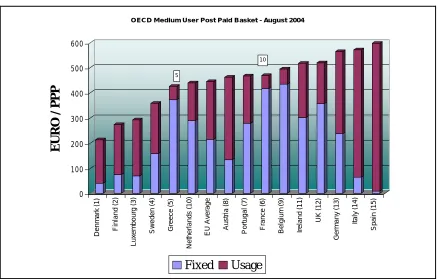
This Basket covers GSM tariffs and reflects post-paid tariffs available from the incumbent mobile operator. The “Business Mobile Basket” sets out the average cost of Business mobile tariffs. The data presented for Ireland is based on Vodafone’s tariff. The main differences between the two options are fixed costs. Ireland’s remains in

[image:26.595.73.511.180.459.2]

11th position, five places behind the EU average.

Figure 5: OECD Business Mobile Basket – August 2004

10 5 0 100 200 300 400 500 600 E U RO / PPP D enm a rk ( 1 ) F inl a nd ( 2 ) Lu xem bou rg ( 3 ) S w ede n ( 4 ) G reece ( 5 ) N e ther lands ( 1 0) E U A v er age A u s tri a (8 ) P o rt ug al ( 7 ) F rance ( 6 ) B e lg iu m ( 9 ) Ir el an d ( 1 1 ) U K ( 12) G e rma n y (1 3 ) Ita ly ( 1 4 ) S pai n ( 15)

O ECD M e dium Use r Post Paid Baske t - August 2004

Fixed Usage

(27)

Appendix 3: Summary of Broadband Access Technologies

Figure 6 provides a summary of the advantages and disadvantages of all the various broadband technologies and how they may contribute to providing broadband in Ireland. What can be discerned is that the deployment of broadband in Ireland is dependent largely on two technologies, DSL and fibre, while others may play a minor role. For large business customers and enterprise in business parks or industrial estates, fibre is the preferred medium. For SMEs and residential customers in metropolitan or urban areas, DSL is the only choice.

[image:27.595.49.547.243.722.2]

While cable modem technology has the potential to provide for the needs especially of residential customers with CATV service, progress to date by the Irish CATV operators has been abysmal. Satellite is an option in remote, unserved areas but take up will always be very small because of the cost. WLAN is being ‘trialled’ in a number of hot spots around the country and may provide some public broadband access.

Figure 6: Summary and Comparison of Broadband Access Technologies

Technology Bandwidth Requirements and

Characteristics

Advantages Disadvantages Major Players Applicability to Ireland

DSL 0.5Mbit/s - 2 Mbit/s downstream, 0.1-0.64Mbit/s upstream. Variants with speed up to 8Mbits/s now available

Delivered over existing telephone lines within 4km radius of switch; switch needs broadband backhaul connection

High speed, low cost, always on Internet access

Bandwidth depend on characteristics of cable. OLO21 need unbundled loops or collocation space

Eircom, Esat BT, UTV

Suitable for SMEs and residential customers in cities and towns. Can be the number 1 provider of broadband to this market, if encouraged

Fibre Cable FTTH or FTTB

2m - 155Mbit/s 1G, 10G

Customers premises must be within reach of metro or fibre distribution networks

Unlimited bandwidth, futureproof

High cost of deployment, high CPE cost but falling

Eircom, Esat BT, WorldCom, Colt, MFN, C&W, Local Authorities, Smart Telecom

Suitable for large business customers, customers in business parks, business areas in cities and large towns

Cable Modems

0.5Mbit/s - 2 Mbit/s downstream, 0.1-0.64 Mbit/s upstream Upgraded HFC networks

High speed, low cost, always on Internet access

Upgrade cost of existing CATV networks NTL, Chorus, Casey Cablevision, Crossan Cable but general availability very limited

Suitable for residential customers in all areas with CATV networks. Can be a major provider of broadband access particularly for residential. Can be competition to DSL

Fixed Wireless Access

2 Mbit/s - 10Mbit/s

Base station and transmitter, broadband backhaul Rapid deployment possible

Limited reach from base station and line-of-sight required. CPE expensive

Eircom, Esat BT. Limited application for business customers in urban areas, business parks. Currently out of favour and unlikely to be a major force in delivering broadband

WiMax 2 Mbit/s -

10Mbit/s

Base station and transmitter, broadband backhaul

Standards developed. CPE cost lower than higher frequency FWA

Need installation of external antenna. (This requirement will be removed as standards develop)

Irish Broadband, Leap Telecom, Digiweb, Amocom

Can provide some competition to DSL in some areas, can provide symmetrical service to business customers, new service to SOHO requires no antenna

Broadband Mobile

0.144Mbit/s (GPRS), up to 0.384Mbit/s (3G)

Base stations and network coverage

Provides mobility and mobile access to data and multimedia services

High cost of licence and network, high cost of broadband services

Vodafone, O2, Hutchinson Whampoa

Not an alternative to other fixed technologies but may provide limited access to some services particularly for business customers. Limited availability in 2004

21

(28)

Technology Bandwidth Requirements and Characteristics

Advantages Disadvantages Major Players Applicability to Ireland

Free Space Optics

Up to 10,000Mbit/s

Line of sight required, used for campus networks and to reach metro or fibre rings in last mile

High bandwidth; quick to deploy, no bandwidth licence required

Limited range, weather affected, not yet widely deployed in the public network

Terabeam and LightPointe

Enterprise and campus networks for pt-to-pt links, possible last mile applications in limited areas; not likely to have a major impact for some time Wireless LAN 11Mbit/s, 52Mbit/s Provides high speed Internet access within range of node, operates in unlicensed band; needs broadband link to ISP node

Inexpensive to establish WLAN node, interface to laptops becoming standard feature Security, roaming, billing issues to be resolved. Limited range - 100m from node without antenna. Pt-to-pt links also possible

T-Mobile in US, Telia in Scandinavia, SingTel, BT , The Cloud,

Megabeam in UK, eircom, O2, Esat BT, Digiweb, BitBuzz

Suitable for 'hotspots' like airports, conference centres. May have some application in bringing Internet to rural communities

Satellite 0.128 to 2Mbit/s

down,

0.128Mbit/suplink

Dish required for reception, must be in service footprint

Immediate and complete coverage in footprint once service is launched Limited bandwidth, relatively high cost, high latency make it unsuitable for web hosting, VPN, gaming Hughes, SATLYNX, Eutelsat, Astra. Digiweb, Mediasat, Osirx, Orbitlink in Ireland

Suitable for delivering services to areas beyond reach of other technologies, e.g. rural, low density areas, isolated areas, island communities Digital Terrestrial Television DTT and MMDS 0.25 –0.5Mbit/s downstream, 0.128Mbit/s uplink National DTT network or digital MMDS

Can reach rural areas unserved by other technologies

Coverage can be problematic; return path technology untried

NTL & Chorus (MMDS)

In UK, Freeview (BBC)

No national DTT in Ireland

Could provide service to rural areas if service is provided. But DTV future very uncertain and only Chorus has digital MMDS. Will not be a major factor for broadband delivery.

Further Detail on Three Main Alternative Broadband Technologies

There are a number of alternative technologies which can provide broadband to business. To date, none of them have widespread usage due to technical and market reasons. However, they may become important technologies in the future, providing greater competition to DSL and fibre, or serve particular niches of the broadband market.

Fixed Wireless Access

Fixed Wireless Access (FWA) also referred to as Wireless Local Loop provides a fixed wireless link between a central base station and the subscribers’ premises. FWA can provide an effective last-mile solution for incumbent or new service providers and is likely to be most suited for densely populated urban areas. When the services were being planned, it was hoped that this technology would make broadband more readily available to small and medium enterprises at a more affordable cost than was possible with fibre. However, a combination of technology shortcomings cost of equipment and lack of enthusiasm by both network operators and customers have resulted in a much lower impact than was originally expected.

Following the first round of licensing in 2000, licences were issued to Eircom, Esat Telecom, Formus and Chorus in the 26 GHz band, based on a commitment to rollout the Fixed Wireless networks according to a defined schedule. Following the collapse of Formus and the withdrawal of the licence from Chorus, only Eircom and Esat BT continue to provide a service in this band. Eircom now has 23 broadband FWA base stations and Esat BT has 23 base stations.

(29)

ComReg awarded nine further licences, covering Athlone, Arklow, Ennis, Kilkenny, Letterkenny, Newbridge, Portlaoise, Wexford and Carlow.

Irish Broadband provides services with speeds ranging from 512Kbps up to 6Mbps and its customer base includes residential users, SMEs and large corporate players. The company’s service to business and home Internet users includes high speed always-on Internet access (symmetrical service) with unlimited connection to the internet from €30 per month for home users and €45 per month for business users. Different services with different contention ratios are offered and the charges are linked to capacity and contention ratio. Irish Broadband has also announced a wireless product using RipWave aimed at the residential and SOHO market. For €30 per month and €99 connection fee, a broadband service is being offered that requires only a wireless modem which connects to the PC via a USB or Ethernet port and does not require an external antenna.

Digiweb and Leap have also been successful in being allocated a number of licences. Leap is expanding its network rollout using licensed spectrum from Dublin to Limerick, Galway, Cork and Waterford. Leap also began as carrier in the unlicensed bands, but after allocation of the 3.5GHz spectrum last year, the company has been expanding in the new bands. Digiweb have been issued with sixteen 3.5GHz licences and expect to increase this number. Currently they offer services in about 50% of the country and are adding other areas. Equipment being implemented is pre-WiMax and will be upgraded to WiMax later.

[image:29.595.44.548.342.631.2]

There are also other wireless service providers offering broadband Internet access services.

Figure 7: Broadband Internet Wireless Access Prices (2004)

Internet Service

Irish Broadband22

Rental

Irish Broadband Installation

Leap Rental

Leap Installation

Digiweb Rental

Digiweb Installation

1 Mb Business €70 €149 €199 - €299 €299 €79 €79

2 Mb Business €135 €149 €599 €299 €145 €79

3 Mb Business €250 €149 N/a N/a N/a N/a

Figure 8: Broadband FWA Take-up (June 2004)

Country Licence allocation Take-up

Germany >1,600 licences issued. 6,000

France 2 national and 44 regional licences issued. Many licences returned or revoked 175 base stations in 17 regions, representing coverage of 18% of population.

1,500

Spain 6 national licences 6 national licences three at 26GHz going to Broadnet, Sky Point, and Banda 26, and three at 3.5GHz going to Firstmark, Abranet and Alo 2000.

3,100

UK 7 licences in 28GHz band issued, 1 returned. Only 1 company currently offering commercial services: Your Communications. Coverage reaches 12% of population.

>2,500

Ireland 4 national broadband 26GHz licences issued, 1 returned and another revoked in March

2003. 42 base stations in total.

35 licences issued to 7 operators for 3.5GHz in Phase 1 and more in Phase 2. Operators providing broadband access in unlicensed band and in 3.5GHz band throughout the country.

~200

~1,200

Cable Networks

Cable networks can provide a general platform for interactive services with cable modems. Cable TV is predominantly a service for residential subscribers in Ireland although there may be some SOHO passed or served by the networks. It is unlikely to become a real contender for delivery of broadband Internet access for SMEs because network coverage has been concentrated in residential areas and a new rollout to business areas is prohibitively expensive.

In order to deliver broadband services, the cable network in Ireland and internationally will require to be upgraded extensively. Analysis of available data notes that while more than 500,000 Irish households have

22

(30)

access to cable, there are only an estimated 5,380 cable modems in service on the NTL, Chorus and Casey Cablevision networks. This places Ireland at the lower end of the ranking. While cable TV networks and cable modems are suited primarily for delivery of broadband Internet access to residential subscribers, next

generation modem standards will increase the appeal of cable modems for small business users.

Broadband Mobile

Figure

Figure 2: National Leased Lines Cost
Figure 3: Overall Broadband Take-Up
Table 1: DSL Take-up and Growth in Take-up, by Population and Businesses, 3 rd Quarter 2003 – 3rd Quarter 2004   DSL DSL Take-up DSL Take-DSL Take-up –  Growth in
Figure 2: Ireland’s broadband take-up versus the average of the benchmarking group
+7

References

Related documents

The key segments in the mattress industry in India are; Natural latex foam, Memory foam, PU foam, Inner spring and Rubberized coir.. Natural Latex mattresses are

Different configurations of hybrid model combining wavelet analysis and artificial neural network for time series forecasting of monthly precipitation have been developed and

According to the findings on objective three, the statutory protection to the right to privacy against mobile phone usage does not provide direct clue as majority of the

The PROMs questionnaire used in the national programme, contains several elements; the EQ-5D measure, which forms the basis for all individual procedure

Cast iron motors in sizes 71-225 are greased for life and motors in sizes 250-355 have a regreasing device as a standard.. Strong

Furthermore, since Ergin’s (2002, Theorem 1) result remains unchanged when consistency is replaced by reallocation-consistency (i.e., for the best rule respecting a fixed

• Speed of weaning: induction requires care, but is relatively quick; subsequent taper is slow • Monitoring: Urinary drug screen, pain behaviors, drug use and seeking,

Goldfish care Planning your aquarium 4-5 Aquarium 6-7 Equipment 8-11 Decorating the aquarium 12-15 Getting started 16-17 Adding fish to the aquarium 18-19 Choosing and