TECHNICAL UNIVERSITY OF CLUJ-NAPOCA
ACTA TECHNICA NAPOCENSIS
Series: Applied Mathematics, Mechanics and Engineering Vol. 60, Issue II, June, 2017
EXERGY METRICATION OF LOW TEMPERATURE PANEL
HEATING SYSTEMS
Dragan CVETKOVIĆ, Saša ĆUKOVIĆ, Ionuţ GHIONEA
Abstract: This paper compares the exergy efficiency of panel heating system using different energy sources such as natural gas and geothermal heat pump. The analysis is performed on a CAD model of the family building, located in Kragujevac, Serbia with different heating systems such as floor panels, wall panels, ceiling panels and floor-ceiling panels. The operation of these panels is simulated by software EnergyPlus, product of Lawrence Berkley Laboratory in USA. This research is a part of the project "Development of a net-zero-energy building“.
Key words: exergy efficiency, radiant panel, heat pump, energy consumption, EnergyPlus, ground heat source.
1. INTRODUCTION
Nowadays, the panel heating systems are increasingly used in Serbia due to accessible price of panels. Since panel heating systems work with low-temperature of fluids, it is important to select the proper heating generator. Thus, the classic gas boilers remain the choice due to a low investment rates. On the other hand, experts from the field will strongly recommend a Ground Source Heat Pumps (GSHP) system.
To better understand the effectiveness of the panel heating systems in addition to the analysis of energy flow, the analysis of exergy flow must be also included. Exergy analysis is an important tool in designing the efficiency of the thermal systems and in determining of the unavoidable thermal inefficiencies of the system [1].
Exergy GSHP devices and applications are widely described and tested in literature. In [2], a relatively new approach of ground heat exchanger (GHE) optimization is presented, based on the second law of thermodynamics. It was adopted to test an optimum combination of circulating water flow rate and pipe diameter. Other authors [3] analyzed an energy and exergy flow of a ground-coupled heat pump
(GCHP) system. The exergy flows between the components and the consumptions in each of
the GCHP system components were
determined. In [4], the authors compared different heat generators and energy and exergy analyses. They concluded that the ground source heat pump heating system is better than air source heat pump or conventional heating system. Thermodynamic analysis of a GSHP system for district heating in terms of both energy and exergy analysis, described in [5], aims to improving the process efficiency. The on-going climatic change and effects of global warming with significant impact on GSHP systems are investigated in [6].
Some studies are conducted to investigation of panel systems performance in different heating objects inside the building. Paper [7] showed that optimal operation of radiant panels with ground-source heat pumps driven by renewable energy sources improves the exergy efficiency and primary energy ratio. In [8], the authors applied the low-temperature radiant
systems in combination with localized
non-condensing natural gas boiler were compared. Authors analyzed different panel heating system (floor, wall, ceiling and floor-ceiling) connected on a natural gas boiler.
In this paper, the exergy analysis showed benefits of using low-temperature sources in panel systems. We tested natural gas boiler as a high-temperature source and GSHP as a low-temperature.
As a panel system, we tested floor heating, wall heating, ceiling heating and newly developed concept of floor-ceiling heating system [10].
2. MATHEMATICAL MODEL
2.1Building description
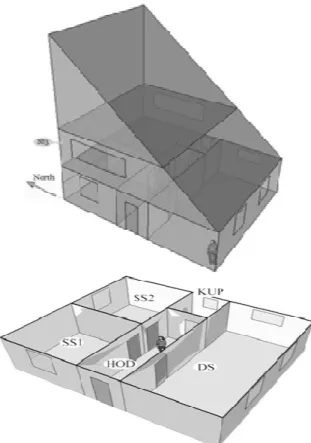
The analyzed building is a residential family house (Figure 1). The building is designed for one family and has a living area of 190m2. The envelope of the building is made of 190 mm porous brick, 50 mm thermal insulating layer and 20 mm lime mortar. The U-value is 0,57W/ (m2K). The windows are double glazed with U-value of 2.72 W/ (m2K). The overall ratio of
glass to the exterior walls is 7.32%, where the total area of exterior walls is 264m2 and the whole area of windows is 19m2.
2.2CAD model of the building
The simplified CAD model of the building and its ground level is created in SketchUp 3D modeling software (Trimble Navigation). The CAD models of the building has one living room, hallway, bathroom and three bedrooms.
The analyzed building is located in Kragujevac, Central Serbia. The elevation of Kragujevac is 209m and its latitude and longitude are 44oN and 20o55E. The city has a continental temperate climate with four different seasons (summer, autumn, winter and spring). As part of the EnergyPlus, weather file used as an *.epw file generated by the Meteonorm [11]. The heating season runs in Kragujevac from 15 October to 15 April [12].
Fig. 1. Analyzed building – CAD models: DS – living room, HOD – hallway, KUP – bathroom, SS1 –
bedroom, SS2 – bedroom, SS3 – bedroom.
2.3Description of the heating systems
In order to calculate the primary energy consumption, as a heating systems in this model we selected heating panels and heat generator. In this approach, we investigated: 1. the floor heating, 2. the wall panel heating, 3. the ceiling heating and 4. the floor-ceiling heating. The floor heating panel had the total surface area of 190m2. The wall heating panel is located at the external wall and its total surface area is 210m2. The ceiling heating panel is located at the ceiling of the first and second store of the building and its total surface area is 190m2. The floor-ceiling heating panel operates as a ceiling heating of the lower store and as a floor heating of the upper store. Its total surface area is 95m2.
The main heating source of the heating panels is the water with the same temperature of 37oC for all heating systems, circulated by
the electric pumps.
gas boiler was 24kW. The nominal electricity input of GSHP was 4kW. Also, length of geothermal probe was 76m with two U-pipes.
2.4Primary energy consumption of the heating system
The primary energy consumption per heating season of the analyzed building is calculated by the following equations:
Esys = Eng+R Eel (1)
Esys = R Eel (2)
Equation (1) refers to the system with a natural gas boiler and the equation (2) refers to the heating system with GSHP unit.
Here, Eng represents the consumption of
natural gas per heating season, Eel represents
the consumption of electricity per heating season and R stands for the primary energy consumption coefficient. This coefficient is defined as a ratio of the total input energy of energy resources (hydro, coal, oil and natural gas) and the finally produced electric energy. Its value for the Serbian energy mix for electrical energy production is R = 3.01 [13].
2.5Consumed exergy
The exergy consumed by the analyzed heating panels is calculated by:
(3)
where, n is the number of heating rooms, To is
the reference temperature, Tini and Treti are the
inlet and return temperatures of heating emission panels in the observed room and Eh,t -
transferred heat from the panels.
2.6Lost exergy
The lost exergy presents exergy supplied by natural gas to the boiler through combustion. This is calculated using the following equation:
Exdest = (1-To/Tf)Eh,s (4)
where, Tf is the temperature of heat source,
(combustion temperature for natural gas, Tf =
2000K [7], average fluid temperature from ground exchanger Tf = 283.03K) and Eh,s –
transferred energy from heat source.
2.7Exergy efficiency of heat transfer
A value of exergy efficiency of heat transfer between the boiler and the heating panels is calculated by using the following equation:
Ψ
R=Exdest/Exsup. (5)3. RESULTS AND DISCUSSION
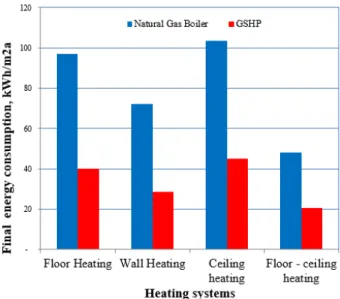
For a better understanding of the flow exergy, on the figure 2 and 3 the final and primary energy consumption are represented. Comparing the used panel systems, on Fig. 2,
floor-ceiling heating has the lowest
consumption of final energy. The consumption of the floor-ceiling panels connected with natural gas boiler and GSHP was 48kWh/m2a and 20kWh/m2a, respectively.
The classical ceiling heating has the highest consumption of final energy 104kWh/m2a and 45kWh/m2a for natural gas boiler and GSHP, respectively.
Fig. 2. The final energy consumption of heating panel system connected on natural gas boiler and GSHP
consumption among the four analyzed panel heating systems.
However, as a result of higher primary energy conversion factors for electricity from National grid, primary energy consumption of panel heating systems connected to the heat pump will be higher than the panel heating systems connected to the natural gas boiler.
The final energy of the floor-ceiling panel heating system showed the least consuming of energy, 54kWh/m2a for the system connected to the natural gas boiler and 63kWh/m2a for the floor-ceiling heating system connected with GSHP.
Also, classic ceiling heating consumes the
most energy 115kWh/m2a for system connected
to the natural gas boiler and 137kWh/m2a for the system connected to the GSHP.
Fig. 3. The primary energy consumption of heating panel system connected on natural gas boiler and GSHP
Proportional to the energy consumption among comparison panels there is a relation in exergy consumption.
Figure 4 shows the exergy consumption of four observed panel heating systems. The
floor-ceiling panel has the lowest exergy
consumption, 0.69GJ for the system connected to the natural gas boiler and 0.73GJ for the system connected to the GSHP. Also, the classic ceiling heating system has the highest exergy consumption and it is 5.1GJ for the system connected to the natural gas boiler and 1.8GJ for the system connected to the GSHP.
Fig. 4. The exergy consumption of heating panel system connected on natural gas boiler and GSHP
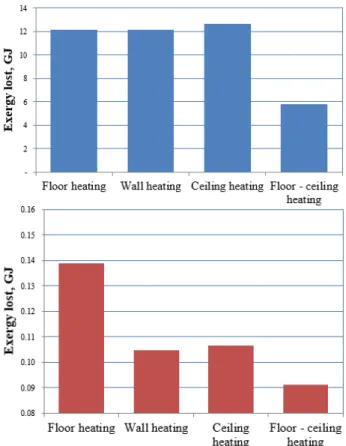
Figure 5 illustrates the amount of exergy lost in the gas boiler and GSHP. This is due to more exergy lost during combustion of natural gas in the boiler than for operation of the GSHP. This means, the floor-ceiling panels lost the least exergy, 5.81GJ for the system connected to the natural gas boiler and 0.09GJ for the system connected to the GSHP. Also, the most exergy is lost at the classic ceiling panels, 12.68GJ for the system connected to the natural gas boiler and 0.11 GJ for the system connected to the GSHP.
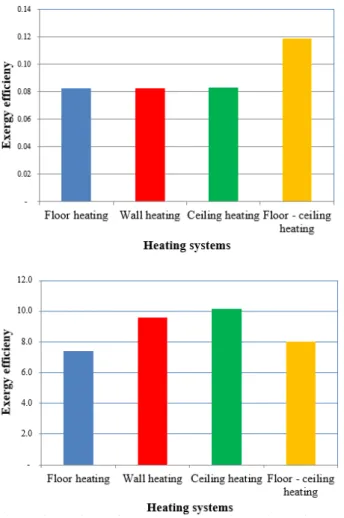
Figure 6 illustrates the exergy efficiency of panel heating systems connected to the boiler or a GSHP. The exergy efficiency actually poses a mismatch between consumed and lost exergy.
Less disagreement will provide higher
efficiency and vice versa. As with combustion of natural gas in the boiler spent much more the amount of exergy than the GSHP the level of exergy efficiency will be much lower for panel system equipped with natural gas boiler. In panel systems connected to the natural gas boiler the floor-ceiling heating is the most exergy effective 0.0118 while the other three systems has approximately the same efficiency of about 0.082.
Panel systems connected to the GSHP suggests that exergy efficiency values are much higher, 10.16 for classic ceiling heating, 8.02 to floor-ceiling heating, 7.38 for floor heating and 9.56 for the wall heating. This is due to the smaller differences between consumed and lost exergy.
Fig. 6. The exergy efficiency of heating panel system connected on natural gas boiler (above) or GSHP (below)
4. CONCLUSION
In this paper, the exergy analysis of panel heating systems is presented. As a panel heating systems we used the floor heating, wall heating, ceiling heating and floor-ceiling heating. As a heat generators two most commonly used devices are selected: the natural gas boiler and the geothermal heat pump. To compare the wasted energy of panel systems the floor-ceiling panels has the minimum requirements for the amount of energy, while the classic ceiling panels have the highest requirements. Also, the same ratio holds for the required amount of exergy.
If it compares the heat sources, the gas boilers use more final energy then the GSHP. However, due the high transformation factor of primary energy from the power grid, the GSHP require more primary energy.
When considering exergy consumption of analyzed panel heating systems, the exergy consumption is slightly higher for the panel systems connected to the GSHP. However, drastic differences occur in quantity exergy that is lost in generating heat. It is much higher for the panel systems connected to the natural gas boiler. This is due to the high temperature combustion of natural gas. In addition, the level of exergy efficiency is much higher for the panel systems connected to the GSHP Ψ = 7.38 to 10.16.
ACKNOWLEDGMENT
Presented paper is a concluding result of two research projects financed by the Serbian
Ministry of Education, Science and
Technological Development: “Investigation and development of Serbian zero-net energy house” - TR33015 and “Investigation and development of energy and ecological highly effective systems of poly-generation based on renewable energy sources”.
5. REFERENCES
[2] Piechowski, M., A ground coupled heat pump system with energy storage. PhD thesis, University of Melbourne, Australia, 1996.
[3] Hepbasli, A., Akdemir, O., Energy and exergy analysis of a ground source (geothermal) heat pump system. Energy
Conversion and Management
2004;45(5):737–53.
[4] Lohani, S.P., Schmidt, D., Comparison of energy and exergy analysis of fossil plant, ground and air source heat pump building heating system, Renewable Energy, Volume 35, Issue 6, June 2010, Pages 1275-1282. [5] Hepbasli, A., Thermodynamics analysis of a
ground source heat pump system for district heating. International Journal of Energy Research 2005;29:671–87.
[6] Mohamad, K., Altorkmany, L., Bo, N., Global warming’s impact on the performance of GSHP, Renewable Energy, Volume 36, Issue 5, May 2011, Pages 1485-1491.
[7] Kilkis, B., Exergy metrication of radiant panel heating and cooling with heat pumps, Energy Conversion and Management 63 (2012) 218–224.
[8] Kosir, M., Krainer, A., Dovjak, M., Perdan,
R., Kristl, Z., Alternative to the
Conventional Heating and Cooling Systems in Public Buildings, Strojniški vestnik - Journal of Mechanical Engineering 56 (2010) 575-583.
[9] Bojić, M., Cvetković, D., Miletić, M., Malešević, J., Harry, B., Energy, cost and CO2 emission comparison between radiant wall panel systems and radiator systems,
Energy and Buildings, Volume 54,
November 2012, Pages 496-502.
[10] Bojić M., Cvetković D., Marjanović, V.,
Blagojević, M., Djordjević, Z.,
Performances of low temperature radiant heating systems, Energy and Buildings, Volume 61, June 2013, Pages 233-238.
[11] Meteonorm, Global Meteorological
Database for Engineers, Planners and Education: http://www.meteonorm.com, Retrieved May 2011.
[12] Bogner, M., Technical regulations about heating, cooling and air conditioning (in Serbian), SMEITS, Belgrade (2002).
[13] The energy balance,
http://www.scribd.com/doc/12836648/Energ etski-Bilans-Plan-Za-2008, May 5, 2011.
Măsurarea exergiei sistemelor de încălzire cu panouri la temperatură joasă
Rezumat: Lucrarea își propune să compare eficiența exergiei unui sistem de încălzire cu panouri folosind diferite surse de energie. Gazele naturale și pompele de căldură geotermale sunt utilizate ca surse de energie. Diferite tipuri de panouri, de pardoseală, de perete, de tavan și de podea sunt folosite ca sisteme de încălzire. Casa care a fost analizată în acest studiu este situată în Kragujevac, Serbia, iar cercetarea este parte a proiectului "Development of a net-zero-energy house". Funcționarea acestor panouri este simulată prin software-ul EnergyPlus, produs de Lawrence Berkley Laboratory din SUA.
Dragan CVETKOVIĆ, PhD, Scientific Associate, University of Kragujevac, Faculty of Engineering, [email protected], Phone: +38134335990, Address: Sestre Janjic 6, 34000 Kragujevac, Serbia.
Saša ĆUKOVIĆ, PhD, Scientific Associate, University of Kragujevac, Faculty of Engineering, Sestre Janjic 6, 34000 Kragujevac, [email protected], Phone: +38134335990, ext. 643, Address: Sestre Janjic 6, 34000 Kragujevac, Serbia.