© 2016, IRJET | Impact Factor value: 4.45 | ISO 9001:2008 Certified Journal
| Page 1950
ABSTRACT: In this paper, system on a , analyzing of echo cancellation in audio signal when reverberated in real environment , this type of filter is mainly used to control the echo noise in the sound like orchestra etc. In general , the echo noise reverberated in the real environment is filtered by kalmans algorithm. this kalmans algorithm is mainly to reduce the error noise in the audio signal. This effect will avoid disturbance to the patients without any physical discomfort. We implement this phenomenon by using sound detection and finding the propagation path and the impulse response of the audio signal by kalmans filtering to reduce the echo noise reverberated in the real environment. We discuss performance analysis scenarios of the system, such as facilitating and reducing echo noise. Finally, the system parameters are analyzed and the gain of the signal is calculated and the error performance is calculated.
Key words: kalmans algorithm, impulse response , kalmans filter ,acoustic echo
I INTRODUCTION
Sound processing Sometimes referred to as sound processing, is the intentional alteration of auditory signals, or sound, often through an sound effect or effects unit. As sound signals may be electronically represented in either digital or analog format, sound processing occurs in analog domain. Analog processors operate directly on the electrical signal, while digital processors calculate mathematically on the digital representation of that signal. Sound broadcasting Traditionally the most important sound processing takes place just before the transmitter. Studio sound processing is limited in the modern era due to digital sound systems being pervasive in the studio.
Echo is to simulate the effect of reverberation from the speakers , one or several delayed signals are added to the original signal. To be observed as echo, the delay has to be of order 35 milliseconds or above. Short of actually playing a sound in the reverberated environment, the effect of echo can be implemented using either digital or analog methods.
Digital Signal Processor (DSP) and Application Specific Integrated Circuits (ASICs) have been the common means by implementing using Adaptive Filters.. Due to the technological advance in the development of program logic devices, Field Programmable Gate Array (FPGA) have become common in realizing adaptive filters.
Acoustic echo occurs when an audio signal is echoed in a real environment, resulting in the original intended signal plus attenuated, time delayed images of this signal. The goal is mainly to subtract a the echo from another signal so that the resulting signal is ‘free of echo’ and really contains only the signal of interest.
II METHODOLOGY :
Initially the sound of the vehicles on the road, sounds of the crackers are received by the noise detector. The information from noise detectors is then passed through the frequency meters . To estimate the DFT of N points in the naive way,by using the definition, it takes O(N2) arithmetical operations, while an FFT can estimate the same DFT in only O(N log N) operations. The difference in the speed can be enormous, especially for real time data such as sound wave or speech signal where N may be in the thousands .For 1024 samples a straight DFT requires 10242 = 1048576 arithmetic operations. However the same number of samples the FFT requires 1024*log2 (1024) = 10240 arithmetic operations. The frequency meters determines the frequency of the received noise from the noise detector. Then only certain range of frequency is passed through the band pass filter. Then those frequencies are processed by the algorithm. SOUND noise detectors is typically used in detecting the loudness in ambient. Sound is detected in the form of analog waveform Sound of the vehicles on the road , thunder, sounds of the crackers are received by the noise detector detects the natural sounds. The sound is detected and processed.
Performance Analysis of Acoustic Echo Cancellation in
Sound Processing
Sakthi Bavatharani.N, Dr.T.Ravichandran
N.Sakthi Bavatharani
[1]Dr.T.Ravichandran
[2]Department of Electronics and Communication engineering
© 2016, IRJET | Impact Factor value: 4.45 | ISO 9001:2008 Certified Journal
| Page 1951
III SOUND DETECTION:
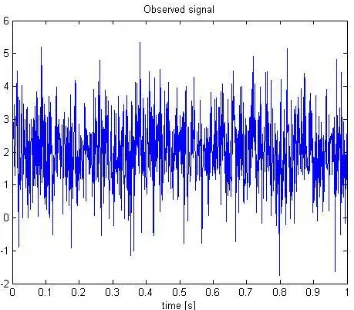
[image:2.612.76.253.190.345.2]Initially the sound of the orchestra are received from the speaker and the sound signal is processed by the use of kalman filter and the actual signal ,the desired output signal with the noise signal are calculated
Fig 3.1 Audio waveform of the orchestra
[image:2.612.359.534.456.594.2]Then with the processed signal.the output signal and the noise signal are detected and the signal is separated
Fig 3.2 identification using kalman filter
IV ACTIVE NOISE CONTROL
In active noise control, one attempts to reduce the volume of an unwanted noise propagating through the air using an electro-acoustic system using measurement sensors such as microphones and output actuators such as loudspeakers. The noise signal usually comes from some device, such as a rotating machine, so that it is possible to measure the noise near its source. The goal of the active noise control system is to produce an "anti-noise" that attenuates the unwanted noise in a desired quiet region using an adaptive filter. This problem differs from traditional adaptive noise cancellation in that: - The desired response signal cannot be directly measured; only the attenuated signal is available. - The active noise control system must take into account the secondary loudspeaker-to-microphone error path in its adaptation.
V PROPAGATION PATH :
© 2016, IRJET | Impact Factor value: 4.45 | ISO 9001:2008 Certified Journal
| Page 1952
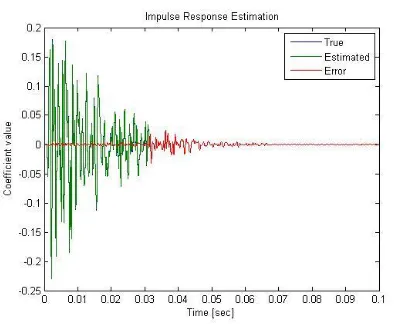
Fig 5.2 Impulse Response Estimation
VI FINTE IMPULSE RESPONSE:
FIR filters is a of two basic type of digital filters used in Digital Signal Processing (DSP) applications and sound processing applications.Finite Impulse Response is a an impulse, considering a "1" sample followed by many "0" samples, zeroes will come out after the "1" sample has made its way through the delay line of the filter. The impulse response is always a finite because there is no feedback from the FIR. A lack of feedback that guarantees the impulse response will be finite. Therefore, the term "finite impulse response" synonymous with "no feedback". if feedback of the impulse response is finite, the filter still is a FIR. An example of FIR is a moving average filter, in which the Nth prior sample is subtracted each time a new sample is fed back . This filter has a finite impulse response even though it uses feedback: after which N samples of an impulse, the output will be zero.
They can easily be designed to be as a linear phase. Linear phase filters have delay in the input signal but don’t distort its phase. They are very easy to implement. most DSP microprocessors, the FIR calculation can be done by looping a single instruction. They are mainly applicable to multi-rate applications. By multi-rate, either decimation and interpolation. Whether decimating or interpolating, the use of FIR filters allows some of the calculations can omitted, thus provides an computational efficiency. In contrast, IIR filters are used, each output will be individually calculated. They have desireable numeric properties. In practice, all DSP filters must be implemented using finite-precision arithmetic, that is, a limited number of bits. The finite-precision arithmetic in IIR filters can
cause significant problems due to the use of feedback, but FIR filters without feedback are implemented using fewer bits, and the designer has fewer practical problems to solve related to non-ideal arithmetic. They can be implemented using fractional arithmetic. Unlike IIR filters, it is always possible to implement a FIR filter using coefficients with magnitude of less than 1.0. (The overall gain of the FIR filter can be adjusted at its output, if desired.) This is an important consideration when using fixed-point DSP's, because it makes the implementation much simpler.
VI KALMANS ALOGRITHM
Kalman filtering, which is also known as linear quadratic estimation (LQE), is an algorithm that uses a series of measurements that are observed observed over time, containing statistical noise and other inaccuracies, and produces estimates of unknown variables that tend to be more precise than those based on a single measurement .
The Kalman filter has wide applications in signal processing technology. Furthermore, the Kalman filter is a widely mainly implemented in time series analysis used in fields such as signal processing and econometrics. Kalman filters also are one of the main topics in the field signal processing and sound processing. The Kalman filter has also found use in modeling the central nervous system's control of movement. Due to the time delay between issuing motor commands and receiving sensory feedback, use of the Kalman filter provides the needs of model for making estimates of the current state of the motor system and issuing updated commands.
© 2016, IRJET | Impact Factor value: 4.45 | ISO 9001:2008 Certified Journal
| Page 1953
model but where the state space of the latent variables are continuous and where all latent have been observed variables with Gaussian distributions.
The Kalman filter assumes the true state at time k is from the state at (k − 1) according to
+ +
where
Fk is the state transition model which is applied to the previous state xk−1;
Bk is the control-input model which is applied to the control vector uk;
wk is the process noise At time k, zk of the true state xk is made according to
where Hk is the observation model which maps the true state space into the observed space and vk is the observation noise which is assumed to be zero mean Gaussian white noise with covariance Rk.
[image:4.612.344.543.103.260.2]The initial state, and the noise vectors at each step {x0, w1, …, wk, v1 … vk} are all assumed to be mutually independent.
[image:4.612.347.545.318.396.2]Fig 6.1 kalmans gain
Fig 6.2 comparision of error between actual value , predicted value and updated value
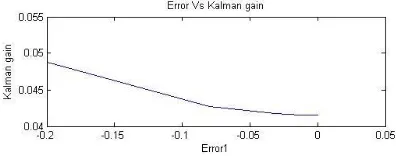
Fig 6.3 comparision of error and kalmans gain CONCLUSION :
In this paper that a system is designed to reduce the echo from audio signal reverberated in a real environment. From this the. Finally, the system parameters are analyzed and the gain of the signal is calculated and the error performance is calculated. this shows. when the error reduces the gain is also constant.
REFERENCES
1. Matti Karjalainen, (2008) “Efficient Realization of Wave Digital Components for Physical Modeling and Sound Synthesis”, IEEE, IEEE transactions on audio, speech, And language processing, July, vol. 16, no. 5
2. Dima Ruinskiy , Yizhar Lavner 2007,“An Effective Algorithm for Automatic Detection and Exact Demarcation of Breath Sounds in Speech and Song Signals”, IEEE transactions on audio, speech, and language processing, march,vol. 15, no. 4
[image:4.612.64.257.497.654.2]© 2016, IRJET | Impact Factor value: 4.45 | ISO 9001:2008 Certified Journal
| Page 1954
processing and techniques, February, vol. 9, no. 2
4. Fei Xiao “Direct Synthesis of General Chebyshev Bandpass Filters in the Bandpass Domain”,IEEE transactions on circuits and systems, August, vol. 61, no. 8, 2411
5. Hamida,A.B; Samet ,M ; Lakhoua “Sound Spectral Processing Based on Fast Fourier Transform applied to coherent implant for the conception of the graphical spectrogram and for the generating of simulating pulses”, IEEE transactions on sound processing and techniques, February, vol. 61, NO. 2,
6. kato,k;abe ,F chauan gao “Two tone signal generation for communication application ADC testing”, IEEE transactions on sound processing and techniques, November vol. 51, no.5
7. Kunio Kashino ,Takayuki Kurozumi “A Quick Search Method for Audio and Video Signals Based on Histogram Pruning” , IEEE transactions multimedia, september vol. 5, NO. 3,
8. Konrad Kowalczyk, Oliver Thiergart, Maja Taseska,Giovanni Del Galdo ,“A flexible and efficient solution to sound scene acquisition, modification, and reproduction”, February.vol. 61, no. 2,
9. Kulakov ,A;stojanov “Sound and video processing in wireless sensor networks”, IEEE transactions on sound processing and techniques February, vol. 2, no 2,
10. Matti Karjalainen, “Efficient Realization of Wave Digital Components for Physical Modeling and Sound Synthesis”, IEEE, IEEE transactions on audio, speech, And language processing, July, vol. 16, no. 5.
11. jarmo,Tommi, “sound signal processing in a virtual room” IEEE, IEEE transactions on sound processing and techniques ,may, vol. 7, no. 2,
12. Lehto;saramaki,T, “Synthesis of narrow band linear phase FIR filters with a piece wise
polynomial impulse response ” IEEE transactions on sound processing and techniques, June, vol. 4, no. 2