THE INFLUENCE OF MUSCLE SIZE AND QUALITY ON STAIR-‐CLIMB PERFORMANCE IN OVERWEIGHT AND OBESE FIREFIGHTERS
Craig Robert Kleinberg
A thesis submitted to the faculty of the University of North Carolina at Chapel Hill in partial fulfillment of the requirement for the degree of Master of Arts in the Department of Exercise and Sport Science in the College of Arts and Sciences (Exercise Physiology).
Chapel Hill Spring 2015
Approved by:
Bonita L. Marks
Eric D. Ryan
Joe Myers
ii © 2015
Craig Robert Kleinberg ALL RIGHTS RESERVED
ABSTRACT
CRAIG ROBERT KLEINBERG: The influence of muscle size and quality on stair-‐climb performance on overweight and obese firefighters.
(Under the direction of Bonita Marks)
Climbing stairs has previously been shown to be one of the most relevant firefighter tasks. Furthermore, ultrasound (US) assessments of muscle size and quality have been shown to have significant influence on lower extremity performance. The purpose of this study was to examine the influence of vastus lateralis (VL) size and quality on stair climb performance (SCP). Panoramic US images of the VL were obtained to determined cross-‐ sectional area (CSA) and echo intensity (EI) in 49 overweight and obese firefighters. A timed and weighted SCP assessment was performed upon completion of the US assessment. Our results demonstrated that EI (r=0.377, p=0.008), but not CSA (r=-‐0.031 p=0.833), was related to SCP. When accounting for age and VO2peak, the EI and SCP relationship was attenuated (r=0.237, p=0.108). Additionally, EI was the only significant predictor of SCP. These findings indicate that lower extremity muscle quality, but not size, may contribute to firefighter SCP.
iv
ACKNOWLEDGEMENTS
This project was made possible by the continuous support and guidance from my friends, family, and thesis committee. First, I would like to thank Dr. Eric Ryan for making this project possible. I would also like to thank my advisor, Dr. Bonita Marks, for keeping on track throughout this entire process, and Dr. Joe Myers for reviewing this document and providing feedback to make this a successful project. Finally, I would like to thank the research team: Andrew Tweedell, Chad Wagoner, TJ Barnette, and Tyler Johnson. The success of this project is due to their efforts during the data collection and analysis.
TABLE OF CONTENTS
LIST OF FIGURES ... viii
LIST OF TABLES ... ix
LIST OF DEFINITIONS AND ABBREVIATIONS ... x
CHAPTER I: Introduction ... 1
Purpose ... 3
Research Questions and Hypotheses ... 4
Delimitations ... 4
Limitations ... 5
CHAPTER II: Review of literature ... 6
Introduction ... 6
Health Concerns of the firefighting profession ... 6
Sudden Cardiac Death ... 6
Environmental contributions ... 7
Obesity status among firefighters ... 8
Health concerns to performance ... 9
Ultrasound Assessments ... 10
Firefighter Performance ... 12
Simulated fire rescue demands ... 12
Stair-‐climb performance ... 13
vi
Conclusion ... 16
CHAPTER III: Methodology ... 17
Participants ... 17
Experimental Design ... 18
Instrumentation ... 19
Procedures ... 20
Body Composition ... 20
Ultrasonography ... 22
Image Analysis ... 23
Stair-‐Climb Test ... 23
Estimated Cardiorespiratory Fitness ... 24
Statistics ... 24
Research Questions and Hypotheses ... 26
CHAPTER IV: Results ... 27
Participant Characteristics ... 27
Relationship Between CSA, EI and Stair-‐Climb Performance ... 27
CHAPTER V: Discussion ... 29
Relationship Between EI and Stair-‐Climb Performance ... 29
Relationship Between CSA and Stair-‐Climb Performance ... 31
Limitations and Future Research ... 32
Conclusion ... 33
Research Questions and Hypotheses ... 34
APPENDICIES ... 36
1. GNC Total Lean® Nutrition Facts ... 36
REFERENCES: ... 37
viii
LIST OF FIGURES:
Figure 1: Participant leg position during ultrasound acquisition ... 22
LIST OF TABLES
Table 1: Participant Characteristics ... 28 Table 2: Stepwise Regression Analysis ... 28
x
LIST OF DEFINITIONS AND ABBREVIATIONS
Candidate Physical Ability Test (CPAT): a specific, nationally recognized simulated fire rescue test.
Cross-‐sectional area (CSA): the area of a muscle perpendicular to its fibers observed at the largest point.
Echo intensity (EI): an index of muscle quality obtained through computer-‐aided grey-‐ scale analysis of the individual pixels within an ultrasound image; representative of the amount of adipose and/or connective tissue in a given cross-‐sectional scan of skeletal muscle. Values are reported between 0 (all black) and 255 (all white), with greater echogenicity indicating poorer muscle quality.
Echogenic tissue: biological tissue consisting of structural and acoustic differences from that of the more organized tissue thereby reflecting sounds waves back to the surface transducer.
Peak Volume of Oxygen Consumption (VO2peak): peak rate of oxygen consumption that can be utilized in one minute during maximal exercise and measured in mlkg-‐1min-‐1. Simulated fire rescue performance: circuit of mock firefighting task to be completed as fast as possible.
Ultrasonography (US): an imaging method using high-‐frequency sound waves to produce relatively precise images of structures within biological tissue.
Vastus lateralis (VL): the largest of quadriceps femoris muscle group located on the lateral portion of the thigh.
CHAPTER I Introduction
Firefighters are a critical part of public safety, and firefighting is often recognized as a hazardous profession. There is agreement that firefighters should maintain high levels of physical fitness; however, current research shows a greater prevalence of obesity and lower cardiovascular fitness levels among firefighters than general population
counterparts (Poston et al., 2011; Roberts, O’Dea, Boyce, & Mannix, 2002). Poston et al. (2011) reported that over 30% of firefighters were classified as obese per the body mass index (BMI) ≥ 25 kg/m2 and met at least one risk factor for metabolic syndrome. Those meeting the standards for metabolic syndrome have 2.5 times increased risk of mortality from cardiovascular disease (CVD; Lakka et al., 2002). Though only accounting for one to five percent of their duties, environmental factors such as sudden heart rate increases, elevated temperature, and dehydration during fire suppression tasks places additional stress on the cardiovascular system increasing risk of sudden cardiac death (SCD) 10-‐100 fold (Fernhall, Fahs, Horn, Rowland, & Smith, 2012; Kales, Soteriades, Christophi, &
Christiani, 2007; Smith, Barr, & Kales, 2013). Furthermore, the self-‐perception of increased fitness levels may also contribute to the elevated obesity issue among firefighter
populations (Peate, Lundergan, & Johnson, 2002).
2
correlation (r = 0.57, p < 0.01) between body fat percentage (BF%) and time to complete simulated firefighting tasks. Conversely, two other studies found no relationship between body composition and firefighter performance (Rhea, Alvar, & Gray, 2004; Sheaff et al., 2009). Additionally, Fukumoto et al. (2012) concluded that BF% and BMI did not influence leg extensor strength whereas muscle size and quality of the rectus femoris displayed significant correlations (r = 0.47, p < 0.41 and r = -‐0.40, p < 0.01 respectively) to lower limb strength. Muscle size and quality of the vastus lateralis (VL) has also been associated with cardiovascular and lower extremity functional performance (Cadore et al., 2012; Visser, 2002). Traditionally, magnetic resonance imaging (MRI) and computed
tomography (CT) have been consider the gold standard for muscle size and quality analysis; however, advancements in ultrasound (US) imaging technology has made this a safe and reliable alternative to muscle imaging (Rosenberg et al., 2014). Panoramic US imaging allows for concurrent analysis of muscle cross-‐sectional area (CSA) and echo intensity (EI; Ryan et al., 2014). Reflection of sound waves from echogenic tissue, such as adipose and connective tissue, allows US technicians to obtain real-‐time images of skeletal muscle architecture (Kremkau, 2002). Increased reflections from adipose and connective tissue are associated with “whiter” images (Pillen et al., 2009). Computer assisted analysis of images allows for quantification of EI values between 0 (all black) and 255 (all white) arbitrary units (Pillen et al., 2006). Use of US technology may provide additional insight into the influence of body composition, or more specifically, muscle size and quality, on firefighter performance.
Thompson, & Brown, 2008; von Heimburg, Rasmussen, & Medbø, 2006). An average heart rate (HR) of 88% of maximum have been recorded upon completion of the stair-‐climb, demonstrating high cardiovascular demand (von Heimburg et al., 2006). Stair-‐climb performance has been assessed through a variety of methods. Commonly used methods include a 3-‐minute StepMill test at a rate of 60 steps per second, repeated ascension and descension of a set of stairs, or the ascension of a single staircase. All stair-‐climb
performance assessments include the additional weight of either full turnout gear and high rise pack or weighted vest with a weight ranging from 22 -‐34 kg (Michaelides, Parpa, Henry, Thompson, & Brown, 2011; Sheaff et al., 2009; von Heimburg et al., 2006). Physiological characteristics influencing stair-‐climb performance include upper body and abdominal strength, VO2max, and upper body muscular endurance. However, lower body
characteristics such as a squat 1-‐repetition maximum (1RM) and reps to failure have not been associated with firefighter performance (Michaelides et al., 2011; Rhea et al., 2004; Sheaff et al., 2009). Measurements of muscle characteristics such as CSA and EI in vivo may provide researchers with additional information as to the lower body influence of stair-‐ climb performance and overall firefighter ability.
Purpose
1. The primary purpose of this study was to examine the influence of vastus lateralis cross-‐sectional area and echo intensity on stair-‐climb performance of overweight and obese career firefighters.
4
Research Question 1: Does vastus lateralis cross-‐sectional area influence stair-‐climb performance in overweight and obese firefighters?
Hypothesis 1: Better stair-‐climb performance (i.e. quicker times) would be associated with greater vastus lateralis cross-‐sectional area.
Research Question 2: Does vastus lateralis echo intensity influence stair-‐climb performance in overweight and obese firefighters?
Hypothesis 2: Better stair-‐climb performance (i.e. quicker times) would be associated with lower vastus lateralis echo intensity values.
Research Question 3: Does vastus lateralis cross-‐sectional area and echo intensity collectively predict stair–climb performance in overweight and obese firefighters?
Hypothesis 3: Vastus lateralis cross-‐sectional area and echo intensity would collectively contribute to the explained variance in stair-‐climb performance.
Delimitations
1. Participants were between the ages of 18-‐50 years.
2. Firefighters were rested for 5 minutes in a supine position prior to US measurements. This allowed for fluid shifts and produced more accurate measurements.
3. The depth of the US image remained constant across all participants (4.5 cm). 4. A convenience sample of firefighters from central North Carolina was recruited. 5. The stairwell remained constant across all participants.
Limitations
1. True random sampling was not used due to accessibility of participant pool. 2. There was no control group due to the nature of a correlational study. 3. Maximal oxygen was predicted using a non-‐exercise equation.
6
CHAPTER II Review of Literature Introduction
This review of literature will begin with health concerns of firefighters. Factors such as environmental characteristics and obesity and how they influence performance will be discussed. The review will then transition into the use of US assessment of muscle size and quality. The last section of this review will briefly mention physiological influences on simulated firefighting performance. The main focus will be on stair-‐climb performance and physiological characteristics specifically related to stair-‐climb performance.
Health Concerns of the Firefighting Profession
Sudden cardiac death. Recent publications from the National Fire Protection Association state that 40% of all on-‐duty firefighter fatalities were a result of sudden cardiac death (Fahy, Leblanc, & Molis, 2009). This accounted for the greatest portion of fire fatalities for the previous five years. Sudden cardiac death is caused from the high stress environment where it is not uncommon for firefighters to be working from 75-‐82% of maximal volume of oxygen consumption (VO2max) reaching 90% of their maximal heart rate (HRmax)
suppression duties making up approximately one to five percent of all firefighter duties (Kales et al., 2007). Understanding the cardiovascular strain placed on firefighters may provide valuable insight to the 10-‐100 fold increased risk of sudden cardiac death among firefighters.
Environmental contributions for cardiovascular strain. Contributions to increase risk of firefighter on-‐duty deaths include near-‐maximal heart rate (HR) responses, physical work, and environmental stress (Kales et al., 2007). Within 30 seconds of the alarm, HR was shown to increase an average of 47 beats per minute and remained at an average of 30 beats per minute above resting while on the truck en route to an emergency (Barnard & Duncan, 1975). After the initial stress of the alarm reaction, fire suppression duties require large capacity of physical work including hose drag, climbing stair, forced entry, and victim rescue while bearing the additional load of a self contained breathing apparatus (SCBA) weighing up to 25kg (Smith et al., 2013). Williams-‐Bell and group (2009) found a greater than expected respiratory exchange ratio for the percentage of VO2 during simulated fire suppression activities suggesting more contribution of anaerobic energy systems.
Increased ambient, core, and skin temperatures lead to increase sweat rates, thereby causing dehydration to become a concern during scenarios that may not allow for adequate fluid consumption. Romet & Frim (1987) documented skin temperatures
8
decrease in body weight of 1.1%. These physiological responses are similar to those observed during long distance endurance events such as marathons and triathlons. Left ventricular end diastolic volume and stroke volume were found to decrease during over 3 hours of intermittent firefighting bouts without a decrease in pulse pressure. This suggests a decrease in arterial compliance and an overall increase in cardiac work and contributing to sudden cardiac death among firefighters (Fernhall et al., 2012).
Obesity status among firefighters. In addition to work environment, the prevalence of obesity among the firefighter population contributes to increased risk of CVD and
ultimately sudden cardiac death. In 2005, 44.7% of 2,000 firefighters were found to be obese as defined by a body fat percentage (BF%) greater than 25% and 32% for males and females respectively (Fahy et al., 2009). More recent studies in 2011 and 2012 report the prevalence of obesity to range between 32-‐42% for volunteer and career firefighters alike (Mayer et al., 2012; Poston et al., 2011). Despite the physically demanding nature of
firefighting, the prevalence of overweight and obese firefighters has remained around 75% since 2002 (Clark & Rene, 2002; Mayer et al., 2012; Poston et al., 2011).
Factors such as hypertension, high serum cholesterol, low high density lipoproteins, and hyperglycemia/insulin resistance have all been linked to obesity and are components of metabolic syndrome (Grundy, Brewer, Cleeman, Smith, & Lenfant, 2004). In an 11-‐year prospective study, Lakka and associates (2002) found that participants meeting
syndrome was defined as an individual having three or more of the following factors: waist circumference >102 cm, blood triglycerides ≥150 mg/dL, high density lipoproteins < 40 mg/dL, blood pressure ≥ 130 ≥ 85 mmHg, and fasting glucose ≥ 110 mg/dL (Grundy et al., 2004). Poston and associates (2011) found that among 478 career firefighters, 33% had a BMI greater than 30 kg/m2 and a minimum of 30% of the sample population met at least one risk factor for metabolic syndrome.
Health concerns for performance. Not only is the risk of SCD increased by the obesity status of firefighters, job performance is also affected. Despite the demanding nature of the occupation, one study found the average firefighter VO2max to be 12% less than the average sedentary controls (Roberts et al., 2002). These issues are further complicated by the decreased performance during simulated fire rescue tasks after an acute bout of resistance training (Dennison, Mullineaux, Yates, & Abel, 2012). In Dennison et al.’s study, firefighters performed simulated fire rescue assessment on two separate occasions. Prior to
completing the second assessment, firefighters performed two circuits of full body resistance exercises. A 10-‐minute recovery period was allowed between the exercise session and simulated fire assessment. Nearly a ten percent increase in time to completion and an overall increase in rate of perceived exertion were found after the second
10 Ultrasound Assessments
The ability to examine skeletal muscle characteristics in vivo is important for
evaluation of changes associated with exercise or nutritional interventions and varieties of clinical conditions such as sarcopenia and neuromuscular disorders. Previous authors have used techniques such as magnetic resonance imaging, computed tomography, and US for muscle size and quality (Kent-‐Braun, Ng, & Young, 2000; Narici, Maganaris, Reeves, & Capodaglio, 2003; Rosenberg et al., 2014). Computed tomography has been considered the gold standard for assessment of muscle size and quality; however use of US to examine muscle size and quality has gained popularity due to its accessibility, portability, and lack of ionizing radiation (Lang et al., 2010; Rosenberg et al., 2014). Originally limited by a narrow field-‐of-‐view, advancements in US technology have enabled investigators to utilize
expanded field-‐of-‐view (panoramic) US techniques. Panoramic brightness-‐mode (B-‐mode) US has been shown to be valid and reliable for examining skeletal muscle characteristics (Ryan et al., 2014).
more distant echoes. This amplification is referred to as time-‐gain compensation, or simply “gain” (Kremkau, 2002). The time difference of reflected sound waves from echogenic structures to the transducer allows researchers to obtain real-‐time ultrasound imaging of skeletal muscle architecture and CSA estimations.
Panoramic US imaging may provide simultaneous assessment of muscle CSA and quality. During US, structural differences have been linked to increased amounts of fat and/or connective tissue resulting in increased US beam reflections and a corresponding “whiter” image (Pillen et al. 2009; Ryan et al. 2014). Echo intensity has previously been graded visually on Heckmatt’s scale, which primarily relied upon a comparison of EI reflected from the muscle with that of the bone. This was a 4-‐point graded scale where grade I represented normal muscle and grade IV represented very strong muscle echo and complete loss of bone reflection (Heckmatt, Leeman, & Dubowitz, 1982). This method does have limitations however. Assuming the reflection of an acoustic US wave is most direct when the propagation direction of the wave is perpendicular to muscle fibers, EI may be influenced by the angulation of fascicles (Madaras, Perez, & Sobel, 1988; Narici et al., 2003). Additionally, this method is dependent on the experience of the observer and may be
subject to considerable inter-‐observer interpretations (Pillen et al., 2006).
Recently, sonographic evaluations have utilized computer-‐assisted quantitative grey-‐scale analysis of individual pixels of a selected region of interest to determine EI on a scale of 0 (all black) to 255 (all white) arbitrary units (Rosenberg et al., 2014). Objective evaluations of quantitative data from computer-‐assisted EI analysis is more sensitive than visual scoring and may be more suitable for statistical analysis because greater
12
Accordingly, computerized grey-‐scale evaluation of EI may be more applicable for research purposes.
Firefighter Performance
Occupational duties of firefighters consist of many physically demanding tasks such as pulling or dragging hoses, carry victims to safety, and forced entry, all while carrying the additional weight of personal protective equipment (Dennison et al., 2012; Michaelides et al., 2011; Sheaff et al., 2009). These tasks elicit significant stress on cardiorespiratory function as demonstrated by heart rates of 88% of age-‐predicted max during actual emergencies (Sothmann, Saupe, Jasenof, & Blaney, 1992). Cardiovascular and muscular demands of simulated fire rescue tests show similar stress through heart rates reaching greater than 90% of maximal heart rate and blood lactate levels greater than 13 mmol/L (von Heimburg et al., 2006; Williams-‐Bell et al., 2009).
Simulated fire rescue demands. A common firefighting simulation test is the Candidate Physical Ability Test (WFI, 2007). During this test, candidates progress through a
predetermined sequence of events that best simulates their use at the scene of a fire while wearing a 22.68 kg vest to simulate the weight of the self-‐contained breathing apparatus and other protective clothing. This evaluation consists of stair-‐climb performance, hose drag, equipment carry, ladder raise, forcible entry, search simulation, dummy drag, and ceiling breach and pull (Sheaff et al., 2009; Williams-‐Bell et al., 2009). Candidates must walk between events and may be disqualified upon a second running infraction.
20 seconds (WFI, 2007). Resulting from stringent requirements, the CPAT has become nationally recognized firefighting assessment.
Several fitness variables have been associated with performance on the CPAT. It has well been documented that firefighting tasks require relative maximal oxygen uptake greater than 40 mlkg-‐1min-‐1 (Sothmann et al., 1992; von Heimburg et al., 2006; Williams-‐ Bell et al., 2009). Significant negative correlations between performance time and 1
repetition max (1RM) bench press (r = -‐0.66, p ≤ 0.05), sit-‐ups to failure (r = -‐0.41, p < 0.1), and power assessed through the Wingate anaerobic cycling test (r = -‐0.66, p < 0.01; Rhea et al., 2004; Sheaff et al., 2009; Williams-‐Bell et al., 2009). Additionally, differences in
performance have been associated with differences in age, upper body strength, peak power, and VO2max (Michaelides et al., 2011; Sheaff et al., 2009; von Heimburg et al., 2006). These studies indicate successful firefighting performance requires contributions of both aerobic and anaerobic fitness. Firefighters not meeting minimal fitness requirements may not be prepared to perform the required duties of the profession.
14
at all and a score of 5 indicated “very relevant,” the average score of the 38 participants was a 4.63 (±0.49). Because of its perceived relevance and demanding nature, stair-‐climb performance is included in the CPAT and considered a valid and reliable method for evaluation of job-‐specific performance among firefighters (Dennison et al., 2012; Plat, Frings-‐Dresen, & Sluiter, 2010; von Heimburg et al., 2006).
Stair-‐climb performance has been evaluated through several methods. According the Wellness Fitness Initiative CPAT 2nd edition manual, a warm-‐up is performed on a Stairmaster StepMill for 20s at a rate of 50 steps per minute. The test begins at the end of the 20s at a rate of 60 steps per minute for 3 minutes while wearing a 22.68 kg weight vest plus an additional 11.34 kg simulating the weight of a high rise pack (hose bundle; WFI, 2007).
Michaelides and associates (2008, 2011) conducted stair-‐climb assessments consisting of the ascension and descent of 12 steps eight times (96 total) while wearing a 22.68 kg weighted vest. One study, using a stair-‐climb performance assessment consisting of ascending and descending 13 stairs five times (65 total), established a high reliability with an intraclass correlation coefficient of ICC = 0.937 for simulated firefighting test (Dennison et al., 2012). Using a stair-‐climb performance assessment consisting of a 20m climb (108, 110, or 117 steps) carrying a high rise pack in turnout gear, Plat and associates (2010) found a high reliability of the stair-‐climb performance assessment one week and three weeks after baseline with an ICC of 0.82 and 0.91 respectively.
correlation (r = -‐0.51, p ≤ 0.05) to overall stair-‐climb time (Rhea et al., 2004). As with CPAT, attributes such as power (r = -‐0.39, p < 0.01), maximal repetitions of push-‐ups (r = -‐0.39, p < 0.01), and sit-‐ups to failure (r = -‐0.50, p < 0.01) have also been associated with stair-‐climb performance (Michaelides et al., 2011; Sheaff et al., 2009). Interestingly, lower body measures such as squat repetitions to failure and one repetition maximal strength measures (1RM) have not shown any significant correlation to stair-‐climb performance (Michaelides et al., 2011; Sheaff et al., 2009). Therefore, a focused effort on improving these fitness parameters could improve performance on related firefighting tasks.
There is disagreement to the degree of contribution of body composition to
firefighter performance. Michaelides et al. (2008) reported a significant correlation (r = 0.41, p < 0.01) between BF% and simulated firefighter rescue time. In a follow-‐up study, BF% was found to be significantly correlated (r = 0.56, p < 0.01) with stair-‐climb performance and the strongest predictor of a firefighters time to completion on simulated fire rescue (Michaelides et al., 2011). Conversely, two studies showed no significance between body composition firefighter performance (Rhea et al., 2004; Sheaff et al., 2009). More direct measurements of muscle quality may provide insight into lower extremity performance among firefighters. For instance, Fukumoto and associates (2012) found that BF% and BMI did not significantly influence muscle strength, whereas muscle thickness and EI of the rectus femoris displayed significant associations (r = 0.47, p < 0.41 and r = -‐0.40, p < 0.01, respectively) with lower limb strength. Additionally, lower muscle CSA and greater fat and connective tissue infiltration of the mid-‐thigh musculature was
16
a 6m-‐walk test and a sit-‐to-‐stand (five repetitions with arms folded across the chest) test (Visser, 2002). Using a Cox’s proportional hazard regression analyses, Visser and
colleagues (2005) reported men and women in the lowest quartile of muscle CSA to be 2.25 and 1.70 times more likely to develop mobility limitations over the 3-‐year follow-‐up period. Additionally, participants with the greatest amount of fat infiltration of the mid-‐thigh
muscle were 50% -‐80% more likely to develop mobility limitations, independent of CSA (Visser et al., 2005). Significant negative relationships have also been found between rectus femoris EI and workloads at the first (r = -‐0.43, p = 0.01) and second (r = -‐0.50, p = 0.01) ventilatory thresholds (Cadore et al., 2012). Collectively, these studies suggest a potential influence of mid-‐thigh muscle size and quality on firefighter performance; however to our knowledge, no study has examined the direct relationship between leg extensor CSA and EI on firefighter stair-‐climb performance.
Conclusion
CHAPTER III Methodology
This study was a prospective cross-‐sectional design utilizing data collected for Dr. Eric D. Ryan’s larger approved study entitled “The effect of a meal replacement shake on energy intake, body composition, blood lipids, skeletal muscle characteristics simulated performance, and quality of life in overweight and obese firefighters” (UNC-‐IRB # 14-‐1045). All participants read and signed consent forms, which were approved by the University of North Carolina’s Office of Human Research Ethics Institutional Review Board prior to completing any testing.
Participants
Forty-‐nine healthy but overweight and obese career firefighters (aged 18-‐50 years) were recruited from local fire departments within a 30-‐mile radius of The University of North Carolina at Chapel Hill. All participants provided standard medical clearance for the occupation prior to participation. Participants were excluded if they had a neuromuscular, cardiopulmonary, and/or metabolic disease. Participants were also excluded for any of the following reasons:
1. Pregnancy or intent to become pregnant,
2. Current or past history (3 mo.) of joint or muscle problems of the lower body that would not allow them to complete the testing,
18 Additional exclusionary criteria included:
1. Participants who performed heavy resistance training (one hour for at least 3 days a week) within the past 3 months,
2. Sport nutrition products supplementation (e.g. creatine, whey protein, beta-‐alanine, etc.) within the last 3 months, and/or
3. A 15 pounds weight change within the last month.
Experimental Design
Participants visited the laboratory on two separate occasions, separated by 3-‐10 days. The first visit consisted of a familiarization trial, followed by an experimental session. During the familiarization visit, participants completed a health history questionnaire, exercise status questionnaire and a written informed consent document approved by the University’s Institutional Review Board. The participants then practiced a weighted stair-‐ climb performance assessment by ascending and descending the designated stairwell with the weighted vest one time, to ensure they are comfortable with all procedures.
Instrumentation
Height was measured using 0.1 cm using a calibrated stadiometer (Detecto, Webb City, MO, USA), and weight was measured to the nearest 0.1 kg on a scale (Model BWB-‐627-‐A, Tanita Inc., Arlington Heights, IL, USA). Dual-‐energy X-‐ray absorptiometry (DEXA) was used to measure bone mineral content (BMC, Hologic Discovery W, Bedford, MA, USA). Body volume (BV) was assessed using a calibrated BOD POD® (COSMED, Inc., Concord, CA, USA). Bioimpedance spectroscopy (BIS) wasused to measure total body water (TBW, ImpediMed SFB7, ImpediMed, Inc., Carlsbad, CA, USA). Muscle CSA and EI of the VL was assessed using an US imaging device (LOGIQ E5, General Electric Company, Milwaukee, WI, USA) and a multi-‐frequency linear-‐array probe (12L-‐RS: 5-‐13 MHz: 38.4 mm FOV) with the panoramic function (LogicView, General Electric Company, Milwaukee, WI, USA). Image-‐J software (version 1.46r, National Institutes of Health, USA) was used to determine muscle CSA and EI for all ultrasound images. Limb length was measured in centimeters using a plastic Gulick tape measure (AliMed, Dedham, MA, USA).
The light snack consisted of a commercially available meal replacement shake (Appendix A. GNC Total Lean™, General Nutrition Centers, Inc., Pittsburgh, PA, USA). Participants wore a 22.73 kg-‐weighted vest (Z Fitness Inc., San Jose, CA, USA) during the stair climb assessment. Stair-‐climb performance will be assessed by time to completion (seconds) using a handheld digital stopwatch (Robic SC-‐505W, Marshall-‐Browning Int’l Corp, Oxford, CT, USA). BMI was used to determine overweight and obesity status
20
Cardiorespiratory fitness (VO2peak) was estimated using a physical activity
questionnaire developed by Jackson et al. (1990) and printed in Ross and Jackson (1990).
Procedure
Body composition. A four-‐component model for body composition was used to determine fat mass, fat-‐free mass and BF% using air displacement plethysmography DEXA, and BIS as described by Wang et al. (2002). The formula to determine fat mass (FM) was:
FM = 2.748(BV) – 0.600(TBW) + 1.129(BMC) – 2.051(BM)
where BV was body volume (L), TBW was total body water (kg), BMC was bone mineral content (kg), and BM was body mass (kg). Body fat percentage was then calculated using the equation:
BF% = FM ÷ BM * 100
Air displacement plethysmography was used to measure BV using the Bod Pod®, which determines BV based on the inverse relationship between air volume and pressure under isothermal conditions and represented by Boyles Law (P1/P2 = V2/V1). Prior to testing, the Bod Pod® was calibrated using a two-‐point calibration according to
difference between the first and second measurement was greater than 3 ml/L * (mean volume in L), a third measurement was performed. Thoracic gas volume was predicted and has previously been shown to be similar to measured volumes, even among obese
populations (Demerath et al., 2002; McCrory, Molé, Gomez, Dewey, & Bernauer, 1998). Total body water (TBW) was estimated using BIS following manufacturer’s instructions. The BIS works by sending a current through the body and measuring the resistance of impedance (Ω) to that current. Bioelectrical impedance spectroscopy has been shown to produce valid estimations of TBW when compared to criterion methods using deuterium oxide (Matthie et al., 1998; Moon et al., 2007). Following five minutes of rest, measurements were taken while the subject was lying in a supine position on a non-‐ conductive surface with arms and legs not touching. Excess hair was shaved and the site was cleaned with alcohol and gauze to remove any interference. Two electrodes were placed 5 cm apart on the right hand and wrist. The first electrode was placed superior to the wrist, medial to the ulnar head. The second was placed proximal to the third
metacarpophalangeal joint, 5 cm from the first electrode. Two electrodes were placed 5 cm apart on the right foot and ankle with the first electrode placed superior to the ankle
between the lateral and medial malleoli. The second electrode was placed 5 cm below the first, proximal to the second metatarsophalangeal joint.
22
manufacturer guidelines. After removing all metal objects from their person, participants laid supine in the middle of the scanner bed with their arms to their sides.
Ultrasonography. Prior to US assessments, participants rested for 10 minutes in a supine position to allow for fluid shifts (Berg, Tedner, & Tesch, 1993). All US imaging was
performed on the right limb at 50% of the distance between the greater trochanter and the femoral condyle. Participants were lying in a supine position on a padded table with the knee propped at 30 degrees of flexion (Figure 1).
Figure 1: Participant leg position during ultrasound acquisition.
continuous movement. In order to prevent possible near field artifacts, water-‐soluble hypoallergenic transmission gel was applied to enhance acoustic coupling (Rosenberg et al., 2014).
Image analysis. All US images were analyzed using Image-‐J software. Prior to each
analysis, images were individually scaled from pixels to centimeters using the straight-‐line function. The straight-‐line function allows users draw a straight line from two points. After scaling the images, subcutaneous fat was determined using the straight-‐line function to measure the distance from the skin to the superficial apneurosis. The selected region of interest included as much muscle as possible without the surrounding fascia. The polygon function was used to determine CSA. Using the same region of interest, EI was assessed by computer-‐aided gray-‐scale analysis using the standard histogram function. The mean EI value were reported as the corresponding index of muscle quality ranging between 0 and 255 arbitrary units (a.u.; black = 0; white = 255) (Rosenberg et al., 2014). Values of EI were then corrected for subcutaneous fat as outlined by Young and associates (Young, Jenkins, Zhao, & McCully, 2015).
24
verbal cue to prevent random delays and stopped when participants reached the last stair with both feet. Research assistants provided strong verbal encouragement and announced the completion of each full lap. Upon completion of the stair climb assessment, the weight vest was removed.
Estimated Cardiorespiratory fitness. Aerobic fitness (VO2peak) was calculated using a non-‐exercise prediction equation. Using the Physical Activity Scale (PAS;) described by Ross and Jackson et al. (1990), participants rated their average weekly physical activity participation. The activity history contained in the medical history form was also used to assist in determining the correct rating. After obtaining the physical activity rating, estimated aerobic fitness was determined using the following equation (Jackson et al., 1990):
V02peak = 50.513 + 1.589 x PAS – 0.289 x age – 0.552 x BF% + 5.863 x gender. Gender was dummy coded with coefficients of “0” and “1” for females and males, respectively. This equation was developed and validated at the Cooper Aerobics Clinic (Dallas, TX) in a subject population of 2,801 men and women ranging from 21-‐82 years of age. The resultant non-‐exercise VO2 peak multiple regression equation using BMI
demonstrated good association to the measured VO2 peak obtained from the max testing (multiple correlation R = 0.794; p < .01, SE = 5.55 mL/ kg/ min). It was reported that this non-‐exercise VO2 peak prediction model was appropriate for 96% of the adult population (Jackson et al. 1990; Ross and Jackson 1990).
Statistical Analysis
previous EI effect sizes, a statistical power (1-‐β) of 0.8 with two predictors requires an estimated sample size of 30 to produce a moderate effect size (F2=0.38). Therefore, a sample size of 40 was recruited to account for potential participant attrition (Fukumoto et al., 2012). Normally distributed descriptive data is presented as means (± standard
deviations). A Pearson product moment correlation was used to determine the relationship between stair climb performance, CSA, EI, and VO2peak, respectively.
Additionally, two partial correlation coefficients were used to determine the relationship between stair climb performance and CSA accounting for age and estimated
cardiorespiratory fitness, and the relationship between stair climb performance and EI accounting or age and estimated cardiorespiratory fitness.
A stepwise multiple regression analysis was used to determine the contributions of CSA and EI to stair-‐climb performance. All statistical procedures were performed using the SPSS statistical package, Version 20 (IBM; Chicago, IL). An alpha level of p ≤ 0.05 was used to determine statistical significance for all data analyses. Multicolinearity was identified via the variance inflation factor as calculated by the SPSS program. The accuracy of the model (i.e. cross validation) was calculated using Stein’s adjusted R2 equation to evaluate the amount of shrinkage.
In summary the above statistical analysis was applied to the following research questions and corresponding hypothesis:
26
Research Question 1: Does vastus lateralis cross-‐sectional area influence stair-‐climb performance in overweight and obese firefighters?
Hypothesis 1: Better stair-‐climb performance (shorter times) would be associated with greater vastus lateralis cross-‐sectional area.
Research Question 2: Does vastus lateralis echo intensity influence stair-‐climb performance in overweight and obese firefighters?
Hypothesis 2: Better stair-‐climb performance (shorter times) would be associated with lower vastus lateralis echo intensity values.
Research Question 3: Does vastus lateralis cross-‐sectional area and echo intensity collectively predict stair –climb performance in overweight and obese firefighters?
CHAPTER IV Results Participant Characteristics
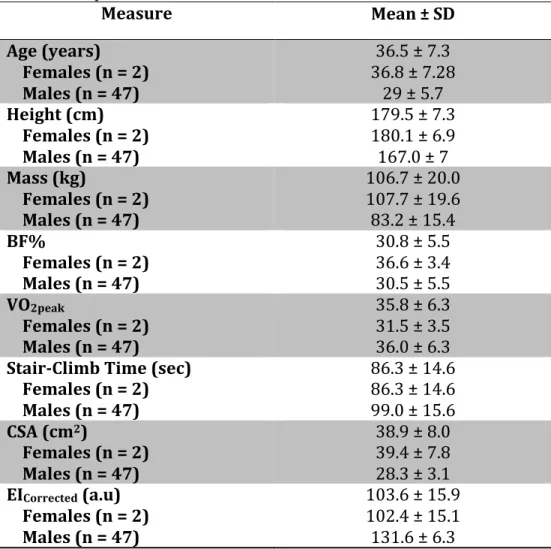
Forty-‐nine firefighters (47 males, 2 females) were recruited from central North Carolina fire departments participated in this study. Physical characteristics, ultrasound measurements, and stair-‐climb time are presented in Table 1. The Shapiro-‐Wilk test for normality indicated VO2peak, and time were not normally distributed (p = 0.049; and
p = 0.38 respectively). Therefore, the natural log for the aforementioned variables were used for further analyses.
Relationship between CSA, EI, and Stair-‐Climb Performance
The Pearson product moment correlation demonstrated that CSA and age were not significantly associated with stair-‐climb time (r = -‐0.031, p = 0.833; r = 0.107, p = 0.464). However, EI demonstrated a significant relationship with stair-‐climb time (r = 0.377,
p = 0.008) and VO2peak (r = -‐0.602, p < 0.001). When controlling for age and V02peak combined, there remained no significant relationship between CSA or EI and stair-‐climb time (respectively, r = 0.105, p = 0.483; r = -‐0.237, p = 0.108).
28 Table 1: Participant Characteristics
Measure Mean ± SD
Age (years) Females (n = 2) Males (n = 47)
36.5 ± 7.3 36.8 ± 7.28 29 ± 5.7 Height (cm)
Females (n = 2) Males (n = 47)
179.5 ± 7.3 180.1 ± 6.9 167.0 ± 7 Mass (kg)
Females (n = 2) Males (n = 47)
106.7 ± 20.0 107.7 ± 19.6 83.2 ± 15.4 BF%
Females (n = 2) Males (n = 47)
30.8 ± 5.5 36.6 ± 3.4 30.5 ± 5.5 VO2peak
Females (n = 2) Males (n = 47)
35.8 ± 6.3 31.5 ± 3.5 36.0 ± 6.3 Stair-‐Climb Time (sec)
Females (n = 2) Males (n = 47)
86.3 ± 14.6 86.3 ± 14.6 99.0 ± 15.6 CSA (cm2)
Females (n = 2) Males (n = 47)
38.9 ± 8.0 39.4 ± 7.8 28.3 ± 3.1 EICorrected (a.u)
Females (n = 2) Males (n = 47)
103.6 ± 15.9
102.4 ± 15.1
131.6 ± 6.3
The stepwise regression analysis suggested EI, but not CSA, was a significant predictor of stair-‐climb time and 14% of the variance can be explained by EI (Table 2). Because it was not significantly related to stair-‐climb time, age was not accounted for in the regression analysis. Stein’s R2 equation resulted in shrinkage of 0.046 for the predictive model. Multicollinearity did not exist because EI did not exceed 1 / (1 – R2) = 1.17.
Table 2: Stepwise Regression Analysis Dependent
Variable Independent Variable Constant beta t value p value Variance Inflation Time
R2 = 0.142
CHAPTER V Discussion
A number of previous studies have examined the relationship among various physiological variables and simulated stair-‐climb tasks in firefighter personnel (Michaelides et al., 2011; Sheaff et al., 2009; Williams-‐Bell et al., 2009). However, no published literature was found that examined the influence of lower extremity muscle size and quality on firefighter performance. Recent technological advances in ultrasonography allow for the simultaneous assessment of muscle size (CSA) and quality (EI) from a single panoramic image (Rosenberg et al., 2014). The primary findings of the present study indicated that EI, a measure of muscle quality, but not CSA, was significantly related to stair-‐climb performance in overweight and obese firefighters. However, when accounting for age and cardiorespiratory fitness (VO2peak), this relationship was attenuated. In
addition, muscle quality was the only significant predictor of stair-‐climb performance. These results contribute to the current knowledge of factors influencing the performance of occupational duties among firefighters.
Relationship Between EI and Stair-‐Climb Performance
30
For example, Fukumoto et al. (2012) demonstrated an inverse relationship between muscle quality assessed through EI and isometric strength of the quadriceps in middle aged and elderly adults. Additionally, several studies observed significant inverse relationships between EI and lower extremity functional performance (Cadore et al., 2012; Visser et al., 2005). For example, poorer muscle quality doubled the risk for mobility limitations in elderly men and women when performing tasks such as climbing stairs (Visser et al., 2005). Furthermore, EI has demonstrated a significant inverse relationship (r = -‐0.50, p < 0.01) with submaximal workloads during a graded cycle ergometer test (Cadore et al., 2012). Together, these results suggest that decreases in muscle quality may impair the ability of firefighters to perform physically demanding occupational duties. As previously stated, controlling for age and VO2peak collectively resulted in negating the relationship between EI and stair-‐climb time. This may be attributed to the strength of the relationship between VO2peak and stair-‐climb time (r = -‐0.602, p < 0.001).
Greater EI values have been reported to be a result of increased US beam reflections and have been linked to increased amounts of intramuscular fat and/or connective tissue (Pillen et al., 2009; Reimers et al., 1993). Reimers et al. (1993) examined the relationship between EI and interstitial fibrous tissue and fat. Echogenicity was compared to total triglyceride content of the corresponding biopsy of 83 muscle samples (n = 83). The authors concluded that intramuscular fat, rather than fibrous tissue constitutes the
increased EI was caused by infiltration of both fat and fibrous tissue, however the relative contributions of fat and fibrous tissue to mean EI may not be determined from EI values alone (Pillen et al., 2009). Collectively, these results suggest that increases in
intramuscular fat and/or connective tissue may contribute to greater muscle echogenicity.
Relationship Between CSA and Stair-‐Climb Performance
Previous studies have shown significant correlations between skeletal muscle CSA and lower extremity performance (Fukumoto et al., 2012; Visser, 2002). Fukumoto and
associates (2012) reported an age-‐related decrease in muscle size (muscle thickness) contributed to reduced strength of the quadriceps femoris (r = 0.32, p < 0.01). In 2002, Visser et al. (2002) concluded that elderly men and women with lower muscle CSA had poorer performance in lower extremity functions such as a sit-‐to-‐stand test and 6 meter walk test. A follow-‐up study in 2005 determined that persons in the lowest quartile of muscle CSA had twice the risk for mobility limitations during everyday functions such as climbing stairs (Visser et al., 2005).
Contrary to those studies, the results of the present study indicated a non-‐significant relationship between CSA and stair-‐climb performance, even when accounting for age and cardiorespiratory fitness. This suggests that muscle size may not influence lower extremity functional assessments. The current study’s results are in agreement with a study