OXIDATION OF ALIPHATIC PRIMARY ALCOHOLS BY
TETRAKIS (PYRIDINE) SILVER DICHROMATE – A KINETIC
AND MECHANISTIC APPROACH
Amit Daiya
[a], Deepika Sharma
[a], Manju Baghmar
[b], Pallvi Mishra
[a],
Shobha Sharma
[a]and Vinita Sharma
[a]*Keywords: Correlation analysis; alcohols; dichromate; kinetics; mechanism; oxidation.
The oxidation of nine aliphatic primary alcohols by tetrakis(pyridine) silver dichromate (TPSD) in dimethylsulfoxide leads to the formation of corresponding aldehydes. The reaction is first order with respect to TPSD. A Michaelis-Menten type kinetics is observed with respect to alcohols. The reaction is promoted by hydrogen ions; the hydrogen-ion dependence has the form kobs= a + b [H+]. The oxidation of
[1,1-2H
2]ethanol (MeCD2OH) exhibits a substantial primary kinetic isotope effect (kH/kD = 5.85 at 298 K). The reaction has been studied in
nineteen different organic solvents. The solvent effect was analysed using Taft's and Swain's multiparametric equations. The rate of oxidation is susceptible to both polar and steric effects of the substituents. A suitable mechanism has been proposed.
* Corresponding Authors Fax: +91 291 2721880
E-Mail: [email protected]
[a] Department of Chemistry, J.N.V. University, Jodhpur, India
[b] Department of Chemistry, University of Rajasthan, Jaipur, India
Introduction
Inorganic chromate and dichromate salts have been used as oxidizing reagents in synthetic organic chemistry for long time. However, these salts are drastic and non-selective oxidants in nature and as ionic compounds generally insoluble in most of the organic solvents. In order to overcome these limitations, a large number of organic derivatives of Cr(VI) have been prepared and used in synthetic organic syntheses as mild and selective oxidants in non-aqueous solvents.1
One such compound is tetrakis(pyridine)silver dichromate (TPSD) reported by Firouzabadi and co-workers.2 Only a few reports are available in literature
regarding oxidation aspects of TPSD.3 It is known that the mode of oxidation depends on the nature of the counter-ion attached to the chromium anion. Therefore, in continuation of our earlier work, we report here the kinetics and mechanism of oxidation of nine aliphatic primary alcohols by TPSD in dimethylsulphoxide (DMSO) as solvent. The mechanistic aspects are discussed.
The main aims of the present investigation are to (i) determine kinetic parameters and to evaluate the rate laws, (ii) to study the correlation analysis of effect of structure on (iii) and to postulate a suitable mechanism for the
Experimental Section
Materials
TPSD was prepared by the reported method2 and its
purity was checked by an iodometric method. The procedures used for the purification of alcohols have been described earlier.4 [1,1- 2H
2]Ethanol (MeCD2OH) was
prepared by Kalpan's method.5 Its isotopic purity, as
ascertained by its NMR spectra, was 96±3%. Due to the non-aqueous nature of the medium, p-toluenesulphonic acid (TsOH) was used as a source of hydrogen ions. TsOH is a strong acid and in a polar medium like DMSO it is likely to be completely ionised. Solvents were purified by the usual method.6
Product analysis
The product analysis was carried out under kinetic conditions. In a typical experiment, ethanol (2.30 g, 0.05 mol) and TPSD (7.48 g, 0.01 mol) were made up to 50 cm3 in DMSO and kept in dark for ca. 15 hr to ensure the completion of the reaction. The solution was then treated with an excess (200 cm3) of a saturated solution of
2,4-dinitrophenylhydrazine in 2 mol dm-3 HCl and
Kinetic Measurements
The reactions were followed under pseudo-first-order conditions by keeping a large excess (× 15 or greater) of the alcohol over TPSD. The temperature was kept constant to ±0.1 K. The solvent was DMSO, unless specified otherwise. The reactions were followed by monitoring the decrease in the concentration of TPSD spectrophotometrically at 365 nm for 80% of the reaction. The pseudo-first-order rate constants, kobs, were evaluated
from the linear (r = 0.990 - 0.999) plots of log [TPSD] against time. Duplicate kinetic runs showed that the rate constants were reproducible to within ±3%. The second order rate constant, k2, was evaluated from the relation k2
= kobs/[alcohol]. Simple and multivariate linear regression
analyses were carried out by the least-squares method on a personal computer.
Results and Discussion
Stoichiometry
The oxidation of alcohols results in the formation of corresponding aldehydes. The overall reaction may be represented as equation (1).
3RCH2OH + Cr2O7−2 + 8H+→ 3RCHO + 7H2O +2Cr+3 (1)
Rate-laws
The reactions are of first order with respect to TPSD. Further, the pseudo-first order rate constant, kobs is independent of the initial concentration of
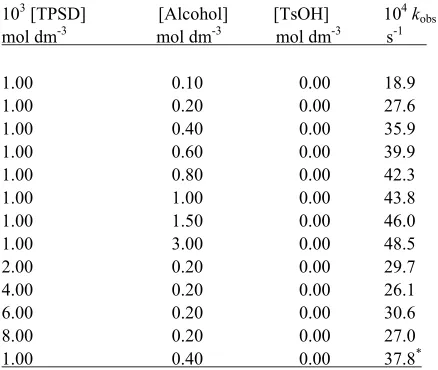
TPSD. The reaction rate increases with increase in the concentration of the alcohols but not linearly (Table 1).
Table 1. Rate constants for the oxidation of ethanol by TPSD at 288 K
103 [TPSD] [Alcohol] [TsOH] 104k obs
mol dm-3 mol dm-3 mol dm-3 s-1
1.00 0.10 0.00 18.9 1.00 0.20 0.00 27.6 1.00 0.40 0.00 35.9 1.00 0.60 0.00 39.9 1.00 0.80 0.00 42.3 1.00 1.00 0.00 43.8 1.00 1.50 0.00 46.0 1.00 3.00 0.00 48.5 2.00 0.20 0.00 29.7 4.00 0.20 0.00 26.1 6.00 0.20 0.00 30.6 8.00 0.20 0.00 27.0 1.00 0.40 0.00 37.8* * contained 0.001 mol dm-3 acrylonitrile
Figure 1. Oxidation of Ethyl alcohol by TPSD: A typical Kinetic Run
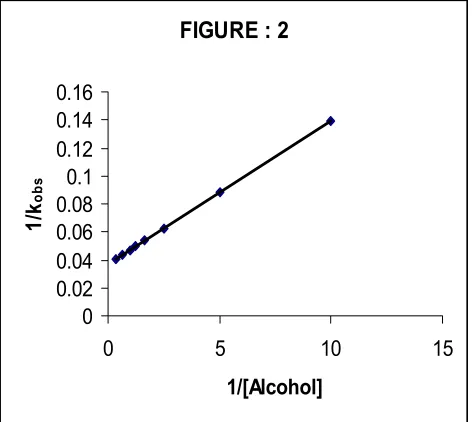
The Figure 1 depicts a typical kinetic run. A plot of 1/kobs
against 1/[Alcohol] is linear (r>0.995) with an intercept on the rate-ordinate. Thus, Michaelis-Menten type kinetics is observed with respect to alcohols. This leads to the postulation of following overall mechanism (2) and (3) and rate law (4).
K
Alcohol + TPSD ' [complex] (2)
k2
[complex] → Products (3)
Rate=k2 K[Alcohol][TPSD]/(1 + K [Alcohol]) (4)
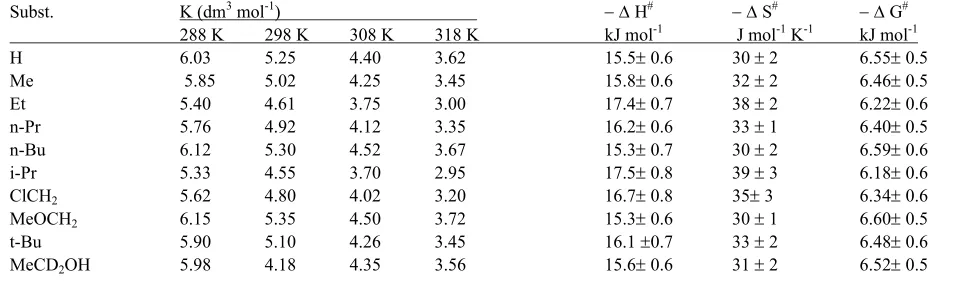
The dependence of reaction rate on the reductant concentration was studied at different temperatures and the values of K and k2 were evaluated from the double
reciprocal plots (Figure 2). The thermodynamic parameters of the complex formation and activation parameters of the decomposition of the complexes were calculated from the values of K and k2 respectively at
different temperatures (Tables 2 and 3).
Induced Polymerization of Acrylonitrile
The oxidation of alcohols, in an atmosphere of nitrogen, failed to induce polymerisation of acrylonitrile. Further, the addition of acrylonitrile did not affect the rate. This indicates that a one-electron oxidation, giving rise to free radicals, is unlikely in the present reaction (Table 1). To further confirm the absence of free radicals in the reaction pathway, the reaction was carried out in the presence of 0.05 mol dm−3 of
2,6-di-t-butyl-4-methylphenol (butylated hydroxytoluene or BHT). It was observed that BHT was recovered unchanged, almost quantitatively.
FIGURE : 1
0 0.5 1 1.5 2 2.5
0 200 400 600 800 1000
Time
2+
lo
g
Figure 2. Oxidation of Alcohols by TPSD: A double reciprocal plot
Effect of Hydrogen Ions
The reaction is catalyzed by hydrogen ions (Table 4). The hydrogen-ion dependence has the following form equation (5). The values of a and b, for ethanol, are 18.6±0.07 × 10⁻⁴ s−1 and 31.8±0.12 ×10⁻⁴ mol−1 dm3 s−1
respectively (r2 = 0.9999).
kobs = a + b [H+] (5)
Kinetic Isotope Effect
To ascertain the importance of cleavage of the α−C−H bond in the rate-determining step, oxidation of [1,1-2H
2]ethanol was studied. The results showed the
presence of a substantial primary kinetic isotope effect (Table 3).
Effect of Solvents
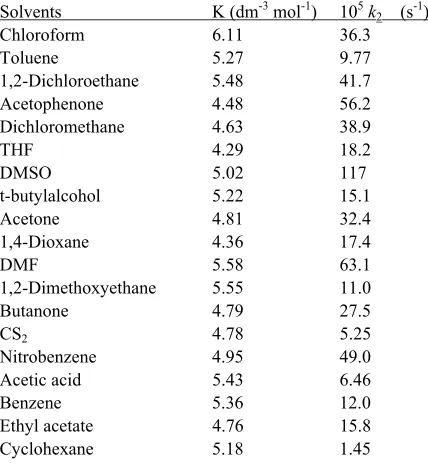
The oxidation of ethanol was studied in 19 different organic solvents. The choice of solvent was limited due to the solubility of TPSD and its reaction with primary and secondary alcohols. There was no reaction with the solvents chosen. The kinetics were similar in all the solvents. The values of k2 are recorded in Table 5.
A satisfactory linear correlation (r = 0.9824; temp. 449 ± 32) between the values the activation enthalpies and entropies of the oxidation of the nine aliphatic alcohols indicated the operation of compensation effect in this reaction. 7 The reaction also exhibited an excellent
isokinetic effect, as determined by Exner’s criterion.8 An
Exner's plot between log k2 at 288K and at 318 K was
linear (r = 0.9961; ψ = 0.07; slope = 0.7744 ± 0.0261) (Figure 3). The value of isokinetic temperature is 500±43 K. The linear isokinetic correlation implies that all the alcohols are oxidized by the same mechanism and the
Solvent Effect
The rate constants of the oxidation, k2, in eighteen
solvents (CS2 was not considered, as the complete range
of solvent parameters was not available) did not yield any significant correlation in terms of the linear solvation energy relationship (LESR) of Kamlet and Taft9 (6).
log k2 = A0 + pπ* + bβ + aα (6)
log k2= − 4.24 + 1.59 (±0.20)π* + 0.19(±0.16) β +
0.14 (±0.16) α (7) R2 = 0.8586; sd= 0.18; n= 18; ψ = 0.41
log k2 = −4.21 + 1.64(±0.19)π* + 0.15 (±0.15) β (8) R2 =0.8508; sd=0.18; n=18; ψ = 0.40
log k2 = − 4.24 + 1.68 (±0.18) π* (9) r2 = 0.8415; sd = 0.18; n = 18; ψ = 0.41
log k2 = −2.83 + 0.44 (±0.36) β (10) r2 = 0.0865; sd=0.43; n=18; ψ= 0.98
Here n is the number of data points and ψ is the Exner's statistical parameter.10 Kamlet's9 triparametric
equation explains ca. 86% of the effect of solvent on the oxidation. However, by Exner's criterion10 the correlation
is not even satisfactory (cf. 7). The major contribution is of solvent polarity. It alone accounted for ca. 86% of the data. Both β and α play relatively minor roles.
The data on the solvent effect were analysed in terms of Swain's11 equation (11) of cation- and anion-solvating
concept of the solvents also.
log k2 = aA + bB + C (11)
Here A represents the anion solvating power of the solvent and B the cation-solvating power. C is the intercept term. (A+B) is postulated to represent the solvent polarity. The rates in different solvents were analysed in terms of eq. (12), separately with A and B and with (A + B).
log k2 = 0.63 (±0.04) A + 1.71 (±0.03) B − 3.98 (12)
R2 = 0.9957; sd = 0.03; n = 19; ψ = 0.07
log k2 = 0.39 (±0.56) A − 2.81 (13)
r2 = 0.0271; sd = 0.46; n = 19; ψ = 1.01
log k2 = 1.66 (±0.11) B − 3.77 (14)
r2 = 0.9248; sd = 0.13; n = 19; ψ = 0.27
log k2 = 1.35 ± 0.14 (A + B) − 3.95 (15)
r2 = 0.8463; sd = 0.18; n = 19; ψ = 0.40
Here n is the number of data points and ψ is the
FIGURE : 2
0 0.02 0.04 0.06 0.08 0.1 0.12 0.14 0.16
0 5 10 15
1/[Alcohol]
1/
Table 2. Formation constants and thermodynamic parameters for the Alcohol – TPSD complexes
Subst. K (dm3 mol-1) −∆ H# −∆ S# −∆ G#
288 K 298 K 308 K 318 K kJ mol-1 J mol-1 K-1 kJ mol-1
H 6.03 5.25 4.40 3.62 15.5± 0.6 30 ± 2 6.55± 0.5
Me 5.85 5.02 4.25 3.45 15.8± 0.6 32 ± 2 6.46± 0.5 Et 5.40 4.61 3.75 3.00 17.4± 0.7 38 ± 2 6.22± 0.6 n-Pr 5.76 4.92 4.12 3.35 16.2± 0.6 33 ± 1 6.40± 0.5 n-Bu 6.12 5.30 4.52 3.67 15.3± 0.7 30 ± 2 6.59± 0.6 i-Pr 5.33 4.55 3.70 2.95 17.5± 0.8 39 ± 3 6.18± 0.6 ClCH2 5.62 4.80 4.02 3.20 16.7± 0.8 35±3 6.34± 0.6
MeOCH2 6.15 5.35 4.50 3.72 15.3± 0.6 30 ± 1 6.60± 0.5
t-Bu 5.90 5.10 4.26 3.45 16.1 ±0.7 33 ± 2 6.48± 0.6 MeCD2OH 5.98 4.18 4.35 3.56 15.6± 0.6 31 ± 2 6.52± 0.5
Table 3. Rate constants and activation parameters for the Alcohols – TPSD complexes Alcohol 104 k
2 / dm3 mol-1 s-1 at ∆H −∆S ∆G
(R) 288 K 298 K 308 K 318 K kJ mol-1 J mol-1 K-1 kJmol-1
H 0.81 2.81 9.00 27.0 86.4 ± 0.1 23 ± 1 95.0 ± 0.6 Me 51.3 117 261 558 58.1 ± 0.3 87 ± 1 84.9 ± 0.4 Et 87.3 189 414 846 55.3 ± 0.5 93 ± 2 83.6 ± 0.7 n-Pr 153 315 621 1260 50.8 ± 0.7 104± 2 82.2 ± 0.2 n-Bu 162 342 693 1350 51.3 ± 0.1 101± 1 81.9 ± 0.3 i-Pr 243 477 954 1800 48.5 ± 0.5 108± 2 81.0 ± 0.3 ClCH2 0.98 2.61 7.02 17.1 70.3 ± 0.5 78 ± 2 94.7 ± 0.5
MeOCH2 8.10 19.8 47.7 108 63.3 ± 0.3 85 ± 1 89.4 ± 0.3
t-Bu 2250 3510 5400 7920 29.5 ± 0.1 155±1 75.5± 0.1
MeCD2OH 8.29 20.0 46.6 105 61.9 ± 0.3 89 ± 1 89.2 ±0.4
kH/kD 6.19 5.85 5.60 5.31
The rates of oxidation of ethanol in different solvents showed an excellent correlation in Swain's equation (cf. equation 12) with the cation-solvating power playing the major role. In fact, the cation-solvation alone account for ca. 92% of the data. The correlation with the anion-solvating power was very poor. The solvent polarity, represented by (A + B), also accounted for ca. 86% of the data. In view of the fact that solvent polarity is able to account for ca. 86% of the data, an attempt was made to correlate the rate with the relative permittivity of the solvent. However, a plot of log k2 against the
inverse of the relative permittivity is not linear (r2 =
0.5313; sd = 0.32; ψ = 0.70).
Correlation Analysis of Reactivity
The rates of oxidation of the alcohols failed to yield any significant correlation separately with Taft's12 σ* and
Es values eqs. (16) and (17).
log k2 = − 2.17(±0.33) Σσ* − 1.73 (16) r2 = 0.8584; sd = 0.42; ψ = 0.40; n= 9
log k2 = − 1.13(±0.36) Σ Es − 2.28 (17) r2 = 0.5804; sd = 0.73; ψ = 0.69; n = 9
The rates were, therefore, correlated in terms of Pavelich-Taft's 13 dual substituent-parameter (DSP)
equation (19).
log k2 = ρ* σ* + δ Es + log k0 (19)
The values of substituent constants were obtained from the compilation by Wiberg12. The correlations are
excellent; the reaction constants being negative (Table 6). There is no significant collinearity (r2 = 0.2322) between
σ* and E
s values of the nine substituents.
The negative polar reaction constant indicates an electron-deficient carbon centre in the transition state of the rate-determining step. The negative steric reaction constant shows a steric acceleration of the reaction. This may be explained on the basis of high ground state energy of the sterically crowded alcohols. Since the crowding is relieved in the product aldehyde as well as in the transition state leading to it, the transition state energies of the crowded and uncrowded alcohols do not differ much and steric acceleration, therefore, results.
Mechanism
Figure 3. Exner’s Isokinetic Relationship in the oxidation of Alcohols by TPSD
The hydride ion transfer may take place either by a cyclic process via an ester intermediate or by an acyclic one-step bimolecular process. This postulation is supported by an analysis of the temperature dependence of kinetic isotope effect. Kwart and Nickle14 have shown
that a study of the dependence of the kinetic isotope effect on temperature can be gainfully employed to resolve this problem.
Table 4. Dependence of the reaction rate on hydrogen−ion concentration,
[Alcohol]=0.10 mol dm−3 ; [TPSD]=0.001 mol dm−3 ; Temp.
298 K
[TsOH]/ mol dm−3 0.10 0.20 0.40 0.60 0.80 1.00
104 k
obs/s-1 21.8 24.9 31.5 37.8 44.1 50.4
Table 5. Effect of solvents on the oxidation of alcohols by TPSD at 308 K
Solvents K (dm-3 mol-1) 105k 2 (s-1)
Chloroform 6.11 36.3
Toluene 5.27 9.77
1,2-Dichloroethane 5.48 41.7 Acetophenone 4.48 56.2 Dichloromethane 4.63 38.9 THF 4.29 18.2 DMSO 5.02 117 t-butylalcohol 5.22 15.1 Acetone 4.81 32.4 1,4-Dioxane 4.36 17.4 DMF 5.58 63.1 1,2-Dimethoxyethane 5.55 11.0 Butanone 4.79 27.5 CS2 4.78 5.25
Nitrobenzene 4.95 49.0 Acetic acid 5.43 6.46 Benzene 5.36 12.0 Ethyl acetate 4.76 15.8 Cyclohexane 5.18 1.45
Table 6. Temperature dependence of the reaction constant
T, K −ρ* −δ r2 sd ψ
288 1.80±0.01 0.73±0.01 0.9999 0.010 0.01 298 1.71±0.02 0.63±0.01 0.9998 0.005 0.02 308 1.62±0.01 0.54±0.02 0.9989 0.002 0.04 318 1.55±0.02 0.45±0.02 0.9999 0.007 0.01
The data for protio- and deuterio-ethanols, fitted to the familiar expression kH/kD = AH/AD exp(Ea/RT)15 show a
direct correspondence with the properties of a symmetrical transition state in which the activa-tion energy difference (∆Ea) for kH/kD is equal to
the zero-point energy difference for the respective C-H and C-D bonds (≈4.5 kJ/mol) and the frequency factors and the entropies of activation of the respective reactions are nearly equal.
The similar phenomena have also been observed earlier in the reactions of halochromates. Bordwell 16 has
documented a very cogent evidence against the occurrence of concerted one-step bimolecular processes by hydrogen transfer and it is evident that in the present studies also the hydrogen transfer does not occur by an acyclic bimolecular process. It is well established that intrinsically concerted sigmatropic reactions, characterized by transfer of hydrogen in a cyclic transition state, are the only truly symmetrical processes involving a linear hydrogen transfer17. Littler18 has also
shown that a cyclic hydride transfer, in the oxidation of alcohols by Cr(VI), involves six electrons and, being a Huckel-type system, is an allowed process. Thus the overall mechanism is proposed to involve the formation of a chromate ester in a fast pre-equilibrium step and then a disproportionation of the ester in a subsequent slow step via a cyclic concerted symmetrical transition state leading to the product (Scheme 1). The observed hydrogen-ion dependence can be explained by assuming a rapid reversible protonation of the chromate ester (A) with the protonated ester decomposing at a rate faster than (A) (Scheme 2).
FIGURE : 3
0 1 2 3 4 5 6 7
1 2 3 4 5 6
2+logk2 at 288K
2+
logk
2
at
31
8K
[AgPy4]2 Cr2 O7
+ [CrO(OH)2OAgPy4]+ + [CrO3 (OAgPy4)]
-C Cr
OH
O OAgPy4
O Acid-independent Path(Scheme-1)
H O
C Cr
OH
OAgPy4
H O
CrO2OAgPy4
O
CrO2OAgPy4
(A)
#
R C OH
H
H +
H
R
R H
k2
K
O
R C O
Conclusion
The reaction is proposed to proceed through a hydride-ion transfer from alcohol to the oxidant in the rate-determining step. It has also been observed that an α-C-H bond is cleaved in the rate-determining step. Both deprotonated and protonated forms of TPSD are the reactive oxidising species.
Acknowledgements
Thanks are due to University Grants Commission, New Delhi for financial support in the form of Major Research Project No. F. 32−207/2006 (SR) dated 22.02.2007, and to Professor K.K. Banerji for their valuable help, guidance and suggestions.
References
1 Mahanti , M.K., Banerji, K.K., J. Indian Chem. Soc., 2002, 79,
31; Khatri, J., Choudhary, A., Purohit, P., Kumbhat, R., and Sharma, V., Eur. Chem. Bull., 2012, 1, 49; Barthora, S., Baghmar, D., Gilla, M., Choudhary, A., Kotai, L., Sharma, V., J. Chem. Biol. Phys. Sci.,2011, 1, 7; Gilla, M., Meena, A., Choudhary, A., Baghmar, M., Sharma, I. K., Kotai, L., Sharma, V., J. Chem. Biol. Phys. Sci.2011,
1, 30; Sharma, D., Pancharia, P., Vyas, S., Kotai, L., Sharma, P. K., Int. J. Chem. 2012, 1, 29; Panchariya, P., Purohit, T., Swami, P., Malani, N., Kotai, L., Prakash, Om, Sharma, P. K., Int. J. Chem. Sci., 2012, 10, 557;
2 Firouzabadi, H., Sardarian, A., Giaribi, H., Synth Communn, 1984, 14, 89.
3 Purohit, P., Kumbhani, S., Shastri, I., Banerji, K. K., Sharma,
P. K. Indian J. Chem., 2008,47A, 1671; Choudhary, A., Yajurvedi, D., Kumbhani, S., Shastri, I., Sharma, V., J. Indian Chem. Soc., 2009, 86, 832; Meena, A. K., Daiya, A., Banerji, J., Sajo, I., Kotai, L., Sharma, V. J. Indian Chem. Soc., 2011, 88, 1887; Meena, A.K., Daiya, A., Sharma, A., Choudhary, A., Banerji, J., Kotai, L., Sajo, I., Sharma, V. Int. J. Chem., 2012, 1, 55.
4 Mathur, D., Sharma, P. K., Banerji, K. K. J. Chem. Soc.,
Perkin Trans. 2,1993, 205.
5 Kalpan, L. J. Am. Chem. Soc., 1958, 80, 2639.
6 Perrin, D. D., Armarego, W. L., Perrin, D. R. Purification of
Organic Compounds, Pergamon Press, Oxford 1966.
7 Liu, L., Guo, W. E. Chem. Review, 2001, 101, 673. 8 Exner, O., Coll. Chem. Czech. Commun., 1977, 38, 411. 9 Kamlet, M. J., Abboud, J. L. M., Abraham, M. H., Taft, R. W.
J. Org. Chem., 1983, 48, 2877.
10 Exner, O., Coll. Chem. Czech. Commun., 1966, 31, 3222. 11 Swain, C. G., Swain, M. S., Powel, A. L., Alunni, S. J. Am.
Chem. Soc., 1983, 105, 502.
12 Wiberg, K.B. Physical Organic Chemistry, Wiley, New York, 1963, 416.
13 Pavelich, W. A. and Taft, R. W., J. Am. Chem. Soc., 1957, 79,
4835.
14 Kwart, H. and Nickel, J. H. J. Am. Chem. Soc., 1973, 95,
3394.
15 Kwart, H. and Latimer, M.C., J. Am. Chem. Soc., 1971, 93,
3770; Kwart, H. and Slutsky, J. J. Chem. Soc. Chem. Comm., 1972, 1182.
16 Bordwell, F.G., Acc. Chem. Res., 1974, 5, 374.
17 Woodward, R. W. and Hoffmann, R. Angew. Chem. Int. Ed
Engl., 1969, 8, 781.
18 Littler, J. S., Tetrahedron, 1971, 27, 81.
Received: 19. July 2012.; Accepted: 23. July 2012.
Acid-dependent Path (Scheme - 2)
(A) + H+ C Cr+ OH
HO OAgPy4 O
H
O CrO2OAgPy4 H
R
H2O + [Cr(OH)OAgPy4]+ + [CrO3 (OAgPy4)] -+
K
k2