Available online throug
ISSN 2229 – 5046
EFFECT OF NON-LINEAR DENSITY TEMPERATURE ON HYDRO MAGNETIC
MIXED CONVECTIVE HEAT AND MASS TRANSFER FLOW IN A CYLINDRICAL ANNULUS
J. DEEPTHI
1, D. R. V. PRASADARAO*
2Research Scholar, Department of Mathematics, Rayalaseema University; Kurnool - (A.P.), India.
2
Department of Mathematics; S. K. University, Anantapur - (A.P.), India.
(Received On: 21-12-16; Revised & Accepted On: 24-01-17)
ABSTRACT
I
n this paper, we analyse non- darcy free and forced convection flow through a porous medium in a Co-axial cylindrical duct where the boundaries are maintained at temperature Tw and Concentration Cw with non-linear densitytemperature relation. The behaviour of velocity, temperature and concentration is analyzed at different axial positions. The shear stress and the rate of heat and mass transfer have also been obtained for variations in the governing parameters N,γ,N1, Pr, ak.
Keywords: Circular duct-Non-linear mixed convection-Thermal radiation-Heat sources
1. INTRODUCTION
Combined heat and mass transfer problems with chemical reaction are important in many processes and have, therefore, received a considerable amount of attention in recent years. In processes such as drying, evaporation at the surface of a water body, energy transfer in a wet cooling tower and the flow in a desert cooler, heat and mass transfer occur simultaneously. Possible applications of this type of flow can be found in many industries. For example, in the power industry, among the methods of generating electric power is one of in which electrical energy is extracted directly from a moving conducting fluid. Obviously, the understanding of this transport process is desirable in order to effectively control the overall transport characteristics.
Free convection in a vertical porous annulus has been extensively studied by several investigators Prasad and Kulacki [16], Prasad and Kulacki [17], Nanda and purushotham[13], Neeraja[14] Leppinen et.al [9] Jha.et.al [8] Saravannan
et.al [21]. Charrier et.al [4].Chen and Yuh [6] have investigated the heat and mass transfer characteristics of natural convection flow along a vertical cylinder under the combined buoyancy effects of thermal and species diffusion, Sivanjaneya Prasad [20] has investigated the free convection flow of an incompressible, viscous fluid through a porous medium in the annulus between the porous concentric cylinders under the influence of a radial magnetic field. Antonio [2] has investigated the laminar flow,heat transfer in a vertical cylinder duct by taking into account both viscous dissipation and the effect of buoyancy, the limiting case of fully developed natural convection in porous annuli is solved analytically for steady and transient cases Al-Nimir (1). Chamkha et al. [4] studied the effect of radiation on combined heat and mass transfer by non-Darcy natural convection about an impermeable horizontal cylinder embedded in porous medium. Sreevani [23] has studied the convective heat and mass transfer through a porous medium in cylindrical annulus under radial magnetic field with Soret effect. Srinivasareddy [22] has discussed the Soret effect on mixed convective heat and mass transfer though a porous cylindrical annulus. For natural convection, the existence of large temperature differences between the surfaces is important. Sudheer Kumar et.al [25] have studied the effect of radiation on natural convection over a vertical cylinder in a porous media. Padmavathi [19] has analyzed the convective heat transfer in a cylindrical annulus by using finite element method.
Madhusudhan Reddy [11] has investigated the convective heat and mass transfer flow of a viscous fluid through a porous medium in a vertical annulus with cylinder maintained at constant temperature and constant concentration. Sudarsana Reddy et.al [24] have discussed the convective heat and mass transfer flow of a viscous fluid in a concentric cylindrical annulus with Soret and Dufour effect. Mallikarjuna et.al [12] have investigated the mixed convective heat and mass transfer flow through a porous medium in a vertical cylindrical annulus with Soret and Dufour effects.
Corresponding Author: D. R. V. Prasadarao*
2z
r Az
T Tw= 0+
Tw=T0+Az Cw=C0+Bz
Cw=C0+Bz
g Fig.1 :CONFIGURATION OF THE PROBLEM
2. FORMULATION OF THE PROBLEM
We consider the free and forced convection flow in a vertical circular annulus through a porous medium whose walls are maintained at a constant heat flux and uniform concentration. The flow, temperature and concentration in the fluid are assumed to be fully developed. Both the fluid and porous region have constant physical properties and the flow is a mixed convection flow taking place under thermal and molecular buoyancies and uniform axial pressure gradient. The Boussinesque approximation is invoked so that the density variation is confined to the thermal and molecular buoyancy forces. The Brinkman-Forchhimer-Extended Darcy model which accounts for the inertia and boundary effects has been used for the momentum equation in the porous region. The momentum, energy and diffusion equations are coupled and non-linear. Also the flow is unidirectional along the axial direction of the cylindrical annulus. Making use of the above assumptions the governing equations in the non-dimensional form are
2 2
1 2 1 1/ 2 2
2 2
1
1
(
)
( (1
)
)
u
u
M
D
u
D
u
G
ak
NC
r
r r
δ
r
δ
δ θ
θ
− −
∂
+
∂
= +
+
+
Λ −
+
+
∂
∂
(1)2
2
4
1
1
3
Pr
Rd
u
r
r
r
θ
θ
α θ
∂
∂
+
+
= +
∂
∂
(2)2
2
1
C
C
C
Sc u
r
r
r
γ
∂
+
∂
−
=
∂
∂
(3)where
Λ
=
FD
−1 (Inertia parameter or Forchhimer number),2 3
) (
ν
β
T T a gG= e − i (Grashof number)
k
a
D
2 1
=
−
(Inverse Darcy parameter),
ν
σµ
a
H
M
e2 0 2 2
=
(Hartmann number)
f p r
k C
P =µ (Prandtl number),
B
Sc
D
ν
=
(Schmidt number),1 2
c
B
k a
D
γ
=
(Chemical Reaction parameter)3
4
eR f
T
Rd
k
σ
β
•
=
(Radiation parameter) , α=2
p
qa
c
The corresponding non-dimensional conditions are
0
=
u
,θ
=
0
, C=0 at r=1 and 1+s (4)3. METHOD OF SOLUTION
1) Discretization of the domain into elements 2) Derivation of element equations
3) Assembly of Element Equations 4) Imposition of boundary conditions 5) Solution of assembled equations
4. COMPARISON
In the absence of non-linear parameter (ak=0) the results are in good agreement with Madhusudana et al [10].
Parameters Madhusudana et al(10) Present results(S0=0)
N Rd γ Nu(1) Nu(2) Sh(1) Sh(2) Nu(1) Nu(2) Sh(1) Sh(2) 1 0.5 0.5 0.10673 1.7335 12.3727 14.5232 0.10669 1.7336 12.36987 14.52289 2 0.5 0.5 0.11549 1.74131 12.3734 14.5233 0.11538 1.741299 12.37299 14.52319 -0.5 0.5 0.5 0.01152 1.74152 12.3718 14.5237 0.011492 1.741499 12.3714 14.52299 -1.5 0.5 0.5 0.01156 1.74162 12.3712 14.5138 0.01151 1.74155 12.3706 14.5136
1 1.5 0.5 0.2225 3.3518 12.3721 14.5237 0.22239 3.35168 12.3719 14.5231 1 5.0 0.5 0.30165 4.5736 12.3713 14.5239 0.30159 4.57345 12.3709 14.52301 1 0.5 1.5 0.11552 1.74131 13.0332 14.4276 0.115499 1.74131 13.03289 14.4266 1 0.5 -0.5 0.11554 1.741525 13.3226 14.4516 0.115035 1.741499 13.32189 14.4516 1 0.5 -1.5 0.115432 1.741625 12.1728 14.4526 0.115437 1.741587 12.17187 14.4522
5. SHEAR STRESS, NUSSELT NUMBER AND SHERWOOD NUMBER
The shear stress ( τ ) is evaluated using the formula
1,1
r s
du dr
τ
= +
=
The rate of heat transfer (Nusselt number) is evaluated using the formula
1,1
r s
d Nu
dr
θ
= +
= −
The rate of mass transfer (Sherwood number) is evaluated using the formula
1,1
r s
dC Sh
dr = +
= −
6. RESULTS AND DISCUSSION
In order to get physical Insight into the problem the coupled equations governing the flow, heat and mass transfer have been solved by using Galerkin finite method with quadratic approximation functions. The velocity, temperature and concentration have been analysed for different parametric variations N, γ, N1, ak, Pr.
The important results of the analysis are
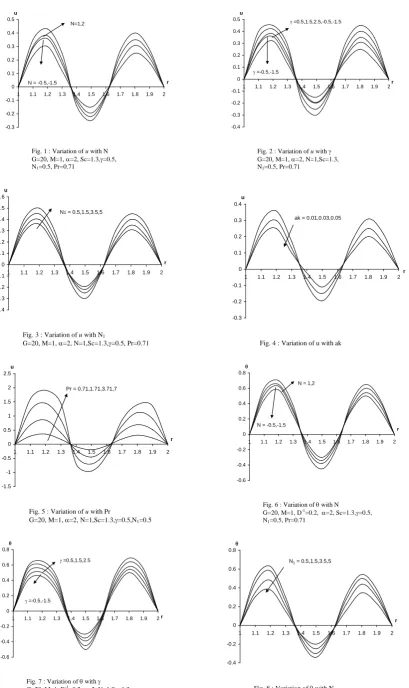
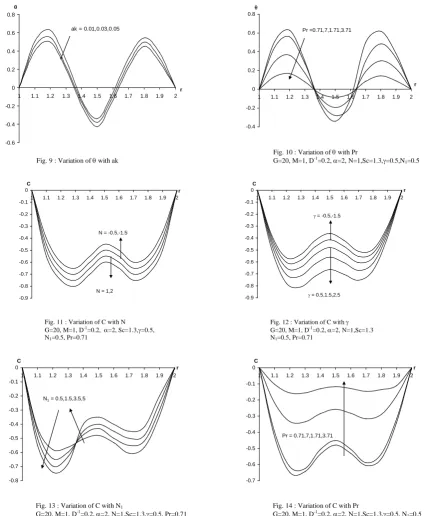
The velocity and the temperature enhances and the concentration reduces in the flow region with increase in N>0 when the buoyancy forces are in the same directions and for the forces acting in opposite directions a reversed effect is noticed (fig.1, 6, 11). The Nusselt number and Sherwood number increases with increases in N >0 and a reversed behaviour is noticed with N<0 (table.1).
With reference to the chemical reaction parameter γ,we find that the velocity, temperature and concentration enhance in the flow region in the degenerating chemical reaction case while in the generating chemical reaction case, they reduces in the flow region (2, 7, 12). The rate of heat transfer reduces for γ>0 and enhance on r=1 &2. The Sherwood number reduces on r=1 and enhances on r=2 for γ>0 and for γ<0,it enhances on r=1 and reduces on r=2 (table.1).
An increase in the radiation parameter N1 enhances ׀u׀ in the regions abutting the boundaries r=1 and 2 in the
entire flow region. Actual temperature decreases in N1, higher the radiative flux larger the magnitude of the
velocity and actual temperature in the flow region. While the actual concentration enhances in the region 1.01 to 1.3 and reduces in the remaining flow region (fig.3, 8, 13).׀τ ׀, ׀Sh׀ enhances at r=1 and 2, while ׀Nu׀ reduces at r=1 and 2 (table.1).
The actual concentration enhances with increase in Pr, the actual temperature reduces in the regions adjacent to the boundaries and enhances in the central region. The magnitude of the velocity enhances with increase in Pr (figs.4, 9, 14).
-0.3 -0.2 -0.1 0 0.1 0.2 0.3 0.4 0.5
1 1.1 1.2 1.3 1.4 1.5 1.6 1.7 1.8 1.9 2 r u
N=1,2
N = -0.5,-1.5
Fig. 1 : Variation of u with N G=20, M=1, α=2, Sc=1.3,γ=0.5, N1=0.5, Pr=0.71
-0.4 -0.3 -0.2 -0.1 0 0.1 0.2 0.3 0.4 0.5
1 1.1 1.2 1.3 1.4 1.5 1.6 1.7 1.8 1.9 2r u
γ =0.5,1.5,2.5,-0.5,-1.5
γ =-0.5,-1.5
Fig. 2 : Variation of u with γ G=20, M=1, α=2, N=1,Sc=1.3, N1=0.5, Pr=0.71
-0.4 -0.3 -0.2 -0.1 0 0.1 0.2 0.3 0.4 0.5 0.6
1 1.1 1.2 1.3 1.4 1.5 1.6 1.7 1.8 1.9 2
r u
N1 = 0.5,1.5,3.5,5
Fig. 3 : Variation of u with N1
G=20, M=1, α=2, N=1,Sc=1.3,γ=0.5, Pr=0.71
-0.3 -0.2 -0.1 0 0.1 0.2 0.3 0.4
1 1.1 1.2 1.3 1.4 1.5 1.6 1.7 1.8 1.9 2r
u
ak = 0.01,0.03,0.05
Fig. 4 : Variation of u with ak
-1.5 -1 -0.5 0 0.5 1 1.5 2 2.5
1 1.1 1.2 1.3 1.4 1.5 1.6 1.7 1.8 1.9 2
r u
Pr = 0.71,1.71,3.71,7
Fig. 5 : Variation of u with Pr
G=20, M=1, α=2, N=1,Sc=1.3,γ=0.5,N1=0.5
-0.6 -0.4 -0.2 0 0.2 0.4 0.6 0.8
1 1.1 1.2 1.3 1.4 1.5 1.6 1.7 1.8 1.9 2 r θ
N = 1,2
N = -0.5,-1.5
Fig. 6 : Variation of θ with N
G=20, M=1, D-1=0.2, α=2, Sc=1.3,γ=0.5,
N1=0.5, Pr=0.71
-0.6 -0.4 -0.2 0 0.2 0.4 0.6 0.8
1 1.1 1.2 1.3 1.4 1.5 1.6 1.7 1.8 1.9 2r
θ
γ =0.5,1.5,2.5
γ =-0.5,-1.5
Fig. 7 : Variation of θ with γ G=20, M=1, D-1=0.2, α=2, N=1,Sc=1.3
N1=0.5, Pr=0.71
-0.4 -0.2 0 0.2 0.4 0.6 0.8
1 1.1 1.2 1.3 1.4 1.5 1.6 1.7 1.8 1.9 2
r
θ
N1 = 0.5,1.5,3.5,5
Fig. 8 : Variation of θ with N1
-0.6 -0.4 -0.2 0 0.2 0.4 0.6 0.8
1 1.1 1.2 1.3 1.4 1.5 1.6 1.7 1.8 1.9 2
r
θ
ak = 0.01,0.03,0.05
Fig. 9 : Variation of θ with ak
-0.4 -0.2 0 0.2 0.4 0.6 0.8
1 1.1 1.2 1.3 1.4 1.5 1.6 1.7 1.8 1.9 2
r
θ
Pr =0.71,7,1.71,3.71
Fig. 10 : Variation of θ with Pr
G=20, M=1, D-1=0.2, α=2, N=1,Sc=1.3,γ=0.5,N1=0.5
-0.9 -0.8 -0.7 -0.6 -0.5 -0.4 -0.3 -0.2 -0.1 0
1 1.1 1.2 1.3 1.4 1.5 1.6 1.7 1.8 1.9 2 r C
N = -0.5,-1.5
N = 1,2
Fig. 11 : Variation of C with N G=20, M=1, D-1=0.2, α=2, Sc=1.3,γ=0.5,
N1=0.5, Pr=0.71
-0.9 -0.8 -0.7 -0.6 -0.5 -0.4 -0.3 -0.2 -0.1 0
1 1.1 1.2 1.3 1.4 1.5 1.6 1.7 1.8 1.9 2 r C
γ = 0.5,1.5,2.5
γ = -0.5,-1.5
Fig. 12 : Variation of C with γ G=20, M=1, D-1=0.2, α=2, N=1,Sc=1.3 N1=0.5, Pr=0.71
-0.8 -0.7 -0.6 -0.5 -0.4 -0.3 -0.2 -0.1 0
1 1.1 1.2 1.3 1.4 1.5 1.6 1.7 1.8 1.9 2
r C
N1 = 0.5,1.5,3.5,5
Fig. 13 : Variation of C with N1
G=20, M=1, D-1=0.2, α=2, N=1,Sc=1.3,γ=0.5, Pr=0.71
-0.7 -0.6 -0.5 -0.4 -0.3 -0.2 -0.1 0
1 1.1 1.2 1.3 1.4 1.5 1.6 1.7 1.8 1.9 2
r C
Pr = 0.71,7,1.71,3.71
Fig. 14 : Variation of C with Pr
G=20, M=1, D-1=0.2, α=2, N=1,Sc=1.3,γ=0.5, N 1=0.5
-0.8 -0.7 -0.6 -0.5 -0.4 -0.3 -0.2 -0.1 0
1 1.1 1.2 1.3 1.4 1.5 1.6 1.7 1.8 1.9 2
r C
ak = 0.01,0.03,0.05
Table: Values of Nusselt number, Sherwood number at ƞ=1 and 2
7. REFERENCES
1. Al. Nimir, M.A: Analytical solutions for transient laminar fully developed free convection in vertical annuli, Int. J. Heat and mass transfer, v. 36, pp. 2388–2395 (1993).
2. Antonio Barletta: Combined forced and free convection with viscous dissipation in a vertical duct, Int. J. Heat and mass transfer v. 42, pp. 2243–2253 (1999).
3. Chamkha, A. J., EL-Kabeir, S. M. M., and Rashad, A. M., Heat and mass transfer by non-Darcy free convection from a vertical cylinder embedded in porous media with a temperature dependent viscosity, Int. J. Numer. Methods Heat Fluid Flow, V. 21, No. 7, pp. 847–863(2011).
4. Charrier-Mojtabi, M.C:Numerical simulation of two and three dimensional free convection flows in a horizontal porous annulus using a pressure and temperature formulation., Int.J.Heat Mass Transfer, v.40, pp.1521-1533(1997).
5. Chmaissem,W., Suh,S.J., Degueene,M; Numerical study of Boussinesq model of natural convection in an annular space:Having a horizontal axis by circular and elliptical isothermal cylinders, Appl. Thermal Eng., V.22, pp.1013-1025(2002).
6. Chen, T.S and Yuh, C.F: Combined heat and mass transfer in natural convection on inclined surface; J. Heat transfer, v. 2, pp. 233–250 (1979).
7. Das,S, Jana,R.N and Makinde: Mixed convective magnetohydrodynamic flow in a vertical channel filled with nanofluids, Enineering science and technology an International Journal,V.18, pp.244-255(2015).
8. Jha,B.K:Free convection flow through an annular porous medium., heat Mass Transfer,V.41,pp.675-679(2005).
9. Leppinen,D.M., Pop,I.Rees,D.A and Storesletten,L: Free convection in a shallow annular cavity filled with a porous medium., J.Porous Media,V.7, pp.929-938(2004).
10. Madhusudan.,K,Sreenivasa reddy,B and Sreedhara babu,M: Finite element analysis of convective heat and mass transfer flow in a cylindrical annulus with thermal radiation and chemical reaction., Int.j.Res.and Development in technology,V.7(7), pp.8-23(2016).
11. Madhusudha Reddy,P: Mixed convective heat and mass transfer flow through a porous medium in channel with Radiation effect. Ph. D. Thesis (2010).
12. Mallikarjuna,B,Ali J Chamkha and R, Bhuvana Vijaya: Soret and Dufour effects on double diffusive convective flow through a non-Darcy porous medium in a cylindrical annular region in the presence of heat sources., J. Porous Media,V.17(7), pp.623-636(2014).
13. Nanda,R.S and Purushotham R: Int. Dedication seminar on recent advances on maths and applications, Varanasi,(1976).
14. Neeraja, G: Ph. D thesis, S.P. Mahila University, Tirupathi, India (1993).
Parameter Nu(1) Nu(2) Sh(1) Sh(2) N 1
2 -0.5 -1.5 -4
0.000399956
γ 0.5
1.5 -0.5 -1.5
0.000399956
N1 0.5
3.5 5.0 10.0
0.000399956
ak 0.01 0.03
0.05 0.006899765 0.00688567 -0.0048765 -0.0048758 -0.000529890 -0.0005287965 0.000399967 0.000399956
Pr 0.71
1.71 3.71 7.0
0.000399956
0.00696551
0.00697059
0.00695781
0.00695275
0.00492285
0.00492665
0.00491709
0.0049133
0.000530933
0.000531328
0.000530335
0.000529942
0.000401198
0.000400461
0.000400169
0.00696551
0.00696563
0.00696541
0.00696532
0.00492285
0.00492294
0.00492278
0.00492271
0.000530933
0.000566472
0.000501852
0.000477517
0.00042687
0.000379564
0.000361628
0.00696551
0.00695616
0.0069529
0.0069522
0.00492285
0.00491625
0.00491395
0.00491345
0.000530933
0.00053094
0.000530942
0.000530943
0.000400911
0.000400912
0.000400913
0.00696552
0.00492286
0.000530933
0.000400905
0.00696551
0.0401592
0.182058
0.608469
0.00492285
0.0283452
0.128153
0.426305
0.000530933
0.00127223
0.00269864
0.00490735
15. Padmavathi,A: Finite element analysis of non-Darcian convective heat transfer through a porous medium in cylindrical & rectangular ducts with heat generating sources and radiation, Ph. D thesis, S.K. University Anantapur, India (2009).
16. Prasad, V and Kulacki, F.A: Int. J. Heat and mass transfer,V.27, pp.207 (1984).
17. Prasad, V,Kulacki, F.A and Keyhani, M: Natural convection in a porous media, J. Fluid Mech,V.150, pp. 89-119(1984).
18. Prasad,M.V.S.N: Hydromagneticmixed convective heat and mass transfer flow through a porous medium in channels, pipeswith heat sources. Ph.D Thesis, S.V.University, Tirupati, pp.73-93(2009).
19. Rani,A :Unsteady convection heat and mass transfer flow through a porous medium in wavy channels,Ph. D thesis, S.K. University Anantapur, India(2003).
20. Sivanjaneya Prasad, P: Effects of convection heat and mass transfer in unsteady hydro magnetic channels flow, Ph. D thesis,S.K. University, Anantapur, India (2001).
21. Saravannan,S and Kandaswamy,P: Non-darcian thermal stability of a heat generating fluid in a porous annulus,Int.J.Heat Mass transfer,V.46,4863- 4875(2003).
22. Sreenivas Reddy, B: Thermo-diffusion effect on convection heat and mass transfer through a porous medium, Ph. D thesis,S.K. University, Anantapur, India (2006).
23. Sreevani, M: Mixed convection heat and mass transfer though a porous medium in channels with dissipative effects, Ph. D thesis, S.K. University, Anantapur, India (2003).
24. Sudarsana Reddy,P, and Prasada Rao,D.R.V: Combined influence of Soret and Dufour effects on convective heat and mass transfer flow through a porous mediumin cylindrical annulus with heat sources., African Journal of Mathematics and Computer Science Research Vol. 3(10), pp. 237-254, (2010).
25. Sudheer Kumar, Dr.M.P. Singh, Dr Rajendra Kumar: Radiation effect on natural convection in porous media; Acta Ciencia Indica v. XXXII M. No. 2, (2006).
26. Tao,L.N: On Combined and forced convection in channels, ASME J.Heat Transfer,V.82, pp.233-238(1960).
Source of support: Nil, Conflict of interest: None Declared.