Electronic Communications of the EASST
Volume 4 (2006)
Proceedings of the
Second International Workshop on
Graph and Model Transformation
(GraMoT 2006)
Parsing of Adaptive Star Grammars
Mark Minas
15 pages
Guest Editors: Gabor Karsai, Gabriele Taentzer
Managing Editors: Tiziana Margaria, Julia Padberg, Gabriele Taentzer
Parsing of Adaptive Star Grammars
Mark Minas
[email protected],http://www.unibw.de/Mark.Minas
Institut f¨ur Softwaretechnik
Universit¨at der Bundeswehr M¨unchen, Germany
Abstract: In a recent paper, adaptive star grammars have been proposed as an
ex-tension of node and hyperedge replacement grammars [DHJ+06]. A rule in an
adap-tive star grammar is actually a rule schema which, via the so-called cloning opera-tion, yields a potentially infinite number of concrete rules. Adaptive star grammars are motivated by application areas such as modeling and refactoring object-oriented programs, and they are more powerful than node and hyperedge replacement gram-mars by this mechanism. It has been shown that the membership problem is decid-able for a reasonably large subclass of adaptive star grammars, however no parser has been proposed. This paper describes such a parser for this subclass motivated
by the well-known string parser byCocke,Younger, andKasami.
Keywords:Graph parser, adaptive star grammar
1
Introduction
Refactoring is a software engineering technique that aims at enhancing the structure of object-oriented software while preserving its behavior. Hoffmann, Janssens, and Van Eetvelde have
introduced cloning and expanding graph transformations for refactoring [HJV06]. Cloning is
used in the context of multiple nodes that may be copied (“cloned”) arbitrarily often.
How-ever, well-formedness of such graph transformations could only be specified in terms of a meta-model. Meta-models, however, are not well suited for program syntax specifications because
of the recursive structure of program syntax. In a recent paper, adaptive star grammarshave
been introduced as an extension of node and hyperedge replacement grammars and based on the
mechanism of cloning [DHJ+06]. Such grammars are well suited for specifying the language
of graphs that are used for refactoring. It has been shown that the membership problem for a certain subclass of those grammars is decidable. However, no parser usable in practice has been presented. This paper proposes such a parser.
Parsing of Adaptive Star Grammars
The next section briefly surveys other work on graph parsing. Sec. 3 then summarizes the
concept of adaptive star grammars as proposed in [DHJ+06]. More restricted versions of these
concepts better suited for parsing are used in this paper. Sec. 4 proposes a
Cocke-Younger-Kasami-style parser for adaptive star grammars without isolated nodes in their rules’ right-hand
sides. This additional restriction is dropped in Sec.5. Sec.6concludes the paper.
2
Related Work
Graph parsers have been used in different application areas, but mainly in the context of visual language parsing. Rekers and Sch¨urr have proposed a parser for context-sensitive graph
gram-mars with an additional layering condition [RS97]. Visual language syntax is specified by such
grammars, i.e., the parser can be used for syntax checking. The paper also contains a nice survey of other parsing approaches. More efficient extensions or modifications of this parser, also in
the context of visual language recognition, have been proposed more recently [BTS00,ZZC01].
The parser described in this paper has been motivated by the parser for hypergraph grammars
used in DIAGEN[Min02]. This parser is restricted to hypergraph grammars being context-free
with some extensions beyond context-freeness that allow for efficient parsing in practical cases.
Other work on graph parsing, e.g., covers computer linguistics [SF04] or theoretical research on
the complexity of graph parsers [Dre93].
3
Adaptive Star Grammars
Throughout the paper, letV be a set of labels partitioned into sets ˙V and ¯V of node and edge
la-bels, resp. A finite subsetΣofV is called a labeling alphabet. Its two components are ˙Σ=Σ∩V˙
and ¯Σ=Σ∩V¯. Node labels ˙V are partitioned into setsN andT of nonterminal resp. terminal
labels. As usual, agraph G=hG˙,G¯,sG,tG,`˙G,`¯Giconsists of finite sets ˙Gofnodes and ¯Gof
edges, of sourceandtarget functions sG,tG: ¯G→G˙, and of node and edge labeling functions
˙
`G: ˙G→V˙ and ¯`G: ¯G→V¯. However, nonterminal nodes cannot be target of any edge, i.e., for
all edgese∈G¯, it is required that ˙`(tG(e))∈/N . The set of all graphs labeled over a labeling
alphabetΣis denoted byGΣ.
An edge is said to beincidentwith its source and target nodes, and makes these nodesadjacent
to each other. Forn∈G˙, IncG(n)denotes all edges ofGincident withn. ForA⊆G˙,G\Adenotes
the subgraph ofGinduced by ˙G\A. Morphisms and isomorphisms are defined as usual. And
Z=X∪Y whereX andY are graphs with disjoint edge sets, i.e., ¯X∩Y¯ = /0, denotes the union
ofXandY with node set ˙Z=X˙∪Y˙ and edge set ¯Z=X¯∪Y¯.
The central notion of adaptive star grammars is thestar, a generalized version of the
hyper-edges known from hyperedge replacement grammars [DHK97]. A star is a graphSthat consists
of a nonterminal nodex, edges incident withx(calledarmsofx) and its adjacent nodes (called
border nodes). By the definition of graphs, each arm points from the center node to a border
node. A star isstraightif the target nodes of its arms are pairwise distinct. For a graphGand a
nodex∈G˙, the starG(x)denotes the subgraph ofGconsisting ofx, all its incident edges, and
all its adjacent nodes.
replaces the starL(left-hand side) by a graph R(right-hand side). LandRshare precisely the
border nodes ofL. A star rule is called straight if the left-hand side and every star of the
right-hand side is straight. A graphGcan be derived to graphHby p, writtenG⇒pH, ifGhas some
nodexsuch that the left-hand sideLis isomorphic toG(x). The replacement ofxbyRyields the
graphHwhich is obtained from the disjoint union of GandRby removingxand its arms, and
identifying every border nodebofLinRwith its imagem(b)∈G˙.
So far, we have used regular nodes only. So-calledmultiplenodes, however, may be copied
(“cloned”) arbitrarily often. A similar mechanism can be found in the PROGRESgraph
transfor-mation language [SWZ99]. We use a special subsetT of multiple node labels. The remaining
node labels are said to besingularones. We assume that every singular node labellhas a copy ¨l
among the multiple node labels. A node is said to be singular or multiple depending on its label. ¨
Gdenotes the set of all multiple nodes of graphG.
Cloning is performed by the cloning operation. Using this operation, a multiple node is turned
into any number of singular nodes, its clones. Thus, we defineGxn to be obtained fromGby
replacing the multiple nodexofGwithn≥0 singular clones in the following way: LetG0(x)be
obtained fromG(x)by replacing the label ¨lofxbyl. Then take the disjoint union of the graph
G\ {x}andncopies ofG0(x). Finally, identify then+1 copies of each node in ˙G(x)\ {x}with each other.
The result obtained by cloning a number of nodes is independent of the order in which
those nodes are treated as shown in [DHJ+06]. We define a cloning operation for the set
of multiple nodes in a graph. For each multiple node in the set, the necessary information
about the number of desired clones is given by a so-called multiplicity function µ: ¨G→ N.
If ¨G={x1,x2, . . . ,xk}(where x1, . . . ,xk are pairwise distinct), then Gµ is the graph defined by
Gµ= (. . .((G x1
µ(x1))
x2
µ(x2)). . .
xk
µ(xk)).
Note that this definition of cloning is a variation of the definition in [DHJ+06] where clones of
multiple nodes can be multiple nodes again. However, as shown in [DHJ+06], this more general
concept is not required for parsing.
Finally anadaptive star grammarΓ=hΣ,N,P,Ziconsists of a labeling alphabetΣcontaining
only terminal labels, a finite setN⊆N of nonterminals, a finite setPof straight star rules over
Σ∪N, and an initial nonterminal Z ∈N. Star rules may contain multiple nodes and, hence,
cannot be used directly for derivation. Instead,star rule clones have to be created first. A star
rule clone of a rule p= (L::=R)∈Pis a star rule p0= (Lµ::=Rµ)where
µ is a multiplicity
function forLandR, andRµ does not contain multiple nodes. Clearly, every star rule clone is a
star rule. The (in general infinite) set of all star rule clones of the setPis denoted byP∆. This
allows to define thelanguage generated byΓas the set of all terminal graphs without multiple
nodes that can be derived by star rule clones in a finite number of steps from a graph consisting of a single node labeledZ, i.e,L(Γ) ={G∈GΣ\Σ¨ |Z⇒+P∆G}.
Note that this definition of adaptive star grammars is different from [DHJ+06]. The definition
in this paper actually corresponds to the notion of so-called straight adaptive star grammars
in [DHJ+06], that is the sub-class of adaptive star grammars whose membership problem is
decidable.
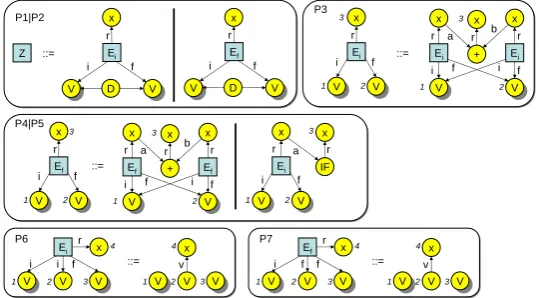
As an example, we consider graphs that represent arithmetic expressions with variables that
Parsing of Adaptive Star Grammars
Z ::=
V
V VV
x D Ef r i f i f P1|P2 V
V VV
x D Ei r i f i f P3 ::= 1 f 2 i i f r a b r r 3 x + V
V VV
x x
Ei Ei
r
i f
1 2 3
V
V VV x Ei r P4|P5 ::= x IF V
V VV x r 3 i f 1 2 a r Ei r i f 1 2 3 V
V VV x Ef r 1 f 2 i i f r a b r r 3 x + V
V VV
x x
Ef Ef
4
x i f
r Ei
1 VV 2 V 3 VV
4 x
1 VV2 V 3 VV
v ::= P6 i 4 x i f r Ef
1 VV 2 V 3 VV
4 x
1 VV2 V 3 VV
v ::= P7 f Z ::= V
V VV
x D Ef r i f P1|P2 V
V VV
x D Ei r i f P3 ::= 1 f 2 i i f r a b r r 3 x + V
V VV
x x
Ei Ei
r
i f
1 2 3
V
V VV x Ei r i f i f P4|P5 ::= x IF V
V VV x r 3 i f 1 2 a r Ei r i f 1 2 3 V
V VV x Ef r 1 f 2 i i f r a b r r 3 x + V
V VV
x x
Ef Ef
4
x i f
r Ei
1 VV 2 V 3 VV
4 x
1 VV2 V 3 VV v ::= P6 i 4 x i f r Ef
1 VV 2 V 3 VV
4 x
1 VV2 V 3 VV v ::= P7
f
Figure 1: Star rules of an adaptive star grammar for the running example.
b r IF x x x x + V V V D r v v a a
f f i
1 3 2 4 5 6 9 8 7 10 Z r x V V V D f f i
1 9 8 7 10 Ef f f i b r x x x + r a 1 3 2 4 V V V D f f i
9 8 7
10
Ef Ef r f f f f i i b r x x x + r a 1 3 2 4 V V V D f f i
9 8 7 10 Ef v f f i P5
P2 P4 P7 b P6
r x x x + r a 1 3 2 4 V V V D f f i
9 8 7 10 Ei v
f f i IF x a 5 6 r Z b r x x x + r a 1 3 2 4 V V V D f f i 9
8
7
10
Ef Ef r f f f f i i P5
P2 P4 P7 r b P6
x x x + r a 1 3 2 4 V V V D f f i
8 10 Ef v f f i 9 7 b r x x x + r a 1 3 2 4 V V V D f f i
8
10
Ei v
f f i IF x a 5 6 r 9 7 r x V V V D f f i
1 8 10 Ef f f i 9 7 b r x x x + r a 1 3 2 4 V V V D f f i
8 10 v IF x a 5 6 v 9 7 Z b r x x x + r a 1 3 2 4 V V V D f f i 9
8 7
10
Ef Ef r f f f f i i P5
P2 P4 P7 b P6
r x x x + r a 1 3 2 4 V V V D f f i
8 10 Ef v f f i 9 7 b r x x x + r a 1 3 2 4 V V V D f f i
8
10
Ei v
f f i IF x a 5 6 r 9 7 r x V V V D f f i
1 8 10 Ef f f i 9 7 b r x x x + r a 1 3 2 4 V V V D f f i
8 10 v IF x a 5 6 v 9 7
G1 G2 G3 G4 G5 G6
Figure 2: Sample derivation using the grammar in Fig.1.
declarations and expressions are represented by a graph: Three variable are declared, represented
byV nodes adjacent to the declaration nodeD. The label of the connection indicates whether it
is an integer variable (i) or a float variable (f). Expressions are represented byx nodes. Anx
node, if it is a variable access, is connected by avedge with aV node. Otherwise, it is connected
by anredge with the operator (+ orIF forinteger-float conversion). Arguments of an operator
are indicated byaandbedges. G6in Fig. 2represents the expressionv7+IF(v9)with integer
variablev9and float variablesv7andv8.
Fig.1shows the rules of an adaptive star grammar for our running example. Terminal nodes
are drawn as circles, nonterminal ones as squares. Multiple nodes (e.g., nodes 1 and 2 in rule P4)
are drawn with a shadow.L::=R1|R2is a shorthand notation for two rulesL::=R1andL::=R2.
Border nodes are indicated by integers, corresponding border nodes of the left-hand side and the right-hand side carry the same integers.
Nonterminals Ei andEf represent an integer resp. float expression. The resultingx is
con-nected by an r edge, and all accessible variables are connected by i and f edges indicating
integer resp. float variables. Productions P1 and P2 create an integer resp. a float expression to-gether with variable declarations from the initial graph. The sets of all integer and float variables
are indicated by the multipleV nodes being connected by ani-labeled resp. f-labeled edge with
V V f 2 V V D‘ i 1 2 V
V i f VV
1 D ::= P3 Z ::= V
V VV
x D’ Ef r i f i f P1|P2 V
V VV
x D’ Ei r i f i f ::= 1 f 2 i i f b r r 3 x V
V VV x
Pi Ei
r
i f
1 2 3
V
V VV x Ei r P4 ::= r i f 1 2 3 V
V VV x Ef r 1 f 2 i i f b r r 3 x V
V VV x
Pf Ef
V
V VV x i f 1 2 r Ei 3 r x C a P5|P6 ::= i f
1 VV V2V
b x Pi 3 x r 2 4 i f r
1 VV 2 VV
Ei
3 x a b
x T x
r 4 P8 ::= r 3 x a b
x T x
1 2
a + b
x x r 3 x 1 2 P9 x r 2 x C a 1 2
x a r x
1 IF ::= P10 ::= i f
1 VV V2V
b x Pf 3 x r 2 4 i f r
1 VV 2 VV
Ef
3 x a b
x T x
r 4 P7 4 x i f r Ei
1VV 2 V 3 VV
4 x
1 VV2 V 3 VV v ::= P11 i 4 x i f r Ef
1 VV 2 V 3 VV
4 x
1 VV2 V 3 VV v ::= P12
f
Figure 3: Star rules of the sample grammar in Fig.1transformed into ACNF
type conversion expression that converts an integer expression to a float expression. P6 and P7 create expressions that consists of just an access to an integer resp. float variable. Note that P6
contains twoV nodes (node 1 and 2) representing integer variables (P7 is similar but with float
variables). Node 1 is multiple whereas node 2 singular. That way, node 2 matches the variable being accessed whereas node 2 matches the set of all other integer variables. Therefore, it is essential that a parser must not try to match only the maximum number of all “fitting” nodes when a production contains a multiple node.
Fig.2 shows a derivation of a graph (G6) representing the sample expressionv7+IF(v9)as
described above. The derivation shows that the expression is well-typed and that its result is of type float. Note that the derivation does not contain any graph with multiple nodes. Multiple nodes in productions are cloned as soon as a production is applied.
4
Parsing without Isolated Nodes
The parser considered in this paper requires adaptive star grammars to be in a certain normalform,
inspired by the Chomsky normalform for context-free string grammars [HU90]:
Definition 1(Adaptive Chomsky normal form) An adaptive star grammarΓ=hΣ,N,P,Ziis in
adaptive Chomsky normal form(ACNF) iff each rulep= (L::=R)∈Pis of one of the following three forms: (1)Terminal rule: every noden∈R˙has a terminal label ˙`R(n)∈Σ˙. (2)Nonterminal
rule: R=S1∪S2consists of two starsS1andS2that do not share their center nodes. (3)Chain
rule:Ris a star.
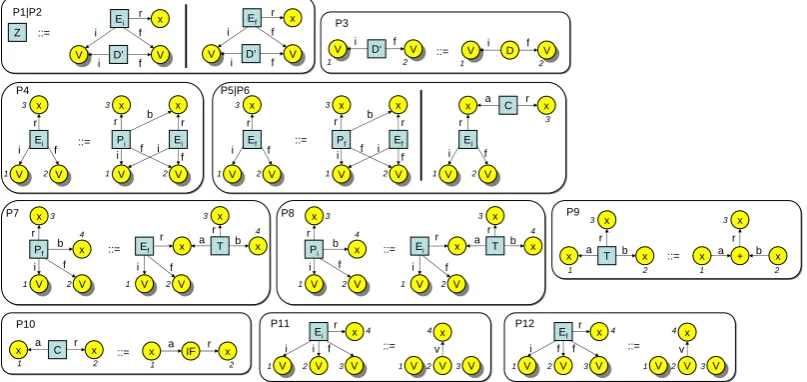
An example of a grammar in ACNF is shown in Fig.3. Rules P3, P9, P10, P11, and P12 are
terminal rules. The other rules are nonterminal. Fig.3does not contain chain rules.
Parsing of Adaptive Star Grammars
is similar as for context-free string grammars that are transformed into Chomsky normal form
(CNF). Fig.3actually shows the rules after transforming the grammar in Fig.1into ACNF. Note
that context-free string grammars in CNF contain terminal and nonterminal rules only. Chain rules are not allowed; it is always possible to transform a context-free string grammar with chain rules into an equivalent one without. It can be shown that this is not possible for every adaptive star grammar with chain rules. Therefore, ACNF has to allow chain rules.
Before parsing adaptive star grammars in ACNF that may contain rules with isolated nodes in their right-hand sides, we consider a sub-class of adaptive star grammars in ACNF in this section:
Definition 2(Restricted adaptive Chomsky normal form) An adaptive star grammar Γ=
hΣ,N,P,Ziis inrestricted adaptive Chomsky normal form(RACNF) iffΓis in ACNF andPdoes
not contain any terminal rule with an isolated node in its right-hand side.
The grammar with rules shown in Fig. 3is not in RACNF since rules P11 and P12 contain
isolated nodes in their right-hand sides (nodes 1 and 3).
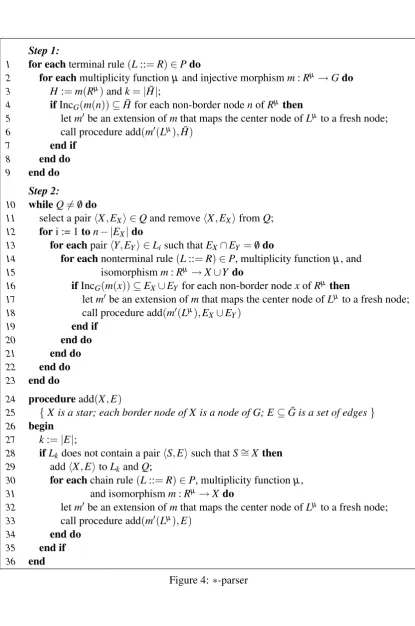
The parsing algorithm in Fig. 4 (called∗-parser in the following) requires an adaptive star
grammar Γ=hΣ,N,P,Zi in RACNF and parses a terminal graph G∈GΣ\Σ¨ without isolated
nodes and with a number n=|G¯| of edges. The algorithm uses as global data structures n
“levels”L1,L2, . . . ,Lnand a working setQ⊆
Sn
i=1Li at every point of time. Each element of a
levelLiis a pairhS,Eiconsisting of a starSand a setE⊆G¯ withiedges ofG. Each border node
ofSis a node ofG.
The parsing algorithm is inspired by the parsing algorithm by Cocke, Younger, and Kasami
(CYK) for context-free string grammars in Chomsky normalform [You67,Kas65]. Given a string
w=a1a2· · ·an, the CYK-parser uses an n×n-matrix M= (mi j)i,j as a global data structure;
however, only those matrix elements mi j with i+j≤n+1 are used. Each matrix element
mi j, after the parser has finished, contains those nonterminal symbols that can be derived to the
substring ajaj+1· · ·aj+i−1, i.e., the substring starting at character j and having length i. The
levels(Li)iof the∗-parser correspond to the matrix elements(mi j)i,j: The CYK-parser classifies
substrings by their length and the index of their first character and assigns them to corresponding matrix elements. Graphs, other than strings, do not have a linear structure that allows to classify
substrings by the index of their first character. Hence, the∗-parser classifies subgraphs by the
number of their edges only and, therefore, maintains an arrayL1, . . . ,Lnof sets instead of a matrix
of sets. Each levelLi, after the parser has finished, contains those stars (together with a set of
edges) that can be derived to a subgraph ofGcontainingiedges. The specific subgraph ofGthat
can be derived from a star in one of the levels is encoded by the set of edges that, together with
the star, is actually stored in the level. Note that, ifGis a member of the language ofΓ, each
subsetE⊆Guniquely identifies a subgraph ofGsinceΓis in RACNF, i.e.,Gmust not contain
isolated nodes.
The structure of the ∗-parser in Fig.4 is similar to the structure of the CYK-parser. Step 1
creates those stars (together with their sets of edges) that can be derived to the corresponding subgraph in a single derivation step. This derivation step must use a terminal rule because
non-terminal rules and chain rules produce nonnon-terminal nodes that are not contained in G. Step 2
Step 1:
1 for eachterminal rule(L::=R)∈Pdo
2 for eachmultiplicity functionµ and injective morphismm:Rµ→Gdo
3 H:=m(Rµ)andk=|H¯|;
4 ifIncG(m(n))⊆H¯ for each non-border nodenofRµ then
5 letm0 be an extension ofmthat maps the center node ofLµ to a fresh node;
6 call procedure add(m0(Lµ),H¯)
7 end if
8 end do
9 end do
Step 2:
10 whileQ6=/0do
11 select a pairhX,EXi ∈Qand removehX,EXifromQ;
12 fori := 1ton− |EX|do
13 for eachpairhY,EYi ∈Lisuch thatEX∩EY =/0do
14 for eachnonterminal rule(L::=R)∈P, multiplicity functionµ, and
15 isomorphismm:Rµ→X∪Y do
16 ifIncG(m(x))⊆EX∪EY for each non-border nodexofRµthen
17 letm0be an extension ofmthat maps the center node ofLµto a fresh node;
18 call procedure add(m0(Lµ),E
X∪EY)
19 end if
20 end do
21 end do
22 end do
23 end do
24 procedureadd(X,E)
25 {X is a star; each border node of X is a node of G; E⊆G is a set of edges¯ } 26 begin
27 k:=|E|;
28 ifLkdoes not contain a pairhS,Eisuch thatS∼=X then
29 addhX,EitoLkandQ;
30 for eachchain rule(L::=R)∈P, multiplicity functionµ,
31 and isomorphismm:Rµ→X do
32 letm0 be an extension ofmthat maps the center node ofLµ to a fresh node;
33 call procedure add(m0(Lµ),E)
34 end do
35 end if
36 end
Parsing of Adaptive Star Grammars
chain rules.
In detail, the algorithm in Fig.4works as follows: Lines 1–9 try every terminal rule that may
have created a subgraph ofG. Such a subgraph must be isomorphic to a clone of the terminal
rule’s right-hand side. Lines 2–8 iterate over each of those clones (specified by its multiplicity
functionµ) and each subgraphH(specified by the image of morphismm). Line 4 checks whether
H is correctly connected to the rest of G, i.e., that there is no edge from a node that does not
belong toHto a node created by this rule. Parsing, i.e., applying this rule in reverse direction,
would produce dangling edges otherwise. MorphismmmapsRµand, hence, border nodes ofLµ
toG. Line 5 extends morphismmtom0such thatm0maps border nodes ofLµ in the same way
asm, but additionally maps the center node ofLµ to a fresh, new node. Them0-image ofLµ is
the star that can be derived toHby applying the current rule clone.
Procedure add(X,E)(line 24–36) is responsible of adding this star to its corresponding level
if the level does not yet contain an isomorphic star that derives to the same subgraphH(line 28).
Moreover, add(X,E) recursively follows all chain rules that may be applied deriving m0(Lµ)
and, hence,H(line 30–34). Note that we need not check for dangling edges as in line 4 since the
right-hand side of a chain rule is a star and, therefore, cannot have non-border nodes. And since chain rules do not create new terminal edges, all results from this process must be added to the same levelLk.
If procedure add(X,E)adds a new pair to a levelLi, this pair is added to working setQ, too.Q,
therefore, contains exactly those pairs that have not yet been considered. Hence, step 2 iterates
overQas long asQis not yet empty (line 10-23). hX,EXiis the current pair. If the star of the
current pair is contained in a derivation ofGand derived by application of a nonterminal rule1,
it must be combined with another starY that derives to a subgraph ofGthat does not have any
edges in common with the subgraph that is derived from the current star X. Dangling edges
would be created otherwise. This condition is checked byEX∩EY = /0 in line 13. In a
CYK-like manner, the combination ofX andY must be isomorphic to some clone of a nonterminal
rule’s right-hand side. Since the border nodes ofX andY are nodes ofG, too, X∪Y denotes
this combination. Like in step 1, the clone of the rule is represented by a multiplicity function.
Again, dangling edges must be avoided. This is checked in line 16. The star that derives toX∪Y
is them0-image ofLµ where morphismm0 is the extension of the isomorphismmsuch that the
border nodes ofLµ are mapped in the same way as bym, but the center node ofLµ is mapped
to a fresh new node. Procedure add(X,E), again, takes care of adding the star with its set of
eventually derived edges, i.e., the disjoint union of those sets associated with the starsX andY,
to the corresponding level and considering chain rules.
Correctness of the∗-parser can be shown (see appendix). Because of these results, a graphG
without isolated nodes belongs to the language of an adaptive star grammar in RACNF iff the ∗-parser, applied toG, terminates with a pairhZ,G¯iin levelL|G¯|.
The∗-parser would actually work with adaptive star grammars in plain ACNF, too, i.e., with
grammars that may have isolated nodes in some of its rules’ right-hand sides. However, parsing
would be really expensive because of line 2 in Fig.4. If the right-hand sideRof a ruleL::=R
contains an isolated singular node, any node of G with a suitable label has to be considered.
The number of possible morphisms, therefore, grows exponentially with the number of isolated
singular nodes. The situation gets even worse ifRcontains an isolated multiple node. This node
can be cloned arbitrarily, i.e., any subset ofGnodes with a suitable label must be considered. As
a consequence, the number of pairshX,Eigrows exponentially in the number of isolated nodes
and exponentially in the number ofGnodes.
A slight modification of the parser in the following section allows to avoid this combinatorial explosion by avoiding to explicitly consider each possibility and avoiding to create each possible pairhX,Ei.
5
Parsing with Isolated Nodes
We now drop the requirement of an adaptive star grammar to be in RACNF. However, we still require the grammar to be in ACNF. It can be shown that the class of adaptive star grammars in RACNF is less powerful than the class of all adaptive star grammars which is the same as the ones in ACNF. Hence, transformation of a grammar in ACNF into an equivalent one in RACNF is not possible in general. Instead, we follow the idea of avoiding the combinatorial explosion by encoding all possibilities in a single graph and dealing with such graphs instead of plain stars
in the∗-parser. This will require another transformation of the grammar. However, the encoding
may be imprecise; graphs may represent proper supersets of all possibilities. The bottom-up
∗-parser, hence, will find derivations that are not correct. A subsequent top-down phase has to
filter out those wrong derivations.
If a terminal rule L::=R contains isolated nodes in its right-hand side R, we consider the
maximal sub-graphR0 ofRwithout isolated nodes and search for multiplicity functionsµ and
morphismsmas shown in line 2 of Fig.4, however based onR0 instead of R. Theseµ andm
are calledcore multiplicity functions resp.core morphisms. In order to take into account the
isolated nodes inR,µ andmmust then be extended. We obtain different starsm0(Lµ)with the
same set ¯H. However, the set of all those stars based on the same core multiplicity function and
core morphism have a common subgraphS with common center node x(up to isomorphism).
The stars differ in nodes ofGthat may be or may be not present in the star. If a node is present,
it is adjacent to the center node. We encode the set of all those stars by adding toS all nodes
that are present in one of those stars and connect them withxin the same way. If the same node
may be connected toxby edges with different labels in different stars, we add different copies of
the node toS. Each copy is connected withxby an edge with one of these different edge labels.
Each node that does not belong to the common subgraph and its incident edge are marked as
optional. The other nodes and labels are calledmandatoryin the following.
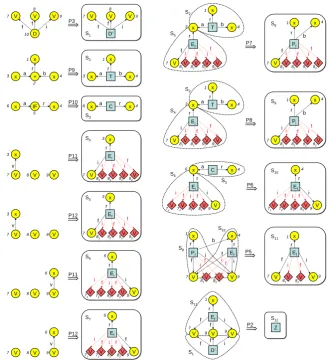
As an example, let the graphG6in Fig.2be graphG, and P11 in Fig.3be the terminal rule.
R0consists of nodes 2 and 4 with their incident edge labeledv. A possible core morphism maps
node 2 and 4 of P11 to node 7 resp. 3 ofG. The set of all possible stars has those nodes 7 and 3
as well as a new nonterminal center node with labelEias common subgraphs. Nodes 8 and 9 of
Gare optional, and they can be connected with the center node either by anior an f edge. The
encoding of all of those stars is shown as starS4 in Fig.6. Nodes marked optional are drawn as
diamonds, and edges marked optional by dashed arrows. Note that nodes 8 and 9 are contained
twice each as 81and 82resp. 91and 92since both nodes can be connected with the center nodes
Parsing of Adaptive Star Grammars
1
::= i
r
x x
V V V
V VV VV V
V V V V V V
V x VV VV VV VV VV VV VV VV
Ef
Ef Pf
r
i i b
f f f i f
r
i f i f i f i f
i f i f i f i f
2 3 4 5 6 7 8 1 2 3 4 5 6 7 8
9 9
1
::= i
r
x x
V V V
V VV VV V
V V V V V V
V x VV VV VV VV VV VV VV VV
Ef
Ef Pf
r
i i b
f f f i f
r
i f i f i f i f
i f i f i f i f
2 3 4 5 6 7 8 1 2 3 4 5 6 7 8
9 9
::= i
r
1V
V x
Ef
i i
f f f i f
V V
2 V
V
3 V
V
4 V
V
5 V
V
6 V
V
7 V
V
8
x
9
i
r
1 V
V
Pf
i i
f f f i f
V V
2 V
V
3 V
V
4 V
V
5 V
V
6 V
V
7 V
V
8
x
9
b
Ef
i f i f i f i f
r
Figure 5: Transformed rule P5 of Fig.3.
It is clear that this encoding may represent a proper superset of all possible stars because the encoding is the same for isolated singular and multiple nodes, i.e., we cannot tell from the encoding how many of the optional nodes have to be selected to obtain a member of the set of all possible stars. This problem is solved by a subsequent top-down phase after the bottom-up
∗-parser (see below).
Step 2 of the∗-parser has to deal with those star encodings that may contain nodes and edges
marked optional. And step 2 has to create new stars that encode possibly large sets of stars, too, without explicitly creating all represented stars. This is done by transforming each nonterminal rule into a rule that can be immediately applied to such encoding graphs. Step 2 then uses those transformed rules instead of the original nonterminal ones.
The transformation is explained for rule P5 in Fig.3. The result is shown in Fig.5. When using
P5 (or its transformed version) in step 2, two starsX andY are combined toX∪Y. Without loss
of generality, letX have a center node labeledPf andY a center node labeledEf. EachV node
adjacent to the center nodes may be marked optional. And each node, optional or mandatory,
can be connected with the center node by an iedge or an f edge. EachV node in the
right-hand side of P5 is connected to both nonterminal nodes by edges with the same labels. The
transformed rule must be applicable to combinations of starsX∪Y where a node is optional in
X andY, or mandatory inX andY, or optional in eitherX orY, and mandatory in the other star.
This is reflected in the right-hand side in Fig.5: Instead of two multiple nodes labeledV in the
original rule P5, there are eight of them. Foriand f edges, each of those four combinations of
optional/mandatory are represented. The left-hand side contains those eight multipleV nodes as
border nodes, too. However, only those nodes resp. edges that are optional inX andY remain
optional after creating the new star from the left-hand side (node 7 and 8). This is so because a
node that is mandatory inX orY has to mandatory in the combinationX∪Y, too.
Note that no nodes in Fig.5are drawn as optional since this may cause conflicts for a
combi-nation of a node being optional and mandatory at the same time.
Step 2 now uses such transformed nonterminal rules. However, combinations ofXandY need
not be isomorphic to a cloneRµ of a rule’s right-hand side becauseX∪Y may contain optional
nodes and edges that cannot be matched withRµ. When searching for an isomorphism, the parser
may drop optional components, but no mandatory ones.
When the∗-parser terminates and a pairhZ,G¯iis contained inL|G¯|, we must check whether
this really indicates thatGbelongs to the grammar’s language. This can be checked top-down by
following the rules fromZtoG. The∗-parser must keep track of all derivations for that purpose.
This is easily done by not only storing pairshX,Ei, but also the stars that have been used when
creatinghX,Ei.
V
V V
D f f i
9 8 7 10 V V V D’ f f i
9 8 7 P3 S1 b r x x x a +
1 3 2 4 b r x x x a T
1 3 4 P9 S2 r x x a C
6 4
P10 r
x x a IF
6 5 4 S3 P2 Z S12 V V V D’ f f i
9 8 7 1 r x Ef f f i S11 S1 x V V V v 3
7 8 9
P11 S4 V V i 7 81 3 r V x i f f i V V Ei
82 91 92
x
V
V V
v
3
7 8 9
P12 S5 V V f 7 81 3 r V x i f f i V V Ef
82 91 92
P11
V
V V
7 8 9
x v 6 S6 i 9 71 6 r x i f i f
V V V
V V
Ei
72 81 82
P12
V
V V
7 8 9
x v 6 S7 f 9 71 6 r x i f f i V V V V V Ef
72 81 82
b x 1 x r 4 P7 S8 b r x x T a 1 4 3 x S5 S2 V V f 7 81 r V i f f i V V Ef
82 91 92
V V f 7 81 V i f f i V V
82 91 92
Pf b x 1 x r 4 P8 S9 b r x x T a 1 4 3 x S4 S2 V V i 7 81 r V i f f i V V Ei
82 91 92
V V i 7 81 V i f f i V V
82 91 92
Pi
6
r
x a C r x 4 4
r x P6 S10 S6 S3 i 9 71 i f i f
V V V
V V
72 81 82
i
9 71
i f i f
V V V
V V
72 81 82
Ei Ef
i f f i b r r 1 x V V x
Pf Ef
4
7 9
f i if
1 x
r
f
7 V V9
i P5 S11 S8 S10 V V
81 82
V V
81 82
Ef i f
reductions2
Figure 6: Reductions performed by the∗-parser when parsingG6in Fig.2.
creates, organized as pairsU=P⇒i S. The left column depicts the (maximal) subgraphsU ofG
matched by right-hand sides of terminal rules. The rule is indicated byPi. Sshows the created
star. The right column depicts the results of step 2. Dashed areas inU indicate which stars are
combined. LevelsLithat contain those stars have been omitted to avoid cluttering of the figure.
The bottom right pair that containsZas a star proves (after the top-down check) thatG6belongs
into the grammar’s language.
6
Conclusions
This paper has outlined a parsing algorithm for adaptive star grammars, an extension of node and hyperedge replacement grammars. A previous paper had shown that the membership problem for a certain subclass of adaptive star grammars is decidable, however, no efficient parser had been
Parsing of Adaptive Star Grammars
parser that is based on the ideas of the well-known parser byCocke,Younger, andKasamifor
context-free string grammars.
The parser has been implemented in Java like the parser for hyperedge replacement grammars in DIAGEN [Min02]. The DIAGEN parser generally runs in super-polynomial time, and so
does the∗-parser. But for applications in practice, the DIAGENparser runs in polynomial time.
Experiments with the∗-parser implementation suggest a similar behavior, too. E.g., it has been
applied to the running example of this paper. On a Pentium M computer with 1.6GHz, the sample
graph in Fig.2(10 nodes and edges) required 1.5ms, and a larger expression with 400 nodes and
more than 500 edges 1.4s. The measured running time was quadratic on the number of edges of the graph.
The parser will then become a component in the planned implementation of the
program-ming language DIAPLAN[DHKM05] for shape analysis, and likewise for refactoring of
object-oriented programs [HJV06].
Bibliography
[BTS00] P. Bottoni, G. Taentzer, A. Sch¨urr. Efficient Parsing of Visual Languages based
on Critical Pair Analysis and Contextual Layered Graph Transformation. In VL
’00: Proceedings of the 2000 IEEE International Symposium on Visual Languages (VL’00). Pp. 59–60. IEEE Computer Society, Washington, DC, USA, 2000.
[DHJ+06] F. Drewes, B. Hoffmann, D. Janssens, M. Minas, N. Van Eetvelde. Adaptive Star
Grammars. In Corradini et al. (eds.), Graph Transformations, Third International
Conference, ICGT 2006, Natal, Rio Grande do Norte, Brazil, Sept. 17–23, 2006. LNCS 4178, pp. 77–91. Springer-Verlag, Sept. 2006.
[DHK97] F. Drewes, A. Habel, H.-J. Kreowski. Hyperedge Replacement Graph Grammars. In
Rozenberg (ed.),Handbook of Graph Grammars and Computing by Graph
Trans-formation. Vol. I: Foundations. Chapter 2, pp. 95–162. World Scientific, Singapore, 1997.
[DHKM05] F. Drewes, B. Hoffmann, R. Klein, M. Minas. Rule-Based Programming with
Dia-Plan. ENTCS 117(1), 2005. Proc. International Workshop on Graph-Based Tools
(GRABATS’04).
[Dre93] F. Drewes. Recognisingk–connected hypergraphs in cubic time.Theoretical
Com-puter Science109:83–122, 1993.
[HJV06] B. Hoffmann, D. Janssens, N. Van Eetvelde. Cloning and Expanding Graph
Trans-formation Rules for Refactoring. ENTCS 152(4), 2006. Proc. Graph and Model
Transformation Workshop (GRAMOT’05).
[HU90] J. E. Hopcroft, J. D. Ullman. Introduction To Automata Theory, Languages, And
[Kas65] T. Kasami. An efficient recognition and syntax analysis algorithm for context-free languages. Technical report AFCRL-65-758, Air Force Cambridge Research Labo-ratory, Bedford Mass., 1965.
[Min02] M. Minas. Concepts and Realization of a Diagram Editor Generator Based on
Hy-pergraph Transformation.Science of Computer Programming44(2):157–180, 2002.
[RS97] J. Rekers, A. Sch¨urr. Defining and Parsing visual Languages with Layered Graph
Grammars.Journal of Visual Languages and Computing7(3), 1996/97.
[SF04] S. Seifert, I. Fischer. Parsing String Generating Hypergraph Grammars. In Ehrig
et al. (eds.),Graph Transformations. LNCS 3256, pp. 352 – 267. Springer-Verlag,
Berlin, 2004.
[SWZ99] A. Sch¨urr, A. Winter, A. Z¨undorf. The PROGRES Approach: Language and
Envi-ronment. In Engels et al. (eds.), Handbook of Graph Grammars and Computing
by Graph Transformation. Vol. II: Applications, Languages, and Tools. Chapter 13, pp. 487–550. World Scientific, Singapore, 1999.
[You67] D. Younger. Recognition and parsing of context-free Languages in Timen3.
Infor-mation and Control10(2):189–208, 1967.
[ZZC01] D.-Q. Zhang, K. Zhang, J. Cao. A Context-sensitive Graph Grammar Formalism
for the Specification of Visual Languages. The Computer Journal44(3):186–200,
Parsing of Adaptive Star Grammars
A
Appendix
Lemma 1 (Termination) Given an adaptive star grammar Γ=hΣ,N,P,Zi in RACNF and a
terminal graph G∈GΣ\Σ¨ without isolated nodes, the∗-parser always terminates.
Proof. The algorithm computes starsm0(Lµ)whose border nodes are nodes of the original graph
G. Hence, the numbers of members of each setLi is finite, and each recursive invocation of
procedureaddmust terminate. The union of all levelsLi is a superset ofQ, and no member is
added toQtwice. Hence, the number of cycles of the while-loop in step 2 must be finite, too.
The proposition now follows from the fact that each for-loop iterates over finite domains.
Lemma 2 (Partial correctness) LetΓ=hΣ,N,P,Zi be an adaptive star grammar in RACNF and G∈GΣ\Σ¨ a terminal graph with a number n=|G¯|of edges, but without isolated nodes. The
following proposition holds after termination of the∗-parser for every star S without multiple nodes:
S=∗⇒
P∆
G ⇔ hS,G¯i ∈Ln
In order to proof this lemma, we make use of the following two elementary lemmata:
Lemma 3(Independence of derivations 1) LetΓ=hΣ,N,P,Zibe an adaptive star grammar,
X1,X2 stars with disjoint edge sets and different center nodes, and G a graph such that X1∪
X2 ⇒k
P∆ G. Then G has two subgraphs G1 and G2 that do not share any nonterminal node,
G=G1∪G2, such that X1⇒kP1∆ G1, X2⇒
k2
P∆ G2, and k=k1+k2.
Proof. We proof the lemma by induction overk. The proposition is true fork=0. For k>0, we assumeX1∪X2⇒kP−∆1G
0⇒
P∆ G. By the induction hypothesis, there are two graphsG1and
G2 that do not share any nonterminal node, G0=G1∪G2, such that X1⇒kP1∆ G1, X2⇒
k2
P∆ G2,
andk−1=k1+k2. G0 ⇒P∆ Gis defined by replacing a star inG0 by a graph. As G1 andG2
do not share any nonterminal node, either G1⇒P∆ G01 and G=G10 ∪G2, or G2⇒P∆ G02 and
G=G1∪G02.
Lemma 4(Independence of derivations 2) LetΓ=hΣ,N,P,Zibe an adaptive star grammar, X1,X2stars with disjoint edge sets and different center nodes, and G1,G2arbitrary graphs such
that X1⇒∗
P∆ G1and X2⇒
∗
P∆G2. Then X1∪X2⇒
∗
P∆ G1∪G2.
Proof. We proof the lemma by induction overn=n1+n2inX1⇒nP1∆ G1 andX2⇒
n2
P∆ G2. The proposition is true forn=0. Without loss of generality, assumen1>0 ifn>0, andX1⇒nP1∆−1
G10 ⇒P∆ G1,X2⇒Pn2∆ G2.X1∪X2⇒
∗
P∆ G
0
1∪G2follows from the induction hypothesis, andG
0
1∪
G2⇒P∆G1∪G2from the definition of star replacements.
Proof of Lemma2. We assumeS⇒k
P∆ Gfor somek≥1 first and provehS,G¯i ∈Lnby induction overk. Ifk=1,hS,G¯iis added toLnin step 1. Fork>1, consider the derivation sequence
S=⇒
P∆
G0=k−⇒1
P∆
The first step in (1) cannot use a terminal rule ask−1>0 and, hence,G0 must contain a
non-terminal node. If the first step in (1) uses a nonterminal rule, there are two starsX1 andX2that
do not share their center nodes such that G0 =X1∪X2. By lemma3, there are two graphsG1
andG2, such thatG=G1∪G2,X1⇒kP1∆ G1,X2⇒
k2
P∆ G2, andk1+k2=k−1. By the induction hypothesis,hX1,G¯1i ∈L|G¯1| andhX2,G¯2i ∈L|G¯2|. Without loss of generality,hX1,G¯1ihas been
added toQwhenhX2,G¯2iwas already member ofL|G¯2|. Therefore,hS,G¯iis added toLnin step 2.
If, however, the first step in (1) uses a chain rule, G0 is a star, and by the induction hypothesis,
hG0,G¯i ∈Ln. Hence,hS,G¯iis added toLnin the procedure invocation add(G0,G¯).
We now assume hS,G¯i ∈Ln and proveS⇒P∗∆ G by induction over n=|G¯|. Since G does
not have isolated nodes,n>0. Ifn=1, hS,G¯i must have been added toLn by invocation of
add(S,G¯)that has been recursively invoked by the first non-recursive invocation of add(S0,G¯)in
step 1. Hence,S⇒∗
P∆ S
0⇒
P∆G. Ifn>1,hS,G¯ihas been added toLneither in the same way as
described forn=1, and henceS⇒∗
P∆ G, or by invocation of add(S,G¯)that has been recursively
invoked by the first non-recursive invocation of add(S0,G¯)in step 2. In the latter case, there are
hX1,E1i ∈L|E1| andhX2,E2i ∈L|E2| such thatE1∩E2=/0, |E1|+|E2|=n, andS0⇒P∆ X1∪X2. By the induction hypothesis, there are graphsG1andG2with ¯G1=E1, ¯G2=E2,X1⇒∗P∆ G1, and
X2⇒∗P∆ G2. And by lemma4,X1∪X2⇒
∗
P∆ G1∪G2 where ¯G
0=E
1∪E2=G¯. G=G0 follows