Master Thesis
September 25
th2018
Examining the effects of a six-week gratitude
intervention
on
emotional,
social,
and
psychological well-being
–
A randomized
controlled trial
Joel Fey
Faculty of Behavioral, Managment and Social Sciences (BMS)
Positive Psychology & Technology University of Twente, 7500AE Enschede, the Netherlands
_____________________________
Supervisors
Marion Sommers-Spijkerman
2
Abstract
Background: Gratitude-based interventions are proven to improve states of well-being.
Despite evidence of the individual and societal benefits of high states in well-being, the effect
of gratitude interventions is not investigated in general public samples thus far. This study
examined the effectiveness of a six-week gratitude intervention on emotional, psychological,
and social well-being. As the mechanisms whereby gratitude relates to well-being are
relatively unexplored, prosocial behavior was investigated as possible mediator.
Methods: 118 participants of the Dutch general public were randomly assigned to a
gratitude condition (n = 51), and a wait-list control condition (n = 67). Emotional,
psychological, and social well-being were measured with the Mental Health Continuum-Short
Form and prosocial behavior with the Theories of Self-Relative-to-Other questionnaire.
Questionnaires were obtained at baseline, post-intervention, and at six-week follow-up. The
Client-Satisfaction questionnaire was used to determine the satisfaction with the intervention
within the gratitude condition.
Results: Repeated measures analyses indicated significant improvements of the
gratitude condition in emotional, psychological, and social well-being from baseline to
post-intervention, with medium to large effects and significant improvements in psychological and
social well-being from baseline to follow-up, with small to medium effects, compared to the
waitlist control condition. Improvements in emotional, psychological, and social well-being
maintained within the gratitude condition between post-intervention and follow-up. The
intervention was rated positive. No mediating effects of prosocial behavior were identified.
Conclusion: Gratitude-based positive psychological interventions are found to be a suitable
way to improve emotional, psychological, and social well-being in non-clinical samples. The
findings can be generalized for higher educated women, as the sample mainly consisted of
participants with these demographic characteristics. Future research should pay attention to
that in order to get more generalizable results. Mechanisms responsible for the found effects
should be further investigated in order to improve the effectiveness of these interventions.
Keywords: Randomized controlled trial, well-being, gratitude, prosocial behavior,
3
Table of Contents
Introduction ... 4
Current study ... 7
Methods ... 8
Design ... 8
Participants and Procedure ... 8
Gratitude intervention ... 10
Wait-list Control condition ... 11
Outcome measures ... 11
Data analysis ... 12
Results ... 15
Study population, randomization, and dropout... 15
Satisfaction with the intervention ... 16
Intervention effects ... 17
Mediation analyses ... 18
Discussion ... 18
Strengths & Limitations ... 21
Future research ... 22
Conclusion ... 24
4
Introduction
The World Health Organization (WHO) defines mental health as “a state of well-being in
which the individual realizes his or her own abilities, is able to cope with normal stresses of
life, works productively, and can make a contribution to his or her community” (WHO, 2004,
p. 10). According to the given definition, mental health is no longer purely regarded as the
absence of mental illnesses, but rather as the presence of well-being (Keyes, 2007; Keyes &
Simoes, 2012). Keyes (2002, 2007) defines well-being on three dimensions: emotional,
psychological, and social well-being. Emotional well-being is about the presence of positive
affect and satisfaction in life. Psychological well-being is about the perception of one’s
personal functioning in life, concerning personal growth, self-acceptance, and having positive
relationships. Social well-being further describes one’s perception of functioning well in
society. This includes accepting society and having feelings of belonging and giving
contribution to it.
Well-being is regarded as an important quality of life which positively influences
various aspects of daily functioning (Kansky & Diener, 2017). As such, high levels in all
three dimensions are associated with fewer mental and physical health complaints (Keyes,
2002, 2004; Keyes & Simoes, 2012). Individuals with high states in well-being, for example,
are more likely to maintain a healthy lifestyle, like diet and exercise, and are more resistant
against mental distress (Kansky & Diener, 2017). Accordingly, well-being is negatively
correlated to mental illnesses (e.g. depression) (Keyes, 2002), and is regarded as preventive
factor for a variety of mental disorders (Seligman, 2002). High levels of well-being at the
workplace are associated with fewer sick days, more productivity, and more collaboration
between employees, which benefits the overall company revenue (Kansky & Diener, 2017).
Thus, besides benefitting domains of healthcare, high states of well-being also benefit
workplace organization and economics (see Kansky & Diener, 2017).
The domain of positive psychology develops evidence-based interventions in order to
strengthen positive aspects of life, including satisfaction, happiness, and well-being (Slade,
2010). Due to the range of individual and societal benefits, promoting well-being became the
main focus of positive psychological research (see Seligman, 2002; Slade, 2010; Wood, Froh,
& Geraghty, 2010).
In order to foster well-being, gratitude is seen as a resource (Renshaw & Rock, 2018).
5
Rock, 2018; Drazwkowski, Kacmarek, & Kashdan, 2017; Wood, Froh, & Geraghty, 2010)
has examined gratitude, it seems difficult to conceptualize it (Renshaw & Rock, 2018).
McCullough, Emmons, and Tsang (2002) describe gratitude as an affective trait, which lowers
the threshold for recognizing and responding to the benevolence of others and creates discrete
emotional experiences. According to that, Fredrickson (2004) states gratitude to be a positive
emotion, like joy, interest, or love. Peterson and Seligman (2004) argue that “what marks
gratitude is the psychological response to a gift, whatever its nature, and the experience,
however briefly, of the transcendent emotions of grace – the sense that we have benefited
from the actions of another.” (p. 524). However, according to Wood, Froh, and Geraghty
(2010) gratitude does not only concern appreciating beneficial actions of others but also
appreciating other aspects of life (see also Emmons & McCullough, 2003). For the aim of this
study, gratitude is described as response to obtain a personal benefit, regardless of its source
(Furlong, You, Renshaw, O’Malley, & Rebelez, 2013).
There is given evidence that gratitude is positively related to all three dimensions of
well-being (Watkins, Woodward, Stone, & Kolts, 2003; Emmons & McCullough, 2003;
Wood, Joseph, & Maltby, 2009; Ryff, 1989; Ryff & Keyes, 1995). With regard to emotional
well-being, feeling gratitude is stated to elicit positive emotions (Diener, 1984; Wood, Froh,
& Geraghty, 2010). As such, feeling and expressing gratitude more frequently results in more
life satisfaction (see Wood, Froh, & Geraghty, 2010). Gratitude can further increase the
likelihood of optimal psychological functioning, by enabling individuals to cope better with
stressors in life (Emmons & McCullough, 2003; Fredrickson, 2004; Wood, Joseph, & Linley,
2007). With regard to social well-being, gratitude is stated to link individuals to society
(Fredrickson, 2004). Perceiving oneself as the beneficiary of the generosity of others leads to
feelings of being affirmed and valued (McCullough, Emmons, & Tsang, 2002), and to
strengthened social bonds (Emmons & McCullough, 2003).
A large body of literature investigated the effects of gratitude-based positive
psychological interventions (PPIs) on each dimension of well-being. In a review, Wood, Froh
and Geraghty (2010) distinguish three types of common PPIs, concerning the expression of
gratitude: Gratitude lists, grateful contemplation, and the behavioral expression of gratitude.
The gratitude list involves making written lists of things for which one feels grateful. This
usually happens in form of a diary, where participants, for example, write down for what they
were thankful for during the day. Grateful contemplation is, compared to the grateful listing
6
grateful in a more general way. The behavioral expression of gratitude focuses on gratitude
towards a certain benefactor, for example by writing a letter thanking a person for the gift or
benefit which is received (see Wood, Froh & Geraghty, 2010).
Taking these PPIs into account, there is evidence that gratitude can be trained as to
improve aspects of well-being. Previous intervention studies with student and community
samples found beneficial effects of gratitude exercises on emotional well-being, for example
enhanced positive affect and optimism regarding the future (Emmons & McCullough, 2003),
improvements in mood, and more satisfaction in life (Watkins et al., 2003; Emmons &
McCullough, 2003; Wood, Froh, & Geraghty, 2010). There is less literature about the effects
of gratitude exercises on psychological and social well-being, but previous studies indicated
that being grateful is positively associated to a range of psychological well-being variables,
including personal growth, self-acceptance, positive relations, and the feeling of having a
purpose in life (Fredrickson, 2004; Wood, Joseph, & Maltby, 2009). Regarding social
well-being, gratitude interventions were found to improve relationship satisfaction (O’Connell,
O’Shea, & Gallagher, 2016) and to lead to a strengthened feeling of connectedness to others
(Emmons & McCullough, 2003). Taking this into account, practicing gratitude might improve
all three dimensions of well-being. Furthermore, given the strong association between
gratitude and well-being, a further step would be to examine the mechanisms responsible for
why gratitude promotes well-being (Emmons & Mishra, 2011).
One possible mechanism relates to prosocial behavior. Gratitude makes people want to
recognize and repay the actions of others (Algoe & Haidt, 2009). Furthermore, instead of
simply repaying the benefactor, beneficiaries report motivation to act in others ways which
promote relationships, such as spending time with the other (see Algoe & Haidt, 2009; Algoe,
2012). To find an answer on why beneficiaries have this motivation, Fredrickson’s (1998,
2000, 2004) Broaden and Build theory might give an explanation. According to this theory,
gratitude broadens the thought-action repertoire. As such, the motivation of repaying the
benefactor does not follow a tit-for-tat fashion by only reciprocating the exact beneficial
action. Gratitude broadens individuals’ way of thinking by considering a variety of actions
that might either benefit the benefactor, others, or both, as reflection of their gratitude
(Fredrickson, 2004). Because of that, gratitude is seen as motivator for prosocial behavior
(McCullough, Kilpatrick, Emmons, & Larson, 2001; Fredrickson, 2004). Peterson and
Stewart (1996) for example found, that being mentored in early adulthood was positively
7
be the urge (see also Fredrickson, 2004). McCullough and Emmons (2003) further found, that
participants following a gratitude intervention reported having helped someone with a
personal problem or provided emotional support, indicating a prosocial motivation due to the
gratitude induction. This is in line with Bartlett and DeSteno (2006) who found that following
a gratitude intervention improves prosocial behavior. According to the Broaden and build
theory, prosocial acts which are motivated by gratitude, help to build up personal resources
(Fredrickson, 2004). According to this, prosocial behavior builds up and strengthens social
relationships, which become the locus of consequential social support in times of need.
Taking this into account, prosocial behavior is proven to promote emotional, psychological,
and social well-being (Nelson, Layous, Cole, & Lyumbomirsky, 2016)
Despite evidence that gratitude might benefit emotional, psychological, and social
well-being, previous research on the effectiveness of gratitude interventions shows a number
of limitations, like small sample sizes (O’Connell, O’Shea, & Gallagher, 2016, 2017), or
specific samples (e.g. psychotherapy clients or students only) (Renshaw & Rock, 2018; Wong
et al., 2018). This leads to limited generalizability of the findings. Thus far, the effect of
gratitude-based PPIs has not been investigated in general public samples. However, the
improvements in well-being due to gratitude exercises underline the relevance of an
investigation in these samples. Regarding the benefits of high states of well-being for both,
the individual and society (Seligman, 2002; Slade, 2010; Wood, Froh, & Geraghty, 2010),
more insight in how gratitude interventions promote well-being could be used for prevention
of mental illnesses, and the promotion of mental health (Bolier et al., 2013). Furthermore,
another limitation of prior studies is that the underlying working mechanisms between
gratitude and well-being are largely unknown (see O’Connell, O’Shea, & Gallagher, 2017).
Current study
A randomized controlled trial was conducted to investigate the effectiveness of a
six-week gratitude intervention on emotional, psychological, and social well-being in the general
Dutch population. This investigation is the first in examining emotional, psychological, and
social well-being in one study. Furthermore, this investigation overcomes limitations of
previous research by using a general population sample. As such, findings were more
generalizable. Because literature over the underlying mechanisms in the effect of gratitude on
well-being is extremely limited, prosocial behavior was tested as mediating variable for each
dimension of well-being. Based on the theoretical evidence reviewed, the following
8
H1: The six-week gratitude intervention leads to improvements in emotional,
psychological, and social well-being, and prosocial behavior, compared to the
wait-list control condition, (a) at post-intervention and (b) at six-week
follow-up.
H2: The effect of the six-week gratitude intervention on emotional, psychological,
and social well-being is mediated by changes in prosocial behavior from
baseline to post-intervention.
Methods
Design
The present study was a randomized controlled trial (RCT). It was part of a large-scale
investigation, examining the effects of different PPIs within the Netherlands, including 5
different conditions: two ‘Acts of Kindness’ (with and without reflection) conditions, a
‘Gratitude’ condition, and two control conditions (active and wait-list control). For the aim of
this study, the gratitude and the wait-list control condition were used. The questionnaires were
obtained at baseline (T0), at the end of the intervention six weeks later (T1), and at six-week
follow-up, thus three months after baseline (T2).
Participants and Procedure
Participants were recruited in the general Dutch public, through advertisements in national
newspapers (Volkskrant, Telegraaf, Metro), and an online newsletter of ‘Psychologie Magazine’. Interested people were referred to a website, where they received further
information about the study and the registration procedure. After downloading and filling out
the contact form, as well as an informed consent, they received a screening questionnaire
(age, gender, educational level, CES-D, GAD-7) testing them for eligibility. Participants had
to be at least 18 years old, with sufficient Dutch language proficiency. Because both the
instructions and questionnaires were received online, a good internet connection and an email
address were required. Participants further had to be willing to do a gratitude exercise each
day during the six-week intervention. To become excluded from the study, participants had to
show indications for serious symptoms of depression or anxiety. As such, participants who
9
(CES-D) or a score of 15 or higher on the Generalized Anxiety Disorder 7 (GAD-7) were
excluded. Those who were excluded based on anxiety or depression were advised to seek help
from the general practitioner. The criteria for exclusion were not given to the participants, to
prevent possible influenced scores at the screening assessment.
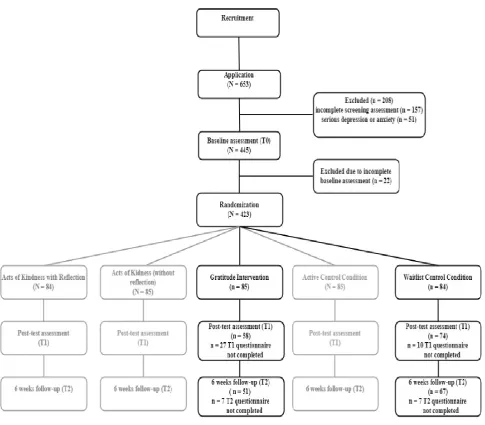
The flow of participants is illustrated in Figure 1. When participants were eligible to
participate, they received an email with the T0-questionnaire. After a sufficient number of T0
questionnaires were obtained, the participants were randomly assigned (allocation ratio 1:1) to
one of the five conditions. Randomization was stratified by gender and level of education
(low, medium, high). In total, 653 registrations were received. After exclusion 423
participants remained. They were allocated to either one of the intervention- or one of the
control conditions. In total, n = 85 participants were assigned to the gratitude and n = 84 were
10
Figure 1. Flow chart of participants.
Gratitude intervention
The aim of the intervention was to promote emotional, psychological, and social
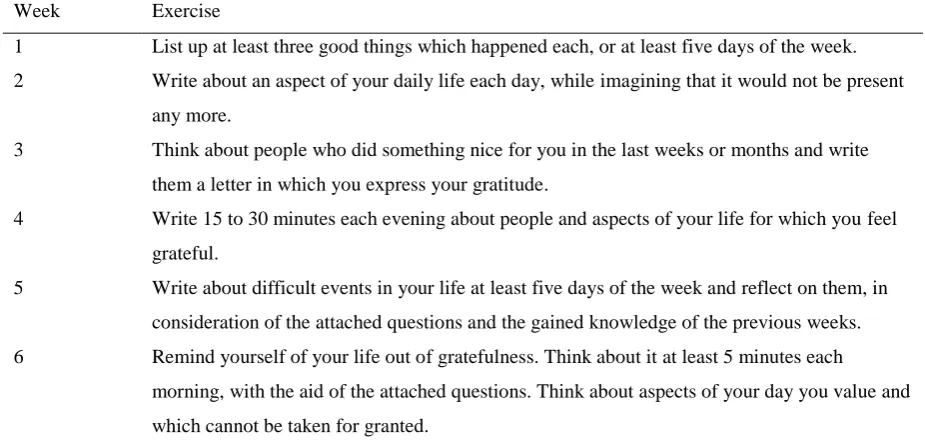
well-being by providing a variety of gratitude-based exercises over the course of six weeks. Each
Sunday, participants received another exercise they had to perform at least five days of the
upcoming week. The exercises were based on the three common types of gratitude
interventions, as discussed previously: Gratitude lists, grateful contemplation, and the
behavioral expression of gratitude (Wood, Froh & Geraghty, 2010). Participants were
allowed to decide for themselves when and where they wanted to practice the exercises. The
estimated time invested by the participants for doing the exercises was around 45-60 minutes
per week, thus, 270-360 minutes in total in the course of the 6 weeks intervention. The weekly
11
Table 1. Description of the weekly gratitude exercises
Week Exercise
1 List up at least three good things which happened each, or at least five days of the week.
2 Write about an aspect of your daily life each day, while imagining that it would not be present
any more.
3 Think about people who did something nice for you in the last weeks or months and write
them a letter in which you express your gratitude.
4 Write 15 to 30 minutes each evening about people and aspects of your life for which you feel
grateful.
5 Write about difficult events in your life at least five days of the week and reflect on them, in
consideration of the attached questions and the gained knowledge of the previous weeks.
6 Remind yourself of your life out of gratefulness. Think about it at least 5 minutes each
morning, with the aid of the attached questions. Think about aspects of your day you value and
which cannot be taken for granted.
Wait-list Control condition
Participants in the wait-list control condition were told that at first, an impression of their
states in well-being is gathered. They obtained the questionnaires at all assessment moments
and received the possibility to start with one of the offered PPIs one month after the follow-up
(T2). In this way, it was possible to determine whether possible effects in well-being could be
attributed to the intervention.
Outcome measures
Mental well-being was measured with the Mental Health Continuum-Short Form (MHC-SF;
14 items). It contains subscales for each aspect of mental well-being used for this study,
including 3 items about emotional, 6 items about psychological, and 5 items about social
well-being (Lamers, Westerhof, Bohlmeijer, Ten Klooster, & Keyes, 2011). Participants had
to report the frequency of every feeling in the past 4 weeks on a six-point Likert scale,
ranging from ‘0’ (‘never’) to ‘5’ (‘(nearly) always’). Higher scores indicate higher levels of
well-being. In the study of Lamers et al. (2011) the questionnaire showed sufficient internal
reliability, as well as good convergent and discriminant validity. Cronbach’s alpha in the
current study showed sufficient internal reliability for emotional (α = 0.85), psychological (α
= 0.85) and social well-being ((α = 0.76).
To measure prosocial behavior, the Theories of Self-Relative-to-Other Behavior
questionnaire (TSROB; Gerbasi & Prentice, 2013) was used. For the aim of this study, it was
12
measure the endorsement of different relationships between self- and other- interest. For the
aim of this study, only the subscale for prosocial behavior (3 items) was used. Participants had
to give answer on how much they agree with the certain statement on a seven-point Likert
scale, ranging from ‘1’ (‘totally disagree’) to 7 (‘totally agree’). Higher scores were associated
with higher amounts of prosocial behavior. Because Cronbach’s alpha on the subscale for
prosocial behavior was low (α = 0.36), the inter-item correlation was examined (Briggs &
Cheek, 1986). Items with a low correlation (r < 0.2) were excluded in order to enhance the
reliability of the scale (Briggs & Cheek, 1986; Field, 2013). The investigation of the prosocial
subscale revealed that the first item correlated low (r = 0.15) with item two and negatively (r
= - 0.7) with item 3. Item two and three showed a suitable correlation (r = 0.44).
Consequentially, the first item was excluded from the analysis, which resulted in a
Cronbach’s alpha of α = 0.61 for the remaining items.
Participants in the gratitude condition further received the Client Satisfaction
Questionnaire – 8 (CSQ-8; 8 items) (Larsen, Attkisson, Hargreaves, & Nguyen, 1979). The
scale was used additionally at post-intervention assessment (T1) to get a picture of the general
satisfaction of participants with the intervention. Participants gave answer on each item by
using a four-point Likert scale, whereby the lowest degree of satisfaction was indicated by ‘1’
and the highest by ‘4’ (Attkisson & Zwick, 1982). The sum score indicated the degree of
satisfaction. Higher scores were associated with being more satisfied with the intervention.
The current study found a Cronbach’s alpha of α = 0.94, which was congruent with the
findings of Larsen et al. (1979). For this investigation, two additional items were
administered, asking participants for the average amount of time they spent in exercising per
week and for giving the intervention an overall grade on a scale from ‘1’ to ‘10’, whereby ‘10’ was the best possible grade.
Data analysis
Analyses were conducted using the statistical program IBM SPSS Statistics 22 (IBM, 2015).
The significance level was set at p < 0.05 for all statistical analyses. Listwise deletion was
regarded as suitable approach to handle missing data, as an analysis of missing values
revealed that the data was missing completely at random (χ2(23) = 18.64, p = 0.72) (Kang,
2013). First, baseline characteristics of both conditions were analyzed. In order to test whether
the randomization of participants led to two comparable groups, independent samples t-test
was conducted for the continuous variable of age, and Chi-Square tests for all other
13
baseline differences of the outcome measures. Mean scores of the gratitude condition were
compared to those of the wait-list control condition. Insignificant results on both, Chi-Square
and independent samples t-tests indicated a successful randomization. Additionally,
Chi-Square tests and independent sample t-tests were conducted to compare the baseline
characteristics of completers and dropouts, in order to determine whether participants who
completed all assessments significantly differed from the non-completers.Insignificant results
indicated no differences. Internal reliability of the outcome measures was computed at T0
using Cronbach’s alpha coefficient. Because values of Cronbach’s alpha below 0.7 could be
expected when dealing with psychological constructs (Field, 2013), the cut-off point for
reliability was set at α = .60.
Participants’ satisfaction with the intervention was measured with the CSQ-8 and its
two additional items. To get an impression of how satisfied the participants were with
following the intervention both, the mean of the original eight-item scale, and the descriptives
of the additional items were analyzed. Due to the scale range of four, a score of M > 2.50 was
interpreted as positive.
Effects of the intervention on emotional well-being, psychological well-being, social
well-being, and prosocial behavior were examined using GLM repeated measures (mixed
ANOVA). To determine the main effects of the intervention, a 3 (time) × 2 (group) design
was used, analyzing the mean scores of the outcome measures (T0, T1, and T2) as
within-subject variable, and the conditions (gratitude and wait-list control) as between-within-subject
variable. Within-subject contrasts were analyzed to determine the effects from T0 to T1 per
outcome measure. In order to test whether the intervention significantly improved the
outcome measures at T2, a 2 (time) × 2 (group) model was used. Thereby, mean scores of the
outcome measures (T0 and T2) were set as within-subject variable and the conditions as
between-subject variable. Effects on the outcome measures from T0 to T2 were determined
by using within-subject contrasts. To determine whether improvements in the outcome
measures maintained between T1 and T2, paired sample t-tests were conducted for the mean
scores of the gratitude condition. Effect sizes were measured with partial eta squared (ηp2) and
set at ηp2 > .01, ηp2 > .06, and ηp2 > .14 for small, medium, and large effects, respectively
(Cohen, 1988; Bakerman, 2005).
To test whether prosocial behavior mediated the effect of gratitude intervention on
well-being, simple mediation analysis was conducted using the PROCESS macro for SPSS
14
behavior due to the intervention, the difference score from T0 to T1 was implemented as
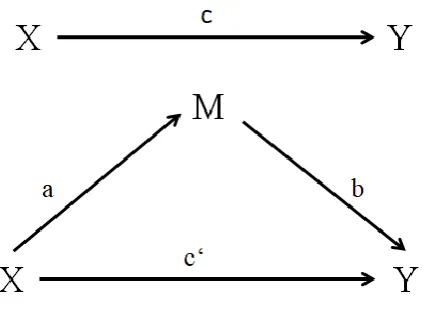
mediating variable for analyses. Figure 2 illustrates the path model as analyzed with
mediation analysis. The independent variable X is the intervention condition, the mediating
variable M is the change in prosocial behavior between baseline and post-intervention, and
the dependent variable Y is emotional, psychological, or social well-being at post-intervention
assessment (T1). Simple mediation analyses were conducted for each dependent variable
separately. The total effect of the intervention on emotional, psychological, and social
well-being is described by the c-path. The a-path is described as the effect of the intervention on
prosocial behavior and the b-path as the effect of prosocial behavior on emotional,
psychological, and social well-being, respectively. The direct effect of the intervention is
described by the c’-path. The mediation effect of prosocial behavior is described as indirect
effect of the intervention on well-being, and is computed by combining the a- and b-paths of a
certain model (a*b) (Hayes, 2012). Because the total effect (c-path) is computed as the sum of
c’ and the combined effect of a and b (a*b), the direct effect (c’) should decrease in cases of
significant indirect effects of prosocial behavior (Hayes, 2012). Analyses were conducted
using bootstrap significance tests with a bias-corrected and accelerated (BCa) 95% confidence
interval (CI) and with a resample procedure of 5000 bootstrap samples (O’Conell, O’Shea &
Gallagher, 2017). Mediation was only significant if any confidence interval for the indirect
effect did not include zero (Hayes, 2012).
Figure 2. Simple mediation model as described by Hayes (2012), considering T0-T1 changes in prosocial behavior (M) as mediator of the effect of the intervention (X) on emotional, psychological and social well-being
[image:14.595.87.302.485.645.2]15
Results
Study population, randomization, and dropout
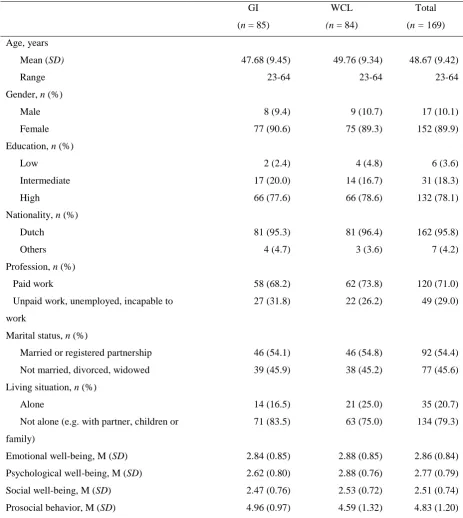
Baseline characteristics of the study population (N = 169) were summarized in Table 2. The
majority of the sample population consisted of higher educated (n = 132, 78.1%) females
(152, 89.9%), having a Dutch nationality (n = 162, 95.8%). The mean age of participants was
48.67 years (SD = 9.42, range: 23-64). Chi-Square analyses and independent samples t-test
revealed that the gratitude condition and the wait-list control condition did not significantly
differ with regard to the demographic variables (p > 0.28), indicating a successful
randomization. With regard to the outcome measures independent sample t-test found a
significant difference between the conditions in psychological well-being (t(167) = -2.10, p <
0.05), indicating a higher mean score in the wait-list control condition for this dimension at
T0, compared to the gratitude condition. Regarding the dropouts, 51 participants of the
gratitude condition (60%) and 67 participants of the wait-list control condition (79.8%)
completed all assessments. As such, 34 participants of the gratitude intervention (40.0%) and
17 participants of the wait-list control condition (20.2%) were excluded for further analyses.
Considering the differences between completers and dropouts, Chi-Square analyses revealed
no significant differences between the two groups (p ≥ 0.10). Independent samples t-tests
further found no significant differences between completers and dropouts with regard to the
outcome measures (p ≥ 0.08). However, there was significant difference in age (t(167) = 3.61,
p < 0.001). With a mean age of 44.80 (SD = 10.45) the non-completers were 5.54 years
16
Table 2. Baseline characteristics of the intervention condition, wait-list control condition, and the total sample.
GI
(n = 85)
WCL
(n = 84)
Total
(n = 169)
Age, years
Mean (SD)
Range 47.68 (9.45) 23-64 49.76 (9.34) 23-64 48.67 (9.42) 23-64
Gender, n (%)
Male Female 8 (9.4) 77 (90.6) 9 (10.7) 75 (89.3) 17 (10.1) 152 (89.9)
Education, n (%)
Low Intermediate High 2 (2.4) 17 (20.0) 66 (77.6) 4 (4.8) 14 (16.7) 66 (78.6) 6 (3.6) 31 (18.3) 132 (78.1)
Nationality, n (%)
Dutch Others 81 (95.3) 4 (4.7) 81 (96.4) 3 (3.6) 162 (95.8) 7 (4.2)
Profession, n (%)
Paid work
Unpaid work, unemployed, incapable to
work 58 (68.2) 27 (31.8) 62 (73.8) 22 (26.2) 120 (71.0) 49 (29.0)
Marital status, n (%)
Married or registered partnership
Not married, divorced, widowed
46 (54.1) 39 (45.9) 46 (54.8) 38 (45.2) 92 (54.4) 77 (45.6)
Living situation, n (%)
Alone
Not alone (e.g. with partner, children or
family) 14 (16.5) 71 (83.5) 21 (25.0) 63 (75.0) 35 (20.7) 134 (79.3)
Emotional well-being, M (SD) 2.84 (0.85) 2.88 (0.85) 2.86 (0.84)
Psychological well-being, M (SD) 2.62 (0.80) 2.88 (0.76) 2.77 (0.79)
Social well-being, M (SD) 2.47 (0.76) 2.53 (0.72) 2.51 (0.74)
Prosocial behavior, M (SD) 4.96 (0.97) 4.59 (1.32) 4.83 (1.20)
Notes: GI Gratitude intervention condition, WCL Wait-list control condition, SD Standard deviation
Satisfaction with the intervention
Participants in the gratitude condition rated the intervention positive (M = 2.99, SD = 0.62).
15 participants (29.4%) reported having invested at least one to two hours a week for the
exercises. 22 participants (43.1%) invested 30 – 60 minutes per week in practicing, and 14
participants (27.5%) spent less than 30 minutes in exercising. 40 participants (78.4%) gave
the intervention a grade of seven or higher. The lowest given grade was four and was given by
17
Intervention effects
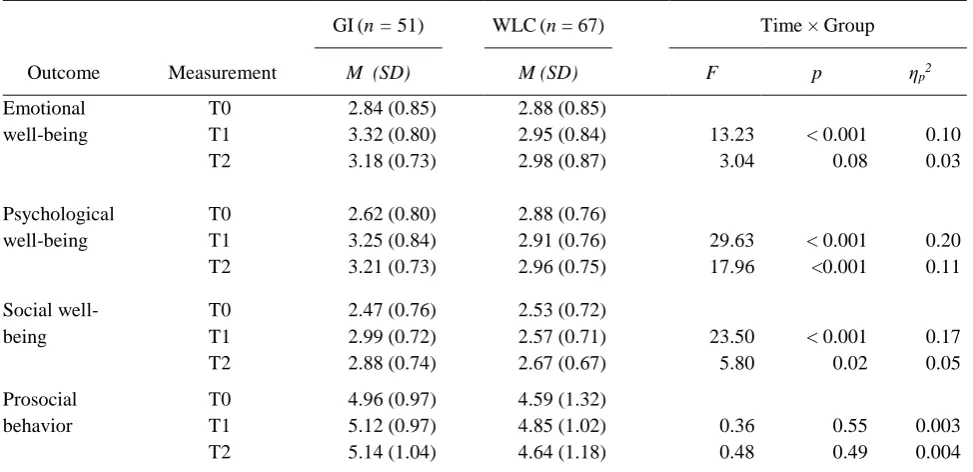
Results of the GLM repeated measures are displayed in Table 3. They indicated that
the gratitude condition had stronger increases in emotional, psychological, and social
well-being, compared to the wait-list control condition, at T1 and at T2. There was a significant
main effect of time × Group interaction (F(8, 109) = 4.93, p < 0.001, ηp2 = 0.27). From T0 to
T1, significant Time × Group interaction effects were found for emotional, psychological, and
social well-being (p < 0.001), but not for prosocial behavior (p = 0.55). Effect sizes for all
significant interaction effects were medium to large (ηp2 = 0.10 to 0.20). From T0 to T2,
significant Time × Group interactions were found for psychological and social well-being (p ≤
0.02) with small to medium effect sizes (ηp2 = 0.05 to 0.11). The interaction effect for
emotional well-being from T0 to T2 was marginally significant (p = 0.08). However,
paired-sample t-tests revealed insignificant results for emotional (t(50) = 1.612, p = 0,11),
psychological (t(50) = 0.58, p = 0.57), and social well-being (t(50) = 1.34), p = 0.19),
indicating that the improvements in these outcome measures within the gratitude condition
were maintained between T1 and T2. The insignificant interaction effects on prosocial
[image:17.595.55.542.459.695.2]behavior (T0-T1 and T0-T2) indicated no changes in this outcome at any assessment.
Table 3. GLM repeated measures results with estimated means and effects of the intervention on emotional, social, and psychological well-being, and prosocial behavior (T0, T1, T2) based on within-subject contrasts, including standard
deviations, and effect sizes
GI(n = 51) WLC(n = 67) Time × Group
Outcome Measurement M (SD) M (SD) F p ηp2
Emotional well-being T0 T1 T2 2.84 (0.85) 3.32 (0.80) 3.18 (0.73) 2.88 (0.85) 2.95 (0.84) 2.98 (0.87) 13.23 3.04 < 0.001 0.08 0.10 0.03 Psychological well-being T0 T1 T2 2.62 (0.80) 3.25 (0.84) 3.21 (0.73) 2.88 (0.76) 2.91 (0.76) 2.96 (0.75) 29.63 17.96 < 0.001 <0.001 0.20 0.11 Social well-being T0 T1 T2 2.47 (0.76) 2.99 (0.72) 2.88 (0.74) 2.53 (0.72) 2.57 (0.71) 2.67 (0.67) 23.50 5.80 < 0.001 0.02 0.17 0.05 Prosocial behavior T0 T1 T2 4.96 (0.97) 5.12 (0.97) 5.14 (1.04) 4.59 (1.32) 4.85 (1.02) 4.64 (1.18) 0.36 0.48 0.55 0.49 0.003 0.004
Notes: GI Gratitude intervention condition, WCL Wait-list control condition, SD Standard deviation, ηp2 effect size
18
Mediation analyses
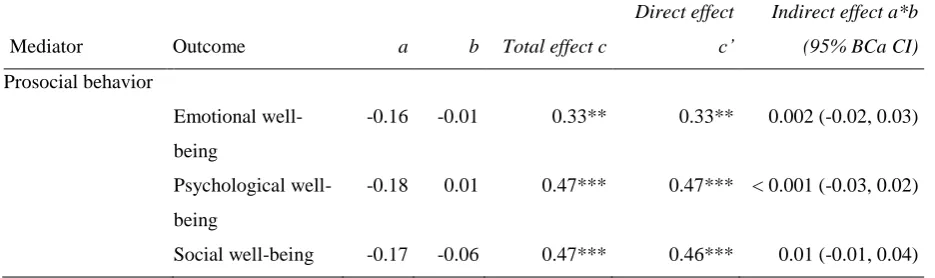
Table 4 represents the results of the mediation analyses. Results revealed significant
effects of the intervention on emotional, psychological, and social well-being (p < 0.01)
(c-path). This effect remained constant in consideration of the mediating variable (c’-(c-path). With
regard to that, analysis found no significant a-paths for any outcome measure, indicating that
the intervention did not lead to changes in prosocial behavior (p ≥ 0.32). Furthermore,
prosocial behavior did not lead to changes in emotional, psychological, or social well-being,
as all b-paths showed to be insignificant, too (p ≥ 0.19). Mediation effect of prosocial
behavior was not found for any outcome measure, as all 95% BCa confidence intervals for
indirect effects did include zero (Table 4).
Notes: a, b, c, c’ path coefficients as given by unstandardized beta values, BCa CI Bias corrected bootstrap
confidence interval for indirect effect, number of resamples is 5,000, * p < 0.05; **p < 0.01; ***p < 0.001.
Discussion
The aim of the current study was to investigate the effects of a six-week gratitude intervention
on emotional, psychological, and social well-being in a general Dutch population sample, and
possible mediating effects of prosocial behavior. In line with hypotheses 1(a) and 1(b), it was
found that participants who followed the gratitude intervention significantly improved in
emotional, social, and psychological well-being, after six weeks, and further significantly
improved in psychological and social well-being after 12 weeks. Although the effect in
emotional well-being from T0 to T2 was marginally significant, it was further found that
improvements in emotional, psychological, and social well-being maintained within the
gratitude condition between post-intervention and follow-up. The intervention did not find
[image:18.595.69.537.328.467.2]any mediating effects of prosocial behavior.
Table 4. Results of simple mediation analyses assessing the indirect effect of the gratitude intervention on
emotional, psychological, and social well-being (T0-T1).
Mediator Outcome a b Total effect c
Direct effect c’
Indirect effect a*b (95% BCa CI)
Prosocial behavior Emotional well-being Psychological well-being Social well-being -0.16 -0.18 -0.17 -0.01 0.01 -0.06 0.33** 0.47*** 0.47*** 0.33** 0.47*** 0.46***
0.002 (-0.02, 0.03)
< 0.001 (-0.03, 0.02)
19
Following the gratitude intervention led to significant improvements in emotional
well-being, as compared to the wait-list control condition from baseline to post-intervention.
This is in line with O’Connell, O’Shea, and Gallagher (2017) who found that following a
gratitude intervention significantly improved life-satisfaction. The aim of the current study
was to let participants consciously deal with gratitude. As such, it is possible that during the
six weeks of the intervention, participants focused more on their positive emotions (see
Diener, 1984; Houben, Van Den Noortgate, & Kuppens, 2015) and positive experiences
(Wood, Froh, & Gergahty, 2010), which led to improvements in emotional well-being at
post-intervention.
With regard to psychological well-being, the current study found significant
improvements from baseline to post-intervention, as compared to the wait-list control
condition. Grateful individuals tend to use more positive coping strategies when dealing with
problematic situations (Wood, Joseph, & Linley, 2007). According to that, positive
reinterpretation is stated to be a strategy which promotes personal growth (see Wood, Froh, &
Geraghty, 2010). The current intervention asked participants, among other things, to think
about difficulties in their life in consideration of their positive aspects, for example what they
learned from these situations, or whether they changed positively due to the experienced
difficulties. In this way participants may have accepted and positively reinterpreted the certain
events, which led to improvements in their psychological well-being at post-intervention (see
Updegraff & Taylor, 2000; Wood, Joseph, & Linley, 2007).
Following the gratitude intervention further significantly improved social well-being
from baseline to post-intervention, as compared to the wait-list control condition. This is
conform with findings of previous investigations, which found that following a gratitude
intervention led to improved relationship satisfaction (O’Connell, O’Shea, & Gallagher, 2016)
and connectedness to others (Emmons & McCullough, 2003). Participants of the current
intervention were asked to actively think about and express their gratitude towards their
benefactors. Feeling and expressing gratitude towards a certain benefactor prompts
individuals to find new positive qualities in that person, or reminds them of their known
positive qualities (Algoe, Haidt, & Gable, 2008; Algoe, 2012; O’Connell, O’Shea &
Gallagher, 2017). This leads to strengthened feelings of closeness and connection between
benefactor and beneficiary (O’Connell, O’Shea, & Gallagher, 2017), improves the perception
of social support (McCullough, Emmons, & Tsang, 2002), and promotes the quality of social
20
stimulated participants to express their gratitude more often, which led to improvements in
social well-being at post-intervention.
With regard to the significant improvements in all dimensions of well-being from
baseline to post-intervention, it can further be stated that the intervention significantly
improved psychological and social well-being from baseline to follow-up, as compared with
the wait-list control condition. The effect on emotional well-being was marginally significant.
However, between post-intervention and follow-up, the mean score in emotional well-being
within the gratitude condition showed a small decrease, while the wait-list control condition
showed a small increase. The approximation of both groups could explain the insignificant
interaction effect in emotional well-being from baseline to post-intervention. Nonetheless,
paired sample t-tests indicated that the improvements in all dimensions of well-being were
maintained between post-intervention and follow-up within the gratitude intervention.
However, effect sizes for emotional, psychological, and social well-being at follow-up
were smaller than the effect sizes at post-intervention. This is in line with Wong et al. (2018)
who stated that the effects of gratitude-based PPIs gradually accrue over time. It is possible
that after the intervention, thus between post-intervention and follow-up, participants not
longer actively dealt with gratitude. According to that, participants may have experienced
positive emotions less frequently, which led to a decreased effect in emotional well-being at
follow-up. With regard to psychological well-being, participants were specifically asked to
positively reinterpret difficult events of their life during the intervention, while individuals
usually avoid thinking about those events to not get in contact with unpleasant feelings
associated with these experiences (Hayes, Wilson Gifford, Follette, & Strohsal, 1996).
Participants might be relapsed into these patterns after the intervention, which would explain
the decreased effects in psychological well-being at follow-up. By no longer actively dealing
with gratitude, participants further might have expressed their gratitude towards their
benefactors less frequently after the intervention, which led to a decreased effect in social
well-being at follow-up. Taking these explanations into account, it can be stated that, in order
to prevent decreased effects at follow-up, gratitude should be practiced beyond the time of the
intervention (see Wood, Froh, & Geraghty, 2010).
Against the formulated hypothesis, the current study did not find any mediating effects
with regard to prosocial behavior. Neither did the intervention lead to improvements in
prosocial behavior, nor did prosocial behavior mediate any effects of the intervention on
21
behavior (Emmons & McCullough, 2003; Bartlett & DeSteno, 2006). Fredrickson (2004)
describes gratitude to be the urge for prosocial behavior. According to her Broaden and Build
theory (Fredrickson 1998, 2000, 2004) grateful individuals tend to creatively consider a wide
range of prosocial actions as reflection of their gratitude. Moreover, literature found prosocial
behavior to improve well-being (Nelson et al., 2016). According to that, why did the current
study find no effects with regard to prosocial behavior? A possible reason could be that
behaving prosocially towards others is costly to oneself (Bartlett & DeSteno, 2006; DeWall,
Lambert, Pond, Kashdan, & Finsham, 2012). Despite evidence that focusing on others
improves well-being, Cialdini and Kenrick (1976) argue that there are also many people who
prioritize their own needs and feelings as a way to feel good (see also Nelson et al. 2016). As
such, prosocial behavior might not have been used by participants to express their gratitude.
However, non-significant findings with regard to prosocial behavior may also be due
to the measurement instrument. In order to measure prosocial behavior, the prosocial behavior
subscale of the Theories of Self-Relative-to-Other Behavior questionnaire (Gerbasi &
Prentice, 2013) was used, which consisted of three items. Even if small scales are generally
good, too small scales with too few items can limit the use of the findings (Morgado,
Meireles, Neves, Amaral & Ferreira, 2017). Due to low inter-item correlation, the subscale for
prosocial behavior was shortened to an amount of two items. Although reliability increased
with exclusion, it is possible that the two items did not measure the fully construct of
prosocial behavior (see Morgado et al., 2017). As such, the two items as used in this study
asked participants for their prosocial behavior in general and concerned the benefits of
everyone (“I am concerned with overall best interest for everyone.”; “I would be happy to
give up a little of something that I wanted if it meant that everyone is better off in the long
run.”; Gerbasi & Prentice, 2013), while other intervention studies asked for the daily prosocial
experiences of their participants and whether they had helped someone at all (Emmons &
McCullough, 2003). In this way, each daily prosocial action could have been reported,
without asking for general views on prosocial actions which benefit everyone. Although it is
possible that prosocial behavior does not mediate the effects of gratitude on well-being at all,
the discussed reasons would at least explain the non-significant results with regard to
prosocial behavior.
Strengths & Limitations
The current study was the first in investigating the effects of a brief gratitude intervention on
22
working mechanisms underlying these effects (O’Connell, O’Shea, & Gallagher, 2017). A
further strength of the study was its RCT design, as it demonstrated the effects of the
intervention in comparison with a wait-list control condition (American Psychology
Association, 2006).
Despite these strengths, the current study also showed a number of limitations which
should be taken into account. First, the wait-list control condition showed higher baseline
scores in psychological well-being as compared to the gratitude condition. Thus, there was
less space for improvements and the effects as found in psychological well-being could have
been overestimated. Secondly, the study was interested in the effects of the gratitude
intervention within a general Dutch population sample. The actual sample largely consisted of
higher educated females. Accordingly, the findings can only be generalized to these
demographic characteristics and not to the general population. Thirdly, all outcome measures
were measured at the beginning of and after the intervention and at follow-up. It is indicated
that gratitude exercises differ in their efficacy (Seligman, Steen, Park, & Peterson, 2005).
Taking this into account, it would be suitable to also implement measurements during the
intervention period, to determine the temporary effects of the intervention and to identify
more and less effective exercises. Fourth, although the improvements in emotional,
psychological, and social well-being were maintained six weeks after the intervention, it is
unclear how long the effects will sustain. As such, longer follow-ups would be suitable to
determine the sustainability of gratitude-based interventions.
Future research
Following the six-week gratitude intervention significantly improved emotional,
psychological, and social well-being. As such, grateful individuals experience more positive
emotions and satisfaction in life, experience more personal growth and positive relations, as
well as they have a strengthened feeling of closeness to others and society. Regarding these
effects of gratitude on well-being, a further step would be to identify the mechanisms whereby
gratitude relates to well-being (Wood, Froh, & Geragthy, 2010). Identifying the underlying
mechanisms of the effect of gratitude interventions on well-being will help to get a more
refined understanding of how emotional, psychological, and social well-being are influenced
(Song & Lim, 2015). According to that, the mechanisms responsible for the effectiveness of
these interventions on well-being remains extremely limited (O’Connell, O’Shea, &
Gallagher, 2017). The current study found no mediating effect of prosocial behavior.
23
Gratitude motivates individuals to behave prosocially in order to reflect their gratitude
(Fredrickson, 2004). Furthermore, individuals who act prosocially may feel greater joy,
contentment, and love, which improves their well-being (Nelson et al., 2016). Taking this into
account, experimental studies found gratitude to improve prosocial behavior (Emmons &
McCullough, 2003; Bartlett & DeSteno, 2006), as well as prosocial behavior is evident to
improve well-being (Nelson et al., 2016). Thus, although the current study did not found any
mediating effects, future research should still regard prosocial behavior as a potential
mechanism in the effect of gratitude on well-being.
Furthermore, the research sample as used for this study mainly consisted of higher
educated females. Although this is very common in positive psychological interventions (see
Fledderus, Bohlmeijer, Pieterse, & Schreus, 2011), future research should pay attention to that
when considering generalizing the results to a greater population. Along with that, the
interpretation and use of gratitude might depend on demographic characteristics (Froh, Sefick,
& Emmons, 2008; Titova, Wagstaff, & Parks, 2017). Emmons and McCullough (2003) argue
that the way in which gratitude is understood and practiced could depend on gender. Froh,
Sefick, and Emmons (2008) found, that females are more thankful than males, and especially
grateful for family and friends, while males were more grateful with regard to material
objects. Regarding that females are generally more thankful, male participants might have
been benefitted more from this intervention. However, gratitude can also be associated with
indebtedness (Emmons & McCullough, 2003; Titova, Wagstaff, & Parks, 2017). Is this the
case, being grateful could have adverse effects on well-being (Titova, Wagstaff, & Parks,
2017). Furthermore, with regard to the dropouts of the study, participants who did not
complete all assessments were younger than the completers. Taking this into account, future
investigations could implement qualitative research methods in order to get a better
understanding of different perspectives in gratitude and how younger participants keep
motivated in following gratitude-based interventions (Flick, 2009; Ludden, van Rompay,
Kelders, & van Gemert-Pijnen, 2015).
Gratitude-based interventions are found to enhance states of well-being and have the
potential to prevent mental disorders (Seligman, 2002), and to improve workplace
organization and company revenue (Kandky & Diener, 2017). Taking these implications into
account, new insight in how gratitude works will help to optimize positive psychological
interventions in order to promote well-being in general population samples. Implementing
24
Kansky & Diener, 2017) and economics (Kansky & Diener, 2017). Although the current
findings may only be generalizable for populations consisting of higher educated women, they
give indications for the effectiveness of gratitude-based interventions in non-clinical samples.
Conclusion
The current study found evidence that following the six-week gratitude-based PPI has the
potential to improve emotional, psychological, and social well-being, and to maintain these
improvements up to six weeks within a general population sample. The findings give
indications for the usefulness of gratitude-based interventions in non-clinical samples.
However, it can be claimed that in order to benefit longer from the effects of such
25
References
Algoe, S. B. (2012). Find, remind, and bind: The functions of gratitude in everyday
relationships. Social and Personality Psychology Compass, 6(6), 455-469.
doi:10.1111/j.1751-9004.2012.00439.x
Algoe, S. B., & Haidt, J. (2009). Witnessing excellence in action: the ‘other-praising’
emotions of elevation, gratitude, and admiration. The Journal of Positive
Psychology, 4(2), 105-127. doi:10.1080/17439760802650519
Algoe, S. B., Haidt, J., & Gable, S. L. (2008). Beyond reciprocity: Gratitude and
relationships in everyday life. Emotion, 8(3), 425-429.
doi:10.1037/1528-3542.8.3.425
American Psychological Association (2006). Evidence-based practice in psychology.
American Psychologist, 61(4), 271-285. Doi: 10.1037/0003-066X.61.4.271
Attkisson, C. C., & Zwick, R. (1982). The client satisfaction questionnaire- Psychometric
properties and correlations with service utilization and psychotherapy
outcome. Evaluation and Program Planning, 5(3), 233-237.
doi:10.1016/0149-7189(82)90074-X
Bakerman, R. (2005). Recommended effect size statistics for repeated measures
designs. Behavior Research Methods, 37(3), 379-384. doi:10.3758/BF03192707
Bartlett, M. Y., & DeSteno, D. (2006). Gratitude and prosocial behavior. Psychological
Science, 17(4), 319-325. doi:10.1111/j.1467-9280.2006.01705.x
Bolier, L., Haverman, M., Westerhof, G. J., Riper, H., Smit, F., & Bohlmeijer, E. (2013).
Positive psychology interventions: a meta-analysis of randomized controlled
studies. BMC Public Health, 13(1). doi:10.1186/1471-2458-13-119
Briggs, S. R., & Cheek, J. M. (1986). The role of factor analysis in the development and
evaluation of personality scales. Journal of Personality, 54(1), 106-148.
doi:10.1111/j.1467-6494.1986.tb00391.x
Cialdini, R. B., & Kenrick, D. T. (1976). Altruism as hedonism: A social development
perspective on the relationship of negative mood state and helping. Journal of
Personality and Social Psychology, 34(5), 907-914. doi:10.1037/0022-3514.34.5.907
Cohen, J. (1988). Statistical Power Analysis for the Behavioral Sciences. Second edition.
USA: Lawrence Erlbaum Associates
DeWall, C. N., Lambert, N. M., Pond, R. D., Jr, Kashdan, T. B., & Fincham, F. D. (2012). A
26
Longitudinal, and Experimental Evidence. Social Psychological and Personality
Science, 3(2), 232-240. Doi: 10.1177/1948550611416675
Diener, E. (1984). Subjective well-being. Psychological Bulletin, 95(3), 542-575.
doi:10.1037//0033-2909.95.3.542
Drążkowski, D., Kaczmarek, L. D., & Kashdan, T. B. (2017). Gratitude pays: A weekly
gratitude intervention influences monetary decisions, physiological responses, and
emotional experiences during a trust-related social interaction. Personality and
Individual Differences, 110, 148-153. doi:10.1016/j.paid.2017.01.043
Emmons, R. A., & McCullough, M. E. (2003). Counting blessings versus burdens: An
experimental investigation of gratitude and subjective well-being in daily life. Journal
of Personality & Social Psychology, 84(2), 377-389.
doi:10.1037//0022-3514.84.2.377
Emmons, R. A., & Mishra, A. (2011). Why gratitude enhances well-being: What we know,
what we need to know. In K. M. Sheldon, T. B. Kashdan, & M. F. Steger (Eds.),
Designing positive psychology: Taking stock and moving forward (pp. 248–262).
New York, NY: Oxford University Press.
Field, A. (2013). Discovering statistics using ibm spss statistics - And sex, dugs ad rock 'n'
roll (4th ed.). London, England: SAGE.
Fledderus, M., Bohlmeijer, E. T., Pieterse, M. E., & Schreurs, K. M. (2011). Acceptance and
commitment therapy as guided self-help for psychological distress and positive
mental health: a randomized controlled trial. Psychological Medicine, 42(03),
485-495. doi:10.1017/s0033291711001206
Flick, U. (2009). Qualitative Research: Why and How to Do It. In Flick, U. (Ed.), An
Introduction to Qualitative Research. Edition 4. (pp. 11-22). London: SAGE
Publications Ltd.
Fredrickson, B. L. (1998). What good are positive emotions? Review of General
Psychology, 2(3), 300-319. doi:10.1037//1089-2680.2.3.300
Fredrickson, B. L. (2000). Cultivating positive emotions to optimize health and
well-being. Prevention & Treatment, 3(1). doi:10.1037//1522-3736.3.1.31a
Fredrickson, B. L. (2004). Gratitude, Like Other Positive Emotions, Broadens and Builds. In
R. A. Emmons & M. E. McCullough (Eds.), Series in affective science. The
27
Froh, J. J., Sefick, W. J., & Emmons, R. A. (2008). Counting blessings in early adolescents:
An experimental study of gratitude and subjective well-being. Journal of School
Psychology, 46(2), 213-233. doi:10.1016/j.jsp.2007.03.005
Furlong, M. J., You, S., Renshaw, T. L., O’Malley, M. D., & Rebelez, J. (2013). Preliminary
development of the positive experiences at school scale for elementary school
children. Child Indicators Research, 6, 753-775. doi:10.1007/s12187-013-9193-7
Gerbasi, M.E., & Prentice, D. A. (2013). The self- and other-interest inventory. Journal of
Personality and Social Psychology, Vol. 105(3), 495-514. doi: 10.1037/a0033483
Hayes, A. F. (2012). PROCESS: A versatile computational tool for observed variable
mediation, moderation, and conditional process modeling [White paper]. Retrieved
from http://www.afhayes.com/ public/process2012.pdf
Hayes, S. C., Wilson, K. G., Gifford, E. V., Follette, V. M., & Strohsal, K. (1996).
Experiential Avoidance and Behavioral Disorders: A Funtional Dimensional
Approach to Diagnosis and Treatment. Journal of Consulting and Clinical
Psychology, 64(6), 1152-1168
Houben, M., Van Den Noortgate, W., Kuppens, P. (2015). The relation between short term
emotion dynamics and psychological well-being: A meta-analysis. Psychological
Bulletin, 141(4), 901-930. Doi: http://dx.doi.org/10.1037/a0038822
IBM Corp. (2015). IBM SPSS statistics: Version 22. Chicago, IL: IBM Corporation.
Kang, H. (2013). The prevention and handling of the missing data. Korean Journal of
Anesthesiology, 64(5), 402-406. doi:10.4097/kjae.2013.64.5.402
Kansky, J., & Diener, E. (2017). Benefits of well-being: Health, social relationships, work,
and resilience. Journal of Positive Psychology and Wellbeinng, 1(2), 129-169.
Retrieved from http://journalppw.com/index.php/JPPW/article/view/20
Keyes, C. L. (2002). The mental health continuum: From languishing to flourishing in
life. Journal of Health and Social Behavior, 43(2), 207-222. doi:10.2307/3090197
Keyes, C. L. (2004). The nexus of cardiovascular disease and depression revisited: The
complete mental health perspective and the moderating role of age and gender. Aging
& Mental Health, 8(3), 266-274. doi:10.1080/13607860410001669804
Keyes, C. L. (2007). Promoting and Protecting Mental Health as Flourishing: A
Complementary Strategy for Improving National Mental Health. American
Psychologist, 62(2), 95-108. Doi:10.1037/0003-066X.62.2.95
Keyes, C. L., & Simoes, E. J. (2012). To flourish or not: Positive mental health and all-cause
28
doi:10.2105/ajph.2012.300918
Lamers, S. M., Westerhof, G. J., Bohlmeijer, E. T., Ten Klooster, P. M., & Keyes, C. L.
(2011). Evaluating the psychometric properties of the mental health Continuum-Short
Form (mhc-sf). Journal of Clinical Psychology, 67(1), 99-110.
doi:10.1002/jclp.20741
Larsen, D. L., Attkisson, C., Hargreaves, W. A., & Nguyen, T. D. (1979). Assessment of
client/patient satisfaction: Development of a general scale. Evaluation and Program
Planning, 2(3), 197-207. doi:10.1016/0149-7189(79)90094-6
Ludden, G. D. S., Van Rompay, T. J. L., Kelders, S. M., & Van Gemert-Pijnen, J. E. W. C.
(2015). How to Increase Reach and Adherence of Web-Based Interventions: A
Design Research Viewpoint. Journal of Medical Internet Research, 17(7), Doi:
10.2196/jmir.4201
McCullough, M. E., Kilpatrick, S. D., Emmons, R. A., & Larson, D. B. (2001). Is gratitude a
moral affect? Psychological Bulletin, 127(2), 249-266.
doi:10.1037//0033-2909.127.2.249
McCullough, M. E., Emmons, R. A., & Tsang, J. (2002). The grateful disposition: A
conceptual and empirical topography. Journal of Personality and Social
Psychology, 82(1), 112-127. doi:10.1037//0022-3514.82.1.112
Morgado, F. F., Meireles, J. F., Neves, C. M., Amaral, A. C., & Ferreira, M. E. (2017).
Erratum to: Scale development: ten main limitations and recommendations to
improve future research practices. Psicologia: Reflexão e Crítica, 30(3).
doi:10.1186/s41155-016-0057-1
Nelson, S. K., Layous, K., Cole, S. W., & Lyubomirsky, S. (2016). Do unto others or treat
yourself? The effects of prosocial and self-focused behavior on psychological
flourishing. Emotion, 16(6), 850-861. doi:10.1037/emo0000178
O’Connell, B. H., O’Shea, D., & Gallagher, S. (2016). Enhancing social relationships
through positive psychology activities: A randomised controlled trial. The Journal of
Positive Psychology, 11(2), 149-162. doi:10.1080/17439760.2015.1037860
O’Connell, B. H., O’Shea, D., & Gallagher, S. (2017). Examining psychosocial pathways
underlying gratitude interventions: A randomized controlled trial. Journal of
Happiness Studies. doi:10.1007/s10902-017-9931-5
Peterson, C., & Seligman, M. E. (2004). Character strengths and virtues: A handbook and
classification. New York: Oxford University Press and Washington, DC: American
29
Peterson, B. E., & Stewart, A. J. (1996). Antecedents and contexts of generativity motivation
at midlife. Psychology and Aging, 11(1), 21-33. doi:10.1037/0882-7974.11.1.21
Renshaw, T. L., & Rock, D. K. (2018). Effects of a brief grateful thinking intervention on
college students’ mental health. Mental Health & Prevention, 9, 19-24.
doi:10.1016/j.mhp.2017.11.003
Ryff, C. D. (1989). Happiness is everything, or is it? Explorations on the meaning of
psychological well-being. Journal of Personality and Social Psychology, 57(6),
1069-1081. doi:10.1037//0022-3514.57.6.1069
Ryff, C. D., & Keyes, C. L. (1995). The structure of psychological well-being
revisited. Journal of Personality and Social Psychology, 69(4), 719-727.
doi:10.1037//0022-3514.69.4.719
Seligman, M. E. P. (2002). Positive psychology, positive prevention, and positive therapy. In
C. R. Snyder & S. J. Lopez (Eds.), Handbook of positive psychology (pp. 3-9). New
York, NY, US: Oxford University Press.
Seligman, M. E., Steen, T. A., Park, N., & Peterson, C. (2005). Positive psychology progress:
Empirical validation of interventions. American Psychologist, 60(5), 410-421.
doi:10.1037/0003-066x.60.5.410
Slade, M. (2010). Mental illness and well-being: the central importance of positive
psychology and recovery approaches. BMC Health Services Research, 10(1).
doi:10.1186/1472-6963-10-26
Song, J. H., & Lim, D. H. (2015). Mediating analysis approaches: Trends and implications
for advanced applications in hrd research. Advances in Developing Human
Resources, 17(1), 57-71. doi:10.1177/1523422314559807
Titova, L., Wagstaff, A. E., & Parks, A. C. (2017). Disentangling the effects of gratitude and
optimism: A cross-cultural investigation. Journal of Cross-Cultural
Psychology, 48(5), 754-770. doi:10.1177/0022022117699278
Updegraff, J.A., & Taylor, S.E. (2000). From vulnerability to growth: Positive and negative
effects of stressful life events. In J. Harvey & E. Miller (Eds.) Loss and Trauma:
General and Close Relationship Perspectives (pp. 3-28). Philadelphia, PA:
Brunner-Routledge.
Watkins, P. C., Woodward, K., Stone, T., & Kolts, R. L. (2003). Gratitude and happiness:
Development of a measure of gratitude, and relationships with subjective
well-being. Social Behavior and Personality, 31(5), 431-452
30
WHO, 2004. Promoting mental health: Concepts, emerging evidence, practice (summary
report). World Health Organization, Geneva.
Wong, Y. J., Owen, J., Gabana, N. T., Brown, J. W., McInnis, S., Toth, P., & Gilman, L.
(2018). Does gratitude writing improve the mental health of psychotherapy clients?
Evidence from a randomized controlled trial. Psychotherapy Research, 28(2),
192-202. doi:10.1080/10503307.2016.1169332
Wood, A. M., Froh, J. J., & Geraghty, A. W. (2010). Gratitude and well-being: A review and
theoretical integration. Clinical Psychology Review, 30, 890-905.
doi:10.1016/j.cpr.2010.03.005
Wood, A. M., Joseph, S., & Linley, P. A. (2007). Coping style as a psychological resource of
grateful people. Journal of Social and Clinical Psychology, 26(9), 1076–1093. Doi:
https://doi.org/10.1521/jscp.2007.26.9.1076
Wood, A. M., Joseph, S., & Maltby, J. (2009). Gratitude predicts psychological well-being
above the big five facets. Personality and Individual Differences, 46, 443-447.