Proceedings of the
7th International Workshop on Graph Based Tools
(GraBaTs 2012)
Gray Box Coverage Criteria for Testing Graph Pattern Matching
Martin Wieber, Andy Sch¨urr
12 pages
Guest Editors: Christian Krause, Bernhard Westfechtel
Managing Editors: Tiziana Margaria, Julia Padberg, Gabriele Taentzer
Gray Box Coverage Criteria for Testing Graph Pattern Matching
Martin Wieber1, Andy Sch ¨urr2
1[email protected],2[email protected]
Technische Universit¨at Darmstadt, Real-Time Systems Lab,
D-64283 Merckstraße 25, Darmstadt, Germany
Abstract: Model transformations (MT) are a core building block of Model-Driven Engineering. The quality of MT specifications and implementations is vital to their success. The well-researched formal underpinning of graph transformation (GT) theory allows for proving quality-relevant properties and enables stringent implementations. Yet, in practice, MT implementations often depend on verifica-tion/validation techniques based ondynamic testing. This work presents a newgray box coverage approachfor systematic testing of GT-based MT implementations and pattern specifications. The approach uses GT specifics and enforces systematic test-ing by examintest-ing variable bindtest-ing and unbindtest-ing steps, thereby not maktest-ing further assumptions about the underlyingpattern matchingalgorithm. A family of cover-age criteria is defined as temporal logic (LTL) formulae, and the effectiveness of concrete criteria in limiting the testing effort is examined by an example.
Keywords:gray box testing, adequacy criterion, coverage, graph pattern matching
1
Introduction
Model transformations (MT) are a core concept of Model-Driven Engineering (MDE), and like any other software, MT programs should be examined thoroughly w.r.t. quality and correctness. MTs are usually written in specialized languages, often rule-based, following a declarative ap-proach (cf. [CH06]). Languages and tools (code generators, interpreters) are still frequently under construction, the number of users is limited, and esp. tools are commonly considered im-mature to some extent. Formal underpinnings like graph transformation theory [EEPT06] temper the negative effects of this situation, but application of formal methods to concrete realizations is often tedious and infeasible in practice due to the imposed effort and inherent complexity.
Element
0..*
departs 0..1 1 hasOut 0..*
0..* enters 0..1
1
hasIn
0..*
0..* contains 1 System Port
Outport Inport
Line
Block
(a) Simple metamodel (Simulink)
hasIn
enters
hasOut
departs
I1: Inport B: Block O: Outport
S: System
I2: Inport
L: Line
hasIn
contains
(b) Graph pattern (abstract syntax)
Figure 1: Metamodel and graph pattern
tests – in form of concrete input models – is beyond the scope of this work). Several applica-tion scenarios are conceivable: (1) testing a concrete PMimplementationbased on the pattern (black-box) (2) testing an immediately executable MTspecification(white-box) (3) rough figure of merit for existing test suite’s completeness. For the sake of clarity, compare a graph transfor-mation (GT) tool to the Java compiler: MT specification plus metamodel correspond to source code plus Java types. Testing a Java method requires test inputs that exercise the method’s code sufficiently (w.r.t. statement coverage etc.). The same is true for good graph pattern tests exer-cising a PM implementation, except that other and new coverage notions are required.
The remainder of the paper is organized as follows: Section 2 introduces terminology and concepts based on an example. Section 3describes the PM process (esp. its operational seman-tics) and necessary testing infrastructure.Section 4presents our novel coverage notion and core contribution. Section 5reports on first results drawn from an application of the concepts to the given example based on a prototype framework implementation and manually derived test suites.
Section 6provides related work, and inSection 7we draw conclusions and outline future work.
2
Terminology and Running Example
Metamodels and Models Ametamodel(MM) reflects the core concepts of the modeled do-main. It features a graph-like structure and defines the (abstract) syntax of corresponding (in-stance)models (M). The MM comprisesclasses as its nodes andassociationsas its edges, the former define valid types of the models, the latter define the structuring/relations among them.
Figure 1ashows an exemplary metamodel. It represents a minimalist description of Simulink
(a tool often used in engineering). ASystemcontainsBlocksandLines,BlockscompriseOutports
andInports.Blockscan further be interconnected viaLinesoriginating and ending atPorts.
Graph Patterns The aforementioned tools all specify a MT viadeclarative, rule-based de-scriptions ofgraph rewriting step. They all use some sort ofgraph pattern(GP) notion, which is referred to as theleft-hand side(LHS) of a GTrule. During the processing of onerule, the transformation engine tries to find amatchfor the LHS graph in the model (or host graph), where a match is a sub-graph of the host graph that is isomorphic to the LHS. This process is commonly implemented based on some elaborated search algorithm, instead of relying on a trivial “generate and test”-approach. The former usually combines depth-first-search and backtracking, one ex-ception being RETE-like pattern matching algorithms which compute (sub)matches in parallel, sacrificing memory consumption for run-time performance [B ¨OR+08]. In the following we will restrict ourselves to depth-first-search algorithms (for more details see below).
Figure 1b depicts an exemplary GP. This GP comprises sixvariables: S, I1, I2, B, O, L of
the respective typesState,Inportand so forth. The specially outlined nodeSis initiallybound, meaning that is initially set to some fixed node. During PM, the engine tries to assignobjects(of compatible types; links constrain the number of valid variable bindings further) to the remaining variables. The process of assigning a concrete value to one of the variables is called binding operation/step. To reassign a new value to the variable, this binding step needs to be reverted first, resulting in an unbound (intermediate) state. We refer to this asunbinding step.
Pattern Matching The goal of PM is to find a match of the LHS of the GP in the host graph. As mentioned before, PM is usually done stepwise by a form of local search: a partial match (defined by a set of bound variables) is extended incrementally by binding additional variables, starting with a set of initially bound variables (in our example: {S}). If all variables can eventually be bound without violating constraints, a match will be found. If, during the process, the next to-be-assigned variable can not be bound, already bound variables get unbound and reassigned, when possible. This procedure is repeated until either a complete match can be determined or all possible permutations have been checked and discarded. In case a match has been found, it is replaced by a copy of theright-hand side(RHS) of the GT rule (rewrite step). This modifying step is out of scope and neglected here, since the focus lies solely on testing the PM.
In addition to structural and type constraints, and depending on the underlying graph model, the pattern might further be constrained byattribute conditions. Another common extension to basic GP is the concept ofnegative application conditions(NAC). NACs are specially marked elements of a pattern that, if their identification is possible, prevent a match from being valid. Other possible extensions to GP includeoptional elements(nodes or edges that can optionally be included in a match) andset-nodes(results in matches of variable and unknown size; comparable to the *-operator in regular expressions). In the remainder, only basic patterns are considered; NACs, optional elements, and set-nodes are omitted and left for future work.
3
Operational Semantics and Tracing
3.1 Operational Semantics of Pattern Matching
The process of determining a valid match for a given pattern in an input graph is crucial for the entire model transformation. Our experience in developing code-generator-based pattern matching engines shows that implementing/optimizing this task is complex and error-prone.
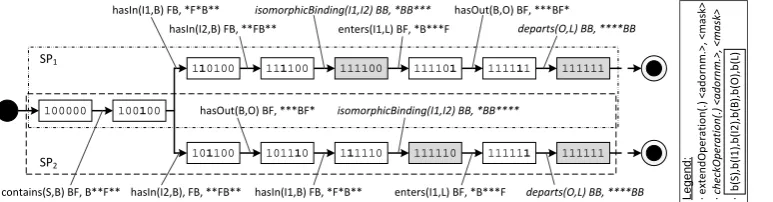
As already mentioned, a pattern is usually searched for iteratively by partial match extension and relying on backtracking. The overall process can be visualized in form of a decision tree as inFigure 2, where each decision/branching corresponds to anatomic operationlike “extend partial match by navigating along linklbinding previously free variableX”, “check existence of linklbetween two bound nodesX,Y” or “ensure variableXand variableY are not bound to the same node”. The PM process is essentially characterized by such a sequence of operations (of typesextendandcheck), and one (not necessarily unique) concrete ordering of such operations is called asearch plan(SP). The derivation of all possible, viable SPs for a given pattern, in order to determine the optimal one, is often computationally infeasible, and optimality also depends partially on the model (cf. [VDWS12] for details on this issue).
Failed checkoperations eventually lead to backtracking steps and indirectly result either in variable reassignments or incomplete matches. The pattern matching process thus is character-ized solely by a sequence of binding and unbinding steps, whereby, by definition, the unbinding steps can only occur ininverse orderof the corresponding binding steps.
The motivation for this abstraction lies in the possibility to describe the PM process in as much detail as possible without depending on a concrete implementation (e.g. in the sense of source-code). When using a compiled, generator-based approach, where code is derived from the pattern specification, one might design test suites based on that code using classical techniques. Unfortunately, even small changes to the pattern or a non-deterministic code-generator would result in different code, deprecating existing tests. The situation even worsens when using an interpreter-based approaches. Testing the PM process based on the source-code of an interpreter seems futile, because the exercised fraction of code can not be expected to change much with different SPs or models as the authors of [HLG+12] indicate.
3.1.1 Generated Search Plans
We generated several code variants with our customizedCodeGen2fork (fromFujaba), result-ing in equivalent but different SPs. We considered two SPs, termed SP1 and SP2, for further investigation. Figure 2depicts them. In the figure, each node represents a state, characterized by a mapping of then(n=6) variables of the pattern (S,I1, . . . ) to the domain{0,1}n, where a value of 0 indicates that the resp. variable is not bound, and a value of 1 indicates the oppo-site. Transitions are labeled with the operations that are either used to structurally extend the partial match or to check pattern constraints. We use grey highlighting to indicate no change in the binding vector. From our previous work [VDWS12], we borrow the notions ofadornments
100000 100100
110100 111100
101110
111100 111101 111111 111111
111110 111110 111111 111111 101100
SP1
SP2
contains(S,B) BF, B**F**
hasIn(I1,B) FB, *F*B**
hasIn(I2,B), FB, **FB** hasIn(I2,B) FB, **FB**
isomorphicBinding(I1,I2) BB, *BB***
enters(I1,L) BF, *B***F
hasOut(B,O) BF, ***BF*
departs(O,L) BB, ****BB
hasOut(B,O) BF, ***BF*
hasIn(I1,B) FB, *F*B**
isomorphicBinding(I1,I2) BB, *BB****
enters(I1,L) BF, *B***F departs(O,L) BB, ****BB b(S)
,b( I1 ),b(I 2 ),b(B ), b(O ),b( L) L egen d: · e xte ndOpe rat ion(.) < adornm .> , < m ask > · ch ec kO p era ti on (. ) <a d o rn m.>, <ma sk> ·
Figure 2: Search plans (seeEquation 1for the definition of functionb)
3.2 Tracing the Pattern Matching Process
Observabilityis one prerequisite fortestability, as Binder states in [Bin00]. So, when examining the dynamic behavior of the pattern matcher, one needs information on the engine during the algorithm’s running. One can imagine that (almost) any pattern matching implementation can be easily extended orinstrumented to output traces of states comprising the binding status of the pattern’s variables. Consequently, we restrict ourselves to the information obtained through simple (offline) tracing, where status information is collected/stored during run-time. In our case, we instrumented the PM code manually, but adapting our generator templates is considered to be a straight forward task and left for future work.
4
Coverage Metrics
We continue by defining the gray box coverage metrics and motivate their usefulness to PM testing. As far as our experience goes, implementation bugs are likely to manifest in incorrect backtracking behavior during the search (e.g. premature, too late, etc.). On the other hand, bugs that only manifest in “unusual” situations are more likely to be overlooked in comparison to others. Consequently, for thorough testing, one needs to ensure that the test suite exercises the search plan in a systematic and sufficient manner. Our coverage metrics define minimal requirements so that when met, the test suite can be reasonably considered sufficient w.r.t. the examined patterns. Consequently, the metrics serve the same purpose as (code) coverage in traditional testing, namely “[. . . ] to mitigate unavoidable blind spots [. . . ]” [Bin00] during test suite design, and to help the tester in performing the task ofpath sensitization1. If one tries to test thegeneral functioning and fitnessof a PM engine, regardless of any concrete MT, one needs to provide metamodels plus patterns (together they form the test cases) that are “complex enough” to cover all supported language features – a task that is out of scope here. This suggests, that the presented method is MT specific.
Coverage Items The basic idea of our testing approach is to stimulate the PM engine in such a way that certain combinations of variable binding and unbinding steps actually do occur. This is achieved either by extending a partial match or by performing a backtracking step. One single
sequence of such steps represents acoverage item. If a trace log indicates that a test run led to the occurrence of the demanded sequence, we say that the test covers the sequence and thus the coverage item. To be able to precisely control the testing effort, we developed different metrics and ensured them to form a hierarchy, where more elaborated metricssubsumemore basic ones, so that coverage of the subsuming criterion implies coverage of the subsumed one.
In the following, Linear-time Temporal Logic2 (LTL) is used to define the cov. items. Some basic definitions are required first (xrefers to one variable,Xto the set of variables defined by the pattern,X := (X, <)is a strict totally ordered set, andX0:=X \ {initially bound variables}. Additionally, for this exampleX = ({S,I1,I2,B,O,L},order of appearance)):
b :X → {0,1}, b(x):=
(
0, if variablexis unbound
1, if variablexis bound (1)
m∈ {−1,?,+1}, m,
−1, matching failed
?, match still incomplete +1, match found
(2)
Equation 1defines a function that assigns binding information to variables, and inEquation 2m
is introduced, which represents knowledge about the outcome of the PM run. Figures2and3use these concepts. Both definitions are used to formulate temporal predicates, whereby the pattern, SP, and traces are kept implicitly fixed. In this regard, actual values depend on an implicit notion of time/state (corresponding indices/arguments are omitted here, as in [HR04]). For example, to state that a run should result in a complete match, one would define a predicateΦ+ω such as the
one inEquation 3using LTL-operators. It states thateventually(F(.)) variablemshould remain ‘+1’ “forever” orglobally(G(.)).Untilthis happens ((.)U(.)) variablemshould have the value ‘?’, indicating an incomplete match.Equation 4considers the opposite outcome.
Φ+ω := (m=?)U(G(m= +1)) (3)
Φ−ω := (m=?)U(G(m=−1)) (4)
4.1 PMC0
We now define the simplest of our coverage criteria, called PMC0, whereby PMC stands for
pattern matching coverage. It comprises the two conditions PMC+0 and PMC−0 which need to be fulfilled separately. Informally, the first states that for every variablexthere has to be (at least) one test case that eventually bindsxto some node in the model (of compatible type) and results in a complete match (positive test). The second one states the same but excludes a complete match in the end (negative test). More formally, the following proposition has to hold:
PMC0(T):= (PMC+0(T)∧PMC −
0(T)) (5)
wherebyT denotes a set of captured traces, and one single trace (= sequence of trace entries, whereby an entry is a bit vector, cf. columns inFigure 3) is referred to ast. We also define a
S0 … Si … S∞
S 1 1 1
I1 0 # #
I2 0 # #
B 0 1 #
O 0 # #
L 0 # #
m 0 0 ±1
(a) PMC0forB
S0 … Si … Sj … Sk … S∞
S 1 1 1 1 1
I1 0 # # # #
I2 0 # # # #
B 0 1 0 1 #
O 0 # # # #
L 0 # # # #
m 0 0 0 0 ±1
(b) PMC1resp. PMC1,1forB
Figure 3: Coverage metrics examples (“#” symbolizes “don’t care”)
theoreticalextended trace t∞being an infinite sequence that repeats the last item oftin positive
direction along the time axis.
The aforementioned proposition holds iff the following is true:
(∀x∈X0 ∃t∈T : PMC+0(t,x))∧(∀x∈X0∃t∈T : PMC−0(t,x)) (6)
PMC±0(t,x)⇔ Φ±0(x)holds for the extended tracet∞ (7)
Φ±0(x):=
initial configuration and global constraints
z }| {
Φα(x)∧F(b(x) =1)∧
final steady state
z}|{
Φ±ω (8)
Φα(x):= (b(x) =0)∧(m=?) (9)
Equation 8andEquation 9state thatxhas to be initially unbound and has to become eventually
bound. At the end, a steady state has to be reached where either a match has been found or not.
Figure 3avisualizes the concept for the case wherexis set toB. A minimal test suite meeting
the requirements of PMC0is presented later on inSection 5. Note that the initial, one intermedi-ate, and the final state are restricted w.r.t. variable states. Any number of arbitrary intermediate states (indicated by the dots in the resp. fig.) are allowed to occur. Also note, that no distinct matching order, as predetermined by a concrete SP, is required for the definitions. Note further that one can expect the variables to be bound in the final state, at least in the case where there is a complete match. Nevertheless, the presented formulation is open to adaption (potential exten-sions could supports optional nodes etc.). Summarized, PMC0only ensures a very rudimentary coverage, since it does not necessarily imply or require any form of complex branching during the PM process, but introduces the concepts and forms the basis for refinements.
4.2 PMC1
is the adapted version of Equation 8. Compared to the latter case, there are additional nested statements requiring variable x to be bound first (outermost F in the disjunction), afterwards unbound (intermediateF), and ultimately bound thereafter (innermostF).
Φ±1 :=Φ±0 ∧
G(b(x) =0)∨F
(b(x) =1)∧F
(b(x) =0)∧F G(b(x) =1)
(10)
Figure 3b and the previous remarks suggest that one could also demand more than one
“cy-cle” of unbind/bind operations for a variable. This motivates the generalization of PMC1, or PMC1,1 from now on (the second index stands foronecycle), to the case of PMC1,n requiring n,{n∈N|n≥1}, of such cycles. A higher value ofnwill likely lead to increased test model sizes, but this does not necessarily imply coverage of subsuming metrics as explained later.
Right now, there is ongoing work spent on the extension of the concept to PMC2,n (pairs of
variables), PMC3,n (triples of variables) and so forth by considering variable tuples instead of
single variables. This would help in testing the interplay of binding/unbinding steps for different variables. Further details are omitted here, due to space limitations.
5
Application
Now we come to the discussion of preliminary results obtained during evaluation of our protoype coverage framework. We modeled the pattern ofFigure 1bin oureMoflon[ALPS11] tool suite and generated two Java realizations featuring a distinct SP from it (cf.Figure 2). Tracing com-mands were added manually to the code, and the tracing information was collected and analyzed by a prototypic tool.
Basic Test Suites We used the setup to evaluate whether it is possible to construct input data that leads to complete coverage for certain metrics, given the previously fixed SPs. With prior knowledge of an actual SP, it turned out to require not much of an effort to find small test models meeting the requirements. Figure 4depicts test suites for PMC0 and PMC1,1 respectively. The results indicate that one can effectively limit oneself to a pair of input models to ensure coverage of one (or several, in case of subsumption) metric for all relevant pattern variables at the same time, although this seems not very favorable when thinking of maintainability and traceability. Nevertheless, metamodels with additional constraints might restrict input models (e.g. by upper multiplicity bounds) so that one can not achieve the required coverage level with a minimum of two models. Chained patterns (as in programmed GT) would complicate things considerably.
s1 :System
b1 :Block i1 :Inport
i2 :Inport
o1 :Outport
l1 :Line
s1 :System
b1 :Block i11 :Inport
i12 :Inport
o11 :Outport
l11 :Line
b2 :Block i21 :Inport
i22 :Inport
o21 :Outport
l21 :Line
s1 :System
b2 :Block i21 :Inport
i22 :Inport
o21 :Outport
l21 :Line
l22 :Line b1 :Block
s1 :System
b2 :Block i21 :Inport
i22 :Inport
o21 :Outport
l21 :Line
l22 :Line b1 :Block
o22 :Outport s2 :System
i11 :Inport
(a) PMC0(incl. dashed for pos. test)
(b) Statement coverage (includei11forSP2)
(c) PMC1,1(neg. test bottom, pos. top)
Figure 4: Test models for different coverage criteria
Comparison with Code Coverage Deriving imperative code from a MT specification gener-ally enables us to compare our coverage concept to well-accepted code coverage approaches. We used Cobertura3, which supports basic block coverage and branch coverage, to measure code-based coverage figures for the example.
Results shows that even the test data for PMC0already lead to complete statement coverage of the code. We presume that this is always the case, but this claim needs to be supported by further investigation (ongoing work). Also, there is no such thing as acanonicalimplementation, and it would be interesting to compare code coverage measures for functionally equivalent (even down to the search plan) code representations which are sufficiently different.
We also investigated whether code statement coverage implies coverage in our sense. Think of the situation, where one tries to test the code sections that process a complete match. One needs an input model comprising a complete match as test case, which shall be the only test in an initial test suite. We could extend the model to cover as many additional statements as possible, but due to the code fraction that processes incomplete matches as ultimate result, it is not possible to cover all statements with only just one test. A second, rather small model without complete matches is required. In general, this model can be expected to be rather small so that it does not ensure PMC0coverage (cf. negative test). For the running example,Figure 4bdepicts a test suite that achieves statement coverage but fails in achieving PMC0 coverage. For our concrete example, statement coverage is implied by PMC0coverage, so here even our weakest coverage criterion subsumes statement coverage (unnecessary/dead code is neglected). This is obviously not a prove, though, and more experiments are required to investigate the interplay with code-based criteria.
6
Related Work
Several groups published results related to MT testing. A wide range of articles examine test data generation, but this only partially relates to test adequacy evaluation. By far the most coverage related work involves specification-based black box testing. A good example is [FBMT09] by Fleurey et al., where they motivate their decision for a black box approach with its independence from the underlying transformation language. They introduce the notions ofclass,attributeand
association coverage. Bauer et al. extend these concepts in [BKE11] by introducing feature
andtransformation contract coverage. Their overall goal is to assess and optimize the test suite quality for model transformation chains. Both works do not anticipate pattern definition and/or implementation related bugs directly.
In [GV11], Gogolla et al. present a testing approach based on OCL constraints on source and target metamodel calledTracts (MT contracts). They describe how their USE tool can check contract adherence on the outcome and how corresponding test models can be derived. Cabot et al. describe a similar approach in [CCGL10] where they use OCL in conjunction with their UMLtoCSP tool whereby focusing on the analysis of MT properties rather than on testing. Both works do not examine test data adequacy aspects and esp. no coverage notion.
Darabos et al. take a different view on testing in [DPV08]. They present afault model, which condenses their knowledge of typical programmer faults during implementation of PM engines. They use a hardware verification technique calledBoolean difference methodto derive test data which is sensitive to such faults. In some sense, the faults captured by their model could be interpreted as coverage items. A drawback of this approach is that it depends on the quality of the fault model. Unconsidered faults are likely to be overlooked.
Hildebrandt et al. use TGG rules to derive pairs of input models and expected output models for testing a TGG implementation in [HLG+12]. Although this represents an elegant approach to test oracle construction, the approach can only be applied if a TGG specification exists. Un-fortunately, TGGs are not (yet) as expressive as most MT languages. The authors also evaluate code coverage of their interpreter-based MT engine with different derived test suites, and state that it remains virtually unchanged.
In [KA07], K¨uster et al. report on what they call a white box approach to validation. In addition to the input metamodel they use the “design and implementation of the model transformation” by building on so-calledmeta model templatesplus constraints. A basic fault model is provided and theinterplay of rulesis examined. Other white box approaches are presented by Ciancone et al.
in [CFM10], where unit testing of MT specified in QVT Operational is applied, and in [MP09]
by McQuillan et al., where standard code coverage metrics are used for ATL specifications. Such white box approaches have the draw-back of being language specific. They also require more insight in the machine-runnable implementation, which contravenes the declarative paradigm.
Steel et al. describe the test driven development of the Tefkat engine in [SL04]. Geiger et al. derive JUnit tests from pattern specifications in [GZ05] which are used to test transformation code conformance. A different approach is presented by Baldan et al. [BKS04] where GT spec-ifications are used to model the behavior of code generators, and tests are derived from those specifications. All those works focus on testing code generators rather than on testing MTs, the former task being more comparable to compiler testing than to program testing.
a focus on analyzing transformation properties. The work of Baresi et al. [BRRS08] is one example where LTL is used, but there exist several other texts on that topic.
7
Conclusion
Testing model transformations is vital for their future success in practice. Coverage concepts are an important aspect of a full-fledged testing process, but there is no silver bullet to this problem as the number of approaches show.
We introduced a new coverage concept for gray box testing of GT and esp. graph pattern matching, which is an error-prone sub-task. Our coverage criteria are based on the operational semantics defined by search plans (and traces), and we motivate its usefulness with first experi-mental results and a comparison of its properties and performance to that of statement coverage. Future work comprises a comparison with more elaborated code-based coverage criteria (like branch or path coverage), and an extension of the approach to treat optional, set and negative nodes in patterns. On the implementation side remains the task of developing an integrated test-ing framework includtest-ing the new coverage concept plus other functionality like test generation and oracle functions. On theory side, other/additional temporal constraints are conceivable.
Bibliography
[ALPS11] A. Anjorin, M. Lauder, S. Patzina, A. Sch¨urr. eMoflon: Leveraging EMF and Pro-fessional CASE Tools. InINFORMATIK 2011. LNI 192, p. 281. GI, 2011.
[BGF+10] B. Baudry, S. Ghosh, F. Fleurey, R. France, Y. Le Traon, J.-M. Mottu. Barriers to Systematic Model Transformation Testing.Commun. ACM53(6):139–143, 2010.
[Bin00] R. Binder. Testing Object-Oriented Systems: Models, Patterns, and Tools. The Addison-Wesley Object Technology Series. Addison-Wesley, 2000.
[BKE11] E. Bauer, J. K¨uster, G. Engels. Test Suite Quality for Model Transformation Chains. InObjects, Models, Components, Patterns. LNCS 6705, pp. 3–19. Springer, 2011.
[BKS04] P. Baldan, B. K¨onig, I. St¨urmer. Generating Test Cases for Code Generators by Unfolding Graph Transformation Systems. InProc ICGT ’04. LNCS 3256, pp. 194– 209. Springer, 2004.
[B ¨OR+08] G. Bergmann, A. ¨Okr¨os, I. R´ath, D. Varr´o, G. Varr´o. Incremental Pattern Match-ing in the Viatra Model Transformation System. InProc GRaMoT ’08. Pp. 25–32. ACM, 2008.
[BRRS08] L. Baresi, V. Rafe, A. T. Rahmani, P. Spoletini. An Efficient Solution for Model Checking Graph Transformation Systems.ENTCS213(1):3–21, 2008. Elsevier.
[CFM10] A. Ciancone, A. Filieri, R. Mirandola. MANTra: Towards Model Transformation Testing. InProc QUATIC ’10. Pp. 97–105. 2010. IEEE.
[CH06] K. Czarnecki, S. Helsen. Feature-based survey of model transformation approaches.
IBM Syst. J.45(3):621–645, 2006.
[DPV08] A. Darabos, A. Pataricza, D. Varr´o. Towards Testing the Implementation of Graph Transformations.ENTCS211:75–85, 2008. Elsevier.
[EEPT06] H. Ehrig, K. Ehrig, U. Prange, G. Taentzer. Fundamentals of Algebraic Graph Transformation. Springer, 2006.
[FBMT09] F. Fleurey, B. Baudry, P.-A. Muller, Y. Traon. Qualifying input test data for model transformations.SoSyM8:185–203, 2009.
[GV11] M. Gogolla, A. Vallecillo. Tractable Model Transformation Testing. In Proc ECMFA ’11. LNCS 6698, pp. 221–235. Springer, 2011.
[GZ05] L. Geiger, A. Z¨undorf. Story Driven Testing - SDT. InProc SCESM ’05. Pp. 1–6. ACM, 2005.
[HLG+12] S. Hildebrandt, L. Lambers, H. Giese, D. Petrick, I. Richter. Automatic Con-formance Testing of Optimized Triple Graph Grammar Implementations. InProc AGTIVE ’11. LNCS 7233. Springer, 2012. To appear.
[HR04] M. Huth, M. Ryan. Logic in Computer Science: Modelling and Reasoning about Systems. Cambridge University Press, 2004.
[JBK10] E. Jakumeit, S. Buchwald, M. Kroll. GrGen.NET. Int. J. on STTT 12:263–271, 2010. Springer.
[KA07] J. K¨uster, M. Abd-El-Razik. Validation of Model Transformations - First Ex-periences Using a White Box Approach. In Models in Software Engineering. LNCS 4364, pp. 193–204. Springer, 2007.
[LV02] J. de Lara, H. Vangheluwe. AToM3: A Tool for Multi-formalism and Meta-modelling. InProc FASE ’02. LNCS 2306, pp. 174–188. Springer, 2002.
[MP09] J. McQuillan, J. Power. White-Box Coverage Criteria for Model Transformations. In(prel.) Proc MtATL ’09. Pp. 63–77. 2009. AtlanMod INRIA & EMN.
[SL04] J. Steel, M. Lawley. Based Test Driven Development of the Tefkat Model-Transformation Engine. InProc ISSRE ’04. Pp. 151–160. 2004. IEEE.
[Tae04] G. Taentzer. AGG: A Graph Transformation Environment for Modeling and Valida-tion of Software. InProc AGTIVE ’04. LNCS 3062, pp. 446–453. Springer, 2004.