ISSN-L: 2501 - 1235 Available on-line at: www.oapub.org/edu
doi: 10.5281/zenodo.2538274 Volume 5 │ Issue 3 │ 2019
A RELATIVE STUDY OF THE FITNESS COMPONENTS OF MOTOR
FITNESS AMONG FEMALE PHYSICAL EDUCATION STUDENTS OF
HIGHER SECONDARY AND FEMALE BOXING PLAYERS
Hilal Ahmad Ratheri
Dr., Research scholar, Swami Vivekanand University, Sagar, M.P., India Director/Founder PES Foundation
www.drhilalrather.com Abstract:
Motor abilities play important role in achieving proficiency in games and sports. Motor Fitness is an athlete’s ability to perform effectively during sports. Motor Fitness involves a mixture of speed, agility, power, coordination, strength and so on and is essential for competing at high levels. For this study, 20 female players each from Boxing (after 6 months of training) and Physical Education were selected from Sher-i-Kashmir Indoor Sports Complex Srinagar and Delhi Public School Budgam, J&K who had played at least at district level or state level. The age group of subjects was ranging between 17-19 years. Test by Barrow motor ability test was used to measure motor fitness components. To find out the significant differences between means of the Boxing and Physical Education Students, unpaired ‘t’ test was applied. From the study, differences were observed on leg- strength, speed and arm & shoulder strength variables between Boxing and Physical Education Students but these were insignificant. It was found that Boxing players are better in leg strength and arm & shoulder strength whereas Physical Education Students are superior to boxing player in speed.
Keywords: explosive strength, flexibility, lower limb strength, speed, strength
1.Introduction
The general definition of physical fitness is ‚a set of attributes that people have or achieve relating to their ability to perform physical activity‛ (U.S. Department of Health and Human Services. Measureable components of physical fitness are health-related physical fitness and skill-related physical fitness. Health-related physical fitness relates to functional health. It is believed that all students can improve their health status through daily
physical activity. On the other hand, skill related physical fitness refers to physical performance related to athletic ability. It is performance oriented and influenced by genetic traits and abilities.
Motor abilityhas been defined by Barrow (1964) as ‚the present acquired and innate
ability to perform motor skills of a general or fundamental nature, exclusive of highly specialized sports and gymnastic techniques.”
Motor competency/ ability refer to the mastery of physical skills and movement
patterns that enable enjoyable participation in physical activities. Skill related physical fitness components are agility, balance, coordination, speed, power and reaction time. Agility is the ability to make successive movements in different directions efficiently and rapidly, e.g. shuttle run. Balance is the ability to maintain equilibrium when one’s centre of gravity and base of support are altered, e.g. stork stand. Coordination is the ability to effectively integrate the moments of the body parts, e.g. ball catch, jump rope. Speed is ability to perform rapidly successive movements over a short period of time in a single direction, e.g. short distance sprint. Power is the ability of a muscle or group of muscles to generate maximal force in a single effort e.g. vertical jump. Reaction time/movement is the ability to respond rapidly to a stimulus, e.g. reaction time stick tests. Competence in fundamental movement patterns precedes the development of more-complex motor skills, such as using skills in combination with each other or in environments that are more dynamic. Even with quality instruction and practice, however, some children exit elementary school without developing sufficient technique in a variety of motor skills (Smith & O’Keefe, 1999). Because fundamental skill development is a prerequisite for the development of advanced sport-specific skills, acquiring competence at the fundamental level is critical for determining whether children will have the ability to engage in activities that require a more advanced level of development.
2. Methodology
2.1 Sample
For this study, 20 female players each from Boxing (6 months of training) and Physical Education Students were selected, who had played at least at district level or state level. The age group of subjects was ranging between 17-19 years.
2.2 Tool Used
Barrow’s General Motor Ability Test was used for collecting data. This test battery has following three test items:
1. Standing Broad Jump (for measuring leg strength).
2. Zig-Zag Run (for measuring agility and speed).
2.3 Test Administration
The three items were conducted in an athletic field area.
Test Item 1: Standing Broad Jump
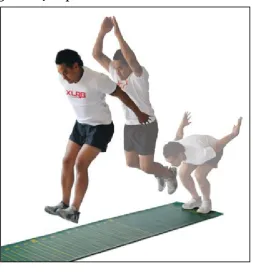
Figure 1: Standing broad jump
(source: www.duyen-even-lift.tumblr.com, March 31, 2015)
This test measures the power of legs in jumping horizontal distance and may be applied to children of both sexes aged seven years and above.
Equipment: Floor was used, measuring tape, marking chalk.
Administration: A demonstration of standing broad jump was given to subjects. The subject was then asked to stand behind the starting line with the feet parallel to each other. She was instructed to jump as farthest as possible by bending knees and swinging arms to take off for the broad jump in the forward direction (as shown in the fig. 1). The subject was given three trials.
Test Item 2: Zig-Zag Run
Figure 2: Showing zigzag running
(source: Researcher, 11 July, 2018 at Delhi Public School, Budgam, India)
This test item measures primarily agility and secondarily the speed. The subject was given demonstration about the course of Zig-Zag running as illustrated in Fig. 2. Then she was instructed to take the standing start position on the signal ready and to start running on the signal ‘Go’ and that three laps were to be run and fast run was to be continued even after the finish line so as to slow down only after crossing the finish line. After the signal ready! Go! The subject began the zig-zag run; the timer started the stop watch. As soon as the runner crossed the finish point (F) after the third round, the timer stopped the watch.
Scoring: The final score was the time taken to run the three rounds of figure-of-eight.
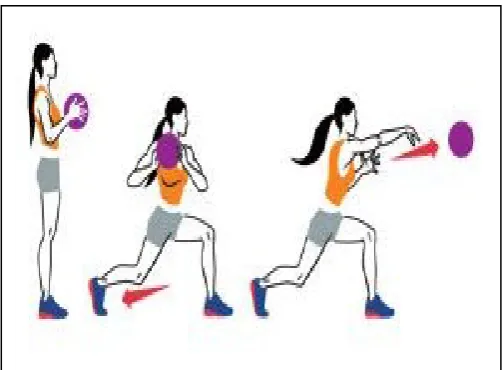
Test Item 3: Medicine Ball Put
This test measures primarily arm and shoulder girdle strength and secondarily power, agility, arm and shoulder girdle coordination, speed and balance.
Administration: Before starting the test, the subjects were given following instructions. The medicine ball was not to be thrown but to be put as was demonstrated. The subject was to stand between the two restraining lines as in Fig. 3 and the ball was to be put straight down the course. After giving above instructions, the event was explained by giving a live demonstration. Then a subject was asked to take a position in the throwing area and put the medicine ball as explained and demonstrated. Subject was given three trials.
Scoring: The maximum distance out of three trials of putting the medicine ball was the final score.
3. Statistical Technique
To determine the significant differences of mean score of female Boxing players and Female Physical Education Students, unpaired ‘t’ test was employed for data analyses to test the hypothesis, and the level of significance
4. Discussion and Findings
Table 1: Mean Difference between Female Boxing Players and Female Physical Education Students on Variable of Leg Power
Group Number Mean (in sec.) S.D Df t -value
Boxing 20 67.25 8.42
38 0.81
Physical Education Students 20 65.2 7.55 Table Value at 0.5= 2.02
Table 1 shows that mean and standard deviation values of Female Boxing players on the variable of Leg Power were 67.25 and 8.42 whereas in case of Female Physical Education Students it was 65.2 and 7.55 respectively. No significant difference was found between Boxing and Physical Education as the calculated ‘t’-value 0.81 was less than tabulated value of 2.02 at 0.05 level of significance.
Table 2: Mean Difference between Female Boxing Players and Female Physical Education Students on Variable of Speed
Group Number Mean (in sec.) S.D Df t-value
Boxing 20 61.7 1.9
38 1.61
Physical Education Players 20 59.42 5.83 Table Value at 0.5= 2.02
between Boxing and Physical Education Students as the calculated t-value was less than tabulated value of 2.02 at 0.05 level of significance.
Table 3: Mean Difference between Female Boxing Players and
Female Physical Education Students On Variable Of Arm And Shoulder Strength
Group Number Mean (in sec.) S D Df t -value
Boxing 20 21 5.20
38 0.13
Physical Education Students 20 21.2 3.81 Table Value at 0.5= 2.02
Table 3 shows that mean and standard deviation values of Female boxing players on the variable of speed were 21 and 5.20 whereas in case of Physical Education students it was 21.2 and 3.81 respectively. No significant difference was found between boxing players and Physical Education Students as the calculated t-value 0.13 was less than tabulated value of 2.02 at 0.05 level of significance.
5. Conclusion
It is concluded, it can be said that from the findings that insignificant differences were found between Female Boxing Players and female physical education students of higher secondary on the variables of Motor Abilities, i.e. leg strength, speed and arm & shoulder strength. It was found that Female Boxing players are better in leg strength and arm & shoulder strength whereas physical education students are superior to boxing players in speed. The reason can be put forward that physical education students were involved in physical activity from 18 months, while as female boxers were having training of 6 months only.
References
Darla M. Castelli and Julia A. Valley, University of Illinois at Urbana-Champaign Chapter 3: The Relationship of Physical Fitness and Motor Competence to Physical Activity, Journal of Teaching in Physical Education, 2007, 26, 358-374© 2007 Human Kinetics, Inc.
Kansal, D.K. (1996) ‚Test and measurement in sports and Physical Education‛, D V S Publications, New Delhi.
Lega Sushil (2016) ‚A Comparative Study Of Selected Motor Abilities Of Football And
Handball Players‛ www.ijobsms.in, Vol.03,No.o4
Mandeep Singh Nathial, (2015) Analysis of Set Shot in Basketball in Relation with Time to Perform the Course and Displacement of Center of Gravity. American Journal of Sports Science. Vol. 2, No. 5, 2014, pp. 122-126. doi: 10.11648/j.ajss.20140205.13
Thakur D. and Motimath, Flexibility and Agility Among Children and Adolescent
Athletes: An Observational Study, International Journal of Physiotherapy and
Research, 653-656 (2014)
Sallis J., Prochaska and Taylor, A Review of Correlates of Physical Activity of Children
and Adolescent, Medicine and Science in Sports Exercise, 963, (1999)
Creative Commons licensing terms