EFFECTS OF CONCURRENT ECCENTRIC OVERLOAD AND
HIGH-INTENSITY INTERVAL TRAINING ON TEAM SPORTS
PLAYERS’ PERFORMANCE
Javier Sanchez-Sanchez
1, Oliver Gonzalo-Skok
1,2, Manuel Carretero
1, Adrian Pineda
3,
Rodrigo Ramirez-Campillo
1,4, and Fábio Yuzo Nakamura
1,51
Research Group Planning and Assessment of Training and Athletic Performance,
Pontifical University of Salamanca, Salamanca, Spain,
2
San Jorge University, Zaragoza, Spain,
3Santiago de Compostela Fut-Sal, La Coruña, Spain,
4
Department of Physical Activity Sciences, Research Nucleus in Health,
Physical Activity and Sport, University of Los Lagos, Osorno, Chile,
5
Department of Medicine and Aging Sciences, “G. d’Annunzio” University of Chieti-Pescara,
Italy
Original scientific paper https://doi.org/10.26582/k.51.1.14
Abstract:
The aim of the study was to compare the effects of an in-season five weeks of high-intensity training (HIT) with a concurrent HIT eccentric overload training (CT) program on male amateur team-sports players’ fitness performance. Twenty-two athletes were randomly assigned to either HIT (n=10) or CT (n=12). Both groups completed a HIT program. The CT group also completed two-three sets of six repetitions of eccentric overload training. Before and after training, performance was assessed for change of direction ability (COD), repeated sprint ability for best time (RSAb), mean time (RSAm) and slowest time (RSAs), jumping, and
shuttle-run performance. Within-group analyses in both groups showed substantial better scores on COD, RSAb and RSAm and shuttle-run performance. Between-group analyses showed greater improvements in
COD, RSAb, RSAm, RSAs, and jumping after the additional CT compared to solely HIT. In conclusion,
compared to HIT alone, concurrent eccentric overload and HIT training within the same session improved COD, RSA, jump, and shuttle-run performance in basketball and soccers amateur players.
Key words: repeated sprint, maximal aerobic power, resistance training, change of direction, plyometrics,
basketball, soccer
Introduction
In team sports, players are required to repeatedly perform brief high-intensity actions (HIAs) such as sprints, accelerations-decelerations, turns, changes of direction (CODs) and jumps (Ben Abdelkrim, El Fazaa, & El Ati, 2007; Stolen, Chamari, Castagna, & Wisloff, 2005). For example, during a basket-ball match, a short sprint takes place every 21 to 39 s, while a HIA is repeated every 10 to 20 s (Ben Abdelkrim, Castagna, El Fazaa, & El Ati, 2010; Ben Abdelkrim, et al., 2007). The ability to maintain HIAs for the entire match is important in soccer (Gabbett, & Mulvey, 2008) and basketball (Cast-agna, et al., 2007) alike. However, decrements in HIAs, mainly at the later stages of matches, have been reported (Ben Abdelkrim, et al., 2007).
Several physiological and mechanical factors may mediate performance decrements in HIAs during team sports matches (Mendez-Villanueva, Hamer, & Bishop, 2008). Of note, players with a greater fatigue-resistance perform HIAs more frequently, with short rest intervals in competition (Carling, Le Gall, & Dupont, 2012). High-intensity interval training has been recommended to enhance fatigue-resistance and repeated HIA ability in team sports athletes (Buchheit, Mendez-Villanueva, Delhomel, Brughelli, & Ahmaidi, 2010a; Buchheit, Mendez-Villanueva, Quod, Quesnel, & Ahmaidi, 2010b; Gonzalo-Skok, et al., 2016).
a great percentage of goals in soccer (i.e., 83%), for example, are preceded by at least one powerful action of the scoring or the assisting player (Faude, Koch, & Meyer, 2012). Development of the ability to perform HIAs through eccentric overload training (EOT) has become very common (Nadal & Carlin, 2011), improving COD speed/kinetics, jumping and sprinting (de Hoyo, et al., 2016; Gonzalo-Skok, et al., 2017; Tous-Fajardo, Gonzalo-Skok, Arjol-Serrano, & Tesch, 2016), besides its role in injury prevention (Askling, Karlsson,, & Thorstensson, 2003; de Hoyo, et al., 2015). Therefore, training strategies that focus on improving HIAs (i.e., EOT) and fatigue-resistance (i.e., high-intensity interval training), may enhance players’ performance.
A common team sports weekly practice includes both high-intensity interval training and strength/ power training in a concurrent manner (Buchheit & Laursen, 2013a). Accordingly, concurrent high-intensity strength (i.e., EOT) and high-high-intensity interval training has been recently proposed as an effective training method to minimize the interfer-ence phenomenon and enhance the player’s overall performance (Silva, Nassis, & Rebelo, 2015). Notably, in some instances strength-power training can hamper endurance adaptations (Docherty & Sporer, 2000). However, to our knowledge, no studies have analyzed the effects of concurrent EOT and high-intensity interval training in team sports players in comparison to high-intensity interval training alone. Therefore, the aim of the present study was to compare the effects of 5 weeks of high-intensity interval training (HIT) program with a concurrent HIT plus EOT (CT) program on amateur team-sports players’ repeated sprint ability (RSA), COD ability, jumping and shuttle-run performance.
Methods
Subjects and experimental design
Initially, 24 male amateur team-sports players (age = 22.5±2.2 years; body height = 175.8±7.1 cm; body mass = 72.6±9.1 kg) volunteered to participate
in a five-week training study during the in-season.
Athletes were competing at regional level in soccer (n=12) or basketball (n=12). Using a randomized controlled study design, half of the players from each sport were divided into HIT (n=10) or CT (n=12). Two athletes originally randomized to the HIT group did not complete the intervention.
Athletes participated in four-six hours of tech-nical-tactical training plus one competitive match per week. None of them had already participated in systematic HIT or CT. Prior to the commence-ment of the study, participants completed a health questionnaire to document that they were free of cardiovascular disease, physiological disorders, or any other illness. Written informed consent was received from all the subjects after a brief
explanation about the aims, benefits, and risks
involved in this investigation. The present study is in accordance with the ethical standards from the latest version of the Declaration of Helsinki and the protocol was fully approved by the Clinical Research Ethics Committee.
Testing procedures
Physical fitness tests were carried out on an
indoor basketball court on two different days of the week preceding the intervention and the week immediately following the completion of the last
training session. On the first day, the Illinois test
and the RSA test were administered. On the second day, a countermovement jump (CMJ) test for maximal height and the 20-m shuttle run test were performed. Every assessment session took place under similar environmental conditions and at the same time of the day (5-8 p.m.), thus minimizing circadian rhythms variations. Players were asked not to perform intense exercise at least 48 hours before testing and to consume their last meal three hours before the scheduled test time.
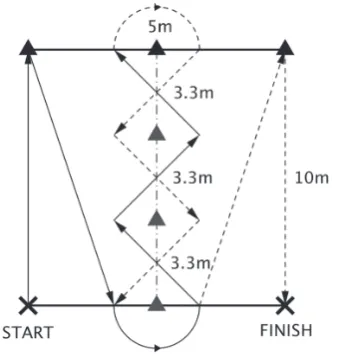
The COD ability was examined using the Illinois test (Figure 1), as previously described (Ramirez-Campillo, et al., 2016). The test was used to determine the ability to accelerate, decelerate, turn in different directions, and run at different angles (Sheppard & Young, 2006). The Illinois test is set up with four cones forming an area 10-m long and 5-m wide. A cone was placed at each point (a) to mark the start, (b and c) to mark the turn spots,
and (d) to mark the finish. Another four cones were
placed in the center of the testing area, 3.3-m from each other. The test was conducted indoors on a wooden running surface. The athletes started on the
floor, facing the floor, and begun when they were
ready. The athletes completed the circuit as fast as possible. Test time was measured with photoelectric cells (DSD Laser System, and software Sport test
v3.2.1), positioned at the finish point, 1-m over the floor (i.e., athletes hip level). Subjects were given
two practice trials performed at half speed after a thorough warm-up to familiarize with the circuit and timing device. Two trials were completed, and the best performance trial was used for the subse-quent statistical analysis. Three minutes of rest were allowed between the trials. Times were measured to the nearest 0.001 second.
The RSA test comprised six bouts of two 15-meter sprints with 180º COD and 30 seconds of passive recovery between bouts (Buchheit, et al., 2008). Prior to the RSA test, participants executed a preliminary single shuttle-sprint which was used as the criterion score (Wong, Chaouachi, Chamari, Dellal, & Wisloff, 2010). Subjects rested 5 minutes before starting the RSA test. If performance in the
first sprint was worse than the criterion score (i.e., an increase of 2.5% in time), the test was finished,
and this participant was required to rest for 5 minutes before re-starting the RSA test. Participants commenced each sprint from a standing start posi-tion with their front foot placed 0.5 m behind the
starting/finishing timing gate (DSD Laser System
and software Sport test, v3.2.1). The best (RSAb),
the mean (RSAm) and the slowest (RSAs) times and
the percentage of decrement (%Dec) in sprint time were retained for subsequent analysis. The %Dec was calculated using the following formula:
[100 · (total sprint time / RSAb)] – 100,
as it was considered the most valid and reliable calculation to quantify fatigue in RSA testing (Glaister, Howatson, Pattison, & Mcinnes, 2008). Verbal encouragement was provided during each sprint.
Jumping height was calculated through flight
time (Globus Ergo System®, Codogne, Italy) in
a vertical CMJ. Visual inspection confirmed that landing occurred without any knee flexion with the
hands kept at the hips/waist. Each player performed two jumps with two minutes of passive recovery between jumps. The best jump was selected for subsequent analysis.
The 20-m shuttle run test is an incremental running test. This test began with an initial running speed of 8.5 km/h followed by a consecutive speed increase of 0.5 km/h each minute until exhaustion. The participants adjusted their running speed to match auditory signals (Sony ENG203® speakers) set to correspond to 20-m shuttle runs. The end of the test was taken when players failed to reach the next line in the required time two successive times. Throughout the test, heart rate (HR) was recorded beat to beat (Polar® Team System-2, Kempele, Finland). Moreover, the last period completed in the test was also used for analysis.
Training protocol
Participants in both groups performed two HIT sessions a week (Monday and Wednesday or Tuesday and Thursday) always in the afternoon
(5-8 p.m) during 5 weeks. Experienced researchers controled every training session. The HIT sessions lasted 26 minutes and were completed on an athletic track. The HIT was compounded of 6 minutes of warm-up (low-intensity running and accelerations) and two sets of eight repetitions of linear running for 30 seconds at 90-100% of the maximum heart rate (HRmax) interspersed with 30 seconds of active
recovery between repetitions (60% HRmax) and 3
minutes of passive recovery between sets. The HR was continuously monitored (Polar® RS-400). The HRmax achieved during the 20-m shuttle run test
(described below) determined running intensity. The CT group performed several eccentric over-load iso-inertial drills in addition to HIT. EOT was always executed before the HIT sessions. Between the EOT and HIT sessions, participants passively recovered for 10 minutes. EOT consisted of back-wards lunges and unilateral hamstrings “kicks” using an iso-intertial portable conical pulley (Versapulley®, Costa Mesa, CA; Inertia 0.27 kg/ m2) and half-squats employing the kBox3
(Exxen-tric AB®, Bromma, Sweden; Inertia 0.05 kg/m2).
The exercise load was progressively increased from two sets of six repetitions performed during the
first five training sessions to three sets of six repe
-titions during the following five training sessions. During the training on the flywheel iso-inertial
devices, players were encouraged to perform the concentric phase as fast as possible, while delaying the braking action to the last third of the eccentric phase. Between sets and exercises, one and two minutes of passive recovery were provided, respec-tively.
Statistical analysis
Data are presented as M ± standard deviation
(SD). All data were first log-transformed to reduce
bias arising from non-uniformity error. The stand-ardized difference or effect size (ES), with 90%
of confidence limits (CL) in the selected variables,
was calculated using the pooled pre-training SD. Threshold values for Cohen ES statistics were >0.2 (small), >0.6 (moderate), and >1.2 (large) (Hopkins, Marshall, Batterham, & Hanin, 2009). For within/ between-group comparisons, the chances that the differences in performance were better/greater (i.e., greater than the smallest worthwhile change, SWC [.2 multiplied by the between-subject standard devi-ation, based on the Cohen’s d principle]), similar or worse/smaller were calculated. Quantitative
chances of beneficial/better or detrimental/poorer
effect were assessed qualitatively as follows: <1%, almost certainly not; >1-5%, very unlikely; >5-25%, unlikely; >25-75%, possible; >75-95%, likely; >95-99%, very likely; and >99%, almost certain (Hopkins, et al., 2009). If the chance of having
bene-ficial/better or detrimental/poorer performances
unclear. Otherwise, we interpreted that change as the observed chance (Hopkins, et al., 2009). The
Pearson product-moment correlation coefficient
was used to determine the relationship between different variables. The following criteria were adopted for interpreting the magnitude of correla-tion (r) between tests measures: ≤.1, trivial; >.1-.3,
small; >.3-.5, moderate; >.5-.7, large; >.7-.9, very large; and >.9-1.0, almost perfect (Hopkins, et al., 2009). If the 90% CL overlapped small positive and negative values, the magnitude of the correlation was deemed unclear; otherwise the magnitude was deemed to be the observed magnitude (Hopkins, et al., 2009). The spreadsheet of Hopkins (Hopkins, 2012) was also used to determine the change in the mean between trials and the typical error of
measurement, expressed as a coefficient of varia -tion (CV, %). A CV of 5% was set as the criterion for reliability.
Results
The CV values were 2.1% (90% CL: 1.8; 2.7%), 1.3% (90% CL: 1.1; 1.8%), 0.8% (90% CL: .7; 1.1%), 1.5% (90% CL: 1.2; 2%), 28.3% (90% CL: 22.1; 39.8%), 3.3% (90% CL: 2.7; 3.9%) and 6.8% (90% CL: 5.3; 9.6%), for COD ability, RSAb, RSAm, RSAs,
%Dec, CMJ and 20-m ST, respectively.
Within-group changes
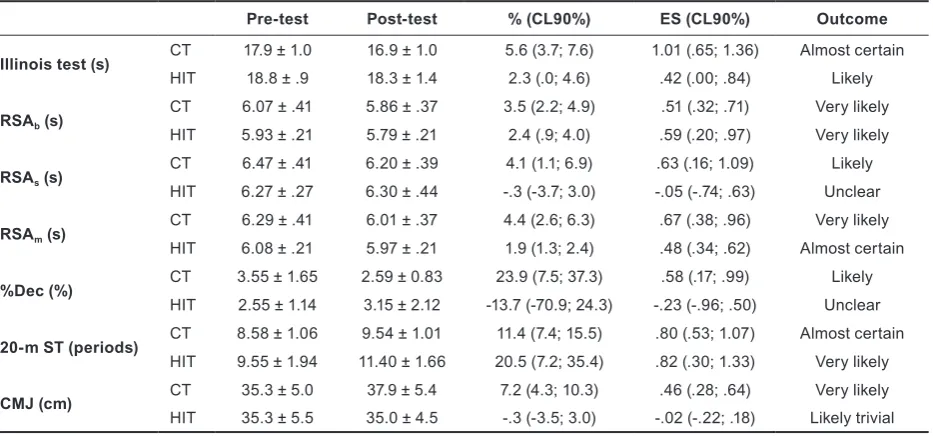
The best and the mean time in the RSA test, the Illinois test, and the 20-m shuttle run test were substantially improved in both the CT and HIT groups (Table 1). Additionally, a substantial improvement was found for RSAs, %Dec, and CMJ
in the CT group (Table 1).
Between-group changes
Results from the between-group analysis are illustrated in Figure 2. The differences between the groups in relative improvements showed substan-tially greater improvements after CT than HIT for RSAb (2.6% [.7; 4.5]; QC: 87/13/0%), RSAm (3.6%
[1.1; 6.0]; QC: 93/7/0%), RSAs (5.1% [1.1; 8.9]; QC:
94/6/1%), %Dec (49.3 [-3.6; 131.5]; QC: 87/10/3%), Illinois test time (3.5% [-.3; 7.2]; QC: 85/13/2%) and CMJ height (7.5% [2.7; 12.4]; QC: 93/7/0%).
Relationships between physical performance improvements
When data of both groups were pooled, the training-induced RSAm changes were very largely
and largely correlated with changes in RSAb (r=.77;
CL 90%: .57; .90) and RSAs (r=.68; CL 90%: .43;
.85), respectively. Interestingly, the %Dec changes
Table 1. Effects of concurrent eccentric overload (CT; n=12) and high-intensity interval training (HIT; n=10) on repeated sprint ability, change of direction ability, jumping and shuttle-run performance before (pre) and after (post) five weeks of training
Pre-test Post-test % (CL90%) ES (CL90%) Outcome
Illinois test (s) CT 17.9 ± 1.0 16.9 ± 1.0 5.6 (3.7; 7.6) 1.01 (.65; 1.36) Almost certain
HIT 18.8 ± .9 18.3 ± 1.4 2.3 (.0; 4.6) .42 (.00; .84) Likely
RSAb (s)
CT 6.07 ± .41 5.86 ± .37 3.5 (2.2; 4.9) .51 (.32; .71) Very likely HIT 5.93 ± .21 5.79 ± .21 2.4 (.9; 4.0) .59 (.20; .97) Very likely
RSAs (s)
CT 6.47 ± .41 6.20 ± .39 4.1 (1.1; 6.9) .63 (.16; 1.09) Likely HIT 6.27 ± .27 6.30 ± .44 -.3 (-3.7; 3.0) -.05 (-.74; .63) Unclear
RSAm (s)
CT 6.29 ± .41 6.01 ± .37 4.4 (2.6; 6.3) .67 (.38; .96) Very likely HIT 6.08 ± .21 5.97 ± .21 1.9 (1.3; 2.4) .48 (.34; .62) Almost certain
%Dec (%) CT 3.55 ± 1.65 2.59 ± 0.83 23.9 (7.5; 37.3) .58 (.17; .99) Likely
HIT 2.55 ± 1.14 3.15 ± 2.12 -13.7 (-70.9; 24.3) -.23 (-.96; .50) Unclear
20-m ST (periods) CT 8.58 ± 1.06 9.54 ± 1.01 11.4 (7.4; 15.5) .80 (.53; 1.07) Almost certain
HIT 9.55 ± 1.94 11.40 ± 1.66 20.5 (7.2; 35.4) .82 (.30; 1.33) Very likely
CMJ (cm) CT 35.3 ± 5.0 37.9 ± 5.4 7.2 (4.3; 10.3) .46 (.28; .64) Very likely
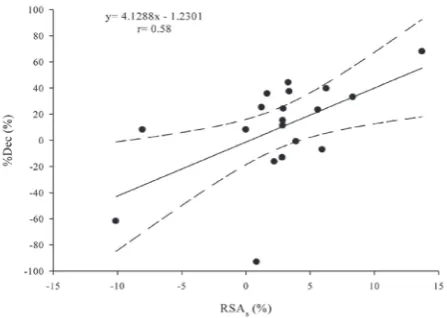
were positively correlated with changes in RSAs
(r=.58; CL 90%: .25; .79) (Figure 3), while a nega-tive relationship was found between the former and changes in RSAb (r=-.45; CL 90%: -.71; -.09).
Discussion and conclusions
The aim of this study was to compare the effects
of five weeks of HIT program with a CT program
on amateur team-sports players’ RSA, COD ability, jumping and shuttle-run performance. The main
findings were as follows: i) five weeks of CT simul -taneously induced small to moderate improvements in COD, RSA, CMJ and 20-m ST; ii) RSAm
adapta-tions were associated with better RSAb, rather than
enhancements in 20-m ST; iii) CT elicited substan-tially better results than HIT in all performance measurements, with the exception of the 20-m ST, where unclear differences were reported. All training effects were greater than the CV presented in the reliability analysis. Hence, it is worth noting that all changes should be considered meaningful performance improvements.
Regarding the effects of CT on COD ability, a previous study showed a small effect (ES=.43) in a group of professional Swedish soccer players
after five weeks of pre-season training (McGawley
& Andersson, 2013). It seems that EOT included during CT may improve COD ability as eccen-tric strength is one of the most important deter-minants of its performance (Girard, et al., 2011; Jones, Bampouras, & Marrin, 2009; Tous-Fajardo, et al., 2016). This partially may help to explain the greater COD ability improvement in the CT group compared to the HIT group, especially considering
that the influence of strength on COD performance depends heavily on the specific COD test used. In
this sense, strength and power in the lower limbs become more important with sharper turns and increased number of direction changes (Young,
James, & Montgomery, 2002), as in the COD test used in our study (i.e., Illinois test). However, this issue remains speculative, as neither eccen-tric strength nor direct measures of power were obtained in this study.
The RSA improvements found in the present study after both the HIT and CT training (ES=.48 to .67) are within the range (ES=.23 to 1.63) of those previously published (Ferrari Bravo, et al., 2008; Gonzalo-Skok, et al., 2016a; Suarez-Arrones, et al., 2014). Even though the HIT program was capable to substantially improve RSAb and RSAm,
the addition of EOT provided a likely better effect for all RSA measures than the solely execution of HIT. As previously reported, RSA is mostly deter-mined by RSAb and the ability to tolerate repeated
sprints with incomplete recovery (Bishop, Girard, & Mendez-Villanueva, 2011). With this in mind, compared to HIT, the inclusion of CT may simulta-neously have improved several determinant factors of RSA (muscular and neural) (Bishop & Spencer. 2004). However, possible underlying mechanisms
related to these findings remain speculative.
A very strong relationship was observed between the RSAb and RSAm enhancements (r=.77;
CL 90%: .57; 090), similar to previous studies (Gonzalo-Skok, et al., 2016a; Suarez-Arrones, et al., 2014). On the other hand, while RSAs and %Dec
were not improved (i.e., unclear effects) after HIT training, CT showed a substantial improvement in both variables (ES=.63 and .58, respectively). These enhancements together with the large asso-ciation observed between the changes in RSAm and
RSAs (r=.68; CL 90%: .43; .85) and between RSAs
and %Dec (r=.58; CL 90%: .25; .79) all seem to indicate that the ability to resist the sprint-induced fatigue was also enhanced after CT. These results are comparable to those of a previous strength training intervention with short recovery periods between effort bouts (Gonzalo-Skok, et al., 2016a). The potential underlying physiological mechanisms responsible for the improvement were not assessed in this study. However, it has been indicated that improved buffering capabilities may be linked to the ability to tolerate fatigue during repeated high-intensity efforts (Bishop, et al., 2011).
Both training programs improved 20-m ST performance. Improvement in endurance is common after HIT, even in highly-trained athletes (Buchheit & Laursen, 2013b). Although less studied, previous studies showed VO2max
improve-ments after a CT that combined resistance training and HIT within the same session (Cantrell, Schil-ling, Paquette, & Murlasits, 2014; Chtara, et al., 2008). However, others have indicated strength interference over endurance improvement (Bishop, Jenkins, Mackinnon, Mceniery, & Carey, 1999; Docherty & Sporer, 2000), especially when strength training was combined with continuous training
Figure 3. Relationship between relative changes in percentage decrement (%Dec) and relative changes in the slowest time (RSAs) of the repeated sprint ability test. Solid line represents
methods for endurance development (Wong, et al., 2010). However, in our study EOT showed no interference with shuttle-run performance improve-ment. As such, it seems that HIT (i.e., an intermit-tent training method for endurance development) may be well suited for combination with strength training methods such as EOT.
Jumping ability was very likely enhanced after CT and trivially affected following HIT. The lack of effect of HIT on CMJ was somewhat expected, as
previous findings suggested that HIT was limited
to trigger neuromuscular adaptations required to jumping higher (Ferrari Bravo, et al., 2008). Other-wise, the small effect (ES=.46) after CT is within the range of results previously reported (ES=.25 to .77) after the training of both adult and young athletes (Buchheit, et al., 2009; Tous-Fajardo, et al., 2016). Thus, the inclusion of strength training might be fundamental when the aim is to improve vertical jumping height during concurrent training.
Some potential limitations should be acknow-ledged. Firstly, we did not incorporate physiolog-ical measures, thus the underlying mechanisms
potentially explaining the observed physical fitness
improvements remained to be determined in future research. Secondly, both basketball and soccer players were included in the study, and the same
physical fitness tests were applied to them. However, the tests may not reflect equal ecological validity for
both types of players. Although in the current study
both basketball and soccer athletes were deemed as appropriate to be included in the study in order to increase the statistical power, future studies should
look at replication of this intervention in a specific
group of athletes from a given sport, including a
set of physical fitness tests that better resemble the demands of their specific sport. Thirdly, and related
with the previous point, while the levels of physical
fitness of those athletes improved, we cannot draw
any conclusions regarding changes in their foot-ball/basketball performance as these had not been assessed. Fourthly, the improvements following two training regiments were observed in amateur-level athletes and no conclusions regarding the effective-ness of these training regiments should be extended to highly trained professional athletes.
In conclusion, compared to HIT alone, concur-rent eccentric overload and HIT training within the same session concurrently improved RSA, COD, jump, and shuttle-run performance. The take-home message is that amateur team-sports players can
maximize their in-season physical fitness perfor -mance (i.e., COD ability, RSA, jumping, and 20-m shuttle run performance) by including a short-term
(i.e., five weeks) CT program into their training
schedules, involving two ~30 minutes training sessions per week of EOT (i.e., three lower-body drills, for two-three sets of six repetitions each) together with HIT.
References
Askling, C., Karlsson, J., & Thorstensson, A. (2003). Hamstring injury occurrence in elite soccer players after preseason strength training with eccentric overload. Scandinavian Journal of Medicine and Science in Sports,13, 244-250. Ben Abdelkrim, N., Castagna, C., El Fazaa, S., & El Ati, J. (2010). The effect of players’ standard and tactical strategy
on game demands in men’s basketball. Journal of Strength and Conditioning Research,24, 2652-62.
Ben Abdelkrim, N., El Fazaa, S., & El Ati, J. (2007). Time-motion analysis and physiological data of elite under-19-year-old basketball players during competition. British Journal of Sports Medicine,41, 69-75; discussion 76.
Bishop, D., Girard, O., & Mendez-Villanueva, A. (2011). Repeated-sprint ability ‒ Part II: Recommendations for
training. Sports Medicine,41, 741-56.
Bishop, D., Jenkins, D.G., Mackinnon, L.T., Mceniery, M., & Carey, M.F. (1999). The effects of strength training on endurance performance and muscle characteristics. Medicine and Science in Sports and Exercise, 31, 886-91. Bishop, D., & Spencer, M. (2004). Determinants of repeated-sprint ability in well-trained team-sport athletes and
endurance-trained athletes. Journal of Sports Medicine and Physical Fitness,44, 1-7.
Buchheit, M., & Laursen, P.B. (2013a). High-intensity interval training, solutions to the programming puzzle. Part II: Anaerobic energy, neuromuscular load and practical applications. Sports Medicine,43, 927-954.
Buchheit, M., & Laursen, P.B. (2013b). High-intensity interval training, solutions to the programming puzzle: Part I: Cardiopulmonary emphasis. Sports Medicine,43, 313-338.
Buchheit, M., Lepretre, P.M., Behaegel, A.L., Millet, G.P., Cuvelier, G., & Ahmaidi, S. (2009). Cardiorespiratory responses during running and sport-specific exercises in handball players. Journal of Science and Medicine in Sport,12, 399-405.
Buchheit, M., Mendez-Villanueva, A., Quod, M., Quesnel, T., & Ahmaidi, S. (2010b). Improving acceleration and repeated sprint ability in well-trained adolescent handball players: Speed versus sprint interval training.
International Journal of Sports Physiology and Performance,5, 152-164.
Buchheit, M., Millet, G.P., Parisy, A., Pourchez, S., Laursen, P.B., & Ahmaidi, S. (2008). Supramaximal training and postexercise parasympathetic reactivation in adolescents. Medicine and Science in Sports and Exercise,40, 362-371.
Cantrell, G.S., Schilling, B.K., Paquette, M.R., & Murlasits, Z. (2014). Maximal strength, power, and aerobic endurance adaptations to concurrent strength and sprint interval training. European Journal of Applied Physiology,114, 763-771.
Carling, C., Le Gall, F., & Dupont, G. (2012). Analysis of repeated high-intensity running performance in professional soccer. Journal of Sports Sciences,30, 325-336.
Castagna, C., Manzi, V., D’ottavio, S., Annino, G., Padua, E., & Bishop, D. (2007). Relation between maximal aerobic power and the ability to repeat sprints in young basketball players. Journal of Strength and Conditioning Research,21, 1172-1176.
Chtara, M., Chaouachi, A., Levin, G.T., Chaouachi, M., Chamari, K., Amri, M., & Laursen, P.B. (2008). Effect of concurrent endurance and circuit resistance training sequence on muscular strength and power development.
Journal of Strength and Conditioning Research,22, 1037-1045.
De Hoyo, M., Pozzo, M., Sanudo, B., Carrasco, L., Gonzalo-Skok, O., Dominguez-Cobo, S., & Moran-Camacho, E. (2015). Effects of a 10-week in-season eccentric-overload training program on muscle-injury prevention and performance in junior elite soccer players. International Journal of Sports Physiology and Performance,10, 46-52.
De Hoyo, M., Sanudo, B., Carrasco, L., Mateo-Cortes, J., Dominguez-Cobo, S., Fernandes, O., Del Ojo, J.J., & Gonzalo-Skok, O. (2016). Effects of 10-week eccentric overload training on kinetic parameters during change of direction in football players. Journal of Sports Sciences,34, 1380-1387.
Docherty, D., & Sporer, B. (2000). A proposed model for examining the interference phenomenon between concurrent aerobic and strength training. Sports Medicine,30, 385-394.
Faude, O., Koch, T., & Meyer, T. (2012). Straight sprinting is the most frequent action in goal situations in professional football. Journal of Sports Sciences,30, 625-631.
Ferrari Bravo, D., Impellizzeri, F.M., Rampinini, E., Castagna, C., Bishop, D., & Wisloff, U. (2008). Sprint vs. interval training in football. International Journal of Sports Medicine,29, 668-674.
Gabbett, T.J., & Mulvey, M.J. (2008). Time-motion analysis of small-sided training games and competition in elite women soccer players. Journal of Strength and Conditioning Research,22, 543-552.
Girard, O., Mendez-Villanueva, A., & Bishop, D. (2011). Repeated-sprint ability ‒ Part I: Factors contributing to fatigue.
Sports Medicine,41, 673-694.
Glaister, M., Howatson, G., Pattison, J.R., & Mcinnes, G. (2008). The reliability and validity of fatigue measures during multiple-sprint work: An issue revisited. Journal of Strength and Conditioning Research,22, 1597-1601. Gonzalo-Skok, O., Tous-Fajardo, J., Arjol-Serrano, J.L., Suarez-Arrones, L., Casajus, J.A., & Mendez-Villanueva, A.
(2016). Improvement of repeated-sprint ability and horizontal-jumping performance in elite young basketball players with low-volume repeated-maximal-power training. International Journal of Sports Physiology and Performance,11, 464-473.
Gonzalo-Skok, O., Tous-Fajardo, J., Valero-Campo, C., Berzosa, C., Bataller, A.V., Arjol-Serrano, J.L., Moras, G., & Mendez-Villanueva, A. (2017). Eccentric overload training in team-sports functional performance: Constant bilateral vertical vs. variable unilateral multidirectional movements. International Journal of Sports Physiology and Performance, 12, 951-958.
Hopkins, W.G. (2012). Reliability from consecutive pairs of trials (Excel spreadsheet). Internet Society for Sport Science. Retrieved from: sportsci.org/resource/stats/xrely.xls on March 13, 2012.
Hopkins, W.G., Marshall, S.W., Batterham, A.M., & Hanin, J. (2009). Progressive statistics for studies in sports medicine and exercise science. Medicine and Science in Sports and Exercise,41, 3-13.
Jones, P., Bampouras, T.M., & Marrin, K. (2009). An investigation into the physical determinants of change of direction speed. Journal of Sports Medicine and Physical Fitness,49, 97-104.
Mcgawley, K., & Andersson, P.I. (2013). The order of concurrent training does not affect soccer-related performance adaptations. International Journal of Sports Medicine,34, 983-990.
Mendez-Villanueva, A., Hamer, P., & Bishop, D. (2008). Fatigue in repeated-sprint exercise is related to muscle power factors and reduced neuromuscular activity. European Journal of Applied Physiology,103, 411-419.
Nadal, R., & Carlin, J. (2011). Rafa: My story. London: Hachette Digital.
Ramirez-Campillo, R., Meylan, C.M., Alvarez-Lepin, C., Henriquez-Olguin, C., Martinez, C., Andrade, D.C., Castro-Sepulveda, M., Burgos, C., Baez, E.I., & Izquierdo, M. (2015). The effects of interday rest on adaptation to 6 weeks of plyometric training in young soccer players. Journal of Strength and Conditioning Research,29, 972-979.
Submitted: October 9, 2017 Accepted: August 19, 2018
Published Online First: May 3, 2019
Correspondence to:
Fábio Yuzo Nakamura, Ph.D.
Department of Medicine and Aging Sciences, “G. d’Annunzio” University of Chieti-Pescara, Via dei Vestini, 31, 66100 Chieti, Italy E-mail: [email protected]
Acknowledgements
The authors wish to thank all the volunteers who participated in this study.
Authors’ contributions
JSS, OGS, FYN and RRC conceived the study design, participated in its design, coordination, helped to draft the manuscript and carried out the statistical analysis. MC and AP applied the programs and assessments and critically
reviewed the manuscript. All authors have read and approved the final version of the manuscript and agreed with the
order of presentation of the authors.
Competing interests
The authors declare that they have no conflict of interest.
Funding sources
This research did not receive any specific grant from funding agencies in the public, commercial, or not-for-profit sectors.
training on maximal-intensity exercise and endurance in male and female soccer players. Journal of Sports Sciences,34, 687-693.
Sheppard, J.M., & Young, W.B. (2006). Agility literature review: Classifications, training and testing. Journal of Sports Sciences,24, 919-932.
Silva, J.R., Nassis, G.P., & Rebelo, A. (2015). Strength training in soccer with a specific focus on highly trained players.
Sports Medicine Open, 1, 1.
Stolen, T., Chamari, K., Castagna, C., & Wisloff, U. (2005). Physiology of soccer: An update. Sports Medicine,35, 501-536.
Suarez-Arrones, L., Tous-Fajardo, J., Nunez, J., Gonzalo-Skok, O., Galvez, J., & Mendez-Villanueva, A. (2014). Concurrent repeated-sprint and resistance training with superimposed vibrations in rugby players. International Journal of Sports Physiology and Performance,9, 667-673.
Tous-Fajardo, J., Gonzalo-Skok, O., Arjol-Serrano, J.L., & Tesch, P. (2016). Enhancing change-of-direction speed in soccer players by functional inertial eccentric overload and vibration training. International Journal of Sports Physiology and Performance,11, 66-73.
Wong, P.L., Chaouachi, A., Chamari, K., Dellal, A., & Wisloff, U. (2010). Effect of preseason concurrent muscular strength and high-intensity interval training in professional soccer players. Journal of Strength and Conditioning Research,24, 653-660.
Young, W.B., James, R., & Montgomery, I. (2002). Is muscle power related to running speed with changes of direction?