ISSN: 2501 - 1235 ISSN-L: 2501 - 1235 Available on-line at: www.oapub.org/edu
doi: 10.5281/zenodo.1524467 Volume 5 │ Issue 1 │ 2018
PHYSICAL ACTIVITY AND GROSS MOTOR PROFICIENCY OF
CHILDREN WITH AUTISM SPECTRUM DISORDER:
A SYSTEMATIC REVIEW
Muneer P.1,
D. Sultana2
1PhD Research Scholar, Department of Physical Education & Sports, Pondicherry University, Puducherry, India 2Prof., Dr., Department of Physical Education & Sports,
Pondicherry University, Puducherry, India
Abstract:
The autistic children (ASD) have been expressing impairments of certain area of development which including communication, socialization, gross motor skills and physical activity behavior. Indeed physical activities are the tools for developmental process of children with ASD, predominantly gross motor development. The objectives of this systematic review are to describe research on recommended physical activities and level of gross motor skills of ASD children. The referred research articles involved physical activities, TGMD-3 and ASD. Searching keywords were used to get articles from selected electronic databases over 18 year’s period from 2000 to 2018. 12 articles were identified pre-determined inclusion criteria out of 124 articles. These articles were examined in terms of: (a) nature of participants, (b) research methodology, (c) variables and testing tools, (d) findings & outcome. Physical activity intervention implemented with N: 243 participants with ASD age category in between 4 – 19 years. Exercise intervention involved locomotor and object control skills (varied kinds of walking, jogging, aquatic exercise). Children with ASD are predominantly impaired with stereotyped behavior and lack of physical activities. Majority of results suggested that systematic planned physical activity intervention can decrease stereotyped behavior and better gross motor development.
Keywords: ASD, TGMD, physical activity, stereotyped, systematic review.
1. Introduction
state of impairment of communication and social responses as well. From the last decade these disorder has rapidly increased all over the globe, now autism is the third most common developmental disorder (National Autism Association). Autism is a condition of social and communication impairments, it may occur due to the abnormality of biological and cognitive development among the children. The difficulties of socialization, communication and mental imagination which are universal in nature are the common trace of an autistic person (Francesca Happe, 1994). The term ‘autism’ was described sixth decades ago, (Dr. Leo Kanner, in 1943). More than one million ASD cases are reported every year in India and has become a very serious issue in Indian families. The autistic symptoms will be evident during the first three years of age. Unfortunately, there is no medical test for diagnosing the autism, which is the major challenge faced by India (Dr. Kunjal Upadhyay). The predominant characteristics of autistic children are difficulty to express their emotions and barrier in communicating what they want to. And this disorder might unfortunately disturbed entire family. The autistic children (ASD) have difficulties of social skills, communication skills, restricted, recitative, and stereotypical behavior (APA). And many of these disorders are classified on basis of the core symptoms. In the case of autistic children, they may or may not be showing major symptoms and it’s not a mandatory. More often the autism causes are still unknown and autistic prevention measures have yet to be discovered, it's all we can be controlled those symptoms due to effective therapeutic activities such as, behavioral therapy, occupational, and speech therapy. Generally, people focusing on developing social, cognitive and communication skills by using behavioral intervention. Moreover, recent studies and scholars have to be suggested that physical activates, exercises and participation of sports & games bring to significant changes in the autistic symptoms and self-enjoyment of children with ASD (Pan & Frey, 2006). U.S. Health Department indicated that serious of health issues in the children aged 2-19 years, 16% of the total population, they are overweight and 19% of children with ASD failed basic health fitness. Inactivity conditions which bring serious of health problems such as cardiovascular diseases, diabetes, joint and bone problems and depression of autistic and typical developmental people compare to the normal people (Anderson, Curtin, Must, and Bandini, 2010; Garrison et al., 2013, Phillips et al., 2014, Rimmer et al., 2010, Todd et al., 2010). Most of the autistic children could not getting chances to participation of the physical activity programme as per the national recommendations of physical activity levels (Feehan et al., 2012; Bandini et al., 2013; Pan & Frey, 2006).
anticipation of motor skills, body postural control, and dyspraxia (Fournier et al., 2010; Schmitz et al., 2003) children have difficulties to perform the motor skills because of poor postural balance (Melissa A. Mache & Teri A. Todd , 2016), impairment of motor skills are not a symptom’s of autism (Pavel Zikl et al., 2016; Berkeley S.L. et al., 2001). The present study will be dealing with gross motor proficiency and recommended physical exercises of children with ASD, for that well-structured physical activity should be beneficial for all the peoples (Pitetti, Rendoff, Grover, & Beets, 2007). The researcher trying to find out the best physical exercise for children with ASD and level of gross motor efficiency of autistic children. For that, finally assessing 12 original article were selected and evaluating the level of gross motor skills.
2. Procedure
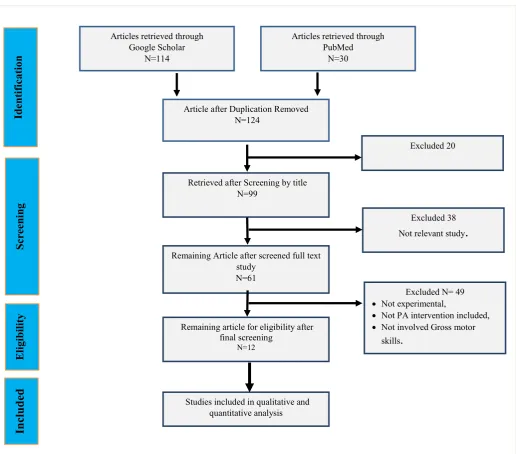
Figure 1:Flowchart of screening procedures in the study
2.1 Searching Procedures
Total of N 144 articles was collected through electronic data base (Google Scholar and PubMed) almost 79% percentage of article was selected from the Google Scholar. All the articles were retrieved through the electronic database by used keywords over 18- year’s period from 2000 to 2018. The keywords searched namely; autism children, physical activity for autism, gross motor skills of autism, and autism spectrum disorder. More detailed searching and screening procedure have clearly explained flowcharts.
2.2 Exclusion and Inclusion Criteria
The researcher fixed inclusion and exclusion criteria based on the systematic reviews process, there are three inclusion criteria’s were fixed namely (a) physical activity for ASD, (b) gross motor skills of ASD., and (c) experimental studies of PA with ASD. Initially collected articles N: 144 and finial sorting articles based on the inclusion
Remaining Article after screened full text study
N=61
Remaining article for eligibility after final screening
N=12
Studies included in qualitative and quantitative analysis
Excluded N= 49 Not experimental,
Not PA intervention included, Not involved Gross motor
skills. Articles retrieved through
PubMed N=30 Articles retrieved through
Google Scholar N=114
Article after Duplication Removed N=124
Excluded 20
Retrieved after Screening by title N=99
Excluded 38 Not relevant study
.
Ident
if
ica
ti
on
Scre
en
ing
E
li
gi
bi
li
ty
In
clu
d
criteria’s n: 12 only. Based on the journal sorting such as 1) Springer (N: 4), 2) Elsevier (N: 2), 3) Sage (N: 2), and 4) other international journals (N: 4). All the included articles were published standard and pre reviewed journals, ethical clearance were approved by the concerned body.
2.3 Data Extraction
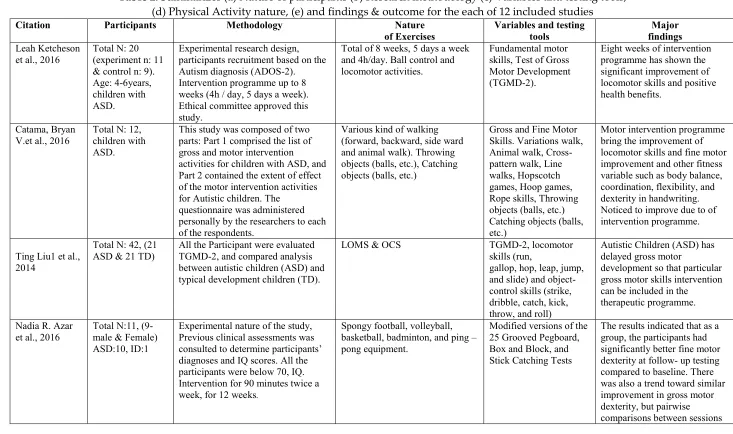
After the inclusion and exclusion was identified the article reviewed to assess the (n: 12) study. The selected article were examining in terms of the following categories: (a) nature of participants, (b) research methodology, (c) variables and testing tools, (d) physical activity nature and (e) findings & outcome. All the selected studies come under the experimental research design nature, examining the gross motor proficiency and activity intervention also included.
Table 1: Participants
Gender ASD TD Without ASD
Male 267 146 26
Female 4 - -
Total 271 146 26
Total number of participation N: 433.
Table 2: Summarizes (a) Nature of participants (b) Research methodology (c) Variables and testing tools, (d) Physical Activity nature, (e) and findings & outcome for the each of 12 included studies
Citation Participants Methodology Nature
of Exercises
Variables and testing tools
Major findings
Leah Ketcheson
et al., 2016 Total N: 20 (experiment n: 11 & control n: 9). Age: 4-6years, children with ASD.
Experimental research design, participants recruitment based on the Autism diagnosis (ADOS-2). Intervention programme up to 8 weeks (4h / day, 5 days a week). Ethical committee approved this study.
Total of 8 weeks, 5 days a week and 4h/day. Ball control and locomotor activities.
Fundamental motor skills, Test of Gross Motor Development (TGMD-2).
Eight weeks of intervention programme has shown the significant improvement of locomotor skills and positive health benefits.
Catama, Bryan
V.et al., 2016 Total N: 12, children with ASD.
This study was composed of two parts: Part 1 comprised the list of gross and motor intervention activities for children with ASD, and Part 2 contained the extent of effect of the motor intervention activities for Autistic children. The
questionnaire was administered personally by the researchers to each of the respondents.
Various kind of walking (forward, backward, side ward and animal walk). Throwing objects (balls, etc.), Catching objects (balls, etc.)
Gross and Fine Motor Skills. Variations walk, Animal walk, Cross-pattern walk, Line walks, Hopscotch games, Hoop games, Rope skills, Throwing objects (balls, etc.) Catching objects (balls, etc.)
Motor intervention programme bring the improvement of locomotor skills and fine motor improvement and other fitness variable such as body balance, coordination, flexibility, and dexterity in handwriting. Noticed to improve due to of intervention programme.
Ting Liu1 et al., 2014
Total N: 42, (21
ASD & 21 TD) All the Participant were evaluated TGMD-2, and compared analysis between autistic children (ASD) and typical development children (TD).
LOMS & OCS TGMD-2, locomotor
skills (run,
gallop, hop, leap, jump, and slide) and object-control skills (strike, dribble, catch, kick, throw, and roll)
Autistic Children (ASD) has delayed gross motor
development so that particular gross motor skills intervention can be included in the
therapeutic programme.
Nadia R. Azar et al., 2016
Total N:11, (9- male & Female) ASD:10, ID:1
Experimental nature of the study, Previous clinical assessments was consulted to determine participants’ diagnoses and IQ scores. All the participants were below 70, IQ. Intervention for 90 minutes twice a week, for 12 weeks.
Spongy football, volleyball, basketball, badminton, and ping – pong equipment.
Modified versions of the 25 Grooved Pegboard, Box and Block, and Stick Catching Tests
did not reach statistical significance.
Megan Eversole
et al., 2015 Total N: 131 (TD; n = 64) (ASD; n = 67)
Age: 6 to 13.
Researcher has used a case–control comparison with total of 105 samples (Hilton et al., 2008), samples ages in between 6 to 13 years, 67 autistic children and 64 samples were belong to typical development. Each Parents are voluntarily filled up of social responsiveness questionnaires (SRS-2
Fun games / activities, 2. Physical activities, 3. Social, 4. skill based, and 5.self-improvement activities
Physical activity, fun games, Skill based intervention, and self-improvement activities. Independent t test and chi-square was applied.
There was insignificant of age, IQ or gender between TD and ASD groups. Perhaps all the samples were enjoying activity in their own level of
satisfactions. In order to noted that activity participation enjoyment of autistic children have slightly better.
Milica Duronjić1, Hana Valkova2, 2010
N:5 (male: 4 & female:1) 5-6 years old
The researcher were used quantitative as well as qualitative aspect of research, movement assessment battery were used for quantitative analysis and qualitative skills analysis by observational method (Henderson & Sugden, 1992). Experimental duration up to eight weeks, all the samples were assigned initial and final testing procedure.
Manual Dexterity, Ball Skills,
Static and Dynamic Balance. MABC: Manual Dexterity (MD); Ball Skills (BS);
Static & Dynamic Balance (SDB).
The statically significant difference between pre and post-test were seen due to the eight weeks of physical activity programme of all the
participants. In terms of both quantitative as well as qualitative improvement were seen the participants, four participants has shown the better improvement out of 5 samples.
Chine-Yu Pan Georgia C. Frey, 2006
N:30 With ASD, 10-19 Years.
The experimental research design was chosen in this study, total samples were divided into elementary (n=9), middle (n=9) and high (n=12) all the samples were measured physical activity rate by using accelerometry, asked to wear five consecutive days.
MVPA / Day. Accelerometry (MTI)
Child/Adolescent Activity Log (CAAL).
The result of the study was (1) Elementary group was far better that the other group for PA participations, (2) there are not same degree of participation of PA during time and days defenses. The researchers finding this study that structured physical activity intervention needed for adult with ASD.
Chine-Yu Pan,
. PACER
aquatic intervention programme bring the better result of children with ASD and their siblings.
Melissa A. Mache & Teri A. Todd, 2016
N: 22 (n:11 with ASD & n: 11 without ASD) 5–12 years.
To assessment of Test of Gross Motor Development (TGMD-3), assessment were administrated in the laboratory place. Analyses TGMD-3 by used video record (video
analysis).
TGMD-3 Locomotor and objective
control (TGMD-3) The result reveled that children with ASD have difficulties to perform complex motor skills because of the lack of body posture and body control. The study were focused that improved body balance through the interventional activities, for that locomotor skills can be performed as well.
Mengxian Zhao and Shihui Chen, 2018
N:50 with ASD [Experimental n:25,
Control group n: 25.]
5-8 Years
Experimentation duration up to 12 weeks. Pretest –mid test and posttest were applied for these studies. Physical activity intervention for 12 weeks / 60 minutes per session. Total of 24 sessions.
Jogging on the playground, playing ball (tap the ball, ball throw, catch the ball, ball passing the partner)
Group ball games.
Social interaction and communication.
The result indicated that overall improvement were seen in terms of social and communication skills for experimental group when the compared to the control group. The researcher has been recommended the 12 weeks physical activity for better improvement of autistic children.
Heidi I. Stanish
et al.,2017 N: 95 (n: 35 with ASD) n: 60 with TD.
13–18 years
All the samples were measured MVPA by used the Accelerometers and activity engaged questionnaire. Samples asked to wear the
Accelerometer for seven days, including week days as well as weekend days.
Running/Jogging, Walking, Video Gaming, /Hiking, Swimming,
Basketball, Bicycling, Dancing, Football, Weightlifting, And Baseball /Softball.
Accelerometry &
Questionnaire
The children with ASD who have Adolescents stage were met less participated in MVPA when compared to the typical development children. This condition shows that failure to maintaining national
adolescent autistic children. Pitetti et al.,
(2007)
Total samples N: 5 ASD (male:3; female: 2).age between 14–18 years old (M= 16),
Random group design for selected participants and assigned two group exercise and non exercises group. To get the group difference by the independent t test were applied.
Basketball (Shooting, dribbling, passing), jumping rope, roller skating, Scooter-Board activities, object control skills (throwing the ball and catching the ball), striking a ball with a tennis racket or plastic bat, and cycling skills. Treadmill walking,
Walk on treadmill. The researcher was found the improvement of exercise capability and increased calories expenditure due to activity intervention. The major finding of the research that Body mass index were decreased statically.
3. Results
Total of 433 participations (ASD children n=271; TD n=146; without ASD n=26) their age range in between 4 to 19 years old. Physical activity must be an essential fact for people health and wellness. (U.S. Department of Health and Human Services, 1996). Many of the scholars have suggested that physical activity bring probability of improving dorsal striatum volume, hippocampal, focus, problems involving response and motor coordination of the brain associated with attention span (Chaddock et al., 2010). Due to aerobic exercise intervention, bring significant improvement of social skills and attention span of children with ASD (C. K. Bass 1985). Same variables improvement has shown used summing, bicycle, and therapeutic horse raiding (Pan, 2010; M. M. Bass, 2009; Lang et al., 2010). Treadmill exercise programmers helped to decrease the body fat especially body mass index of (ASD) autistic children (Pitetti et al., 2007). Structured physical activity plays an essential role in affecting people live in many aspects, and it's more beneficial of children because its contribution not only the physical condition but also their social skills, self-esteem and behavior.
4. Discussion
Autism is not a disease, for that there is no medical treatment as well (American Academy of Pediatrics) but certain level of autistics stereotyped behavior we can reduced due to the structured physical activity programme. There are 12 original article has been included systematic reviews analysis out of 144 searched studies. Apart from that 12 studies more classified based on the journal character (Springer n: 4, SAGE n: 2, Elsevier n: 2, and other international journal n: 4). The selected studies were close examining in termers of; (a) nature of participants, (b) research methodology, (c) variables and testing tools, (d) physical activity nature and (e) findings & outcome. Nature of participants of 12 studies has to included ASD children (N=256 with ASD) and typical development children (N=145), their age category between 4 – 19 years old. To go through the methodological analysis, all the 12 studies has been insist the experimental research design, some scholars put the intervention period up to 8 weeks, two more studies leads up to 12 weeks and 14 weeks respectively. Nature of exercise which was included almost locomotor and objective control skills (running, leaping, jumping, skipping etc.). Four studies assessing the TGMD intervention programme (Catama, Bryan et al., 2016; Ting Liul et al., 2014; Mache & Todd, 2016). Two studies insist to assess the degree of physical activity with help of Accelerometry (Stanish et al., 2017). 14 weeks aquatic exercises intervention programme (Chine Yu Pan, 2011) and structured physical activity intervention like ball throws, minor games, jogging playground bicycling and various kind of ball games were recommended to children with ASD (Nadia et al., 2016; Millica Duronji, 2010; Mengxian, 2018; Pitetti et al, 2007).
children. Most of the studies proved that Autism Spectrum Disorder children have lack of sufficient postural control, poor body balance to produce motor movement and delayed motor development (Melisa 2016; Bhat et al., 2012; Chawarska et al., 2007; Flanugan et al., 2012). The difficulty of in locomotor skills, poor body control, body balance, lack of muscle strength, and coordination, moreover uncontrolled speed movement of autism spectrum children may having (Schopler et al., 2011). Majority of the studies conspicuously proved that well planned structured physical activity intervention positively influenced on gross motor development, balance and coordination for autistic children (Leah et al., 2016; Catama et al., 2016; Ting et al., 2014; Melissa et al., 2016). Stereotyped behaviour is one of the major symptoms for autistic children, due to exercises activity intervention programme bring to decrease the certain level of stereotypical behaviour and it can offer to improve self-enjoyment, social interaction as well (Megan et al., 2015; Milica et al., 2010). To developed health fitness components and motor skills of autistic children by cause of 14 weeks of aquatic skills intervention (Chine Yu Pan, 2011). Treadmill walk intervention programme bring the change of body mass index ratio among children with ASD (Pitetti et al., 2007). In order to find out the main target of this study must be for recommended physical activity of autistic (ASD) children, second target gross motor proficiency and finding the research gap of the future research. Age appropriate physical activity should be beneficial for these children with included colorful equipment must be motivated. Indeed picture diagram of the entire activity scheduled will be more cooperative and teacher or coaches must be identified autistic condition of the children whether mild or sever. ASD children has less motor proficiency than the typical developed children (Ting Liul et al., 2014) but it can be developing due to physical activity intervention programme. To identify the research gaps were existing database so as to insist further research, most of the studies shown the case control studies there is lack of experimental nature. Perhaps experimental research design can be applied future research and mostly in India, there was not much experimental research in these areas. No doubt physical exercises intervention of autistic (ASD) children has shown significantly positive outcomes, especially gross motor skill improvements.
Reference
Azar, N.R., McKeen, P., Carr, K., Sutherland, C.A., & Horton, S. (2016). Impact of Motor Skills Training in Adults with Autism Spectrum Disorder and an Intellectual Disability. Journal on Developmental Disabilities, 22(1).
Bass, M.M., Duchowny, C.A., & Llabre, M.M. (2009). The effect of therapeutic horseback riding on social functioning in children with autism. Journal of Autism and Developmental Disorders, 39, 1261–1267.
Bandini, L.G., Gleason, J., Curtin, C., Lividini, K., Anderson, S.E., Cermak, S.A.,< Must, A. (2013). Comparison of physical activity between children with autism spectrum disorders and typically developing children. Autism, 17, 44–54.
Berkeley, S.L., Zittel, L.L., Pitney, L.V., & Nichols, S.E. (2001). Locomotor and object control skills of Children diagnosed with autism. Adapted Physical Activity Quarterly, 18(4), 405-416.
Catama, Bryan V., Calalang, Wielm Mae S., Cada, Renz Karlo D., Ballog, Angelica C., Batton, Kaylee B., Bigay, Ma. Lourdes R and Borje, Denice Jan J(2017). Motor intervention activities for children with autism spectrum disorders. International Journal of Research Studies in Psychology, Volume 6 Number 1, 27-42.
Chaddock, L., Erickson, K.I., Prakash, R.S., Van Patter, M., Voss, M.W., Pontifex, M.B., & Kramer, A.F. (2010). Basal ganglia volume is associated with aerobic fitness in preadolescent children. Developmental Neuroscience, 32, 249–256. doi:10.1159/000316648.
Clark J.E., Metcalfe J.S. (2002) The mountain of motor development: A metaphor. In: Clark J.E, Humphrey J.H. (Eds). Motor Development: Research and Review. NASPE Publications, Reston, VA.
Curtin, C., Anderson, S.E., Must, A., & Bandini, L. (2010). The prevalence of obesity in children with autism: A secondary data analysis using nationally representative data from the National Survey of Children’s Health. BMC Pediatrics, 10(11). doi:10.1186/1471-2431-10-11.
Duronjić, M., & Válková, H. (2010). The influence of early intervention movement programs on motor skills development in preschoolers with autism spectrum disorder (case studies). Acta Gymnica, 40(2), 37-45.
Eversole, M., Collins, D.M., Karmarkar, A., Colton, L., Quinn, J.P., Karsbaek, R., ... & Hilton, C.L. (2016). Leisure activity enjoyment of children with autism spectrum disorders. Journal of autism and developmental disorders, 46(1), 10-20.
Feehan, K., O’Neil, M.E., Abdalla, D., Fragala-Pinkham, M., Kondrad, M., Berhane, Z., & Turchi, R. (2012). Factors influencing physical activity in children and youth with special health care needs: A pilot study. International Journal of Pediatrics,
Article ID 583249. doi:10.1155/ 2012/583249.
Fournier, K.A., Hass, C.J., Naik, S.K., Lodha, N., & Cauraugh, J.H. (2010). Motor coordination in autism spectrum disorders: A synthesis and meta-analysis.
Journal of Autism and Developmental Disorders, 40, 1227–1240.
Fournier, K.A., Kimberg, C.I., Radonovich, K.J., Tillman, M.D., Chow, J.W., Lewis, M. H.,... & Hass, C.J. (2010). Decreased static and dynamic postural control in children with autism spectrum disorders. Gait & posture, 32(1), 6-9.
Lang, R., Koegel, L.K., Ashbaugh, K., Regester, A., Ence, W., & Smith, W. (2010). Physical exercise and individuals with autism spectrum disorders: A systematic review. Research in Autism Spectrum Disorders, 4, 565–576.
Liu, T., Hamilton, M., Davis, L., & ElGarhy, S. (2014). Gross motor performance by children with autism spectrum disorder and typically developing children on TGMD-2. Journal of Child and Adolescent Behaviour.
Mache, M.A., & Todd, T.A. (2016). Gross motor skills are related to postural stability and age in children with autism spectrum disorder. Research in Autism Spectrum Disorders, 23, 179-187.
Menear, K.S., & Neumeier, W.H. (2015). Promoting physical activity for students with autism spectrum disorder: barriers, benefits, and strategies for success. Journal of Physical Education, Recreation and Dance, 86(3), 43-48.
Menear, K.S., Smith, S., & Lanier, S. (2006). A multipurpose fitness playground for individuals with autism: Ideas for design and use. Journal of Physical Education, Recreation & Dance, 77(9), 20-25.
Pan, C.Y., & Frey, G.C. (2006). Physical activity patterns in youth with autism spectrum disorders. Journal of autism and developmental disorders, 36(5), 597.
Pan, C.Y. (2014). Motor proficiency and physical fitness in adolescent males with and without autism spectrum disorders. Autism, 18, 156–165.
Pan, C.Y. (2010). Effects of water exercise swimming program on aquatic skills and social behaviors in children with autism spectrum disorders. Autism, 14, 9–28. Pan, C.Y. (2011). The efficacy of an aquatic program on physical fitness and aquatic
skills in children with and without autism spectrum disorders. Research in Autism Spectrum Disorders, 5(1), 657-665.
Phillips, K.L., Schieve, L. A., Visser, S., Boulet, S. Sharma, A.J., Kogan, M.D.,. . . Yeargin-Allsopp, M. (2014). Prevalence and impact of unhealthy weight in a national sample of US adolescents with autism and other learning and behavioral disabilities. Maternal and Child Health Journal, 18, 1964–1975.
doi:10.1007/s10995-014-1442-y.
Provost B., Lopez B.R. and Heimerl S. (2007) A comparison of motor delays in young children: Autism spectrum disorder, developmental delay, and developmental concerns. Journalof Autism and Developmental Disorders 37(2): 321–328.
Pitetti, K.H., Rendoff, A.D., Grover, T., & Beets, M.W. (2007). The efficacy of a 9-month treadmill walking program on the exercise capacity and weight reduction for adolescents with severe autism. Journal of Autism and Developmental Disorders, 37(6), 997-1006.
Robinson L.E., Goodway J.D. (2009) Instructional climates in preschool children who are at risk, part II: Perceived physical competence. Res Q Exercise Sport 80: 543-551.
intellectual/developmental disabilities. Journal of Intellectual Disability Research, 54, 787–794.
Srinivasan, S.M., Pescatello, L.S., & Bhat, A.N. (2014). Current perspectives on physical activity and exercise recommendations for children and adolescents with autism spectrum disorders. Physical Therapy, 94(6), 1–46.
Staples, K.L., & Reid. G. (2010). Fundamental movement skills and autism spectrum.
Autism and Developmental Disorders,40, 209–217.
Stanish, H.I., Curtin, C., Must, A., Phillips, S., Maslin, M., & Bandini, L.G. (2017). Physical Activity Levels, Frequency, and Type Among Adolescents with and Without Autism Spectrum Disorder. Journal of autism and developmental disorders, 47(3), 785-794.
Schmitz, C., Martineau, J., Barthélémy, C., & Assaiante, C. (2003). Motor control and children with autism: deficit of anticipatory function?. Neuroscience letters, 348(1), 17-20.
Todd, T., Reid, G., & Butler-Kisber, L. (2010). Cycling for students with ASD: Self-regulation promotes sustained physical activity. Adapted Physical Activity Quarterly, 27, 226–241.
Obrusnikova, I., & Cavalier, A. (2011). Perceived barriers and facilitators of participation in after school physical activity by children with autism spectrum disorders. Journal of Developmental and Physical Disabilities,23, 195–211.
Zhao, M., & Chen, S. (2018). The Effects of Structured Physical Activity Program on Social Interaction and Communication for Children with Autism. BioMed Research International, 2018.
Zikl, P., Petru, D., Danková, A., Dolezalová, H., & Safaríková, K. (2016, January). Motor skills of children with autistic spectrum disorder. In SHS Web of Conferences (Vol. 26). EDP Sciences.
Hills, A.P., King, N.A., & Armstrong, T.P. (2007). The contribution of physical activity and sedentary behaviours to the growth and development of children and adolescents. Sports medicine, 37(6), 533-545.
http://www.autismspeaks.org/whatisit/index.php?WT.svl=Top_Nav
Creative Commons licensing terms