ARTIGO ORIGINAL
Anaesthesia in Dental Medicine with Local Infiltrative
Anaesthetic Technique
Versus
Diploe Anaesthesia
Delivery Systems: Efficacy and Behaviour, an
Experimental Study
Anestesia em Medicina Dentária com Técnica
Infiltrativa Local
Versus
Anestesia Diploica: Eficácia e
Comportamento, um Estudo Experimental
* Co-primeiros autores
1. Faculdade de Medicina. Universidade de Coimbra. Coimbra. Portugal.
2. Centro de Neurociências e Biologia Celular. Instituto de Ciências Biológicas e de Ciências da Vida. Universidade de Coimbra. Coimbra. Portugal. 3. Serviço de Estomatologia. Centro Hospitalar e Universitário de Coimbra. Coimbra. Portugal.
Autor correspondente: José Pedro Figueiredo. [email protected]
Recebido: 21 de janeiro de 2017 - Aceite: 16 de junho de 2017 | Copyright © Ordem dos Médicos 2017
Manuel MARQUES-FERREIRA*1,2, Eunice CARRILHO*1,2, Siri PAULO1, Teresa CARRILHO1, José PEDRO-FIGUEIREDO1,3, Ricardo MACEDO1
Acta Med Port 2017 Dec;30(12):848-853 ▪ https://doi.org/10.20344/amp.8710
RESUMO
Introdução: Este estudo teve como objetivo comparar a eficácia analgésica e a influência no ritmo cardíaco das técnicas de anestesia
infiltrativa local, com a anestesia diploica.
Material e Métodos: Foram selecionados 32 voluntários, saudáveis, aos quais foram administradas ambas as técnicas anestésicas
no dente 1.4. (0,45 mL de lidocaína com adrenalina, 1:80 000). Numa primeira fase os voluntários foram sujeitos a anestesia infiltrativa periapical e numa segunda fase foi realizada anestesia diploica, com um dispositivo QuickSleeper®. Os parâmetros analisados foram
a resposta pulpar ao teste elétrico e o ritmo cardíaco dos participantes. Estes parâmetros foram avaliados nos tempos: antes da anestesia (t0), logo após a anestesia (t1), 15 minutos depois (t15), 30 minutos depois t(30) e 60 minutos depois (t60). Foi feita análise estatística dos dados obtidos, através do software SPSS 2.0, com α = 0,05.
Resultados: Com a anestesia diploica o estado de analgesia foi atingido de forma mais rápida. Registou-se um ligeiro aumento do
ritmo cardíaco logo após a administração da anestesia diplóica, que estabilizou após t15 do procedimento. Esta técnica revelou ainda ser indolor.
Conclusão: A anestesia diploica demonstrou melhores resultados em termos de analgesia do que o método convencional. Revelou
ser um procedimento fácil, seguro e eficaz, que permite anestesiar quase todas as situações clínicas. Esta abordagem apresenta vantagens particularmente para a terapêutica endodôntica, proporcionando maior conforto para o doente.
Palavras-chave: Anestesia Dentária; Anestesia Local; Frequência cardíaca
ABSTRACT
Introduction: This study aimed to compare the analgesic efficacy and the influence of local infiltrative anesthesia techniques, with
diploe anesthesia, on the cardiac rhythm
Material and Methods: We selected 32 healthy volunteers who were given both anaesthetic techniques on tooth 1.4 (0.45 mL of
lidocaine with adrenaline, 1:80 000). In the first phase, the volunteers underwent periapical infiltrative anaesthesia. In the second phase, diploe anaesthesia was performed with a QuickSleeper® device. The parameters analysed were pulp response to the electrical test and
heart rate of the participants. These parameters were evaluated on five different occasions: before anaesthesia (t0), immediately after anaesthesia (t1), 15 minutes later (t15), 30 minutes later (t30) and 60 minutes later (t60). Statistical analysis of the data was performed using SPSS 2.0 software, with α = 0.05.
Results: With the diploe anaesthesia, a level of analgesia was obtained faster. There was a slight increase in heart rate soon after
administration of diploe anaesthesia, which stabilized after t15 of the procedure. This technique still proved to be painless.
Conclusion: Diploe anaesthesia demonstrated better results in terms of analgesia than the infiltrative anaesthesia. It has been reported
to be easy, safe and an effective procedure that allows anaesthesia in almost all clinical situations. This approach may offer particular advantages for endodontic therapy, providing greater comfort for the patient.
Keywords: Anesthesia, Dental; Anesthesia, Local; Heart Rate
INTRODUCTION
Pain management is a key factor in overcoming our patients’ expectations and in minimizing pre-operative stress. Inappropriate analgesia may result in increased consultation time, as well as causing pain and anxiety in the patient.1 Lower dental nerve block as well as local infiltrative anaesthesia are the most commonly used techniques used to achieve the desired analgesia for
ARTIGO ORIGINAL pain, as well as causing damage of the periodontal
ligament.1,3 In this context, diploe anaesthesia is presented as an alternative to conventional methods. The anaesthetic solution would then be delivered at the spongy bone adjacent to the tooth. This model is the basis for the techniques of diploe anaesthesia that we know today.3,6-8 When properly performed, this technique implies no increased risk to the patient. The fact that the anaesthetic is deposited directly into the spongy bone allows a reduction in the total amount of anaesthetic needed to obtain deep analgesia and only the tooth becomes anaesthetized, unlike all accessory structures.9,10 These conditions play a particularly important role in children since there is a lower risk of administration of toxic doses as well as a lower risk of lacerating the lip or other accessory structures, which in this case are not anaesthetized.10 Due to the good vascularization of the spongy bone this approach allows us shorter analgesia time compared to conventional techniques.2 While various diploe anaesthesia systems are available on the market, such as Quicksleeper®, X-Tip®, Stabident® and IntraFlow®, they all follow the principle described above.
The objective of this study was to evaluate the analgesic efficacy of a local infiltrative technique and diploe anaesthesia and its effect on heart rate.
MATERIAL AND METHODS
In this study, 32 healthy volunteer students of dentistry were given two anaesthetic techniques. First, they underwent periapical vestibular infiltrative anaesthesia of tooth 1.4. In a second time point, diploe anaesthesia was used by the same operator. Inclusion criteria were volunteers aged between 20 and 23 years of age, ASA status I, tooth 1.4 without caries or other oral pathologies. Exclusion criteria were allergy to local anaesthetics, medical comorbidities, being uncooperative and absence of tooth 1.4 All participants in the study were informed and understood the possible risks, accepted and signed the informed consent form. The study was submitted and approved by the ethics council of the Faculty of Medicine of the University of Coimbra.
The parameters evaluated were the heart rate, evaluated by the same operator, in the right radial artery and the degree of analgesia of the tooth, using the electrical test (SybronEndo Vitality Scanner, Kerr®). The values of this test vary between 1 unit (low degree of analgesia) and 80 units (high degree of analgesia).
The parameters were calculated at the following five different time points: before anaesthesia (t0); immediately after anaesthesia (t1); 15 minutes after (t15); 30 minutes after (t30) and 60 minutes after anaesthesia (t60).
In both anaesthesia techniques, 0.45 mL of 2% lidocaine with vasoconstrictor (adrenaline) at the concentration of 1:80 000 was administered.
The protocol was initiated with a detailed examination of the oral cavity and clinical history in order to evaluate if the volunteer met all the inclusion and exclusion criteria to be included in the study. The Diploe anesthesia was performed by the same operator, a specialist in dental medicine. Data on the heart rate and the electrical test (time t0) were collected The proximal mucosa of tooth 1.4 was air-dried and topical anaesthesia (Topigel®-Benzocaine - Laboratories Clarben S.A) was applied with a cotton pellet in order to relieve discomfort when inserting the needle. Then, with QuickSleeper®, the periosteum adjacent to the distal tooth to be evaluated was anaesthetized, three drops of the anaesthetic solution were delivered in the mucosa, where we drilled the cortical bone, in order to relieve the discomfort and pain associated with the perforation of the cortical bone. After the anaesthetic technique we re-evaluated the parameters re-evaluated at T0, and at times t1, t15, t30 and t60.
Statistical analysis was performed using IBM® SPSS® v. 20.0 (IBM Corporation, Armonk, New York, USA). The Kolmogorov-Smirnov test was used for the evaluation of the normal distribution of the quantitative variables. In descriptive analysis the median and interquartile range were used for quantitative variables (cardiac rhythm and sensitivity to the electrical test).
In the inferential analysis, parametric tests were used in case of a normal distribution of variables and non-parametric tests in the opposite case. Student’s t-test (parametric test) or the Mann-Whitney test (non-parametric test) was used to compare heart rate and electrical test between the two types of anaesthesia for each time. The evaluation of both variables over time for each type of anaesthesia was performed according to the Friedman test, with multiple comparisons according to Bonferroni correction. A value of α = 0.05 was considered for all comparisons.
RESULTS
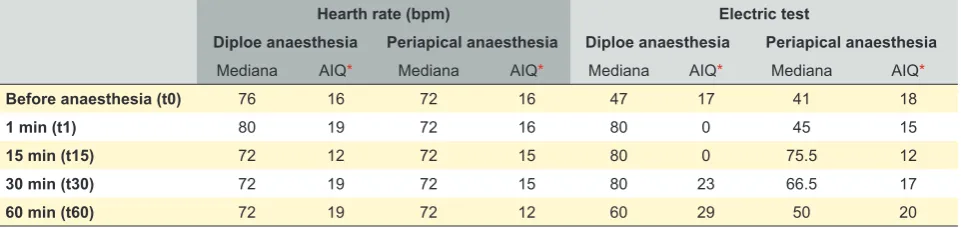
The descriptive analysis of the heart rate and electrical Table 1 - Descriptive analysis of heart rate measurements (bpm: beats per minute) and response to the electrical sensitivity test for diploe and periapical anesthesia
Hearth rate (bpm) Electric test
Diploe anaesthesia Periapical anaesthesia Diploe anaesthesia Periapical anaesthesia
Mediana AIQ* Mediana AIQ* Mediana AIQ* Mediana AIQ*
Before anaesthesia (t0) 76 16 72 16 47 17 41 18
1 min (t1) 80 19 72 16 80 0 45 15
15 min (t15) 72 12 72 15 80 0 75.5 12
30 min (t30) 72 19 72 15 80 23 66.5 17
60 min (t60) 72 19 72 12 60 29 50 20
ARTIGO ORIGINAL
sensitivity test responses for each type of anaesthesia is shown in Table 1. Before the anaesthesia was administered, there were no statistically significant differences in heart rate (p = 0.480) and in the response to the electrical sensitivity test (p = 0.090) between the groups subjected to the two anaesthetic techniques. The same is not true for t1, where there were statistically significant differences regarding the heart rate (p = 0.003) and the response to the electrical sensitivity test (p < 0.001), both of which were higher for the diploe anaesthesia technique. Concerning the heart rate for t1, t15, t30 and t60, there were no statistically significant differences between the two techniques (p = 0.830, p = 0.844, p = 0.352 respectively). Concerning the degree of analgesia with the electrical test, there were statistically significant differences at all times (t15, p = 0.002, t30, p = 0.040, t60, p = 0.007 respectively).
When the heart rate (bpm) values were analysed over time, the existence of significant differences (p = 0.003) was found; multiple comparisons identified only a statistically significant difference between t1 and t30 (p = 0.004), with no differences between the remaining time points. Periapical infiltrative anaesthesia, on the other hand, did not show any difference in the comparison of the same time points (p = 0.070) (Table 1, Fig. 1).
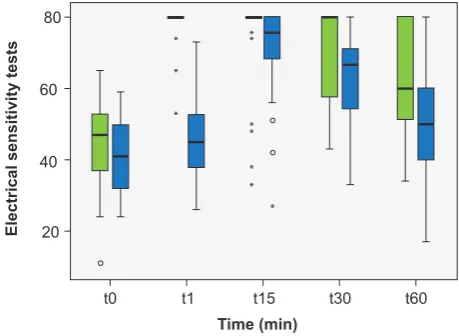
When analysing the values of the response to the electrical sensitivity test over time, comparing the points evaluated, there were statistically significant differences for both diploe anaesthesia (p < 0.001) and periapical anaesthesia (p < 0.001). For diploe anaesthesia, multiple comparisons showed a statistically significant difference between t0 and all other points assessed (p < 0.001). In the comparison of t1, t15 and t30 with the remaining points there was no statistically significant difference except for the comparison of t1 and t15 with t60 (p = 0.001 and p = 0.018 respectively) (Table 1, Fig. 2).
Regarding periapical infiltrative anaesthesia there were statistically significant differences between t0 and all other points assessed (p < 0.001) except for comparison
with t1. In the comparison of t1 with the remaining times a statistically significant difference was found with respect to t15 and t30, but not t60. In the remaining comparisons there were statistically significant differences except for t15 with t30 (Table 1, Fig. 1).
DISCUSSION
Adequate analgesia is a fundamental condition for the operative procedure in dental medicine. However, conventional anaesthesia may sometimes be unsuccessful in irreversible pulpitis, especially in the posterior mandibular teeth, where the bone is denser and less porous.4,6,11 The combination of anaesthetic techniques such as lower dental nerve block, periapical infiltrative anaesthesia and intra-ligament injections increase efficacy, but are not always sufficient to obtain acceptable levels.1,2 In the study performed by Aggarwal et al, they compared the efficacy of administration of periapical infiltrative (lingual and vestibular) anaesthesia after lower alveolar nerve block with 2% lidocaine (adrenaline 1: 200 000). In this study, only patients with irreversible pulpitis were included. They also compared the efficacy of two different anaesthetic solutions: 2% articaine with 1: 200 000 epinephrine and 2% lidocaine with epinephrine at a concentration of 1: 200 000. Lower alveolar nerve block (IANB) was well achieved in only 33% of cases. The success rate increased to 47% and 67% when the IANB was supplemented with lidocaine and articaine, by buccal and lingual side, respectively.6 Ashraf et al carried out a similar study, and they concluded that IANB alone has a success rate of only 14%.4 The success rate increased to 29% and 71% when they supplemented the IANB with lidocaine and articaine, by buccal and lingual side, respectively.4 The results, although close, diverge due to slight differences in anaesthetic solutions applied. It should be noted that lip numbness as well as its accessory structures do not always guarantee that IANB was successful.4,6,12
The difficulty in anaesthetizing teeth with irreversible Figure 1 – Heart rate values at t0, t1, t15, t30 and t60
40
Diploe anaesthesia Periapical anaesthesia t0 t1 t15 t30 t60 60
80 100
Heart rate (BPM)
Time (min)
Figure 2 – Response values to the electrical sensitivity test at t0, t1, t15, t30 and t60
20
Diploe anaesthesia Periapical anaesthesia t0 t1 t15 t30 t60 40
60 80
Electrical sensitivity tests
ARTIGO ORIGINAL pulpitis is consensual that in inflamed periapical tissues
there is a release of inflammatory mediators that reduce the sensitivity threshold of nociceptive neurons, to the point where any minor stimulus activates it.6,11 Goodis et al (2009) demonstrated that by lowering the pH from 7.4 to 6.5 the sensitivity of nociceptor neurons is increased. They also showed that by reducing the temperature from 37°C to 26°C the signal from these neurons would be blocked or drastically attenuated. There is therefore a correlation with clinical observations in the sense that by decreasing the local temperature of the tissue, the pain in cases of severe pulpitis also decreases.6,13
Anaesthetic solutions need to maintain their alkaline pH in order to penetrate the neurons and block the nerve stimulus to ensure analgesia of the tooth. Under these conditions, depositing the solution in the area surrounding the tooth will cause its pH to decrease, with less anaesthetic in the ionized form to produce analgesia. For this purpose, intraligamentary or diploe anaesthesia is used, since they allow the anaesthetic solution to be deposited near the apex of the tooth in question.6 Success rates have been reported of 50% to 96%.11 However, its use is not advisable since the anaesthetic solution diffuses along the external surface of the cribiform plate, through the spinal cord spaces and not through the periodontal ligament.6 Its duration of action is reduced and there is a significant incidence of postoperative pain resulting from its use.6 To achieve the highest success rates, at least two injections were required at sites other than the periodontal ligament.11 In this context, diploe anaesthesia is presented as an alternative to the anaesthesia techniques previously referenced. Several authors have conducted studies in order to evaluate the success rate of this technique in cases of irreversible pulpitis, where there is great difficulty in anaesthetizing the tooth with this condition. It was possible to conclude that the success rate varied between 82% and 95%, and this value could reach 100% if a supplementary diploid anaesthesia was applied.3,10,12,14-18 Like other anaesthetic methods, diploe anaesthesia has a lower success rate in posterior mandibular teeth due to the high density and low bone porosity.4,6,11,17 There was also the possibility that the reduced distance between the buccal and lingual cortical bone may cause lateral diffusion of the anaesthetic, leading to lower success rates.17 Once the anaesthetic solution is deposited in the spongy bone, the onset of action is almost immediate.11,16 It was possible to verify this factor during the experimental component of this study. Our results demonstrate that between t0 and t1, there is a statistically significant improvement with diploe anaesthesia, which does not occur with periapical infiltrative anaesthesia. In all volunteers, the onset of analgesic action with QuickSleeper® was immediate. The spongy bone of both the jawbone and the jaw has a good blood supply, which causes the anaesthetic deposited there to be metabolized more quickly. As a result, the duration of the anaesthetic effect of this method in the tooth is lower than in conventional anaesthesia techniques.19 Jensen et al (2008) conducted a study where they evaluated the duration of
diploe anaesthesia. They concluded that on average the anaesthetic effect begins to decay after 30 minutes, and at the end of an hour this effect is practically zero. There is the possibility of complementary administrations to prolong the anaesthetic effect.19 According to our results, the maintenance of deep analgesia is verified between t1 and t30. The results also show that there is a statistically significant difference between t1 and t60, indicating that anaesthesia is losing its efficacy. After completing this procedure, anaesthesia no longer plays a major role in the development of endodontic therapy. In this way, additional diploe anaesthesia will only be necessary in cases where unforeseen events occur that require more operative time. We must also emphasize that with this system, only the tooth becomes anaesthetized, unlike all its accessory structures.10 It means that there is less possibility of the patient biting their lip or other structures nearby, which represents a great advantage in the treatment of children, reducing their fear of dental treatments.
When we use a technique that involves deposition of the anaesthetic solution in a well-irrigated place, such as spongy bone, some concerns arise about its impact at the systemic level. Wood et al (2009) conducted some studies comparing levels of lidocaine and epinephrine present in the bloodstream when using conventional anaesthesia and diploe anaesthesia. They also studied the implications of these techniques. Regarding the levels of lidocaine in the bloodstream, there are no differences in both techniques.8 However, when we resort to diploid anaesthesia, it is normal to experience an increase in the heart rate, due to a greater absorption of adrenaline into the bloodstream. This increase appears soon after administration of the anaesthetic solution and ceases after a few moments (it may take up to two minutes to regularize the heart rhythm).8 In patients with heart disease or those whose clinical condition requires some caution in the administration of adrenaline, 3% mepivacaine is an alternative. Since it does not have a vasoconstrictor, its efficacy and duration are lower, but they still represent an added value compared to conventional anesthesia.8,20
Our results are in agreement with these studies, since there is an increase in the heart rate in the first minute when compared with the t1 of periapical infiltrative anaesthesia. Although some authors report increased heart rate as a disadvantage of the diploe anaesthesia technique, our results show that there is only a statistically significant difference at t1 (p = 0.003), which does not happen for t15, t30 and t60.
In addition, the analgesic effect of diploe anaesthesia in the first minute was superior, which was also the case at t15, t30 and t60. The fact that this difference is statistically significant highlights the efficacy and importance of this technique in the face of difficult analgesia.
ARTIGO ORIGINAL this technique requires a relatively long learning curve. 1 Woodmansey et al (2009) reported a case of osteonecrosis in an HIV-positive patient related to the administration of diploe anaesthesia. Its cause was not related to the fact that the patient was HIV positive.1 It was possibly due to the heat generated by the needle when continuously drilling the cortical bone and in high rotation. In order to avoid overheating the periradicular structures, the needle should perforate the bone at the speed of predefined rotation (11 000 rpm) in order to increase the safety of the procedure. Sometimes the space available to administer diploe anaesthesia can be greatly reduced, leading the dentist to accidentally perforate the root of the tooth. Graetz et al (2013) carried out an in vitro study in which these types of accidents were analysed and concluded that irreversible damage to the dental root could occur, compromising both pulp and perirradicular tissues.21 In some cases fracture of the needle may occur, especially in the X-Tip®, IntraFlow® and Anesto® systems.21 In the event that the fracture occurs within the spongy bone, surgical access may be required to remove the fragment. Overheating caused by needle contact can cause irreversible damage to the tooth as well as its accessory structures. Osteonecrosis, external root resorptions, irreversible pulpal lesions and/or periodontal lesions may occur.21 Dental fractures derived from perforation by the needle were not described. In order to prevent these iatrogenic lesions, the authors propose a set of preventive measures. The dentist should have a thorough knowledge of the root anatomy, perform a careful clinical examination of all protrusions of the cortical bone, and perform a periapical radiograph to determine exactly where the root is located, which is the most appropriate place to drill and administer the anaesthetic solution.21 Sometimes the needle penetrating the cortical bone may become obstructed stopping the anaesthetic from being deposited at the intended site.2 Another aspect to take into account when using this technique, especially in a more apical location, is the backflow of the anaesthetic solution. Sometimes the anaesthetic does not remain in the spongy bone, but instead flows in the opposite direction through the guide until it reaches the oral cavity, leading to the failure of analgesia of the tooth.
Diploe anaesthesia is often referred to as painful, leaving patients apprehensive about its use. Sixou et al (2009) performed the first study in children who related diploe anaesthesia to pain when perforating and administering the anaesthetic solution. When properly performed, this technique does not cause pain in the patient and induces a deep analgesia of the tooth. In this sense, the author concludes that this approach can be a good alternative to anaesthetizing teeth for children.22 Gallatin et al (2003)
conducted a similar study in adults where they evaluated operative and postoperative pain in adults and concluded that this technique is painless in most cases; however, in a small number of cases it may cause a slight postoperative pain for a few days.23 During the course of our study, we found that volunteers did not report pain during the application. However, only a small number of volunteers reported postoperative pain the next day. Several authors, during their clinical studies, questioned patients, including children, about which anaesthetic approach they preferred, and the vast majority preferred diploe anaesthesia, not only for its excellent analgesia but also for the absence of pain in the application.15,22-24 Bangerter et al (2008) conducted a questionnaire with 2528 endodontics dentists, where they realized that more than half use a system of diploe anaesthesia, especially in cases of irreversible pulpitis. Those who do not have this system use intraligamentary anaesthesia in situations where there is greater difficulty in anaesthetizing.25
The design of this these systems has been improved throughout its versions, making it simpler and friendlier to the eye, which inspires confidence in patients.
CONCLUSION
In all volunteers, the onset of analgesic action with diploe anaesthesia was immediate and the duration effect is lower than with conventional anaesthesia techniques. When compared with the t1 of periapical infiltrative anaesthesia, there was an increase in the heart rate in the first minute with diploe anaesthesia, which may be an alternative technique to infiltrative anaesthesia.
PROTECTION OF HUMANS AND ANIMALS
The authors declare that the procedures were followed according to the regulations established by the Clinical Research and Ethics Committee and to the Helsinki Declaration of the World Medical Association.
DATA CONFIDENTIALITY
The authors declare having followed the protocols in use at their working center regarding patients’ data publication.
CONFLICTS OF INTEREST
The authors deny any conflicts of interest related to this study.
FUNDING SOURCES
This research received no specific grant from any funding agency in the public, commercial, or not-for-profit sectors.
REFERENCES
1. Woodmansey KF, White RK, He J. Osteonecrosis related to intraosseous anesthesia: report of a case. J Endod. 2009;35:288–91.
2. Remmers T, Glickman G, Spears R, He J. The efficacy of IntraFlow intraosseous injection as a primary anesthesia technique. J Endod.
2008;34:280–3.
ARTIGO ORIGINAL
4. Ashraf H, Kazem M, Dianat O, Noghrehkar F. Efficacy of articaine versus lidocaine in block and infiltration anesthesia administered in teeth with irreversible pulpitis: a prospective, randomized, double-blind study. J Endod. 2013;39:6–10.
5. Rosenberg PA, Amin KG, Zibari Y, Lin LM. Comparison of 4% articaine with 1:100,000 epinephrine and 2% lidocaine with 1:100,000 epinephrine when used as a supplemental anesthetic. J Endod. 2007;33:403–5. 6. Aggarwal V, Jain A, Kabi D. Anesthetic efficacy of supplemental buccal
and lingual infiltrations of articaine and lidocaine after an inferior alveolar nerve block in patients with irreversible pulpitis. J Endod; 2009;35:925– 9.
7. Clark TM, Yagiela JA. Advanced techniques and armamentarium for dental local anesthesia. Dent Clin North Am. 2010;54:757–68. 8. Wood M, Reader A, Nusstein J, Beck M, Padgett D, Weaver J.
Comparison of intraosseous and infiltration injections for venous lidocaine blood concentrations and heart rate changes after injection of 2% lidocaine with 1:100,000 epinephrine. J Endod. 2005;31:435–8. 9. Penarrocha-Oltra D, Ata-Ali J, Oltra-Moscardo M, Penarrocha-Diago
M, Penarrocha M. Side effects and complications of intraosseous anesthesia and conventional oral anesthesia. Med Oral Pat Oral Cir Bucal. 2012;17:e430–4.
10. Sixou JL, Barbosa-Rogier ME. Efficacy of intraosseous injections of anesthetic in children and adolescents. Oral Surg Oral Med Oral Pathol Oral Radiol Endod. 2008;106:173–8.
11. Nusstein JM, Reader A, Drum M. Local anesthesia strategies for the patient with a “hot” tooth. Dent Clin North Am. 2010;54:237–47. 12. Parente SA, Anderson RW, Herman WW, Kimbrough WF, Weller RN.
Anesthetic efficacy of the supplemental intraosseous injection for teeth with irreversible pulpitis. J Endod. 1998;24:826–8.
13. Goodis HE, Poon A HK. Tissue pH and temperature regulate pulpal nociceptors. J Dent Res. 2009;11:1046–9.
14. Zarei M, Ghoddusi J, Sharifi E, Forghani M, Afkhami F, Marouzi P. Comparison of the anaesthetic efficacy of and heart rate changes after periodontal ligament or intraosseous X-Tip injection in mandibular molars: a randomized controlled clinical trial. Int Endod J. 2012;45:921– 6.
15. Penarrocha-Oltra D, Ata-Ali J, Oltra-Moscardo M, Penarrocha-Diago M, Penarrocha M. Comparative study between manual injection intraosseous anesthesia and conventional oral anesthesia. Med Oral Patol Oral Cir Bucal. 2012;17:e233–5.
16. Bigby J, Reader A, Nusstein J, Beck M, Weaver J. Articaine for supplemental intraosseous anesthesia in patients with irreversible pulpitis. J Endod. 2006;32:1044–7.
17. Coggins R, Reader A, Nist R, Beck M, Meyers WJ. Anesthetic efficacy of the intraosseous injection in maxillary and mandibular teeth. Oral Surg Oral Med Oral Pathol Oral Radiol Endod 1996;81:634–41.
18. Gallatin J, Reader A, Nusstein J, Beck M, Weaver J. A comparison of two intraosseous anesthetic techniques in mandibular posterior teeth. J Am Dent Assoc. 2003;11:1476–84.
19. Jensen J, Nusstein J, Drum M, Reader A, Beck M. Anesthetic efficacy of a repeated intraosseous injection following a primary intraosseous injection. J Endod. 2008;34:126–30.
20. Walton ER, Reisman D, Reader A, Nist R, Beck M. Anesthetic efficacy of the supplemental intraosseous injection of 3% mepivacaine in irreversible pulpitis. J Endod. 1997;84.
21. Graetz C, Fawzy-El-Sayed K, Graetz N, Dorfer C. Root damage induced by intraosseous anesthesia-An in vitro investigation. Med Oral Patol Oral Cir Bucal. 2013;18:e130–4.
22. Sixou JL, Marie-Cousin A, Huet A, Hingant B, Robert J-C. Pain assessment by children and adolescents during intraosseous anaesthesia using a computerized system (QuickSleeper). Int J Paediatr Dent. 2009;19:360–6.
23. Gallatin J, Nusstein J, Reader A, Beck M, Weaver J. A comparison of injection pain and postoperative pain of two intraosseous anesthetic techniques. Anesth Prog. 2003;50:111–20.
24. Beneito-Brotons R, Penarrocha-Oltra D, Ata-Ali J, Penarrocha M. Intraosseous anesthesia with solution injection controlled by a computerized system versus conventional oral anesthesia: a preliminary study. Med Oral Patol Oral Cir Bucal. 2012;17:e426–9.