ISSN: 2339-076X (p); 2502-2458 (e), Volume 7, Number 1 (October 2019):1915-1919
DOI:10.15243/jdmlm.2019.071.1915
www.jdmlm.ub.ac.id 1915
Review
Grain-size composition predicting models after explosion in open-pit
mining
A.K. Kirsanov
1*, S.A. Vokhmin
1, G.S. Kurchin
1, E.V. Zaitseva
1, E.P. Volkov
21 Underground Mining Construction Department, Siberian Federal University, Krasnoyarsk, Russia
2 Underground Mining Department, Siberian Federal University, Krasnoyarsk, Russia
*corresponding author: [email protected]
Received 3 July 2019, Accepted 3 August 2019
Abstract:
One of the main technological tasks facing mining engineers today is a reduction of the oversized fraction output. Currently, the efforts of scientists are aimed at developing reliable grain-size composition predicting models for the extracting rock mass, as one of the initial factors for reducing economic losses throughout the technological cycle. However, many of the existing models do not consider the mutual influence of a number of factors, which explains the instability of the drilling and blasting performance indicators, their low efficiency and, as a result, an increased oversized fraction output. The model for grain-size composition predicting for mining enterprises will be interesting only if the proposed technological solution together with a pre-established fraction of rock mass will increase the efficiency of blasting operations with the desired reduction of all material and non-material expenditures. In this paper the authors give a brief overview of the global mining volumes; provides information on the extraction of key types of minerals, as well as revenues derived from their sale. They also specify the direction for future actions in creating a predicting model for the rock mass output of a certain fragmentation after the explosion.Keywords: blasting, fragmentation, economics, grain-size composition, mineral resources, rock
To cite this article: Kirsanov, A.K., Vokhmin, S.A., Kurchin, G.S. and Zaitseva, E.V. 2019. Grain-size composition predicting models after explosion in open-pit. J. Degrade. Min. Land Manage. 7(1): 1915-1919, DOI: 10.15243/jdmlm. 2019.071.1915.
Introduction
Currently, the volume of proved solid minerals reserves is large enough, which is a good basis for creating a well-functioning economy of the country. In this regard, a detailed and objective analysis of the situation, in the context of the analysis of global trends in the development of the mining industry, is crucial to determine the potential risks in the development of the deposit.
A promising development strategy of a mining enterprise directly depends on the complexity of extracting a component from the subsoil (the impact of mining, geological and technical factors), as well as from the cost of extracted raw materials on the market. However, there are also indirect geopolitical factors leading to a shortage of mineral resources. Thus, detailed
knowledge of the mining volume and certain competencies in the economic sector are important for strategic decision making. The reason is that changes in the mineral resource market can significantly affect the welfare of the company, industry or even the country in general.
Journal of Degraded and Mining Lands Management 1916 that consumption volumes will grow, companies
will switch to developing deposits with a poorer raw material base, which will inevitably lead to an increase in production expenditures. The power balance in the near future will remain unchanged.
Companies, regions, and countries with technological advantage ensuring the minimization of costs at each specific process or operation will be successful.
Table 1. Mineral resources mining volumes by regions in 2017.
Region Mining volume, mln tons Percentage ratio, % Increment rate from 1984, %
Africa 966.25 5.62 50.84
Asia 9 962.35 57.95 36.35
Europe 1 459.91 8.49 160.54
Latin America 1 127.95 6.56 49.82
North America 2 477.11 14.41 83.15
Oceania 1 199.02 6.97 21.21
Total 17 192.60 100 54.28
Table 2. Mineral extraction volumes.
Mineral resources Russia Extraction volume, mln tons USA China
Mineral fuels 1 508.03 1 888.68 3 468.56
Ferrous metals 59.88 30.12 336.03
Non-ferrous metals 4.75 3.09 42.03
Precious metals 1.68 1.27 3.92
Industrials minerals 32.03 91.39 192.25
Total 1 610.81 2 013.64 4 107.91
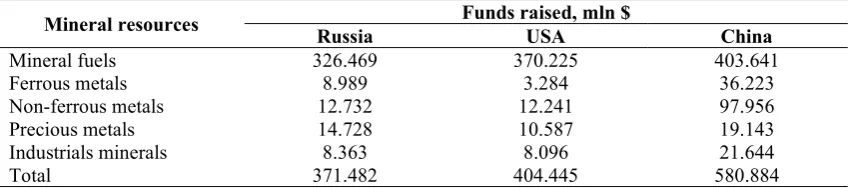
Table 3. Funds raised from mineral extraction sale.
Mineral resources Russia Funds raised, mln $ USA China
Mineral fuels 326.469 370.225 403.641
Ferrous metals 8.989 3.284 36.223
Non-ferrous metals 12.732 12.241 97.956
Precious metals 14.728 10.587 19.143
Industrials minerals 8.363 8.096 21.644
Total 371.482 404.445 580.884
Open-pit mining is the most popular mineral extraction method. It entails a lot of technological and environmental problems (Fedorko, 1998; Kryukov et al., 2011; Kurchin et al., 2013). One of the primary technological tasks for open-pit mining is the reduction of the oversized fraction output. With an increase in the volume of blasting operations, there is often an increase in the output of the oversized fraction, due to the deterioration of mining and geological conditions as the depth of mining increases, the incorrect choice of drilling and blasting parameters caused by the desire to reduce production costs, etc. This phenomenon arises an uncontrolled increase in additional costs of secondary operations, which in general,
negatively affects the economic efficiency of the company. In this connection, it is very important to solve the problem of predicting the output of the grain-size composition of the mining rock mass at the designing stage, based on the available mining, geological and technical data.
Journal of Degraded and Mining Lands Management 1917 efficiency of ore blasting fragmentation also
affects directly the costs of its mechanical fragmentation during processing. As mentioned above, the quality of blasting operations directly affects the efficiency of rock mass fragmentation. It leads mainly to a significant increase in the costs of mechanical fragmentation and grinding of ore, which are the most energy-consuming processes in mining and processing. The share of breakage costs, depending on the strength of rocks, is 20-35%. Factors that predetermine the growth of these costs are:
reduction in the ore mass output from 1 linear meter of the well;
an increase in the consumption of explosive materials per ton of broken ore;
a decrease in the productivity of drilling equipment (in meters of drilling or in cubic meters of a drilled mountain massif).
It should also be noted that each company makes its own requirements for the conditioning fraction (conditioning piece), and, as a consequence, for the size of a fraction considered oversized. This value is influenced by the following factors: the type of mining and crushing equipment used, the explosives used, the type and physicomechanical properties of the extracted mineral resources, etc. The standard value of the oversized output is determined at the stage of the work execution plan development and usually varies in the range of 1-5%. Currently there is a large number of methods for determining and predicting the fragmentation of broken rock massif (Cunningham, 1987; Kuznetsov, 1973; Kuznetsov, 2010; Rozhdestvenskiy, 2012; Vasilchuk, 2012; Vokhmin et al., 2018), but there is no integrated scientifically proven design model for determining drilling and blasting operations parameters and taking into account the set of factors influencing the results of explosive breakage.
Researching of rock mass fragmentation
As a result of the considered models' analysis, the following conclusions were made.Summarizing the results of the analysis of calculations performed by the Kuznetsov's model it can be concluded that this model does not take into account the type of explosives used, the parameters of the explosive network and the physical and mechanical properties of rocks (except for the hardness). Therefore, this model can be used only for large-scale calculations or when having large statistical material for each specific enterprise.
Analysis of the Kuz-Ram model let us conclude that the available initial data is sufficient enough to accurately predict rock piece
fragmentation after the explosion. Working with this model allows including the predicted fragmentation rates as a percentage, and therefore it is possible to predict the percentage of a certain fraction after the blasting. This model is widely used and improved by many scientists around the world, which indicates its flexibility.
KCO model and other similar models are recommended for use in addition to models capable of calculating the fraction of the mined rock mass in advance. Such integration of models will allow the mining enterprise to predict possible problems with fragmentation.
Thus, the authors of the article briefly presented some factors influencing the calculation of the value of the average broken rock mass.
In the presented models the mutual influence of factors is mostly neglected, which explains the instability of drilling and blasting operations indicators, their low efficiency and, as a consequence, an increased output of oversized fractions. Therefore, it is being discussed massively to analyze and develop techniques capable of predicting the grain-size composition of the broken rock mass as one of the initial factors for reducing economic losses in the technological cycle.
In general, the parameters that can affect the results of rock mass fragmentation can be divided into two main groups - controlled and uncontrolled, and four subgroups (parameters of drilling and blasting operations; parameters of explosives; rock mass characteristics; geomechanics characteristics of undisturbed rock mass) (Bakhtavar et al., 2015; Chakraborty et al., 2004; Kulatilakc et al., 2010; Latham et al., 2006).
Currently, the dependence of the average broken rock piece on the parameters of drilling and blasting operations and rock properties is determined for each mining enterprise by empirical patterns based on the experience of analogical enterprises, and its rational values at the operating enterprise - by conducting a series of pilot explosions.
Journal of Degraded and Mining Lands Management 1918 low efficiency and, as a result, an increased output
of oversized fractures.
Therefore, the scientific community is widely developing both a technologically and economically efficient method for fragmenting of an oversized fraction and a methodology for shattering parameters that allow reducing the specific consumption of an explosive and increasing the safety of blasting operations.
Conclusion
Improvement of drilling and blasting operations is one of the ways to increase the efficiency of field development. Depending on the correctness of the drilling and blasting operation parameters calculation, the technical and economic performance of the block can significantly change (Vokhmin et al., 2017).
From the above mentioned, it can be concluded that production volumes are steadily growing, at the same time the demand for the creation of more powerful explosives and the development of new prediction models (techniques) or models determining the grain-size composition of the rock mass is also increasing.
When implementing the internal development strategy, enterprises should regularly analyze the technical and economic performance indicators. The analysis should change the orientation of the economic policy from the predominantly costly to resource-saving and environmentally safe.
It is necessary to study a large number of models predicting the grain-size composition output of the rock mass, which will provide more details about the main factors influencing the results of the explosion. The efficiency of such analysis depends not only on the improved methods but also on the analysis immediacy. Current science and technology development rates demand promptly production change. Hence the main requirements of the analysis are its consistency, complexity, and immediacy (Karenov, 2009).
Acknowledgements
Work is conducted within the framework of the grant of the President of the Russian Federation for state support of young Russian scientists - candidates of science (MK-1178.2018.8).
References
Bakhtavar, E., Khoshrou, H. and Badroddin, M. 2015. Using dimensional-regression analysis to predict the
mean particle size of fragmentation by blasting at the
Sungun copper mine. Arabian Journal of
Geosciences 8: 2111-2120. doi:10.1007/s12517-013-1261-2.
Chakraborty, А.К., Raina, A.K., Ramulu, M.,
Choudhury, P.B., Haidar, A., Sahu, P. and
Bandopadhyay, C. 2004. Parametric study to develop guidelines for blast fragmentation improvement in jointed and massive formations.
Engineering Geology 73:105-116.
Cunningham, C.V.B. 1987. Fragmentation estimations
and the Kuz-Ram model - four years on. In
Proceeding of 2nd International Symposium on Rock Fragmentation by Blasting. P. 475-478.
Fedorko, V.P. Methodological problems of open-cast mining technology. Dissertation thesis of doctor of science. Irkutsk, 1998. - 200 p.
Karenov, R.S. 2009. Problems of the development of an integrated structure of mining sciences and the
theory of mining. Access mode:
https://articlekz.com/article/5435 (circulation date
July 02, 2019).
Kryukov, G.M., Dokutovich, M.I. and
Zharovonko, S.N. 2011. Degree of crushing and output of oversize with the explosive loosening of
rocks in quarries. Gornyy
informacionno-analiticheskiy byulleten. №5. pp. 347-351.
Kulatilakc, P.H.S.W., Qiong, Wu., Hudaverdi, T. and Kuzu, C. 2010. Mean particle size prediction in rock blast fragmentation using neural networks / PHSW.
Enineering Geology 114:298-311.
Kurchin, G.S., Volkov, E.P., Zaitseva, E.V. and
Kirsanov, A.K. 2013. Problems of ecology in the extraction of non-metallic building materials in
Russia. Sovremennye problemy nauki i
obrazovaniya. №6. p.1.
Kuznetsov, V.A. 2010. Substantiation of a technology of drilling and blasting operations in quarries and open mining and construction workings on the basis of deformation zoning of blasted benches. Dissertation
thesis of doctor of science.Moscow, 225 p.
Kuznetsov, V.M. 1973. The mean diameter of the fragments formed by blasting rock. Soviet Mining Science 9(2): 144-148.
Latham, J.P., Mculcn, J.V. and Dupray, S. 2006. Prediction of fragmentation and yield curves with
reference to armourstone production. Engibeering
Geology 87:60-74.
Reichl C., Schatz M. and Zsak, G. 2019 World Mining Data. Mineral Production. Volume 34. Vienna, 264 p.
Rozhdestvenskiy, V.N. 2012. Forecasting the quality of crushing of fractured mountain massifs in the case of
a multiple-charge explosion of charges. Conference
«Tekhnologiya i bezopasnost vzryvnyh rabot». Ekaterinburg: IGD UrO RAN. pp. 38–43.
Vasilchuk, Ya.V. 2012. Mathematical model for forecasting the granulometric composition of blasted
rocks. Vіsnik KrNU іmenі Mihayla Ostrogradskogo.
№4 (75). pp.94-99.
Vokhmin, S.A., Kurchin, G.S., Kirsanov, A.K., Shigin, A.O. and Shigina, A.A. 2017. Destruction of rock
Journal of Degraded and Mining Lands Management 1919
Engineering and Applied Sciences 12(13):3978-3986.
Vokhmin, S.A., Kurchin, G.S., Kirsanov, A.K.,
Lobatsevich, M.A., Shigin, A.O. and Shigina, A.A. 2018. Prospects of the use of grain-size composition predicting models after explosion in open-pit
mining. International Journal of Mechanical