Volume 39 (2011)
Graph Computation Models
Selected Revised Papers from the
Third International Workshop on
Graph Computation Models (GCM 2010)
Incremental update of constraint-compliant policy rules
Paolo Bottoni, Andrew Fish, Francesco Parisi Presicce
18 pages
Guest Editors: Rachid Echahed, Annegret Habel, Mohamed Mosbah Managing Editors: Tiziana Margaria, Julia Padberg, Gabriele Taentzer
Incremental update of constraint-compliant policy rules
Paolo Bottoni1, Andrew Fish2, Francesco Parisi Presicce1
Department of Computer Science, Sapienza University of Rome, Italy1, School of Computing, Engineering and Mathematics, University of Brighton, UK2
Abstract: Organizations typically define policies to describe (positive or negative) requirements about strategic objectives. Examples are policies relative to the secu-rity of information systems in general or to the control of access to an organization’s resources. Often, the form used to specify policies is in terms of general constraints (what and why) to be enforced via the use of rules (how and when). The consistency of the rule system (transforming valid states into valid states) can be compromised and rules can violate some constraints when constraints are updated due to changing requirements. Here, we explore a number of issues related to constraint update, in particular proposing a systematic way to update rules as a consequence of modifica-tions of constraints, by identifying which components of the rule have to be updated. Moreover, we show the construction of sets of rules, directly derived from a positive constraint, to guarantee constraint preservation and constraint enforcement.
Keywords:Constraints, incremental construction of rules, rule update.
1
Introduction
Graph constraints and graph transformations provide a formal model for defining and manag-ing strategic policies adopted by organisations with respect to security or access control issues. Policies can be specified with constraints, while rules of a graph transformation system are used for consistent management of these policies. In both cases, the specifications are given within the framework of typed attributed graphs, with special attributes defining the relevant properties, while rules exploit application conditions to enforce consistency. By consistency, we mean that rules can only cause transformations from valid states to valid states. As a consequence, the class of graphs generated, starting from a valid graph, by using the rule is a subset of the class of graphs satisfying the constraints.
Usually, policies and rules are not fixed, but can evolve independently, following the introduc-tion, revision or deletion of constraints and rules. In any case, at each moment the current set of constraints must be satisfied by the current collection of rules. Two cases can be considered in which the consistency of the system can be compromised: introduction of new rules – which must be adapted to the current constraints – and definition of new constraints, again requiring rule adaptation. The identification of the modifications needed to adapt rules to constraints has been the subject of several studies [KMP05,HP09]. However, these usually require the complete analysis of each rule after each modification, without the possibility to adopt an incremental ap-proach, taking into account the relations between the previous sets of constraints and rules.
where each rule is guaranteed to preserve the constraint. Second, we show how these rules can be incrementally updated when the constraint from which they were created is modified. The paper is complemented by two further contributions. First, we produce a set of rules to check and repair a model with respect to the introduction of a new constraint. Second, we present a technique for checking if a rule, not generated by the procedure, has to be updated when a constraint is modified, and for computing the relevant updates.
Paper organisation.After presenting related work in Section2, we provide background notions on graph constraints and graph transformations in Section3. Section4introduces the running ex-ample for the paper, while Section5recalls the notion of security policy and presents a procedure for the construction of a collection of rules realising a policy. Section6discusses modifications to rules derived from the procedure and Section7draws conclusions and points to future work.
2
Related work
In [KMP05], a security policy framework is defined by giving a type graph, a set of (named) graph transformation rules, and two sets of simple positive and negative constraints, expressed as morphisms from a premise to a conclusion. A framework was considered to be (positive/negative) coherent if all the graphs derivable from the rules and consistent with the type graph satisfied all the (positive/negative) constraints. A number of constructions were given for repairing possible violations, by modifying rules with application conditions, in situations where different policy frameworks were merged. Based on this approach, [KP06] defines a UML language to specify access control policies and exploits graph transformations to give a semantics and a verification method for such specifications. This line of research has also led to defining basic rules for con-trolling access in workflows [WWP08]. Rules allow the addition/removal of tasks and roles, plus the execution of tasks, and application conditions are defined based on existing constraints.
In [BFP10], we considered the construction of transformation units ensuring coherence with a simple form of nested constraints, admitting a single alternation of universal and existential quantifiers. The units were defined starting with the simple addition of an element, and producing repair rules to restore violated constraints. The procedures presented in this paper can also be exploited in transformation units, but each rule is guaranteed not to violate any constraint.
Habel and Pennemann have extensively treated the problem of making rules compatible with nested constraints by adding positive and negative application conditions. In [HP09] they unify theories about application conditions [EEHP06] and nested graph conditions [Ren04], lifting them to high-level transformations. An existing rule is transformed to make it constraint pre-serving or constraint guaranteeing, but no direct construction of rules from constraints is given.
Orejas is investigating a new approach, calledSymbolic Attributed Graphs, relating attributed graph constraints with attribute evaluation (for a summary see [OL10]). For our restricted form of attributed evaluation, the presented techniques should be applicable with the same results.
constraint systems, the consequences of modifying (weakening or strengthening) existing con-straints were not analysed, nor does this problem seem to have been treated by other authors.
3
Background
We adopt the framework of attributed typed graphs. A graphG= (V,E,s,t)consists of a set of nodes V=V(G), a set ofedges E=E(G), andsourceandtargetfunctions,s,t:E→V. For a set S, its cardinality is denoted by∣S∣and we use the notations∣G∣V=∣V(G)∣and∣G∣E=∣E(G)∣. In atype graph T G= (VT,ET,sT,tT),VT andET are sets of node and edge types, while the functionssT:ET→VT andtT:ET →VTdefine source and target node types for each edge type. ForGa typed graph onT G, there is a graph morphismtype:G→T G, withtypeV:V →VT andtypeE:E→ET s.t.typeV(s(e)) =sT(typeE(e))andtypeV(t(e)) =tT(typeE(e)).
To introduce attributes, we follow [EEHP06], but we consider attributes only on nodes. Intu-itively, we partitionV intoVGandVD(Dfordomain), the sets ofgraphandvaluenodes, respec-tively, whileE is partitioned intoEG andEA (Afor attribute). Graph edgesEG are equivalent to those for non-attributed graphs, while anattribute edgein the setEA defines the assignment of a value to an attribute of a node. Moreover, we haves=sV ∪sA, with sV:EG→VG and sA:EA→VG; andt=tV∪tA, withtV:EG→VGandtA:EA→VD. In a similar way,T Ghas dis-tinct setsVTGandVTDof graph and value node types respectively, as well as distinct setsETGand ETA for graph and attribute edge types. Givent∈VTG, all nodes of typet are associated with the same subsetA(t)⊂ETAof edge types, corresponding to the set of attribute names fort. Formally:
∀t∈VTG[∃!A(t)⊂ETA[∀n∈VG[typeV(n) =t =⇒ {typeE(e)∣e∈EA∧sA(e) =n}=A(t)]]]1.
Values inVDare taken over the disjoint union of the set of sorts in a data signature DSIG. In what follows, we call thestructural partofG, its projection to elements typed onVTGandETG.
We use graph transformations according to the Double PushOut (DPO) approach [EEPT06]. A DPO rule has the formp:L←l K→r RwhereL,KandRare called left-hand side, interface and right-hand side graphs, respectively,K contains the elements preserved by the rule application, and the morphismsl: K→Landr:K→Rmodel the embedding ofKinLandR. The left of Figure1 shows a DPO direct derivation diagram, modeling the application of a rule2 p:L←l K →r R to a host graph G to produce a target graphH. First, the pushout complement D is evaluated. This is the unique graph for which morphismsK→D→Gexist s.t. square (1) is a pushout (i.e. Gis the union ofLandDthrough their common elements inK). In particular,D contains the elements ofGwhich are not in the image of the elements inL∖K. The pushout (2) is then computed, adding toDnew elements to formH, viz. the elements inR∖K. We denote the application of the rulepon a matchm:L→GbyG⇒m
p Hand writeG⇒pHto denote that Hcan be derived fromGby applyingpwith respect to some matchmforLinG.
DPO rules for typed graphs are lifted to attributed typed graphs by considering algebras on some signature including the sorts forVD. Since morphisms can only identify values inVD present inLandR, the modification of the value of an attributeafor a given nodenfromv1 to
v2is represented by removing an edgee1of typeafromntov1(i.e.eappears inLbut not inK),
and creating an edgee2of the same typeafromntov2(i.e. e2appears inRbut not inK).
1In the graphs of this paper, some attributes may not be present for some node, indicating “don’t care” situations.
L
m
(1)
K
(2)
l
o
o r //
k R m∗
Yi j
oi j
/ / = Xi ni , , =
yi j
o
o L
m
(1)
xi
o
o K
(2)
l
o
o r //
k R m∗
Goo l∗ D r∗ //H Goo l∗ D r∗ //H
Figure 1: DPO Direct Derivation Diagram for simple rules (left) and with AC (right).
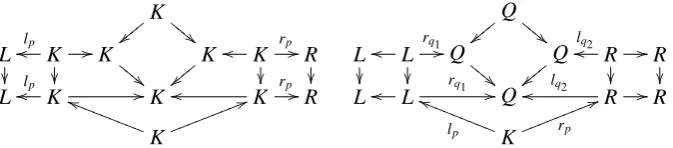
In this paper we consider only rules which are only increasing (L=K) or only decreasing (K= R) in their structural parts. However, from Proposition1, rules of this form can be combined to express any DPO rule. To this end, the construction of an E-concurrent production (see Figure2), denoted by∗E, is required, for an appropriate choice of the E-dependency relation [EEPT06].
Proposition 1 Any rule p:L←lp K→rp R is equivalent to the E-concurrent production of two rules, one increasing and one decreasing.
Proof. With reference to Figure2, and with all unnamed morphisms identities, we have:
1. if p1:L←lp K→iK
Kandp2:K←iK
K→rp R, thenp1is only decreasing,p2is only increasing, andp=p1∗Kp2. (In this case the role ofEis performed byK.)
2. if L→rq1 Q←lq2 R is the pushout of L←lp K →rp Rand K is also its pullback (as in our case
sinceL←lp Kis injective), thenq1:L
iL
←L→rq1 Qis only increasing,q2:Q
lq2
←R→iR Ris only decreasing, andp=q1∗Qq2. (In this case the role ofEis performed byQ.)
Case 1 proves the⇒direction and case 2 proves the⇐direction.
K
|
|
yyyy EEEE""
Q
|
|
yyyy EEEE""
L
K
lp
o
o //K
" " E E E E K | | yyyy K o
o rp//
R L L
o
o rq1//
Q " " E E E E Q | | yyyy R
lq2
o
o //
R
Loolp K //K oo K rp//R Loo L
rq1 //
Q R
lq2
o
o //R
K i i SSSSSSSSS 5 5 l l l l l l l l
l lp K
i
i
RRRRRRRRR r
p 5 5 l l l l l l l l l
Figure 2: Decomposing (left) and constructing (right) a rule with increasing and decreasing parts.
Anatomic constraintis a morphism3of typed attributed graphsc:X→Y. A graphG satisfies c, notedG⊨c, if for eachmatch morphism m:X →Gthere exists a morphismy:Y →Gs.t. y∘c=m. Ifc:X→Y is an atomic constraint,¬cis an atomic constraint, andG⊨¬c iff G⊭c.
An atomic constraint of the form ¬iX:X →X, where iX is the identity, is called a negative atomic constraint, and is represented by simply showingX. We callM(c) ={G∣G⊨c}the set ofmodelsforc, and assume that a constraint systemCis consistent, i.e.∩
ci∈CM(ci)∕=/0.
The right of Figure1shows that an atomic constraint can be associated with a rule in the form of an application condition AC, of the form {xi: L→Xi,{yi j: Xi →Yi j}j∈Ji}i∈I, for a match
m:L→Gof the LHS of a rule, whereI andJi are index sets for eachi∈I. An AC is satisfied bymif, for eachni:Xi→Gs.t. ni∘xi=m, there exists someoi j:Yi j→Gs.t. oi j∘yi j =ni. A negative application condition(NAC) derives from a negative application constraint: for the rule to be applicable,Ximust not be present.
4
A scenario for policy update
We consider policies on type graphs which are instances of the metamodel MM in Figure 3
(left). Here,Document, PersonnelandResourceare meta-types for graph node types, defining the structural elements involved in a policy, whileStateandLevel are metatypes for attribute types. In this case, the structural nodes are those whose type is an instance of
Document,PersonnelorResource.
Figure3(right) presents the specific type graph for the paper, where typeDocis an instance of Document, Mgr, representing managers, is an instance of Personnel, and the Printer type is an instance ofResource. The attribute types denote a document authorisation state and different types of access levels associated with structural elements. A concrete representa-tion is adopted, where rectangular boxes represent instances of structural nodes inVGand ovals represent attribute values. Attribute edges are distinguished from graph edges by the arrow end.
Figure 3: Metamodel for security policies (left) and type graph for the scenario (right).
A simple scenario illustrates the type of problems considered, introducing the notation ex-ploited in the paper, Consider an organisation in which the policy for document authentication requires that, for a documentDto be authenticated, it must have been signed off by two man-agers, one of level Lv1 and one of level Lv2, Lv2 being higher than Lv1 in the organisation hierarchy. Moreover, a general policy requires that documents signed off byLv2 managers must have also been signed off by anLv1 manager. Figure4illustrates the two resulting constraints.
1:Doc
Auth
1:Doc
Auth
:Mgr
:Mgr Lv1
Lv2
1:Doc :Mgr
2:Mgr Lv2 Lv1 1:Doc
2:Mgr Lv2
1
X
1
c
c
21
Y
X
2Y
2Figure 4: The two original constraints for document authentication.
First anLv1 manager will provide a reference for the document, and then anLv2 manager will authorise it. The rules are equipped with NACs to avoid that the same manager reviews the same document twice. Note that a rule which requires a simultaneous authorisation by both managers would also be consistent with the constraints in Figure4.
1:Doc
2:Mgr Lv1
1:Doc
2:Mgr Lv1
1:Doc
3:Mgr Lv2
2:Mgr Lv1 1:Doc
3:Mgr Lv2 2:Mgr Lv1
Auth
1:Doc
3:Mgr Lv2 2:Mgr Lv1 1:Doc
2:Mgr Lv1
2,1
N
1,1
N
1
L
R
1L
2R
21
r
2
r
Figure 5: The two original rules for document authentication.
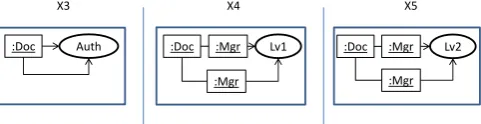
Realising that the current implementation of the policy does not prevent work on the same document from being duplicated, the organisation decides to forbid a document from being au-thorised twice, or referenced by two or more managers of the same level. Such conditions could be added as NACs to the rules, but a decision is made for these to be defined as negative con-straints – shown in Figure6as forbidden graphs –¬i:X3→X3,¬i:X4→X4, and¬i:X5→X5,
respectively, becoming part of the general policy for document management.
X3
:Doc
:Mgr :Mgr Lv1
X4
:Doc
:Mgr :Mgr Lv2 :Doc Auth
X5
Figure 6: Negative atomic constraints for the authentication policy.
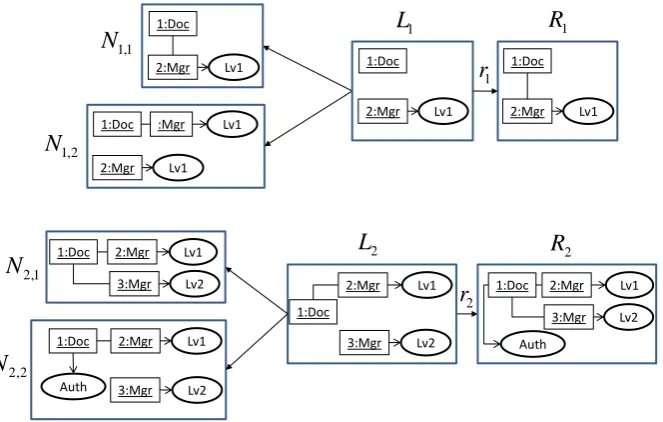
Rules r1 andr2 of Figure 5 are no longer consistent with the current configuration of
con-straints and must be amended by adding NACs to them. In particular, ruler1must be upgraded
with the NAC N1,2 requiring that no other manager of levelLv1 has already pre-approved the
document, while ruler2is upgraded usingN2,2to check that no authorisation already exists,
be-sides requiring that no otherLv2 manager has approved the document. Figure7shows the new versions of the two rules. In a second moment, a general revision of the authorisation policies is issued, now requiring that twoLv1 managers must approve a document, while maintaining the request forLv2 authentication, represented by the constraintc6:X6→Y6in Figure8, which
sub-sumesc1:X1→Y1. Moreover, the constraint defined by the forbidden graphX4must be dropped to ensure the overall satisfiability of the system of constraints.
1:Doc
2:Mgr Lv1
1:Doc
2:Mgr Lv1 :Mgr Lv1
1:Doc
3:Mgr Lv2
2:Mgr Lv1 1:Doc
3:Mgr Lv2 2:Mgr Lv1
Auth 1:Doc
3:Mgr Lv2 2:Mgr Lv1
1:Doc
2:Mgr Lv1
1:Doc
2:Mgr Lv1
1:Doc
3:Mgr Lv2 2:Mgr Lv1
Auth
1,1
N
1,2
N
2,2
N
2,1
N
1
L
2
L
1
R
2
R
1
r
2
r
Figure 7: The modified rules with NACs.
1:Doc
Auth
X6 Y6
1:Doc
Auth
:Mgr
:Mgr Lv2 c6
:Mgr Lv1
Figure 8: Revising authorisation constraints.
r1, which was derived from the forbidden graphX4, now dropped, would prevent the satisfaction
of constraintc6:X6→Y6. Moreover, the right-hand side of ruler2would not be consistent with c6, as it might lead to approval of documents without the signature of twoLv1 managers. While
the solution to the first problem is simple (removeN1,2), the second problem can be addressed
in different modes: by requiring concurrent approval by the additionalLv1 manager and theLv2 one, by sequentialising the approvals of the manager according to the level (i.e. simultaneous approval of both Lv1 managers and subsequent Lv2 approval) or by considering a sequential process, where the second Lv1 and the Lv2 approval can occur in any order. Note that since c2:X2→Y2still holds, it remains impossible to have a collection of rules which leads to Lv2
approval without prior or concurrentLv1 approval.
5
Constraint-compliant policy rules
as operations on attributes.
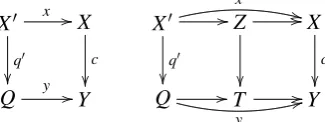
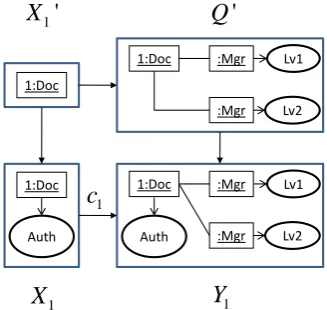
We first propose a procedure for deriving a collection of increasing (in the structural part) rules consistent with a positive constraint, based on the initial pushout construction in the category of Attributed Typed Graphs [EEPT06]. Given the square in Figure9 (left), this is the initial pushoutoverc:X→Y,iff for every other pushout formed withX ←Z→T →Y, there exist morphismsX′→Z andQ→T such that all the squares in Figure9 (right) commute. In the adopted framework, the boundary object X′ is computed as the discrete graph formed by the structural nodes inX which are attached to edges inE(Y)∖E(c(X)), and thecontextofcis the attributed typed graphQwhich is the pushout complement alongX′forX′→x X→c Y.
X′ x //
q′
X
c
X′ //
q′
x
+
+
Z //
X
c
Q y //Y Q // y
3
3
T //Y
Figure 9: (left) Boundary and context for a constraint. (right) Initiality of pushout.
We work on a restricted form of positive constraintsc:X→Y, for which we can derive a set of constraint-preserving rules. In particular, we definepolicyconstraints on singlesecurednodes, describing the conditions under which such a node can be in certain states, as in the examples from Section4. In particular, structural edges are inE(Y)∖E(X)only if both their source and target are inVG(Y)∖c(VG(X)), or if one of them is the secured node.
5.1 The procedure for incremental satisfaction
Given a policy constraint c:X →Y, ConstructRules(c) generates a collection P(c) of increasing rules preservingc. Each rule constructs a subgraph ofY, in such a way that until an occurrence ofY is built no occurrence of X is produced in the host graph. To this end, it first constructs the rules for producing graphs intermediate between the boundary objectX′ and the contextQin the construction of the initial pushout overc, and then produces rules allowing the construction of intermediate graphs between QandY. After this, NACs are added to prevent the premature formation ofY and to force the application of the most specialised rule in case of conflicts. Finally, the rules are completed to include attribute assignment.
functionConstructRules(c:Constraint):SetOfRules=
[Q,H]:=FromBoundaryToContext(c); PQ(c):=FromMorphismsToRules(Q,H); P′(c):=CompleteToConclusion(PQ(c),Y); P′′(c):=CompleteWithNacs(P′(c))
P(c):=UpdateAttributes(P′′(c))
FromBoundaryToContext(c:Constraint):GraphSet×MorphSetconstructs the uniquely determined (up to isomorphism) setsQ={Q0,. . .,Qk}andH ={h
j
i :Qi→Qj}of
∙ Q0=X′andQk=Q;
∙ for eachi=1, . . . ,k, there exist inclusions4;hiX′:X′→QiandhQi :Qi→Q;
∙ for eachi=1, . . . ,k, for j>is.t. hij:Qi→Qjexists,h j
X′ =h
j
i ∘hiX′ andh
Q
i =h
Q
j ∘h
j
i;
∙ Qis the colimit of the diagram obtained from graphs inQand morphisms inH;
∙ givenhij:Qi→Qjwe have that:ea∈EA(Qj)∖EA(Qi) =⇒ sA(ea)∈VG(Qj)∖VG(Qi)5.
FromMorphismsToRules(Q:GraphSet,H:MorphSet):SetOfRulesproduces the
in-termediate rule setPQ(c) ={p(hij):Qi l
←Qi
r
→Qj∣r=h
j
i :Qi→Qj∈H}, under the conditions:
1. givenQi,Qj,Ql∈Qandh j
i,hli,hlj∈H, we havehli=hlj∘h j
i =⇒ p(hli)∕∈PQ(c);
2. eitherQj=QkorEG(Qj)∕=EG(Q), i.e. the structural part of the right hand-side is equal to the structural part of the contextQonly in rules which add some structural edge.
CompleteToConclusion(int:SetOfRules,conc:Graph):SetOfRulesbuilds the set P′(c) by generating the set IQY of all the graphs Z s.t. inclusions k1: Q→Z and k2:Z→Y exist, but no inclusionk3:X→Z exists. The setHIQY of morphismshZQ:Q→Z, hYZ:Z→Y, s.t.Yis the colimit of the diagram formed with nodes inIQY∪{Q}and morphisms in HIQY∪{y:Q→Y}, is concurrently built as before. In particular, as for eache∈E(Y)∖E(c(X)) we havee∈E(Q), graphs inIQY∖ {Y}can only differ fromQby: (i) structural nodes inV(X) not connected with the secured node inY; (ii) structural edges attached to such nodes; and (iii) attribute edges already present inX (hence neither inX′nor inQ).
The structural parts of rules in a new set PY(c) is built through the same construction as in FromMorphismsToRules for cases (i) and (ii). For case (iii), for any attribute edgeea ∈ EA(W) s.t. W ∈IQY∧∄e′a ∈Q, withhWQ(e
′
a) =ea, we produce a primed version Q′i for each graphQi∈Q s.t. ∃v∈V(Qi), withhWQ(h
Q
i (v)) =s(ea)∈V(W), i.e. we have e ′
a∈E(Q′i)with
s(e′a) =v andt(e′a) =t(ea). As a consequence, Q′ is still the colimit of the diagram for the primed versions of the graphs inQ. We then correspondingly update the rules with the attribute parts for all the rules derived from morphisms involvingQi. The function then returns the union of the modified versions ofPY(c)andPQ(c), forming the setP′(c).
The rules inP′(c) are underspecified. Given morphisms hij and hil, both rules derived from them inP′(c)are applicable on any match forhij.CompleteWithNacs(rls:SetOfRules):
SetOfRules constructs a NAC forcing the application of the more specific rule. Given pi:
Ql l
←Ql
r
→Qi∈P′(c), we add a NACQi
ni
←Ql for eachhil. Moreover, NACs are added to
pre-vent the formation of the premiseX in rules with p:L←l L→r R∕=Y. In particular, we define the graphWs.t. Yoo X′ //L ,,//Wis a pushout and add the NACW ←n Ltop.
Finally,UpdateAttributes(rls:SetOfRules):SetOfRulestakes care of attribute update for the secured node, producing the final setP(c). This is needed for the case where the
4In order to emphasizeX′=Q
0andQ=Qkwe abuse notation, writingh
Q
i forhki :Qi→QandhXi′forhi0:X′→Qi.
constraint concerns the assignment of a valuedfor an attribute of the secured nodev, i.e. ∃ea∈ EA(X)withs(ea) =vandt(ea) =d. Any rule p:Z←= Z→r Y is such thatea∈EA(Y)∖EA(r(Z)), but v∈VG(Z). However, for a host graph G and a match m: Z →G, there can be an edge e′a∈E(G)withs(e′a) =m(v)andt(ea) =d, for somed∈V Da,d∕=d, whereV Dais the set of values of sortain the domainD. The application of p would then produce two values for the same attribute. To avoid this problem, we transform any such rule into a version with attribute updateZd←l Z→r Y, for eachd∈V Da. In particular,Zd contains an edgeeawiths(ea) =vand t(ea) =d, so that the overall effect of the rule is to produce an occurrence ofY while updating the previous attribute assignment forv. We call rules withR=Y final.
Following Theorem1, given a constraintcthe resulting setP(c)is consistent withc.
Theorem 1 Given a constraint c:X →Y , a graph G with G∣=c, and a rule p:L=K→R∈ P(c), for any graph H s.t. G⇒pH we have H∣=c.
Proof. IfG∣=c, then one of two cases occur.
1. ∃m:X→G,g:Y →G, withm=g∘c. As all rules are increasing andcis positive, each application ofppreservesmandg. We are left to prove that no further matchm′:X→Gis created for which a matchg′:Y →Gwithm′=g′∘cdoes not exist. We first observe that an additional match would require the addition of an edge (either structural or attribute)eto G, withs(e) =v,v=m′(v). But, due to the construction inCompleteToConclusion
and the NACs added inCompleteWithNacs, this only happens in a final rule, which would also generate the required part to complete the matchg′.
2. ∄m:X→G. By the same argument as before, we observe that any non final rule would
not create such a match, while a final rule would also create the required matchg:Y →G.
No other case can occur and this concludes the proof.
To maintain consistency over the whole policy, a rulep:L←= L→r R∈P(c)should be checked against any constraintc′:X′→Y′, withc′∕=c, for situations where applying pwould cause the formation ofX′ without ensuring the formation ofY′. Figure 10shows the possible solutions (for reasons of space we omit the morphismsL←= L). The first (left) generates a NAC whereW′ is a graph s.t. the spanR w
′
←W′ →w X′ exists andR→rz Z′ ←X′ is the cospan s.t. the resulting square is a pushout. Then the NACn:L→N is generated, withNthe pushout complement of L→r R→rz Z′. This construction can be applied both for negative and positive constraints.
Alternatively, in Figure10(center), one extendsLandRby adding to both of them the “miss-ing part” ofY′. The morphismsL→r RandW′ w
′
→Rare jointly surjective onR, the triangle com-mutes, and all squares are pushouts.L′is constructed as the pushout complement forL→r R→rw R′. These constructions (adapted from those in [KP06]) can be applied if the required pushout complements exist. Otherwise, Figure10(right) presents an alternative construction generating a more restrictive NAC, withn=rz∘r. A negative constraint can only generate a NAC.
A word on complexity is in order. The upper bound for∣Q∣is∣Q∣E ×2(∣Q∣V−∣X
′∣
V)(reached
consider-L
n
r //
R rz W′ w′ o o w
L r //
R rw W′ w′ o o w /
/X′
c′
L r // n ; ; ; ; ; ; ; R rz W′ w o o
N //Z′oo X′ c
′
/
/Y′ L′ r′ //R′oo Y′ Z′ oo X′ c′ //Y′
Figure 10: Permissive NAC (left), rule extension (centre) and restrictive NAC (right) forc′.
ing, that security policies are usually not exceedingly large in their structural size, and that the procedure has to be computed once, the approach remains feasible in many practical situations.
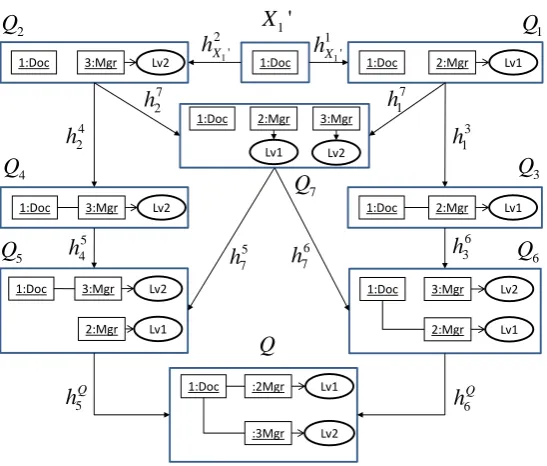
ExampleFigure11shows the construction of the boundary and context graphs forc1:X1→Y1
from Figure4, while Figure12presents the construction of the setsQ andH for this case. We have indicated only direct morphisms, and omitted those which can be derived by transitivity.
1:Doc Auth 1:Doc Auth :Mgr :Mgr Lv1 Lv2 1:Doc 1:Doc :Mgr :Mgr Lv1 Lv2
'
Q
1'
X
1X
Y
11
c
complement.pdf
Figure 11: The construction of the context forc1:X1→Y1in Figure4.
The top of Figure13shows how the last rule derived from morphismhQ6 would be modified. As the whole context forc:X→Y is present, we can complete the right-hand side to be the full Y, i.e. presenting also an instance ofX. Underneath this rule, we show one of its possible final versions, assuming that preAuth∈AuthState. Such a rule would be generated only if such a state is compatible with the presence of the association of the document with a manager of Level 1, i.e. if thepreAuthstate is not associated with some constraint forbidding the presence of the association with such a manager. In the policy in our original scenario, the constraintc2:X2→Y2 from Figure4will have to be used to modify the rules p(h42)andp(hQ5).
5.2 Repairing inconsistencies
1:Doc 1:Doc 2:Mgr Lv1
1:Doc 2:Mgr Lv1
1:Doc 3:Mgr Lv2
1:Doc :2Mgr
:3Mgr Lv1
Lv2 1:Doc 3:Mgr Lv2
1:Doc 3:Mgr Lv2
2:Mgr Lv1
1:Doc 3:Mgr Lv2
2:Mgr Lv1 1:Doc 2:Mgr 3:Mgr
Lv1 Lv2 4
2 h
7 2
h h17
3 1 h
6 3 h 5
4
h 5
7
h h76
5
Q
h 6Q
h Q
1' X 2
Q
4 Q
5 Q
3 Q
6 Q
1 Q
1 2
'
X
h
1 1
'
X
h
7 Q
Figure 12: The setsQandH inConstructRules(c1).
a matchx:X→G, but no matchy:Y →Gs.t.x=y∘c. Considering Figure4(left), a document which was authorised after being reviewed only by a manager of level 1 would be inconsistent with the new policy. There are two possible ways to repair this inconsistency. The first is to complete the configuration, so that the missing review is provided. This is achievable by forcing the application of a sequence of rules, constructed in a similar manner to that of the procedure above, to produce an instance of the conclusion for the existing instance of the premise.
An alternative method destroys all the occurrences of the premise, so that a securing process can now be applied according to the new policy. Given a positive constraint c:X →Y, and depending on the form of the premiseX, two possible types of modification can be identified.
1. Ifvis associated inX with some attribute, the ruleX←l X′→r X′(withX′boundary object for the initial pushout overc) removes all the associations of this element with its attributes.
2. If the secured element has a set S of structural edges incident with it in X, generate the collection of edge-removing rulesRS={X
l
←X′→r X′∣E(X′)⊈E(X)}.
1:Doc 3:Mgr Lv2
2:Mgr Lv1
1:Doc :2Mgr
:3Mgr Lv1
Lv2 Auth
lastRule.pdf
1:Doc
3:Mgr Lv2
2:Mgr Lv1 1:Doc :2Mgr
:3Mgr Lv1
Lv2 Auth
PreAuth
1:Doc :2Mgr
:3Mgr Lv1
Lv2
lastRuleModified.pdf
Figure 13: Ensuring constraintc1(top) and one version updating the state (bottom).
5.3 Rule-Constraint conflict
In this subsection, we complete our study by considering possible conflicts between decreasing rules and arbitrary atomic constraints (i.e. positive or negative).
While a deleting rule never violates a negative constraint, since it does not add forbidden graph elements, it may violate a positive constraint if the rule deletes conditionally required graph elements (parts of the conclusion) but preserves the premise of the constraint.
One way to resolve conflicts between rules pand constraintsc:X→Y is by adding NACs to the rules p. We present next the construction of these NACs in a general case (generalising that in Figure10) and then show how it is used to resolve conflicts.
Definition 1(Conversion) Given a rulep:L←lp K→rp Rand a constraintc:X→Y, letSbe a nonempty overlap betweenRand the conclusionY (preservingX) as in the diagram of Figure14
(left). LetD=R+SY be the pushout object ofs1:S→Randc∘s2:S→Y, and letD
p−1,h
⇒ N
be the derivation with the inverse rule p−1 :R←rp K→lp L with match h. Define AC(p,c) =
{n:L→N∣D(p
−1,h)
⇒ N,D=R+SY for some overlapS}. The rulepcconsists of the original rule
p:L←lp K→rp Rtogether with the setAC(p,c)of NACs, and is called theconversion of p by c.
L
n
K
lp
o
o rp //
R
h
S
s1
o
o s2 //
X
c
L
m
R=K
lp
o
o
N M r
∗
p //
o
o Coo Y G l H
∗
p
o
o oo k X
c
Y
q′
b
b
DDDD DDDDD q
d
d
Figure 14: Construction for conflicts. NACs (left) and satisfaction by conversion (right).
or expanding rules, and it reduces to the one in [HW95] ifc:X→Y is the identity morphism. This construction may generate redundant application conditions, in the case, for example, where the overlapS→Rcan be decomposed intoS→K→R. The graphNgenerated from such an overlap can be eliminated by requiring only overlapsSfor whichs1(S)∩(R∖rp(K))∕=/0.
Another form of redundancy stems from the fact that ifS1andS2 are overlaps withS1⊆S2 and compatible morphisms si1 and si2 with i=1,2, then D2 =R+S2Y ⊆D1=R+S1Y and
thus N2⊆N1. Hence, if a match L→Gsatisfies(L,N2), then it also satisfies (L,N1) and the
application condition(L,N1)can be removed fromAC(p,c).
A negative constraint is a morphism !c:X→Y, andG∣=!c iff no morphismm:X→Gcan be extended to a morphismm′:Y →Gs.t.m=m′∘!c. In the special case where !cis the identity we obtain what we called forbidden graphs. There can be no real conflict between a deleting rule
p:L←lp K=Rand a negative constraint !c:X→Y, since the deleting rule may remove parts of Y, in which case !cis trivially satisfied, or parts ofX, in which case !cis vacuously satisfied.
For the potential conflict between deleting rules and positive constraints we can add NACs to prevent the rule from destroying the conclusionY, by preventing the applicability ifXis present and part of the conclusionY is intended to be deleted by the rule.
Theorem 2(Satisfaction by conversion) Let p:L←lp K=R be a deleting rule and let AC(idL, idY))be the NACs constructed as in Definition 1 for the rule idL:L→L with respect to the
constraint idY :Y →Y . Define pc= (p,A(idL,c)). If G∣=c:X →Y and G
pc
⇒H is a derivation with pc, then H∣=c.
Proof. In Figure14 (right), letG⇒p H via the matching morphismm:L→Gandk:X →H a morphism. Since pis deleting, the derivation induces a morphisml∗p:H→Gand therefore a morphismk′=l∗p∘k:X →H→G. By the assumption thatG∣=c, there exists a morphism q:Y →Gs.t. q∘c=k′. To complete the proof we need to show that there is aq′ :Y →Hs.t. k=q′∘c. Sincel∗pis injective, it is sufficient to show thatq(y)∈l∗p(H)for everyy∈Y. Suppose this is not the case. Then,∃y∈Y,l∈L∖lp(R)s.t. q(y) =m(l)and therefore thisy defines an overlap ofLandY, contradicting the assumption thatmsatisfies the NACAC(idL,c)ofpc.
6
Incremental update
We analyse the problem of incrementally updating the rules inP(c)when the original positive constraintc:X→Y is replaced by a new one,cu:Xu→Yu, according to one of the following modifications, with inequalities indicating inclusion from the smallest to the biggest graph. We study modifications preserving the image of the original premise in the original conclusion for the common parts ofX andXuand ofY andYu, and in particular preserving the secured node.
1. (conclusion expansion)X=Xu,Y <Yu
2. (conclusion reduction)X=Xu,Y>Yu
4. (premise reduction)X>Xu,Y =Yu
5. (semantic reduction)X>Xu,Y <Yu
6. (semantic expansion)X<Xu,Y >Yu
7. (common expansion)X<Xu,Y <Yu
8. (common reduction)X>Xu,Y >Yu
We do not consider modifications which simultaneously add some elements and delete others from the premise or the conclusion of a constraint. Hence, if a premise is expanded, the conclu-sion is reduced only by removing parts neither in the original nor in the expanded premise. We consider the creation of new rules or updates of the existingL,Ror NAC parts of the rules, while new NACs can be generated according to the constructions in the Section5.
From Figure 15(left), modeling premise expansion, we observe that if a graph Gsatisfiesc non trivially, i.e.Ghas a subgraph which is a match forY, it will also satisfycuunder the same match. On the other hand, the only rules inP(c)which can produce an occurrence ofXuare final rules (producing the corresponding original occurrence ofX by placing an edge attached to the secured node), so no modification is required to them.
For the case of conclusion reduction, centre of Figure15, we observe that we can only remove elements which are not inX. Hence, we can simply modify a rule p:L→l R∈P(c)by removing all elements inV(Y)∖V(Yu)∪E(Y)∖E(Yu)from bothLandR.
The combination of premise expansion and conclusion reduction defines what is called se-mantic expansion, asM(c)⊂M(cu). Indeed, considering the diagram on the right of Figure15, we observe that for each graphG,G∣=c =⇒ G∣=cu. On the other hand, we can have a graph GwithG∕∣=c(i.e. a matchm:X →Gexists which cannot be extended to a matchy:Y →G) andG∣=cu, if no matchmu:xu→Gexists (i.e.Gtrivially satisfiescu).
Xu < < < < < < < cu & & X o
o c //
Y X cu & &
c //
: : : : : : : Y
oo Yu
Xu m′ & & M M M M M M M M M M M M cu * * X o
o c //
m : : : : : : : Y Yu o o x x
r r r r r r
G G G
Figure 15: Premise expansion (left), conclusion reduction (centre), semantic expansion (right).
Figure16(left) presents premise reduction, where one notices that the evaluation of the initial pushout forcu would give a smaller Xu′ and a bigger Qu. Hence, one has to perform a con-struction similar to that ofFromBoundaryToContextandFromMorphismsToRulesto generate the rules creating the intermediate graphs betweenXu′andX′. Furthermore, for a rule
p:L←l L→r R∈P(c) with Xu included in L or R, a new rule p′ is created with each such occurrence ofXureplaced by an occurrence ofXu′.
those derived from graphs intermediate betweenQandY. These can be easily identified, as they present any of the elements inYuand not inY, but they do not present at least one element inX. Semantic reduction in Figure 16 (right) combines premise reduction and conclusion expan-sion. The relative modifications can be derived from the composition of the two processes.
Xu < < < < < < < cu & & /
/X c //
Y X cu & &
c //
: : : : : : : Y
//Yu
Xu & & M M M M M M M M M M M M cu * * /
/X c //
: : : : : : : Y /
/Yu
x
x
r r r r r r
G G G
Figure 16: Premise reduction (left), conclusion expansion (centre), semantic reduction (right).
In a similar way, common expansion and common reduction can be obtained by combining the above processes, in the following order:
∙ For common expansion, expandY toYu first, and then expand X to Xu, in both cases expanding the morphism so as to preserve the image ofXinY.
∙ For common reduction, reduceXtoXufirst, and then reduceY toYu, in both cases reduc-ing the morphism so as to preserve the image ofXinY.
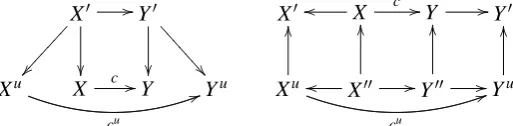
One wonders whether a similar construction can be defined when simultaneously removing and including elements in both premise and conclusion (while preserving the secured node). Figure17illustrates the problem with this. In order to maintain incrementality, one needs to first identify the intersectionsX′andY′between the original and the updated versions, update under common reduction forX′→Y′, and then use common expansion to generateP(cu)forcu:Xu→ Yu(left). Alternatively, one can first use common expansions and then common reduction, where the intersections areX′′andY′′(right). But in this case there is no guarantee that the nodes which receive the additional edges inY andY′ are the same. Hence, depending on the order in which the transformations are applied, one can obtain different rule sets.
X′ /
/Y′
<<<
< < <
< X′ oo X c //Y //Y′
Xu
cu
5
5
X c //Y Yu Xu
O O cu 5 5 X′′ o o O O /
/Y′′
O
O
/
/Yu
O
O
Figure 17: Incorrect constructions for simultaneous removal and increment.
ExampleConsidering the scenario in Section4, Figure8presents a case of conclusion expan-sion, making stricter requests on the authorisation process. Following the algorithm above, the construction of the new rules for this policy starts with the identification of the rules inL∈LY1;
in this case ruler2:L2→R2in Figure7(omitting the study of the modification of NACs). We
the modified conclusionY6, with the proviso thatXcan appear only in the right-hand side of the
rule building the wholeY6. Figure18shows the process replacing ruler2with rulesr′2andr22.
1:Doc
3:Mgr Lv2
2:Mgr Lv1 1:Doc
3:Mgr Lv2
2:Mgr Lv1
Auth
𝐿2 𝑅2
𝑟2
1:Doc
3:Mgr Lv2
2:Mgr Lv1
:Mgr 1:Doc
3:Mgr Lv2
2:Mgr Lv1
4:Mgr 1:Doc
3:Mgr Lv2
2:Mgr Lv1
4:Mgr
Auth
𝑟22
𝑅22
𝐿22
𝑅2′
𝑟2′
Figure 18: Revising ruler2from the scenario.
7
Conclusions and future work
We have presented an approach to the construction of incremental procedures ensuring the ap-plication of rules consistently with atomic constraints and to the modification of such procedures in an incremental way after the modification of the original constraints. The approach works under a number of assumptions, which are reasonably met in practical cases. First, conclusions in constraints are defined by graphs with a specific relation with the premise, viz. only one node can receive additional edges. Second, constraint updates preserve the images for the preserved elements in the premise (i.e. we do not deal with revocation [HJPW01]). Third, constraints and rules are typed according to a metamodel maintaining distinct finite domains for each attribute and allowing only equality comparison operations among values. The procedures are defined as sets of rules, which can be exploited in different contexts, or organised into transformation units, typically consistent with the partial order induced by injections on structural parts of graphs.
Acknowledgments. Partially funded by Progetto Sapienza 2007: ”Sistemi interattivi per la fruizione e la produzione di eventi culturali”.
Bibliography
[BFP10] P. Bottoni, A. Fish, F. Parisi-Presicce. Preserving constraints in horizontal model transformations.ECEASST29, 2010.
[EEHP06] H. Ehrig, K. Ehrig, A. Habel, K.-H. Pennemann. Theory of Constraints and Ap-plication Conditions: From Graphs to High-Level Structures. Fundam. Inform. 74(1):135–166, 2006.
[EEPT06] H. Ehrig, K. Ehrig, U. Prange, G. Taentzer. Fundamentals of Algebraic Graph Transformation. Springer, 2006.
[EKTW06] K. Ehrig, J. M. K¨uster, G. Taentzer, J. Winkelmann. Generating Instance Models from Meta Models. InProc. FMOODS 2006. LNCS 4037, pp. 156–170. Springer, 2006.
[HJPW01] A. Hagstr¨om, S. Jajodia, F. Parisi-Presicce, D. Wijesekera. Revocations-A Classifi-˚ cation. InCSFW. Pp. 44–58. 2001.
[HP09] A. Habel, K.-H. Pennemann. Correctness of high-level transformation systems rela-tive to nested conditions.Mathematical Structures in Computer Science19(2):245– 296, 2009.
[HW95] R. Heckel, A. Wagner. Ensuring consistency of conditional graph rewriting - a con-structive approach.ENTCS2:118–126, 1995.
[JKW08] M. Janota, V. Kuzina, A. Wasowski. Model Construction with External Constraints: An Interactive Journey from Semantics to Syntax. InProc. MoDELS 2008. Pp. 431– 445. 2008.
[KMP05] M. Koch, L. V. Mancini, F. Parisi-Presicce. Graph-based specification of access control policies.J. Comput. Syst. Sci.71(1):1–33, 2005.
[KP06] M. Koch, F. Parisi-Presicce. UML specification of access control policies and their formal verification.Software and System Modeling5(4):429–447, 2006.
[OL10] F. Orejas, L. Lambers. Symbolic Attributed Graphs for Attributed Graph Transfor-mation.ECEASST 30, 2010.
[Ren04] A. Rensink. Representing First-Order Logic Using Graphs. In Proc. ICGT. LNCS 3256, pp. 319–335. Springer, 2004.