Australian Journal of Basic and Applied Sciences
2019 October; 13(10): pages 1-9 DOI: 10.22587/ajbas.2019.13.10.1
Original paper AENSI Publications Journal home page: www.ajbasweb.com
Australian Journal of Basic and Applied Sciences ISSN: 1991-8178, EISSN: 2309-8414
The mediating effects of innovation culture on leadership traits,
leadership style, and firm performance
Seema Al Kabi a, Khalid Almarrib
a,b
The British University in Dubai, Project Management Department, Faculty of Business and Law, PO Box 345015, Dubai, United Arab Emirates.
Correspondence Author: Dr Khalid Almarri, The British University in Dubai, Project Management Department, Faculty of Business and Law, PO Box 345015, Dubai, United Arab Emirates.
Received date: 15 July 2019, Accepted date: 28 September 2019, Online date: 28 October 2019
Copyright: © 2019 Seema Al Kabi & Khalid Almarri, This is an open-access article distributed under the terms of the Creative Commons Attribution License, which permits unrestricted use, distribution, and reproduction in any medium, provided the original author and source are credited.
Keywords: Leadership, Innovation Culture, Construction, Manufacturing, Information Technology, Firm Performance.
INTRODUCTION
Knowledge The rapid change in economy and technology require quick responses by the organization to cope with this dynamic transformation. Many organizations neglect to pay attention to the wind of the transformation, leading them to stay behind and sometimes fail or die. Oman is an oil-based economy for several decades. The Omani economy has dramatically transformed for the past 7 years mainly attributable to falling oil prices (Trading Economics, 2018). All the recent events have necessitated Oman to be a diversified non-oil-based economy. Studies indicate that countries that have a well-diversified economy lead to low risk, can sustain during the times of turbulence and can lead to sustainable growth in GDP (Dissart, 2003; Pece et al., 2015). Therefore, this study will focus on three main potential industries in Oman including construction, manufacturing and information technology.
Construction sectors in Oman is growing steadily and sharply. In the last 2 years, the building industry has grown by 10.4% in 2016. The construction sector is considered one of the main pillars of Oman’s government (Oxford Business Group, 2018), and it is currently achieving high performance. The construction sector contributed around 5 -6 % to the GDP in 2016 and it is expected to rise to 10% by 2020 (Trading Economics, 2018). The construction sector is working also towards enhancing its competitiveness by streamlining the activities streamline, decreasing expenses, increasing efficiency through adopting the latest technology. As for the manufacturing sectors, it has become the key drivers of non-oil field and economic diversification. This particular sector
Abstract
Purpose - The purpose of this paper is to examine the association of the four main constructs; leadership traits towards innovation, leadership style, innovation culture, and firm performance. In particular, this paper focuses on three sectors comprising of construction, manufacturing an information technology. Additionally, this paper attempts to examine the role of innovation culture in mediating the relationship between leadership traits, leadership style and firm performance.
Design/methodology/approach – The conceptual model of this study incorporating tow construct of leadership including leadership traits towards innovation and leadership style along with constructs addressing the role of innovation culture as a mediating variable and firm performance. Quantitative date was collected from a questionnaire survey of 150 design professionals working in constructions, manufacturing and information technology firm. Specifically, Component Factor Analysis (CFA) conducted to affirm the factors underlying each construct. To validate the data, face validate was undertaken to determine the suitability of the instrument and pre-tested before the distribution to respondents. The Cronbach Alpha for each constructs were above 0.700 which means that it is internally consistent.
Findings – The results confirmed that there is a positive correlation between leadership traits towards innovation and leadership style which means that leadership traits impact leadership style. Additionally, the study generated positive relationship between leadership traits towards innovation and innovation culture, and positive relationship between leadership style and innovation culture. Furthermore, it was found that leadership traits towards innovation and leadership style directly influence firm performance. Finally, innovation culture mediates the relationship between leadership towards innovation and firm performance as well as leadership style and firm performance.
contributed around 10% to the GDP in 2014, and the government of Oman planning to increase the contribution of this sector to 15% by 2020. The Oman vision 2020 indicates that industries such as construction, manufacturing, mining and agriculture will contribute about 29% to the GDP by 2020 (Oxford Business Group, 2017). Furthermore, the government of Oman have put huge efforts in developing a digital economy. Information Technology Authority (ITA) is a public authority responsible for implementing the Digital Oman Strategy a nation’s extensive strategy aiming at transforming the Sultanate of Oman into sustainable knowledge-based economy by leveraging information and communication technology to empower individual, enhance government services and businesses (Information Technology Authority, 2018).
Many researchers studied the importance of leadership and innovation on improving organizational performance (Montes et al., 2005; Orazi et al., 2013; Kuncoro et al., 2017). Chan et al. (2013) stated that leadership attributes and innovation culture play a big role in improving organization performance. However, applying a proper innovation culture depends on the type of culture that the organization adopts. Leadership have an effective impact on the organization environment that leads to encouraging subordinates to innovate and hence the organization to become innovative. As a result, this will enhance organization performance and ensure sustainability, gaining competitive advantage, enhance productivity and optimizing profit.
Most of the studies conducted are based on one single sector. However, few studies focused on the relationship between leadership and innovation in mainly three sectors i.e. construction, manufacturing and information technology. All the three sectors have higher scope for adoption of innovation that can enhance the performance of the organization. Innovation in such sectors has a positive influence on firm’s performance (Prajogo, 2006). There is a need to examine data from multiple sectors. Specifically, this research will address the primary objective of the study which is to examine the association of the four main constructs: leadership traits towards innovation, leadership style, innovation culture, and firm performance as applied to the selected industries in Oman particularly the three sectors comprising of construction, manufacturing and information technology. The research question that can be formulated from the objective of this study will be stated, “How leadership and innovation culture affect firm performance”? Will innovation culture mediate the relationship between leadership traits, style and firm performance?
LITERATURE REVIEW
Relationship between leadership traits towards innovation and leadership style
Leadership traits and leadership style are often used interchangeably in any studies about management and leadership. However ; in context they are different considering that leadership style basically anchored on theories and methods to manage or lead groups, teams and individuals while leadership traits refer to the characteristics that the individual leader possesses that may comprise of physical, emotional, social and intellectual characteristics (Northouse, 2013). Recently, only a few studies have been conducted to determine the relationship between leadership traits and leadership style towards innovation. Accordingly, the study of Diaz and Mazuera (2015) posits that the characteristics that shape the perceived leadership style of a formal leader in a financially sustainable social innovation projects consist of idealized influence, self-awareness of the leader, delegation-freedom, intellectual stimulation, individualized consideration, team development and open-mindedness. Hence, the leadership traits and leadership style are positively correlated as evidenced in social innovation projects. In the study of Cristina (2013) titled “The importance of an innovative leader in the organization”, leadership traits that positively relate to innovativeness include employee motivation, training and communication, ability to make decisions, charisma and the ability to innovate. In addition, to be a n effective leader, leadership traits or qualities should be possessed such as flexibility, self-awareness, be transformational, foresees long-term direction of organization, visionary, and capable of duplicating and motivating future leaders (Dalluay and Jalagat, 2016). Taking into consideration this literature, the hypothesis can be drawn as stipulated hereunder.
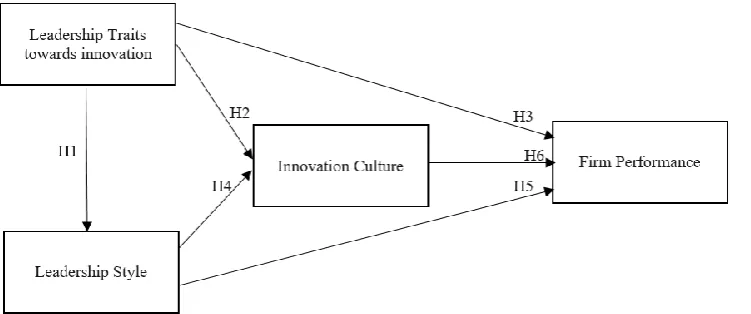
H1. Leadership traits towards innovation significantly affect leadership style.
Leadership traits towards innovation, leadership style, innovation culture, and firm performance
decisively towards innovation by actively promoting its progress through critical organization stages (Howell and Shea, 2001). For instance, change-oriented leaders contributed positive impacts on innovation culture, structure and management systems wherein it has driven firms to quickly adapt to the changing business environment which potentially leads to innovation (Yukl, 1999).
The most important drivers of innovation are people and culture (Capozzi, 2010). Earlier research indicated that firm that encourages leadership and innovation culture has better performance, and firm that innovates is better than the firm that does not innovate (Aragón-Correa et al., 2007; Oude, 2014; Wipulanusat et al., 2017; Rajapathirana et al., 2017; Njeri, 2017). Innovation is always considered one of the important drivers of performance and growth across all sectors. Capozzi (2010, p. 25) point out that leaders “pioneer innovations in not just products but also services, consumer experiences, operational processes, distribution, value chains, policies, business models, and even the functions of management and how people work”. ost innovative firms embed leadership and innovation in the organization, because these two constructs are the most driver for growth and successful firm performance. Barsh et al. (2008) stated that executives consider innovation as the way to increase pace of change in any business environment. Attaining innovation culture entails that organizations should have embraced the ideas and concepts of culture of innovation as part of the internal operations of the firms. This has been the emphasis of many firms in discharging the successful management and diffusion of innovation (Egbu et al., 1998; Hivner et al., 2003). As many researchers have claimed, an organizational culture that stimulates creativity and innovation tend to be more successful than those who have not embarked with innovation initiatives which in turn promotes innovation culture which is a major determining factor for successful implementation and maintenance of innovation (Amabile et al., 1996; Hartmann, 2006; Hivner et al., 2003; Steele and Murray, 2004; Ahmed, 1998).
Barsh (2008, p. 45) suggests that “in an innovation culture, employees know that their ideas are valued and believe that it is safe to express and act on those ideas and to learn from failure”, moreover, leaders need to emphasize on employees engagement by involving them in decision that matter to them and the firm. This mind-set has close relation with strong innovation performance. Furthermore, learning new skills is required to lead, coach and engage subordinate in innovative projects and build their capabilities for the assigned tasks. Empirical studies have focused on the effectiveness of six sets of leadership skills and abilities that positively influence firm’s success rate in enhancing innovation, including ability to coach, ability to reward, ability to involve and support others, ability to promote teamwork and collaboration, ability to communicate, and ability to motivate (Bel, 2010). These sets help leaders to positively influence their subordinate’s creative performance which subsequently will help in creating the culture of innovation and enhance organization performance.
Many kinds of research indicated the importance of implementing innovation culture within organizations as firms who have classified themselves as innovative experienced autonomy and high level of freedom, risk-tolerant and are generally flexible (Amabile et al., 1996; Egbu et al., 1998; Martins and Terblanche, 2003; Steele and Murray, 2004). In the context of many organizations, leadership style plays an important role in attaining higher level of innovation culture (Ahmed, 1998). Innovation culture has been defined as working environment wherein leaders enable anybody in the workplace to think outside the box and its applications (Steele and Murray, 2004). In organizations where culture of innovation are emphasized, supported, encouraged and rewarded, results showed that cultural characteristics directly correlates innovation and creativity in the workplace (Chandler et al., 2000; Dulaimi et al., 2005; Scott and Bruce, 1994). Kemp et.al. (2003) on the other hand have found a positive relationship between innovation/culture innovation and business firm performance. This is supported by the study of Aragón-Correa et al. (2007) into 900 firms operating in the farming, manufacturing, construction and service industry and found out that innovation has a positive impact on business performance. From these contexts, five hypotheses can be formulated as stated.
H2. Leadership traits towards innovation significantly affect innovation culture. H3. Leadership traits in innovation significantly affect firm performance. H4. Leadership style strongly correlates the innovation culture.
H5. Leadership style significantly affects firm performance H6. Innovation culture significantly affects firm performance
Mediating effects of innovation culture
Hardly according to the researcher’s knowledge, literature can be found to demonstrate the mediating effects of innovation culture on leadership style, leadership traits and firm performance. However; related research with similar findings had been identified by the researcher specifically in the study of Panuwatwanich et al. (2008) where findings revealed that leadership for innovation significantly correlates or influenced organizational culture for innovation (0.52, p, 0.001) while team climate for innovation was found to have a moderate and positive influence on organizational culture of innovation (0.35, p, 0.001). Both the leadership for innovation and team climate for innovation have not directly influenced culture for innovation; and innovation culture indirectly influenced business performance management. The researcher after searching different literatures that relate the study constructs distinctly developed the model that considers the mediating effects of innovation culture on leadership traits, leadership st yle and firm performance. This proposition leads to the two remaining hypotheses that will be displayed accordingly.
H7. Innovation culture mediates the relationship between leadership style and firm performance.
H8. Innovation culture mediates the relationship between leadership traits towards innovation and firm performance.
Extant literature have established a relationship between these constructs: leadership, innovation and organizational performance. However; very little literatures can be found relating leadership traits and characteristics, innovation culture and firm performance. Consequently, few studies discuss extensively the relationship between leadership traits towards innovation and leadership st yle. From the literature review, the framework of the study was formulated leading to the development of research hypotheses thereby resulting to the four main constructs namely: leadership traits towards innovation, leadership style, innovation culture and firm performance. These constructs are illustrated in Figure 1.
Figure 1: Conceptual model of the study
RESEARCH METHODOLOGY
Questionnaire survey
The data was collected through the employment of the online survey questionnaires specifically utilizing the Google documents to the three sectors: construction, manufacturing and information technology. The choice of choosing these three sectors was based on the assumption that innovation seems to be more prevalent and relevant to the nature of its operation. Based on the distribution of the respondents, 72 construction firms (48%); 31 manufacturing firms (20.7%); and 47 information technology firms (31.3%). The information was sorted out from LinkedIn to select which of these respondents were coming from these sectors. The research is purely a quantitative research approach and drafted based on the review of existing kinds of literature and past empirical studies and had been subjected to pre-testing using the expert review technique with which minor changes thereafter were made. Out of the 600 managers who were the recipient of the questionnaires from large, medium and small-scale firms in Sultanate of Oman, only 150 completed the questionnaires thereby posting a retrieval ratio of 25%. The manager respondents were preferred in line with the previous study conducted by Ropo and Parviainen (2001) claiming that knowledge of the managers and executives are very important considerations in discussing and implementing leadership and innovation. There are four main constructs in this study that primarily centred on leadership, innovation and firm performance. Based on innovation literatures from various researchers (Capozzi, 2010; Barsh, et. al., 2008; Bel, 2010), these constructs were identified and developed namely: Leadership Traits (5 items), Leadership Style (3 items), Innovation Culture (4 items), and Firm Performance (3 items). Each of these constructs was uniformly measured using the 5-point Likert scale ranging from 1 (Strongly Disagree) to 5 (Strongly Agree).
Sample
DATA ANALYSIS
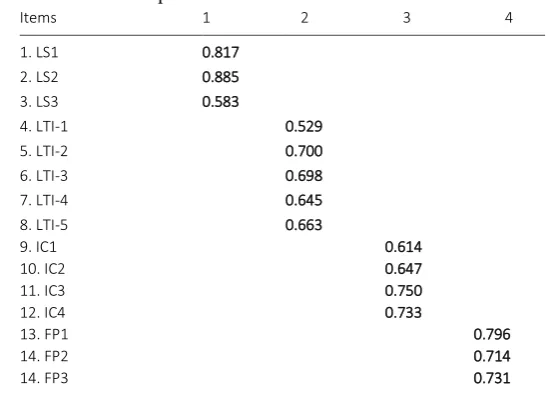
Principal Component Analysis (PCA) was utilized to show the number of extracted factors and the pattern of loadings of the variables used. Further, each construct was tested with using the factor analysis with VARIMAX orthogonal rotation method where it shows that the sample size is acceptable and thus exceeded the requirement in terms of case-to-variable ratio (Hair et al., 2006). In addition, the Kaiser-Meyer-Olkin (K O) and Bartlett’s Test revealed a good outcome with 0.803 which is above 0.6 and indicates sampling adequacy (Tabachnick and Fidell, 2007). Approximate Chi-Square also shows acceptable ratio with 657.236 and significant at 0.000. The outcome of PCA with eigenvalue (greater than 1.0) as also evidenced by screen test and prior criterion, four factors have emerged that 57.64% of the cumulative percentage of variance extracted. The loading of the factors displayed a rating more than 0.500 in all items with the elimination of one item. In other words, the developed measures have achieved the requirement of reliability and validity considering the items used and the model constructs as summarized in Table I.
Furthermore, there was no cross-loading of the items and thus, the variables are significantly correlated according to the four constructs: leadership traits towards innovation, leadership style, innovation culture and firm performance.
Table 1: Rotated component matrix
Correlation constructs and descriptive statistics
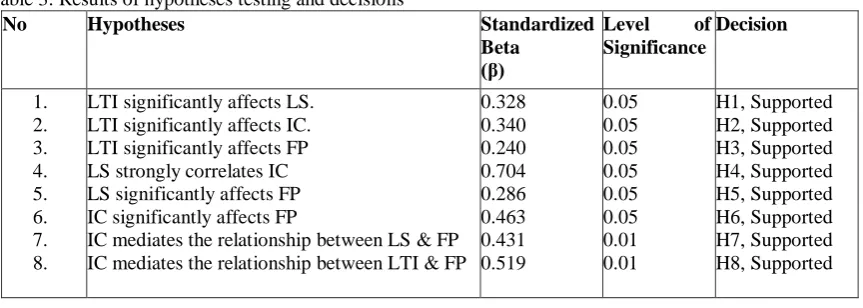
Further test was performed to determine the correlation of different variables used in this study with mean values and standard deviation. Outcome revealed that Leadership Traits towards innovation (LTI) significantly affects Leadership Style (LS) with β=0. 28 (p<.05 H1) Leadership Traits towards innovation (LT ) significantly affects nnovation Culture ( C), β=0. 40 (p<.05 H2) Leadership Traits towards innovation (LT ) significantly affects Firm Performance (FP), β=0.240 (p<0.05 H ) Leadership Style (LS) strongly correlates nnovation Culture ( C), β=0.704 (p<.05 H4) Leadership Style (LS) significantly affects Firm Performance (FP), β=0.286 H5) nnovation Culture ( C) significantly affects Firm Performance (FP), β=0.46 (p<.05 H6) see Table 2.
Table 2: Correlation Matrix and Descriptive Statistics
Furthermore, the Sobel’s test of mediation was utilized to assess the mediating effects of innovation culture to both leadership traits for innovation and leadership style on firm performance. Results depict that innovation culture positively mediates leadership style (LS) and firm performance (FP), β=0.4 1 (t=5.577 p<.01) based on H7. Likewise, to determine the mediating effects on H8, innovation culture (IC) significantly mediates the relationship between leadership traits for innovation (LTI) and firm performance (FP), β=0.519 (t=5.056 p<.01). The results of hypotheses testing can be summarized in Table .
Items 1 2 3 4
1. LS1 0.817
2. LS2 0.885
3. LS3 0.583
4. LTI-1 0.529
5. LTI-2 0.700
6. LTI-3 0.698
7. LTI-4 0.645
8. LTI-5
9. IC1 10. IC2
11. IC3 12. IC4
13. FP1 14. FP2 14. FP3
0.663
0.614 0.647 0.750 0.733
Table 3: Results of hypotheses testing and decisions
No Hypotheses Standardized
Beta (β)
Level of
Significance Decision 1. 2. 3. 4. 5. 6. 7. 8.
LTI significantly affects LS. LTI significantly affects IC. LTI significantly affects FP LS strongly correlates IC LS significantly affects FP IC significantly affects FP
IC mediates the relationship between LS & FP IC mediates the relationship between LTI & FP
0.328 0.340 0.240 0.704 0.286 0.463 0.431 0.519 0.05 0.05 0.05 0.05 0.05 0.05 0.01 0.01 H1, Supported H2, Supported H3, Supported H4, Supported H5, Supported H6, Supported H7, Supported H8, Supported
DISCUSSION AND CONCLUSION
Findings from the study posit varied discussion and implications. The hypotheses developed associated with the conceptual model suggests the relevance of the interrelationship of the four main variables utilized in the study which are leadership traits towards innovation, leadership style, innovation culture, and firm performance. Firstly, statistical testing of relationship between leadership traits towards innovation and leadership style posits positive correlation which means that leadership traits impact leadership style. This study did not mention the specific type of leadership style that will be utilized and the respondents were made aware that leadership style, in general, will be considered as variable along with other variables. This finding has affirmed the study of Diaz and Mazuera (2005) claiming that specific leadership traits and characteristics shaped perceived leadership style which consists of idealized influence, self-awareness of the leader, delegation-freedom, intellectual stimulation, individualized consideration, team development and open-mindedness. While many studies have not mentioned the relationship between leadership traits toward innovation and leadership style, this study proved the positive relationship that may suggest consideration for researchers and scholars to examine in-depth the relevance of these two variables in relation to innovation and business firm performance. A positive relationship is also generated after correlation matrix analysis between leadership traits toward innovation and innovation culture. Excerpts from the questionnaire related to leadership traits emphasized characteristics of leader suc h as openness to new ideas, creativity and high tolerance to risks, confidence in once ability to succeed, thinking outside the box, action-oriented and motivational ability. This is consistent with the findings of Cristina (2013) and Dalluay and Jalagat (2016) who exclaimed that ability to innovate, charisma, visionary, flexibility, self-awareness, training and communication and other traits stimulate innovation and the culture of innovation.
Furthermore, leadership traits toward innovation directly influence firm performance based on the respondent’s feedback and after testing its relationship. Though only few studies investigate the relationship between these two constructs, this study strongly suggests that firms should consider leadership traits as predicting variable of firm performance since the correlation is evident. On the other hand, when the relationship between leadership style and innovation were examined, results clearly showed a strong relationship. This result coincides with many types of research and literature that have proved the influence of leadership style on innovation culture. A positive relationship was examined and affirmed by various authors indicating the significance of leadership style (Jung et al., 2003; Oke et al., 2009). Specifically, transformational and transactional leadership style, for instance, contributed the highest impact related to the culture of innovation in organizations. Being visionary, effective communication skills, leadership and professional skills were given emphasis on leadership style that was integrated in the study and favourable and convincing feedback were obtained from the respondents. This may imply that leadership style and innovation culture plays an essential role for leaders and organizations if they will decide to pursue innovation. Leaders should also be committed to ensuring that the workplace is conducive for innovation and enable the employees to think outside the box, be creative and productive. mposing culture of innovation is difficult to obtain if leaders don’t possess the leadership style that best suited to innovation in the workplace. Leaders are also required to be committed to organizational resources that will be utilized to create an innovative culture and the potential success of innovation initiatives. Likewise, innovation culture directly affects firm performance which means that the higher perception of innovation the organization possess will result to higher firm performance. Two types of research were found by the researcher that established the positive relationship between innovation culture and business firm’s performance as expressly stated in the literature. Clearly stipulated in the study of Kemp et. al. (2003) is the positive relationship between innovation culture and organizational performance which is also affirmed in the research survey conducted by Aragón-Correa et al. (2007) into 900 firms operating in the farming, manufacturing, construction and service industry and found out that innovation has a positive impact on business performance.
leadership traits to contribute to the increased firm performance. Firms should ensure that innovation culture have taken place while leadership towards innovation is employed to experience an increased business firm performance. Based on these findings, recommendations can be offered. Considering firstly the positive relationships of the four constructs, it can be suggested that leadership traits, leadership style, innovation culture and firm performance should be given equal attention by business firms to ensure its potential success. The strong correlation between leadership style and innovation culture further lead to the recommendation that examining the significance of the different leadership style should be done so that identification of the best suitable leadership style could be applied to pursue innovation and in establishing culture of innovation. Thirdly, the mediating effects of innovation culture cannot be undermined as the results of this study clearly signifies the positive mediating effects to the three constructs as previously mentioned.
This study has been limited only to the three sectors in Sultanate of Oman and its variables are general constructs. Leadership style, for instance, does not specify the specific leadership style that may contribute specifically to innovation, innovation culture and firm performance. Also, some other variables that may potentially considered in the study which had been tested by other researches such as organizational learning, innovation diffusion, transactional and transformational leadership, innovation management and team climate. The study also limits to innovation in general and thus, do not specify which type of innovation will be considered and emphasized. Hence, this study can serve as input for further studies considering its applicability and with larger sample size and wider coverage for more comprehensive outcome.
REFERENCES
Ahmed, P.K. (1998), “Culture and climate for innovation”, European Journal of Innovation Management, Vol. 1 No. 1, pp. 30-43.
Al-Husseini, S. and lbeltagi, . (2012), “The impact of leadership style and knowledge sharing on innovation in Iraqi higher
education institutions”, n Proceedings of the 4th European International Conference on Intellectual Capital: Arcada
University of Applied Sciences, Helsinki, Finland, pp. 26-35.
Amabile, T.M., Conti, R., Coon, H., Lazenby, J. and Herron, . (1996), “Assessing the work environment for creativity”, The
Academy of Management Journal, Vol. 39 No. 5, pp. 1154-84.
Aragón-Correa, J.A., García-Morales, V.J. and Cordón-Pozo, . (2007), “Leadership and organizational learning's role on
innovation and performance: Lessons from Spain”, Industrial marketing management, Vol. 36 No. 3, pp.349-359.
Barsh, J., Capozzi, M.M. and Davidson, J. (2008), “Leadership and innovation”, McKinsey Quarterly, Vol. 1, p.36.
Bel, R. (2010), “Leadership and innovation: Learning from the best”, Global business and organizational excellence, Vol. 29 No.
2, pp.47-60.
Bossink, B.A.G. (2004), “ ffectiveness of innovation leadership styles: a manager’s influence on ecological innovation in
construction projects”, Construction Innovation, Vol. 4 No. 4, pp. 211-28.
Bossink, B. A. (2007), “Leadership for sustainable innovation”, International Journal of Technology Management and
Sustainable Development, Vol. 6, pp. 135-149.
Capozzi, . . (2010), “Leadership and innovation” Development Outreach, Vol. 12 No. 1, pp.25-28.
Chan, .Y., Liu, A. . and Fellows, R. (201 ), “Role of leadership in fostering an innovation climate in construction
firms”, Journal of management in engineering, Vol. 30 No. 6, pp.06014003.
Chandler, G.N., Keller, C. and Lyon, D.W. (2000), “Unraveling the determinants and consequences of an innovation-supportive
organizational culture”, Entrepreneurship Theory and Practice, Vol. 25 No. 1, pp. 59-76.
Chen, J.K., and Chen, .S. (2012), “Don’t worry, ’m with you: Can visionary leadership release neurotic employees for more
perceived innovative interactions?”, Innovation Management, Policy & Practice, Vol. 15 No. 2, pp. 215-223.
Cristina, V. (201 ), “The importance of an innovative leader in the organization”, Annals of the University of Oradea, Economic
Science Series, Vol. 22 No. 2, pp.703-710.
Dalluay, V.S, and Jalagat, R.C. (2016), “ mpacts of Leadership Style ffectiveness of anagers and Department Heads to
mployees’ Job Satisfaction and Performance on Selected Small-Scale Businesses in Cavite, Philippines”, International
Journal of Recent Advances in Organizational Behavior and Decision Sciences, Vol. 2 No. 2, pp. 734-752.
Diaz, L.R. and Mazuera, N.R. (2015), “Leadership characteristics that shape the leadership style of leaders of financially sustainable social innovation projects: An exploratory study of the perceptions of project managers in the UK”, Available at: https://www.diva-portal.org/smash/get/diva2:781435/FULLTEXT01.pdf (Accessed: 20 June 2018).
Dissart, J.C. 200 , “Regional conomic Diversity and Regional conomic Stability: Research Results and Agenda.”
International Regional Science Review, Vol. 26 No 4, pp.423-446.
Dulaimi, .F., Nepal, .P. and Park, . (2005), “A hierarchical structural model of assessing innovation and project
performance”, Construction Management and Economics, Vol. 23 No. 6, pp. 565-77.
gbu, C.O., Henry, J., Kaye, G.R., Quintas, P., Schumacher, T.R. and Young, B.A. (1998), “ anaging organizational innovations
in construction”, in Proceedings of the 14th Annual Conference Association of Researchers in Construction Management
(ARCOM), Reading, pp. 605-14.
ngelen, A., Schmidt, S., Strenger, L., and Brettel, . (201 ), “Top management’s transformational leader behaviors and
innovation orientation: A cross-cultural perspectives in eight countries”, Journal of International Management, Vol. 20 No. 2,
seinbeib, S.A., and Boerner, S. (2010), “Transformational leadership and R&D innovation: Taking a curvilinear approach”,
Creativity and Innovation Management, Vol. 19 No. 4, pp. 364-372.
Garcia-Morales, V. J., Jimenez-Barrionuevo, M. M. and Gutierrez-Gutierrez, L. (2012), “Transformational leadership influence
on organizational performance through organizational learning and innovation”, Journal of Business Research, Vol. 65, pp.
1040-1050.
Gumusluo lu, L., and Ilsev, A. (2009), “Transformational Leadership and Organizational nnovation: The Roles of nternal and
xternal Support for nnovation”, Journal of Product Innovation Management, Vol. 26 No. 3, pp. 264-277.
Hair, J. F. J., W. C. Black, B. J. Babin, R. E. Anderson, and R. L. Tatham. (2006), Multivariate Data Analysis, Pearson Prentice
Hall, New Jersey.
Hartmann, A. (2006), “The role of organizational culture in motivating innovative behaviour in construction firms”, Construction
Innovation, Vol. 6 No. 3, pp. 159-72.
Hivner, W., Hopkins, S.A. and Hopkins, W. . (200 ), “Facilitating, accelerating, and sustaining the innovation diffusion process:
an epidemic modeling approach”, European Journal of Innovation Management, Vol. 6 No. 2, pp. 80-9.
Howell, J. . and Shea, C. . (2001), “ ndividual differences, environmental scanning, innovation framing, and champion
behavior: key predictors of project performance”, The Journal of Product Innovation Management, Vol. 18 No. 1, pp. 15-27.
ITA. (2018), “ nformation Technology Authority ( TA) Portal”, Available at: https://ita.gov.om/ TAPortal/ TA/default.aspx (Accessed 13 Jun. 2018).
Jung, D.I., Chow, C. and Wu, A. (200 ), “The role of transformational leadership in enhancing organizational innovation:
hypotheses and some preliminary findings”, The Leadership Quarterly, Vol. 14 Nos. 4/5, pp. 525-44.
Kemp, R.G.M., Folkeringa, M., De Jong, J.P.J. and Wubben, .F. . (200 ), “ nnovation and Firm Performance”, Scientific
Analysis of Entrepreneurship and SMEs (SCALES), Zoetermeer.
Kuncoro, W. and Suriani, W.O. (2017), “Achieving sustainable competitive advantage through product innovation and market
driving”, Asia Pacific Management Review, PP. 1-7.
anu, F.A. and Sriram, V. (1996), “ nnovation, marketing strategy, environment, and performance”, Journal of business
Research, Vol. 35 No. 1, pp.79-91.
artins, .C. and Terblanche, F. (200 ), “Building organisational culture that stimulates creativity and innovation”, European
Journal of Innovation Management, Vol. 6 No. 1, pp. 64-74.
Mejia-Trejo, J., Sanchez-Sanchez-Gutierrez, J., Vazquez-Avila, G. (201 ), “ nnovation generation and leadership on value
creation: The case of software developer sector in Guadalajara, exico”, International Journal of Strategic Management,
Vol. 13 No. 3, pp. 85.
ichaelis, B., Stegmaier, R., & Sonntag, K. (2009), “Affective commitment to change and innovation implementation behavior:
The role of charismatic leadership and employees’ trust in top management”, Journal of Change Management, Vol. 9 No. 4,
pp. 399-417.
ontes, F.J.L., oreno, A.R. and orales, V.G. (2005), “ nfluence of support leadership and teamwork cohesion on
organizational learning, innovation and performance: an empirical examination”, Technovation, Vol. 25 No. 10, pp.
1159-1172.
Nam, C.H. Tatum, C.B. (1992), “Strategies for technology push: Lessons from construction innovations”, Journal of
Construction Engineering and Management, Vol. 118 No. 3, pp. 507-524
Njeri, A. (2017), “ ffects of nnovation Strategy on Firm Performance in Telecommunications Industry: A Case of Safaricom Kenya Limited”, working paper, United States nternational University-Africa, Kenya.
Northouse, P. G. (2013), Leadership: Theory and practice, 6th edition, Sage Publications.
Oke, A., Munshi, N. and Walumbwa, F.O. (2009), “The influence of leadership on innovation processes and activities”,
Organizational Dynamics, Vol. 38 No. 1, pp. 64–72.
Orazi, D.C., Turrini, A. and Valotti, G. (201 ), “Public sector leadership: new perspectives for research and
practice”, International Review of Administrative Sciences, Vol. 79 No. 3, pp.486-504.
Oude Luttikhuis, M. (2014), “ nfluence of leadership behaviors and attitudes on innovativeness' of employees”, University of Twente, The Netherlands.
Oxford Business Group. (2017), “The Report: Oman 2017”, Available at: https://oxfordbusinessgroup.com/oman-2017 (Accessed 2 June. 2018).
Oxford Business Group. (2018), “The Report: Oman 2018”, Available at: https://oxfordbusinessgroup.com/oman-2018/construction (Accessed 1 Jun. 2018).
Panuwatwanich, K., Stewart, R.A., & ohamed, S. (2008), “The role of climate for innovation in enhancing business
performance: The case of design firms”, Engineering, Construction and Architectural Management,Vol. 15 No. 5,
pp.407-422.
Paulsen, N., Callan, V. J., Ayoko, O. & Saubders, D. (201 ), “Transformational leadership and innovation in an R&D
organization experiencing major change”, Journal of Organizational Change Management, Vol. 26, pp. 595-610.
Pece, A. M., O. E. O. Simona, and F. Salisteanu. (2015), “ nnovation and conomic Growth: An mpirical Analysis for C
Countries”, Procedia Economics and Finance, Vol. 26, pp. 461-467.
Prajogo, D. ., & Ahmed, P. K. (2006), “Relationships between innovation stimulus, innovation capacity, and innovation
Rajapathirana, R.J. and Hui, Y. (2017), “Relationship between innovation capability, innovation type, and firm
performance”, Journal of Innovation & Knowledge, Vol. 3 No. 1, pp.44-55.
Rogers, . . (1981), “Diffusion of innovations: An overview”, In Use and Impact of Computers in Clinical Medicine,
Springer-Verlag, New York, pp. 113-131
Ropo, A. and Parviainen, J. (2001), “Leadership and bodily knowledge in expert organizations: epistemological
rethinking”, Scandinavian Journal of Management, Vol. 17 No. 1, pp.1-18.
Samad, S. (2012), “The influence of innovation and transformational leadership on organizational performance”, Procedia Social
and Behavioral Sciences, Vol. 57, pp. 486-493.
Scott, S.G. and Bruce, R.A. (1994), “Determinants of innovative behavior: a path model of individual innovation in the
workplace”, Academy of Management Journal, Vol. 37 No. 3, pp. 580-607.
Steele, J. and urray, . (2004), “Creating, supporting and sustaining a culture of innovation”, Engineering, Construction and
Architectural Management, Vol. 11 No. 5, pp. 316-22.
Tabachnick, B.G. and Fidell, L.S. (2007), Using Multivariate Statistics, Pearson Education, Boston, MA.
Trading Economics (2018), “Oman GDP From Construction”, Available at: https://tradingeconomics.com/oman/gdp-from-construction (Accessed 1 Jun 2018).
Vaccaro, I.G., Jansen, J.J., Van Den Bosch, F.A. and Volberda, H.W. (2012), “ anagement innovation and leadership: The
moderating role of organizational size”, Journal of Management Studies, Vol. 49 No. 1, pp.28-51.
Wipulanusat, W., Panuwatwanich, K. and Stewart, R.A. (2017), “ xploring leadership styles for innovation: an exploratory factor
analysis”, Ekonomia i Zarzadzanie, Vol. 9 No. 1, pp.7-17.
Ye, L., Junye, D. and Yan, . (2011), “The relationships between leadership styles and organizational innovation climate: Cases
of some high-tech enterprises in Hebei”, n Business Management and Electronic Information (BMEI) in International
Conference, Guangzhou, China, 2011, IEEE, Vol. 2, pp. 316-319.
Yoshida, D.T., Sendjaya, S., Hirst, G. and Cooper, B. (2014), “Does servant leadership foster creativity and innovation? A
multi-level mediation study of identification and proto typicality”, Journal of Business Research, Vol. 67 No. 7, pp.1395-1404.
Yukl, G. (1999), “An evaluation of conceptual weaknesses in transformational and charismatic leadership theories”, Leadership