ARTIGO ORIGINAL
Experience of the MALA Bag in the Open
Abdomen Management in an Obstetrical
Intensive Care Unit
Experiência da Bolsa MALA no Tratamento do Abdomén Aberto
numa Unidade de Cuidados Intensivos Obstétricos
1. Maternal-Perinatal Hospital Mónica Pretelini Sáenz. Health Institute of the State of Mexico. Toluca. México. 2. Asociación Científica Latina A.C. (ASCILA) and Ciprés Grupo Médico S.C. (CGM). Toluca. México. Recebido: 31 de Julho de 2013 - Aceite: 10 de Agosto de 2013 | Copyright © Ordem dos Médicos 2013
Ricardo Mauricio MALAGón REYES1, Luis Emilio REYES MEnDOZA1, María de Jesús AnGELES VÁZQUEZ1, Hugo
MEnDIETA ZERón1,2
Acta Med Port 2013 Nov-Dec;26(6):699-704
RESUMO
Introdução: As indicações atuais para a gestão de abdómen aberto são a cirurgia de controlo de danos, a abordagem de sepsis intra-abdominal grave, a síndrome de compartimento intra-abdominal, o encerramento da parede intra-abdominal sob tensão e a perda de massa da parede abdominal.
Objetivo: Descrever a experiência em gestão e cirurgias de abdómen aberto usando a bolsa MALA (Maior Absorção de Líquido Ab-dominal).
Material e Métodos: Estudo descritivo, incluindo todos os doentes com o diagnóstico de abdómen aberto gerido com a bolsa MALA internados na Unidade de Cuidados Intensivos Obstétricos de Fevereiro de 2009 a Junho de 2012.
Resultados: Dos 25 casos identificados no período do estudo, sete foram eliminados por arquivos incompletos, permanecendo 18 ca-sos para a análise. A média de idade foi de 31,5 anos. Setenta e oito por cento dos doentes eram multíparas, 50% com uma história de dois ou mais partos, 83% com uma cesariana anterior e 78% histerectomizadas, por atonia uterina, na maioria dos casos. A principal indicação para tratamento cirúrgico foi o controlo de danos. Uma doente morreu e uma segunda foi transferida para outra instituição, tendo as demais tido melhoria clínica. Doze doentes (67%) permaneceram menos de 14 dias na Unidade de Cuidados Intensivos Obstétricos e apenas uma precisou de mais de 30 dias na unidade.
Conclusão: A bolsa MALA pode oferecer uma opção económica e eficaz para a gestão cirúrgica abdominal aberta, bem como uma técnica de drenagem.
Palavras-chave: Complicações na Gravidez/ cirurgia; Abdomén/ cirurgia; México.
ABSTRACT
Introduction: Current indications for open abdomen management are damage control surgery, severe intra-abdominal sepsis, abdomi-nal compartment syndrome, abdomiabdomi-nal wall closure under tension and mass loss of the abdomiabdomi-nal wall.
Objective: To describe the experience in open abdomen management using the MALA (mayor absorción de líquido abdominal [greater absorption of abdominal liquid]) bag at the Maternal-Perinatal Hospital Mónica Pretelini Saénz, Health Institute of the State of Mexico.
Material and Methods: This was a bidirectional, descriptive and observational study. All patients with the diagnosis of open abdomen managed with the MALA bag admitted to the Obstetric Intensive Care Unit from February 2009 to June 2012 were included.
Results: From 25 cases identified in the period of the study, seven were eliminated for incomplete files, remaining 18 cases for the analysis. The mean age was 31.5 years. 78% of the patients were multigravidas, 50% of them with a history of 2 or more deliveries, 83% had a previous cesarean section and 78% were hysterectomized. Evisceration was present in one patient. The main indication for surgi-cal management was damage control. One patient died and a second was transferred to another institution, the rest were discharged by clinical improvement. 12 patients (67%) spent less than 14 days in the Obstetric Intensive Care Unit, only one patient required more than 30 days in the unit. Discussion: Halve the women who required this surgical alternative, were above 30 years of age. Stressing is the fact that from the 18 admitted patients, 14 (78%) had undergone obstetric hysterectomy, with the etiology of uterine atony in most cases. Damage control surgery seems to be the most elective surgical option to use MALA bag followed by ACS and abdominal sepsis.
Conclusion: The MALA bag can offer an economic and effective surgical option for the open abdomen management as well as a drainage technique.
Keywords: Abdomen/ surgery; Pregnancy Complications/ surgery; Abdominal Wound Closure Techniques; Mexico.
INTRODUCTION
Current advances in open abdomen management are encouraging; however, the results do not show the same benefits to all patients.1-4 The abdominal closure should
ide-ally allow abdominal viscera containment, protect against mechanical damage and prevent intestinal tissue drying, contamination of peritoneal cavity and peritoneal fluid loss.5
Today, the election of the open abdomen management is growing as surgeons become more familiar with its use; however, it is associated with high morbidity and morta-lity.4,6 Besides, the elective treatments of patients that
pre-sent with any of the current indications for open abdomen management involves substantial costs to the institutions responsible for their care.
Current indications for this surgical option are: damage control surgery, severe intra-abdominal sepsis, abdomi-nal compartment syndrome (ACS), abdomiabdomi-nal wall clo-sure under tension and mass loss of the abdominal wall.3
ARTIGO ORIGINAL prevention of peritoneal cavity infection and ACS.
7-11
Intra-abdominal pressure (IAP) is a hemodynamic monitoring op-tion in critically ill patients to avoid this syndrome.7
Until now, the open abdomen management involves many doubts. This is due to the fact that there is uncer-tainty regarding the most appropriate surgical technique. Among the options to treat this condition have been de-scribed vacuum systems,7-11 Bogota bag,3,5,7,11 close skin
only technique,12 prosthetic materials,13 Wittman Patch,3,6
topical negative pressure (TnP), fascial closure, temporary abdominal closure, fascial dehiscence and deep wound de-hiscence,14 cutaneous-adipose tissues detachment,15
modi-fied Bogota bag (MBB),16 etc.
Among all the options to treat open abdomen there are three similar in cost/effectiveness: The Bogota bag, the sub-cutaneous polyethylene bag and the MALA (mayor absor-ción de líquido abdominal in the original spanish/ greater absorption of abdominal liquid) bag (introducing). The first was implemented by Borráez in Colombia about 20 years ago, referring to a sterile bag fixed to the edges of the wound or aponeurosis.2,17 The subcutaneous polyethylene bag was
proposed in the national Medical Center Siglo XXI, Insti-tuto Mexicano del Seguro Social (IMSS), placing a plastic bag beneath the peritoneum, covering the entire abdominal content and extracted by a small opening approximately 5 cm below the inferior angle of the wound, closing the skin over the plastic.5,17 Our main objective was to describe the
experience in the open abdomen management using MALA bag.
MATERIAL AND METHODS Design
This was a bidirectional, descriptive and clinical study. Initially we proceeded to search the cases of open abdo-men manageabdo-ment in the statistical program database of the Maternal-Perinatal Hospital Mónica Pretelini Saénz (HMPMPS) from February 2009 to January 2012.
Patients
All women in the pregnancy-puerperal cycle with open abdomen managed with the MALA bag in the period of the study were included. Patients with incomplete files or pre-vious pathology or abdominal wall defects were excluded.
Sociodemographic and clinical data
All variables were collected through a data-sheet de-veloped by the researchers. Once selected, the files were reassessed to confirm the diagnosis reliability.
Laboratory
We measured hematic biometry (Advia 120, Bayer Health), glucose (mg/dl), cholesterol (mg/dl), high-density lipoproteins (HDL) (mg/dl), low-density lipoproteins (LDL) (mg/dl) and triglycerides (mg/dl) (Dimension Rx L Max, Dade Behring).
Intra-abdominal pressure
We measured intra-abdominal pressure (IAP) with sa-line solution instillation (50 cc) by urethral catheter.
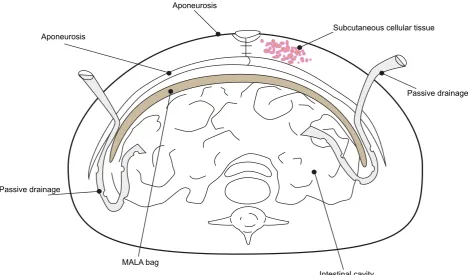
Figure 1 - Schematic representation of the MALA bag insertion.
Aponeurosis
Aponeurosis
Subcutaneous cellular tissue
Passive drainage
Passive drainage
ARTIGO ORIGINAL
MALA bag
The technique of the MALA bag is: Once solved the cause of the laparotomy, the MALA bag (a sterile bag for urine collection or for dialysis) is open in three corners, then is put above the bowel loops and the great omentum, trying to cover as much area as possible, with this we diminish the adherence formation. The MALA bag is externalized about 5 cm above the suprapubic limit and fixed with two non ab-sorbable simple sutures. In this opening, a collection bag must be put to quantify the fluids (Fig. 1).
Statistical analysis
Data analysis was performed using Excel program. Fre-quency distribution tables were constructed for categorical variables, calculating measures of central trend and disper-sion for quantitative variables.
Ethical implications
In accordance with Articles 96, 100 and 102 of the Ge-neral Law of Health (Mexico), this study is classified as zero risk to participants and involves no procedures that endanger their health. This research was authorized by the Ethics and Research Committee of the HMPMPS (regis-tration number: 2012-01-228) and we were adhered to the Helsinki recommendations.
RESULTS
During the study period, 1067 obstetric patients were admitted at the ICU. 25 records (2.3%) in the database of the HMPMP fulfilled the entry criteria for this protocol, du-ring the period considered for the study. Seven cases that were not able to complete data analysis were eliminated. In Table 1 we list the principal clinical characteristics of the studied population.
The age (mean ± SD) of patients was 31.5 ± 5.15 years (range 37-19), similar to a case-control study conducted in
England (29.6 years, controls, 28.7 years)18 and to those
described in a 12-year study conducted in the netherlands (30 years),19 but older than in an Indian ICU study, which
was 25.5 years.20
Average gestational age was 36.1 ± 4.01 weeks. Re-garding the number of gestations, six women developed their third gestation (33%), five patients (28%) had their fourth pregnancy, those in their first, second and seventh pregnancy, each were two patients (11%); and one patient (6%) developed its sixth pregnancy.
Of all patients who have had vaginal deliveries, five patients had a history of five previous births (28%), three patients (17%) had a birth, similarly, three more women (17%) had only one delivery, one participant (3%) was pri-miparous, six patients (33%) have failed vaginal obstetrical resolution.
Of the total population, the history of C-section was dis-tributed as follows: the group with the highest percentage (50%, 9 individuals) was that of one cesarean section fol-lowed by those with two C-sections (17%, 3 participants), also with 17% was the group which has never been sub-mitted to C-section, two patients (11%) had a history of 3 cesareans and one woman (5%) had four abdominal deli-veries.
In a previous study carried out in Brazil, caesarean sec-tion was performed in 65.3% of patients who had their de-liveries during the ICU stay.21 While in our study there were
5 women (28%) in vaginal postpartum, 12 women (67%) in post-cesarean puerperium and only one woman (5%) was in post-abortion puerperium. When listing the presence of complications, 14 women (78%), corresponding to more than three-quarters of the total, required hysterectomy due to severe obstetric hemorrhage. Evisceration was present in only one patient (6%).
Considering the history of abortions, 50% of the partici-pants had no previous abortion, seven patients (39%) had
Table 1 - Clinical characteristics of the women treated with MALA bag (n = 18)
Characteristic Distribution (mean ± SD) [range]
V F %
Age (years) < 30 7 38.8 31.5 ± 5.1 [19-37]
≥ 30 11 61.1
Parity
0 6 33.3
1.5 ± 1.4 [0-4]
1 3 16.6
2 5 27.7
3 1 5.5
4 3 16.6
Gestational age at ICU admission (weeks)
≥ 37 5 27.7
36.1 ± 4 [28-39.3] < 37 13 72.2
Days with MALA bag
2 2 11.1
3.8 ± 1.6 [2-7]
3 10 55.5
4 1 5.5
6 3 16.6
7 2 11.1
ARTIGO ORIGINAL
one previous abortion, and two patients (11%) presented abortion on 2 occasions. no patient in the present study had over two abortions.
In relation to the IAH, the patients were divided into five groups: a) three (17%) with physiological IAP (0 to < 12 mmHg), b) seven (39%) with grade I (12-15 mmHg), c) four (22%) with grade II (16-20 mmHg), d) three (17%) with grade III (21-25 mmHg) and e) one (5%) with grade IV (> 25 mmHg). ACS (IAH higher than 20 mmHg associated with any organ dysfunction), appeared in four individuals (22%). The indications for MALA bag were: 14 patients (78%) for damage control surgery, three patients (17%) for ACS, and one patient (5%) for abdominal sepsis. The average time of MALA bag use was of 3.8 ± 1.6 days (range 2-7). On the first day the liquid quantification was of 1954 ± 1739 ml. The average hospital stay of these patients in the ICU was 12 days, with a minimum of five and a maximum of 30 days of hospitalization. Eight patients (32%) un derwent mechanical ventilation, with a mean of 171 ± 201 days. One patient was 28 days under mechanical support with a final evolution to decease.
Finally, 16 patients (89%) were discharged for clinical improvement, one patient (5.5%) had to be transferred to another ICU and one patient died.
DISCUSSION
The three indications adopted in our study for the open abdomen management: damage control surgery, ACS and abdominal sepsis corresponds to those described in the literature.13 The election of this technique is not for every
woman but the particularities of the medical attention in our third level hospital implies a time-dependent survival for the patients as they come from small towns far away from To-luca City, which means several hours since the beginning of the obstetric complication until arriving to our hospital with the increased risk of bowel distension and abdominal wall
oedema that may prevent tension-free closure forcing the surgeon to leave the abdomen open.22
Among the complications of open abdomen manage-ment there are short-term such as fistulas, residual abscess formation, secondary haemorrhage or long-term such as in-cisional hernia. These complications depend on the indivi-dual characteristics of the patient and the elected tech-nique. In our study, we had a case of evisceration in a mor-bidly obese woman.
According to the literature, age is a risk factor predis-posing to perinatal morbidity.23 In this regard, we observed
that more than half of the women who required this sur-gical alternative, were above 30 years of age. Likewise, women with multiple pregnancies or multiple births, are at increased risk of obstetric complications.24 Moreover,
cae-sarean section is itself a risk factor for placenta previa or placenta accreta and uterine rupture. In the present study, 78% of the patients were multiparous, only 22% had two or fewer pregnancies. Also noteworthy is the fact that 50% of patients had a history of 2 or more births, and only one was primiparous.
The need for more frequent obstetric hysterectomy as part of the consequences of complications in cesarean pu-erperal condition of our study, with 12 women (67%), sub-mitted to this surgery after cesarean section, coincided with reports on the issue. Stressing is the fact that from the 18 admitted patients, 14 (78%) had undergone obstetric hys-terectomy, with the etiology of uterine atony in most cases, data that corresponds to that reported by Mercier and Van de Velde.25
The global prevalence of IAH, reaches 35%. We found IAH as a constant variable, perhaps because pregnant women have inherent IAH, even without perinatal morbidity. Specifically, we found that IAH was present in 15 patients (83%) and four of them (22%) developed ACS.
The odds ratio (OR) determination of each variable
Table 2 - Characteristics of Bogota bag, Polyethylene bag and MALA bag
Technique
Bogota bag Polyethylene bag MALA bag
Advantages Economical. Economical. Utility: skin closure.
Economical.
Favors passive drainage.
It is not required a second surgical intervention for abdominal wall plastia.
Disadvantages The repeated repositioning causes significant tissue loss.
Complications include evisceration, intestinal fistulas and massive fluid drainage.
It is required a second surgical intervention for abdominal wall plastia.
ARTIGO ORIGINAL against a control group is beyond the scope of this study
due to its design of case series report. Probably, in a com-parative study, the number needed in each group to reach a power higher than 80% should be so high to be developed in a relatively short period of time in one unique ICU. The open abdomen is not a safe surgical approach; complications ranging from electrolyte disturbances, enteric fistulas, intra-abdominal abscesses and giant abdominal muscle-aponeurotic defects development with their impor-tant functional and aesthetic consequences are common. In this case series report, evisceration complication of open abdomen management was present only in one patient (6%).
At present, the benefits that arise with the open abdo-men technique are best evidenced by the decreased range of mortality, compared with the closed treatment. In Ger-many, most commonly used treatments for open abdomen are staged abdominal lavage (87%), commercial abdominal dressing system (82%), planned ventral hernia (69%), and other intra-abdominal dressings (e.g. vacuum pack 15%, Bogota bag 5%).26 The Opsite sandwich or Bogota bag
in-variably leaks, and sometimes needs changing daily. VAC systems are not financially affordable.27 On the contrary,
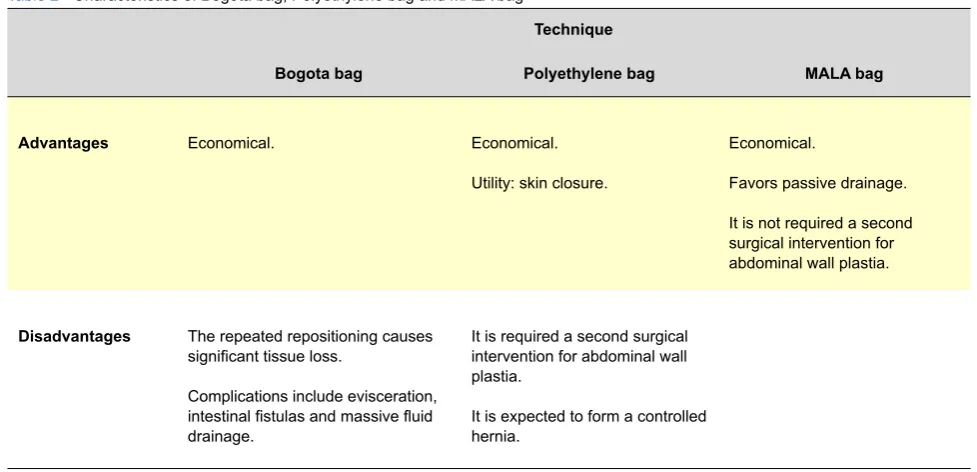
MALA bag is inexpensive and easy to apply, even more, has simplified the nursing of patients with an open abdo-men, and has enabled us to reduce the frequency of a se-cond surgical time. Even more, the drainage capacity of the MALA bag almost doubles that of two Penrose catheters. In the Table 2 we list the principal characteristics of three simi-lar techniques for the open abdomen management: Bogota bag, polyethylene bag and MALA bag.
There is a lack of studies comparing the techniques to treat open abdomen, which supports the importance of the current report to introduce a novel option to be consid-ered. The advantage of the current study is to have been performed in a third level hospital with strong expertise in
several methods to treat open abdomen, however, a clear disadvantage is the retrospective phase, also although a case series report could be of limited interest for most experts in obstetric hemorrhage, this type of article pre-dominate in the scientific literature related to open abdo-men manageabdo-ment.14 For a more convincing argument in
fa-vor of the MALA bag use, it is required a randomized study contrasting at least two methods of open abdomen ma-nagement.
CONCLUSIONS
In our case series study, the damage control surgery was the main indication for open abdomen, followed by ACS. With these data on, these indications seem to benefit from MALA bag use. Thus far, this surgical and drainage technique is economical as well as of easy placement and removal.
Finally, given the lack of consensus regarding optimal management strategies for the open abdomen, there is a need for prospective, multi-institutional studies to evaluate therapeutic approaches to treat this challenging problem.28
ACKNOWLEDGMENTS
Authors thank Kátia da Boit Martinello, Instituto de Pes-quisas Ambientais e Desenvolvimento Humano, Capivari de Baixo - Santa Catarina, Brazil for helping us with the Portuguese abstract translation.
CONFLICT OF INTEREST
The authors have no competing interests to declare.
FUNDING SOURCES
This research received no specific grant from any fun-ding agency in the public, commercial, or not for-profit sec-tors.
REFERENCES
1. Borráez OA. Abdomen abierto: la herida más desafiante. Rev Colomb Cir. 2008;23:204-9.
2. Brox-Jiménez A, Ruíz-Luque V, Torres-Arcos C, Parra-Membrives P, Díaz-Gómez D, Gómez-Bujedo L, et al. Experiencia con la técnica de la bolsa de Bogotá para el cierre temporal del abdómen. Cir Esp. 2007;82:150-4.
3. Iñaguazo SD, Astudilllo AM. Abdomen abierto en la sepsis intraabdo-minal severa. ¿Una indicación beneficiosa? Rev Chil Cir. 2009;61:294-300.
4. Sánchez-Lozada R, Ortiz-González J, Dolores-Velázquez R, Soto--Villagrán R, Gutiérrez-Vega R. Abdomen abierto vs cerrado en peri-tonitis grave por traumatismo. Estudio comparativo. Gac Med Mex. 2004;140:295-8.
5. de la Fuente-Lira M, Mendoza MV, Robledo-Ogazón F, Mier y Díaz J, Martínez-Ordaz JL, Blanco Benavides R. Cierre temporal de la pared abdominal con polietileno. Cir Ciruj. 2002;70:157-63.
6. Tavares-de la Paz LA, Andrade-de la Garza P, Gone-Fernández A, Sán-chez-Fernández P. Abdomen abierto. Evolucion en su manejo. Cir Cir. 2008;76:177-86.
7. Carrillo-Esper R, Sosa García JO. Presión Intraabdominal: su importan-cia en la práctica clínica. Med Int Mex. 2010;26:48-62.
8. Forero JC, Rodríguez JA. Cirugía de abdomen abierto en gineco obstetricia: indicaciones, técnica y manejo. Rev Colomb Obstet Ginecol. 2005;56:155-65.
9. Malbrain ML, De laet IE. Intra-abdominal hypertension: evolving
con-cepts. Crit Care nurs Clin north Am. 2012;24:275-309.
10. Teicher EJ, Pasquale MD, Cipolle MD. Abdominal Compartment Syn-drome. Operative Techniques Gen Surg. 2008;10:39-59.
11. Timoney MF, Zenilman ME. How we manage abdominal compartment syndrome. Contemp Surg. 2008;64:468-73.
12. Blackbourne LH. Combat damage control surgery. Crit Care Med. 2008;36:S304-10.
13. Benítez Valdez LV, Pirota MF, Sánchez CE, Gorodner A. Manejo del abdomen abierto y contenido con malla: técnica de Bogotá. Rev Posg VIa Cátedra Med. 2007;171:5-7.
14. Quyn AJ, Johnston C, Hall D, Chambers A, Arapova n, Ogston S, et al. The open abdomen and temporary abdominal closure systems-histori-cal evolution and systematic review. Colorectal Dis. 2012;14:e429-38. 15. Drumond DA. Skin-adipose tissue detachment for laparotomy closure:
a simple and effective technique for a complex problem. Rev Col Bras Cir. 2010;37:175-83.
16. Joglar F, Agosto E, Marrero D, Canario QM, Rodríguez P. Dynamic retention suture closure: modified Bogota bag approach. J Surg Res. 2010;162:274-8.
17. Manterola C, Moraga J, Urrutia S. Contained laparostomy with a Bogota bag. Results of case series. Cir Esp. 2011;89:379-85.
18. Waterstone M, Bewley S, Wolfe C. Incidence and predictors of severe obstetric morbidity: case-control study. BMJ. 2001;322:1089-93. 19. Keizer JL, Zwart JJ, Meerman RH, Harinck BI, Feuth HD, van RJ.
ARTIGO ORIGINAL
centre. Eur J Obstet Gynecol Reprod Biol. 2006;128:152-6.
20. Karnad DR, Lapsia V, Krishnan A, Salvi VS. Prognostic factors in obstetric patients admitted to an Indian intensive care unit. Crit Care Med. 2004;32:1294-9.
21. Coelho MA, Katz L, Coutinho I, Hofmann A, Miranda L, Amorim M. Pro-file of women admitted at an obstetric ICU due to non-obstetric causes. Rev Assoc Med Bras. 2012;58:160-7.
22. Hirshberg A, Mattox KL. Planned reoperation for severe trauma. Ann Surg. 1995;222: 3-8.
23. Mbamara SU, Obiechina n, Eleje GU. An analysis of uterine rupture at the nnamdi Azikiwe University Teaching Hospital nnewi, Southeast nigeria. niger J Clin Pract. 2012;15:448-52.
24. ACOG Practice Bulletin: Clinical Management Guidelines for
Obstetri-cian-Gynecologists number 76, October 2006: postpartum hemorrhage. Obstet Gynecol. 2006;108:1039-47.
25. Mercier FJ, Van d V. Major obstetric hemorrhage. Anesthesiol Clin. 2008;26:53-66.
26. Herrle F, Hasenberg T, Fini B, Jonescheit J, Shang E, Kienle P, et al. Offenes abdomen 2009 umfrage zu behandlungsstrategien des offenen abdomens in Deutschland. Chirurg. 2011;82:684-90.
27. Campbell AM, Kuhn WP, Barker P. Vacuum-assisted closure of the open abdomen in a resource-limited setting. S Afr J Surg. 2010;48:114-5. 28. MacLean AA, O’Keeffe T, Augenstein J. Management strategies for the
Hugo MEnDiEta ZERón