International Journal Advances in Social Science and Humanities
Available online at: www.ijassh.com
CASE STUDY
The Function of Sexual Imagery and Visual Seduction in Food
Advertising
Stephen T.F. Poon
Taylor’s University, Malaysia.
Abstract
The purpose of this study was to investigate the psychological and emotional connections between sexual imagery and food advertising, with the aim of gaining insight about why consumers are drawn to this form of eroticism. Case study of advertisements for a well-known international brand of fast food featuring female subjects as objects of desire will be critically analysed, and the relevance of sexual imagery with regard the product utility is examined. Discussion of findings show that suggestive visual imagery is frequently invoked by making the seductive nature of the subject a key factor to arouse audience attention and reaction. Marketing and media advertising today integrate so seamlessly that audiences exert almost no effort to memorise, re-enact and emulate the concept of advertising messages. Insofar as it is crucial for brand recognition to follow seductive marketing tactics, it is argued that the usefulness of visually seductive codes for commercial persuasion extends so far as product recognition and arousal goes, but that method must align with clear brand recall strategies for food advertising to be deemed effective.
Keywords: Sexual imagery, Visual seduction, Hyper-ritualisation, Food advertising, Brand recall.
Introduction
This paper is presented with the goal of achieving two contextual objectives, first, to determine the effectiveness of visual seduction in food advertising; second, to discuss the usefulness and influence of female sexual imagery in its role to increase consumer brand recall and positive attitudes towards the brand.
Even before the advent of consumer marketing and advertising in the 1960s, Western social science researchers have brooded over the function of female sensuality “to attract and please men” in the kitchen, a cultural normative value that had until then had usually been kept within the privacy of bedrooms [1]. Before women in food advertisements became objects of sexual desire and consumption inducement, they were naturally visible in gendered roles, presented as domesticated, wholesome health-givers where food was concerned [2],
reflecting the adage, the way to a man’s
stomach is through food. Being
predominantly men, however, 20th-century
creative advertisers started to ingrain
psychological insecurities into food
advertising, with intention to enhance the associative appeals between women as sex objects and food.
and behavioural persuasion techniques will be provided. The research proposes that gender representation through advertising,
as with other socio-demographic
considerations of race, age, economic status,
must crucially address audience‟s
sensitivities and not be content to rest on the sentiment of „creating controversy for controversy‟s sake‟.
Literature Review
Reichert et al [3], in a review of the use of sexual imagery as commercial appeals, attempt to correlate sexual appeals with brand recall (information such as brand name), and found that typical seduction messages for food products may provoke hedonistic imagination, but this happens “largely at the expense of the brand”. As the main goal of the advertisement is to gain attraction; both gestures and verbal representations of sexual gratification are the fundamental forms of human appetites and advertisers have begun tinkering with this advantage, using pleasure as a strategy to attract attention towards fantasy fulfilment that are generally repressed in the everyday confines of social living [4].
Hyper-Ritualised Sexploitation
Women in advertising are a form of
hyper-ritualisation: constantly used in amplified,
inter-textual categorisation which
eventually normalises as a reflection of social reality in the daily rituals of self-presentation [5; 6]. Erving Goffman [7] theorises five prominent forms of hyper-ritualisation in advertising, namely, that women are touching objects or themselves in
delicate yet unnatural ways; are
occupationally and socially ranked lower in comparison to male; are lower in the textual frame or contorting the body in ways of submission; presented as smaller or weaker relative to men; and disoriented or removed psychologically from social reality [5]. Researchers also cite cases where the subject‟s identity or position is subsumed as an aspect of social virtue [8; 6].
Studies of gender advertisements since Goffman stress the use of models as socialising agents, and thus, expectations of perfect physiques follow exposure to
desirable images. Many advertisers objectify the woman‟s body to represent a feminine norm, thus mechanizing the total gender code as represented by her figure or shape [5].
Sex is a strong selling technique, reflecting predisposition towards sexual imagery and their motivation to purchase [9; 3]. However, sex advertising is also manifest in commercial practices labelled as less ideal for social morality and acceptable relational behaviours, besides increasing the risks of indulgent behaviours and uninformed attitudes towards lifestyle choices and relationships [10].
Sexual Techniques
Cultural sensitivity towards sexual gestures and words cues our innate, almost effortless conjuring of sexual thoughts and fantasies, though prurient consumers would claim otherwise. Arousal acts as a stimulus in sexually-oriented ads and is an element of surprise, where consumer is perceived to gain motivation through watching the commercial, although its tension-producing effects are not well delineated [11]. This effect can be proven by putting a consumer at an equilibrium regarding sex. Erotica as appetite stimuli creates an imbalance: the image is associated with sexual activity
which arouses sexual thought.
Psychological and possibly physiological tension is produced by that imbalance. This then produces an increase in attention
towards the advertisement,
sexually-oriented advertising influence consumers with both actual and ideal forms of self-concept [11].
Smut and sexuality in product commercials have long been mainstays of Western media [12]. The average audience today is overexposed and influenced by producers and advertisers crafting distorted sexual content as alluring normative values, defined by permissive lifestyles and impacted substantially by widespread
Internet usage [13; 14]. Teenagers‟
orientation of youth is often framed on fiction rather than facts.
An Appetite for Desire
Adolescents‟ sexual curiosity also coincides with the worldwide growth of entertainment and media channels, and studies suggest that in cases where lesser parental oversight and strong peer pressure is evident, cumulative attitudinal and behavioural affects including tendency towards violence, smoking, eating disorders, tobacco and alcohol use are found in adolescent market segments, some are directly linked to messages in media outlets [15; 9].
The study aims to substantiate the existing literature by observing the effects of such advertisements by asking the research
question: what is the significant role of
sexual imagery as brand recall strategy in
food advertising? These highlight the need
for a research to be conducted in order to better understand the consumer mind-set and reaction towards sexual advertising.
Methodology
Sexual imagery and seduction texts, as various authors may argue, overuse gender role clichés and stereotyping [6], and have hence become illusory and ridiculous when behavioural outcomes are assessed. Be that as it may, utilisation of sexual elements is an interesting thought model to study consumer brand recall; researchers have proved both the effectiveness and salience of sexual appeals in consumer advertising [10]. Advertisements that arouse a carnal provocation or integrate appetite and sensual passions to food have further been shown to encourage innovation in specific products, including flavoured condoms and in the soft sell advertising attributed to the marketing of chocolates [16].
Qualitatively, two video commercials for Carl‟s Jr. American fast food brand will be analysed and discussed in-depth to understand the application of visual seduction as a tool for advertising
communication through selective yet
impactful use of suggestive words, actions or gestures and other elements. Fixing the product‟s unique selling proposition (USP) in
chunky servings, the contrarian use of lean or slim-figured models is applied in Carl‟s Jr. advertisements, namely, in video commercials featuring with celebrities. The latter, as the restaurant‟s head of marketing describes, is a “great-looking actress”, whose notoriety is a ploy to promote the brand‟s spicy burger variant [17].
A discussion of both advertisements‟ textual narratives, and their effectiveness in utilising sexual imagery as the key cognitive and behavioural persuasion techniques, now follows.
Content Analysis
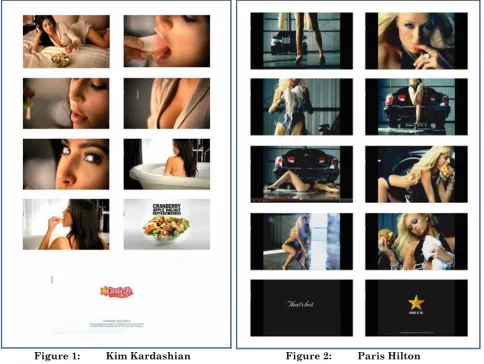
Socialite Kim Kardashian is featured in a 32-second commercial (Figure 1), eating a Cranberry Apple Walnut Chicken Salad seductively while informing viewers of her no-mess creed, “I‟m such a neat freak. Everything‟s gotta be clean, crisp and tasty.” The statement is ironic as she lies on a white bed eating a salad which is dripping with dressing. Uninhibited twirling and whirling moves accompany her guiltless act, as the salad disappears piece by piece.
The camera zooms in on the salad dressing, oozing and dripping down her mouth past her subtly exposed breast region. Aiming for the likeability factor, Kardashian eyes the camera, an unspoken “oops” (to symbolise acknowledgement of the mess), leads to the bathroom scene. She soaks herself in a bathtub, continues eating the salad and 32 seconds of seduction ends. Another Carl‟s Jr. commercial presents American model and heiress Paris Hilton washing a car in a bathing suit (Figure 2). She squeezes the sponge on herself instead of the car, getting deliberately bubble-drenched. Her moves speak seduction until the end, when she grabs and takes a bite out of a Spicy BBQ Burger, leaving the audience lost in translation about the connection between the carwash and the burger. Attention caught, viewers may not realise the main message of the advertiser, or that the commercial is also an insidious form of automobile co-branding (for Bentley).
brand, as their acts are objectified in glamorous environments that allow them to „play naughtily‟. For the targeted segments, sexual stereotyping in commercial forms may serve to reinforce the pleasurable excitement behind mundane eating; they are persuaded to feel unashamed to indulge in the meal (or their own escapist narratives).
The product‟s unique selling proposition (USP) has always positioned itself in chunky
servings, yet the use of slim-figured models in Carl‟s Jr. advertisements shows the selective yet impactful use of suggestive icons, words, gestures and other elements. Hilton, as the restaurant‟s head of marketing describes, is described as a “great-looking actress”, whose social fame and notoriety is a ploy to promote the brand‟s spicy burger [17].
Figure 1: Kim Kardashian Figure 2: Paris Hilton
Discussion
Fast food, cheap and unhealthy, is an
illustration of audience‟s search to
understand their innate psychological and moral dilemmas. Models and celebrities fit perfectly into communicator mode. For the advertiser, having pretty “objects” speak on behalf of their products is a strategic counteraction for unwholesomeness.
Celebrities represent a superficial freedom among American advertisers to inform audiences about „desirable‟ goods using
Too Fast, Too Sexy
Arguably, for the demographic of 18 to 34 year old males, despite a lack of genuine warmth projected in the commercials, heightened brand recall and salience is still possible. Some consumers are steered to assume the characterisation or role presented by the model; for others, the latter‟s sensuality may be able to stimulate or increase their egos [10], giving a shallow 30-second reassurance of self-worth. Carls‟ Jr. advertisements suggest that female hyper-ritualised acts of seduction are still powerful forms of persuasion for today‟s clamorous, media-savvy audiences, because
the commercials have become transferable,
allowing viewers to re-enact the models‟ roles, image and behaviours (actual); or to use the setting for their own fantasies (ideal), as proposed [11].
Clichés and stereotypes provide vital visual clues to consumers‟ ego dimensions: actors are socially desirable; the settings of advertisements are often hidden realities of yearned-for experiences of those seeking security, popularity, sexual gratification or pleasure [10].
Permutations of possible allures create a hypothetical „likeability‟ link between the targeted audience and the advertiser and sex advertising in food familiarises them
with metaphorical persuasion as a
resolution, the answer for the individual‟s psychological guilt, low esteem and insecurity issues [9]. Mature consumers would realise the commercials‟ obvious manipulation, but the measure of false expectations could lead to a dissonant attitude or image of the brand [9]. Negative
or confused evaluation of sexual appeals may frustrate immature target segments; while the male consumer‟s preconditioning to experience fantasy fulfilment may result in disappointment in their real mission [18] if they cannot achieve the promised rewards of consumption.
Conclusion
Food advertisements are able to stimulate brand recall through the use of actors to suggest and enhance the vital aspects of consumption, an influence derived from an inward psychological illusion of control. From general perceptions of fast food as unwholesome dietary inclusions, it is unsurprising that most fast food advertising avoid representation from overweight or anorexic models. The application of sex as visual provocateur in food advertising was studied to reflect on the challenges of producing advertisements in this repertoire.
It is true, the need to be contextually appropriate for specific audiences, along with advertiser‟s concern for self-regulation and commitment towards ethical marketing, are all factors that drive every advertiser‟s strive to maintain tasteful presentation of normative social behaviour. In the advertising industry, sex has proven its appeal as a mainstream gender discourse with staying power:
“There is always going to be sex in advertising for the simple reason that it’s just one of our basic strong emotions. And advertisers are always looking for basic emotions to attach to
products in order to sell them.” [18]
References
1. Parkin KJ (2006) Health, Beauty, and Sexuality: A Woman‟s Responsibility. Food is Love: Food Advertising and Gender Roles in Modern America (pp.159-192). Philadelphia, Penn: University of Pennsylvania Press; p.186.
2. Beckerman M (2015) Women Selling Food: A Delicious, Kinda Disturbing History. Esquire. [updated 23 September 2010; cited 04 October 2015]. Available from
http://www.esquire.com/blogs/food-for-men/sexy-food-advertisments-092310
3. Reichert T, Heckler SE, Jackson S (2001) Effects of sexual social marketing appeals on cognitive processing and persuasion. Journal of Advertising, 30(1); 13-27.
5. Lawton E (2009) Gender Advertisements: Replication of a Classic Work Examining
Women, Magazines, and Facebook
Photographs. Senior Capstone Project.
6. Mac Rury I (2008) Advertising. London: Routledge; p.167-170.
7. Goffman E (1979) Gender Advertisements. New York: Harper & Row; p.37-39.
8. Marchand R (1985) Advertising the American dream: Making way for modernity 1920–1940. Berkeley: University of California Press.
9. Brierly S (2005) The Advertising Handbook. London: Routledge.
10. Packard V (1957) The Hidden Persuaders. New York, N.Y.: Simon & Schuster, Inc.
11. Reichert T, Ramirez A (2000) Defining Sexually Oriented Appeals in Advertising: A Grounded Theory Investigation. Advances in Consumer Research, 27:267-273.
12. Thompson D (2015) What‟s Up with these Dumb, Pornographic Fast Food Ads? The Atlantic. [updated 25 June 2009; cited 06 September 2015]. Available from http://www.theatlantic.com/business/archive/
2009/06/whats-up-with-these-dumb-pornographic-fast-food-ads/20151/
13. Neil D Seduced by a Burger: Carl‟s Jr. Advertising Finds its Groove. Los Angeles Times. [updated 04 April 2009; cited 15
August 2015]. Available from
http://articles.latimes.com/2009/apr/14/busine ss/fi-ct-neil14
14. Washington Times (2004) Teens
„overexposed‟ to media sex. [updated 19 February 2004; cited 08 December 2015].
Available from
http://www.washingtontimes.com/news/2004/ feb/19/20040219-110954-2892r/?page=all
15. Norris P, Inglehart R (2012) Do Cosmopolitan Communications Threaten Traditional Moral Values? In H.A. Semetko and M. Scammell (eds.), Sage Handbook of Political Communication. London: Sage Publications Ltd.; 2012.
16. Fahim J. Sex, Chocolate Propaganda Research. Sociological Images. [updated 02 December 2010; cited 13 November 2015].
Available from
http://thesocietypages.org/socimages/2010/12/ 02/guest-post-sex-desire-and-chocolate-propaganda-research/
17. James M (2005) Critics Are Saying „That‟s Too Hot‟ for Sexy Carl‟s Jr. Ad. The Times. [updated 24 May 2005; cited 17 November
2015]. Available from
http://www.frankwbaker.com/sexy_carls_ads. htm