ISSN: 2278-3369
International Journal of Advances in Management and Economics
Available online at:
www.managementjournal.info
RESEARCH ARTICLE
The Usage of Twitter in Small Businesses for Countries with a Low
Twitter User Base
Munif Mohammed Ali Al-Zoubi
University of Sopron, Hungary.
*Corresponding Author Email: [email protected]
Abstract:Purpose: This research aims to find the differences in the use of Twitter between small and large businesses, and how small businesses (SMEs) can follow and learn from their larger counterparts or refuse to use this platform due to the small number of Twitter users in that country. Design/methodology/approach: The research will use data obtained through multiple interviews with businesses in Amman Jordan, and uses secondary data gathered through a questionnaire regarding the usage of Twitter in the day to day life, Jordan is used as an example of a country with a low Twitter base.
Keywords: Social Media, Twitter, e-WOM, Online Marketing Strategy, SMEs’.
Article Received: 01 June 2020 Revised: 10 June 2020 Accepted: 26 June 2020
Introduction
Social media has been rapidly growing since the beginning of the twenty first century, the growth has been substantial in the past ten years, the growth in social media was indicated by a survey that was conducted in 2010, which shows that 94% of marketing managers and executives believe that there will be a large increase in the usage of social media in the next decade [1]. As predicted, the growth in the next three years was considerably high; the number of users grew from .97 Billion in 2010 to 1.59 Billion users according to Statistica.com an online social
media statistics website [2].
There are currently many social media platforms that support different forms of social media content. For example, Face book is a social networking site where users of that site can share comments, pictures, links and even news with their friends and followers. There are many other forms of social media content, one of the newest forms of social media is micro-blogging; the term “blogging” comes from keeping an online journal or information site and these blogs appear reverse chronologically, allowing the latest posts to appear first and was extremely popular in the late ninety’s and early two thousands and was followed by “vlogging” which is video blogging [3]. Micro-blogging on the other hand, is a mixture between blogging
and instant messaging; where users share small messages instantly with their followers online. Currently the biggest micro-blogging site is Twitter, Twitter has over 326 million active users, and over 500 million Tweets are sent each day and is extremely popular due to
its accessibility through the phone
application; many of the Twitter users are checking their accounts via their cellphones, which is an extreme convenience in itself according to the website.
Jack Dorsey, Noah Glass and Biz Stone, for people to keep tabs on one another. Noah Glass named the website Twitter; which is Twitter without the vowels, believing this will give their domain an edge over others, but was renamed later to Twitter.
According to Twitter for businesses, Twitter provides businesses with four different ways in which to get leverage in the online market:
Twitter allows businesses to find out what are
the current issues in the industry or market they are currently in. Twitter allows users to
join in into relevant. Conversations
happening regarding a topic related to your business.
Twitter allows a business to expand their
brand, being more active on the account and communicating with your followers could attract more followers, and impact the brand positively, Twitter even provides further help by using their Twitter Ads, where Twitter markets your product to people who might be interested.
Many major companies provide customer
service using Twitter it is another method where companies can deal with customers’ grievances and solve their problems online.
Twitter allows businesses to connect with
other businesses, influencers, and entire communities online. This allows the business to connect to potential customers or building valuable connections with other business owners or leaders [4.]
In fact, what made twitter a great platform is that they listen to the users grievances, giving them a chance to help further develop the site. For example, the “@” symbol was added for users to be able to acknowledge other users or direct their next tweet towards them. The “@” symbol was also adopted by the rest of the social media platforms afterwards. Furthermore, in 2017 Twitter increased the number of characters allowed to 280, allowing users to focus on the content of the message rather than the length. These changes show how much the company listened to their followers, the website tried its best to cope with the users desires and that is why it is currently one of the leading social networking sites in many countries. When following large organizations on Twitter such as Pepsi, it can be seen that a lot of time and money are put into these accounts; from the monitoring of customer’s Tweets and answering them to
posting daily updates on their Twitter page, According to [5] Pepsi’s Gatorade has been growing explosively on Twitter when it comes to platform presence, however this is does not come without extra costs, Pepsi’s Gatorade has over five employees working on their Twitter Page alone.
Although, Gatorade’s online presence is growing rapidly, there is still an uncertainty in the effectiveness of their campaign, as their number one competitor; Coca Cola’s PowerAde, has a bigger market share, and is doing better than Gatorade, although they have a much lower social media presence [5].
As previously mentioned, larger
organizations such as Pepsi and Coca Cola have extremely active social media pages, and have a large number of followers that read their Tweets and retweet them, and as previously mentioned these companies hire a large number of employees to monitor their online activities.
However, this is not luxury affordable by small businesses, thus making it not a strategy that these small businesses can mimic. The following study will try and understand how small businesses can make use of Twitter without overexerting their resources, and if it is worth maintaining a Twitter page in a country with very low Twitter users.
Research Aim
This research aims to find a better understanding of how small businesses can market their product by observing and researching larger more successful businesses. Furthermore, finding the most efficient way a business can take advantage of Twitter in enhancing their brands image.
Research Objectives
The Main Points that Need to be Covered by this Research are
Understanding how small businesses can
benefit from using Twitter for marketing.
Recognizing differences between the use of
Twitter in large businesses and in small ones.
Identifying the problems small businesses
Understanding why some businesses would rather not use Twitter?
Material
The Internet and Its Early Uses for Businesses
The Internet’s growth over the past two decades has been exponential, people use the internet in their day to day life in every aspect, from work to filling their free time, whether it is watching videos on YouTube or checking your social media feed, the world is
currently online. However, this phenomena
was not in any way planned or foretold, conversely the internet was supposed to be a static system designed to send and receive data; small amounts of bytes through one
terminal and out through another.
Furthermore, the data sent was primary designed to be small and to not be read by users, with the exception of the expert coders sending and receiving them [6].
However, in the past twenty years the internet has branched into something much larger than anyone expected, some people’s day to day activities can be governed by the availability of the internet, from ordering food, watching movies, playing video games and even doing their weekly shopping, all that and more can be done online now via the internet [7]. The internet has not only changed the life of adults, but has also changed the life of children as well, a study conducted by [8] targeting children from the
age of 9 till the age of 19, and the study shows that even with the current growth of means of communication such as SMS services and cell phone carriers, children still prefer to communicate via the internet. Livingstone and Bober’s study shows that 72% of the children communicate with each other online, whether its through email, instant messaging or through a social media platforms.
This might be due to social media and other internet based communications, the only requirement is having a connection to the internet whether through Wi Fi or data from the cell phone carrier, making it basically free, on the other hand using the offline communication mediums still costs money. Communication is only one part of our lives
that the internet has changed, many other
sectors have drastically changed because of
the internet, such as education,
entertainment, and even medicine.
According to Fallows [9] many internet users
in the United states use the internet for health consultation; in the year 2000 which was still the beginning of the internet craze over 54% of adults used the internet for self diagnosis and 38% of the adults used the internet for information about exercise and fitness, and the previous number have only
grown since the study. As seen in Figure (1)
according to Hoot suite a social media management service providing website, there is a 57% penetration of internet users worldwide:
Privacy and security, personal relationships and even political activism. This can be credited to the shear amount of information and learning opportunities provided by the internet. Almost 60% of the people in the world today have an established internet connection; this went up from 1% in 1995, there are ten times the number of internet users in the year 2013 than there was in the year 1999, and as shown in Figure (1) the number of users is increasing rapidly [10]. With the redefinition of many of our day to day tasks due to the internet, businesses began to take note, including the internet in their corporate strategies and incorporating internet users into their targeted segments, with all these potential gains, businesses began using the internet in many different ways.
Firstly businesses began communicating within the organization and with other businesses using email, and with the new “Go Green” initiatives using email not only saves time and effort, it reduces the use of paper unless a hard copy is needed; the internet has in many countries made Fax machines obsolete, the communication using the internet can also be used for customer service purposes; it covers B2B, B2C and internally [11].
Secondly, information for businesses means power; whether it is information about the marker, competitors, or even information within the organization itself, and in an age where most information about most companies is provided online, it is a shame for any organization not to make use of this potential information stream. Websites such as dnb.com provide information about over 120 million companies located in the United States, allowing businesses to uncover targeted leads and new sales opportunities.
The website easily performs public and private company research. Companies can be targeted based on size, location, industry, competitors and more. This could provide small businesses with a reference to their growth by monitoring larger ones, and could provide larger businesses the chance to monitor any growing companies that could be potential threats [12].
Thirdly, with the current inflation in prices for venues and storage unit, many businesses are not moving towards e-marketing,
According to Hansia A [13], there are five types of online presence:
Transnational e-commerce sites:
Manufacturers or retailers provide their products for sale online, such sites as Amazon which are considered a titanic organization when it comes to online presence.
Service oriented relationship building
websites: These websites provide interested consumers with the information needed for an offline purchase, such as the address, working hours, typically asked questions, and could even provide an online newsletter where you can sign up for, to receive any updates on the companies’ products.
Brand-Building sites: Such websites are
usually catering to the mid to low value, large volume, fasting moving products. These websites don’t sell the actual product, but provide merchandise and information about the product, these websites are used to support the main brand, for example WWE.com is a website that provides WWE themed T-shirts, glasses and even cereal boxes, however you cannot buy tickets to their shows on their main site.
Portal sites or media sites: the following
sites provide a bridge to news and information about several topics, such websites have news, entertainment, and search engines, Yahoo.com is one of these sites.
Social Networking or Community sites: The
following sites are what this study will be focusing on mostly, social networking sites such as Facebook, Twitter, Instagram, and
YouTube. These websites have
revolutionized online and word to mouth marketing.
Social Media
Social media sites are sites that allow
communication between consumers
interested in a certain product or idea; these interaction are considered Consumer to Consumer (C2C) interactions, and can come in many forms, such as likes, follows, up-votes, sending messages, tagging a person in a picture or a status, or even rating a product or service. Social media sites allow businesses to interact with their consumers and vice-verse, making business to consumer (B2C) and consumer to business (C2B)
Social media has been rapidly growing since the beginning of the twenty first century, the growth is substantial in the past ten years, the growth in social media was indicated by a survey that was conducted in 2010, which shows that 94% of marketing managers and executives believe that there will be a large increase in the usage of social media in the next few years [14].
Social media is incorporated in the marketing strategy of most large organizations and business leading companies. In the mid twentieth century globalization began to flourish, with the establishment of GATT and the WTO, the decrease in tariffs and ease of export and import. An incredible increase in production, research and development, a decrease in transportation lag, reduction in the time taken for communication, and even information transfer between countries, all these factors helped shape a movement for economists around the world, connecting them together allowing them to mirror and follow in each other’s strategies [15].
Moreover, with globalization flourishing, the information movement between countries online became more of a factor when it comes to online strategy. Furthermore, increasing the effectiveness of word of mouth marketing (WOM), online research in these field have broken down into two types, first being the WOM marketing research and the second
being customer brand relationships [16]. In a
study done in 2004, Henning-Thurau et al [17] created a framework to determine the factors
that motivate people to engage in WOM communication, he broke it down into five different factors. Firstly, is the consumer’s focus related utility, which is focused on the consumer’s need to contribute to the community as a whole. Secondly, the approval utility factors, which is when others benefit from the consumer’s experience. Thirdly, is the opposite of approval utility, and is called consumption utility, and is the consumer’s benefiting from the experience of others.
Fourthly, this factor is called moderator related utility, and is achieved when there is a moderating party that intermediates between the consumer and the company; usually this happens when there is a
complaint about a product. Finally,
homostate utility, and it is when the consumer gives their positive or negative feedback and is based on balance theory [17].
In brand imaging a study by Sasmita J. et.al
[18] has shown that brand awareness majorly affects brand equity in the younger generations of customers. These younger consumers mostly get the information about a brand or product either through word of mouth online, or user reviews on social media. Younger consumers use social media to compare the brands and products with their respective competitors; whether its price comparison, quality, or any other specific characteristic in any product. Thus, social media has become an important factor in a brand’s image strategy.
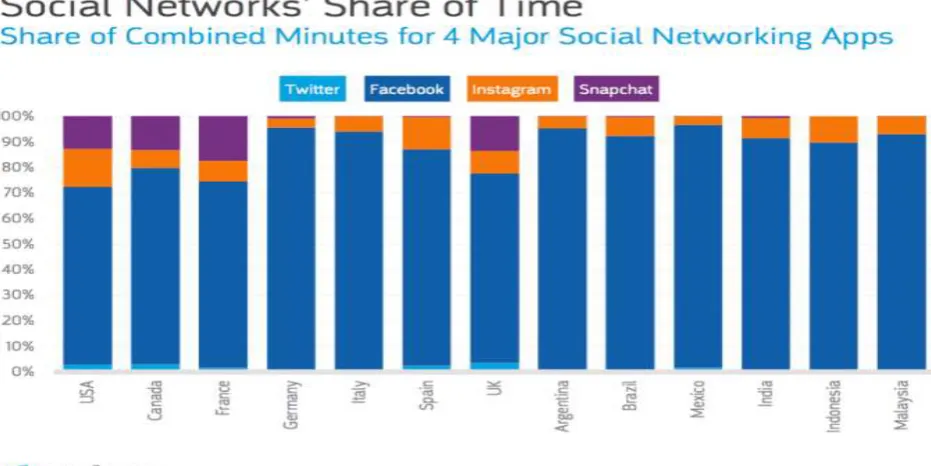
As the data illustrates, the highest number of users on any social networking site, is by far
Facebook, it currently has 2320 million
users around the world. This could be considered a reason behind using Facebook as a good word of mouth (WOM) tool, the larger the network the easier it is to spread the online WOM. According to current numbers the largest of all social networking sites by sheer numbers alone is Facebook, the website is a social media behemoth. Although, Facebook started as more of a socializing websites, the business opportunities that were available were countless in regards to marketing or recruitment. Facebook allowed businesses to build a public or private online profile and to create a list of users with whom relations can be developed, which permits businesses to inform their cliental about any updates or new products online and in real time [19].
However in the current study on social networking sites the focus will be on another type of social media, which is micro-blogging and specifically Twitter, and how it currently can be used by small businesses for marketing and other purposes, and why many of the consumers and small businesses in Jordan are not jumping on the Twitter Band wagon.
In a study done in 2009, research showed that when it comes to micro-blogging, more than 19% of these micro-blogs with mentions contain a name of a brand, and of these micro-blogs, almost 20% had a brand sentiment; could be a negative or a positive sentiment, over 50% of these micro-blogs were positive and sentiments, and 33% were
extreme sentiments relating to the
organization or the product the organization is marketing, this study tried to show that even with an automated coding method of analyzing micro-blogs it is still easy to analyze a Tweets sentiments, thus allowing micro-blogging to be an amazing online WOM tool. As such, the study believes that using Twitter by organizations means that a business is taking advantage of a great online
tool for customer word of mouth
communications; whether it is a good or bad sentiment and most corporations should discuss using these platforms as a part of their overall marketing strategy [20].
Methodology
The following chapter will attempt to demonstrate the reasoning behind choosing the methodology used in this study, the chapter will discuss and describe the tools used and reasoning behind using these tools, and will discuss the philosophy behind the methodology.
Philosophical Approach
When it comes to choosing a methodology, economists have almost always been split into following two different paradigms; some would call it the paradigm wars. The arguments for which paradigm to follow have been told for a century, the arguments were labeled under the “Positivists” arguments or under the “Interpretivists”; both arguments having valid reasoning, each with their own unique way of effectively gaining knowledge, the following figure shows the research onion and where some of the research methods are located on that onion [21].
Figure.3
The Paradigms
The paradigms discussed earlier both have their own ontological and epistemological perception, giving these paradigms their own awareness on how one perceives reality and the source of knowledge. Equally important, these paradigms in addition to their views have an extreme outlook on which data gathering methodology is best for a study [22]. The two paradigms that will be showcased in this study categorized under the names
“post-positivists” and “interpretivists”.
Post-positivism is a theory cultivated in the west and it focuses on studying society and believe that knowledge comes from sensing and experiencing, and the belief that a quantitative method is the most accurate method of data collection. The next paradigm to be considered is Interpretivism, which from what the name implies, most things are open to the researcher’s interpretation; all the parts of the study should be interpreted by the user, in many interpretivist’s studies the focus of the study is showcasing a new perception of the data, explored different sides of a social issue for example.
The data gathering method usually used by interpretivists is a qualitative data method; meaning data is usually delivered using interviews rather than questionnaires. Moreover, in qualitative research the data used is usually apporach with an inductive approach; most Interpret visits approach
their study with no pre-determined
hypothesis allowing them to objectively find a contrasting way of analyzing the data (Rauschnabel P., Praxmarer S., Ivens B [23].
However, in some cases; this study being one, some researchers where in need of a paradigm that is not so purist. Thus, some researchers decided to follow pragmatism; which is dealing with any situation and solving the current issue, making the main focus the research objective and gathering data accordingly, advocating the use of mixed method of data gathering; as this could be the best method to fulfil the research objectives (Rauschnabel P., Praxmarer S., Ivens B [23].
Data Collection and Analysis
The study will be taking some of its secondary data from the Arab Social Media Report 2017, it’s a yearly report given Mohammad Bin
Rashid School of Government [24]; the data
collected will be in the form of statistics
created from data gather by a quantitative survey using data from 7000 users of social media spread equally across 18 Arab countries carried out over the telephone; the Arab countries in the survey were GCC countries and Yemen, The Levant and Iraq, and North Africa., the data gives information about the number of users on each social media platform in Jordan, and the times these users are online during the day.
This data will help identify some of the questions for the interviews in later stages [24]. The secondary data used will help the research cut down on time and effort needed by providing the governmental data issued every year to be used for this research’s purposes [25]. As mentioned previously, the study will follow a mixed method, the qualitative data will be in a form of interviews with the social media department in ARAMEX an international courier company based in Jordan, and the counterpart for small businesses will be EDU Valley a small company that assists students in finding universities to study abroad the study will compare the use of social media in both companies and provide some insight for Edu Valley on what are the correct ways of utilizing Twitter in Jordan.
Discussion and Findings
In this chapter we will discuss the interviews done with both companies, and hope to find a way for small businesses to benefit from Twitter despite Jordan being one of the countries that has a low Twitter user base.
SME Interview
Firstly, after the first interview with Edu Valley, the information gathered showed lack of customer participation on Twitter, it was hard for the small business to gather traffic on Twitter; be it an increase in the amount of followers or number of re-Tweets. Secondly, and in regards to the resources allocated by company towards social media, the company has one person in charge of all the social media platforms; which is the case in most small businesses; however they use a social media services company that helps them during major events and university fairs.
which they link videos through on other platforms, the person interviewed was Miss Shari Qatamin, the person in charge of social
media in the company.
Miss Qatamin believes that Twitter could be a great marketing tool when they build up a following; however she also believes it’s hard to build one up in Jordan due to the low number of people using the platform.
According to Miss Qatamin, she usually posts on Twitter to her followers first thing in the morning, since it has the least amount of Traffic she starts with it first out of any other platform, she “gets it out-of-the-way” first every morning. Although, she does not believe that its one of the best platforms to use for a company in Jordan, she uses it due to many studies en encouraging the use of the platform, and believing that it is one of the best platforms to build your brand as a company, if used correctly.
Large Company Interview
As mentioned previously, Aramex is an international courier company with offices in 96 countries all over the world, and has 200,000 Twitter followers on their main account and thousands more on specific country accounts (For example: you can follow their South African branch on @Aramex SA.), after speaking to Khaled Jaber, a customer service analyst at the company, he informed us that there are 62 employees currently working in the social media department, and the information showed that Aramex as a company uses Twitter as one of their main platforms; the company mainly uses Twitter, Facebook, Instagram and LinkedIn).
According to Mr. Jaber Twitter is an extremely important social media platform for the company, mainly used not only for marketing and public relations, but for customer service as well; people can contact them directly through direct messages or ask about packages on their Twitter page. Furthermore, the company values twitter so highly, that it has allocated a team to of 12 employees to observe and reply to any Tweets and messages coming their way, covering the page 24 hours a day, 7 days a week.
According to Khaled Jaber the company uses a social media management tool to keep track of how many messages, comments and Tweets they receive on daily basis and their metrics are sentiment analysis and response
time, and by using that they can track the average response time of the company, and sentiments of the users and how much is the customer satisfaction with their services. When asked about if they would recommend small businesses to use Twitter as a platform, Mr. Jaber tentative to recommend its use, he believes Twitter users in countries such as Jordan are too little and will not harbor so much traffic. However, if the services or products of an SME is offered to neighboring countries such as Saudi Arabia; where most of Aramex’s Twitter traffic comes from (being the fifth largest Twitter base worldwide) [2], then he believes that yes it is a must to add Twitter to their social media marketing strategy.
Conclusion
Jordan is one of many countries that Twitter as a social media platform never had the user base it had in countries such as the United States, Japan and Russia. According to [2] 89% of Jordanians have a Facebook account, while only .88% have Twitter accounts, this phenomena made the researcher question small companies in Jordan should use Twitter in their social media strategy, and if yes, should when and why they should use it.
The data collected from the interviews, and the advise given by Khaled Jaber; a Senior Social Media Analyst at Aramex, shows that Twitter could be a great marketing tool if the SME’s offer their goods and services to neighboring countries with a high Twitter user base; in the case of Jordan it was Saudi Arabia. Furthermore, from the data gathered from the Arab Social Media Report [17] it shows that activity for users in Jordan is usually around 17:00, which means the time frame used by Edu Valley; the SME Interviewed, which was early in the morning, would never reach the users they have.
Limitations
Interviewees also noticed the researcher’s inexperience when it came to the technical aspect of Twitter; the third party software
used to measure the metrics, which could have provided more findings through the information given in the interviews.
References
1. Busby E, Field D, Forth P, Harsaae J, Rose J,
H Salha (2010) “The CMO’s Imperative. Tackling New Digital Realities,” Boston: The Boston Consulting Group.
2. Statista (2019) Twitter: monthly active users
2010-2016 - Statista. [online] Available at :http://www.statista.com/statistics/282087 /number-of-monthly-active-Twitter-users/
3. Kietzmann J, Hermkens K, McCarthy I,
Silvestre B (2011) Social media? Get serious! Understanding the functional building blocks of social media. Business Horizons, 54(3): 241-251.
4. Twitter.com (2019) Twitter. [online]
Available at: <https://twitter.com/>
[Accessed 20 December 2019].
5. Burton S, Soboleva A (2011) Interactive or
reactive? Marketing with Twitter. Journal of Consumer Marketing, 28(7):491-499.
6. Kaye B (2001) Just A Click Away. Boston,
MA: Allyn and Bacon.
7. Dentzel Z (2014) How the Internet Has
Changed Everyday Life - Open Mind. [online]
Open Mind. Available at:
https://www.bbvaopenmind.com/en/article/in
ternet-changed-everyday- life/?full
screen=tru
8. Livingstone S, Bober M (2004) Taking up
Online Opportunities? Children's Uses of the Internet for Education, Communication and Participation. E-Learning and Digital Media, 1(3):395-419.
9. Fallows D (2006) Pew/Internet: Pew Internet
& American Life Project. Choice Reviews Online, 44(01):44-0384-44-0384.
10.Inc H (2020) Social Media Marketing &
Management Dashboard - Hootsuite.
[online] Hootsuite. Available at:
<https://hootsuite.com/> [Accessed 22
September 2019].
11.Bulearca M, Bulearca S (2020) Twitter: a
Viable Marketing Tool for SMEs?. Global Business and Management Research: An International Journal, 2(4).
12.dnb I (2019) Dun And Bradsteet. [Online]
dnb.com. Available at:
<https://www.dnb.com/> [Accessed 17
December 2019].
13.Hansia A (2008) Introduction to
E-Marketing. Academia, 15-34.
14.Busby E, Field D, Forth P, Harsaae J, Rose
J, H Salha (2010) “The CMO’s Imperative. Tackling New Digital Realities,” Boston: The Boston Consulting Group.
15.Incekara A, Savrul M, Sener S (2014) The
Potential of E-commerce for SMEs in a
Globalizing Business
Environment. Procedia - Social and
Behavioral Sciences, 150:35-45.
16.Park C, Lee T (2009) Information direction,
website reputation and e WOM effect: A moderating role of product type. Journal of Business Research, 62(1):61-67.
17.Hennig-Thurau T, Gwinner K, Walsh G,
Gremler D (2004) Electronic word-of-mouth via consumer-opinion platforms: What
motivates consumers to articulate
themselves on the Internet? Journal of Interactive Marketing, 18(1):38-52.
18.Jumiati Sasmita Norazah Mohd Suki (2015)
"Young consumers’ insights on brand equity", International Journal of Retail & Distribution Management, 43 (3):276 - 292
19.Carrillat F, d’Astous A, Morissette Grégoire
E (2014) Leveraging social media to enhance recruitment effectiveness. Internet Research, 24(4):474-495.
20.Zhang M, Jansen B, Chowdhury A (2011)
Business engagement on Twitter: a path analysis. Electronic Markets, 21(3):161-175.
21.Saunders M, Lewis P, Thornhill A
(2003) Research Methods For Business Students. 5th ed. Pearson Education, 13-29:106-121.
22.Scotland J (2012) Exploring the
Philosophical Underpinnings of Research: Relating Ontology and Epistemology to the Methodology and Methods of the Scientific,
Interpretive, and Critical Research
Paradigms. English Language Teaching, 5(9).
23.Rauschnabel P, Praxmarer S, Ivens B (2012)
Social Media Marketing: How Design Features Influence Interactions with Brand
Postings on Facebook. Advances in
24.Salem F (2017) the Arab Social Media Report 2017: Social Media and the Internet
of Things: Towards Data-Driven
Policymaking in the Arab World (7). Dubai: MBR School of Government.
25.Hox J, Boeije H (2005) Data Collection,
Primary vs. Secondary. [Online]
joophox.net.
Appendix
1. Can you tell me a bit about your organization? (Organization size, profile, number of
employees in the marketing department, day to day activity, etc...)
2. What is your current job title and description?
3. Is Twitter a part of the marketing strategy? And how long have you been using it?
4. Which social media networks does your company use?
5. What made you incorporate Twitter into your strategy? (Example: personal initiative,
recommended by others)
6. What is your opinion on using Twitter as a marketing tool? ||| is it useful, has potential,
useless?)
7. How are you currently using Twitter in your organization? And for what purpose? (Expecting:
word of mouth, informing customers about new products/ services, customer service, interacting with customers, PR tool, managing the brand).
8. What do you believe can make Twitter effective as a marketing tool?
9. How many resources do you put into your Twitter marketing strategy?
10. How do you measure your effectiveness of using Twitter? How did you find out about these
measurement tools?
11. What is the timeframe given to Twitter as a platform? And where is this timeframe alocated in
the work hours?
12. What are the problems you are facing with using Twitter?
13. Do you believe other companies should be using Twitter in Jordan? And for those who are
using it do you have any advise?
14. What makes Twitter different than other social media platforms?
15. Did your use of Twitter as a marketing tool change your expectations of the platform?
16. Is there any reason not to use Twitter in Jordan?
![Figure 1: Shows number of users is increasing rapidly Digital Hootsuite.com [10]](https://thumb-us.123doks.com/thumbv2/123dok_us/7836355.2090183/3.595.55.551.520.777/figure-shows-number-users-increasing-rapidly-digital-hootsuite.webp)