ISSN: 2501 - 1235 ISSN-L: 2501 - 1235 Available on-line at: www.oapub.org/edu
doi: 10.5281/zenodo.3595435 Volume 5 │ Issue 12 │ 2019
PHYSIOLOGICAL RESPONSES OF ACUTE EXERCISE
ON TWO DIFFERENT GROUPS
Ayşegül Yapıcıi,
Engin Güneş Atabaş
Pamukkale University, Faculty of Sport Sciences,
Denizli, Turkey
Abstract:
The aim of this study to compare the physiological responses of acute exercise on wrestlers and kickboxers. 8 kickboxers and 12 wrestlers participated voluntarily from Pamukkale University. For each player, oxygen saturation (SpO2), heart rate, blood
lactate and respiratory function test values were measured before and immediately after the test. The difference between in-group test values was analyzed by t-test in dependent groups. Significant differences in test values between groups were analyzed by independent samples t-test. The significance level was taken as p<0.05. No statistically significant difference was found between the SpO2, FVC, FEV1 and MVV
test values of kickboxers and wrestlers in-group comparison (p>0.05). There was a statistically significant difference between heart rate, blood lactate and FEV1/FVC test values in kickboxers (p<0.05). There was a statistically significant difference between heart rate, SpO2, blood lactate and FEV1/FVC test values in wrestlers (p<0.05). There
was a statistically significant difference between MVV values pre and post the test and blood lactate values post the test between groups (p<0.05). There was no statistically significant difference in FVC, FEV1, FEV1/FVC, pre-test blood lactate, pre and posttest SpO2 and heart rate values (p>0.05). In conclusion, the findings of the study showed that
there was a significant difference between MVV values and blood lactate values when wrestling and kickboxing were anaerobic based sports. Physical training is considered as an acute response to the development of respiratory muscles and respiratory system as a reason of increasing oxygen exchange at the cell level.
Keywords: oxygen saturation, respiratory, anaerobic exercise
1. Introduction
the physiological, hormonal and psychological aspects of the individual (Slimani et al., 2017; Ouergui, 2015). Wrestling; it is important as a close combat sport that requires preparations to be started at an early age as it is a sport that requires the whole body to work together and also requires skill, endurance and strength (Kürkçü et al., 2005). In order to be successful in wrestling, determination of physical and physiological characteristics and monitoring the development of these characteristics is an important factor (Tamer, 1995). Wrestling is the struggle of two athletes to establish superiority in accordance with FILA rules by using their technical, skill, strength, endurance and intelligence, which takes place through the joint work of body parts without using a vehicle on certain sizes of mattresses (Kürkçü et al., 2009). Kickboxing is a combat sport consisting of 3 sets of 2 minutes and a rest period of 1 minute; and wrestling, which consists of 2 sets of 3 minutes and requires 30 seconds of rest and complex skills and tactical excellence. These branches are intertwined in both defense system and attack system, the implementation of games in a very short time, the short duration of the encounter, the close contact of the struggle, the athletes are very active because the anaerobic energy system is used predominantly, velocity, strength, speed, flexibility, balance, muscular and cardiovascular endurance, coordination is also defined as the sport that affects factors such as performance (Ouergui et al., 2015).
The physiological response to exercise is dependent on the intensity, duration and frequency of the exercise as well as the environmental conditions. During physical exercise, requirements for oxygen and substrate in skeletal muscle are increased. Chemical, mechanical and thermal stimuli affect alterations in metabolic, cardiovascular and ventilatory function in order to meet these increased demands. To obtain an understanding of the physiological capacities underlying combat sport performance, it would be useful to know the cardiovascular demand and the degree of recruitment of anaerobic metabolism during a match. Ventilation increases linearly with increases in work rate at submaximal exercise intensities. Oxygen consumption also increases linearly with increasing work rate at submaximal intensities.
The increase in pulmonary ventilation is attributable to a combination of increases in tidal volume and respiratory rate and closely matches the increase in oxygen uptake. The amount of oxygen carried depending on hemoglobin in the blood is named as SpO2 and this forms the main mechanism for the transportation of oxygen to the cells (SpO2 was used to indicate that a non-invasive measurement was realized using pulse oximeter in this study). Measurement of oxygen saturation gives information about hypoxia (Giuliano et al., 2005; Hakemi et al., 2005).
However, there are several methods used by coaches and strength and conditioning specialists to evaluate the internal and external combat loads undertaken
and to monitor athletes’ stress per se. To date, many studies have examined
2. Material and Methods
2.1 Participants
8 athletes of kickboxing team (Xage: 21.3 ± 1.9 years, Xheight: 174 ± 7.02 cm, Xweight: 68.3 ±
13.8 kg); 12 athletes from the wrestling team (Xage: 20.4 ± 1.6 years, Xheight: 175.1 ± 4.24 cm,
Xweight: 76.75 ± 10.1 kg) from Pamukkale University Faculty of Sport Sciences, a total of
20 athletes participated voluntarily. Participants had fifteen years of training and competitive experience. Athletes who had recently suffered from a serious injury were not included in this study. The players were informed of the experimental procedures and signed an informed consent form. The approval of experimental procedures was provided by Pamukkale University Ethics Committee and also written consent forms were obtained from all subjects, who were completely informed about the procedures.
2.2 Experimental Design
All the subjects who participated in the study were tested on different days but in the same time periods. The study was conducted a two days period, during which the players did not participate in any other training or matches. On the first day, For kickboxers, oxygen saturation, heart rate, blood lactate values and respiratory function test values were performed respectively before and immediately after the test. On the
second day, wrestling athletes’ performance were measured. All measurements were
taken during the preparation period at the beginning of the season. During this period an average of 8 training sessions were performed by the players every week. In addition, the players had 3-4 sessions of strength training every week that included mainly weight lifting of different forms. The athletes were informed about the exercise and test protocol, rules and requirements before the application. They were asked to eat at least 2 hours before the measurements on the test day, not to use stimulants like tea, coffee and medicine before the exercise, not to exercise 24 hours before the test and avoid challenging exercises on the test day.
2.3 Procedures
2.3.1 Anthropometric Measurements
The body height of the soccer players was measured using a stadiometer with an accuracy ± 1 cm (SECA, Germany), and an electronic scale (Tanita BC 418, Japon) with an accuracy of ± 0.1 kg was used to measure body mass.
2.3.2 Heart Rate (HR)
2.3.3 Oxygen Saturation
The Nellcor NPB-40 (California, USA) handheld pulse oximeter was used for measuring arterial oxygen saturation. OXI-P/I OxiBand was applied for children less than 40 kg and DURASENSOR DS-100A for children above 40 kg, respectively. We cleaned the
surface of the sensor and subject’s finger with 70% isopropyl alcohol. The sensor was
attached around the index finger. The arterial oxygen saturation was recorded before and immediately after the test.
2.3.4 Blood Lactate Values
3 minutes after the end of the training protocol, blood was taken with a Lactate Scout Plus analyzer from the earlobe while subjects were sitting.
2.3.5 Respiratory Parameters Values
Respiratory function characteristic was evaluated by vital capacity (VC), forced vital capacity (FVC), forced expiratory volume in one second (FEV1), the ratio of FEV1 to FVC (the Tiffeneau index), tidal volume (TV) and maximum voluntary ventilation (MVV). Respiratory analyses were measured with a BTL brand Spirometer by closing the nose with a clamp while the subject was sitting.
2.3.4Circuit Training Protocol
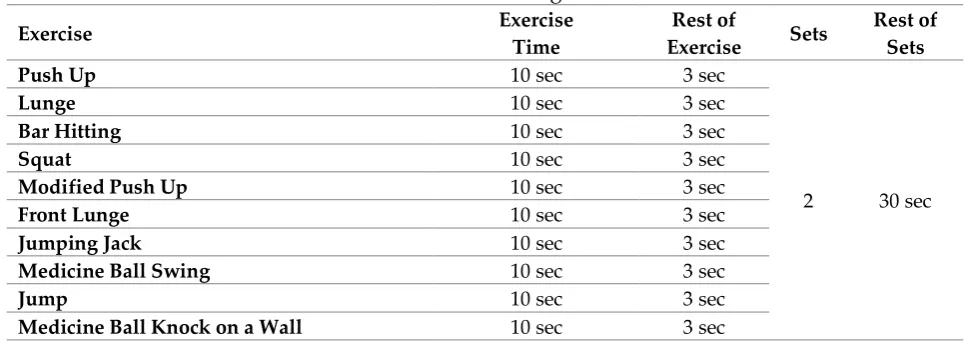
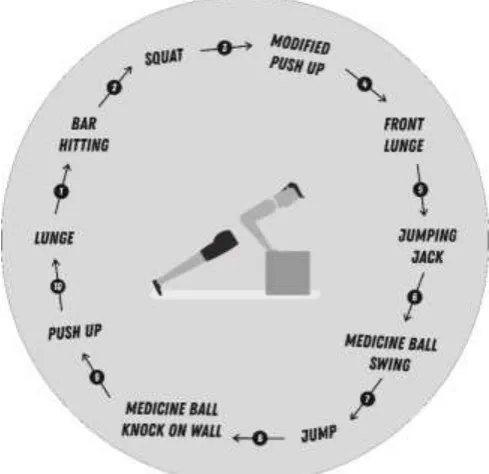
The subjects were given a circuit training consisting of 3 minutes, 2 sets, 30 seconds rest on different days. For the test and post-test evaluation, the warmup consisted of 10 minutes of articular mobility including circumduction movements, flexion and extension of the limbs, continuous, 10 minutes, passive flexibility of eight seconds for each muscular group. All protocol was shown and explained to the athletes before the training.
Table 1: Circuit Training Protocol
Exercise Exercise
Time
Rest of
Exercise Sets
Rest of Sets
Push Up 10 sec 3 sec
2 30 sec
Lunge 10 sec 3 sec
Bar Hitting 10 sec 3 sec
Squat 10 sec 3 sec
Modified Push Up 10 sec 3 sec
Front Lunge 10 sec 3 sec
Jumping Jack 10 sec 3 sec
Medicine Ball Swing 10 sec 3 sec
Jump 10 sec 3 sec
Figure 1: Circuit Training Protocol
2.4 Statistical Analysis
Descriptive analyzes of the test parameters were calculated as mean and standard deviation. Shapiro-Wilk test was used to determine whether the data showed normal distribution. The difference between in-group test values was analyzed by t-test in dependent groups. Significant differences in test values between groups were analyzed by independent samples t-test. The analyzes were performed with SPSS 22.0 package program and the significance level was taken as p <0.05.
3. Results
Table 2: Dependent groups T-test analysis of kickboxing athletes
M SS t p
Heart Rate (beat/min) (Pre) 88,6250 12,76085 -6,401 ,000*
Heart Rate (beat/min) (Post) 149,0000 24,57060
SpO2 (%) (Pre) 95,2500 3,24037
-,321 ,758
SpO2 (%) (Post) 95,7500 2,65922
Blood Lactate (mmol) (Pre) 2,5625 ,70496
-5,102 ,001*
Blood Lactate (mmol) (Post) 9,0750 3,75680
FVC (L) (Pre) 3,7313 1,18749
-,941 ,378
FVC (L) (Post) 3,8663 ,94120
FEV1 (L/sec) (Pre) 3,0988 1,04335
-1,654 ,142
FEV1 (L/sec) (Post) 3,3388 ,84067
FEV1/FVC (%) (Pre) 76,9875 16,71751
-2,922 ,022*
FEV1/FVC (%) (Post) 86,4088 10,55851
MVV (L/min) (Pre) 81,9875 16,05744
-1,078 ,317
MVV (L/min) (Post) 90,3113 20,87179
In Table 2, no statistically significant difference was found between the oxygen saturation, FVC, FEV1 and MVV test performances of kickboxing athletes (p>0.05). There was a statistically significant difference between heart rate, blood lactate and FEV1/FVC test values (p<0.05).
Table 3: Dependent groups T-test analysis of wrestling athletes
M SS t p
Heart Rate (beat/min) (Pre) 87,3333 18,19757
-9,156 ,000*
Heart Rate (beat/min) (Post) 153,1667 22,74296
SpO2 (%) (Pre) 97,2500 1,13818
4,526 ,001*
SpO2 (%) (Post) 94,2500 2,05050
Blood Lactate (mmol) (Pre) 2,7000 1,14097
-12,507 ,000*
Blood Lactate (mmol) (Post) 12,8500 1,99750
FVC (L) (Pre) 4,4433 ,59866
,697 ,500
FVC (L) (Post) 4,3117 ,55607
FEV1 (L/sec) (Pre) 2,9717 ,64929
-1,477 ,168
FEV1 (L/sec) (Post) 3,3842 ,86544
FEV1/FVC (%) (Pre) 67,3742 15,04966
-2,523 ,028*
FEV1/FVC (%) (Post) 78,6942 17,26682
MVV (L/min) (Pre) 114,4692 114,4692
-1,746 ,109
MVV (L/min) (Post) 125,1417 125,1417
p<0,05
In Table 3, no statistically significant difference was found between the FVC, FEV1 and MVV test performances of wrestling athletes (p>0.05). There was a statistically significant difference between heart rate, oxygen saturation, blood lactate values and FEV1/FVC test values (p<0.05).
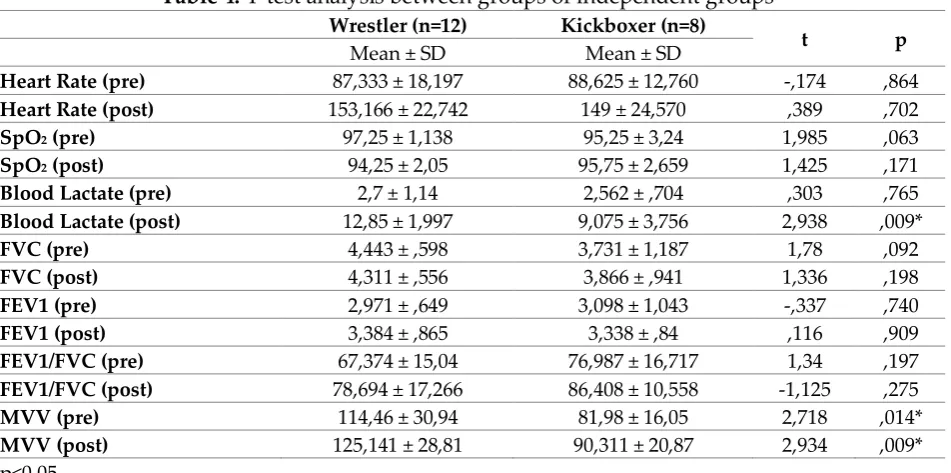
Table 4: T-test analysis between groups of independent groups
Wrestler (n=12) Kickboxer (n=8)
t p
Mean ± SD Mean ± SD
Heart Rate (pre) 87,333 ± 18,197 88,625 ± 12,760 -,174 ,864
Heart Rate (post) 153,166 ± 22,742 149 ± 24,570 ,389 ,702
SpO2 (pre) 97,25 ± 1,138 95,25 ± 3,24 1,985 ,063
SpO2 (post) 94,25 ± 2,05 95,75 ± 2,659 1,425 ,171
Blood Lactate (pre) 2,7 ± 1,14 2,562 ± ,704 ,303 ,765
Blood Lactate (post) 12,85 ± 1,997 9,075 ± 3,756 2,938 ,009*
FVC (pre) 4,443 ± ,598 3,731 ± 1,187 1,78 ,092
FVC (post) 4,311 ± ,556 3,866 ± ,941 1,336 ,198
FEV1 (pre) 2,971 ± ,649 3,098 ± 1,043 -,337 ,740
FEV1 (post) 3,384 ± ,865 3,338 ± ,84 ,116 ,909
FEV1/FVC (pre) 67,374 ± 15,04 76,987 ± 16,717 1,34 ,197
FEV1/FVC (post) 78,694 ± 17,266 86,408 ± 10,558 -1,125 ,275
MVV (pre) 114,46 ± 30,94 81,98 ± 16,05 2,718 ,014*
MVV (post) 125,141 ± 28,81 90,311 ± 20,87 2,934 ,009*
In Table 4, there was a statistically significant difference between MVV values pre and post the test and blood lactate values post the test (p<0.05). There was no statistically significant difference in FVC, FEV1, FEV1/FVC, pre-test blood lactate, pre and posttest oxygen saturation and heart rate values (p>0.05).
Chart 1: Wrestlers and Kickboxers pre-exercise and post-exercise heart rate values
Chart 3: Wrestlers and Kickboxers pre-exercise and post-exercise blood lactate values
Chart 4: Wrestlers and Kickboxers pre-exercise and post-exercise FVC, FEV1, FEV1/FVC, MVV values
4. Discussion
During exercise, ventilation might increase from resting values of around 5-6 liter min-1
to >100 litre min-1. The increase in pulmonary ventilation is attributable to a
combination of increases in tidal volume and respiratory rate and closely matches the increase in oxygen uptake and carbon dioxide output. There was a statistically significant difference between the pretest-posttest values of the Kickboxing group between FEV1/FVC test values. Also, we found similar results from between the pretest-posttest values of the Wrestling athletes’ between FEV1/FVC test values. There was a statistically significant difference between the pre-posttest values of the Kickboxing and Wrestling groups between MVV values.
oxygen uptake of the person increases remarkably with controlled exercises increasing regularly and growing. Not only the increased one is VO2 max, but also person's maximum respiratory minute volume and maximum heart minute volume show increase by affecting each other (Akgün, 1994). Every single step involved in transferring the inspired air oxygen to the final utilization target, the skeletal muscle mitochondria, is an important determinant for VO2max. Contribution of respiratory system is much more significant in keeping delivered oxygen content constant during the high intensity physical activities that exceeds the limit of cardiac output (Kurdak, 2012). Breathing capacity, however, does not reach its maximum even during strenuous exercise and it is not responsible for the limitation in oxygen delivery to muscles seen during high intensity activity.
In addition to wrestling, kickboxing, many striking combat including sports karate, taekwondo, judo, boxing use anaerobic metabolism extensively during competition. Depending on the intensity and duration of the effort, different energy systems will be predominantly taxed. An anaerobic activity is the form of energy that uses anaerobic metabolism during an exhaustive effort and lasts less than 90 seconds (Freischlag, 2014). The very short, high intensity activity lasting less than 1-2 s will mostly involve the adenosine triphosphate (ATP) depots in the muscles. The high intensity activities lasting up to 5-6 s depends on the high energy phosphagen, phosphocreatine depots in addition to the ATPs. The longer but still high intensity activities will depend more on the muscle fibers ability to produce ATP through the glycolytic pathway, the nonaerobic breakdown of carbohydrate. Wrestling and kickboxing are a high-intensity intermittent striking combat sport that requires complex skills and tactical excellence for success where athletes are classified by gender, weight, and age (Slimani et al., 2017). Kickboxing bouts consist of 3 rounds of 2 min with 1 min of recovery between rounds. Free style wrestling has changed from 2, 3-minute periods with 1 minute rest to a continuous he physiological demands of the continuous 5-minute format. All branches taxes both the aerobic and an-aerobic systems. The anaerobic system provides the short, quick, all-out bursts of maximal power during the
match while the aerobic system contributes to the athlete’s ability to sustain effort for
the duration of the match and to recover during the brief periods of restore reduced effort (Franchini et al., 2011; Ritschel, 2008; Slimani et al., 2017a).
body's oxygenation has become an interesting research subject by exercise physiologists and training scientists (Kurdak, 2012; Slimani et al., 2017b).
The main results of study were that oxygen saturation of participants decreased after exercise, whereas heart rate and blood lactate values increased after exercise. The fact that VO2 max, a determinant of aerobic capacity, is high allows athletes to conduct exercise longer in homeostatic conditions. During physical activity some digits (e.g. oxygen uptake into the lungs via alveolar ventilation) are known to determine how much atmospheric air oxygen used from alveolus moving to skeletal muscle mitochondria can be used (Taylor, 2008). Working of any of these digits at high capacity
by itself doesn’t mean that more oxygen would be used by skeletal muscle tissue but a
decrease in capacity of any of them will cause oxygen uptake decrease affecting all reactions (Kurdak, 2012).
There was a statistically significant difference between the posttest values of the wrestling and kickboxing groups between blood lactate values. There was a statistically significant difference between not only the pretest-posttest values of the wrestling group but also kickboxing groups between blood lactate values. As the lactate is a by-product of anaerobic glycolysis, higher increase in blood lactate concentration in wrestlers indicates that they utilize more anaerobic glycolysis reserves in respect to the aerobic and phosphocreatine reserves (Wilmore et al., 2008; Chien, 1997).
Slimani and Chéour (2016) found a statistically significant difference in the lactate values of athletes after a 14-movement interval training in their study on combat sports athletes. Similar training method was applied in our study and a significant difference was found in lactate values. Ourgui et al. (2015) found a statistically significant difference in their heart rate values as a result of the anaerobic training they applied to kick boxing athletes. In the present study, statistically significant differences were observed in wrestlers and kick boxers within the group, but no significant difference was found between the groups.
During the intense acute exercise, it can be observed that generally erythrocyte’s
structure parameters do not change while plasma viscosity and hematocrit values increase (Kohl et al., 1992; Tong et el., 1995). During and after the heavy exercise determine increasing total blood and plasma viscosity is impaired (Tong et el., 1995; Yang et al., 1995; Brun et al., 1994; Brun et al., 1998). During the heavy exercise, leukocyte activation may be observed. Its effect on erythrocyte mechanics features can be explained oxidant stress, leukocyte activation or increased lactate into the cell (Baskurt et al., 1997; Branemark and Bagge, 1977; Chien, 1997).
Steady state is defined as the highest blood lactate concentration for which the workload is sustainable over time without a continual blood lactate accumulation (Billat et al., 2003). High blood lactate concentrations, well above the steady state (in various sports) indicate that without continuous significant increase in blood lactate concentration, present level of activity is unsustainable which in return forces the wrestler to lower his physical activity and as a consequence his activity in combat.
different diets due to the fact that both branches are weight sports can be shown as the reason for the statistical differences between the groups themselves. In conclusion, the findings of the study and literature showed that there was a significant difference between MVV values and blood lactate values when wrestling and kickboxing were anaerobic based sports. Since physiological oxygen distribution is sufficient in the muscles that are intensely involved in the exercise, proper ventilation perfusion rate is provided to meet the needs of the exercise and transition from anaerobic respiration to aerobic respiration can be realized. As a result of physical training, the development of respiratory muscles and respiratory system and the acute response to training are considered as the reason for the increase of oxygen exchange at the cell level.
Conflicts of interest
The author declares no conflict of interest.
Acknowledgements
The author would like to thank all athletes for their willingness to participate in this study.
References
Akgün, N., (1994). Egzersiz Fizyolojisi. 2. Cilt, Ege Üniversitesi Basimevi, Bornova,
İzmir.
Baskurt, O. K., Temiz, A., Meiselman, H. J. (1997). Red blood cell aggregation in experimental sepsis. J. Lab. Clin. Med, 130: 183-190.
Billat, V. L. and Mercier, J. (2003). The Concept of Maximal Lactate Steady State. Sport
Med, 33(6): 407-26.
Branemark, P., Bagge, U. (1977). Intravascular rheology of erythrocytes in man. Blood
cells, 3: 11-24.
Brun, J. F., Micallef, J. P., Orsetti, A. (1994). Hemorheologic effects of light prolonged exercise. Clin Hemorheol Microcirc, 14: 807-818.
Brun, J. F., Khaled, S., Ranaud, E., Bouix, D., Micallef, J. P., Orsetti, A. (1998). The triphasic effects of exercise on blood rheology: which relevance to physiology and pathophysiology? Clin Hemorheol Microcirc, 19: 89-104.
Chien, S. (1997). Red cell deformability and its relevance to blood flow. Ann Rev Physiol,
49:177-192.
Franchini, E., Vecchio, F. B., Matsushigue, K. A., Artioli, G. G. (2011). Physiological profiles of elite judo athletes. Sport Med, 41(2), 147-166.
Freischlag, J. (2014). Weight loss, body composition, and health of high school wrestlers.
Phys Sportsmed, 6:106-111.
Hakemi, A., Bender, J. A., 2005. Understanding pulse oximetry advantages and limitations. HHCMP, 17: 416-418.
Kohl, H. W., Powel, K. E., Gordon, N. F., Blair, S. N. (1992). Physical activity, physical fitness and sudden cardiac death. Epidemiol Rev,14: 37-57.
Kurdak, S. S. (2012). Solunum sistemi maksimal egzersiz kapasitesini sınırlar mı?
Solunum, 14: 12-20.
Kürkçü, R., Ersoy, A., Aydos, L. (2009). Güreşçilere uygulanan 12 haftalık antrenman
programının bazı fiziksel ve fizyolojik özellikler üzerine etkisi. e-Journal of New
World Sciences Academy Sports Sciences, 4:21- 313.
Kürkçü, R., Özdağ, S. (2005). Antrenman Bilimi Işığında Güreş. s.12-18, Saray Kağıtçılık ve Matbaacılık Ankara.
Ouergui, I., Hammouda, O., Chtourou, H., Gmada, N., Franchini, E. (2014). Effects of recovery type after a kickboxing match on blood lactate and performance in anaerobic tests. Asian J Sports Med, 5(2):99-107.
Ouergui, I. et al. (2015). Development of a noncontact kickboxing circuit training protocol that simulates elite male kickboxing competition. J Strength Cond Res, 3405-3411.
Ritschel, J. (2008). The kickboxing handball. New York: The Rosen Publication Group. Slimani M., Chéour F. (2016). Effects of cognitive training strategies on muscular force
and psychological skills in healthy striking combat sports practitioners. Sport Sci
Health, 1-9.
Slimani, M., Chaabene, H., Miarka, B., Chamari, K. (2017). The activity profile of elite low-kick kickboxing competition. Int J Sports Physiol Perform, 12(2):182-189.
Slimani, M., Chaabene, H., Davis, P., Franchini, E., Cheour, F., Chamari, K. (2017a). Performance aspects and physiological responses in male amateur boxing competitions: A brief review. J Strength Cond Res, 31(4), 1132-1141.
Slimani, M., Miarka, B., Cheour, F. (2017b). Effects of competitive level and gender on anthropometric profile and physiological attributes in kickboxers. Coll Antropol,
41(3), 267-274.
Tabben, M., Sioud, R., Haddad, M., Franchini, E., Chaouachi, A., Coquart, J., et al. (2013). Physiological and perceived exertion responses during international karate kumite competition. Asian J Sports Med, 4(4):263-71.
Tamer, K. (1995). Sporda Fiziksel, Fizyolojik Performansın Ölçülmesi ve Değerlendirilmesi, s. 48, Türkerler Kitapevi, Ankara.
Taylor, N. A. S., Groeller, H. (2008). Physiological Bases of Human Performance During Work and Exercise. China, Churchill Livingstone Elsevier, 169-176.
Tong, S. F., Nasrawi, F., Fanari, M. P. Agosti, R. (1995). Hemorhelogy during exercise: is there a microcirculatory relationship? Biorheol, 32: 400.
Wilmore, J. H., Costill, D. L., & Kenney, W. L. (2008). Physiology of Sport and Exercise
(Fourth Ed. b.). USA: Human Kinetics.
Creative Commons licensing terms