Proceedings of the
7th International Workshop on Graph Based Tools
(GraBaTs 2012)
R
EC
ONN
ET: A Tool for Modeling and Simulating with Reconfigurable
Place/Transition Nets
Marvin Ede, Kathrin Hoffmann, Gerhard Oelker, Julia Padberg
11 pages
Guest Editors: Christian Krause, Bernhard Westfechtel
Managing Editors: Tiziana Margaria, Julia Padberg, Gabriele Taentzer
R
EC
ONN
ET: A Tool for Modeling and Simulating with
Reconfigurable Place/Transition Nets
Marvin Ede, Kathrin Hoffmann, Gerhard Oelker, Julia Padberg
Hochschule f¨ur Angewandte Wissenschaften Hamburg, Gemany
Abstract:
In this contribution we present a tool for modeling and simulation with reconfig-urable Petri nets. Taking the idea of algebraic graph transformations to marked Petri nets we obtain Petri nets whose net structure can be changed dynamically. The rule-based change of the net structure enables the adequate modeling of complex, dynamic structures as for example of the scenarios of the Living Place Hamburg. The tool RECONNETuses decorated place/transition nets that are extended by var-ious annotations. Especially, they have transition labels that may change when the transition fires. The transformation approach is based on the well-known algebraic transformation approach, but here we use a variant, namely the cospan approach, that inverts the relation between left- and right-hand sides and interface in the rules.
Keywords:net transformation tool, reconfigurable Petri nets, cospan DPO approach
1
Motivation
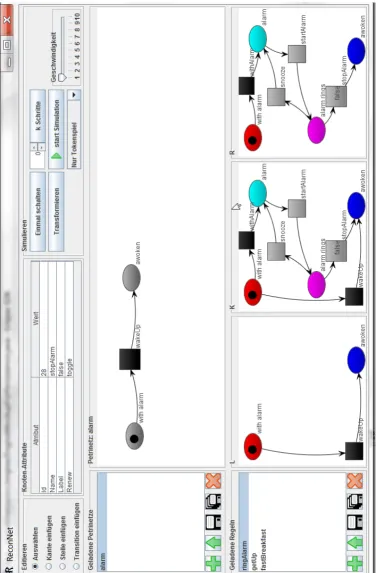
study. It shows the ruleringAlarm that belongs to a “morning scenario”. The rule models the extension of the scenario in case an alarm clock should be used. The transition wakeUp is replaced dynamically by the netR, describing a simple alarm clock with a snooze function. Unfortunately for the case study [Rei12] the tool RECONNET could not be employed as both have been developed simultaneously.
In this contribution we first summarize the underlying formal technique that is based on deco-rated place/transition nets and net transformations in the cospan approach. Then we present the tool RECONNET for modeling and simulation reconfigurable place/transition nets The tool is the result of two courses at the HAW Hamburg. Concluding remarks concern related and future work.
2
Reconfigurable Place/Transition Nets
Using the algebraic approach to Petri nets facilitates the combination of the algebraic approach to transformation. So, a marked place/transition net is given by N= (P,T,pre,post,M) with pre- and post-domain functionspre,post:T→P⊕and a markingM∈P⊕, whereP⊕is the free commutative monoid over the setPof places. ForM1,M2∈P⊕ we haveM1≤M2 ifM1(p)≤
M2(p)for allp∈P. A transitiont∈TisM-enabled for a markingM∈P⊕if we havepre(t)≤M, and in this case the follower markingM0 is given byM0=M pre(t)⊕post(t) andM[tiM0 is called firing step. To gain an adequate modeling technique a few new features needed to be added. Obvious is the extension to capacities and names. More interesting are the transition labels that may change, when the transition is fired. This allows a better coordination of transition firing and rule application, for example can be ensured that a transition has fired (repeatedly) before a transformation may take place.
2.1 Decorated Place/Transition Nets
In order to provide the technical basis for the modeling of scenarios we need place/transition nets that have the following additional decorations: capacities, names for places as well as transitions and additional transition labels that can be changed by firing that transition. This last extension is conservative with respect to Petri nets as it does not change the net behavior. But it is crucial for the application of the rules and provides the possibility to control the application of rules.
A decorated place/transition net is a marked place/transition net N= (P,T,pre,post,M) to-gether with names and labels. Based on AP, AT a name space with pname:P→ AP and
tname:T →AT we have explicit names for places and transitions. Moreover, transitions need
to be equipped with labels that may change when the transition fires. For the correct application of a rule it may be important that a transition has already fired. This cannot be modeled with usual place/transition nets. Considering the tokens in the transition’s post places, does not work as these tokens may be consumed as well. So we have to change the label of the transition. For example, the label changes fromfalse(indicating that the transition has not yet fired) totrue (indicating that it has already fired). In Fig.2in Section3the transitionstopAlarmin the netK
is a function mappingfalsetotrueand the other way round. More formally,togglecan be expressed using propositional logictoggle(x):=¬x.
Formalizing this notion we introduce a set W of changing labels for each transition and a functiontlb:T→Wmapping transitions to transition labelsW. Then each transition is decorated with a endomorphism onW, i.e. a function that maps labels to labels. Th is decoration is given by the functionrnw:T →ENDwhere ENDis a set containing some endomorphisms onW, so thatrnw(t):W→W is the function that renews the transition label. Note that a partition of the changing labels(Wt)t∈T with respect to the transitions can easily be obtained (see [Pad12]).
These labels are important for the control of the rules, but not for the net’s behavior.
The firing of the extended nets is the same as in place/transition net except for the changing transition labels. Moreover, this extension works for parallel firing as well. Given a transition vectorv=∑t∈Tkt·tthen the label is renewed by firingtlb[vitlb0andtlb0is computed by:
tlb0(t) =rnw(t)kt◦tlb(t)
Analogously to the marking the transition labels also evolve during the token game.
2.2 Net Transformations in the Cospan-Approach
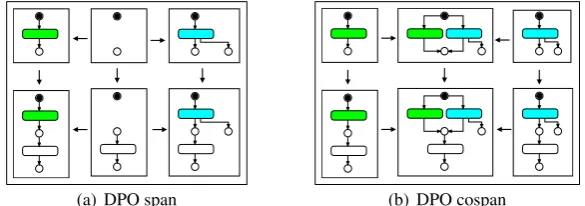
The cospan approach is a variant of algebraic transformations - namely the double pushout (DPO) approach - where the left-hand side and right-hand side of the rule are embedded in the interface (L→K ←R), hence cospan. In contrast to the classical DPO approach (where to morphisms starting from the interfaceL←K→R) we add new items first and then delete (some of) the old items in the second step.
In [EHP09] the cospan DPO approach has been shown to be equivalent to the classical DPO approach. In this way we are able to switch between these two approaches and, finally, omit the interface in the graphical description. In this paper we use the cospan DPO approach, because from implementation point of view, it is often more convenient to add the new items first and delete some of the old items in a second step. This idea is adopted in the cospan DPO approach where a rule is given by a cospan of morphisms, while a transformation step via a cospan rule is still defined by two pushouts. Roughly spoken, in the classical DPO approach the intermediate net obtained by rule application is often full of holes like Swiss cheese, while in the cospan DPO approach this net includes the source net and the target net.
(a) DPO span (b) DPO cospan
For example in Fig. 1(a) the rule is in the DPO approach and the rule in Fig. 1(b) is in the cospan DPO approach. But both of these two rules replace the transition on the left-hand side by one on the right-hand side, that has a further place in its post-domain. In contrast to the classical approach in the cospan DPO approach we are able to relate the old and new items in an easy way. The interface of this cospan rule (see Fig.1(b)) states for example that the environment of both transitions have to have at least the same places in the pre- and post-domain.
Thus, on the one hand several properties could be formulated in a more intuitive way and on the other hand some aspects could be investigated that have escaped our attention in the classical DPO approach. The main results in [HEH10] are not only sufficient (as in [EHP+07] using the classical approach) but also necessary conditions, so that a transformation step and a firing step can be executed in arbitrary order. Moreover in future work we will consider further property preserving net transformations in the cospan DPO approach. Of special interest are strongly connectivity and liveness and we expect that especially these properties could be formulated and proven in a more intuitive way in the cospan DPO approach.
For decorated place/transition nets as given above, we obtain with the following notion of morphisms an M-adhesive HLR-category (see [Pad12]). M-adhesive HLR systems can be considered as a unifying framework for graph and Petri net transformations providing enough structure that most notions and results from algebraic graph transformation systems are available (e.g. in [EEPT06,EGH+12]).
Morphisms are given as a pair of mappings for the places and the transitions, so that the structure and the decoration is preserved and the marking may be mapped strictly. Given two netsNi= (Pi,Ti,prei,posti,Mi,pnamei,tnamei,tlbi,rnwi)fori=1,2 then the morphism f:N1→
N2 is given by f = (fP,fT) the mapping of places to places and the mapping of transitions
to transitions. Additionally, the usual equations have to hold that ensure the preservation of markings and of labels [Pad12].
Given a decorated place/transition net and a rule together with an occurrence morphismo, the a transformation step(N1,M1)
(rule,o)
=⇒ (N2,M2) consists of the following pushout diagrams (1) and (2).
(L,ML) l //
o
(1)
(K,MK)
(2)
(R,MR) r
oo
n
(N1,M1) //(N0,M0)oo (N2,M2)
A rule in the cospan approach is given by the left-hand side, interface and right-hand side net, respectively, and a cospan of two net morphismslandr. An occurrence morphismoidentifies the relevant parts of the left-hand side in the given net (N1,M1). Then a transformation step (N1,M1)(rule=⇒,o)(N2,M2)can be constructed in two steps, provided that gluing conditions hold. The characterization of specific points is a sufficient condition for the existence and uniqueness of the so-called pushout complement which is needed for the second step in a transformation.
A reconfigurable place/transition netRN= ((N,M),R)is given by
• a decorated place/transition netN = (P,T,pre,post,pname,tname,cap,tlb,rnw) and its markingMand
• a set of rulesR, where rulesruleare given in the cospan approach
rule= (L,ML)→(K,MK)←(R,MR).
3
R
EC
ONN
ET: Editor and Simulator
The software tool RECONNET(RECONfigurable NET) has been developed so that the modeling and simulation capabilities of reconfigurable nets are supported adequately. The most important feature of the tool is the ability to create, modify and simulate reconfigurable nets in a single tool through an intuitive graphic-based user interface. RECONNETis completely implemented in Java 6, therefore being fully portable. For the purposes of the user interface, SWING [SWI] was found to be suitable. In combination with JUNG [JUN], the JAVA universal network/graph framework, a first net rendering and editing component can be forged readily. For more cus-tomized net editing capabilities, many JUNG behaviors need to be overwritten or to be used in custom classes.
3.1 Editor and Simulator
The most important aspects of RECONNETare reflected in its graphical user interface. There are two different areas for nets and rules, underlining the importance of both those constructs. The user can basically choose among four modes that can be operated in. Note in Fig. 2the check-box with the options: pick(Ausw¨ahlen),insert arc(Kante einf¨ugen), insert place (Stelle einf¨ugen), andinsert transition(Transition einf¨ugen). In thepick mode, the user can click on nodes (i.e. a place or a transition) to select them to highlight them or edit its attributes like marking. Also transition labels and the renew function can be set by typing into the attribute table in the top middle. Nodes can be easily moved by drag-and-drop. When the user drag-and-drops onto the white space, the whole net is moved. By scrolling the mouse wheel the zoom function can be used. When right-clicking a node, it can be deleted (also its incident arcs) or a color can be assigned. Colors do not interfere with the graph matching or any logical function at all. All of this applies to the rule editing, also. The renew function is restricted to one of the three modes: id, that does not change the labels, being the identity function, toggle, that swaps the Boolean values true and false, andcount, that increases an integer given as the label. In the arc mode, arcs can be added by drag-and-dropping among nodes of different types. In the place and transition mode, places or transitions can be added to the net by clicking onto the white space.
This procedure also enables the user to quickly model the basic functions of a rule: By adding a node to the left part of the ruleL, it automatically is added into the interfaceK, this leads to the deletion of the node when applying the rule. If a node is added into the interfaceK, it is added in both left and right parts of the rule to ensure being part of the matching subgraphs. Adding a node into the right-hand sideRof the rule also inserts the node intoK, meaning this node is added when the rule is applied. The same treatment is used for arcs as well except the coloring.
Another important feature of RECONNET is the simulation of nets, which can be done in different fashions. First of all there is a button to fire one transition. The transition is chosen randomly among those that are active. A transition is represented as a dark gray rectangle if it is activated and as a light gray rectangle if not. The follower marking is computed and the tokens are moved accordingly. The application of rules leads to the transformation of the net. The rule that is applied to the displayed net is chosen randomly among those who are selected in the left hand overview. Also the morphism is found in a non-deterministic fashion. If there is an injective match morphism, then the gluing conditions will be checked for the intermediate net. Then the resulting net is computed and displayed.
Additionally there are two more advanced simulation options - k steps (k Schritte) and running simulation - which can operate in three different modes: tokens (Nur Tokenspiel), transformation (Transformation) and both (Beides). The k steps options executes a definable amount of steps on the net. In the token mode only transitions are fired, in the transformation mode only rules are applied. In theboth modeit is randomly chosen whether a transition is fired or a rule is applied for each step. Those three operations can be applied by k steps instantly, but also in a simulation running mode, which can be set to run fast or slow in 10 speed levels from 1 step every 2 seconds to basically as fast as the running system can offer.
3.2 Architecture and Persistency
The software is designed with component based architecture to allow refinement throughout the process of development. Thus its functionalities are divided into the five broad components Petrinet,Transformation,Engine,PersistenceandGUI. WhilePetrinetandTransformation offer the more abstract functionalities of nets and rules, the Enginecombines them to a more tool-specific interface, transforming data, checking correctness of user input, performing simu-lations and managing session data. On top is theGUIcomponent that defines the displays and controls of nets and rules. Aside from that, thePersistencecomponent is adjoined by the engine to load and store Petri nets, rules and simulation results to the local file system.
Each part of a rule is a net element, just as a Petri net. In addition it has a net type attribute which can have one of three values L, K and R. Also each net element in K has its own id which is shared with their respective counterpart in L and R. A node that occurs in all parts of a rule will appear in each three net elements of the rule with always the same attributes and always the same id. This id is used to encode the corresponding morphism formL⊆K andK⊇R. In Fig. 3in the appendix an excerpt of the XML-code of the ruleringAlarmfrom Fig.2is given that represents the rule’s left-hand sideL.
4
Conclusion
To conclude this paper we discuss related and future work.
Up to now there have been two tools that also implement some kind of reconfigurable Petri nets. MCReNet [LO05] is a tool for the specification, modeling, simulation, and verification of con-current systems that are subject to dynamic changes by using Marked-Controlled Reconfigurable Nets. In addition to the Petri nets it is equipped with a configuration graph, a labeled directed graph whose nodes are the configurations.
The Reconfigurable Object Nets (RON) Editor [BEHM07,BM08,BEMS08] integrates tran-sition firing and rule-based net structure transformation of place/trantran-sition nets during system simulation. In contrast to our approach they are high-level nets with two types of token: object nets (place/transition nets) and net transformation rules (a dedicated type of graph transformation rules). Firing of high-level transitions may involve firing of object net transitions, transporting object net token through the high-level net, and applying net transformation rules to object nets. Net transformations include net modifications such as merging or splitting of object nets, and net refinement. Nevertheless the RON Editor is capable of simulating reconfigurable place/transi-tion nets by putting all place/transiplace/transi-tions nets as high-level tokens on high-level object-net places, putting all rules on high-level net reconfiguration rule places, and connecting a rule place with a net place by a transition that triggers the application of a net transformation rule to an object net. Moreover the RON Editor supports negative application conditions [BM08] and an independence analysis of net transitions [BEMS08].
In [GN11] the Living Place Hamburg is modeled using Algebraic High-Level Nets with Indi-vidual Token, short AHLI nets, as well as rule-based transformation of such nets following the double pushout approach. In that thesis the focus was on the detailed modeling of the data types. Since the scenario modeling in [Rei12] makes use of negative application conditions as well as capacities these are the obvious extensions that need to be implemented next. In [Pad12] the construction of a reachability graph for reconfigurable place/transition nets is given. Moreover, the modeled scenarios - due to negative application conditions and capacities – are bounded leading to bounded reachability graph and hence to the corresponding possibilities of model checking.
Philipp K¨uhn, Thorsten Paech, Florian Reiter, Zabihullah Safai, Niklas Schreiber, Moritz Uhlig (fall semester 2010).
References
[BEHM07] E. Biermann, C. Ermel, F. Hermann, T. Modica. A Visual Editor for Reconfigurable Object Nets based on the ECLIPSE Graphical Editor Framework. In Juhas and Desel (eds.), Proc. 14th Workshop on Algorithms and Tools for Petri Nets (AWPN’07). GI Special Interest Group on Petri Nets and Related System Models, Universit¨at Koblenz-Landau, Germany, 2007.
[BEMS08] E. Biermann, C. Ermel, T. Modica, P. Sylopp. Implementing Petri Net Transforma-tions using Graph Transformation Tools.ECEASST14, 2008.
[BM08] E. Biermann, T. Modica. Independence Analysis of Firing and Rule-based Net Transformations in Reconfigurable Object Nets.ECEASST 10, 2008.
[DRR04] J. Desel, W. Reisig, G. Rozenberg (eds.).Lectures on Concurrency and Petri Nets, Advances in Petri Nets. Lecture Notes in Computer Science 3098. Springer, 2004.
[EEPT06] H. Ehrig, K. Ehrig, U. Prange, G. Taentzer. Fundamentals of Algebraic Graph Transformation. EATCS Monographs in TCS. Springer, 2006.
[EGH+12] H. Ehrig, U. Golas, A. Habel, L. Lambers, F. Orejas. M-AdhesiveTransformation Systems with Nested Application Conditions. Part 2: Embedding, Critical Pairs and Local Confluence.Fundam. Inform.118(1-2):35–63, 2012.
[EHP+07] H. Ehrig, K. Hoffmann, J. Padberg, U. Prange, C. Ermel. Independence of Net Transformations and Token Firing in Reconfigurable Place/Transition Systems. In Kleijn and Yakovlev (eds.), ICATPN. Lecture Notes in Computer Science 4546, pp. 104–123. Springer, 2007.
[EHP09] H. Ehrig, F. Hermann, U. Prange. Cospan DPO Approach: An Alternative for DPO Graph Transformations.Bulletin of the EATCS98:139–149, 2009.
[EP03] H. Ehrig, J. Padberg. Graph Grammars and Petri Net Transformations. Pp. 496–536 in [DRR04].
[GN11] S. Gottmann, N. Nachtigall. Modelling the Living Place Project using Algebraic Higher Order Nets. Diploma Thesis, Technische Universit¨at Berlin, 2011.
http://users.informatik.haw-hamburg.de/∼ubicomp/arbeiten/diplom/
gottmann-nachtigall.pdf
[HKPT10] L.-M. Hillah, F. Kordon, L. Petrucci, N. Tr`eves. PNML Framework: An Extendable Reference Implementation of the Petri Net Markup Language. In Lilius and Penczek (eds.),Petri Nets. Lecture Notes in Computer Science 6128, pp. 318–327. Springer, 2010.
[JAX] Java Architecture for XML Binding.
http://www.oracle.com/technetwork/articles/javase/index-140168.html
[JUN] Java Universal Network/Graph Framework.
http://jung.sourceforge.net/
[LO04] M. Llorens, J. Oliver. Structural and Dynamic Changes in Concurrent Systems: Re-configurable Petri Nets.IEEE Trans. Computers53(9):1147–1158, 2004.
[LO05] M. Llorens, J. Oliver. MCReNet: a tool for Marked-Controlled Reconfigurable Nets.
Quantitative Evaluation of Systems, International Conference on0:255–256, 2005. doi:http://doi.ieeecomputersociety.org/10.1109/QEST.2005.18
[Pad12] J. Padberg. Abstract Interleaving Semantics for Reconfigurable Petri Nets. InPNGT 2012. Volume 51. 2012.
[PEHP08] U. Prange, H. Ehrig, K. Hoffman, J. Padberg. Transformations in Reconfigurable Place/Transition Systems. In Degano et al. (eds.),Concurrency, Graphs and Models: Essays Dedicated to Ugo Montanari on the Occasion of His 65th Birthday. Lecture Notes in Computer Science 5065, pp. 96–113. Springer Verlag, 2008.
[Rei12] F. Reiter. Modellierung und Analyse von Szenarien des Living Place mit rekon-figurierbaren Petrinetzen. Bachelor Thesis, Hochschule f¨ur Angewandte Wis-senschaften Hamburg, 2012.
http://users.informatik.haw-hamburg.de/∼ubicomp/arbeiten/bachelor/reiter.pdf
[SWI] Swing Enhancements in the Java TM Standard Edition 6.0.
Appendix
<?xml v e r s i o n= ” 1 . 0 ” e n c o d i n g = ”UTF−8” s t a n d a l o n e= ” y e s ” ?>
<pnml n o d e S i z e = ” 5 0 . 0 ” t y p e = ” r u l e ” x m l n s = ” h t t p : / / www. pnml . o r g / v e r s i o n −2009/ grammar / pnml ”>
<n e t i d = ” 8 ” n e t t y p e = ”L”> <p a g e>
<a r c i d = ” 21 ” s o u r c e = ” 17 ” t a r g e t = ” 13 ”> <g r a p h i c s>
<d i m e n s i o n /> <p o s i t i o n /> </ g r a p h i c s> <i n s c r i p t i o n>
<t e x t>u n d e f i n e d</ t e x t> </ i n s c r i p t i o n>
</ a r c>
. . .
<p l a c e i d = ” 10 ”> <g r a p h i c s>
<c o l o r b= ” 0 ” g= ” 0 ” r = ” 255 ” /> <p o s i t i o n x= ” 6 8 . 0 ” y= ” 2 3 . 0 ” /> </ g r a p h i c s>
<i n i t i a l M a r k i n g> <t e x t>1</ t e x t> </ i n i t i a l M a r k i n g> <p l a c e N a m e>
<t e x t>w i t h a l a r m</ t e x t> </ p l a c e N a m e>
</ p l a c e>
<p l a c e i d = ” 13 ”> <g r a p h i c s>
<c o l o r b= ” 255 ” g= ” 0 ” r = ” 0 ” /> <p o s i t i o n x= ” 2 8 1 . 0 ” y= ” 2 1 5 . 0 ” /> </ g r a p h i c s>
<i n i t i a l M a r k i n g> <t e x t>0</ t e x t> </ i n i t i a l M a r k i n g> <p l a c e N a m e>
<t e x t>awoken</ t e x t> </ p l a c e N a m e>
</ p l a c e>
. . .
</ p a g e> </ n e t>
<n e t i d = ” 7 ” n e t t y p e = ”K”> <p a g e>
. . .
</ p a g e> </ n e t> </ pnml>