Comparing the Effectiveness of a Supplemental Online Tutorial to Traditional Instruction with Nutritional Science Students
Patrice Zubas, MS, RD Consultant Dietitian Cindy Heiss, PhD, RD Missouri State University
Mary Pedersen, PhD
California Polytechnic State University
Abstract
The purpose of this study was to ascertain if an online computer tutorial on diabetes mellitus, supplemented to traditional classroom lecture, is an effective tool in the education of nutrition students. Students completing a web-based tutorial as a supplement to classroom lecture displayed greater improvement in pre- vs. post-test scores compared with students who attended lecture only. Students completing the tutorial indicated a favorable attitude toward computer supplemented instruction.
Introduction
As a teaching tool, computers are used for multimedia presentations in the classroom along with computer-based courseware and tutorials. Online computer tutorials are useful in many ways: they provide for self-paced, independent learning, allow for remediation, and provide for a means of distance and asynchronous education. Online teaching tools can be expensive to purchase or develop in addition to the cost of acquisition and maintenance of equipment. Therefore, before instructors adopt computer-based learning as a teaching tool, the effectiveness of this teaching modality must be documented. In addition, educators must find the best approach for initiating computers as learning tools to make a successful transition from traditional learning to technology-enhanced learning.
Potentially, computer-based education can increase effectiveness and efficiency in the education of students, while increasing student interest and learning retention (Byrd-Bredbenner & Bauer, 1991). When students are involved and interested in a subject, their learning most likely will increase. Computer simulations typically lead to intense involvement with subject matter, where other teaching techniques may not. By simulating a situation and providing prompt feedback, computers stimulate the learner to experiment with decisions and take risks in a practical setting (Corby, 1988).
Online tutorials can be used as stand-alone learning tools or as an adjunct to traditional classroom instruction. The efficacy of online learning has been documented. A study by Buzzell, Chamberlain, and Pintauro (2002) found that student improvement on pre- vs. post-test scores
76
online tutorial only, and lecture plus online tutorial. In addition the students reported equally positive attitudes toward all three learning formats.
Nutrition, as a content area, consists of many science-based applications. Case studies of real life scenarios are used to prepare students for clinical and public health settings, yet case studies do not necessarily encourage active learning. Computer simulations of case study scenarios, while not common in dietetic education, have provided practical experience and greater preparation of the student (Turner, Evers, Wood, Lehman & Peck, 2000).
The purpose of this study was to ascertain if an online computer tutorial on diabetes mellitus, supplemented to traditional classroom lecture, is an effective tool in the education of nutrition students
.
Methods
Online Diabetes Tutorial
A comprehensive web-based tutorial on diabetes mellitus was developed by a group of faculty members and graduate students at California Polytechnic State University, San Luis Obispo. The tutorial included topics related to diabetes such as pathophysiology, types of diabetes, diagnosis, nutrition assessment, complications, and management of the disease. The tutorial was set up so that students could navigate through the site in a linear or nonlinear fashion, according to their preferred mental model. The tutorial included a 50-item test as well as interactive case studies. Registered dietitians evaluated the tutorial, including the test and case studies. The tutorial can be found at www.csun.edu/~cjh78264/diabetes.
Subjects and Procedure
Thirty-one nutrition majors enrolled in a senior level clinical nutrition course at California Polytechnic State University, San Luis Obispo, participated in the study. Students were randomly assigned to learn a unit on diabetes in one of two ways: (1) through an online diabetes tutorial plus classroom lecture (treatment group, n=10) or (2) via classroom lecture alone (control group, n=12). Fifty-item multiple choice pre- and post- tests were administered to all students. Students in the treatment group also completed the Flashlight™ survey (Flashlight, 2004), an online questionnaire regarding perceptions and attitudes toward computers as a learning tool. Twelve students from the previous semester had also completed the tutorial and the Flashlight™ survey, and their data were pooled with the data from the present study to evaluate student perceptions and attitudes toward the tutorial.
Descriptive statistics including means and standard deviations were calculated on test scores for both parts of the study. Inferential statistics were calculated using a general linear model (Ott, 1993). A general linear model was used to compare improvement in test scores of the treatment and control groups, controlling for pre-test scores. Confidence intervals were calculated at 95% to estimate the mean improvement in test scores (Moore & McCabe, 1993). Minitab Statistical Software, Version 12.0, produced by Minitab, Inc. (State College, PA) was used to calculate all statistics for this project. Significance was set at p < .05.
Results
A total of twenty-two students completed both pre- and post- tests and were included in the data analysis. All students were nutritional science students; a majority were undergraduates. Most of the undergraduates were in their senior year of school. All were currently enrolled in a clinical nutrition course containing a diabetes component.
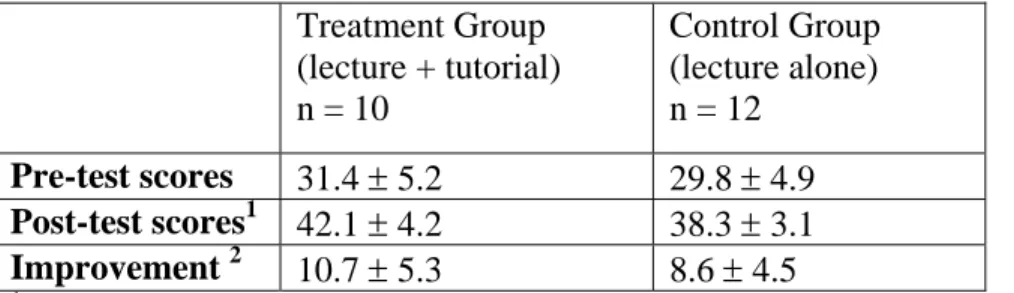
Pre-test/post-test scores for the 50-item multiple choice quiz on diabetes are shown in Table 1. Post-test scores were significantly higher than pre-test scores for the entire sample, with a mean improvement of 7.0 ± 4.6 points. The improvement for the lecture plus tutorial group (n=10) was significantly greater (p=.04) than for the lecture only group (n=12). The 95% confidence interval for the mean improvement in fall treatment post-test scores was between 0.2 and 6.4. It took an average of 45 minutes for students to complete the tutorial. A summary of responses to selected questions from the Flashlight™ survey from the 10 students in the treatment group of the present study pooled with responses of 12 students who completed the tutorial the previous term are shown in Table 2.
Table 1. Summary of pre- and post-test scores of summer treatment group and fall treatment and control groups (mean ± standard deviation)
Treatment Group (lecture + tutorial) n = 10 Control Group (lecture alone) n = 12 Pre-test scores 31.4 ± 5.2 29.8 ± 4.9 Post-test scores1 42.1 ± 4.2 38.3 ± 3.1 Improvement 2 10.7 ± 5.3 8.6 ± 4.5 1
Improvement between treatment and control groups were significantly different at p< .05.
2
78
Table 2. Student responses to Flashlight survey questions regarding perceptions and attitudes about computer usage in education1,2
Part 1 Questions
Strongly Agree
Agree Disagree Strongly Disagree
I am acquiring skills (computer) that will be useful in my chosen profession
54 38 8 0
I spent too much time learning to use the tutorial 4 4 38 50
I am able to learn at my own pace 41 54 0 0
I am able to experience situations that I would not be able to otherwise
17 42 33 0
With this tutorial, I am better able to visualize ideas and concepts
25 38 29 4
The technology used was appropriate for performing the tasks required
4 88 8 0
I would recommend to others, a course that uses computerized tutorials
21 71 8 0
I would recommend to others, a course that uses multimedia texts or course modules
29 54 17 0
I would recommend to others, a course that uses materials on the Internet/World Wide Web
33 58 8 0 Part 2 Questions Compared to traditional education, I am more likely to… Much more likely Somewhat more likely About the same Some-what less likely Much less likely No basis for judg-ment
miss important information because I moved too quickly through tutorial
17 42 8 13 21 0
feel isolated from the instructor
29 17 17 8 13 17 get individualized attention
from instructor
17 0 25 29 13 17
skip over parts of the information
21 38 29 8 4 0 discuss the ideas and
concepts with other students
0 25 38 29 4 0
Discuss the ideas and concepts with the instructor
0 29 33 33 4 0
Apply what I learned to ‘real world’ problems
13 21 54 8 0 0
1
N=24
2
Discussion
Computer-based instruction been shown to increase practical experience of dietetic interns (Turner et al, 2000). In addition, computer-assisted instruction tutorials have been successful in enhancing clinical reasoning skills (Raidl et al, 1995). When compared to traditional lectures, computer-assisted instruction modules improved nutrition knowledge and increased student enjoyment of learning in an introductory nutrition course (Byrd-Bredbenner & Bauer, 1991). Attitudes toward subject matter improved in a computer-based instruction class to a greater degree when compared to a traditional lecture/laboratory class and with the computer based instructed students achieving higher test scores with less study time (Schroeder & Kent, 1982).
On the other hand, Oh and Lim (2005) found that students reported that they learned best by listening to a lecture, taking notes, and reading a textbook. In addition, the students indicated a preference for reading hard copy over a computer screen. Thus, using online teaching tools as an adjunct to traditional lecture would provide the benefits of computer-based instruction, such as remediation, simulation, and practice, without losing the effectiveness of traditional classroom instruction.
The present study confirmed the benefit of a self-paced computer tutorial on test score results. In an upper division clinical nutrition course, students who completed the self-paced tutorial in addition to traditional classroom lecture, improved test scores (on a pre/post-test) significantly more than the group receiving traditional lecture only. This demonstrates that traditional lectures supplemented with computer-based tutorials improved diabetes knowledge with nutrition students. Garson (1999) agrees that students benefit from a mixed model, were traditional lecture is supplemented with online learning.
There are a few factors that could have contributed to the greater improvement for the lecture plus tutorial group, in addition to multimedia enhancement of learning. The time on task element could have had an effect on the outcome. Students who participated in the tutorial obviously had more structured time (an average of 45 minutes) with the subject of diabetes. The Hawthorne Effect, which states any special attention elicits an improvement in productivity or performance, could have also played a role in the results.
The general consensus from the Flashlight™ evaluation of the tutorial was that the tutorial was a useful learning tool. This is in agreement with a study by Swann et al (2003) that indicated that Extension educators had favorable views toward computer-based instruction. In a recent study, students indicated that prior online learning experience and computer skills significantly improved learning outcomes and attitude toward online learning (Oh and Lim, 2005).
The students in the present study liked the self-paced nature of the tutorial (95%) yet some felt they may have moved too quickly through the information (59%). Some students felt they skipped over more information compared to traditional lectures (59%). Since online learning provides an open learning environment that allows the student to make choices (Reiser and Dempsey, 2002), they may miss information or become confused with the options presented in the online environment (Chen, 2002; Daniels and Moore, 2000; Ford and Chen, 2000). With the independent nature of tutorial learning, techniques should be used regarding restraint and motivation. Factors that motivate students in an online learning environment include relevant
80
Most students felt the tutorial was a good method for learning. Most participants agreed that they were able to experience situations through the tutorial (59%) and would recommend computerized learning to fellow students (92%). Many agreed (33%) that the tutorial helped them better visualize concepts. Most students felt comfortable enough with the computer to not let the technology hinder their learning experience (88%). Adequate computer skill is important for the success of online learning (Oh and Lim, 2005)
Feelings of isolation, or being separated from instructors and fellow students (46%) had an effect on students. The absence of individualized attention from an instructor (42%) presented some negative feelings. Being isolated from peers and instructors are likely events of independent computer learning experiences. During classroom instruction, students can ask instructors questions and receive immediate feedback, a trait lost with tutorials unless an interactive component is a part of the software. Relating “real world” practical problems to learning was regarded about the same when compared to traditional learning in the present study. If the tutorial was more interactive, these views could have been different.
Online tutorials used to learn basic information outside of the classroom could free classroom time to be used for higher order learning activities such as discussion, debate, presentation of information critically synthesized from research, or group exercises. If nutrition students could master lower order learning, the acquisition of information, facts, terminology, procedures, and basic application on their own, they would have more time with the instructor to practice critical thinking skills. For example, for the diabetes unit, students could learn about the different dietary approaches via the tutorial, then have a debate on the merits of the approaches in class or generate learning materials for patients.
Limitations of this study included the small sample size, reducing statistical power and generalizability of results and the fact that results may be different for a different instructor providing the lecture on diabetes. In addition, practical application of the knowledge learned from the tutorial was not tested using the pre- and post-tests.
Conclusions
The present study demonstrated that an online tutorial on diabetes supplemented to class lecture has a positive impact on student learning. Educators in dietetics can benefit from incorporating online learning resources into their teaching strategy not only for remediation and reinforcement of classroom information, but also to provide a learning tool that students can use on their own time and at their own pace. Instructors may find more time to spend on higher order learning activities if students can acquire lower order learning outside of classroom time. The ability to incorporate information, images, animations, interactive problems, quizzes, and cases provides variety to maintain student interest. In addition, students may feel a greater sense of engagement in the learning process having increased control over when they spend time with the material and what content they access. The use of online tutorials create an exciting learning environment for nutrition students, facilitating learning and preparing them for professional life.
References
Buzzell, P.R., Chamberlain, V.M., & Pintauro, S.J. (2002). The effectiveness of web-based, multimedia tutorials for teaching methods of human body composition analysis. Advan Physiol Edu, 2, 21-29.
Byrd-Bredbenner, C. & K. Bauer. (1991). The development and evaluation of computer assisted instruction modules for an introductory, college-level nutrition course. Journal of
Nutrition Education, 23(6), 275-282.
Cehn, S. (2002). A cognitive model of non-linear learning in hypermedia programs. British Journal of Educational Technology, 33(4), 449-460.
Corby, L. (1988). Microcomputers: How can nutrition educator use them more effectively.
Canadian Home Economics Journal, 38(1), 7-9.
Daniels, H.L. & Moore, D.M. (2000). Interaction of cognitive style and learner control in a Hypermedia Environment. International Journal of Instructional Media, 27(4), 369-382. Flashlight. (2004). TLT Group. Takoma Park, MD. Retrieved October 6, 2005, from
http://www.tltgroup.org.
Ford, N.& Chen, Y. (2000). Individual differences, hypermedia navigation and learning: An empirical study. Journal of Educational Multimedia and Hypermedia, 9(4), 281-311. Garson, G.D. (1999). The role of technology in quality education. North Carolina State
University. Retrieved October 6, 2005, from http://hcl.chass.ncsu.edu/sscore/garson2.htm.
Hodges, C.B. (2004).Designing to Motivate: Motivational Techniques to Incorporate in E- Learning Experiences. Journal of Interactive Online Learning, 2(3), 1-7.
Moore, D.S. & McCabe, G.P. (1993). Introduction to the Practice of Statistics, W.H. Freeman and Company, New York.
Oh, E. & Lim, D. (2005). Cross relationships between cognitive styles and learner variables in online learning environment. Journal of Interactive Online Learning, 4(1), 53-66. Ott, R.L. (1993). An Introduction to Statistical Methods and Data Analysis, 4th Edition.
Duxbury Press.
Raidl, M.A., Wood, O.B., Lehman, J.D., & Evers, W.D. (1995). Computer-assisted instruction improves clinical reasoning skills of dietetics students. Journal of the American Dietetic Association, 95, 868-873.
Reiser, R. A., & Dempsey, J.F. (2002). Trends and issues in instructional design and technology,
Upper Saddle River, NY: Merril Prentice Hall.
Schroeder, L., & P. Kent. (1982). Computer-based instruction in dietetics education. Journal of Computer-Based Instruction, 8(4), 85-90.
Swann, D.L, Branson, F. & Talbert. B.A. (2003). Educator beliefs regarding computer-based instruction. Journal of Extension. 41(1): http://www.joe.org/joe/2003february/rb4.shtml. Turner, R.E., Evers, W.D., Wood, O.B., Lehman, J.D., & L.W. Peck, L.W. 2000. Computer-
based simulations enhance clinical experience of dietetic interns. Journal of the American Dietetic Association, 100(2), 183-190.