Integrated Management System Job Management Partner 1
(JP1), Version6
i
for Broadband Networks
OVERVIEW: Due to the rapid growth of e-business, various kinds of client machines connected to IP (Internet protocol) networks, and the rate of transmission of video and voice over IP networks, IP networks are becoming larger in scale and capacity. As a result, there is a strong need for a network management system that can easily manage large-scale networks composed of multi-vendor network devices and can support state-of-the-art technologies, such as IPv6 (Internet protocol version 6), and QoS (quality of service). To meet this demand, Hitachi has released integrated management system Job Management Partner 1 (JP1), version6i suite. JP1 can manage large-scale networks composed of multi-vendor network devices, based on both IPv4 and IPv6 protocol stacks, and also can manage the QoS setting of networks.
Yoshiyuki Kurosaki Toshio Sato
Kiminori Sugauchi Tokuji Tamada
INTRODUCTION
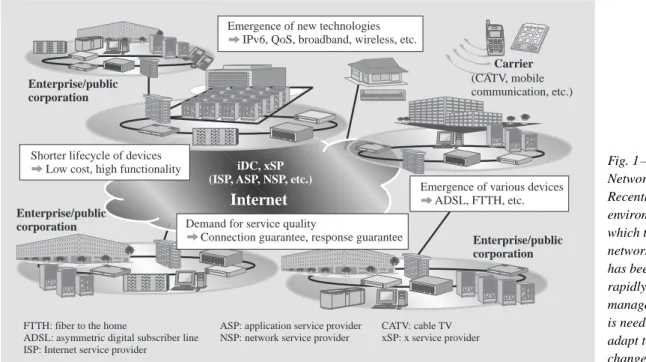
DUE to the rapid growth of e-business, the spread of broadband network access, and the increase in the rate of transmission of video and voice over IP networks, the network traffic is increasing. Accordingly, the lifecycle of network devices tends to get shorter, and many vendors are releasing new network devices on the market. Also due to spread of the Internet and the availability of inexpensive services provided by carriers, iDC (Internet datacenter) or service providers in enterprise networks, networks are becoming larger,
and more complex especially with the installation of firewalls and NAT (network address translator) devices. The rapid growth of e-business has intensified the demand for maintaining a high level of service quality in the network infrastructure (see Fig. 1).
Hitachi has developed a network management system, integrated management system Job Management Partner 1 (JP1), version6i suite, for efficient network management, as well as system, security and application management.
In this paper, we describe the JP1 network
Fig. 1 — Today’s Networks. Recently, the environment in which today’s networks operate has been changing rapidly. A network management system is needed to quickly adapt to these changes. Enterprise/public
corporation
Enterprise/public corporation
Enterprise/public corporation
FTTH: fiber to the home
ADSL: asymmetric digital subscriber line ISP: Internet service provider
CATV: cable TV xSP: x service provider ASP: application service provider
NSP: network service provider
iDC, xSP (ISP, ASP, NSP, etc.)
Internet
Carrier
(CATV, mobile communication, etc.) Emergence of new technologies
IPv6, QoS, broadband, wireless, etc.
Emergence of various devices ADSL, FTTH, etc. Demand for service quality
Connection guarantee, response guarantee Shorter lifecycle of devices
management system for broadband networks, which can be used in large-scale and complex network environments composed of multi-vendor network devices and firewalls, and in new netw ork environments in which new technologies such as IPv6 or QoS are being used.
FEATURES OF JP1 NETWORK MANAGEMENT SYSTEM
The JP1 network management system conforms to SNMP (simple network management protocol) v1 and SNMPv2C, and provides such functionality as configuration management, fault management, and performance management for multi-vendor networks.
Flexible Operation Management
The JP1 network management system enables flexible operation management, such as management from home or outside of the office by using a web browser with access certification. It also enables distributed management from multiple sites, multiple management consoles, or by multiple management operators.
Scalability
The JP1 network management system provides an API (application program interface) to develop network management applications on the JP1 network management platform, templates to enable easy development of such applications, and assisting tools in defining extension MIBs (management information bases). The system provides hierarchical management (refer to “Management of Large-Scale and Wide-Area Networks” in the next section) and enables the management of a network of any scale.
Integrated Management of a Wide Range of Management Objects
(1) Configuration management
The JP1 network management system automatically discovers network elements, draws logical maps and sub-maps of networks such as IPv4, IPv6, or ATM (asynchronous transfer mode) networks, and provides integrated configuration management.
Also, the system can specify the physical location of fault nodes and their impact, and show related IT asset information by cooperating with the IT asset management function, which can draw physical layout maps based on logical configuration, show where network devices and servers are located, and show how the wires are connected. Therefore, JP1 can provide
efficient fault management to operation managers. (2) Fault management
The JP1 network management system can provide integrated fault management on network devices and servers by using a common user interface and by cooperating with the server management function, which monitors the operation of processes on servers and the use of computer resources. Therefore, operation managers can efficiently distinguish network faults from server faults.
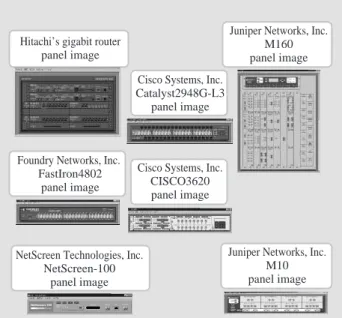
Also, the JP1 network manag ement system provides definition templates to display front-panel images of not only Hitachi’s network devices but also network devices of other vendors such as Cisco Systems, Inc., Juniper Networks, Inc., Foundry Networks, Inc., and NetScreen Technologies, Inc. Therefore, operators can monitor the physical configuration and operating status of each port on those devices from a remote station by watching front-panel images on the console screen, and can make a thorough analysis of faults (see Fig. 2).
Also, JP1 can seamlessly coordinate fault management with the control of network element management products like CiscoWorks*1 of Cisco Systems, Inc.
(3) Performance management
The JP1 network management system can provide
Fig. 2 —Network Element Management of Multi-vendor Network Devices.
Specific faults can be quickly identified by monitoring multi-vendor network devices on panel images.
Hitachi’s gigabit router panel image
Foundry Networks, Inc. FastIron4802
panel image
Cisco Systems, Inc. Catalyst2948G-L3
panel image
Juniper Networks, Inc. M160 panel image
Juniper Networks, Inc. M10 panel image Cisco Systems, Inc.
CISCO3620 panel image
NetScreen Technologies, Inc. NetScreen-100
panel image
*: Company and product names shown in this figure are or may be trademarks of their respective owners.
integrated management of performance information not only about the use of resources of network devices from multiple vendors but also about the use of server resources and the resources of server applications like Oracle*2, the status of printers, and the status of disk array systems using SNMP.
Also, it can seamlessly coordinate network performance management with the control of network traffic management products like Sniffer*3 of Japan Network Associates, Inc.
JP1 NETWORK MANAGEMENT SYSTEM FOR BROADBAND NETWORKS
Network Management in the Internet Environment
Network security is becoming more and more important, and firewalls are now essential elements of most networks. Also, because the global IPv4 (Internet protocol version 4) address space is limited, networks are usually made by using NAT technology, which enables converting global IPv4 addresses into private IP addresses and vice versa.
In April 1998, the JP1 network management system was enhanced to enable network management over firewalls and NAT devices (see Fig. 3).
As a result, JP1 can provide the management of networks over firewalls without compromising the network security, as well as the management of networks connecting multiple sites by using NAT technology in which private IP addresses overlap.
Management of Large-scale and Wide-area Networks
When we try to manage large-scale and wide-area networks by using one manager, the management traffic load becomes a problem, and efficient management is hard to obtain.
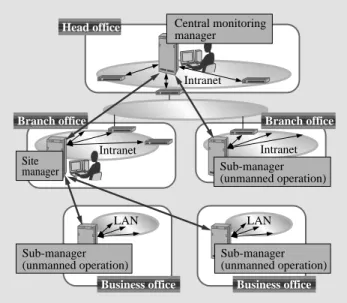
The JP1 network management system provides hierarchical distributed management. In hierarchical distributed management, the JP1 manager does not monitor all the JP1 agents, but JP1 site managers or JP1 sub-managers between the JP1 manager and JP1 agents monitor the JP1 agents periodically. Since the JP1 site managers or JP1 sub-managers can filter SNMP traps to relay only important SNMP traps to the JP1 manager, they can help reduce the management traffic load. Also because JP1 sub-managers can operate without an operator, hierarchical distributed management can be used on sites that do not have an operator (see Fig. 4).
Besides efficient management for large-scale and wide-area networks, hierarchical distributed
Fig. 3 —Network Management in the Internet Environment.
Networks can be managed even when firewalls or NAT devices are installed in them.
Fig. 4 — Effective Management of Large-Scale and Wide-area Networks.
Hierarchical distributed management and filtering of SNMP traps enable efficient management of large-scale and wide-area networks.
Intranet in head office Head office
DMZ: demilitarized zone
Site
Central monitoring manager
Sub-manager (unmanned operation)
Internet
Intranet in site DMZ
Firewall Firewall Firewall • Capsulating
SNMP packets • Adapting to
NAT devices
IP address: 192.16.45.XX
IP address: 192.16.45.XX Site manager
Central monitoring manager
Intranet
Intranet Intranet
LAN LAN
Head office
Branch office Branch office
Business office Business office Site
manager Sub-manager (unmanned operation)
Sub-manager (unmanned operation)
Sub-manager (unmanned operation)
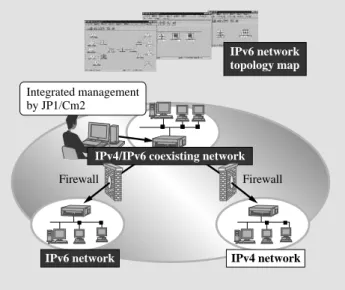
Fig. 5 —IPv6 Network Management.
Both IPv4 and IPv6 networks using a common user interface can be managed.
*1: Cisco is a registered trademark of Cisco Systems, Inc. and/or its affiliates in the U.S. and certain other countries.
*2: Oracle is a registered trademark of Oracle Corporation.
*3: Sniffer is a registered trademark of Network Associates Technology, Inc. and/or its affiliates in the U.S. and other countries.
*4: PacketShaper is a trademark or registered trademark of Packeteer, Inc. *5: Windows NT is a registered trademark of Microsoft Corp. in the U.S.
and other countries.
*6: Windows is a registered trademark of Microsoft Corp. in the U.S. and other countries.
*7: HP-UX is a registered trademark of Hewlett-Packard Company. *8: Solaris is a trademark or registered trademark of Sun Microsystems,
Inc. in the U.S. and other countries. management also provides a reduction in initial costs
and phased expansion of monitoring targets.
Control of Quality of Service in Networks
A lot of data traffic is moving on IP networks, and the demand for improving the quality of service in networks for such applications as VoIP (voice over Internet protocol) and mission-critical business applications is increasing.
The JP1 network management system conforms to the IETF (Internet Engineering Task Force) standards for DiffServ (differentiated services), which specify the mechanism for guaranteeing QoS in routers, and COPS (common open policy services), which is a communication protocol between routers and management servers. JP1 can manage the QoS setting of network devices including not only Hitachi’s gigabit routers but also the routers of Cisco Systems, Inc, and PacketShaper*4 of Packeteer, Inc. In addition to network devices, the JP1 network management system can also manage the QoS setting of server computers and client computers with Windows NT*5, Windows*6 2000, HP-UX*7, and Solaris*8.
As a result, the JP1 network management system can control the bandwidth and the priority of specific IP packets based on various parameters such as the destination/source IP address, the destination/source port number, the date and time, and the day of the week, and it can transmit important traffic without delays during traffic congestion.
IPv6 Network Management
Given the exhaustion of the IPv4 addressing space, the use of IPv6 addresses will be inevitable, and network devices are becoming IPv6-ready. Also many carriers are starting commercial or experimental IPv6 services in Japan. On the other hand, IPv6 networks will most likely be added to present IPv4 networks rather than replaced by IPv6 networks in a short term. Since September 2001, the JP1 network management system has been supporting the coexisting management of IPv6 and IPv4 networks1) using a common user interface. The system has the following functions:
(1) Configuration management
• It discovers IPv6 network devices automatically based on IPv6 MIBs and draws IPv6 topology maps. (it can draw topology maps including those of the Internet by setting ISP access point addresses) • It displays information related to terminals
connected to IPv6 networks.
• It displays IPv6 routing-table information on IPv6 routers.
(2) Fault management
• It monitors operational status of IPv6 interfaces and IPv6 nodes and reflects this information on IPv6 topology maps. [it can monitor the operational status of nodes that support only IPv6 by using ICMPv6 (Internet control message protocol for the Internet protocol version 6).]
(3) Performance management
• It measures response time from IPv6 interfaces and IPv6 nodes.
• It monitors performance on IPv6 interfaces and IPv6 nodes (the average count of packets sent or received during a given period).
Also, the seamless management of IPv6 sites connected using firewalls or NAT devices is possible (see Fig. 5). The JP1 network management system makes it possible to manage IPv6 and IPv4 coexisting networks efficiently by using a common user interface.
IPv6 network topology map
IPv4/IPv6 coexisting network
IPv6 network IPv4 network
Firewall Firewall Integrated management
ABOUT THE AUTHORS
Yoshiyuki Kurosaki
Joined Hitachi Ltd. in 1984, and now works at the Network & Security Software Department of the Software Division. He is currently engaged in product planning of network management products and security management products for Integrated System Management JP1. Mr. Kurosaki is a member of the Information Processing Society of Japan, and can be reached by e-mail at [email protected].
Toshio Sato
Joined Hitachi Ltd. in 1984, and now works at the Network & Security Software Department of the Software Division. He is currently engaged in product development of network management products for Integrated System Management JP1. Mr. Satou can be reached by e-mail at [email protected].
Kiminori Sugauchi
Joined Hitachi Ltd. in 1991, and now works at the IP Network Research Center, Network SE/SI Research Department. He is currently engaged in the research of IP QoS measurement and next-generation network management. Mr. Sugauchi is a member of the IEEE and IEICE, and can be reached by e-mail at [email protected].
Tokuji Tamada
Joined Hitachi Ltd. in 1989, and now works at the Product Planning Department of the Software Division. He is currently engaged in product planning of system and network management products. Mr. Tamada can be reached by e-mail at [email protected].
CONCLUSIONS
This article described our JP1 network management system for broadband networks including IPv6 networks.
In the future, Hitachi will continue to provide configuration management for secure communications via VPNs (virtual private networks) or MPLS (multiprotocol label switching). Also Hitachi will develop a wide range of network management functions to support managing the life cycle of networks from network planning to network evaluation by adding a function for analyzing the IP traffic, both video and voice.
REFERENCE
(1) H. Hirose et al., “Operation Management of IPv6 and IPv4 Coexisting Network,” Transactions of Information Processing Society of Japan (Sep 2001).