
November 19-21, 2008, Taipei, TAIWAN
VisPMIS: A VISUAL PROJECT MANAGEMENT INFORMATION SYSTEM
I. C. WU1 and S. H. HSIEH2
ABSTRACT: Based on questionnaires and industry interviews, the research in this paper prototypes a visual project management information system (VisPMIS) for effectively solving project related problems such as information and system integration among different project participants and engineering application systems. VisPMIS can provide users with a full view of the ongoing project, along with functions to integrate the information and display it in a multi-dimensional view. In addition, a real engineering project is used as an example to demonstrate the applicability and feasibility of VisPMIS.
KEYWORDS: Project Management Information System, Integration, Visualization, nD Modeling, Construction Management
1. INTRODUCTION
The construction industry has placed growing importance on project management over the past few years. Project management is the application of modern management techniques and systems during the execution of a project from start to finish. Project management aims to achieve the predetermined objectives of scope, quality, time and cost, to the equal satisfaction of those involved. There is no doubt that a project management system is an important element of the overall project management effort. Therefore, construction management firms and teams are usually requested to use project management systems to assist projects in reaching the goals such as finishing on-time and within budget while producing a high-quality result.
The project management systems currently employed in the construction industry can be divided into two types. The first one is off-the-shelf commercial software, where projects are managed using Gantt Charts, the Program Evaluation and Review Technique (PERT) [1] and the Critical Path Method (CPM) [2]. These management techniques have quickly spread into many private enterprises. Thus, a lot of the related commercial software packages cater for the aforementioned techniques; examples include Microsoft Project, Primavera Project Planner and SAP. The second type of project management system is custom in-house software, when commercial software does not meet the particular requirements of an engineering project or firm; some firms will develop custom in-house project management software to meet their needs. Examples of this include Bechtel [3, 4], Parsons Brinckerhoff [5, 6], Kajima [7, 8], and CTCI [9, 10].
Project management systems are very useful in assisting project managers in effectively managing engineering projects; however, there are still areas open for improvement. Traditional project management systems mainly provide text, basic graphs, and complicated network schedules for controlling projects and making decisions. Today’s projects are becoming evermore complex and time driven, especially as the amount of project information and active project participants increases. Thus, we require more effective project tools for integration, management and communication. The question
1
Postdoctoral Research Assistant, Department of Civil Engineering, National Taiwan University, Taipei 10617, Taiwan.
2
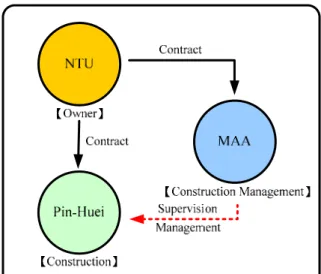
Figure 1: The organizational relationship of the NTU project
then arises about multi-dimensional information integration, management, and visualization of engineering projects. It follows from what has been mentioned earlier that an effective project management system should not only provide sufficient and comprehensive information to facilitate project management, but also provide the various visualization tools to assist with information distribution and communication.
As a result of the issues mentioned above, the research presented in this paper prototyped a project management tool called the Visual Project Management Information System (VisPMIS), which is based on the PIIM Framework [11]. This tool can assist construction management firms and teams to cope with issues of multi-dimensional information integration, management, and visualization of engineering project information, as well as achieving general project objectives of scope, quality, time, and cost.
2. REQUIREMENTS ANALYSIS OF VisPMIS
In this research, we selected a real engineering project in the campus of National Taiwan University (NTU) for case study. The project was about the construction of an underground parking area and an information center. As illustrated in Figure 1, the organization of this project may be divided into three roles of responsibility: the first one is NTU, who was the property owner and had a contractual relationship with the MAA Group and Pin-Huei Construction & Engineering (Pin-Huei). The second role is the MAA Group (MAA), a professional engineering and consulting service provider, who provided professional construction management services for NTU, while supervising and managing Pin-Huei. The third role belongs to Pin-Huei, a construction firm, who provided the physical workforce for the design and construction of this engineering project. Each of the major project
participants executed their respective project management responsibilities. However, in this research, the majority of the work was the responsibility of the construction management firm. We analyzed the project management requirement by interviewing MAA and NTU. After interviewing NTU, we were able to understand the responsibilities of MAA as stipulated in the contract and requested by owner. Once MAA was interviewed, we were able to then picture how the project management process would function in a practical context.
The main objective of MAA is to monitor and control all aspects of a project to achieve project goals such as completing on-time and to the specified cost, quality, and performance. The work performed by MAA is mainly focused on project management during engineering constructing. We can divide their main work activities into three phases: (1) the Project Preparation Phase, (2) the Project Construction Phase, and (3) the Project Completion Phase.
During the Project Preparation Phase, the main focus of MAA before construction is project information collection and verification. MAA obtained the planned project information from Pin-Huei and other project participants. The information includes schedule information, cost information, 3D models of the project, and relevant documents. After receiving the project information, MAA needs to examine the project information and verify its feasibility in order to implement corrective or preventive actions to bring the project into compliance with the project management plan. MAA then
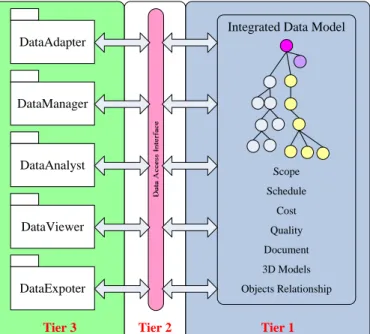
Figure 2: The three tiers of the PIIM framework submitted the planned project information to NTU. After NTU provided approval, the planned project information was then baselined and became a reference for controlling the project.
The Project Construction Phase consists of the processes used to complete the work defined in the project management plan to accomplish the project's requirements. Therefore, MAA controls the execution of the project, monitors the ongoing project activities against the project management plan and evaluates the project performance baseline in this phase. Additionally, MAA is responsible for effectively communicating with other project participants as information is needed to facilitate easy, effective, and timely decisions. These work items are required for achieving the project objectives on-time, and within the scope and budget.
In the Project Completion Phase, the main focus of MAA is on administrative activities which include project information management, project information maintenance, and information sharing. During this phase, they are responsible for filing and preserving the related project information and documents. Furthermore, the reciprocal sharing of project information allows the receiver to use the information for their own purposes and thus supply value added services.
This research prototyped VisPMIS according to the requirements for assisting MAA in achieving the objectives of the NTU project.
3. THE PIIM FRAMEWORK
This research takes advantage of the PIIM Framework [11] to develop VisPMIS in order to reduce the amount of programming time required. As shown in Figure 2, the PIIM Framework is an application framework which can be divided into three tiers: the first tier is the integrated data model, which describes and stores information about entire engineering projects; the second tier is the data access interface, which mainly deals with data access between the integrated data model and kernel module; the third tier is the kernel module, which provides core project management services and encapsulates complicated project management functions into five easy-to-use modules. These five modules are comprised of the following: (1) DataAdapter provides functions to receive
and transform the common data formats into the integrated data model; (2) DataManager is responsible for project data management and manipulation; (3) DataAnalyst provides functionality for performing Earned-Value analysis and calculation of schedule progress and quality statistics; (4) DataViewer provides five visualization style to assist the user in efficiently acquiring applicable information; (5) DataExporter can export data to three different data formats for broader exchange and sharing of data, the data formats are IFC, ifcxml, and GML.
Integrated Data Model DataAdapter DataManager DataAnalyst DataViewer DataExpoter Scope Schedule Cost Quality Document 3D Models Objects Relationship Tier 1 Tier 2 Tier 3
Figure 3: System architecture of VisPMIS
Figure 4: The main class diagram of VisPMIS Return DataAnalyst DataAdapter DataExporter DataManager Return Return DataViewer Return Return Return Return
4. DESIGN AND IMPLEMENTATION OF VisPMIS
The system architecture of VisPMIS is shown in Figure 3. All of the application functions implemented by VisPMIS are based on the PIIM Framework. Core project management services and the complicated functionilty of project information integration, management and visualization, are implemented in the PIIM Framework. In this paper, we mainly focus on the application service and the graphical user interface (GUI). In regards to the application service, we implemented the application functions as they are needed by MAA, using the services supported by the PIIM Framework. Furthermore, we designed and implemented the GUI to fit in with their requirements according to the specific workflow and needs of MAA.
Object-oriented technology was employed for the development of VisPMIS. Therefore, the conceptual model was developed using the Unified Modeling Language (UML), depicting the process and logical views of VisPMIS. As depicted in Figure 4, VisPMIS is established on the five easy-to-use modules of the PIIM Framework, while eighteen GUI forms are available for the user to control and manipulate VisPMIS. The implementation of VisPMIS was carried out in the Microsoft Visual Basic .NET environment.
Figure 6: nD model binding
5. DEMONSTRATION
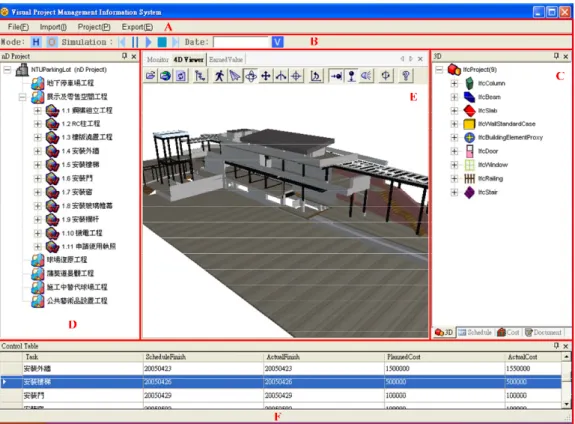
The NTU project mentioned earlier was used as an example to test and demonstrate the functionality of VisPMIS. Figure 5 illustrates the main graphical user interface (GUI) of VisPMIS. The upper-most menu bar (as indicated by Frame A) consists of menu items for quick access to the functions of VisPMIS. The second upper-most toolbar (as indicated by Frame B) is used to control the action of the construction simulation. The right-hand side window (as indicated by Frame C) is used to separately manage various construction project data. The left-hand side window (as indicated by Frame D) is used to facilitate the nD binding tasks. The middle window (as indicated by Frame E) is for the graphical visualization of 3D models and 4D simulation. The bottom window (as indicated by Frame F) is used to show related information for simulation and the Earned-Value method analysis.
Figure 5: The main graphical user interface of VisPMIS
The main set of functionality designed and implemented in VisPMIS will be demonstrated in this section. We can divide the functionality of VisPMIS under the following categories: (1) Multi-Dimensional Integrated Data Model, (2) Project Management, (3) Visualization, and (4) Information Sharing.
(1) Multi-Dimensional Integrated Data Model
VisPMIS can provide functions to assist the user in establishing the multi-dimensional integrated data model. First, we import existing project data into the VisPMIS software. VisPMIS can support approximately 80% of data formats from commercial software packages. The first format is the IFC file format; VisPMIS can import 3D models created using any commercial CAD software (for example, ArchiCAD, Triforma, and Revit). The second format is the ProjectXML file format; the system is capable of importing data which is
Figure 7: Earned Value Management
Figure 8: Monitor project work
Figure 9: Multi-data-view generated from MS Project or Primavera P3, and then transforming it into the IFC 2x3 data format
which is employed in the integrated data model for integration. The third is the Excel file format; VisPMIS can adapt and manipulate this data format for cost data integration. In order to bind a multi-dimensional integrated data model, the user can simply drag and drop selected 3D objects, schedule objects, cost objects, quality objects, and document objects to the target scope item in the left-hand side window as shown in Figure 6. The user is then able to save the data to create a new integrated data model.
(2) Project Management
VisPMIS provides a lot of useful functionality for project management. As shown in Figure 7, a user can employ the Earned Value Management (EVM) method [12], which is a project management technique used for measuring the project progress in an objective manner, to control and monitor the project. After the integrated data model is established, VisPMIS can be used to animate the progression of construction according to a given time interval. As Figure 8 illustrates, VisPMIS provides a main panel for users to monitor the project status according to the specified date. Additionally, the system can provide a multi-data-view for users to find and obtain the necessary and relevant data in a more direct and efficient way as shown in Figure 9.
(3) Visualization
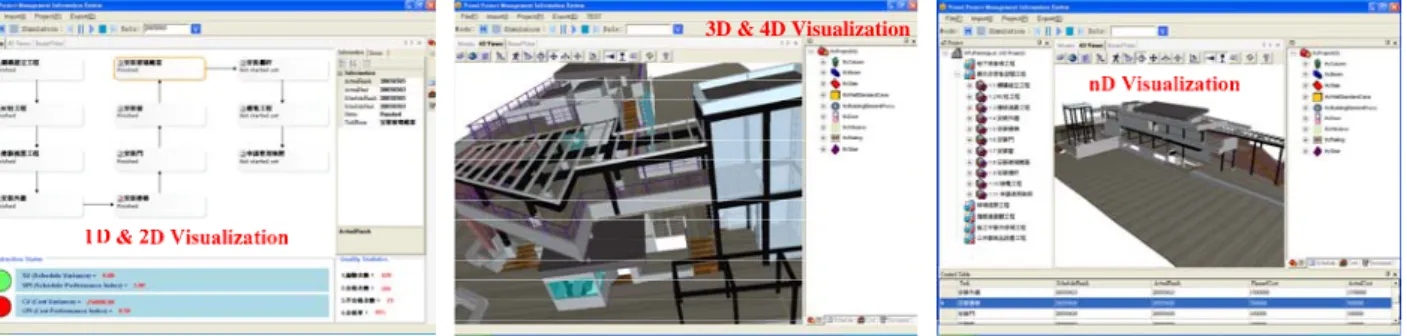
A good visual representation of data can assist people in efficiently acquiring applicable information. As shown in Figure 10, VisPMIS can provide 1D (text), 2D (graph and chart), 3D (3D Model), 4D (3D+Time Simulation), and nD (multi-dimensional information) visualization for communication among the project participants.
Figure 10: Visualization types in VisPMIS
(4) Information Sharing
VisPMIS can export project data to three different file formats. The first is the IFC data format, which is used for data exchange with IFC-based systems. The second is the ifcxml data format, which is utilized for data exchange with general information management systems using XML technology. The third and final format is the GML data format, which is used for integrating with 3D-GIS geo-data [13], as shown in Figure 11.
Figure 11: GML exporting function in VisPMIS [13]
6. CONCLUSION
This research prototyped a visual project management information system (VisPMIS) that is based on the PIIM Framework. It assists construction management firms in controlling and managing engineering projects. There are five major characteristics of VisPMIS: (1) with the establishment of an integrated data model, engineering project information can be stored intact and complete; (2) by representing the project information visually, the project manager can quickly grasp the present stage of an ongoing project, and communicate and coordinate accordingly with other project participants more efficiently; (3) with the support of data queries from a multi-data-view, users can find and obtain necessary and relevant data in a more direct and efficient way; (4) through the performance evaluation and statistical analysis functionality, the project management team can accurately monitor project progress; (5) the information in the integrated data model can be exported to different file formats for data exchange and sharing, thus increasing the value of the system while extending the application of the integrated information.
For the characteristics mentioned above, VisPMIS can not only integrate and manage engineering project information for construction management firms, but also effectively assist in controlling and monitoring the engineering project. In addition, a real engineering project example was used in this research to demonstrate the functionality and applicability of VisPMIS. We believe that VisPMIS can effectively assist construction management firms in achieving project goals and delivering the project with the best balance of cost, schedule, and quality.
REFERENCES
1. Kerzner, H., Project Management: A Systems Approach to Planning, Scheduling, and Controlling, 9/e, Wiley, USA, 2005.
2. Woolf, M. B., Faster Construction Projects with CPM Scheduling, McGraw Hill, USA, 2007. 3. Schmitz, J., “Boston Central Artery/Tunnel (CA/T) project. Interface management,”
Proceedings of the Project Management Institute Annual Seminars & Symposium, Dallas, TX, USA, Sep. 27-Oct. 2, 1991, pp. 312-317.
4. Parsons, B. K., James, J. E. and Reuss, M. C., “Automation Integration Over the Project Lifecycle for the Pueblo Chemical Agent-destruction Pilot Plant,” Proceedings of the ASME Design Engineering Technical Conference and Computers and Information in Engineering Conference, Salt Lake City, UT, USA, Sep. 28-Oct. 2, 2004, pp. 925-934.
5. Parsons Brinckerhoff, Corporate IT Tools SC DOT Construction and Resource Management,
PB Network, Issue 58, July, 2004.
6. Parsons Brinckerhoff, Building Our Future, PB Network, Issue 60, June, 2005.
7. Nagasaki, T., Banno, K., Wakasugi, K., Yasaka, A. and Tanimura, T., “LINCS (Kajima Linkage of Information for New Construction System),” Proceedings of the Eight International Conference on: Computing in Civil and Building Engineering, Stanford, CA, USA, Aug. 14-16, 2000, pp. 518-525.
8. Pena-Mora, F. and Tanaka, S., “Information Technology Planning Framework for Japanese General Contractors,” Journal of Management in Engineering, Vol. 18, No. 3, pp. 138-149, 2002.
9. Hsieh, S. H., Chen, C. S., Liao, Y. F., Yang, C. T. and Wu, I. C., “Experiences on Development of a 4D PLANT Construction Simulation System,” Proceedings of the 11th International Conference on Computing in Civil and Building Engineering, Montreal, Canada, June 14-16, 2006.
10. Hsieh, S. H., Chen, C. S., Liao, Y. F., Yang, C. T. and Wu, I. C., “Construction Director: 4D Simulation System for Plant Construction,” Proceedings of the Tenth East Asia-Pacific Conference on Structural Engineering and Construction (EASEC-10), Bangkok, Thailand, Aug. 3-5, 2006, pp. 135-140.
11. Wu, I. C., “Integration, Management and Visualization of Multi-Dimensional Information in Engineering Projects,” Doctoral Dissertation, Department of Civil Engineering, National Taiwan University, Taipei, Taiwan, 2007 (in Chinese).
12. Fleming, Q. W. and Koppelman, J. M., Earned Value Project Management, Third edition, Project Management Institute, 212 pages, 2005.
13. Wu, I. C. and Hsieh, S. H., “Transformation from IFC Data Model to GML Data Model: Methodology and Tool Development,” Journal of the Chinese Institute of Engineers, Vol. 30, No. 6, pp. 1085-1090, 2007.

![Figure 11: GML exporting function in VisPMIS [13]](https://thumb-us.123doks.com/thumbv2/123dok_us/8691422.2351497/7.892.198.705.285.566/figure-gml-exporting-function-vispmis.webp)
