IBM Cúram Social Program Management
Cúram Modeling Reference Guide
This edition applies to version 6.0.4 of IBM Cúram Social Program Management and all subsequent releases and modifications unless otherwise indicated in new editions.
Licensed Materials - Property of IBM
Copyright IBM Corporation 2012. All rights reserved.
US Government Users Restricted Rights - Use, duplication or disclosure restricted by GSA ADP Schedule Contract with IBM Corp.
Table of Contents
Chapter 1Introduction ... 1
1.1Overview ... 1
1.2Intended Audience ... 2
1.3Prerequisites ... 2
1.4Rational Software Architect ... 2
1.5The Cúram Server Code Generator ... 2
1.6Chapters in this Guide ... 3
1.6.1Part 1 - UML Overview ... 3
1.6.2Part 2 - Class Stereotypes ... 3
1.6.3Part 3 - Attribute Stereotypes ... 4
1.6.4Part 4 - Operation Stereotypes ... 4
1.6.5Part 5 - Relationship Stereotypes ... 4
1.6.6Part 6 - Other Topics ... 5
Chapter 2UML Overview ... 7
2.1UML and the Input Meta-model ... 7
2.2Overview of the Architecture Layers ... 7
2.2.1Remote Interface Layer ... 7
2.2.2Business Object Layer ... 7
2.2.3Data Access Layer ... 8
2.3Stereotypes ... 8 2.3.1Class Stereotypes ... 8 2.3.2Attribute Stereotypes ... 9 2.3.3Operation Stereotypes ... 10 2.3.4Relationship Stereotypes ... 11 2.4Data types ... 12 Chapter 3Packages ... 16 3.1Overview ... 16 3.2Options ... 16 3.2.1CODE_PACKAGE ... 16
Chapter 4Audit Mappings Classes ... 19
4.1Overview ... 19
4.2Rules ... 19
4.3Outputs ... 21
Chapter 5Domain Definition Classes ... 23
5.1Overview ... 23
5.1.1Defining a Domain Hierarchy ... 24
5.1.2Proper Use of Domains ... 25
5.1.3Storage Options for String Domains ... 25
5.2Options ... 27
5.2.1Code Table Name ... 27
5.2.2Code Table Root ... 27
5.2.3Compress Embedded Spaces ... 27
5.2.4Convert to Uppercase ... 28
5.2.5Custom Validation Function Name ... 28
5.2.6Default ... 28
5.2.7Maximum Size ... 28
5.2.8Maximum Value ... 29
5.2.9Minimum Size ... 29
5.2.10Minimum Value ... 29
5.2.11Multibyte Expansion Factor ... 29
5.2.12Pattern Match ... 29
5.2.13Remove Leading Spaces ... 30
5.2.14Remove Trailing Spaces ... 30
5.2.15Storage Type ... 30
5.3Overriding a Domain Definition ... 30
5.3.1How to use Domain Definition Overrides ... 30
5.3.2Considerations / Limitations ... 30
5.3.3Usage Rules ... 31
Chapter 6Entity Classes ... 33
6.1Overview ... 33 6.2Rules ... 33 6.3Attributes ... 34 6.3.1Details ... 34 6.3.2Key ... 34 6.4Operations ... 34 6.4.1Database Operations ... 34 6.4.2Non-database Operations ... 34 6.5Outputs ... 35
6.5.1Standard Key Structs ... 35
6.5.2Standard Details Structs ... 35
6.5.3Standard List Structs ... 35
6.6Options ... 35
6.6.1Abstract ... 36
6.6.2Allow Optimistic Locking ... 36
6.6.3Audit Fields ... 36
6.6.4Enable Validation ... 36
6.6.5Last Updated Field ... 36
6.6.6No Generated SQL ... 36
6.6.7Replace Superclass ... 37
6.7Concurrency Control - Optimistic Locking ... 37
6.8.1Information Captured by Table-level Auditing ... 38
6.8.2Storage of Audit Information ... 39
6.9Exit Points ... 40
6.9.1Pre Data Access ... 40
6.9.2Post Data Access ... 40
6.9.3Validation ... 40
6.9.4On-fail ... 40
6.9.5Exit Point Parameters ... 41
6.9.6What should exit points be used for ... 41
6.9.7What should exit points not be used for ... 41
6.10Entity Inheritance ... 42
6.10.1Rules when Using Entity Inheritance ... 42
6.11Last Updated Field ... 42
Chapter 7Extension Classes ... 44
7.1Overview ... 44
7.2How to use Extension Classes ... 44
7.3When to use Extension Classes ... 44
7.4Considerations / Limitations ... 45
7.5Usage Rules ... 45
Chapter 8Facade Classes ... 46
8.1Overview ... 46 8.2Rules ... 46 8.3Operations ... 46 8.3.1default ... 46 8.3.2batch ... 47 8.3.3wmdpactivity ... 47 8.3.4qconnector ... 47 8.4Options ... 47 8.4.1Abstract ... 47
8.4.2Generate Facade Bean ... 47
8.4.3Replace Superclass ... 47
Chapter 9Process Classes ... 48
9.1Overview ... 48
9.2Business Process Objects ... 48
9.3Rules ... 49 9.4Operations ... 49 9.4.1default ... 49 9.4.2batch ... 49 9.4.3wmdpactivity ... 49 9.4.4qconnector ... 49 9.5Options ... 50 9.5.1Abstract ... 50 9.5.2Generate FIDs ... 50 9.5.3Replace Superclass ... 50
Chapter 10Struct Classes ... 51
10.1Overview ... 51
10.2Rules ... 51 10.3Outputs ... 52 10.4Options ... 52 10.4.1Audit Fields ... 52 Chapter 11Attributes ... 53 11.1Overview ... 53 11.2Attribute Rules ... 53 11.3Attribute Options ... 54 11.3.1Allow NULLs ... 54
11.3.2Multibyte Expansion Factor ... 54
Chapter 12Operations ... 56
12.1Overview ... 56
12.2Rules ... 56
12.3Operation Options ... 57
12.3.1Audit BI (Business Interface) Calls to this Operation ... 57
12.3.2Auto ID Field ... 57
12.3.3Auto ID Key ... 57
12.3.4Business Date ... 57
12.3.5BytesMessage encoding character set ... 60
12.3.6Database Table-level Auditing ... 60
12.3.7Field Level Security ... 61
12.3.8JNDI name of the QueueConnectionFactory class ... 62
12.3.9JNDI name of the transmission queue ... 62
12.3.10JNDI name of the reply queue ... 62
12.3.11Message type ... 62
12.3.12No Generated SQL ... 62
12.3.13On Fail Operation ... 64
12.3.14Optimistic Locking ... 64
12.3.15Order By ... 64
12.3.16Post Data Access Operation ... 64
12.3.17Pre Data Access Operation ... 65
12.3.18Readmulti_Max ... 65
12.3.19Readmulti_Informational ... 65
12.3.20Response message timeout (seconds) ... 65
12.3.21Security ... 65
12.3.22SQL ... 66
12.3.23Transactional ... 66
12.3.24Where ... 66
12.4Operation Parameter Options ... 66
12.4.1Mandatory Fields ... 66
Chapter 13Entity Operations Overview ... 68
13.1Introduction ... 68
13.2Standard Operations ... 68
13.2.1Standard Single-Record Operations ... 68
13.2.2Standard Multi-Record Operations ... 69
13.3Non-Standard Operations ... 69
13.3.2Handcrafted SQL Operations ... 70
13.4Non-Key Operations ... 70
13.5Batch Operations ... 70
Chapter 14Entity Insert Operations ... 71
14.1Overview ... 71
14.2Standard Insert ... 71
14.2.1Description ... 71
14.2.2Use ... 71
14.2.3Parameter and Generator Notes ... 72
14.3Non-standard Insert (Generated SQL) ... 72
14.3.1Description ... 72
14.3.2Use ... 72
14.3.3Parameter and Generator Notes ... 73
Chapter 15Entity Read Operations ... 74
15.1Overview ... 74
15.2Standard Read ... 74
15.2.1Description ... 74
15.2.2Use ... 74
15.2.3Parameter and Generator Notes ... 75
15.3Standard Readmulti ... 75
15.3.1Description ... 75
15.3.2Use ... 75
15.3.3Parameter and Generator Notes ... 76
15.4Non-standard Read (Generated SQL) ... 76
15.4.1Description ... 76
15.4.2Use ... 76
15.4.3Parameter and Generator Notes ... 76
15.5Non-standard Readmulti (Generated SQL) ... 77
15.5.1Description ... 77
15.5.2Use ... 77
15.5.3Parameter and Generator Notes ... 77
15.6Non-key Read ... 78
15.6.1Description ... 78
15.6.2Use ... 78
15.6.3Parameter and Generator Notes ... 78
15.7Non-key Readmulti ... 79
15.7.1Description ... 79
15.7.2Use ... 79
15.7.3Parameter and Generator Notes ... 79
Chapter 16Entity Update Operations ... 80
16.1Overview ... 80
16.2Standard Modify ... 80
16.2.1Description ... 80
16.2.2Use ... 80
16.2.3Parameter and Generator Notes ... 81
16.3Non-standard Modify (Generated SQL) ... 81
16.3.1Description ... 81
16.3.2Use ... 81
16.3.3Parameter and Generator Notes ... 81
16.4Non-key Modify ... 82
16.4.1Description ... 82
16.4.2Use ... 82
16.4.3Parameter and Generator Notes ... 82
Chapter 17Entity Delete Operations ... 83
17.1Overview ... 83
17.2Standard Remove ... 83
17.2.1Description ... 83
17.2.2Use ... 83
17.2.3Parameter and Generator Notes ... 84
17.3Non-standard Remove (Generated SQL) ... 84
17.3.1Description ... 84
17.3.2Use ... 84
17.3.3Parameter and Generator Notes ... 84
17.4Non-key Remove ... 85
17.4.1Description ... 85
17.4.2Use ... 85
17.4.3Parameter and Generator Notes ... 85
Chapter 18Entity Batch Operations ... 86
18.1Overview ... 86
18.2BatchInsert ... 86
18.2.1Description ... 86
18.2.2Use ... 87
18.2.3Parameter and Generator Notes ... 87
18.3BatchModify ... 88
18.3.1Description ... 88
18.3.2Use ... 88
18.3.3Parameter and Generator Notes ... 88
Chapter 19Entity Handcrafted SQL Operations ... 90
19.1Overview ... 90
19.2Non-standard ... 90
19.2.1Description ... 90
19.2.2Use ... 91
19.2.3Parameter and Generator Notes ... 91
19.3Non-standard multi ... 91
19.3.1Description ... 91
19.3.2Use ... 92
19.3.3Parameter and Generator Notes ... 92
19.3.4Example 1 - nsmulti with a Single (List) Parameter ... 92
19.3.5Example 2 - nsmulti with Two Parameters (Key + List) ... 94
19.4Using Handcrafted SQL in Non-Standard Entity Operations ... 97
19.4.1Overview ... 97
19.4.2Using Host Variables ... 97
19.4.3Null Considerations ... 97
19.4.5SQL Example 1 ... 99
19.4.6SQL Example 2 ... 99
Chapter 20Aggregation ... 101
20.1Overview ... 101
20.2Rules when Using Aggregation ... 101
20.3A Special Case ... 101
20.4One-to-One Aggregation ... 101
20.5One-to-Many Aggregation ... 103
Chapter 21Assignable ... 105
21.1Overview ... 105
21.2Explicit Field Assignment ... 106
21.3Suppressing Default Assignment Fields ... 108
21.4Combining structs ... 109
Chapter 22Foreign Keys ... 110
22.1Overview ... 110
22.2Rules when Using Foreign Keys ... 110
22.3How to Add a Foreign Key to a Database Table ... 110
22.4Naming Primary and Foreign Key Constraints ... 111
22.5Example ... 111
Chapter 23Indices ... 113
23.1Overview ... 113
23.2Rules when Using Indices ... 113
23.3How to Add an Index to a Database Table ... 113
23.4Naming Indices ... 114
23.5Example ... 114
Chapter 24Unique Indices ... 116
24.1Overview ... 116
Chapter 25Generated Class Hierarchy ... 118
25.1Overview ... 118
25.2Basic Hierarchy Example ... 118
25.3Hierarchy for Subclasses ... 120
25.4Hierarchy for Abstract Classes ... 121
25.5Considerations ... 122
25.5.1Access Control - private/protected/public/package ... 122
25.5.2The Meaning of super ... 122
25.5.3Enforcing the Factory Mechanism ... 122
25.6Summary ... 122
Chapter 26Cúram JMS Queue Connectors ... 124
26.1Overview ... 124
26.2How It Works / What It Does ... 124
26.3Options on qconnector Operations ... 125
26.4How to Use qconnector Operations ... 126
26.4.1 Decide on Format of Message and Create the struct(s) to Correspond to the Message ... 126
26.4.2Add the operation to the application meta-model. ... 126
26.4.3Configure the Queues in the Application Server ... 126
26.4.4Implement the message recipient in the remote system ... 127
26.5Rules / Restrictions ... 127
26.6Encoding Methods for Fundamental Types ... 127
26.7Using Customized Encoding/Decoding Classes ... 128
26.8Example 1 - Working with Variable Length Fields ... 129
26.9Example 2 - Working with Lists ... 131
Chapter 27Subclassing ... 136
27.1Introduction ... 136
27.2Reasons for Subclassing ... 136
27.3How to Model It ... 136
27.3.1Basic Subclassing ... 136
27.3.2Replacing the Superclass ... 137
27.3.3Abstract Classes ... 137
27.3.4Restrictions ... 137
27.4How to write Code for Subclassing ... 138
27.5Example - Using Subclassing to Override Entity Exit Points ... 138
27.5.1Overriding Validation Exit Point ... 138
27.5.2Overriding Pre Data Access, Post Data Access, and On-Fail exit points . 138 Chapter 28Application Customization ... 140
28.1Overview ... 140
Chapter 1
Introduction
1.1
Overview
IBM Cúram Social Program Management enables the creation of
client-server applications by minimizing the complexity application developers face in developing database access, EJB management, client-server interac-tion, etc. This minimizing of complexity is achieved by developers model-ing the application(s) they wish to create usmodel-ing a UML1meta-model.
The Cúram Generator uses this UML meta-model to automatically generate all the required stubs, skeletons, classes, and communications required to in-teract with a back-end database and remote clients leaving the developer to concentrate on providing the application business logic. This guide de-scribes the tools and components available to an application developer when they are modeling the application, and how the Cúram Server Code
Gener-ator will treat each of these components when generating classes.
The UML meta-model is a platform-independent model which describes the following aspects of the application:
• Domains—application-specific datatypes. Analogous to C++ typedefs.
• Entities—the objects modelled and persistently stored by the
applica-tion. These correspond to relational database tables.
• Processes—related sets of activities to achieve some business goal.
• Structs—passed as messages throughout the application. Analogous to
structs in C++.
• Remote Interfaces—client-visible interfaces through which server
func-tionality may be accessed.
This document provides a reference for Cúram model-based functionality such as: Cúram domains, classes, operations, attributes and how they map to the underlying database.
The model is edited using the IBM® Rational® Software Architect and code is generated using the Cúram Server Code Generator.
1.2
Intended Audience
This document should be read by people who will be using the Cúram Serv-er Development Environment for Java® (SDEJ) tools to genServ-erate applica-tions from UML models.
1.3
Prerequisites
The reader should be familiar with Cúram model development concepts and should have a good working knowledge of the following before reading this document:
• Cúram server development (see the Cúram Server Developer's Guide for more details);
• Rational Software Architect;
• SQL; • UML; • Java.
1.4
Rational Software Architect
Rational Software Architect is the third-party tool used for developing and
maintaining the UML meta-model. It is primarily used as a tool for object mapping, analysis and design. A key reason Rational Software Architect was selected for these functions is because of its extensibility, which en-ables support of modeling for Cúram. The use of Rational Software
Archi-tect is covered in the Working with the Cúram Model in Rational Software Architect document.
Note
Please refer to the Cúram Supported Prerequisites document for more information on the supported versions of third party tools.
1.5
The Cúram Server Code Generator
The Cúram Server Code Generator takes as its input the UML meta-model and produces the following outputs:
• Java server implementation code;
• XML2for the database entities and other classes in the model.
1.6
Chapters in this Guide
This chapters in this guide can be logically grouped into six parts as de-scribed below.
1.6.1
Part 1 - UML Overview
Part 1 consists of a high-level overview of UML and how it applies to Cúram modeling. These are the chapters making up this part:
• Chapter 2 UML Overview • Chapter 3 Packages
1.6.2
Part 2 - Class Stereotypes
Part 2 provides reference and usage information for the various class stereo-types used with Cúram modeling and related topics.
Some notes applicable to classes in general:
• Two or more struct or process classes may have the same name provided they are in different packages and have different CODE_PACKAGE
names. All other class names must be completely unique within the in-put model. For more information on theCODE_PACKAGEoption see the CODE_PACKAGE option in Section 3.2, Options.
• All classes and domain definitions are visible to each other throughout the model.
• All new classes should be created within a sub-package of a custom model. It is advisable to model new classes within a suitable package structure. The package structure within the Cúram model is a good pat-tern to follow. For clarity, new class name should be prefixed with a rel-evant acronym or abbreviated word as discussed in the Cúram
Develop-ment Compliancy Guide.
These are the chapters making up this part: • Chapter 4 Audit Mappings Classes • Chapter 5 Domain Definition Classes • Chapter 6 Entity Classes
• Chapter 7 Extension Classes • Chapter 8 Facade Classes • Chapter 9 Process Classes
• Chapter 10 Struct Classes
1.6.3
Part 3 - Attribute Stereotypes
Part 3 provides reference and usage information for the attribute stereotypes used with Cúram modeling and is made up of this chapter:
• Chapter 11 Attributes
1.6.4
Part 4 - Operation Stereotypes
Part 4 provides reference and usage information for the operation stereo-types used with Cúram modeling and related topics. These are the chapters making up this part:
• Chapter 12 Operations
• Chapter 13 Entity Operations Overview • Chapter 14 Entity Insert Operations • Chapter 15 Entity Read Operations • Chapter 16 Entity Update Operations • Chapter 17 Entity Delete Operations • Chapter 18 Entity Batch Operations
• Chapter 19 Entity Handcrafted SQL Operations
1.6.5
Part 5 - Relationship Stereotypes
Part 5 provides provides reference and usage information for the relation-ship stereotypes used with Cúram modeling and related topics.
Adding relationships to existing classes can be accomplished as follows: Create a class diagram in the custom area of the model and drag the existing class(es) onto this diagram. This does not create a copy of the class, rather, it creates a reference to it. Model the relationship on this diagram as normal. These are the chapters making up this part:
• Chapter 20 Aggregation • Chapter 21 Assignable • Chapter 22 Foreign Keys • Chapter 23 Indices
1.6.6
Part 6 - Other Topics
Part 6 provides reference and usage information for other modeling topics. These are the chapters making up this part:
• Chapter 25 Generated Class Hierarchy • Chapter 26 Cúram JMS Queue Connectors • Chapter 27 Subclassing
• Chapter 28 Application Customization
Notes
1
UML stands for Unified Modeling Language and is an open method used to specify, visualize, construct and document the artifacts of an object-ori-ented software system under development.
2The XML produced by the Cúram Server Generator is then processed by
the Cúram Data Manager (described in the Cúram Server Developer's
Guide), which produces the relevant SQL scripts that are used to create the
Chapter 2
UML Overview
2.1
UML and the Input Meta-model
UML constructs, created and maintained by the user with Rational Software
Architect, are referred to collectively as the input meta-model and this is
used as input to the Cúram generator. It is a logical representation of the system being developed. Another way of looking at it is: it is the mechanism that developers use in order to tell the generator what to generate.
This meta-model consists of a set of packages, which in turn contain class representations, potentially containing attributes and operations, which have relationships with one another. Classes in the input meta-model result in various generated Java classes and in some cases tables and indices in gen-erated DDL1.
2.2
Overview of the Architecture Layers
The Cúram architecture is conceptually divided into three layers, as follows.
2.2.1
Remote Interface Layer
The Remote Interface Layer presents an interface to business functions that can be used by a client program. It also interacts with third-party middle-ware components to ensure consistency and atomicity of the transactions that execute in business functions.
2.2.2
Business Object Layer
The Business Object Layer implements all of the server's business function-ality. As such, this layer contains the business application's “smarts”. Within this layer, Business Process Objects (BPOs) represent the basic business en-tities modeled by the server application. BPOs implement the business logic
of a Cúram server application. Typically these are responsible for manipu-lating Entity Objects in a business-specific way. This is where most of the development effort is (or should be) concentrated in business application de-velopment. For more information about BPOs, see Chapter 9, Process
Classes.
2.2.3
Data Access Layer
The Data Access Layer is responsible for all interactions with the back end Relational Database Management System (RDBMS). For more information about Entities, see Chapter 6, Entity Classes.
2.3
Stereotypes
Stereotypes are a UML concept used to further describe the various aspects of the Cúram application model. In UML a stereotype is a string expression used to assign a classification to an object.
In general, stereotypes affect the behavior of the generator and thus determ-ine its output. For example, an entity class is identified by having a stereo-type of <<entity>> and consequently will have DDL and data-access code produced by the generator.
The supported stereotypes are as shown in the following sections.
2.3.1
Class Stereotypes
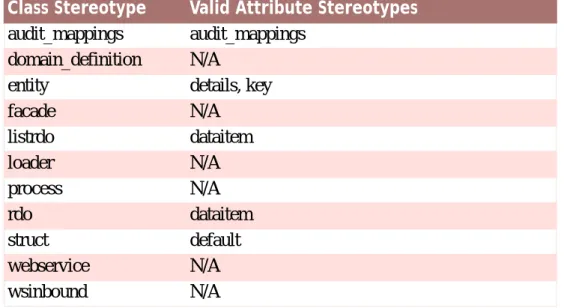
The following table lists the class stereotypes with a short description and reference to where they are described in more detail.
Stereotype Description Reference
audit_mappings An audit mappings class enables additional fields to be defined in the data-base for auditing pur-poses.
Chapter 4, Audit
Map-pings Classes
domain_definition A domain definition is a meta-model class which defines a datatype.
Chapter 5, Domain
Defini-tion Classes
entity An entity class encapsu-lates data-maintenance functionality on a data-base table.
Chapter 6, Entity Classes
extension Extension classes are in-tended to be used to change theAudit FieldsorLast Up-dated Fieldoptions
Chapter 7, Extension
Stereotype Description Reference of an<<entity>>or
<<struct>>class. facade Facade classes are used to
create client-visible opera-tions. They provide a sim-plified interface to a larger body of code, such as a class.
Chapter 8, Facade Classes
listrdo ListRDO classes are simply an aggregation (list) of RDO classes.
Cúram Rules Codification Guide
loader Loader classes are spe-cified for rules data items in the model (<<rdo>>
&<<listrdo>>).
Cúram Rules Codification Guide
process A process class encapsu-lates a business process.
Chapter 9, Process
Classes
rdo RDO (Rules Data Object) classes are used to contain data used by the Cúram rules engine.
Cúram Rules Codification Guide
struct A struct class is a meta-model representation of a
Java class containing a
collection of fields.
Chapter 10, Struct Classes
webservice A WebService class rep-resents an inbound legacy web service.
Cúram Web Services Guide
wsinbound A WS Inbound class rep-resents an inbound web service.
Cúram Web Services Guide
Table 2.1Cúram Class Stereotypes
2.3.2
Attribute Stereotypes
The following table lists the attribute stereotypes with a short description and reference to where they are described in more detail.
Stereotype Description Reference
audit_mappings An audit field entry on the Audit Mappings Class.
Chapter 4, Audit
Map-pings Classes
dataitem A attribute on a RDO or ListRDO class.
Cúram Rules Codification Guide
Stereotype Description Reference default A public attribute or field
in a struct class.
Chapter 10, Struct Classes
details An attribute or field which is part of an entity but not part of the entity key.
Chapter 6, Entity Classes
key An attribute or field which is part of an entity's key.
Chapter 6, Entity Classes
Table 2.2Cúram Attribute Stereotypes
2.3.3
Operation Stereotypes
The following table lists the operation stereotypes with a short description and reference to where they are described in more detail.
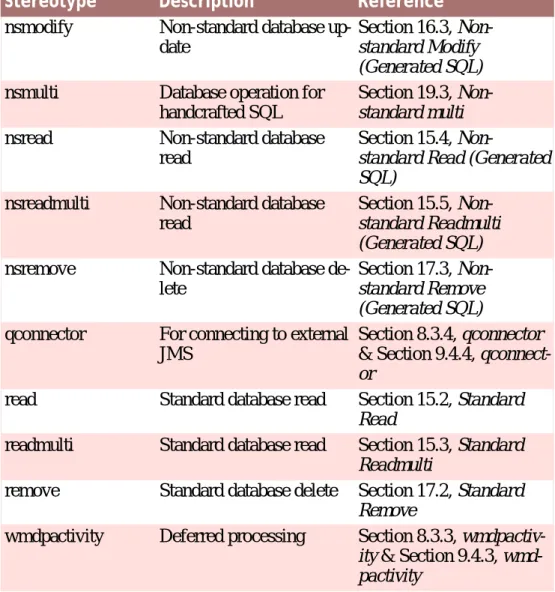
Stereotype Description Reference
batch Process by the Batch Launcher via generated wrapper code
Section 8.3.2, batch & Section 9.4.2, batch
batchinsert For inserting large
amounts of data via batch
Section 18.2, BatchInsert
batchmodify For modifying large amounts of data via batch
Section 18.3, BatchModify
default Standard non-database op-eration
Section 8.3.1, default & Section 9.4.1, default insert Standard database insert Section 14.2, Standard
In-sert
modify Standard database update Section 16.2, Standard
Modify
nkmodify Non-key database update Section 16.4, Non-key
Modify
nkread Non-key database read Section 15.6, Non-key
Read
nkreadmulti Non-key database read Section 15.7, Non-key
Readmulti
nkremove Non-key database delete Section 17.4, Non-key
Re-move
ns Database operation for handcrafted SQL
Section 19.2,
Non-standard
nsinsert Non-standard database in-sert
Section 14.3,
Non-standard Insert (Generated SQL)
Stereotype Description Reference nsmodify Non-standard database
up-date
Section 16.3,
Non-standard Modify (Generated SQL)
nsmulti Database operation for handcrafted SQL
Section 19.3,
Non-standard multi
nsread Non-standard database read
Section 15.4,
Non-standard Read (Generated SQL)
nsreadmulti Non-standard database read
Section 15.5,
Non-standard Readmulti (Generated SQL)
nsremove Non-standard database de-lete
Section 17.3,
Non-standard Remove (Generated SQL)
qconnector For connecting to external JMS
Section 8.3.4, qconnector & Section 9.4.4,
qconnect-or
read Standard database read Section 15.2, Standard
Read
readmulti Standard database read Section 15.3, Standard
Readmulti
remove Standard database delete Section 17.2, Standard
Remove
wmdpactivity Deferred processing Section 8.3.3,
wmdpactiv-ity & Section 9.4.3, wmd-pactivity
Table 2.3Cúram Operation Stereotypes
2.3.4
Relationship Stereotypes
The following table lists the attribute stereotypes with a short description and reference to where they are described in more detail.
Stereotype Description Reference
aggregation The ability to embed or nest instance(s) of one type of class within anoth-er type of class
Chapter 20, Aggregation
assignable An assignable relationship provides the ability to map differing or exclude fields for an assign
func-Chapter 21, Assignable
Stereotype Description Reference tion.
extension The link between an ex-tension class and target class.
Chapter 7, Extension
Classes
foreignkey A modeled description of a database foreign key.
Chapter 22, Foreign Keys
index A modeled description of a database index.
Chapter 23, Indices
uniqueindex A modeled description of a database unique index.
Chapter 24, Unique
In-dices
Table 2.4Cúram Relationship Stereotypes
2.4
Data types
The input meta-model supports a number of data types that provide abstrac-tion for the developer from the different underlying data types used by the database, middleware and Java layers. These data types can be used to define attributes, arguments and return values in a platform and database neutral way, and the SDEJ will take care of mapping them to the appropriate data type in each layer of the application.
Type Description
SVR_BLOB Used for holding binary data.
Corresponds to classcuram.util.type.Blob. Requires a size qualifier although this is only actually used if the field is used on a database table.
Fields of typeSVR_BLOBmay be null on the data-base.
SVR_BOOLEAN Used for holding binary values.
Corresponds to the primitive Java typeboolean. Is stored as a single character field on the database where0= false and1= true.
Fields of typeSVR_BOOLEANcannot be null on the database.
SVR_CHAR Used for holding single character values. Note that this data type cannot be used to hold strings or arrays of characters and therefore does not take a size quali-fier.
Type Description
Fields of typeSVR_CHARcannot be null on the data-base.
SVR_DATE Used for holding date values with a resolution of one day.
Corresponds to classcuram.util.type.Date. Fields of typeSVR_DATEcan be stored as null on the database.
SVR_DATETIME Used for holding date and time values with a resolu-tion of one second.
Corresponds to classcuram.util.type.Date. Fields of typeSVR_DATETIMEcan be stored as null on the database.
SVR_DOUBLE Used for holding floating point numbers.
Corresponds to the primitive Java typedouble. Fields of typeSVR_DOUBLEcannot be null on the database.
SVR_FLOAT Used for holding floating point numbers. Used for holding floating point numbers. Corresponds to the primitive Java typefloat. Fields of typeSVR_FLOATcannot be null on the database.
SVR_INT8 An eight bit integer.
Corresponds to the primitive Java typebyte.
Fields of typeSVR_INT8cannot be null on the data-base.
SVR_INT16 A sixteen bit integer.
Corresponds to the primitive Java typeshort. Fields of typeSVR_INT16cannot be null on the database.
SVR_INT32 A thirty-two bit integer.
Corresponds to the primitive Java typeint. Fields of typeSVR_INT32cannot be null on the database.
SVR_INT64 A sixty-four bit integer.
Corresponds to the primitive Java typelong. Fields of typeSVR_INT64may be null on the
Type Description base.
SVR_MONEY A fixed point numeric value with two decimal places used for holding currency values.
Corresponds to the primitive Java type
curam.util.type.Money.
Fields of typeSVR_MONEYcannot be null on the database.
SVR_STRING Used for holding string values. Corresponds to the Java class
java.lang.String.
ASVR_STRINGmay optionally have a length quali-fier. ASVR_STRINGwithout a length qualifier is a
SVR_UNBOUNDED_STRING. Strings stored on the database must have a length qualifier to enable a max-imum size to be specified for the database column. ASVR_STRINGcan be stored on the database as eitherCHAR,VARCHARorCLOBdepending on its size and the type of database. For more information about storage options for strings, see Section 5.1.3,
Storage Options for String Domains.
Fields of typeSVR_STRINGmay be null on the data-base.
SVR_UNBOUNDE D_STRING
Used for holding string values for which a maximum length need not be specified.
Corresponds to the Java class
java.lang.String.
SVR_UNBOUNDED_STRINGis the only Cúram data type which cannot be used by an attribute of an
<<entity>>class. This is because this data type does not allow the developer to specify its maximum size and therefore cannot be used to define a database column. To define a string field on an<<entity>>
you must useSVR_STRINGwith a length qualifier. Table 2.5Cúram Data Types
Notes
1
DDL means Database Definition Language. It is an SQL language subset enabling the structure and instances of a database to be defined in a human and machine-readable form.
Packages
3.1
Overview
The package structure in the UML meta-model does not affect any of the generated outputs. The hierarchy of the meta-model is effectively “flattened” during the build process.
The one area where the structure of the hierarchy is significant is that op-tions, which can be specified at package level, will apply to all classes and other packages within that package. However, any option can be overridden in any of the sub-packages by setting the option at that level to its new value.
3.2
Options
3.2.1
CODE_PACKAGE
It is possible for two or more process or struct classes in the model to have the same name. Equally named classes are distinguished (on the server side only) by theirCODE_PACKAGEvalue which may be specified for one of its containing packages.
The CODE_PACKAGE option, when specified, affects struct, entity, facade and process classes within that package and in the packages contained with-in that package. Applywith-ing theCODE_PACKAGEoption to a class has the ef-fect of moving that class into a package within the default package,curam, and including any of the package's parent CODE_PACKAGE options. The following example outlines how this works:
For example, the UML meta-model classMyProcessin the model causes the following Java classes to be created:
• <ProjectPackage>.base.MyProcess
• <ProjectPackage>.fact.MyProcessFactory
and the developer must implement:
• <ProjectPackage>.impl.MyProcess
If the developer wishes to create another class named MyProcess, they can do so provided that they create the class within a package for which a differentCODE_PACKAGE option has been specified. This is to ensure that the corresponding Java classes can be stored in separate locations on disk. The developer specifies the following option for the package containing the
MyProcessclass (this must be manually typed into the documentation for the package in the UML meta-model):
• CODE_PACKAGE=custom
In this instance the following classes and interfaces will result: • <ProjectPackage>.custom.intf.MyProcess
• <ProjectPackage>.custom.base.MyProcess
• <ProjectPackage>.custom.fact.MyProcessFactory
and the developer must implement:
• <ProjectPackage>.custom.impl.MyProcess
Rules for the CODE_PACKAGEFeature
• CODE_PACKAGEvalues must be valid Java identifiers.
• Setting the CODE_PACKAGE option for a package recursively affects sub-packages and process, facade, entity and struct classes within the package.
• Specifying aCODE_PACKAGEvalue within a package whose parent has specified a CODE_PACKAGE will override the value specified by the parent rather than append to it.
For example:
• PackageAcontains packageB
• PackageAspecifiesCODE_PACKAGE=cp1
• PackageBspecifiesCODE_PACKAGE=cp2
Then:
• The effective code package of classes in packageAiscp1
• The effective code package of classes in package B is cp2 (Not
cp1.cp2).
• ACODE_PACKAGEsetting of.(dot) or$is interpreted as blank. (This is because a literal blank is ignored by the generator and therefore can-not be used to override a non-blank setting.)
• Multiple level code packages may be specified using a similar syntax to
Java packages whereby each level is delimited by a dot. For example,
the following code package setting represents three levels of Java pack-ages:
CODE_PACKAGE=cp1.cp2.cp3
• TheCODE_PACKAGE option allows multiple struct and process classes to have the same name, however only one instance of each facade class name may exist. Cúram clients currently cannot distinguish between multiple facade classes with the same name, regardless of their
CODE_PACKAGEsetting.
• The behavior of the CODE_PACKAGE option with entity classes is the same as that of process and struct classes in that the resulting generated interface and struct classes are produced in different packages. However, entity class names must still be unique throughout the application re-gardless of the CODE_PACKAGEoption setting. This is due to the fact that all entities correspond to tables in the single underlying database. • Generated list wrapper structs (triggered by the existence of readmulti
operations) are produced in the same code package as the structs that they wrap. Note that this will not necessarily be the same code package as the operation which caused their creation.
Chapter 4
Audit Mappings Classes
4.1
Overview
Audit Fields are fields which can be added to database tables to contain ex-tra information about the modification history of each record for auditing purposes.
Audit fields are only available on entity and struct classes and are updated only by certain entity operations.
The information specified in audit fields can be specified by the developer. Typically, the audit fields should include the following:
• Creation time; • Modification time; • Program ID; • User ID.
Audit fields consist of all the attributes of a special class in the input meta-model called AuditMappings. A field corresponding to each attribute of this class can then be automatically added to the database table, and also to all the standard details structs for the entity.
4.2
Rules
The following rules apply to theAuditMappingsclass: • The stereotype must be<<audit_mappings>>.
• The attributes of the class must be valid domain definitions. • The class must be “flat”, i.e. it cannot aggregate any other classes.
Audit mappings are made available to an application by adding a class named AuditMappings with a <<audit_mappings>> stereotype to the model. Individual entity classes can then enable audit mappings by set-ting theAudit Fieldsoption.
If the meta-model contains an AuditMappings class then a Java imple-mentation class for it must be provided in theimplpackage.
Note
If this implementation class is not present, the server application cannot be compiled. In this situation the developer should either: • delete the `AuditMappings` class from the model
• explicitly disable audit mappings completely by specifying the generator switch-noauditmappings.
The following rules apply to theAuditMappingsimplementation class: • it must contain the same fields as defined in the meta-model (i.e. they
must have the same name and data type.) • these fields must be public
• it need not inherit from any other class
• it may optionally contain the following method:
public void set(final boolean isInsert, final boolean isModify)
This is a call back method which is called whenever necessary (i.e. dur-ing inserts and modifies) by the data access layer and should be used to populate the fields of the `AuditMappings` class. The two boolean para-meters indicate whether the database operation is an insert or modify, re-spectively.
• it may optionally contain a public void method named setwhich takes no parameters. This method will be called by the data-access layer whenever it needs the fields to be updated. (In fact any public method whose name starts with set and which takes no parameters will be called in arbitrary order, but it is not recommended to use multiple setter methods and support for doing so will be discontinued in future.)
If the details struct contains any of the audit mapping fields, then these are updated in the struct automatically during the operation and are included in the update or insert.
For audit mapping fields, which are not present in the details struct, the cor-responding field will still be updated on the database, i.e. it is not necessary to include the audit mapping fields in the details struct to get them updated on the database. Note however that such fields are not included in table level auditing.
4.3
Outputs
Switching on auditing for an entity has the following effect:
• Fields are automatically added to the entity and to the generated stand-ard details struct for the entity.
• Infrastructure data-access code automatically makes calls to the Audit-Mappings class to populate its fields whenever audit fields are being up-dated on the database.
The following operation stereotypes cause audit information to be set: • <<modify>>; • <<nsmodify>>; • <<insert>>; • <<nsinsert>>; • <<nkmodify>>; • <<batchinsert>>; • <<batchmodify>>.
4.4
Options
Two options are available for attributes of the AuditMappings class in the model:
• Exclude from insert
• Exclude from modify
If Exclude from modify is set for an audit mappings field, then the value of this field will not be changed by a <<modify>> /
<<nsmodify>> / <<nkmodify>> operation. i.e. the field will be set when a record is inserted, and will never be changed by subsequent updates. Similarly if Exclude from insert is set then the value of the field will not be set by a<<insert>>/<<nsinsert>>operation but will be changed by any subsequent updates. The default value for each of these op-tions isfalse.
Note that it is not possible to cause audit mapping fields to be excluded from operations of stereotype <<ns>>. Handcrafted SQL in these opera-tions can still be used to access audit mapping fields directly.
Note
If your audit mappings include a time stamp then you should
late this field with the value returned by
TransactionInfo.getProgramTimeStamp(). This will en-sure that all audit mapping-enabled tables modified during the trans-action will have the same time stamp value even though the tables will not have been written to at the exact same time.
Chapter 5
Domain Definition Classes
5.1
Overview
In relational database terminology, a domain defines the range of values al-lowed for an attribute of an entity. IBM Cúram Social Program
Manage-ment uses domain definitions in a similar way. Domains are datatype
defini-tions which resolve to either a primitive datatype or another domain. Equi-valent primitive types are supported across client, middleware, server and database components of a Cúram application:
Cúram Architecture Layer Datatypes Server Remote Interface Layer Java datatypes
Server Business Object Layer Java datatypes
Server Data Access Layer Java datatypes
Database Database datatypes
Table 5.1Domain primitive types at different levels of a Cúram application
By working with domains, rather than primitive types, developers are pro-tected from having to worry about different representations of data in the various application layers. For this reason, entity and structure attributes must be defined in terms of a previously defined domain - it is not possible to use primitive datatypes directly.
Validations on each domain type are also allowed to be defined in the client application. A specific validation can then be executed for all attributes defined in terms of a given domain type, before transactions are invoked on the server. This client-side pre-flight validation gives the user feedback on basic datatype validation without having to call the server, resulting in lower network overhead because of the reduced number of failed transactions.
5.1.1
Defining a Domain Hierarchy
Another advantage of using domains is that it allows changes to the data-types of related attributes to be effected simply by changing a domain defin-ition. Say, for example, that a particular type of reference number changes from a 10-digit to a 12-digit number. The reference number probably ap-pears as an attribute in many different entities and structures. As long as these attributes have been defined in terms of a common domain definition, they can all be changed together by modifying the domain definition (obviously, there will also be database impact, etc. to consider).
By defining domains in terms of other domains, it is possible to set up a hierarchy of related domain definitions. For instance, consider the following entity classes and their domain-specified attributes:
• <<entity>>class:Customer
Attribute Domain
<<details>>address_1 CUSTOMER_ADDRESS_LINE
<<details>>address_2 CUSTOMER_ADDRESS_LINE
<<details>>address_3 CUSTOMER_ADDRESS_LINE
• <<entity>>class:Employer
Attribute Domain
<<details>>address_1 EMPLOYER_ADDRESS_LINE
<<details>>address_2 EMPLOYER_ADDRESS_LINE
<<details>>address_3 EMPLOYER_ADDRESS_LINE
In the above tables, the address attributes of the Customer and Employer en-tities are defined in terms ofCUSTOMER_ADDRESS_LINEand EMPLOY-ER_ADDRESS_LINE respectively. Both of these domains are in turn defined in terms of the ADDRESS_LINE domain. All of the domains ulti-mately unwind to a 30-character string primitive datatype.
The following rules of thumb should be followed when defining attributes: • attributes whose types must be able to vary independently of each other
should be defined in terms of different domains;
• attributes that should always have the same types should be defined in terms of the same domain;
• attributes that initially have the same type, but might in the future vary independently should be defined in terms of related domains.
Thus, in the example, it is possible to change the ADDRESS_LINEdomain in order to change the types of all entity address line attributes, but the
Cus-tomer and Employer address line attributes can also be varied independ-ently. Given different design decisions, the entity address line attributes might just have been defined in terms ofADDRESS_LINE(on the assump-tion that all address lines will always have the same type), or each address line might have had a separate domain definition (on the assumption that ad-dress lines 1, 2, and 3 might not always be the same size).
5.1.2
Proper Use of Domains
Getting the granularity of domain definitions right is important - too few separate definitions might make it difficult to change the datatypes of some attributes without impacting others; too many definitions make it difficult to follow which attributes are related to which others. Remember that the gran-ularity also determines at what level validations on attributes can be imple-mented in the Cúram web client.
A design in which every attribute has a different associated domain is prob-ably wrong. At the very least, attributes which are foreign keys should share their domain definitions with the original key.
In general, an analysis of the types of data your application uses early in the design stage is probably the best approach to coming up with a sensible do-main hierarchy. You should also decide at this point which dodo-mains will re-quire special client-side validations to be constructed.
5.1.3
Storage Options for String Domains
There are three categories of database storage for string: small, medium
and large, corresponding to the maximum sizes of the CHAR, VARCHAR
and CLOB data types in the database. By default, the Cúram generator will place each string domain definition into the smallest possible category based on its size.
For example, in IBM® DB2® the maximum size of aCHAR column is 254 and the maximum size of aVARCHARcolumn is 32768, so aSVR_STRING
of up to 254 will be categorized 'small', aSVR_STRINGfrom 255 to 32768 will be categorized “medium”, and larger strings will be categorized as “large” and are stored as aCLOB.
The Storage Type option allows developers to specify that a string be treated as a small/medium/large regardless of the size of a string. For ex-ample, in DB2, this enables developers to useVARCHARorCLOBinstead of
CHAR, orCLOBinstead ofVARCHAR, if necessary.1
The decision to override the default selection of small/medium/large - i.e. CHAR/VARCHAR/CLOB - is a database tuning exercise which should in-volve the developer and DBA, and can be quite complex. For example CHAR can be more performant than VARCHAR but uses more space. And while VARCHAR can save space, it can lead to row migration if not tuned correctly. Database tuning is the responsibility of the DBA and is not covered by this document.
This option is applicable to all domain definitions whose eventual type is a
SVR_STRING. Specifying this option on a domain definition will affect that domain definition and all domain definitions derived from it - unless it is overridden in one of the derived domain definitions.
For example, consider the following domain definitions: • PHONE_NUMBERis aSVR_STRING<32>.
This domain definition does not have a storage_type option spe-cified so the size 32 means that this domain definition will have a de-fault storage_type of small i.e. it will be stored as CHAR on the database.
• BUSINESS_PHONE_NUMBERis aPHONE_NUMBER
This domain definition specifies astorage_typeofmedium. So in-stead ofCHARit will be stored asVARCHARon the database.
• ALTERNATE_BUSINESS_PHONE_NUMBER is a BUSI-NESS_PHONE_NUMBER
This domain definition does not have a storage_type option spe-cified so it inherits the value storage_type specified in BUSI-NESS_PHONE_NUMBER. Therefore it will be stored as VARCHAR on the database
So while the underlying business meaning of the above three domain defini-tions is the same - all are phone numbers - they can be stored differently on the database as appropriate.
Note
For database operations on entities in which the parameters are spe-cified by the developer (i.e. <<nsread>>,<<ns>>, etc.) it is ne-cessary to ensure the domain definitions used in the parameter structs are the same or at least compatible with those in the entity. This is because the type of the domain definition in the parameter struct determines the type of host variable which gets produced in the generated data-access-layer. For example, in DB2, this could mean that a CLOB gets read into a CHAR host variable, or a
VARCHAR gets read into a CLOB host variable, etc. The combina-tions permitted are different depending on the target database type. Caution is advised whenever custom parameters are specified in this way.
Note
For DB2 and IBM® DB2® for z/OS® the allocation of strings to
CHAR,VARCHARandCLOBin the database may be impacted by the setting of the Multibyte_Expansion_Factor storage option and related build-time settings. See Section 5.2.11, Multibyte
Ex-pansion Factor and the Cúram Server Developer's Guide for more
5.2
Options
The following are the options allowed for Domain Definitions:
5.2.1
Code Table Name
This specifies the name of the code table which contains valid entries for this Domain Definition. If the domain definition represents a hierarchy of code tables, the name of the lowest code table in the hierarchy should be specified as the code table name.
For fields for which a code table has been specified, the client application will display a drop-down list of valid values for the field if it is editable, or the code table translation for the field if it is read-only. In the case of a code table hierarchy, if the code table field is editable, n-levels of drop-down lists are displayed, where n is the number of code tables in the hierarchy. Only the first level is populated and a selection must be made to populate the next level in the hierarchy. For a read-only field where the code table is a hier-archy, the translation for the lowest level code table only is displayed. This option is only valid for Domain Definitions which have been defined in terms of one which has theCode Table Rootoption set toyes.
5.2.2
Code Table Root
Specifies whether the current Domain Definition is the root of a hierarchy of code table Domain Definitions. If this is set toyes, then all Domain Defini-tions which use this one (i.e. they are defined in terms of it) must specify the
Code Table Name option. If the developer forgets to specify theCode Table Nameoption, an error will be displayed by the generator.
Since this Domain Definition will be used to hold code table codes, its type should match that of a Cúram code table code, i.e.SVR_STRING<10>. For more information see Section 5.2.1, Code Table Name above.
5.2.3
Compress Embedded Spaces
Implemented in the Cúram client application.
It specifies that any extra whitespace2 (not all whitespace) embedded in the string, and that all leading and trailing whitespace is removed before being sent to the server.
Extra whitespace consists of a run of whitespace characters immediately after another whitespace character. This means that each run or sequence of
whitespace characters is deleted except for the first whitespace character of the run. For example, a pair of words separated by three spaces will be con-verted to the pair of words separated by one space.
Note that in cases where the first whitespace character is not a space, the
results may not be as expected. For example, a pair of words separated by carriage-return, line-feed, space, space will be converted to the pair of words separated by the carriage-return character.
Note also that if this feature is used on multiple line text fields it will re-move indentation.
Note
Switching on this option also causes leading and trailing whitespace to be trimmed from the string, regardless of the Remove Lead-ing SpacesandRemove Trailing Spacesoption settings.
5.2.4
Convert to Uppercase
Implemented in the Cúram client application.
It specifies that the contents of this string field be converted to uppercase before being sent to the server.
5.2.5
Custom Validation Function Name
Domain Definition validations implemented in the client infrastructure in-clude a custom validation type which corresponds to a developer-supplied function for performing validations on data entered by users via the client interface.
This option allows the developer to specify the name of this function which associates it with the application UML model. The value of the option should be simply the name of a function (just function, not class + function, since the class name is defaulted in the client code). It must also be a valid
Java identifier.
Note
This feature has been deprecated, please see the “Custom Data Con-version and Sorting” chapter of the Web Client Reference Manual for information on the new domain plug-in system.
5.2.6
Default
Implemented in the Cúram client application.
It specifies that this field will contain a default value after it is displayed.
5.2.7
Maximum Size
Implemented in the Cúram client application and database DDL.
It specifies a maximum number of characters which can be entered to this field before it can be sent to the server and forms the field storage size on the database.
5.2.8
Maximum Value
Implemented in the Cúram client application.
It specifies a maximum permitted numeric value which must be entered into this field before it can be sent to the server.
5.2.9
Minimum Size
Implemented in the Cúram client application.
It specifies a minimum number of characters which must be entered to this field before it can be sent to the server.
5.2.10
Minimum Value
Implemented in the Cúram client application.
It specifies a minimum permitted numeric value which must be entered into this field before it can be sent to the server.
5.2.11
Multibyte Expansion Factor
Implemented in the Data Manager for DB2 and DB2 for z/OS only.
For string domains it specifies an expansion factor (float from 1.0 to 4.0) to be applied when multibyte character set (MBCS) data will be used with
DB2 or DB2 for z/OS. It overrides the global build-time property
(curam.db.multibyte.expansion.default.factor) and is only necessary in order to deviate from the global setting (e.g. a particular domain is causing a DB2 limit to be exceeded). A setting of 1.0 effectively turns off expansion for this domain. You might choose to set this option for domains where you know the contents will never contain localized data; e.g. they are constrained to programmatically-defined Western characters and can't be input via a client. The same option set for a string entity attribute can override this domain setting (see Section 11.3.2, Multibyte Expansion
Factor for more information). This option is ignored if the feature is turned
off (curam.db.multibyte.expansion set to false at build time; see the Cúram Server Developer's Guide for more information).
5.2.12
Pattern Match
Implemented in the Cúram client application.
It specifies a regular expression that the string value must match before it can be sent to the server. The regular expression must match the whole string, not just a portion of it. The regular expression syntax is the standard
Java regular expression syntax used in Java 1.5. Full details on the
suppor-ted syntax for these regular expressions can be found in the JavaDoc docu-mentation for the java.util.regex.Pattern class supplied with
your Java SDK.
5.2.13
Remove Leading Spaces
Implemented in the Cúram client application.
It specifies that any leading spaces be stripped off the string before it is sent to the server.
5.2.14
Remove Trailing Spaces
Implemented in the Cúram client application.
Specifies that any trailing spaces be stripped off the string before it is sent to the server.
5.2.15
Storage Type
It allows the developer to specify what type of string storage datatype to use for this domain definition on the database. See Section 5.1.3, Storage
Op-tions for String Domains for more information. This option is only relevant
for string domain definitions for which a length has been specified.
5.3
Overriding a Domain Definition
The SDEJ provides the facility to override existing domain definitions without modifying the original domain definition. This is desirable in situ-ations where the original domain definition is provided by a third party and should not be modified locally.
Suggested uses:
• Change the maximum size of a string field.
• Change theStorage Typeof a domain definition.
5.3.1
How to use Domain Definition Overrides
A domain definition is overridden by creating a new domain definition with the same name prefixed by an asterisk. For example, the domain definition,
PERSON_NAME, would be overridden by creating a domain definition named *PERSON_NAME. At build time the overridden version is used in-stead of the original version, complete with its own data type and options.
5.3.2
Considerations / Limitations
• It is important to be aware that overriding a domain definition affects all usages of the original domain definition. It is the responsibility of the developer to ensure that pre-existing functionality is not broken by
over-riding domain definitions. Specifically attempting to change the Type of the domain definition, the Code Table Name or the Code Table Root is discouraged.
5.3.3
Usage Rules
• A domain definition may be overridden by only one override.
• A domain definition override cannot be overridden. For example, if
PERSON_NAME is overridden by *PERSON_NAME, it is not permitted to further override*PERSON_NAMEwith**PERSON_NAME.
• It is not possible to create overrides for domain definitions which do not exist. For example, if there is a domain definition override named
*PERSON_NAME then the model must contain a domain named PER-SON_NAME.
• Domain definition overrides cannot be used as attributes of structs or en-tities, i.e. attributes cannot use domain definitions whose names begin with an asterisk.
Notes
1
Note that if the developer specifies a Storage Type which is too small for the actual size of the string, the next smallest category will be used. For ex-ample, (in DB2), if a developer specifies aStorage Type ofsmall for a SVR_STRING<1000> the generator will still treat this as a medium
string since the maximum size of asmallstring (i.e.CHAR) in DB2 is 254.
2
A whitespace character consists of any character for which
java.lang.Character.isWhitespace(char) returns true . Such characters include the space character, the tab character and the line-feed character.
Chapter 6
Entity Classes
6.1
Overview
Entity classes have a stereotype of<<entity>>.
An entity is a collection of fields and their associated database operations. Entity classes are the fundamental building blocks of systems developed with the IBM Cúram Social Program Management framework. They corres-pond to database tables and are the type of construct for which the Cúram generator gives the most support in terms of automatic code generation. An entity class is essentially an object wrapper for a database table. The at-tributes of an entity are transformed to columns on the database table. Entit-ies can have various data maintenance operations such as reads, inserts, modifies, removes, readmultis (which read multiple records from a table based on a partial key), etc. Standard operations (e.g. read, insert, etc.) oper-ate on one database table by default. For example, in a banking system you could have an Account entity class whose operations would include insert, read, update, etc.
Entities are allowed to have attributes, operations, dependencies, inherits re-lations, and aggregations. Each of these constructs has a set of rules associ-ated with it, which are detailed below.
For more information, see Section 6.4, Operations
6.2
Rules
• Entities must have at least one attribute unless the entity is a subclass of another entity, in which case it must have no attributes.
6.3
Attributes
Entity attributes correspond to columns with the same name on their associ-ated database table.
Attributes are not contained in the generated BOL or RIL. This is because Cúram interface objects are stateless and atomic. Instead these attributes are contained within generated standard key and details structs (see Sec-tion 10.3, Outputs).
The stereotype of an entity attribute cannot be blank. It must be one of the following:
6.3.1
Details
The attribute is included as a column on the database table and in the stand-ard details struct for the entity. For more information, see Section 6.5.2,
Standard Details Structs.
6.3.2
Key
The attribute is included as a column on the database table, it forms part of the primary key, it is included in both the standard details struct and the standard key struct for the entity. For more information, see Section 6.5.1,
Standard Key Structs.
6.4
Operations
Entity operations can be divided into two categories as determined by their stereotype:
6.4.1
Database Operations
These are operations whose stereotype is recognized by the generator. These operations are fully or partially generated by the generator and operate dir-ectly on the RDBMS table related to the entity. They include standard oper-ations to read, insert, update, delete, together with their variants.
6.4.2
Non-database Operations
These are operations whose stereotype is not recognized by the generator. The generator generates only prototypes and skeletons for these operations, no data-access operations are generated. The body of these functions must be implemented in the BOL by the developer.
The operations available for entity classes are listed in Section 2.3.3,
6.5
Outputs
Entity classes are transformed into classes with operations and no attributes. The attributes from the entity in the input meta-model are transformed into one or more structs.
6.5.1
Standard Key Structs
Standard key structs are generated for entity classes and contain those attrib-utes in the class whose stereotype is<<key>>. If no such attributes exist in the class then a standard key struct is not generated.
This struct will be used as a parameter for operations requiring a primary key. For example, reads and deletes.
Though standard key structs do not appear in the input meta-model they can be used as arguments to operations in the input meta-model. The name giv-en to standard key structs is the name of the corresponding giv-entity with the wordKeyappended. For example, the standard key struct for the class Em-ployerwould be calledEmployerKey.
6.5.2
Standard Details Structs
Standard details structs are generated for all entity classes and contain all the attributes of the class. This struct is used as a data parameter to insert, reads and updates. Structs containing arrays of standard details structs are returned from standard readmulti operations.
Though standard details structs do not appear in the input meta-model they can be used as arguments to operations in the input meta-model.
The name given to standard details structs is the name of the corresponding entity with the word Dtls appended. For example, the standard details struct for the classEmployerwould be calledEmployerDtls.
6.5.3
Standard List Structs
Standard list structs are generated for entity classes which contain one or more operations of stereotype<<readmulti>>or<<nkreadmulti>>. This struct contains a single attribute named dtls which is a sequence of the standard details struct for the entity.
The name for a standard list struct is the name of the standard details struct for the entity with the wordList appended. For example, the standard de-tails struct for the class Employer would be called
EmployerDtlsList.