AUSTRALIAN JOURNAL OF BASIC AND
APPLIED SCIENCES
ISSN:1991-8178 EISSN: 2309-8414 Journal home page: www.ajbasweb.com
Open Access Journal
Published BY AENSI Publication
© 2016 AENSI Publisher All rights reserved
This work is licensed under the Creative Commons Attribution International License (CC BY). http://creativecommons.org/licenses/by/4.0/
To Cite This Article: Balachandran M.K. and Dr.L.Rajaji., Enhanced Performance of Solar Concentrators using Soft Computing Techniques. Aust. J. Basic & Appl. Sci., 10(1): 648-653, 2016
Enhanced Performance of Solar Concentrators
using Soft Computing
Techniques
1Balachandran M.K. and 2Dr.L.Rajaji
1EEE, Research Scholar, St.Peters University, Chennai, India 2Principal/ ARM College of Engineering and Technology , India
Address For Correspondence:
Balachandran M.K., 1EEE, Research Scholar, St.Peters University, Chennai, India. E-mail: [email protected]
A R T I C L E I N F O A B S T R A C T
Article history:
Received 12 February 2016 Accepted 12 March 2016 Available online 20 March 2016
Keywords:
BFO, Concentrators, Kalmanfilter, Photo Voltaic Cell, Solar Panel.
The objective of this paper is to increase the effeciency of photovoltaic cell and to reduce the cost of the photovoltaic module. The efficiency of photovoltic module is increased by covering an angle of nearing 180 degree and the cost is reduced by use of cheaper glass materials.The amount of current produced by a solar cell / panel depends on various factors due to which the state variables of a cell keep changing. The various state variables in question mainfest different behaviours as time and place changes and emprical formula of a solar cell does not suffice. In absence of such emprical formula, one has to relay on estimation in order to predict the behaviour of a solar cell. In this paper behaviour of state of solar cell has been done by kalman filter.Dynamic rapid method for tracking the maximum power angle of solar cell arrays known as Bacteria Foraging Optimisation (BFO) algoritham has been used. Experimental analysis is presented for the comparision of different positions of the sun for maximum power alignment.
INTRODUCTION
The number of photons striking the surface of the photovoltaic module can be increased by using solar concentrators made of lenses by using the refractive property of the lenses .Also, the design of solar concentrators covers an angle of about 180° in a semicircular shape. This provides an option of keeping the module fixed at a particular flat position and avoid the rotation of the module in order to face the sun to absorb more sun rays and increase the efficiency. Kalman estimator has been found to be more accurate than least squares estimation (Thesis (Ph. D.), 2011). Each estimator is optimal for a particular perspective. Our goal is to estimate and predict the state variables of a solar cell in which the noise generated by a photovoltaic cell and the noise of the senor used for current measurement are random in nature. Ours is a time dependent system and best represented by state estimation technique. BFO algorithm yields fast and parameter insensitive MPPT of PV systems. BFO is a new algorithm which has simple implementation to track the maximum power point of photovoltaic array or a solar panel. Nowadays Bacteria Foraging technique is gaining importance in the optimization problems. Because, Biology provides highly automated, robust and effective organism Search strategy of bacteria is salutary (like common fish) in nature .Bacteria can sense, decide and act so adopts social foraging (foraging in groups).
II. Solar Concentrator Design:
The breadth of the lens should be equal to the breadth of the photovoltaic module used.
According to lens maker’s formula for Plano convex lens (Ibrahim Zeid, 1996; “Alternative fuels”, 2006).
1/f = (µ -1) (1/R) (1)
Variation of the focal point (f) depends on refractive index of the lenses (µ) and radius of curvature of the lenses (R)
Table 1: Is obtained using equation (1).
µ 1.5 1.33 1.25 --- 1.10 --- 1 <1
f 2R 3R 4R --- 10R --- ∞ -kR
When the refractive index of a glass is 1, the focal distance will be infinity and when it is less than 1, then the focal length will be negative. For a lens of same refractive index the focal distance can be varied by varying the radius of curvature of the lens and vice versa.
2.1. Angle Calculation:
In this design, the angle at which the side lenses are to be placed with respect to the horizontal lens holds a key in order to utilize the module with maximum efficiency (Chetan Singh Solanki,). The placement of the module mainly depends on R, µ and f.
i.e. θ varies depending on the variations in R and µ, but it mainly depends on f. The variation of θ with respect to f is given by
θ= (70°+Y10°) +47.5° (2)
Where Y=0, 1, 2, ---- and f = 2R + YR.
The value of Y is selected depending on the variation of f with respect to µ as given in table-1. The focal point also varies depending on the variations in radius of curvature of the lens at Constant refractive index and hence variation of angle takes place.
Here R is taken as R=2.5X Where X=1, 4/5, 3/5, 2/5.
For a length of 5X of the lens, so that the related values can be easily calculated for various lengths of the module by making it multiples of 5.
For the values other than this R goes in to decimal values for which the calculations are difficult. The variation of θ with respect to R can be formulated as
θ=90°+ (47.5°X) for f=4R
θ=80°+ (47.5°X) for f=3R (3)
Hence the overall variation of θ depending on the variations of f and R can combinely be formulated as f = 2R+YR
θ = (70°+Y10°) + (47.5°X) (4)
For µ>1.5, f becomes less than 2R. For these values Plano convex lenses will not converge the radiation on to the module surface fully because of the narrowing of the path of the converged rays.
2.2. Module Length:
The module length is inversely proportional to the focal distance of the lenses that are being selected [19]. Hence the module can be selected based on the values of radius of curvature and refractive index of the lenses.
III. State Estimator Design:
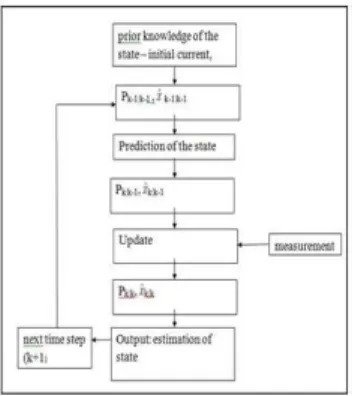
Kalman filter is a linear estimator and hence an assumption is made regarding the linearity of solar cells fig.-1 shows the algorithm of a Kalmanfilter.
The measurement vector z is represented by,
Z = Xtrue(k+1) + σmeas *random noise (5)
where Xtrue is the assumed value
P1= φ*P*φ′ (6)
S = M*P1*M' + R (7)
Kalman gain is found by the following equation
K = P1*M'*inv(S) (8)
P = P1 - K*M*P1 (9)
If Kalman gain shows a high value, more weight is given to the measurement, and if Kalman gain is low, then an emphasis is given on model prediction.
Xk is the state estimation of the latest state and Xk_prev is the state estimation of the previous state.
Xk=φ*Xk_prev+K*(Z-M*φ *Xk_prev) (10)
A single step of iteration is executed when we run the simulation based on equation 5 to equation 9 which calculates and buffers only the (k -1)-th value of Q, R, K and P. Subsequently as more and more measurement data (along with random measurement error) is received, the error between the estimated value and sensor data (measurement) reduces on employing Kalman filter algorithm as stated above.
IV. Modeling of BFO:
Since selection behavior of bacteria tends to eliminate animals with poor foraging strategies and favor the propagation of genes of those animals that have successful foraging strategies, they can be applied to have optimal solution through methods for locating, handling and ingesting food. After many generations, a foraging animal takes actions to maximize the energy obtained per unit time spent foraging. That is, poor foraging strategies are either eliminated or shaped into good ones. Optimization models are also valid for social foraging where groups of animals communicate to cooperatively forage, in the face of constraints presented by its own physiology such as, sensing and cognitive capabilities and environment. This activity of foraging inspired the researchers to utilize it as a novel optimization tool. The E. Coli bacteria present in our intestines also practice a foraging strategy. The control system of these bacteria governing their foraging process can be sub divided into four sections, which are chemo taxis, swarming, reproduction and elimination and dispersal.
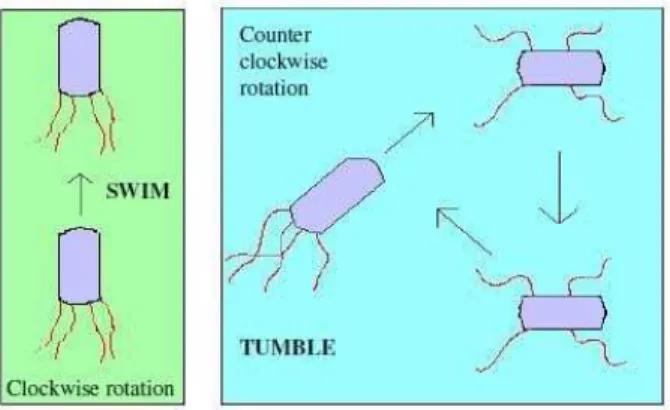
Fig. 2: Swim and tumble of a bacterium.
4.1. Chemotaxis:
This process simulates the environment of an E. Coli cell through swimming and tumbling via flagella as shown in Fig. 2. Biologically an E. Coli bacterium can move in two different ways. It can swim for a period of time in the same direction or it may tumble and alternate between these two modes of operation for the entire lifetime (Das, S., 2009).
4.2. Swarming:
4.3. Reproduction:
The total fitness of each bacterium is calculated as the sum of the step fitness during its life. All bacteria are sorted in reverse order according to their fitness. In the reproduction step, only the first-half of population survive and surviving bacterium splits into two identical ones, which can occupy the same positions in the environment at first step. Thus, the population of bacteria keeps constant in each chemotaxis process .
4.4. Dispersion and elimination:
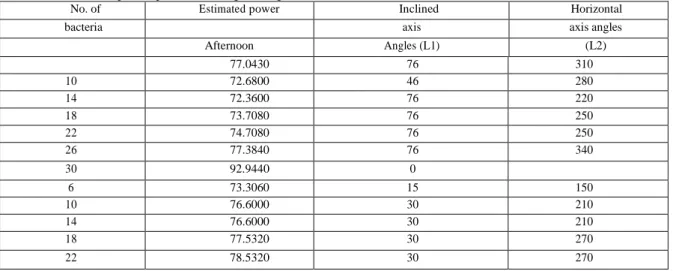
As mentioned in the above, foraging can be modelled as an optimization process which sometimes operates in swarms and relevance of these areas to optimization. Foraging behavior of bacteria can be found using for instance, dynamic programming. Search and optimal foraging decision-making of animals can be used to engineering. Selection behavior or bacteria forage as individuals and others forage as groups. While to perform social foraging an animal needs communication capabilities, it can gain advantages in that it exploit essentially the sensing capabilities of the group, the group can gang-up on large prey, individuals can obtain protection from predators while in a group, and in a certain sense the group can forage with a type of collective intelligence. This paper describes the optimal parameter selection of maximum power point of photovoltaic or solar panel using bacteria foraging (Kim, D.H., J.H. Cho, 2004). Solar radiation power data was recorded in terms of current and voltages. In order to calculate the maximum power from the collected data, BFO algorithm was used. Table II, shows estimation of minimum number of bacteria for finding maximum power and hence its location. Readings were taken during afternoon and evening time. It is observed that different numbers of bacteria are required get power estimated at different time of intervals.
Table 2: Results of solar power optimization using BFO algorithm.
No. of Estimated power Inclined Horizontal
bacteria axis axis angles
Afternoon Angles (L1) (L2)
77.0430 76 310
10 72.6800 46 280
14 72.3600 76 220
18 73.7080 76 250
22 74.7080 76 250
26 77.3840 76 340
30 92.9440 0
6 73.3060 15 150
10 76.6000 30 210
14 76.6000 30 210
18 77.5320 30 270
22 78.5320 30 270
For example, as per Table II, the six number of bacteria get 76.043 (mW) estimated power at 75̊vertical axis and 300 horizontal axis angles in afternoon time, but get 72.3060 (mW) estimated power at 15̊vertical axis and 150̊horizontal axis angles in evening time. It is also observed that however number of bacteria increases, the estimated power also increases respectively with different vertical and horizontal angles to track maximum power point. Thus atleast more than 30 bacteria must be used to find maximum point. Fig. 3 shows 3D-graphical presentation of the results of solar power optimization using BFO algorithm at different time of interval w.r.t. vertical angle (L1) and horizontal angle (L2). During afternoon and evenin g time with bacteria size 30 and 22 respectively.
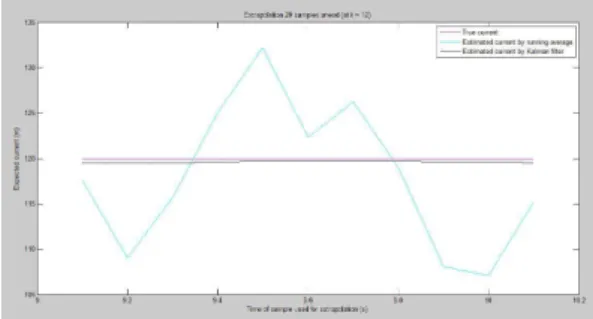
Fig. 4: Prediction of power by Kalman Filter & BFO.
V. Conclusion:
Kalman filter can estimate as well as predict a linear system very closely, but the plant model has to be accurate. To estimate and predict with higher precision more emphasis should be given on plant model than the sensor model. Kalman filter can be termed as second generation estimator as compared to its first generation counterpart like moving average filter. It is not necessary to know the initial state of the system and hence Kalman filter can be used in the problem of filtering, smoothing and prediction. Solar radiation power data was recorded in terms of current and voltages. In order to calculate the maximum power from the collected data, BFO algorithm was used
REFERENCE
Esram, T., J.W. Kimball, P.T. Krein, P.L. Chapman, P. Midya, 2006. Dynamic maximum power point tracking of photovoltaic arrays using ripple correlation control. Power Electronics, IEEE Transactions on, 21(5): 1282-1291.
Mousazadeh, H., A. Keyhani, A. Javadi, H. Mobli, K. Abrinia, A. Sharifi, 2009. A review of principle and sun-tracking methods for maximizing solar systems output. Renewable and sustainable energy reviews, 13(8), 1800-1818.
Leyva, R., C. Alonso, I. Queinnec, A. Cid-Pastor, D. Lagrange, L. Martinez-Salamero, 2006. MPPT of photovoltaic systems using extremum-seeking control. Aerospace and Electronic Systems, IEEE Transactions on, 42(1): 249-258.
Li, D.H., T.N. Lam, 2007. Determining the optimum tilt angle and orientation for solar energy collection based on measured solar radiance data. International Journal of Photoenergy.
Datta, T., I.S. Misra, B.B. Mangaraj, S. Imtiaj, 2008. Improved adaptive bacteria foraging algorithm in optimization of antenna array for faster convergence. Progress In Electromagnetics Research C, 1: 143-157.
Abharian, A.E., E. Shakeri, 2011. Bacterial Foraging Optimization Robust-RED for AQM/TCP Network. International Journal of Modeling and Optimization, 1(1): 49.
Kim, D.H., J.H. Cho, 2004. Robust tuning of PID controller with disturbance rejection using bacterial
foraging based optimization. WSEAS Transactions on Systems, 3(9): 2834-2840.
Guney, K., S. Basbug, 2008. Interference suppression of linear antenna arrays by amplitude-only control using a bacterial foraging algorithm.Progress In Electromagnetics Research, 79: 475-497.
Das, S., A. Biswas, S. Dasgupta, A. Abraham, 2009. Bacterial foraging optimization algorithm: theoretical foundations, analysis, and applications. InFoundations of Computational Intelligence, 3: 23-55. Springer Berlin Heidelberg.
Rodríguez, M., J. Gómez, 2009. Analysis of three different Kalman filter implementations for agricultural vehicle positioning. Open Agriculture Journal, 3: 13-19.
Patnaik, B., P. Sharma, E. Trimurthulu, S.P. Duttagupta, V. Agarwal, 2011. Reconfiguration strategy for optimization of solar photovoltaic array under non-uniform illumination conditions. In Photovoltaic Specialists Conference (PVSC), 2011 37th IEEE pp: 001859-001864). IEEE.
Jain, A., E.Y. Chang, Y.F. Wang, 2004. Adaptive stream resource management using kalman filters. In Proceedings of the 2004 ACM SIGMOD international conference on Management of data (pp: 11-22). ACM.
Mukherjee, E., S. Sengupta, S.P. Duttagupta, 2014. A heuristic approach of estimation and prediction of short-circuit current of a photovoltaic cell by Kalman filter. In India Conference (INDICON), 2014 Annual IEEE (pp: 1-6). IEEE.
Balachandran, M.K., L. Rajaji, Design of Energy Efficient Low Cost Solar Concentrators using BFO Algorithm.
Dr. V.P.Bhatnagar, 1996. “Image Formation by a lens”, An In-Depth Study of Physics, Pitamber Publications, India.
Delhi, India.
Ibrahim Zeid, 1996. “CAD CAM Theory and Practice”, Tata McGraHill, New Delhi, India. “Alternative fuels”, 2006. Electrical India, India.
Chetan Singh Solanki, Solar PhotovoltaicsFundamentals,Technologies and Applications, PHI, II nd Edition, Ch.-3,4,5, 13,7.
Thesis (Ph. D.), 2011.Massachusetts Institute of Technology, Dept. of Mechanical Engineering, Cataloged from PDF version of thesis.Includes bibliographical references, pg, 193-200.
Patnaik, B., P. Sharma, E.Trimurthulu, S.P. Duttagupta, 2011. Reconfiguration strategy for optimization of solar photovoltaic array under non-uniform illumination conditions,” Photovoltaic Specialists Conference.