AUSTRALIAN JOURNAL OF BASIC AND
APPLIED SCIENCES
ISSN:1991-8178 EISSN: 2309-8414 Journal home page: www.ajbasweb.com
Open Access Journal
Published BY AENSI Publication
© 2017 AENSI Publisher All rights reserved
This work is licensed under the Creative Commons Attribution International License (CC BY). http://creativecommons.org/licenses/by/4.0/
To Cite This Article: Layth A. Al dulaimi, R. Badlishah Ahmad, L.A. Hassnawi, Israa Sh. Ahmed., Black Hole Malicious Behaviour via Different Detection Methods. Aust. J. Basic & Appl. Sci., 11(2): 34-40, 2017
Performance Comparison of Different MAC Protocols over Wireless Body
Area Networks (WBAN)
1Layth A. Al dulaimi, 2R. Badlishah Ahmad, 3L.A. Hassnawi, 4P Ehkan,5Israa Sh. Ahmed
1,5Research Student, School of Computer and Communication Engineering, University Malaysia Perlis (UniMap), Malaysia. 2Professor Ir. Dr., Dean of School of Computer and Communication Engineering, University Malaysia Perlis (UniMap), Malaysia. 3Senior lecture, Al-Mustaqbal University College, Ministry of Higher Education, Iraq.
4Senior lecture, School of Computer and Communication Engineering, University Malaysia Perlis (UniMap), Malaysia.
Address For Correspondence:
Layth A. Al dulaimi, Research Student, School of Computer and Communication Engineering, University Malaysia Perlis (UniMap), Malaysia.
A R T I C L E I N F O A B S T R A C T Article history:
Received 18 December 2016 Accepted 16 February 2017
Available online 25 February 2017
Keywords:
Wireless Body Area Networks(WBAN), MAC protocols, Tunable Medium Access Control (TMAC), ZIGBEE MAC BASELINE MAC.
Wireless Body Area Networks (WBAN) is referred to as a body sensor network (BSN), is a wireless network of wearable computing devices. Various MAC protocols with objectives have been proposed for WBANs. In this paper is evaluate, analyzing, and comparing the performance of three types of MAC protocols: Tunable Medium Access Control (TMAC), IEEE 802.15.4 (ZIGBEE MAC) and IEEE 802.15.6 (BASELINE MAC), as they are used on wireless body area networks for different performance metrics. The performance evaluation and analysis of the MAC protocols (TMAC, ZIGBEE MAC, and BASELINE MAC) are carried out under different network conditions in order to find the best MAC protocol which is the most suitable for this type of network and also to find how to improve the performance within these type of networks.
INTRODUCTION
Fig. 1: WBAN Architecture of Medical Applications
In WBANs, sensor nodes of small size with low power and limited computational capabilities are attached or implanted to human body for measurement of physiological signs. These physiological signs include; respiratory patterns, heartbeat, temperature, posture, breathing rate, Electro Cardio Gram (ECG), Electro Encephalo Graphy (EEG) and many more. Transmission data rates for these physiological parameters vary from 1Kbps to 1Mbps. Sensor nodes collect information from human body and communicate with a central device called Coordinator.
Energy efficiency is the most important requirement of a good MAC protocol for WBANs. To improve energy efficiency of WBANs, a versatile MAC protocol should have the capabilities to reduce power dissipation due to collision of packets, overhearing of nodes, idle listening to receive probable data packets and control packet overhead of communication. Similarly, Quality of Service (QoS) is an important goal to achieve in WBANs. This includes latency, jitter, guaranteed communication and security (Rahim et al., 2012; Sruthi, 2016).
The most important parameter in wireless body area networks (WBANs) is the energy efficiency of the system. A medium access control (MAC) layer is the most suitable level to address the energy efficiency (Zheng
et al., 2005; Chiras et al., 2005; Barroso et al., 2005; Miller et al., 2005; Sruthi, 2016). This layer is used to coordinate node access to the shared wireless medium. The MAC is the core of communication protocol stack, which provides the basis for achieving Quality of Service (QoS) in any wireless networks. A versatile MAC should support diverse applications and different types of data such as continuous, periodic, burst and non-periodic data along with high level QoS. MAC plays a major determining factor in improving overall network performance. The fundamental task in MAC protocol is to avoid collisions and to prevent simultaneous transmissions while preserving maximum throughput, minimum latency, communication reliability and maximum energy efficiency. It is important to note that while designing MAC protocols one should keep in mind that nodes are prone to failures, constrained capabilities and restricted energy resources (Abidi et al., 2017).
MAC protocols for Wireless Sensor Networks (WSNs) and other short-range wireless technologies use Time Division Multiple Access (TDMA) or Carrier Sense Multiple Access with Collision Avoidance (CSMA/CA). Due to complex hardware and high computational power requirements, Frequency Division Multiple Access (FDMA) and Code Division Multiple Access (CDMA) are not suitable approaches for medium access in sensor networks [8]. CSMA/CA approach out performs in dynamic networks. It is presumed that WBANs are not dynamic. TDMA approach is well suited for WBANs. However, TDMA based MAC protocols require extra energy consumption for synchronization (Marinkovic et al., 2009; Bhandari and Moh, 2015).
Therefore, the objective of this paper is to analyze, evaluate, and compare different MAC protocols on WBAN. Many parameters need to be taken into consideration when evaluating and analyzing the performance of MAC protocols, such as power consumption, packet delivery ratio, and packet loss ratio.
Related Work:
emerging BAN market, and their merits and demerits are highlighted. On the other hand, a brief overview of standardization activities that related to BANs had been presented in this study.
A comprehensive survey of recent energy-efficient medium access control (MAC) protocols for wireless body area networks (WBANs) presented by (Gopalan, and Park, 2010; Abidi et al., 2017). This study demonstrated a comparison of the various approaches pursued. It outlined the crucial attributes for a good MAC. Several sources that contribute to the energy inefficiency are identified. Then, it investigated a few MAC protocols devised for WBAN by emphasizing their salient features. As a conclusion, this study put forward a number of open research challenges with regard to prospects of medium access techniques and other issues.
IEEE 802.15.4 is a current major technology for low-rate low-power wireless networks. The applicability of IEEE 802.15.4 over a wireless body area network (WBAN) studied in (Li et al., 2009). This study presented an evaluation of three different access schemes’ performance of IEEE 802.15.4 over a wireless body area network (WBAN). Considering the coexistence of contention access period (CAP) and contention free period (CFP), it also studied the mutual influences of these two traffics. The results of this study showed that the unslotted mode has better performance than the slotted one in terms of throughput and latency but with the cost of much power consumption. In addition, the guaranteed time slot (GTS) in CFP cannot guarantee the successful transmission of the CFP frames without sufficient GTS allocation. Finally, this study gave the suggestions for the novel medium access control (MAC) design for a WBAN.
Use of a WBAN will also allow the flexibility of setting up a remote monitoring system via either the internet or an intranet. For such medical systems, it is very important that a WBAN can collect and transmit data reliably, and in a timely manner to the monitoring entity. An evaluation of the performance of an IEEE802.15.4/
Zigbee MAC based WBAN operating in different patient monitoring environment is presented by (Khan et al.,
2008). This research studied the performance of a remote patient monitoring system using an OPNET based simulation model. The simulation results of this study showed that it is possible to monitor patients from remote locations using the WBAN over the internet without reasonable delay. For a remote patient monitoring, two design issues are highlighted in this study. First, a WBAN should not be directly connected to a main hospital network via the service node. With a directly connected WBAN, the service node will continuously transmitting short packets, which reduce the transmission efficiency of network, and increases the transmission delay (Sharavanan et al., 2015).
WBAN MAC Protocols:
The most important requirements of WBANs are the energy efficiency of the system, Quality of Service (QoS), and reliable data transmission ( Zheng et al., 2005; Naik and Sivalingam, 2004). A medium access control (MAC) layer is the most suitable level to address the energy efficiency and effective data transmission while preserving QoS since it is responsible about node access to the shared wireless medium. The main aim of MAC protocol is to avoid simultaneous transmissions while preserving maximum throughput, minimum latency, communication reliability and maximum energy efficiency. The MAC protocol should be able to support different applications and various types of data such as continuous, periodic, burst and non-periodic data along with high level QoS since it plays a major determining factor in improving overall network performance (Sahooa and Sheu, 2017). The next sections demonstrate some of well-known existing MAC protocols proposed for WBANs (Miller et al., 2005).
Tunable MAC (TMAC):
IEEE 802.15.4 MAC (Zigbee MAC):
IEEE 802.15.4 is a new standard to address the need for low-rate low-power low-cost wireless networking. IEEE 802.15.4 is a standard, which specifies the physical layer, and media access control for low-rate wireless personal area networks (LR-WPANs). The IEEE 802.15 working group (Ranjan, 2016) maintains it. The goal of IEEE 802.15.4 is to provide a physical-layer and MAC-layer standard with ultra-low complexity, cost, and power for low data-rate wireless connectivity among cheap fixed devices (Xin, 2012). The IEEE 802.15.4 standard supports multiple network topologies, including both star and peer-to-peer networks depending on the application requirements.
The MAC protocol in IEEE 802.15.4 can operate on both beacon enabled and non-beacon modes. In the beaconless mode, the protocol is essentially a simple CSMA-CA protocol. Since most of the unique features of IEEE 802.15.4 are in the beacon-enabled mode (Ranjan, 2016).
The MAC sub layer provides two services: the MAC data service and the MAC management service interfacing to the MAC sub layer management entity (MLME) service access point (SAP) (MLMESAP). The MAC data service enables the transmission and reception of MAC protocol data units (MPDU) across the PHY data service (Ergen, 2004; Yassein et al., 2016).
The features of MAC sub layer are beacon management, channel access, GTS management, frame validation, acknowledged frame delivery, association and disassociation.
IEEE 802.15.6 MAC (BASELINE BAN MAC):
IEEE 802.15.6 is a bit elusive, but some of the available information points to some kind of wireless BANs. It is possible that it is meant to be the WBAN Study Group Medical Body Area Networks (SG-MBAN), but that group has not yet released any standards. SG-MBAN’s meeting minutes from their meeting in Montreal, May 2007 indicates that the group name has not been clarified as one of their members asked if the group title will be 15.5x or 15.6 without getting an answer (Astrin et al., 2009; kohno et al., 2008; Kaur, 2016).
According to their meeting minutes from San Fransisco, July 2007 and the Montreal meeting minutes, the frequency band has not yet been clarified (Kwak et al., 2010).
IEEE 802.15.6 will define both PHY and MAC layers. The current IEEE 802.15.6 standard defines three PHY layers, i.e., Narrowband (NB), Ultra wideband (UWB), and Human Body Communications (HBC) layers. The selection of each PHY depends on the application requirements. On the top of it, the standard defines a sophisticated MAC protocol that controls access to the channel (Kaur, 2016).
For time referenced resource allocations, the hub (or the coordinator) divides the time axis (or the channel) into a series of super frames. The super frames are bounded by beacon periods of equal length. To ensure high-level security, the standard defines three high-levels (Saleem et al., 2011):
• Level 0 - unsecured communication
• Level 1 – authentication only
• Level 2 - both authentication and encryption.
Network Modeling and Simulation Setup:
OMNeT++ ver. 4.1, (Varga, 1999) is used to model the WBAN evaluation scenarios. The designed models with an extensive set of parameters are performed to evaluate and analyze the performance of different MAC protocols over WBAN, in order to find the best protocol, which can be used in this type of networks. The evaluation of the WBAN using different MAC protocols is done with the following model specifications:
➢ 5, 10, 15, 20, and 25 sensors are distributed randomly on human body in different positions.
➢ All sensors streaming its data to a monitoring station located 10m away from the human body.
➢ The size of data packet is 8 byte.
➢ The values of data rate used are 5,10,15,20 and 25 packets / second.
➢ All the nodes using UDP traffic sources.
➢ Data transfer rate is 54 Mbps.
➢ All experiments tested for 250 seconds simulation time.
➢ Radio TX Output Power is set to be -15dBm.
➢ Tunable MAC (TMAC), IEEE 802.15.4 MAC (Zigbee MAC), and IEEE 802.15.6 MAC (BASELINE
BAN MAC) are used as a MAC protocols.
4.1. Evaluation Scenarios:
A. Varying network density by changing BAN number of nodes, to evaluate the effects of contention on power consumption and packet delivery ratio (PDR).
B. Varying packet rate to evaluate the effects of offered load on the performance of BAN.
4.2. Analysis Metrics:
The metrics, which are selected to compare and analyze the performance of different MAC protocols for the Wireless Body Area Network (WBAN), are:
Power consumption: represent the amount of the power consumed by the node to perform thenetworking process (reading the data from the human body, handshaking, processing the data, and transmission the data).
Packet Loss -- represents the difference between the number of packets sent by the source node and thepackets received at the destination node.
Packet Delivery ratio (PDR) -- represents the ratio between the numbers of packets received by the destination to the number of packets sent by the source.RESULT AND DISCUSSION
Two types of experiments were carried out to evaluate and analyze the impact of number of nodes variations and packet rate variation on the performance of different MAC protocols over wireless body area network. Both experiments are performed to find the best MAC protocol, which can be used in WBAN and how to improve the performance of these protocols over WBAN. These experiments are:
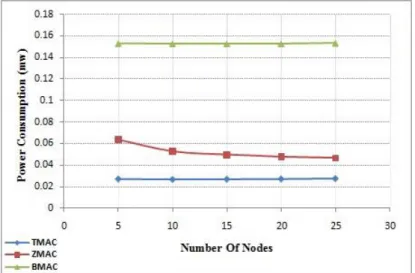
Figure 2 shows the power consumption versus the number of nodes. There are three plots, each corresponding to a different MAC protocol. Figure 2 shows that the power consumed is inconsistently changing due different capability of nodes. Moreover, the figure shows that the power consumption of TMAC is the lowest than BMAC by 45.6% and ZMAC by 82.4%. This is because that the TMAC, maintains a sleep-sense cycle, however instead of having a fixed duty cycle, it has a variable duty cycle and the nodes switches itself to a sleep mode when no activation event has occurred for a predetermined time period which leads to saving the power.
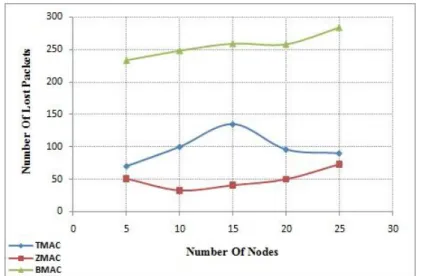
Figure 3 shows number of lost packets versus the number of nodes. There are three plots, each corresponding to a different MAC protocol. Figure 3 show that the number of lost packets at using ZMAC is the lower than number of lost packets at using TMAC by 69.6% and BMAC by 84.2%. This is because ZMAC can operate on both beacon and non-beacon modes which lead to improve the ability of this protocol to deals with packet collision.
On the other hand, Figure 4 shows that the packet delivery ratio is inconsistently changing due to the occurrence of packet collision or packet dropped. The figure demonstrates that the performance of ZMAC in BAN is better than TMAC by 12.8% and BMAC by 29.7% with respect to the number of lost packets while changing BAN node number.
Fig. 3: Number of lost Packets vs. Number of Nodes for Different MAC Protocols over WBAN
Fig. 4: Packet Delivery Ratio vs. Number of Nodes for Different MAC Protocols over WBAN
Conclusion:
In this paper presents a review of three types of MAC protocols for WBAN, the aim of performance assessment of these protocols mechanisms (TMAC, ZIGBEE MAC, and BASELINE MAC), is to provide a suitable and appropriate wireless technologies for such network. The simulation results show that the ZMAC is better than TMAC and BMAC in term of the number of lost packet and the packet deliver ratio. TMAC is better than ZMAC and BMAC in term of the power consumption which the last has an overeating problem doesn't solve and increases the power consumption so is good for normal traffic application, even TMAC is suffering from sleeping problem, TMAC has good adaptabilities to charging traffic condition. Overall, our resulting indicate that there are important tradeoffs that should be seriously taken in to consideration when choosing a protocol for WBAN.
REFERENCES
Gopalan, S.A. and J.T. Park, 2010, October. Energy-efficient MAC protocols for wireless body area
networks: survey. In Ultra Modern Telecommunications and Control Systems and Workshops (ICUMT), 2010
International Congress on IEEE, pp: 739-744.
Abidi, B., A. Jilbab and M.E. Haziti, 2017. Wireless Sensor Networks in Biomedical: Wireless Body Area
Networks. In Europe and MENA Cooperation Advances in Information and Communication Technologies
,Springer International Publishing, pp: 321-329.
Barroso, A., U. Roedig and C. Sreenan, 2005. February. μ-MAC: an energy-efficient medium access control for wireless sensor networks. In Proceeedings of the Second European Workshop on Wireless Sensor Networks. IEEE. pp: 70-80.
Bhandari, S. and S. Moh, 2015. A survey of MAC protocols for cognitive radio body area networks. Sensors, 15(4): 9189-9209.
Chiras, T., M. Paterakis and P. Koutsakis, 2005. September. Improved medium access control for wireless
sensor networks-a study on the S-MAC protocol. In 2005 14th IEEE Workshop on Local & Metropolitan Area
Networks, pp: 5
Ergen, S.C., 2004. ZigBee/IEEE 802.15. 4 Summary. UC Berkeley, September, 10: 17.
Hussain, A. and K.S. Kwak, 2009. Positioning in Wireless Body Area Network using GSM. JDCTA, 3(3):
167-172.
Kaur, J., 2016. Comparative Analysis of MAC protocols for Wireless Body Area Networks. (Doctoral dissertation, THAPAR UNIVERSITY PATIALA).
Khan, J.Y., M.R. Yuce and F. Karami, 2008, August. Performance evaluation of a wireless body area sensor network for remote patient monitoring. In 2008 30th Annual International Conference of the IEEE
Engineering in Medicine and Biology Society IEEE, pp: 1266-1269.
Kohno, R., K. Hamaguchi, H.B. Li and K. Takizawa, 2008. September. R&D and standardization of body
area network (BAN) for medical healthcare. In 2008 IEEE International Conference on Ultra-Wideband IEEE.
3: 5-8.
Kwak, K.S., S. Ullah and N. Ullah, 2010. November. An overview of IEEE 802.15. 6 standard. In 2010 3rd
International Symposium on Applied Sciences in Biomedical and Communication Technologies (ISABEL 2010 IEEE, pp: 1-6.
Li, C., H.B. Li and R. Kohno, 2009. June. Performance evaluation of IEEE 802.15. 4 for wireless body area
network (WBAN). In 2009 IEEE International Conference on Communications WorkshopsIEEE, pp: 1-5.
Marinkovic, S.J., E.M. Popovici, C. Spagnol, S. Faul and W.P. Marnane, 2009. Energy-efficient low duty cycle MAC protocol for wireless body area networks. IEEE Transactions on Information Technology in Biomedicine, 13(6): 915-925.
Miller, M.J. and N.H. Vaidya, 2005. A MAC protocol to reduce sensor network energy consumption using a wakeup radio. IEEE Transactions on mobile Computing, 4(3): 228-242.
Naik, P. and K.M. Sivalingam, 2004. A survey of MAC protocols for sensor networks. In Wireless sensor
networksSpringer US, pp: 93-107.
Patel, M. and J. Wang, 2010. Applications, challenges, and prospective in emerging body area networking technologies. IEEE Wireless Communications Magazine, 17(1): 80-88.
Rahim, A., N. Javaid, M. Aslam, Z. Rahman, U. Qasim and Z.A. Khan, 2012. November. A comprehensive
survey of MAC protocols for wireless body area networks. In Broadband, Wireless Computing, Communication
and Applications (BWCCA), 2012 Seventh International Conference on IEEE, pp: 434-439.
Ranjan, R., H. Singh and G. Manan, 2016. Comparative Analysis of WSN Topologies using ZigBee/IEEE 802.15. 4 standards. International Journal for Science, Management and Technology (IJSMT), 9(9).
Sahooa, P.K. and J. Sheu, 2017. Design and analysis of collision free MAC for wireless sensor networks with or without data retransmission. Journal of Network and Computer Applications, 80: 10-21.
Saleem, S., S. Ullah and K.S. Kwak, 2011. A study of IEEE 802.15. 4 security framework for wireless body area networks. Sensors, 11(2): 1383-1395.
Sharavanan, P.T., R. Kumar and D. Sridharan, 2015. A Comparative Study of Cross Layer Protocols in WBAN. Australian Journal of Basic and Applied Sciences, 9: 294-300.
Sruthi, R., 2016. Medium Access Control Protocols for Wireless Body Area Networks: A Survey. Procedia Technology, 25: 621-628.
Varga, A., 1999. Using the OMNeT++ discrete event simulation system in education. IEEE Transactions on Education, 42(4): 11.
Xin, F., 2012. A Study of MAC Protocols for WBANs Based on Markov Chain. IJACT: International Journal of Advancements in Computing Technology, 4(6): 100-108.
Yassein, M.B., M.R. Fakirah, Q. Abuein, M. Shatnawi and L.B. Yaseen, 2016. Data Traffic Optimization in Different Backoff Algorithms for IEEE 802.15. 4/Zigbee Networks. International Journal of Computer Science and Information Security, 14(4): 62.