Exploitation of Co-reference in Distributional Semantics
Dominik Schlechtweg
University of StuttgartStuttgart, Germany
Abstract
The aim of distributional semantics is to model the similarity of the meaning of words via the words they occur with. Thereby, it relies on the distributional hypothesis implying that similar words have similar contexts. Deducing meaning from the distribution of words is interesting as it can be done automatically on large amounts of freely available raw text. It is because of this convenience that most current state-of-the-art-models of distributional semantics operate on raw text, although there have been successful attempts to integrate other kinds of—e.g., syntactic—information to improve distributional semantic models. In contrast, less attention has been paid to semantic information in the research community. One reason for this is that the extraction of semantic information from raw text is a complex, elaborate matter and in great parts not yet satisfyingly solved. Recently, however, there have been successful attempts to integrate a certain kind of semantic information, i.e., co-reference. Two basically different kinds of information contributed by co-reference with respect to the distribution of words will be identified. We will then focus on one of these and examine its general potential to improve distributional semantic models as well as certain more specific hypotheses.
Keywords:Distributional Semantics, Co-reference, Vector Space Models
1.
Introduction
The original aim of distributional semantics is to model the similarity of the meaning—the semantics—of words. The basic assumption underlying this approach is that the se-mantic similarity of two words is a function of their con-texts. That is, in other words, the meaning of words can be inferred from the frequencies of the words they imme-diately occur with and this can happen in such a way that the degree of similarity of those meanings can be measured. Semantic similarity is a key concept in the modeling of lan-guage and thus in computational linguistics. It is crucial in a variety of linguistic applications influencing our everyday life such as search engines.
In distributional semantics we represent the meaning of a word by a vector. This vector is an abstraction over the contexts in which we find the particular word in question. Here lies the crux of the matter: known algorithms of distri-butional semantics consider only those contexts as relevant to the meaning of a target word which are found as con-texts of theword—the particular combination of letters, the string—in question. However, there are other, particularly definable, contexts which encode some of the meaning of a target word. Consider the following text example:
When Cesar took on the case of{{Fella},{an adorable Jack Russell/Italian Greyhound mix}},
{the little dog}’s antics were about to get{his}
owner slapped with an eviction notice. At the apartment complex where{Fella} resided,{he}
barked nonstop the entire time {his} adoptive mom was at work, ceasing only once she came home at night.1
Building up a vector representation for the meaning of dog, a standard algorithm of distributional semantics would
1
Cesar Millan. Cesar’s Way.
< http://www.cesarsway.com/dogbehavior/barking/What-Your-Dogs-Bark-is-Telling-You>. Last checked on March 10, 2016.
browse through this text snippet, find the word dog just once, include the information from the immediate context (whose size would be defined previously) of this instance of dog into the vector representation and proceed. How-ever, in the above it seems as though the contexts surround-ing the noun phrases that refer to the same referent as the noun phrase which includes the worddog—such asFella, hisandhe—are equally suited for contributing to the vector representation of the meaning ofdog. Actually, the entire passage above is about a dog.
Now, if we want distributional models to use this informa-tion, we must make it explicit on the distributional level. Consider the following paragraph where we try to make co-reference information, which is implicit in the above text snippet, explicit:
When Cesar took on the case of{Fella / an adorable... / the little dog / his / he}, {Fella / an adorable... / the little dog / his / he}’s antics were about to get {Fella / an adorable... / the little dog / his / he} owner slapped with an eviction no-tice. At the apartment complex where{Fella / an adorable... / the little dog / his / he}resided,{Fella / an adorable... / the little dog / his / he}barked non-stop the entire time{Fella / an adorable... / the little dog / his / he}adoptive mom was at work, ceasing only once she came home at night.
We may explicate it by finding co-referent noun phrases and telling the model at every spot a referent is picked up, e.g., byhe, by which words it is elsewhere referred to (in all of the co-referent phrases), e.g., byFella andthe little dog. These alternative words used to refer to the same entity can then be put in the context of the current word, he. By this, the model gets access to the previously latent information, to thelatent contexts.
semantics (Sch¨utze and Adel, 2014). Yet, the authors use a different kind of information than the one presented above. While we use orthogonal co-reference information, i.e., the contexts of co-referent mentions, Sch¨utze and Adel use linear co-reference information, i.e., which mentions are actually co-referent, and consider co-referent mentions as mutual contexts.
We will compare standard distributional semantic models to models incorporating the above-described distribution-ally disguised co-reference information. While additional information gained through new contexts—what we will call here Orthogonal Context Enrichment (OCE)—should help the models in general, it could be particularly helpful for models trained on small data sets, since here the relative enrichment is higher than with bigger training set. The same rationale also applies for rare words: if there are not enough contexts for a word in a training set, then additional contexts gained through OCE may have a stronger impact on the learning of the meaning of the word than for a very frequent word. Also, OCE is expected to have a particular impact on learning the meaning of nouns, because co-reference is a relation holding between noun phrases, and especially proper names, which are very frequent in co-reference chains.
Apart from the general impact OCE may have on distri-butional semantic models, there are certain applications where we may imagine a particular benefit. OCE is, presumably, most helpful when raw text training data is limited, since here we cannot simply gather new contexts by scaling up the amount of training data. Hence, for tasks where we need to build many vectors from many small data points (instead of building one vector from large amounts of training data) we expect a particular benefit from OCE, since for every data point training data is limited. Such tasks occur, e.g., in word sense disambiguation, informa-tion retrieval, named-entity recogniinforma-tion or classificainforma-tion tasks such as spam detection. This makes OCE a widely applicable mechanism.
2.
Procedure
In order to give distributional semantic models access to the above-mentioned latent contexts we first need a co-reference resolution for a corpus. For this we build on the Annotated English Gigaword v.5 corpus(Gigaword) anno-tated with syntactic and discourse structure and providing a co-reference resolution with quality of “current state of the art” (Napoles et al., 2012). We work with a subpart of around 50% of the size of the whole corpus encompassing approximately 100 million sentences and 1.9 billion tokens after preprocessing.
We then build a computational algorithmheadSub replac-ing pronouns in the corpus with the head noun of the repre-sentative (most informative) element inside its co-reference chain, i.e., if the referent of a noun phrasenin the corpus is re-referred to via a pronounp, thenheadSubreplacesp with the syntactic head ofn. By this we aim at enriching the corpus with more distributional information, as described
above.2 As an example the reader may consider the piece of text in (1).
(1) Fella chases a squirrel, since he wants to eat it.
The co-reference resolution for (1) shall be
{(F ella, he),(a squirrel, it)} with the first elements of the chains being the representative element respectively. NowheadSub will produce the following output text for (1):
(2) fella chases a squirrel since fella wants to eat squir-rel
We also experiment with different versions of headSub, e.g., we only insert proper nouns (headSubPN) or lexical nouns (headSubNon-PN).
After this, we train a distributional semantic model on the enriched text (corresponding to (2) in the example above) and for comparison also on the original raw text (corre-sponding to (1)). For training we use the Skip-gram model from theword2vectoolkit (Mikolov et al., 2013a; Mikolov et al., 2013b), which was found to be superior to standard count models (Baroni et al., 2014). Since the relative per-formance of the different models was found to vary with the variation of these training parameters we vary the max-imal window size considered as the context of a token and the minimum count of words considered during training in order to get a broader picture of the impact of OCE. Finally, the resulting vector spaces will be evaluated with respect to their capturing of semantic (attributional) simi-larity.
3.
Evaluation
We evaluate the quality of the vector spaces on a variety of data sets using two basically different ways of evaluation: (i) human similarity judgments of word pairs and (ii) analo-gies.
The word similarity judgments consist of pairs of words rated by human informants for their semantic similarity. Evaluation here means determining the Spearman’s rank correlation coefficient between all similarity judgments for word pairs inside a test set and the cosine similarities of the respective word vectors. We will evaluate the vector spaces on a variety of human similarity judgment test sets includ-ing standard benchmarks such as WordSim353 (Finkelstein et al., 2002; Agirre et al., 2009) (which will allow us to dis-tinguish between similarity and relatedness)3, SimLex-999
(Hill et al., 2014) (which will allow us to distinguish be-tween different parts of speech, i.e., nouns, adjectives and verbs) and MEN (Bruni et al., 2014) plus a data set con-taining mainly rare words, which we will call Rare (Lu-ong et al., 2013), and a data set containing many proper nouns, which we will call MTurk (Radinsky et al., 2011). These test sets are found to have a very different constitu-tion concerning the classes of words they contain. While
2
The reader may note that a similar idea was already applied for sentiment analysis in (Pontiveros, 2012).
some contain mainly nouns, others contain mainly adjec-tives or verbs. Also, the use of proper nouns strongly varies; some do not even contain any proper nouns. As this study also indicates, this varying constitution of test sets may lead to very different results testing a model on them.
The second evaluation procedure follows the idea that there are different kinds of similarities between words (Mikolov et al., 2013a). Evaluation here consists of checking whether a respective vector space captures certain relations via com-paring the distances of word pairs with the same rela-tion. For example, the distance betweengreatandgreatest should be the same as betweensmartandsmartest. Analo-gies provide a convenient way of evaluation, since it is easy to construe new sets testing very different relations involv-ing many different kinds of words. We exploit this fact by construing three new analogy test sets which we provide as an additional resource to this study: one set consisting of word2vec’s analogy questions (Mikolov et al., 2013a) re-constructed with rare words and two sets for proper nouns, one based on words and the other based on phrases (Do-minik Schlechtweg, 2016). These new resources will help us in measuring the quality of a vector space with respect to its ability to capture the similarity properties of rare words and proper nouns, on which we assumed OCE to have a par-ticular impact. Additionally, we evaluate the vector spaces on word2vec’s analogy questions.
3.1.
Rare Words
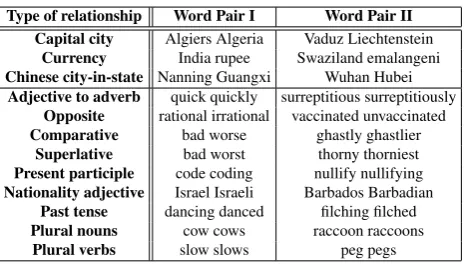
The test set for rare words—exemplified in Table 1—was construed on the basis of word2vec’s analogy questions. We first excluded the(Common) Capital citytask and the Man-Woman (family) task from consideration, since the former necessarily contains frequent words, while for the latter we could not imagine enough rare words and did not find a way to search for it in a corpus. For other tasks this was possible. For theCity-in-statetask we combined En-glish names of Chinese districts with names of their capitals (instead of American states and their capitals in the original file). For the remaining tasks we scanned approximately 1.3 million sentences from theAnnotated English Gigaword v.5 corpus. For theCurrencytask, for instance, we searched for words with the NER-tagMONEY, or for theAdjective to adverbtask we searched for words with the respective POS-tag. Then we worked manually through the rarest words of the respective category (those with frequency below 10) and selected words that seemed well-suited because they were of the specific type required for the task. The selected item, sayghastly, was then combined with the related ele-ment according to the target task; for the comparative task this would beghastlier. This pair was then, in turn, com-bined with all of the pairs from the same relation in the word2vecquestions-wordsfile, and vice versa. By this pro-cedure we always combine one pair which was extracted by us with one pair from thequestions-wordsfile, i.e., one rare pair with a more frequent one. In this way we want to avoid the “adding up” of the rareness of the word pairs which oth-erwise may lead to an extreme drop of performance on the tasks. Moreover, this leads to the effect that we get a large number of questions. In this way we get a total of 29,150 questions, nearly 10,000 more than in thequestions-words
file.4 We provide this data set as an additional resource to this paper, since it might be a complementary utility to the word2vecquestions-wordsfile for further research.
Type of relationship Word Pair I Word Pair II Capital city Algiers Algeria Vaduz Liechtenstein
Currency India rupee Swaziland emalangeni
Chinese city-in-state Nanning Guangxi Wuhan Hubei
Adjective to adverb quick quickly surreptitious surreptitiously
Opposite rational irrational vaccinated unvaccinated
Comparative bad worse ghastly ghastlier
Superlative bad worst thorny thorniest
Present participle code coding nullify nullifying
Nationality adjective Israel Israeli Barbados Barbadian
Past tense dancing danced filching filched
Plural nouns cow cows raccoon raccoons
Plural verbs slow slows peg pegs
Table 1: Structure of thequestions-words-rarefile: word2vec’s analogy questions reconstructed with rare
words.
3.2.
Proper Nouns
In order to evaluate the models specifically with respect to the similarity properties of proper nouns we chose four re-lations involving proper nouns: theleader-countryrelation and theperson-sexrelation shall measure similarity prop-erties of names of humans, while the relations building-cityandriver-countryshall measure similarity properties of names of things. The word pairs contain mostly names of well-known entities, such as former or present state leaders, nations, presently famous or historically important people, buildings, cities and rivers. The structure of the questions-words-proper-nouns file containing a total of 2,746 ques-tions is depicted in Table 2. The questions-phrases-proper-nounsfile based on phrases has the same structure. Both files are provided as an additional resource to this paper.5
Type of relationship Word Pair I Word Pair II
leader-country Obama USA Putin Russia
person-sex Cleopatra woman Einstein man building-city Reichstag Berlin Kremlin Moscow
river-country Nile Egypt Rhine Germany
Table 2: Structure of thequestions-words-proper-nouns file.
4.
Results
4.1.
A Preliminary Study
A preliminary study showed varying results across the dif-ferent tasks we evaluated on. Yet, on analogies one OCE-model, i.e., that is trained on an enriched text, outperformed the other OCE-models on most evaluation tasks and—at
4
Note that by allowing two rare word pairs in the same ques-tion we could further increase this number without any addiques-tional effort.
5
least on analogies—also the baseline model, trained on the original raw text. Surprisingly, this was headSubPN, inserting only proper nouns for pronouns, which we ini-tially did not expect to contribute with so much distribu-tional information.6 For this, headSub
PN was chosen for a deeper analysis. This is not to say that the other OCE-models (headSubandheadSubNon-PN) are not expected to contribute to the learning of the meaning of certain kinds of words. But, with the present means at hand, focusing on one model which showed the clearest results seemed to be the best option. The reader may note, however, that by this restriction and also by the specific restrictions result-ing from the mechanism ofheadSuband its derivatives we presumably only exploit a small share of the full potential of OCE.
4.2.
A Deeper Analysis: Inserting Proper Nouns
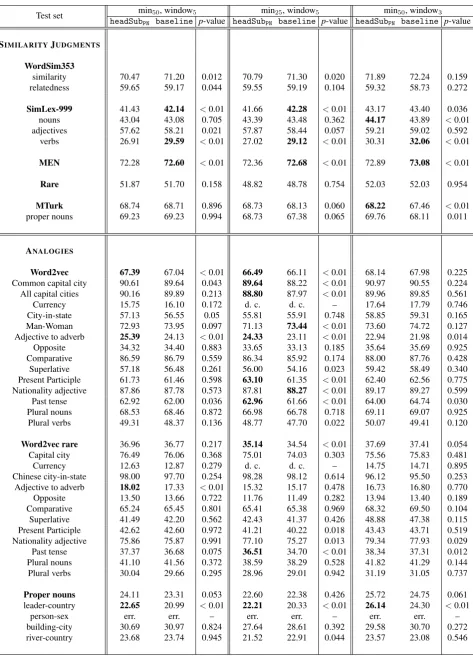
The reader may consider Table 3 for the results of training skip-gram on the output of headSubPN and raw text (the
baseline) respectively with varying training parameters. The models were trained 10 times each. In every iteration the performance on the different test sets was computed at the end of the training period. Here we present the aver-age performance over all iterations. An independent two-sample t-test was performed for each set of training param-eters between the results of the models trained on the out-put ofheadSubPNand the results of the baseline models in order to assure statistical significance of the results.7 The resulting p-value is given for each test set. Performance values are marked boldly where for a certain combination of training parameters the models trained on one of the two texts (headSubPN orbaseline) outperformed the models trained on the other and the difference is statistically sig-nificant, i.e., thep-value is below 0.01.
4.2.1. General Observations
Generally, we do not find very strong performance dif-ferences. The strongest are around 2%. Yet, the first striking observation considering Table 3 is the different performance of the models on similarity judgments and analogies: while the models trained on raw text (baseline-models) have significant advantages on many similarity judgment test sets, the situation looks the other way round on analogies where the models trained on the output of
headSubPN (headSubPN-models) have significant advan-tages. Why is that?
4.2.2. Similarity vs. Relatedness
We may find the reason for the different performances on the two evaluation methodologies in the distinction be-tween similarity and relatedness. While certain similarity judgment test sets particularly aim at measuring similarity and not relatedness (SimLex-999) or distinguish between similarity and relatedness (WordSim353), the analogy test sets—at least in the particular form at hand here—seem to be more suited to measure relatedness than similarity.
6
It is not yet clear what the reason for this effect is. The fact that the quality of the co-reference resolution for proper nouns is better than for other kinds of words may have an influence.
7
A normal distribution of the results was assumed.
Two words arerelatedif they “are associated but not [nec-essarily] actually similar (Freud,psychology)” (Hill et al., 2014) or if they “are connected by broader semantic rela-tions” (Bruni et al., 2014). The latter is exactly the way in which the analogy test sets were construed, i.e., words with the same relation are checked for equal distances in vector space. (The reader may note that these relations have very different natures.) Hence, we can expect the analogy test sets used here to be a better measure for re-latedness rather than the more narrow notion of similarity. This is also supported by the performance of the models on WordSim353. Though not statistically significant yet, we observe advantages of the baseline-models on the similar-ity measure, while we observe advantages of headSubPN -models on the relatedness measure. If the analogy test sets used here are more suited to measure relatedness and the similarity judgment test sets rather measure similarity, the different performances on these two methodologies are ex-plained by the advantages of theheadSubPN-models in cap-turing relatedness.8
4.2.3. Nouns
The advantage ofheadSubPN-models for one set of param-eters on the noun subset of SimLex-999 indicates that— under certain circumstances—OCE might be helpful for learning the meaning of nouns. As we already men-tioned above, this would not be surprising in general, since co-reference—and thus the mechanism of headSubPN— mainly involves insertion of nouns. However, for the partic-ular model used here, i.e.,headSubPN, this effect is indeed surprising, since it only inserts proper nouns, but these are not part of the SimLex-999 noun-subset.
4.2.4. Verbs
The results for verbs on similarity judgments are clear: with all training parameter sets we have significant advantages of the baseline-models. On analogies, though, for tasks in-volving verbs such as Past tenseorPresent participlethe baseline is significantly outperformed for different parame-ter sets and also on rare words.
4.2.5. Adjectives
While for adjectives we have no significant differences on similarity judgments, we do find significant differences on the Adjective to adverb task for different parameter sets and for frequent as well as for rare words in favor of the
headSubPN-models. However, for theNationality adjective task the baseline still significantly outperforms the OCE-model on one set of training parameters.
4.2.6. Rare Words
On Rare we do not find significant differences. However, on the word2vec analogy questions reconstructed with rare
8
Test set min50, window5 min25, window5 min50, window3
headSubPN baseline p-value headSubPN baseline p-value headSubPN baseline p-value
SIMILARITYJUDGMENTS
WordSim353
similarity 70.47 71.20 0.012 70.79 71.30 0.020 71.89 72.24 0.159
relatedness 59.65 59.17 0.044 59.55 59.19 0.104 59.32 58.73 0.272
SimLex-999 41.43 42.14 <0.01 41.66 42.28 <0.01 43.17 43.40 0.036
nouns 43.04 43.08 0.705 43.39 43.48 0.362 44.17 43.89 <0.01
adjectives 57.62 58.21 0.021 57.87 58.44 0.057 59.21 59.02 0.592
verbs 26.91 29.59 <0.01 27.02 29.12 <0.01 30.31 32.06 <0.01
MEN 72.28 72.60 <0.01 72.36 72.68 <0.01 72.89 73.08 <0.01
Rare 51.87 51.70 0.158 48.82 48.78 0.754 52.03 52.03 0.954
MTurk 68.74 68.71 0.896 68.73 68.13 0.060 68.22 67.46 <0.01
proper nouns 69.23 69.23 0.994 68.73 67.38 0.065 69.76 68.11 0.011
ANALOGIES
Word2vec 67.39 67.04 <0.01 66.49 66.11 <0.01 68.14 67.98 0.225
Common capital city 90.61 89.64 0.043 89.64 88.22 <0.01 90.97 90.55 0.224 All capital cities 90.16 89.89 0.213 88.80 87.97 <0.01 89.96 89.85 0.561
Currency 15.75 16.10 0.172 d. c. d. c. – 17.64 17.79 0.746
City-in-state 57.13 56.55 0.05 55.81 55.91 0.748 58.85 59.31 0.165
Man-Woman 72.93 73.95 0.097 71.13 73.44 <0.01 73.60 74.72 0.127
Adjective to adverb 25.39 24.13 <0.01 24.33 23.11 <0.01 22.94 21.98 0.014
Opposite 34.32 34.40 0.883 33.65 33.13 0.185 35.64 35.69 0.925
Comparative 86.59 86.79 0.559 86.34 85.92 0.174 88.00 87.76 0.428
Superlative 57.18 56.48 0.261 56.00 54.16 0.023 59.42 58.49 0.340
Present Participle 61.73 61.46 0.598 63.10 61.35 <0.01 62.40 62.56 0.775 Nationality adjective 87.86 87.78 0.573 87.81 88.27 <0.01 89.17 89.27 0.599 Past tense 62.92 62.00 0.036 62.96 61.66 <0.01 64.00 64.74 0.030
Plural nouns 68.53 68.46 0.872 66.98 66.78 0.718 69.11 69.07 0.925
Plural verbs 49.31 48.37 0.136 48.77 47.70 0.022 50.07 49.41 0.120
Word2vec rare 36.96 36.77 0.217 35.14 34.54 <0.01 37.69 37.41 0.054
Capital city 76.49 76.06 0.368 75.01 74.03 0.303 75.56 75.83 0.481
Currency 12.63 12.87 0.279 d. c. d. c. – 14.75 14.71 0.895
Chinese city-in-state 98.00 97.70 0.254 98.28 98.12 0.614 96.12 95.50 0.253 Adjective to adverb 18.02 17.33 <0.01 15.32 15.17 0.478 16.73 16.80 0.770
Opposite 13.50 13.66 0.722 11.76 11.49 0.282 13.94 13.40 0.189
Comparative 65.24 65.45 0.801 65.41 65.38 0.969 68.32 69.50 0.104
Superlative 41.49 42.20 0.562 42.43 41.37 0.426 48.88 47.38 0.115
Present Participle 42.62 42.60 0.972 41.21 40.22 0.018 43.43 43.71 0.519 Nationality adjective 75.86 75.87 0.991 77.10 75.27 0.013 79.34 77.93 0.029 Past tense 37.37 36.68 0.075 36.51 34.70 <0.01 38.34 37.31 0.012
Plural nouns 41.10 41.56 0.372 38.59 38.29 0.528 41.82 41.29 0.144
Plural verbs 30.04 29.66 0.295 28.96 29.01 0.942 31.19 31.05 0.737
Proper nouns 24.11 23.31 0.053 22.60 22.38 0.426 25.72 24.75 0.061
leader-country 22.65 20.99 <0.01 22.21 20.33 <0.01 26.14 24.30 <0.01
person-sex err. err. – err. err. – err. err. –
building-city 30.69 30.97 0.824 27.64 28.61 0.392 29.58 30.70 0.272
river-country 23.68 23.74 0.945 21.52 22.91 0.044 23.57 23.08 0.546
Table 3: Performance of skip-gram model trained on output ofheadSubPNand raw text (thebaseline) with varying training parameters. For analogies accuracy values are given, while for similarity judgments we give the Spearman’s rank
correlation coefficient (multiplied by 100 for better comparison with the accuracy values). Tasks where models show highly different coverage of the data are excluded (marked by “d. c.”). Theperson-sextask was subsequently excluded
words (Word2vec rare) the baseline is significantly outper-formed for one parameter set, while the performance for the other parameter sets confirms this tendency. The over-all advantage of theheadSubPN-models on Word2vec rare is comparable to the advantage on the original word2vec questions. A particular improvement for rare words with OCE can thus not be confirmed here.
4.2.7. Proper Nouns
As we use an OCE-model inserting only proper nouns we would expect a particular effect for proper nouns. Also, be-cause animate entities are more likely to be re-referred to we would expect a stronger effect for proper names of hu-man entities. There are indeed significant advantages of the
headSubPN-models when it comes to test tasks involving proper names of human entities.9 This is indicated here by their performance onleader-country: the baseline is signif-icantly outperformed for all training parameters.
Further, for most of the tasks in the word2vec analogy set involving proper nouns, such asCommon capital cityand All capital citiesthe baseline is outperformed significantly for one set of training parameters, which is supported by the performances with the other parameters.
Also, for similarity judgments these observations are con-firmed: on MTurk, containing a comparably high number of proper nouns, the baseline is outperformed significantly for one parameter set, where this tendency is confirmed for the other sets. Further, for the subset of proper nouns from MTurk there is—though not clearly significant—a tendency towards advantages of theheadSubPN-models.
4.2.8. Pronouns
The only task containing pronouns isMan-Woman. Since
headSubPN deletes many pronouns we may expect a par-ticular effect here. This is indeed the case. For one set of training parameters the baseline-models significantly out-perform theheadSubPN-models, which is also supported by the performances on the other parameter sets.
5.
Conclusion
In the above we found that one particular way of carry-ing out OCE—i.e, by replaccarry-ing pronouns with the syntac-tic head of the proper nouns they are co-referent with—de facto improves the performance of distributional models on a wide range of analogy tasks and on certain test sets of similarity judgments. We find the clearest results for proper nouns (more specifically, for proper names of human enti-ties), which was what we expected, since only proper nouns were inserted byheadSubPN. Yet, also for nouns in general, adjectives and verbs the findings indicate that OCE may have a potential to improve the learning of their semantic similarity—or perhaps relatedness—properties. However, we also found significant disadvantages of the OCE-model used here, especially on test sets of similarity judgments. The initial hypothesis that OCE will help for learning the meaning of rare words could not be confirmed. Whether the
9The results on theperson-sextask had to be excluded because they were biased due to errors in the test set. Yet, in previous ex-periments certain OCE-models constantly outperformed baseline models on this task, in particular with respect to feminine entities.
different performances on analogies and similarity judg-ments are indeed due to the distinction between relatedness and similarity has to be examined more deeply.
The reader may, however, note that a major downside of OCE is its reliance on co-reference resolution which makes it a computationally costly, supervised and language depen-dent approach in contrast to standard models of distribu-tional semantics. Also, it is strongly dependent on the qual-ity of co-reference resolution, which is—in the best case— around 60% (F1) for present co-reference resolution algo-rithms (Lee et al., 2011).
In the end, also, the results obtained above have to be checked, not only because they vary across tasks, but also because the operation carried out byheadSuband its derivatives may trigger certain side effects that also may have an influence on the performance of the resulting vec-tor space models.10 In order to exclude these factors and in
order to exploit the full potential of OCE co-reference infor-mation shall be integrated directly into the training process of a standard count model. That is, we will retreat from first integrating co-reference information into raw text and then performing training. Instead, we will build a standard count model of distributional semantics sensitive to co-reference information by directly accessing the context of co-referent mentions when encountering a mention which is part of a co-reference chain.
Further, a qualitative analysis of the resulting vector spaces has to be carried out in order to explain how the differ-ent performances caused by OCE come about.11 That is also the question whether we can regard OCE as yielding just more data of the same kind as the linear distribution of words or whether we may gather new—otherwise possibly rare—kinds of information. Also, we may evaluate the ef-fect of OCE on smaller data sets. Above that, the best way to make orthogonal information distributionally explicit has to be examined, i.e., we have to find out which are the sets of words to replace and to insert which yield the best re-sults for a certain task; recall that the OCE-model presented here is restricted in many ways and presumably only
ex-10
Some of these side effects arewindow effects. By substituting one or more tokens we may “push out” or “pull in” other tokens from the training window. Pushing out may happen for instance when we insert more than one token for another token. Pulling in may happen when there was carried out a substitution in the con-text of a token considered during training but the inserted word was deleted during training, for instance by subsampling or be-cause of the minimum word count.
11
ploits a small share of the potential OCE has. Finally, OCE should be evaluated directly with relevant applications as, e.g., information retrieval, classification tasks or sense dis-ambiguation.
6.
Acknowledgments
I thank Sandra Herrmann, Sascha Schlechtweg, Stefanie Eckmann, Tatjana Schlechtweg and Veronika Vasileva for intensive last-minute help.
7.
Bibliographical References
Agirre, E., Alfonseca, E., Hall, K., Kravalova, J., Pas¸ca, M., and Soroa, A. (2009). A study on similarity and relatedness using distributional and wordnet-based ap-proaches. InProceedings of Human Language Technolo-gies: The 2009 Annual Conference of the North Ameri-can Chapter of the Association for Computational Lin-guistics, NAACL ’09, pages 19–27, Stroudsburg, PA, USA. Association for Computational Linguistics. Baroni, M., Dinu, G., and Kruszewski, G. (2014). Don’t
count, predict! A systematic comparison of context-counting vs. context-predicting semantic vectors. In Pro-ceedings of the 52nd Annual Meeting of the Associa-tion for ComputaAssocia-tional Linguistics, pages 238–247, Bal-timore, Maryland, USA.
Bruni, E., Tran, N. K., and Baroni, M. (2014). Multi-modal distributional semantics. Journal of Artificial In-telligence Research, 49:1–47.
Finkelstein, L., Gabrilovich, E., Matias, Y., Rivlin, E., Solan, Z., Wolfman, G., and Ruppin, E. (2002). Placing search in context: The concept revisited.ACM Transac-tions on Information Systems, 20(1):116–131.
Hill, F., Reichart, R., and Korhonen, A. (2014). Simlex-999: Evaluating semantic models with (genuine) simi-larity estimation. CoRR, abs/1408.3456.
Lee, H., Peirsman, Y., Chang, A., Chambers, N., Sur-deanu, M., and Jurafsky, D. (2011). Stanford’s multi-pass sieve coreference resolution system at the conll-2011 shared task. InProceedings of the Fifteenth Con-ference on Computational Natural Language Learning: Shared Task, pages 28–34, Portland, Oregon, USA. As-sociation for Computational Linguistics.
Luong, M.-T., Socher, R., and Manning, C. D. (2013). Bet-ter word representations with recursive neural networks for morphology. InCoNLL, Sofia, Bulgaria.
Mikolov, T., Chen, K., Corrado, G., and Dean, J. (2013a). Efficient estimation of word representations in vector space. InProceedings of Workshop at ICLR.
Mikolov, T., Sutskever, I., Chen, K., Corrado, G., and Dean, J. (2013b). Distributed representations of words and phrases and their compositionality. InProceedings of NIPS.
Napoles, C., Gormley, M., and Durme, B. V. (2012). An-notated gigaword. InProceedings of the Joint Workshop on Automatic Knowledge Base Construction and Web-scale Knowledge Extraction, pages 95–100.
Pontiveros, B. B. F. (2012). Opinion mining from a large corpora of natural language reviews. Master’s thesis, LSI, UPC.
Radinsky, K., Agichtein, E., Gabrilovich, E., and Markovitch, S. (2011). A word at a time: comput-ing word relatedness uscomput-ing temporal semantic analysis. InProceedings of the 20th International Conference on World Wide Web, WWW 2011, Hyderabad, India. Sch¨utze, H. and Adel, H. (2014). Using mined coreference
chains as a resource for a semantic task. InProceedings of the 2014 Conference on Empirical Methods in Natu-ral Language Processing (EMNLP), pages 1447–1452, Doha, Qatar. ACL.