O R I G I N A L A R T I C L E
Open Access
Screening of white-rot fungi manganese
peroxidases: a comparison between the specific
activities of the enzyme from different native
producers
Juho Järvinen
*, Sanna Taskila, Ritva Isomäki and Heikki Ojamo
Abstract
In this study manganese peroxidase (MnP) enzymes from selected white-rot fungi were isolated and compared for potential future recombinant production. White-rot fungi were cultivated in small-scale in liquid media and a simplified process was established for the purification of extracellular enzymes.
Five lignin degrading organisms were selected (Bjerkandera sp., Phanerochaete(P.)chrysosporium,Physisporinus(P.) rivulosus,Phlebia(P.)radiataandPhlebia sp. Nfb19) and studied for MnP production in small-scale. Extracellular MnP activity was followed and cultivations were harvested at proximity of the peak activity. The production of MnPs varied in different organisms but was clearly regulated by inducing liquid media components (Mn2+, veratryl alcohol and malonate). In total 8 different MnP isoforms were purified.
Results of this study reinforce the conception that MnPs from distinct organisms differ substantially in their properties. Production of the extracellular enzyme in general did not reach a substantial level. This further suggests that these native producers are not suitable for industrial scale production of the enzyme. The highest specific activities were observed with MnPs fromP. chrysosporium(200 U mg-1),Phlebia sp. Nfb19 (55 U mg-1) andP. rivulosus(89 U mg-1) and these MnPs are considered as the most potential candidates for further studies. The molecular weight of the purified MnPs was estimated to be between 45–50 kDa.
Keywords:White-rot fungi, Manganese peroxidase, Lignin degradation, Lignocellulose, Enzyme purification
Introduction
At present lignocellulose is a major raw material for for-estry, pulp and paper industry and the emerging second generation biofuel production. Among cellulose and hemi-cellulose, lignin is a major component of lignocellulosic biomass and largely responsible for its strength. Inside the Northern coniferous forest belt the importance of lignin utilization is stressed in wood-based biorefineries due to high amounts of lignin in softwoods (Liet al. 2009).
Lignin is a heterogeneous, branched and complex polymer consisting of phenylalanine-derived aromatic subunits (Whetten & Sederoff 1995). Because of its re-calcitrance, lignin complicates the utilization of biomass
polysaccharides in biorefineries and increases the energy consumption in mechanical pulping (Jiang et al. 2008a). In nature one group of organisms, the basidiomycetous fungi, are able to effectively degrade lignin by employing a family of lignin degrading enzymes. These organisms can be divided into wood-colonizing white-rot fungi and soil litter-decomposing fungi. Fungal attack on lignin is attrib-uted to certain secreted nonspecific oxidoreductases, which produce low molecular weight mediators able to in-trude recalcitrant biopolymers. The family of extracellular ligninolytic enzymes typically includes lignin peroxidases (LiP, EC 1.11.1.14), laccases (EC 1.10.3.2), manganese per-oxidases (MnP, EC 1.11.1.13), versatile perper-oxidases (VP, EC 1.11.1.16) and other accessory enzymes.
Out of these enzymes MnP is thought to play the most crucial role in lignin degradation, as it is found in all lig-nin degrading fungi white-rot fungi. This heme protein * Correspondence:[email protected]
Bioprocess Engineering Laboratory, Department of Process and
Environmental Engineering, University of Oulu, P. O. Box 4300, Oulu FI-90014, Finland
belongs to the commonly occurring class II peroxidase group inbasidiomycetousfungi and has a highly specific Mn2+−binding site. In the binding site of classical long MnPs there are three amino-acid residues (two Glu and one Asp) while several fungal Mn2+−oxidizing enzymes with an additional tryptophan residue on the enzyme surface have been found. These enzymes are called VPs or hybrid MnPs, bearing resemblance to LiPs and able to perform oxidation though long-range electron transfer as well. The evolution of these class II peroxidases appears to be closely related to each other and even consistent with the sharp decline in coal accumulation rate during the Permo-Carboniferous period. Lignin is the main precursor for coal (Hofrichteret al.2010; Floudaset al.2012). MnP catalyses the oxidation of Mn2+ −ions to highly reactive Mn3+−ions. Chelated Mn3+ in turn act as low molecular weight mediators that are able to attack phenolic struc-tures. MnP is able to cause substantial depolymerization if lignin in in vitro biomass treatments (Hofrichter 2002; Hofrichteret al.2001; Maijalaet al.2008).
Potential applications for MnP include biomechanical pulping, pulp bleaching, dye decolorization, bioremedi-ation and production of high-value chemicals from re-sidual lignin from biorefineries and pulp and paper side-streams (Maijala et al. 2008; Moreira et al. 2003; Moreira et al. 2001; Xu et al. 2010a and 2010b; Paice et al.1993; Suslaet al.2008; Hofrichteret al.1998; Sack et al.1997). Applications of MnP are limited due to slow growth and low productivity of native enzyme producers and lack of an efficient recombinant production process (Hofrichter 2002; Jianget al.2008a).
The production of lignolytic enzymes and its regula-tion has been intensively studied in various lignin de-grading fungi (Bonnarme & Jeffries 1990; Hakala et al. 2006; Jiménez-Tobon et al. 2003; Kamitsuji et al. 2004; Lankinen et al. 2005; Martínez et al. 1996; Moilanen et al.1996; Nuskeet al.2002; Perie & Gold 1991; Palma et al. 2000; Petruccioli et al. 2009; Schneegab et al. 1997; Swamy & Ramsay 1999; Steffen et al. 2002; Susla et al. 2008; Silva et al. 2008; Sklenar et al. 2010; Singh et al. 2011; Taboada-Puiget al. 2011; Vares et al.1995; Wanget al.2001; Wang et al.2008) and novel bacterial strains (Bharagava et al. 2009; Mishra & Thakur 2010; Yadav et al. 2011). Recombinant production has been studied in filamentous fungi (Conesa et al. 2000; Irie et al. 2001; Li et al. 2001; Mayfieldet al.1994; Stewart et al. 1996), yeasts (Jiang et al. 2008a), bacterial (Whitwam & Tien 1996) and insect (Johnson et al.1992; Pease et al. 1991) hosts with successful production but modest yields of active enzyme. MnP from P. chrysospor-ium has been the target of most recombinant studies, which however suffer from unsuccessful posttranslational protein modification and the need for exogenous heme in high concentrations (Jianget al.2008a).
Furthermore, industrially robust enzymes need to have high stability in demanding process conditions which promotes the need for screening novel enzymes and en-zyme modification. Multiple crystal structures and mo-lecular models based on gene sequences have been published for MnP and VP (e.g. Sundaramoorthy et al. 1997; Sutherland et al. 1997 and Moreira et al. 2005). The effects of disulfide bonds and calcium-ions on the stability of MnP have been studied by Reading et al. (2001) and Sutherlandet al.(1997), respectively. As a re-sult of enzyme modification, a mutant MnP with one additional disulfide bond had increased stability in alka-line (pH 8) conditions (Reading et al. 2001). Another strategy is to screen for native MnPs with improved properties regarding thermostability, specific activity or pH optimum and stability (Petruccioli et al. 2009 and Urek & Pazarlioglu 2004). Increased specific activity (U mg-1 protein) of the selected protein would also increase the profitability of the recombinant process. Independ-ent of the strategy the bottleneck is the establishmIndepend-ent of an efficient recombinant production.
The aim of the present study was to screen MnPs from promising candidates of lignin degrading fungi for future recombinant production. Specific activities of MnPs were determined after cultivation and purification procedures. Isoforms of MnP from different organisms differ substan-tially and screening for novel MnP enzymes is beneficial for designing applications and developing a production process capable of producing the enzyme at an economically feas-ible cost. However high-throughput screening is challen-ging due to low enzyme yields and diverse regulation of MnP isoenzymes in different native hosts.
Materials and methods Fungi and culture conditions
White-rot fungi strains Bjerkandera sp. BEL LLP4 (D-00810) and P. radiataHatakka & Pirhonen strain 79 (ATCC 64658, D-84236) were ordered from the VTT Technical Research Centre of Finland culture collection, Finland. Strains P. chrysosporium (ATCC 24725, DSM 6909), Phlebia sp. Nf b19 (ATCC 201144, DSM 11239) and P. rivulosusT241i (DSM 14618) were ordered from the Leibniz institute DSMZ-German collection of micro-organisms and cell cultures GmbH, Germany. Phlebia sp. Nf b19 was originally identified asNematoloma fro-wardiispecies but reassigned to the family Corticiaceae and genus Phlebia based on a molecular level study by Hildénet al.(2008).
until covered with mycelium. Plates were stored at 4°C and replated monthly.
The inocula were prepared by suspending the mycelia from one plate to sterile 0.9% (w/v) Sodium chloride. One plate was used to inoculate two parallel fungi cultivations.
The production of extracellular MnP in each organism was followed in two parallel cultivations in 1 L shake flasks containing 300 mL of liquid media with 90 rpm agitation. Cultivation temperatures were 37°C forP. chrysosporium, 25°C forPhlebia sp. Nf b19 and 28°C for all other white-rot fungi strains. P. radiata was grown in low-nitrogen ADMS medium pH 4.5 (Hatakka & Uusi-Rauva 1983) with 1% glucose, 0.05% (w/v) Tween 80 and 1 mM veratryl alcohol (VA, 3,4-dimethoxybenzyl alcohol). Supplements 180μM Mn2+ and 10mM Sodium malonate were added on the 4th day. P. rivulosus was grown in low-nitrogen ADMS medium pH 4.5 (Hatakka & Uusi-Rauva 1983) with 1% glucose and 0.05% (w/v) Tween 20. Supplements 24 μM Mn2+ and 0.36 mM VA were added on the 4th day.P. chrysosporiumwas grown in Kirk’s medium pH 4.5 (Urek & Pazarlioglu 2004; Tien & Kirk 1988 and Bonnarme & Jeffries 1990) with 1% glucose and 0.05% (w/v) Tween 80. Supplements 728 μM Mn2+ and 0.36 mM VA were added on the 4th day.Bjerkandera sp.was grown in Kirk’s medium pH 4.5 (Palmaet al. 2000) with 1% glucose and 0.05% (w/v) Tween 80, 235μM Mn2+ and 0.36 mM VA. Phlebia sp. Nf b19 was grown in a glucose-yeast extract medium pH 4.5 (Nuske et al. 2002) with 0.5% glucose, 0.03% yeast extract and 200 μM Mn2+. Cultivations were continued until extracellular MnP activity was detected and it started to decline.
Sampling
1mL samples were taken every 24 h from each flask. Samples were centrifuged to remove cellmass (16000 × g, 4°C). The supernatant was used for determination of MnP activity and glucose and total protein concentra-tions. All of the cultivations were performed in duplicate and the presented results are average values.
Enzyme assay and analytical procedures
Glucose concentration during cultivation was deter-mined using the YSI 2700 SELECT
™
(YSI limited, UK, Hampshire) biosensor.MnP activity was determined spectrophotometrically at 270 nm by following the formation of Mn3+ −malonate complex at pH 4.5 in 50 mM sodium malonate buffer with 0.5 mM MnSO4. The reaction was initiated by adding H2O2 to the final concentration of 0.1 mM (Wariishi et al.1992). The reaction was followed for 30 sec at room temperature. ΔAbs min-1 was converted to U L-1 using an extinction coefficient of 11590 M-1cm-1. Genesys
10UV spectrometer (Thermo Scientific, USA) was used in all the measurements with semi-micro 1.4 mL UV quartz cuvettes (Sigma-aldrich, Germany)
Total protein was determined with the Bio-Rad pro-tein Assay (USA) using bovine serum albumin (BSA) as a standard. Measurements were made with Genesys 10UV spectrometer (Thermo Scientific, USA) at 595 nm wavelength.
Protein expression and purity was followed using so-dium dodecyl sulfate polyacrylamide gel electrophoresis (SDS-PAGE) with silver nitrate staining. Ready-made Bio-Rad (USA) ready GelTM precast gels (12% Tris–HCl) were used with Bio-Rad (USA) prestained low range pro-tein standards.
Purification of manganese peroxidases
Cellmass was separated from the culture fluids by centri-fugation at 16000 × g, 4°C (Avanti J series centrifuge, Beckman Coulter Inc, USA). Supernatant was then fil-tered through a Whatman grade 1 filter paper (11μm, Whatman, UK). Filtrate was then stored in −20°C until further processing.
Concentration of the culture fluids from the screening cultivations was done by using Vivaspin 20 centrifugal concentrators with 10 kDa cut-off membranes (GE Healthcare, USA and Sartorius Stedim Biotech, Germany). Crude culture liquids were concentrated approximately tenfold by volume. Megafuge 1.0R (Heraeus, England) was used for centrifugation at 3400 ×g, 4°C. Diafiltration was performed in Vivaspin tubes by filtering 20 mM Bis-TRIS-propane buffer (pH 6.2) through the membrane (three times the volume of the concentrate).
ÄKTAavantTM liquid chromatography system (GE Healthcare, USA) equipped with a strong anion ex-change column (HiScreenTM CaptoTM Q, GE Health-care, USA) was used for protein separation. The outflow was monitored at two wavelengths: 280 nm for protein and 405 nm for hemeprotein detection. The column was first equilibrated with 20 mM Bis-TRIS-propane buffer (pH 6.2) and proteins were eluted with a linear gradient of 0–1 M NaCl in the same buffer. 2 mL fractions were collected during the elution phase. The fractions were assayed for MnP activity and total protein. Peaks were pooled separately and stored at−20°C.
Results
MnP production in selected white-rot fungi
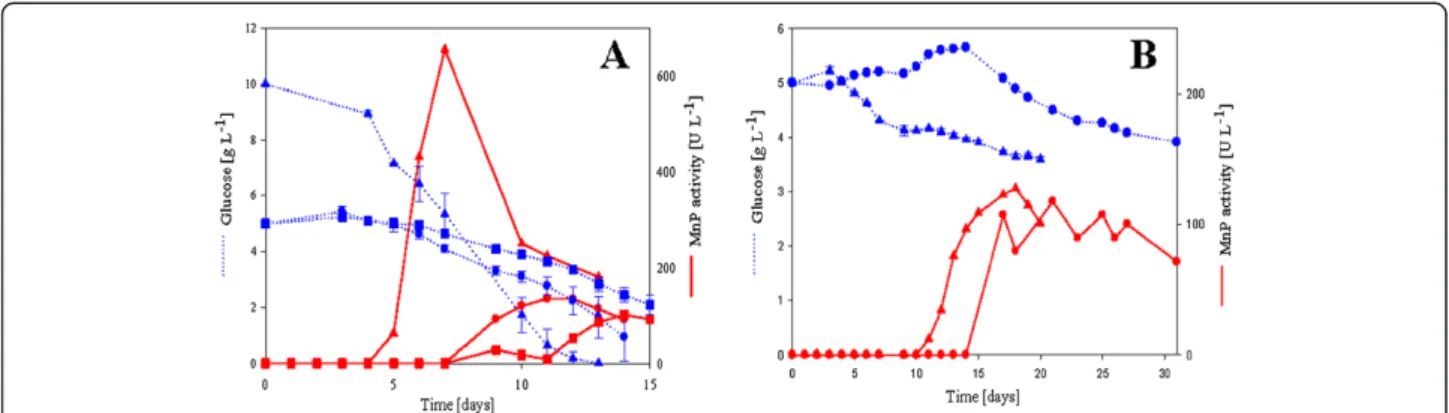
100–800 U l-1, respectively. Fastest growing white-rot fungus in these experiments was Bjerkandera sp., which also produced the highest activities. However, the MnP activity of Bjerkandera sp. increased and subsequently declined very sharply. These cultures were harvested 6 days after the MnP activity peak, which may have resulted in inactivated protein and lowered specific activity.
Purification of MnP isoenzymes from crude culture filtrates
Crude culture filtrates were concentrated and purified in a rapid purification scheme described in the materials sec-tion. Based on the SDS-PAGE gels (Figure 2A-E) MnP was the predominant protein produced in most of the cul-tures and highly purified in the pooled anion exchange fractions (Figures 3, 4, 5, 6, 7). In the Phlebia sp. Nf b19 culture supernatant and concentrate, a larger enzyme (around 70 kDa) was the predominant one. Based on the size, this is probably a laccase. Loss of MnP activity was high during the purification process. MnP activity was lost especially in the concentration step, but this is not relevant for the determination of specific activity. The role of en-zyme inactivation in the purification procedure is mini-mized due to low kept temperatures (4°C) during each step. After the strong anion exchange (Mono Q column) one MnP isoenzyme for Bjerkandera sp.(Figure 3), Phle-bia sp. Nf b19 (Figure 7) andP. rivulosus(Figure 5); two MnP isoenzymes forP. chrysosporium(Figure 4) and pos-sibly three isoenzymes for P. radiata (Figure 6) were detected. All of the MnP active fractions showed absorb-ance peaks in the 280 nm wavelength for protein and in the 405 nm wavelength for the heme containing protein. Wavelenght 405 nm could easily be used for selecting fractions likely to show MnP activity. MnP proteins were eluted between 175 and 320 mM NaCl concentrations.
The molecular weight of the MnPs was between 45 and 50 kDa (Table 1). Specific activities of the MnPs were calculated on the basis of the activity measure-ments and measured total protein in the pooled active fractions. P. chrysosporium MnP1 had the highest spe-cific activity (200 U mg-1). The second highest spespe-cific activity was observed for P. rivulosus(89 U mg-1). Phle-bia sp. Nfb19 MnP had the specific activity of 55 U mg-1. Rest of the MnP isoenzymes had a specific activity below 40 U mg-1 (Table 1).
Preliminary results ofin vitro enzymatic processing of milled pinewood sawdust with crude MnP concentrates showed up to 17% (data not shown) decrease in Klason lignin content and benefitted from the use of co-oxidants (Tween 80 and glutathione) in some cases.
Discussion
These results show that a simplified purification process is capable of producing comparable specific activity results for the screening of novel MnP enzymes. Culture super-natant concentration and anion exchange chromatography using a Mono Q column was enough to purify the enzyme to a high degree. Although the initial enzyme amounts were low and the losses during concentration were quite high, these results provide a basis for enzyme ranking. Based on these results there are significant differences in the specific activities of MnP enzymes from different white-rot fungi. Out of the white-rot fungi used in this study P. chrysosporium, P. rivulosus and Phlebia sp. Nf b19 MnPs were the most promising. ForP. rivulosus and Phlebia sp. Nf b19 these results are also consistent with the MnP activity and protein absorbance (280 nm) ratio in anion exchange chromatography (Table 1). The MnP activity (U l-1) of Bjerkandera sp. had come down over 70% at the point of harvesting. If the lost activity is accounted as inactivated MnP in the total protein
Figure 1Glucose consumption (dotted line) and MnP activity (solid line) by white-rot fungi during 300 mL batch cultivations.Each strain was cultivated in specific conditions and media described in the materials section. Values are calculated averages of two parallel cultivations. Standard deviation of MnP activity in parallel cultures is on average ±40 UL-1.Bjerkandera sp.(A, blue and red triangles),
Phanerochaete chrysosporium(A, blue and red circles),Physisporinus rivulosus(A, blue and red squares),Phlebia radiata(B, blue and red triangles),
Figure 2(A-E) Silver stained SDS-PAGE gels in corresponding order from the purification process with molecular weight protein standards (MW), crude extracellular fluids (I), concentrated samples (II) and MnP isoenzymes from MonoQ anion exchange column (III-V).
Figure 3Anion exchange chromatogram from the purification of MnP fromBjerkandera sp.Dotted line is the absorbance at wavelength 208 nm; Short dash line is the absorbance at wavelength 405 nm; Long dash line is the concentration of the eluent in percentage.
measurement, the specific activity could be at least three-fold higher. In addition to specific activity the stability of the purified MnP enzymes towards temperature, pH and inactivating compounds needs to be studied before candi-dates for recombinant production are selected. The reported specific activities are significantly lower than those previously reported for P. chrysosporium by Urek et al.(2004), Bjerkandera sp. by Palmaet al. (2000) and Taboada-Puig et al.(2011) and for Phlebia sp. Nfb19 by Schneegaβet al.(1997)
The production of MnP by native producers, as also observed in this study, is limited due to relatively low maximal enzyme activities, slow growth and the sensitivity of white-rot fungi towards shear forces, difficult induction strategies and low adaptivity to submerged fermentations. In this study MnP was in most cases induced with several supplements (Mn2+, VA, Tween, Sodium malonate). However, as reported by Hakala et al.(2006), the regula-tion of different MnP isoforms can be largely dependent on the inducing compounds and nutrient (nitrogen and carbon) sources and amounts. This suggests that novel isoforms would be found by changing the culture condi-tions. Mn2+−ions are typically necessary inducers for
MnP production although repressive effects of Mn2+−ions have also been reported (Martinezet al.1996). Although high activity level was not the focus in this study, the cul-ture conditions and inducing strategies (see the materials section) for this study were selected on previous literature to maximize enzyme production. Specified effects of indi-vidual inducing components cannot be separated for any strain, but clearly no MnP was produced before inducing components were added.
In recombinant MnP processes with Pichia pastoris (Jiang et al. 2008b), Aspergillus oryzae (Stewart et al. 1996), Aspergillus niger (Conesa et al.2000) and Echeri-chia coli(Whitwam et al. 1995; Whitwam & Tien 1996) production of high amounts of active protein has been a problem. These processes suffer from incorrect protein folding, insufficient heme synthesis and heme incorpor-ation. However, MnP yield might be significantly increased with the right combination of recombinant enzyme, pro-duction host, promoter system, protein secretion system and optimized process conditions. Jianget al.(2008b) also suspected that P. pastoris lacks the proper heme escorts and reseptors to transport exogenous heme to the site of MnP synthesis. This problem might be relieved by insert-ing the genes for such heme transport from e.g. Shigella (S.) dysenteriae(Mills & Payne 1995). S. dysenteriae is a known pathogen causing shigellosis, which would make the GMO rating of the recombinant strain difficult. On the other handP. pastorissynthesizes large amounts of a homologous heme-containing catalase protein under alchohol oxidase (AOX) promoted recombinant expres-sion. Thus gene expression under AOX promoter might be beneficial for MnP production due to the added need for heme synthesis inside the cells.Coprinus cinereus pro-duces a class II excreted fungal peroxidase (CiP) that read-ily oxidizes phenols, but is unable to oxidize veratryl alcohol or Mn2+−ions (Hofrichter et al. 2010). This en-zyme is successfully produced in a recombinant process using P. pastoris (Kim et al. 2009a) with high
Figure 5Anion exchange chromatogram from the purification
of MnP fromPhysisporinus rivulosus.Symbols as in Figure 2. Figure 7Anion exchange chromatogram from the purification
of MnP fromPhlebia sp. Nfb19.Symbols as in Figure 2.
productivities (peroxidase activity over 1200 U ml-1 and total protein over 1.6 g l-1) and is also sold as a commer-cial enzyme by Novozymes (BaylaseW). The productivity of this heme-containing peroxidase was optimized by host and expression promoter selection (Kim et al. 2009b). Highest productivities were obtained by using the AOX promoter with a fast methanol utilization strain (Mut+) of P. pastoris. This supports the theory, that inducing the methanol utilization pathway in a production host can pro-mote the recombinant production of heme-containing per-oxidases. Commercially available MnP (fromPhlebia sp. Nf b19) and VP (from Bjerkandera adusta) from Jena Bio-science GmbH are native enzymes and overly expensive for any kind of industrial use.
In this study several well known MnP enzymes were compared. MnP and laccase and their regulation in P. rivulosushas been well characterized by Hakalaet al. (2005 & 2006). The Differential regulation of MnP iso-forms inP. rivulosuswas also noted in these articles. In this study only one MnP from P. rivulosus is character-ized, but this may very well be a group of MnP isoen-zymes with approximately the same isoelectric points
and molecular sizes. In characterization studies by Hil-dén et al.(2008), the MnP2 enzyme fromPhlebia sp. Nf b19 showed a 96% amino acid identity to the MnP2 en-zyme ofP. radiatain the primary structure. In this study the specific activities and sizes of the MnP enzymes pro-duced by these related fungal strains were in the same range. Even in growth and MnP production these strains showed similarities (extremely slow growth and late onset of MnP production). Hildénet al.(2005) describe two MnP enzymes from P. radiata that are different in their primary structure, intron amount, length and crys-tal structure. The other isoenzyme being structurally related to LiP, but having an alanine residue instead of tryptophan while still having a conserved Mn2+−binding site. In this study three MnPs fromP. radiatawere sepa-rated, but they seemed to be highly similar in size and specific activity for Mn2+ oxidation.
Many technical applications for MnP have been reported with promising results. The utilization of the enzyme is still dependent on a cost-effective recombin-ant production process and possibly the discovery of more robust novel isoenzymes or modifications of the
Table 1 Purification of MnP isoenzymes fromBjerkandera sp.(A),Phanerochaete chrysosporium(B),Physisporinus rivulosus(C),Phlebia radiata(D) andPhlebia sp. Nfb19 (E)
Activity [U] Protein [mg] Specific activity [U/mg] Activity protein absorbance ratio [UL-1absorbance at 280nm-1]
Yield [%] Purification fold Size of MnP [kDa]
A
Culture fluid 38.0 2.9 13.3 100 1.0
Ultrafiltration 19.8 2.6 7.6 52.2 0.6
Mono Q BSMnP1 15.3 0.5 32.3 18 40.2 2.4 45
B
Culture fluid 38.7 1.447 26.7 100 1.0
Ultrafiltration 6.9 0.403 17.0 17.7 0.6
Mono Q PCMnP1 1.1 0.005 200.5 13 2.8 7.5 45
Mono Q PCMnP2 0.4 0.013 33.0 8 1.1 1.2 45
C
Culture fluid 36.6 2.685 13.6 100 1.0
Ultrafiltration 7.7 0.278 27.6 20.9 2.0
Mono Q PRMnP1 2.3 0.026 88.6 122 6.2 6.5 50
D
Culture fluid 52.0 4.669 11.2 100 1.0
Ultrafiltration 24.6 2.713 9.1 47.2 0.8
Mono QPradMnP1 5.8 0.245 23.7 33 11.1 2.1 50
Mono Q PradMnP2 4.0 0.199 19.9 21 7.6 1.8 50
Mono Q PradMnP3 7.2 0.234 30.8 33 13.8 2.8 50
E
Culture fluid 7.1 0.671 10.6 100 1.0
Ultrafiltration 3.4 0.511 6.6 46.9 0.6
currently known ones. Furthermore, optimization of en-zymatic treatment processes for various technical lignins (Vishtal & Kraslawski 2011), paper pulps (Maijala et al. 2008; Xu et al. 2010) and organopollutants (Sack et al. 1997) with proper process conditions and co-oxidants will probably increase the interest in MnP. Delignification of pinewood sawdust using a MnP treatment in this study was relatively inefficient. The use of several co-oxidants and other enzymes involved in biological ligninolysis may help to achieve more thorough enzymatic delignification demonstrated by many MnP producing and LiP-negative white-rot fungi (Hammel & Cullen 2008). In previous la-boratory experiments by Hofrichter et al. (1998) and Kapich et al. (1999) Mineralization and solubilization of synthetic (14C-labeled) large molecular weight lignin by MnP has been reported. These and various other studies suggest that isolated MnP enzymes can be used to delignify biomasses. However, for now the utilization of class II peroxidases to degrade polluting substances in soils is technically more appealing.
Competing interests
The authors declare that they have no competing interests.
Acknowledgements
The authors would like to thank the funding partners in this research project. Also the support from the finnish geo- and water technology support foundation (MVTT) for the writing part of this work is acknowledged.
Received: 22 August 2012 Accepted: 19 November 2012 Published: 29 November 2012
References
Bharagava RN, Chandra R, Rai V (2009) Isolation and characterization of aerobic bacteria capable of the degradation of synthetic and natural melanoidins from distillery effluent. World J Microbiol Biotechnol 25:737–744 Bonnarme P, Jeffries T (1990) Mn(II) regulation of lignin peroxidases and
manganese-dependent peroxidases from lignin-degrading white rot fungi. Appl Environ Microbiol 56:210–217
Conesa A, van den Hondel C, Punt P (2000) Studies on the production of fungal peroxidases inAspergillus niger. Appl Environ Microbiol 66:3016–3023 Floudas D et al (2012) The Paleozoic origin of enzymatic lignin decomposition
reconstructed from 31 fungal genomes. Science 336(6089):17151719 Hakala T, Lundell T, Galkin S, Maijala P, Kalkkinen N, Hatakka A (2005) Manganese
peroxidases, laccases and oxalic acid from the selective white-rot fungus
Physisporinus rivulosusgrown on spruce wood chips. Enzyme Microb Tech 36:461–468
Hakala T, Hildén K, Maijala P, Olsson C, Hatakka A (2006) Differential regulation of manganese peroxidases and characterization of two variable MnP encoding genes in the white-rot fungusPhysisporinus rivulosus. Appl Microbiol Biotechnol 73:839–849
Hammel K, Cullen D (2008) Role of fungal peroxidases in biological ligninolysis. Curr Opin Plant Biol 11:349–355
Hatakka A, Uusi-Rauva A (1983) Degradation of 14C-labelled poplar wood lignin by selected white-rot fungi. Eur J Appl Microbiol Biotechnol 17:235–242 Hildén K, Martinez A, Hatakka A, Lundell T (2005) The two manganese
peroxidases Pr-MnP2 and Pr-MnP3 ofPhlebia radiata, a lignin-degrading basidiomycete, are phylogenetically and structurally divergent. Fungal Genet Biol 42:403–419
Hildén K, Bortfeldt R, Hofrichter M, Hatakka A, Lundell T (2008) Molecular characterization of the basidiomycete isolateNematoloma frowardiib19 and its manganese peroxidase places the fungus on the corticioid genusPhlebia. Microbiology 154:2371–2379
Hofrichter M, Vares T, Scheibner K, Galkin S, Sipilä J, Hatakka A (1999) Mineralization and solubilization of synthetic lignin by manganese
peroxidases fromNematoloma frowardiiandPhlebia radiata. J Biotechnol 67:217–228
Hofrichter M, Lundell T, Hatakka A (2001) Conversion of milled pine wood by manganese peroxidase fromPhlebia radiata. Appl Environ Microbiol 67:4588–4593
Hofrichter M, Scheibner K, Schneegass I, Fritsche W (1998) Enzymatic combustion of aromatic and aliphatic compounds by manganese peroxidase from
Nematoloma frowardii. Appl Environ Microbiol 64:399–404
Hofrichter M (2002) Review: lignin conversion by manganese peroxidase (MnP). Enzyme Microb Technol 30:454–466
Hofrichter M, Ullrich R, Pecyna M, Liers C, Lundell T (2010) New and classic families of secreted fungal heme peroxidases. Appl Microbiol Biotechnol 87:871–897 Irie T, Honda Y, Watanabe T, Kuwahara M (2001) Homologous expression of
recombinant manganese peroxidase genes in ligninolytic fungusPleurotus ostreatus. Appl Microbiol Biotechnol 55:566–570
Jiang F, Kongsaeree P, Schilke K, Lajoie C, Kelly C (2008a) Effects of pH and temperature on recombinant manganese peroxidase production and stability. Appl Biochem Biotechnol 146:15–27
Jiang F, Kongsaeree P, Charron R, Lajoie C, Xu H, Scott G, Kelly C (2008b) Production and separation of manganese peroxidase from heme amended yeast cultures. Biotechnol Bioeng 99:540–549
Jimenez-Tobon G, Kurzatkowski W, Rozbicka B, Solecka J, Pocsi I, Penninckx M (2003) In situ localization of manganese peroxidase production in mycelial pellets ofPhanerochaete chrysosporium. Microbiology-Sgm 149:3121–3127 Johnson T, Pease EA, Li J, Tien M (1992) Production and characterization of
recombinant lignin peroxidase isozyme H2 fromPhanerochaete chrysosporium
using recombinantbaculovirus. Arc Biochem Biophys 296(2):660–666 Kamitsuji H, Honda Y, Watanabe T, Kuwahara M (2004) Production and induction
of manganese peroxidase isozymes in a white-rot fungusPleurotus ostreatus. Appl Microbiol Biotechnol 65:287–294
Kapich A, Hofrichter M, Vares T, Hatakka A (1999) Coupling of manganese peroxidase-mediated lipid peroxidation with destruction of nonphenolic lignin. Biochem Bioph Res Co 259(1):212–219, Model Compounds and 14C-Labeled Lignins
Kim S, Lee J, Won K, Kim Y, Song B (2009a) Functional expression ofCoprinus cinereusperoxidase inPichia pastoris. Process Biochem 44(7):731–735 Kim S, Lee J, Kim Y, Song B (2009b) Optimization of the functional expression of
Coprinus cinereusperoxidase in pichia pastoris by varying the host and promoter. J Microbiol Biotechn 19(9):966–971
Lankinen P, Hilden K, Aro N, Salkinoja-Salonen M, Hatakka A (2005) Manganese peroxidase ofAgaricus bisporus: grain bran-promoted production and gene characterization. Appl Microbiol Biotechnol 66:401–407
Li J, Gellerstedt G, Toven K (2009) Steam explosion lignins; their extraction, structure and potential as feedstock for biodiesel and chemicals. Biores Technol 100:2556–2561
Li D, Youngs H, Gold M (2001) Heterologous expression of a thermostable manganese peroxidase fromDichomitus squalensinPhanerochaete chrysosporium. Arch Biochem Biophys 385:348–356
Maijala P, Kleen M, Westin C, Poppius-Levlin K, Herranen K, Lehto JH, Reponen P, Mäentausta O, Mettala A, Hatakka A (2008) Biomechanical pulping of softwood with enzymes and white-rot fungusPhysisporinus rivulosus. Enzyme Microb Technol 43:169–177
Martinez M, RuizDuenas F, Guillen F, Martinez A (1996) Purification and catalytic properties of two manganese peroxidase isoenzymes fromPleurotus eryngii. Eur J Biochem 237:424–432
Mayfield M, Kishi K, Alic M, Gold M (1994) Homologous expression of recombinant manganese peroxidase inPhanerochaete chrysosporium. Appl Environ Microbiol 60:4303–4309
Mills M, Payne S (1995) Genetics and regulation of heme iron transport in
Shigella dysenteriaeand detection of an analogous system inEcherichia coli
O157:H. J Bacteriol 177:3004–3009
Mishra M, Thakur I (2010) Isolation and characterization of alkalotolerant bacteria and optimization of process parameters for decolorization and detoxification of pulp and paper mill effluent by Taguchi approach. Biodegradation 21:967–978 Moilanen A, Lundell T, Vares T, Hatakka A (1996) Manganese and malonate are
individual regulators for the production of lignin and manganese peroxidase isozymes and in the degradation of lignin byPhlebia radiata. Appl Microbiol Biotechnol 45:792–799
Moreira M, Feijoo G, Canaval J, Lema J (2003) Semipilot-scale bleaching of Kraft pulp with manganese peroxide. Wood Sci Technol 37:117–123
Moreira M, Sierra-Alvarez R, Lema JM, Feijoo G, Field J (2001) Oxidation of lignin in eucalyptus Kraft pulp by manganese peroxidase fromBjerkandera spstrain BOS55. Biores Technol 78:71–79
Nuske J, Scheibner K, Dornberger U, Ullrich R, Hofrichter M (2002) Large scale production of manganese-peroxidase using agaric white-rot fungi. Enzyme Microb Technol 30:556–561
Paice M, Reid I, Bourbonnais R, Archibald F, Jurasek L (1993) Manganese peroxidase, produced byTrametes-versicolorduring pulp bleaching, demethylates and delignifies Kraft pulp. Appl Environ Microbiol 59:260–265 Palma C, Martínez A, Lema J, Martínez M (2000) Different fungal
manganese-oxidizing peroxidases: a comparison betweenBjerkandera sp.And
Phanerochaete chry-sosporium. J Biotechnol 77:235–245
Pease E, Aust S, Tien M (1991) Heterologous expression of active manganese peroxidase fromPhanerochaete chrysosporiumusing thebaculovirus
expression system. Biochem Biophys Research Comm 179:897–903 Perie F, Gold M (1991) Manganese regulation of manganese peroxidase
expression and lignin degradation by the white-rot fungus Dichomitus-squalens. Appl Environ Microbiol 57:2240–2245
Petruccioli M, Frasconi M, Quaratino D, Covino S, Favero G, Mazzei F, Federici F, D’Annibale A (2009) Kinetic and redox properties of MnP II, a major manganese peroxidase isoenzyme fromPanus tigrinusCBS 577.79. J Biol Inorg Chem 14:1153–1163
Reading NS, Aust SD (2001) Role of disulfide bonds in the stability of recombinant manganese peroxidase. Biochemistry 40:8161–8168 Sack U, Hofrichter M, Fritsche W (1997) Degradation of polycyclic aromatic
hydrocarbons by manganese peroxidase ofNematoloma frowardii. FEMS Microbiol Lett 152:227–234
SchneegaβI, Hofrichter M, Scheibner K, Fritsche W (1997) Purification of the main manganese peroxidase isoenzyme MnP2 from the white-rot fungus
Nematoloma frowardiib19. Appl Microbiol Biotechnol 48:602–605 Singh D, Zeng J, Chen S (2011) Increasing manganese peroxidase productivity of
Phanerochaete chrysosporiumby optimizing carbon sources and supplementing small molecules. Lett Appl Microbiol 53:120–123 Silva E, Martins S, Milagres A (2008) Extraction of manganese peroxidase
produced byLentinula edodes. Biores Technol 99:2471–2475
Sklenar J, Niku-Paavola M-L, Santos S, Man P, Kruus K, Novotny C (2010) Isolation and characterization of novel pI 4.8 MnP isoenzyme from white-rotfungus Irpex lacteus. Enzyme Microb Technol 46:550–556
Steffen K, Hofrichter M, Hatakka A (2002) Purification and characterization of manganese peroxidases from the litter-decomposing basidiomycetes
Agrocybe praecoxandStropharia coronilla. Enzyme Microb Technol 30:550–555
Stewart P, Whitwam R, Kersten P, Cullen D, Tien M (1996) Efficient expression of a
Phanerochaete chrysosporiummanganese peroxidase gene inAspergillus oryzae. Appl Environ Microbiol 62:860–864
Sundaramoorthy M, Kishi K, Gold M, Poulos T (1997) Crystal structures of substrate binding site mutants of manganese peroxidase. J Biol Chem 272:17574–17580
Sutherland G, Zapanta L, Tien M, Aust S (1997) Role of calcium in maintaining the heme environment of manganese peroxidase. Biochemistry 36:3654– 3662
Susla M, Novotny C, Erbanova P, Svobodova K (2008) Implication ofDichomitus squalensmanganese-dependent peroxidase in Dye decolorization and cooperation of the enzyme with laccase. Folia Microbiol 53:479–485 Swamy J, Ramsay J (1999) Effects of Mn2+ and NH4+: concentrations on laccase
and manganese peroxidase production and Amaranth decoloration by
Trametes versicolor. Appl Microbiol Biotechnol 51:391–396
Taboada-Puig R, Lú-Chau T, Moreira M, Feijoo G, Martínez M, Lema J (2011) A new strain ofBjerkandera sp. production, purification and characterization of versatile peroxidase. World J Microbiol Biotechnol 27:115–122
Tien M, Kirk T (1988) Lignin peroxidase ofPhanerochaete chrysosporium. Methods Enzym 161:238–248
Urek R, Pazarlioglu N (2004) Purification and partial characterization of manganese peroxidase from immobilizedPhanerochaete chrysosporium. Process Biochem 39:2061–2068
Vares T, Kalsi M, Hatakka A (1995) Lignin peroxidases, manganese peroxidases, and other ligninolytic enzymes produced byPhlebia radiataduring solid-state fermentation of wheat straw. Appl Environ Microbiol 61:3515–3520
Vishtal A, Kraslawski A (2011) Challenges in industrial applications of technical lignins. BioResources 6:3547–3568
Wang P, Hu X, Cook S, Begonia M, Lee K, Hwang H-M (2008) Effect of culture conditions on the production of ligninolytic enzymes by white rot fungi
Phanerochaete chrysosporium(ATCC 20696) and separation of its lignin peroxidase. World J Microbiol Biotechnol 24:2205–2212
Wang Y, Vazquez-Duhalt R, Pickard M (2001) Effect of growth conditions on the production of manganese peroxidase by three strains ofBjerkandera adusta. Can J Microbiol 47:277–282
Wariishi H, Valli K, Gold M (1992) Manganese(II) oxidation by manganese peroxidase from the basidiomycetePhanerochaete chrysosporium- kinetic mechanism and role of chelators. J Biol Chem 267:23688–23695 Whetten R, Sederoff R (1995) Lignin biosynthesis. Plant Cell 7:1001–1013 Whitwam R, Tien M (1996) Heterologous expression and reconstitution of fungal
Mn peroxidase. Arch Biochem Biophys 333:439–446
Whitwam R, Gazarian I, Tien M (1995) Expression of fungal Mn peroxidase in
Escherichia coliand refolding to yield active enzyme. Biochem Biophys Res Commun 216:1013–1017
Xu H, Scott G, Jiang F, Kelly C (2010a) Recombinant manganese peroxidase (rMnP) fromPichia pastoris. Part 1: Kraft pulp delignification. Holzforschung 64:137–143
Xu H, Scott G, Jiang F, Kelly C (2010b) Recombinant manganese peroxidase (rMnP) fromPichia pastoris. Part 2: application in TCF and ECF bleaching. Holzforschung 64:145–151
Yadav S, Chandra R, Rai V (2011) Characterization of potential MnP producing bacteria and its metabolic products during decolourisation of synthetic melanoidins due to biostimulatory effect of D-xylose at stationary phase. Process Biochem 46(9):1774–1784
doi:10.1186/2191-0855-2-62
Cite this article as:Järvinenet al.:Screening of white-rot fungi
manganese peroxidases: a comparison between the specific activities of the enzyme from different native producers.AMB Express20122:62.
Submit your manuscript to a
journal and benefi t from:
7Convenient online submission
7Rigorous peer review
7Immediate publication on acceptance
7Open access: articles freely available online
7High visibility within the fi eld
7Retaining the copyright to your article