AUSTRALIAN JOURNAL OF BASIC AND
Open Access Journal
Published BY AENSI Publication
© 2016 AENSI Publisher All rights reserved
This work is licensed under the Creative Commons Attribution International http://creativecommons.org/licenses/by/4.0/
To Cite This Article: Rabi K. Mohapatra, Archana Sarangi, Tumbanath Samantara, Siba P. Panigrahi and Santanu K. Nayak Equalizer using Crossover-Cat Swarm Optimization
RBFNN Equalizer using Crossover
1
Rabi K. Mohapatra, 2Archana Sarangi, 3Tumbanath Samantara,
1KIT, Berhampur, Odisha,India
2SOA University, Bhubaneswar, Odisha, India 3OEC, Bhubaneswar, Odisha, India
4NIT, Arunachal Pradesh, India 5Berhampur University, Odisha, India
Address For Correspondence:
Siba P. Panigrahi, NIT, Arunachal Pradesh, India E-mail:[email protected]
A R T I C L E I N F O Article history:
Received 12 January 2016 Accepted 22 February 2016 Available online 1 March 2016
Keywords:
Radial Basis Function Neural Network;Channel
Equalization;Particle swarm optimization;Cat swarm optimization; Crossover cat swarm optimization.
Present day research on filter design and channel equalization focuses around use of swarm and evolutionary algorithms. However, use of artificial neural network (ANN)
range of engineering problems including the problem chan equalization using Multi-layer Perceptron (MLP),
systems is provided in (Burse et al, 2010, shows a pointer for use of neural networks limitations of large complexity and also fa finds global minima (Gan et al., 2012)
based equalizers. Recent research on channel equalization
2001, Yavuz and Yildirim, 2008} also proves popularity of RBFNN
Design of RBFNN still remains as a challenge. Major issues with RBFNN design are determination of the number of Radial Basis functions (RBFs), number of
designing these terms is also time-consuming. T
design remains as a challenge in RBFNN design. To avoid this time consuming process and also to improve local optimal problems, Barreto et.al
Optimization (PSO). These are used to decide these key and bias parameters. Minimization of the Mean Square Error (MSE) between the desired and actual outputs is actual criteria in the designs formulated in
2002. Feng, 2006) Search space in PSO is
AUSTRALIAN JOURNAL OF BASIC AND
APPLIED SCIENCES
ISSN:1991-8178 EISSN: 2309-8414 Journal home page: www.ajbasweb.com
© 2016 AENSI Publisher All rights reserved
This work is licensed under the Creative Commons Attribution International License (CC BY). http://creativecommons.org/licenses/by/4.0/
Rabi K. Mohapatra, Archana Sarangi, Tumbanath Samantara, Siba P. Panigrahi and Santanu K. Nayak Cat Swarm Optimization. Aust. J. Basic & Appl. Sci., 10(5): 1-6, 2016
using Crossover-Cat Swarm Optimization
Tumbanath Samantara, 4Siba P. Panigrahi and 5Santanu K. Nayak
India
NIT, Arunachal Pradesh, India.
A B S T R A C T
Radial Basis function Neural Networks (RBFNN) is one of most popular equalizers to mitigate the channel distortions. Most challenging problem associated with design of RBFNN Equalizer is the traditional hit and trial method. The problem is formulated as an optimization problem and solved using a hybridized version of Cat Swarm Optimization (CSO) termed as Crossover Cat Swarm Optimization (Cross
the exploration and exploitation of the existing CSO is increased by adding the concept of crossover in genetic algorithm to CSO. The new
Cross-with the standard particle swarm optimization (PSO) and original CSO to prove its effectiveness with some standard benchmark functions. The simulation results prove the superior performance of the proposed Cross-CSO as compared to the traditional algorithms.
INTRODUCTION
Present day research on filter design and channel equalization focuses around use of swarm and evolutionary algorithms. However, use of artificial neural network (ANN) is common and popular in a wide range of engineering problems including the problem channel equalization. A detailed review on c
layer Perceptron (MLP), functional-link artificial NN (FLANN) and neuro , 2010, Subramanian et al., 2014). Recent literature on
shows a pointer for use of neural networks (Ruan and Zhang, 2014, Cui et al., 2014). But, limitations of large complexity and also fall to local optima. However, RBFNN contains
., 2012). RBFNN is less complex and provides better performance on channel equalization (Civicioglu et al., 2005, Kaur, 2013, Schilling also proves popularity of RBFNN.
Design of RBFNN still remains as a challenge. Major issues with RBFNN design are determination of the number of Radial Basis functions (RBFs), number of cluster centres etc. This trial
consuming. The key parameters like weights, centers, and spreads and their design remains as a challenge in RBFNN design. To avoid this time consuming process and also to improve local optimal problems, Barreto et.al (2002) used Genetic Algorithm (GA) and Feng (2006)
Optimization (PSO). These are used to decide these key and bias parameters. Minimization of the Mean Square Error (MSE) between the desired and actual outputs is actual criteria in the designs formulated in
in PSO is limited and hence to local minima (Bergh and Engelbrecht, 2002)
Rabi K. Mohapatra, Archana Sarangi, Tumbanath Samantara, Siba P. Panigrahi and Santanu K. Nayak., RBFNN
Cat Swarm Optimization
Radial Basis function Neural Networks (RBFNN) is one of most popular equalizers to mitigate the channel distortions. Most challenging problem associated with design of is the traditional hit and trial method. The problem is formulated as an optimization problem and solved using a hybridized version of Cat Swarm Optimization (CSO) termed as Crossover Cat Swarm Optimization (Cross-CSO). Here, on of the existing CSO is increased by adding the concept -CSO algorithm is compared with the standard particle swarm optimization (PSO) and original CSO to prove its The simulation results prove CSO as compared to the traditional
Present day research on filter design and channel equalization focuses around use of swarm and is common and popular in a wide nel equalization. A detailed review on channel link artificial NN (FLANN) and neuro-fuzzy . Recent literature on channel equalization . But, ANNs have inherent contains only one hidden layer performance then ANN ., 2005, Kaur, 2013, Schilling et al.,
this paper we make use of The CSO (Chu S.C., and Tsai, P.W. 2007) and Cross-CSO (Sarangi et al., 2016) for training of RBFNN based equalizer.
The Cat Swarm Optimization (CSO) algorithm deals with the cat behavior and accomplished in two sub-models .Here, population size for cats can be determined by the user. For each of the iterations .In a M-dimensional space, each cat defines its position, velocity in each direction. A fitness value denotes the efficiency of the cat and a flag identifies the present mode of the cat, seeking or tracing mode. The best position of the best cat provides the final solution. CSO keeps the best solution until it reaches the end of the iteration. In this paper, a new hybrid algorithm is proposed by introducing the concept of crossover of genetic algorithm to the traditional CSO algorithm to increase the exploration and exploitation of the existing search space in a better way.
The Problem:
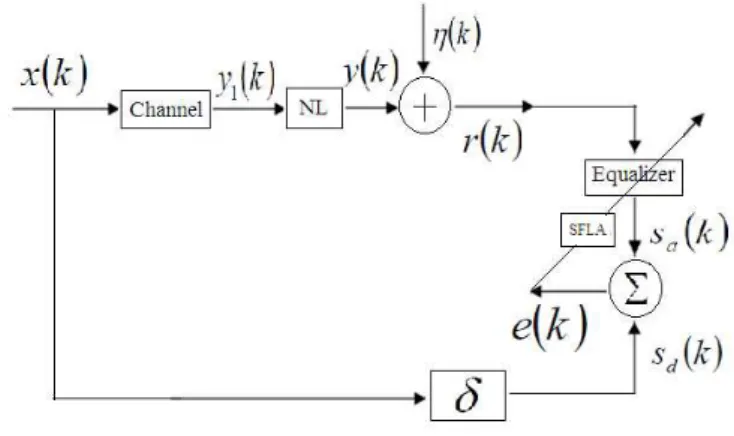
A digital communication system considered in this paper is illustrated through figure 1. If, x
( )
k is the transmitted data at time instant , the channel can be modelled as a FIR filter with output,y1( )
k , at the same timeinstant where,
( )
∑
−(
)
= −
= 1
0 1
N
i
ixk i
h k y
(1)
Fig. 1: Base-band model of digital communication system.
Here,
h
i(
i
=
0
,
1
,
L
N
−
1
)
denotes the tap weights for the channel andN
denotes its length. Thechannel introduces non-linear distortion which is presented by a separate block ‘NL’. The mostly used nonlinear function:( )
(
( )
)
( )
( )
3 1 11 k y k by k
y F k
y = = + (2)
Here,
b
is a constant. Therefore, the channel output becomes:( )
(
)
1(
)
30 1
0
− +
−
=
∑
∑
−= −
=
N
i i N
i
ixk i b hxk i
h k y
(3)
The channel output is once again affected by noise,
η
( )
k
. The noise assumed here as additive zero meanwhite gaussianwith variance,
σ
2. The corresponding output signal that reaches the receiver,r
( )
k
is:( ) ( ) ( )
k
r
k
k
r
≅
+
η
(4)This is the input signal for the equalizer. The job of the equalizer is to recover the original sequence (while considering transmission delay,
δ
) by nullifying the effects of distortion and noise.x
(
k
−
δ
)
. This signal is termed as and given by:( ) (
k
=
x
k
−
δ
)
s
d (5)The equalization process is treated as a classification problem [2-4], where the equalizer task is to partition
the input equalizer space
x
( )
k
=
[
x
( ) (
k
,
x
k
−
1
)
,
L
x
(
k
−
N
+
1
)
]
Tinto two separate regions.( )
( )
∑
( )
= − − = N j j j bay c k x k x f 1 2 2 exp σ β (6)For binary transmitted symbols: ( ) ( ) ∈ − ∈ +
= +−1
1 1 1 d j d j j C c for C c for β (7)
Here,
C
d( )+1/
C
d( )−1 is the set of channel states,c
jis binary symbol,x
(
k
−
δ
)
=
+
1
/
−
1
.In figure 1, the block “Equalizer” denotes RBFNN. GA is used to find number of layers and number of neurons in each layer (except input layer) for this RBFNN and shown by the block “OA”.Number of neurons In input layer is same as number of taps in the channel, N.
The equalizer output:
( )
( )
( )
( ) ( )
k k W t k s w k s f T z j j j j RBF ϕ α = − − =∑
=1 2 exp (8) Here,( )
[
( ) ( )
( )
]
Tz
k
w
k
w
k
w
k
W
=
1,
2,
L
( )
[
( ) ( )
( )
]
Tz
k
k
k
k
φ
φ
φ
ϕ
=
1,
2,
L
( )
− − = j j j t k s α φ 2exp for
j
=
1
,
2
,
L
z
Here,
t
jandα
j respectively denotes the centers and the spreads of the neurons hidden layers andw
j denotes the connecting weights.The equation (8) that is an implementation of the Bay’s decision function of equation (6) considers
t
jsameas the channel states,
c
jwith the adequately regulated connecting weights.Therefore, the decision function for the RBFNN equalizer is:
(
)
( )
( )
− ≥ + = − elsewhere k x f ksd ANN
1
0 1
δ
(9)
The difference between the RBFNN equalizer output (
xˆ
(
k
−
δ
)
) and desired output (x
(
k
−
δ
)
) is the error,e
( )
k
, and used for updating the equalizer weights. Two popular indexes for performance are, MSE andBit Error Rate (BER),
E
[ ]
e
( )
k
. Here,E
is the expectation operator.Cat Swarm Optimization:
Cat Swarm Optimization is a population based algorithm developed by Chu and Tsai (2007}. The CSO algorithm models the nature of cats into two modes: ‘Seeking mode’ and ‘Tracing mode. Cats in CSO play the same role as the particles in PSO. Each of the cat are represented by their position and velocity in D-dimensions. Efficiency of the cats evaluated by their fitness’ he mode of the cat (seeking or tracing) is identified by their flag. The best position of the best cat provides the optimized final solution. Algorithm terminates at arrival of global best solution or preset value of maximum number of iterations. For details on the modes of cats one can refer to. The algorithm steps reproduced below for ease of reading.
• Generate L number of cats and randomly initialize the position and velocity of these cats thus creating L×D matrices in the process where D is the dimension corresponding to the weights of IIR filter.
• Evaluate the fitness of each cat and store best position as Pgm , where m= 1 , 2, ….D.
• Sprinkle the cats into the search space and pickup the number of cats which would undergo tracing mode with the help of mixture ratio(MR) and cats undergoing seeking mode are divided by seeking memory pool(SMP)
• Change the position of the cats according to their flags if cat is in seeking mode , then seeking process is applied otherwise it goes for tracing mode.
• The fitness of the cats are evaluated again and best among them has position Plm where m = 1, 2 … D.
• Compare Pg and Pl to get the better position and update accordingly.
Crossover Cat Swarm Optimization:
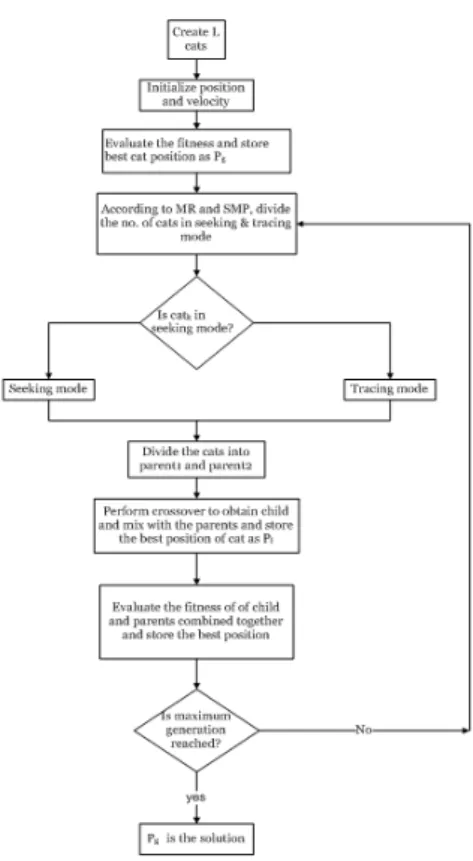
In order to achieve better exploration of the search space with higher accuracy, Cross over CSO (CCSO) algorithm was proposed by Sarangi et al (2016).First the fitness of cat calculated and is stored in best position. According to mixture ratio and SMP we calculate the number of cats which would go to tracing mode and seeking mode .The fitness of cat which are present in seeking mode is evaluated in adaptive way so that we store the best position. The cats present in tracing mode are separated into parent 1 and parent 2. By using crossover mechanism of GA new offspring are generated. The offspring and the parent are mixed .Then fitness of all the cats are evaluated and best position is stored. By comparing the previous position with new position we update the position of cats. Simulation results prove superiority of the proposed Cross-CSO as compared to original CSO. Steps of the algorithm are as follows:
• Generate random population of cats having initial position and velocities. The dimensions of the cats must be same as weights of IIR filter.
• Evaluate fitness of each cat and best position of cat is stored as Pg.
• According to MR, the cats go for tracing mode and according to SMP; the cats go for seeking mode. The indices of position matrix that undergo tracing mode are given by q = 1, 2……L/(1+MR) , where L is population size.
• Evaluate the fitness of cats in seeking mode and store the best position.
• Divide cats in tracing mode into parent 1 and parent 2 cats and apply uniform crossover to produce child. • Then mix child cats and parent cats and calculate fitness values and store the best position as Plm.
• Compare the fitness of Pg and Plm and Update the Pg .
• Check the termination conditions and if they do not satisfy then repeat steps 3 to 6.
Proposed Training Method:
Method of training RBFNN using CSO and its modified forms for optimization of each parameter of RBFNN is discussed below in this section.
Steps for the training algorithm used in this paper can be outlined as:
i. Initialize population of cats. Each cat defines a network and the associated centers and bandwidths. Set the number of iterations as MaxIteration. Start the first iteration.
ii. Decode each cat into a network. Compute the connection weights between the hidden layer and the output of the network by the pseudo–inverse method. Compute the fitness of each cat.
iii. Run CSO to update the position.
i. Go to next iteration;
ii. Go back to step ii until reaching the maximum number of iterations.
In this work, RBFNN trained with original CSO is termed as CRBF, while trained Cross-CSO as CCRBF for convenience of the reader.
Simulation Results:
The simulation of the proposed algorithm is done in MATLAB to demonstrate the potential for equalization of communication channels. In this section of result analysis, the new hybrid algorithm Cross-CSO is compared with two standard effective algorithms i.e. GA, PSO, CSO. The initial population chosen for all the algorithms is 50. The simulation parameters for PSO are: inertia weight is linearly decreased from 0.9 to 0.4, both the acceleration constants are taken as 2 and the random numbers are chosen in the range [0 1]. The parameters for CSO are: SMP = 5, SRD = 20%, CDC = 80%, MR = 0.9, C = 2, inertia weight is linearly decreased from 0.9 to 0.4 and r lies in the range [0 1]. The best feature of GA i.e. uniform crossover is used in Cross-CSO in addition to the same parameters as that of CSO. The algorithms are run a number of times to produce better results.
For evaluation of performance of proposed CRBF equalizers, results of contemporary PSO trained RBFNN (PRBF) [8] based equalizers are reproduced for the purpose of comparison.
Simulations were conducted for the most popular distorted channel with transfer function:
( )
1 226
.
0
93
.
0
26
.
0
+
−+
−=
z
z
z
H
(10)The equalizer performance is affected by channel nonlinearity. This effect studied in this paper introducing the nonlinearity:
( )
n[
x( )
n]
y = tanh (11)
For the comparisons, two parameters, MSE & BER, were taken as performance index. For convergence comparison among RBF based equalizers, i.e., evaluation of MSE under similar conditions, SNR is kept fixed at 10dB.
Fig. 3: MSE plot for RBFNN equalizers.
Figure 2 shows the error convergence at 10dB for different equalizers. It is observed from the figure that, proposed CCRBF outperforms other equalizers. It is also seen that, RBFNN trained CSO are better than as trained with other nature inspired algorithms like GA and PSO. It is also observed that CCSO is a better method for training of RBFNN equalizer as compared to original forms of CSO. It was observed that, CCRBF requires only 835 iterations to converge while other equalizers fail to converge within 1000 iterations.
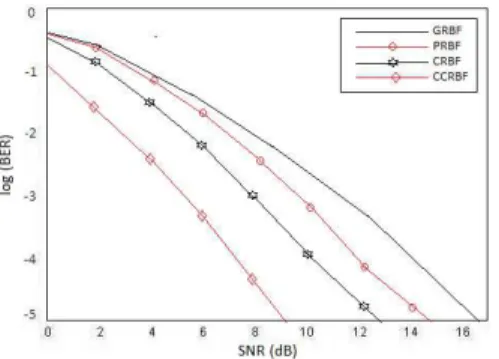
BER comparison among RBFNN based equalizers is depicted in figure 3. It is seen from figure 3 that, performance of GRBF and PRBF are comparable to each other up to SNR of 8dB. CRBF equalizers perform better than GRBF and PRBF. Once again CCRBF performs better than CRBF,
Summary And Future Work:
This paper proposed novel strategy for RBFNN training using CSO and its modified form. This paper also proposed some efficient approaches for channel equalization as evidenced by simulation results. Major contributions by this paper are, RBFNN training using CSO and its modified form, use of CRBF in channel equalization and comparison among CSO and its modified forms while training RBFNN. Significance of the works carried out in this paper as compared to existing RBF based equalizers is that of a better learning and generalization of the RBF network. Performance of CRBF based equalizer also better than the existing equalizers as seen from the simulations.
REFERENCES
Barreto, A.M.S., H.J.C. Barbosa and N.F.F. Ebecken, 2002. Growing Compact RBF Networks Using A Genetic Algorithm, In Proceedings of the VII Brazilian Symposium on Neural Networks, pp: 61-66.
Bergh, V. and A.P. Engelbrecht, 2002. A new locally convergent particle swarm optimizer, Proceedings of IEEE International Conference on Systems, Man, and Cybernetics, 96-101.
Burse, K., R.N. Yadav and S.C. Shrivastava, 2010. Channel Equalization Using Neural Networks: A Review, IEEE Trans. On Systems, man and cybernetics-Part C: Applications and Reviews, 40(3): 352-357.
Chu S.C. and P.W. Tsai, 2007. Computational intelligence based on the behavior of cats. International Journal of Innovative Computing, Information and Control, 3: 163–173.
Alç, M. and E. Beṣdok, 2005. Using an Exact Radial Basis Function Artificial Neural Network for Impulsive Noise Suppression from Highly Distorted Image Databases, Lecture Notes in Computer Science, 3261: 383-391.
Cui, M., H. Liu, Z. Li, Y. Tang and X. Guan, 2014. Identification of Hammerstein model using functional link artificialNeural Networks, Neurocomputing, 142: 419-428
Feng, H.M., 2006. Self-generating RBFNs Using Evolutional PSO Learning, Neurocomputing, 70: 241-251.
Gan, M., H. Peng, and L. Chen, 2012. Global–local Optimization Approach to Parameter Estimation of RBF-type Models. Information Sciences, 197: 144-160.
Kaur, H. and B. Dhaliwa, 2013. Design of Low Pass FIR Filter Using Artificial Neural Network, International Journal of Information and Electronics Engineering, 3(2): 204-207.
Ruan, X. and Y. Zhang, 2014. Blind sequence estimation of MPSK signals using dynamically driven recurrent Neural Networks, Neurocomputing, 129: 421-427.
Sarangi, A., S.K. Sarangi, S.P. Panigrahi, 2016. An approach to Identification of Unknown IIR Systems using Crossover Cat Swarm Optimization, accepted for publication in ICEMS.
Schilling, R.J., Carroll JJ Jr and A.F. Al-Ajlouni, 2001. Approximation of Nonlinear Systems with Radial Basis Function Neural Networks, IEEE Trans. on Neural Network, 12(1): 1-15.
Subramanian, K., R. Savitha, M. Suresh, 2014. A complex-valued neuro-fuzzy inference system and its learning mechanism, Neurocomputing, 123: 110-120.