Original Article
The Influence of Surface Polish and Beverages on the Roughness of
Nanohybrid and Microhybrid Resin Composites
Sadeghi Ma, Deljoo Za, Bagheri Rb
aUndergraduate Student, Shiraz Dental School, Shiraz University of Medical Sciences, Shiraz, Iran
bDental Materials Department and Biomaterials Research Centre, Shiraz Dental School, Shiraz University
aof Medical Sciences, Shiraz, Iran
ARTICLE INFO Abstract
Article History:
Received 24 November 2015 Accepted 2 February 2016
Statement of the Problem: Surface roughness is a key factor in the aesthetics of restorative dentistry as it can determine the clinical quality and success of restorative materials. The chemical process of dissolution in the presence of mechanical forces can accelerate the surface roughness of tooth-coloured restorative materials.
Objectives: To determine the degree of surface roughness of a microhybrid and a nanohybrid resin composite after polishing and immersion in various solutions.
Materials and Methods: Two resin composites were used : a microhybrid (Gradia direct, GC), and a nanohybrid (Ice, SDI). A total of 54 disc-shaped specimens were prepared for each composite and immersed in distilled water incubated at 37 °C for 24 hours. After 24 h, the baseline measurement for surface roughness (Ra) was performed and the specimens were divided into 3 groups of 18 and tested with unpolished or after polishing with Sof-Lex disc and Enhance point systems. Specimens in each group were subdivided into 3 subgroups (n = 6) and immersed in 3 solutions (distilled water, coffee, and cola) for 7 days incubated at 37 °C. After 7 days, the specimens were rinsed with tap water for 10 seconds, dried with paper towel and Ra was measured again. Two randomly selected specimens of each group were sputter coated with gold and examined using a Field-Emission Scanning Electron Microscope (SEM).
Results: Gradia direct showed a greater Ra than ice in all solutions for all polishing systems (p < 0.001). Specimens polished with Enhance point revealed a significantly greater roughness than Sof-Lex discs and both showed greater Ra than unpolished specimens. Specimens immersed in coffee exhibited significantly greater surface roughness than that of distilled water (p < 0.05) and cola (p < 0.001).
Conclusions: Nano-hybrid composite showed a significantly smoother surface than microhybrid. Coffee exhibited the highest Ra compared to distilled water and cola. Enhance point revealed significantly greater Ra than Sof-Lex discs and unpolished group.
Key words:
Surface Roughness Nanohybrid Composite Microhtbrid Composite Staining Solutions
Corresponding Author: Rafat Bagheri,
Dental Materials Department and Biomaterials Research Centre, Shiraz Dental School, Shiraz University of Medical Sciences, Shiraz, Iran Tel: +98-7136280119 Email: [email protected]
Cite this article as: Sadeghi M, Deljoo Z, Bagheri R. The Influence of Surface Polish and Beverages on the Roughness of Nanohybrid and Microhybrid Resin Composite . J Dent Biomater, 2016;3(1):177-185.
Introduction
One of the main advantages of resin composite is its gloss surface that is associated with its surface properties such as polishability. Due to its excellent aesthetic and surface characteristics, dental composite is frequently requested by patients even for restoration of the posterior teeth. Resin composites have grown fast since 50 years ago when the materials were first introduced to the market [1]. The most significant changes in the formulation of resin composites over the time are reduction of the filler particle sizes and increase in filler loading [2]. To achieve a better surface smoothness and optical properties nanofill and nanohybrid composites are introduced to the dental market [3,4].
Microfill resin composites with particles ranging from 0.02 to 0.04 μm represent excellent surface smoothness but they suffer functional durability due to having approximately 50 vol% resin matrix [5]. The combination of particles and nanoclusters reduces the interstitial spaces between the inorganic particles at the same time giving a possibility to have the maximum filler loading, thus providing better functional properties and polish maintenance [6]. On the other hand, discoloration of resin composite still remains a major disadvantage of the restorations. A survey of published studies showed that the highly polished and smooth surface restorations compared to rough surfaces have better aesthetics and less susceptibility to plaque accumulation and extrinsic discoloration [7].
The effect of polishing systems on the surface roughness of different types of resin composites has been reported. Some studies [8-10] that used polishing discs, wheels, and glaze materials indicated that the average roughness value of hybrid resin composites was the highest compared to microhybrid or nanohybrid resin composites [8-10]. It has been reported that after polishing procedures, nano-hybrids showed a similar or slightly lower roughness than micro-hybrids [11]. Although the smoothest surface is obtained when the resin composite polymerizes against a Mylar strip without further finishing or polishing [12,13], most restorations require finishing and polishing for final marginal adjustment. Moreover, the top surface polymerized against Mylar strip is a resin rich layer with low mechanical properties that
wear resistance of the materials but also provide the smoothest possible surface [14,15].
It is reported that among different polishing systems, multi-step aluminum-oxide discs (Sof-Lex discs) exhibited the smoothest surface [9,16,17]. Antonson et al. [16] in their study evaluating the effect of polishing systems on different resin composites found that the baseline surface roughness (unpolished) of nanohybrid and hybrid differed significantly from each other whereas postoperatively there were no significance differences. The Sof-Lex discs provided the smoothest surface and microhybrid polished by Sof-Lex revealed lower gloss than the nanohybrid composite.
Although some studies have been conducted to assess the surface roughness of resin composites, the effect of different polishing systems exposed to common used beverages on the surface roughness of the microhybrid and nanohybrid resin composites are not widely studied. Therefore, this study aimed to assess the combined effect of mechanical and chemical factors on the surface property of resin composites. In this study, 3 polishing and finishing systems (Mylar strip, Sof-Lex disc and Enhance point systems) and 3 common drinks (distilled water, cola and coffee) were used to evaluate the effect of the combination of those on the surface roughness of nanohybrid and microhybrid resin composites. This study used profilometer to measure the surface roughness (Ra) and scanning electron microscope
(SEM) to observe the surface roughness generated by all factors.
Materials and Methods Specimen preparation
Two resin composites of shade A2 (Table 1), three polishing methods and three solutions were used in this study. A total of 108 disc-shaped specimens (54 for each composite) were prepared using a polyethylene mould of 10 mm diameter and 2 mm thickness. Resin composite was gently packed into the mould, and a clear Mylar strip was placed on the top and bottom surface to minimize oxygen inhibition layer. Then two glass slabs were placed over the strip and slight hand pressure was applied to extrude excess material. The top glass slide was removed and the specimen was cured for 20s each side using an LED curing unit
Lot number Composition
Type Manufacturer
Material
2096SN (80 wt% / 61 vol%),
SAS, AS
(0.04 - 3 μm,) UDMA/ BisEMA/TEGDMA Nanohybrid resin
composite SDI, Vic, Australia
Ice
1311063 (75 wt% / 59 vol% )
FAS, Silica, prepolimerized filler
Average 0.85μm UDMA
dimethacrylate Microhybrid resin
composite GC Corporation,
Tokyo, Japan Gradia
direct
UDMA = urethane dimethacrylate, TEGDMA=triethylene glycol dimethacrylate, SAS= Strontium alumino silicate, AS= amorphous , silica, BisEMA= bisphenol a Ethylmethacrylate
Table 2: Detail of polishing systems used in the study and instruction of use
Lot number Instruction of use
Manufacturer Polishing systems
N494170 Applied coarse, medium, fine
and superfine discs for 15, 30,45, and 70 circular motion respectively, finished with the same polishing paste mentioned
below 3M /ESPE, USA
Sof-Lex disc
1405271 Applied with 60 circular
motion, finished with polishing paste (SDI) on rubber cap for 30 seconds at low speed and
light pressure Dentsply,caulk, USA
Enhance polishing points(type:rubber points)
Table 1: Materials used in this study
of 1500 mW/cm2 (Radii plus LED, SDI, Bays water, Vic, Australia). The specimen was removed from the
mould and the edges were ground gently using 1000- grit silicon carbide paper. All the specimens were incubated in distilled water at 37ºC for 24 h.
After 24 h immersion, all the specimens of each material were divided into three groups of 18. One group was marked ‘unpolished’ and left undisturbed after removal of the matrix strip. Specimens in the second and third groups were polished using a low speed hand piece in a circular motion on just one side either with aluminum oxide-impregnated discs (Sof-Lex®, 3M/ESPE) or aluminum oxide-impregnated
silicon points (Enhance®, Dentsply). Details of the polishing procedures of both systems are explained in Table 2.
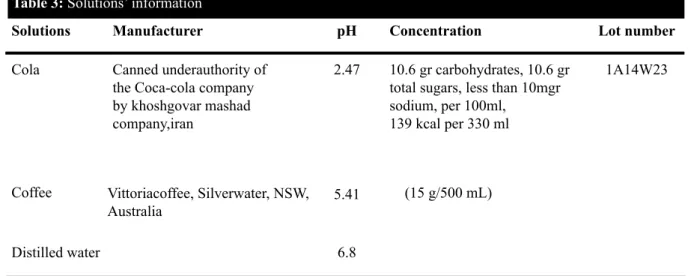
When all specimens were polished, each of the 3 groups was subdivided into 3 subgroups of 6 and immersed in distilled water, cola or coffee (Table 3) for 7 days incubated at 37ºC (n = 6). The staining solution was replaced with fresh solution every 48 h during the storage period.
Measurement of surface roughness
Surface roughness (Ra) of each specimen was
Table 3: Solutions’ information
Lot number Concentration
pH Manufacturer
Solutions
1A14W23 10.6 gr carbohydrates, 10.6 gr
total sugars, less than 10mgr sodium, per 100ml,
139 kcal per 330 ml 2.47
Canned underauthority of the Coca-cola company by khoshgovar mashad
company,iran Cola
(15 g/500 mL) 5.41
Vittoriacoffee, Silverwater, NSW, Australia
Coffee
6.8 Distilled water
Table 4: Analysis after 24 hours immersion in distilled water. A comparison between the surface roughness (Ra) of the composites with all polishing systems, and effect of time (24 versus 7 days) on the (Ra).
Comparison of time (P value( Solution
Enhance Sof-Lex
Unpolished Enhance
Sof-Lex Unpolished
Composite
24h > 7d (p < 0.001) 24h > 7d
(p < 0.001) 7d > 24h
(p = 0.001) .858 ± .004Da
.620 ± .004Ba
.315 ± .005Aa
Gradia direct
Distilled
W
ater
24h > 7d (p < 0.001) 24h > 7d
(p < 0.001) 7d > 24h
(p < 0.001) .534 ± .005Db
.320 ± .003Bb
.158 ± .003Ab
Ice
solutions for the unpolished group and after polishing for the 2 polished groups. After 7 days of immersion, the measurement procedures were performed again. A profilometer (Perthometer M2, Mahr, Germany)
with a 0.25-mm cutoff value and 2-mm tracing length was used for the measurement. The roughness of three locations of each specimen was obtained and the average value was recorded. Before the measurement, each specimen was rinsed with tap water for 10 seconds and dried with paper towel. Two randomly selected specimens of each group were sputter coated with gold and examined using a Field-Emission Scanning Electron Microscope (SEM, CB1, Cambridge, England).
Statistical Analysis
SPSS version 18 (SPSS Inc., Chicago, IL., USA) was used for data analysis. Three-way ANOVA was used to assess the interaction between three factors: materials, polishing methods, and solutions. Due to significant interaction effects in the model, subgroup analysis using student’s T-test and one-way ANOVA/ Tukey’s HSD tests was applied. Paired T-test was used to compare the surface roughness between two time intervals (24 h and 7 days) in distilled water. A p value of < 0.05 was considered to be statistically significant.
Table 5: Analysis after 7 days immersion comparison of composites, 3 polishing systems and solutions Enhance Sof-Lex Unpolished Composite Solution
.842 ± .004Da
.522 ± .005Db
.610 ± .005Ba
.310 ± .003Bb
.320 ± .005Aa
.162 ± .003Ab
Gradia direct Ice
Distilled water
.892 ± .005Da
.540 ± .003Db
.600 ± .006Ba
.340 ± .004Bb
.310 ± .004Aa
.152 ± .002Ab
Gradia direct Ice
Cola
.832 ± .005Da
.557 ± .004Db
.622 ± .004Ba
.360 ± .003Bb
.333 ± .006Aa
.170 ± .004Ab
Gradia direct Ice
Coffee
A,B,D letters show significant difference in the surface roughness between different polishing systems. a,b letters show significant difference in the surface roughness between different types of resin composite.
Table 6: Comparing the surface roughness between 3 solutions.
Significant pairwise result for solutions Polishing methods
Resin composites
coffee > distilled water > cola coffee > distilled water > cola cola > distilled water > coffee Unpolished
Sof-Lex Enhance Gradia direct
coffee > distilled water > cola coffee > cola>distilled water coffee > cola>distilled water Unpolished
Sof-Lex Enhance Ice
Results
Three-way ANOVA revealed a significant interaction between all factors (p < 0.001). Table 4 shows that Gradia direct has a greater surface roughness (Ra)
than Ice after 24 h immersion in distilled water and also after 7 days immersion in all solutions for all polishing systems (p < 0.001). Enhance point revealed significantly greater roughness than Sof-Lex discs and both showed greater Ra than Mylar strip
(unpolished group).
Generally, the specimens of both resin composites of unpolished groups after 24 h of immersion in distilled water showed significantly lower Ra values than those of 7 days of immersion (p < 0.001), which is in contrast with the other 2 polishing groups in
distilled water (Table 5). Table 5 compares the effect of staining solutions and distilled water on the surface roughness of resin composites based on different surface polishes which varies based on the material and polishing systems. Generally, for unpolished specimens, immersion in coffee after 7 days exhibited significantly greater surface roughness than in distilled water (p < 0.05) and cola (p < 0.001). Table 6 shows the significant pairwise result for solutions and compares the surface roughness cause by 3 solutions. Discussion
A significant difference was found between the surface roughness of microhybrid and nanohybrid. Gradia direct showed a greater surface roughness Comparison of time (P value(
Solution Enhance Sof-Lex Unpolished Enhance Sof-Lex Unpolished Composite
24h > 7d (p < 0.001) 24h > 7d
(p < 0.001) 7d > 24h
(p = 0.001) .858 ± .004Da
.620 ± .004Ba
.315 ± .005Aa
Gradia direct
Distilled
W
ater
24h > 7d (p < 0.001) 24h > 7d
(p < 0.001) 7d > 24h
(p < 0.001) .534 ± .005Db
.320 ± .003Bb
.158 ± .003Ab
Ice
A,B,D letters show difference in the surface roughness between different polishing systems. a,b letters show difference in the surface roughness between different types of resin composite.
than Ice. For both materials, using Mylar strip showed the smoothest surface; this is in agreement with many other previous studies [18-22]. However, resin rich layer in the restorations polymerized under Mylar strip is less resistant to abrasion and needs to be removed. Furthermore, all restorations need contouring adjustment, especially in the marginal area and occlusal surface, which needs to be polished that may end up with rough surfaces. Therefore, it is essential for a tooth-coloured restoration to be polished and finished with the best method to create the smoothest surface, hence prevents the plaque accumulation and staining.
The results of our study showed a significantly greater Ra when the Enhance point was used compared
to Sof-Lex discs. This result is in agreement with those of other reported studies [23]. The authors speculated that the reason that Sof-Lex discs created smooth surfaces is related to their ability of removing the same amount of inorganic particles and organic matrix. The plane movement of the disc contributes to a smoother surface [23]. Despite the production of a rougher surface, Enhance polishing system is easier to form anatomic landmarks especially in the posterior teeth due to the rubber-like flexible material used in the system [24]. In contrast, the Soft-Lex disc has limitations for use in the proximal surfaces and posterior region of the mouth because of their rigidity; the discs are difficult to produce [25]. Therefore, the outcome of the polishing systems in the mouth may be different from the results obtained in the laboratory. The results revealed that Ice (nanohybrid composite) performed significantly smoother than Gradia direct (microhybrid composite) in all solutions while using all polishing and finishing systems. This performance may be explained by the inorganic filler particles’ hardness, volume percentage, shape, and size that are exposed after polishing [26]. It has been shown that solid filler particles in microhybrids are considerably larger than nanosized particles [27]. Moreover, Ice contains smaller filler particles and greater filler loading (61 vol %) in comparison to Gradia direct (59 vol %). This quantitative result was proven by qualitative examination (SEM images) shown in Figure 1. A few representative images of
of Ice and Gradia direct after immersion in coffee. The smoothest surface observed was for unpolished specimens of Ice immersed in coffee (Figure 1-A) and the roughest for Gradia polished with Enhance point immersed in coffee (Figure 1-D). After immersion in coffee, specimens polished by Sof-Lex discs, Ice (Figure 1-B) showed a smoother surface with less air bubbles than Gradia direct (Figure 1-C).
With regards to the effect of staining solutions on the surface roughness of resin composites, immersion in coffee (pH 5.41) resulted in a greater surface roughness than either cola (pH 2.47) or distilled water (pH 6.8) for both materials with almost all polishing systems. For unpolished specimens, immersion in coffee after 7 days exhibited significantly greater surface roughness than in distilled water (p < 0.05) and cola (p < 0.001). This is in agreement with the results of others [28,29] who found that coffee (pH 5.01) and tea (pH 5.38) stimulated the surface alteration of resin composites more significantly compared to red wine (pH 3.7). It is concluded that [30] increase in surface roughness in coffee may be associated with its acidic pH and a correlation between the type and quantity of load and the capacity of coffee to dissolve at a high temperature.
However, the other parts of the results of our study revealed that the surface roughness of both resin composites increased after 7 days of immersion in distilled water compared to 24 hours of immersion. It is speculated that the water uptake over the time could be a major reason for surface alteration of the materials rather than acidic pH or the temperature at which coffee is dissolved. Water softens the material [31] and, consequently, decreases the surface hardness [32]. Therefore, water sorption of these materials may have a significant outcome on the surface degradation of the materials.
Conclusions
Within the limitation of this study, the following conclusions were drawn: Gradia direct (microhybrid) showed significantly greater surface roughness than Ice (nanohybrid). Specimens immersed in coffee exhibited the highest R compared to distilled water
Figure 1: A- Ice unpolished after immersion in coffee, B- Ice polished with Sof-Lex after immersion in coffee, C- Gradia direct polished with Sof-Lex after immersion in coffee, D- Gradia direct polished with Enhance point after immersion in coffee
References
1. Ferracane JL. Resin compositestate of the art. Dent Mater. 2011;27:29-38.
2. Chen MH. Update on dental nanocomposites. J Dent Res. 2010;89:549-560.
3. Fortin D, Vargas MA. The spectrum of composites:
new techniques and materials. J Am Dent Assoc. 2000;131:26S-30S.
4. St-Georges A, Bolla M, Fortin D, et al. Surface finish produced on three resin composites by new polishing systems. Oper Dent. 2005;30:593-597. 5. Da Costa J, Ferracane J, Paravina RD, et al. The effect of different polishing systems on surface point revealed significantly greater surface roughness
than Sof-Lex discs and both showed greater Ra than
unpolished group. Acknowledgments
The authors thank the Vice-Chancellor of Shiraz
University of Medical Sciences for supporting this research (Grant# 9238) which is based on the thesis by Dr. Maryam Sadeghi. The authors also thank Dr. Mehrdad Vossoughi Statistician in Shiraz Dental School for his help with the statistical analysis, and SDI and GC for providing the materials used in this study.
roughness and gloss of various resin composites. J Esthet Restor Dent. 2007;19:214-224.
6. Attar N. The effect of finishing and polishing procedures on the surface roughness of com-posite resin materials. J Contemp Dent Pract. 2007;8:27-35.
7. Endo T, Finger WJ, Kanehira M, et al. Surface texture and roughness of polished nanofill and nanohybrid resin composites. Dent Mater J. 2010;29:213-223.
8. Gulati G, Hegde R. Comparative Evaluation of two Polishing Systems on the Surface Texture of an aesthetic material (nano-composite): A Profilometric Study. People`s Journal of Scientific Research. 2010;3:17-20.
9. Sarac D, Sarac YS, Kulunk S,et al. The effect of polishing techniques on the surface roughness and colour change of composite resins. J Prosthet Dent. 2006;96:33-40.
10. Schmitt VL, Puppin-Rontani RM, Naufel FS, et al. Effect of the polishing procedures on colour stability and surface roughness of composite res-ins. ISRN Dent. 2011;2011.
11. de Moraes R, Gonçalves Lde S, Lancellotti AC, et al. Nanohybrid resin composites: nanofiller loaded materials or traditional microhybrid resins? Oper Dent. 2009;34:551-557.
12. Ergücü Z, Türkün L. Surface roughness of novel resin composites polished with one-step systems. Oper Dent. 2007;32:185-192.
13. Janus J, Fauxpoint G, Arntz Y, et al. Surface roughness and morphology of three nanocom-posites after two different polishing treatments by a multitechnique approach. Dent Mater. 2010;26:416-425.
14. Gordan V, Patel S, Barrett A, et al. Effect of sur-face finishing and storage media on bi-axial flexure strength and microhardness of resin-based composite. Oper Dent. 2003;28:560-567.
15. Ergücü Z, Türkün L, Aladag A. Colour stability of nanocomposites polished with one-step systems. Oper Dent. 2008;33:413-420.
16. Antonson SA, Yazici AR, Kilinc E, et al. Comparison of different finishing/polishing systems on surface roughness and gloss of resin composites. J Dent. 2011;39:9-17.
17. Lu H, Lee Y, Oguri M, et al. Properties of a dental resin composite with a spherical inorganic filler.
18. Turkun L, Turkun M. The effect of one-step polishing system on the surface roughness of three esthetic resin composite materials. Oper Dent. 2004;29:203-211.
19. Barbosa SH, Zanata RL, Navarro MFdL, et al. Effect of different finishing and polishing techniques on the surface roughness of micro-filled, hybrid and packable composite resins. Braz Dent J. 2005;16:39-44.
20. Gedik R, Hürmüzlü F, Coskun A, et al. Surface roughness of new microhybrid resin-based composites. J Am Dent Assoc. 2005;136:1106-1112.
21. Çelik Ç, Özgünaltay G. Effect of finishing and polishing procedures on surface roughness of tooth-coloured materials. Quintessence Int. 2009;40:783-789.
22. Jefferies SR, Boston DW. Conventional polishing techniques versus a nanofilled surface sealer: preliminary findings regarding surface roughness changes and analysis. J Clin Dent. 2010;21:20-23. 23. Ritter AV. Posterior Resin‐Based Composite
Restorations: Clinical Recommendations for Optimal Success. J Esthet Restor Dent. 2001;13:88-99.
24. Yap A, Lye K, Sau C. Surface characteristics of tooth-coloured restoratives polished uti-lizing different polishing systems. Oper Dent. 1997;22:260-265.
25. Özgünaltay G, Yazici A, Görücü J. Effect of finishing and polishing procedures on the surface roughness of new tooth‐coloured restoratives. J Oral Rehabil. 2003;30:218-224.
26. Taha NA, Ghanim A, Tavangar MS. A comparison evaluation of mechanical properties of resin modified glass ionomer with resin composite restoratives. J Dent Biomater. 2015;2:47-53. 27. Jung M, Sehr K, Klimek J. Surface texture of
four nanofilled and one hybrid composite after finishing. Oper Dent. 2007;32:45-52.
28. Bagheri R, Burrow MF, Tyas M. Surface char-acteristics of aesthetic restorative materials–an SEM study. J Oral Rehabil. 2007;34:68-76. 29. Wongkhantee S, Patanapiradej V, Maneenut C, et
al. Effect of acidic food and drinks on surface hardness of enamel, dentine, and tooth-coloured filling materials. J Dent. 2006;34:214-220. 30. de Gouvea C, Bedran LM, de Faria MA, et al.
composites after immersion in coffee and soft drink. Acta Odontol Latinoam. 2011;24:3-7. 31. Bagheri R, Tyas MJ, Burrow MF. Comparison of
the effect of storage media on hardness and shear punch strength of tooth-coloured restorative
materials. Am J Dent. 2007; 20:329-334.
32. Bagheri R, Mese A, Burrow MF, et al. Comparison of the effect of storage media on shear punch strength of resin luting cements. J Dent.2010;38:820-827.