•Correspondence: Pat H. Wilson, University of Sydney, Australia; e-mail: [email protected]
Learning to Sing in Tune:
Does Real-Time Visual Feedback Help?
Pat H. Wilson1, Kerrie Lee1, Jean Callaghan2, and C. William Thorpe31University of Sydney 2 Freelance voice and singing specialist
3 University of Auckland
Background in singing pedagogy. Learning to sing involves mastery of basic motor and sensory skills combined with an understanding of relevant musical parameters and assimilation of appropriate behavioural, sociological, cultural and aesthetic information. Traditional teaching methods include modelling and verbal feedback in a one-on-one learning situation. Recent technology, especially computer software, has potential to alter practices in singing pedagogy.
Background in human-computer interaction. Computers have been used effectively for some time in training neuromuscular skill development in diverse areas including sports, speech pathology, and non-native language teaching. The use of computers as an effective learning tool for singers requires that we understand what information must be represented, and how to make that information accessible and useful to the singer.
Aim. The aim of this research was to study the effects of computer-based visual feedback on teaching pitch accuracy in singing, investigating whether the style of feedback affects the amount of learning achieved, and whether provision of concurrent visual feedback hampers the simultaneous performance of the singing task.
Main contribution. The study used a baseline-intervention-post-test between-groups design. Participants were randomly assigned to one of three groups – either a Control group (receiving no visual feedback), or one of two experimental groups offered visual feedback about their pitch accuracy via computer screen: (a) continuous, contextual feedback, with information about degree of accuracy; and (b) continuous but categorical (right/wrong) feedback. Each session was digitally recorded and acoustically analysed to assess the degree of pitch accuracy of each assessable sung note. The mean pitch accuracy for all participants in each group was analysed at baseline and at post-test, using a repeated measure analysis of variance. In both experimental groups pitch accuracy improved significantly after training with visual feedback, while the Control group showed no change in performance, suggesting that visual feedback helps learner singers to improve their pitch accuracy. During training with visual feedback, both experimental groups showed a significant performance decrement because of the increased information processing load associated with the task. However, there was no significant difference between the pitch accuracy results of the two experimental groups.
Implications. Findings indicate that singers whose training is a hybrid of traditional methods and real-time visual feedback should make better gains in pitch accuracy than those taught by traditional means only. Singing teachers who recognize the major role of motor learning in vocal skill development will talk less during teaching sessions, while structuring lesson conditions which permit students to attend to and build up the essential implicit memory needed to develop their singing skills. Improving singing pedagogy using new technologies requires the sharing of knowledge across areas of neuromuscular skills acquisition, information design and processing, and musicology.
Keywords: Human-computer interaction, motor learning, singing – pitch, singing – pedagogy, visual feedback
Introduction
Management of pitch (fundamental frequency - F0) is a foundational singing skill. Measuring a singer’s pitch accuracy is a simple way of assessing their improvement in one aspect of the range of capabilities which together constitute singing skill. Singing teachers traditionally use a master-apprentice training model (Callaghan, 2000); the student sings (notes, scales, exercises, songs) and, when they have finished, the teacher offers feedback, usually verbal. The student then repeats the sung performance, attempting to improve by incorporating what the teacher has either discussed or demonstrated. Singing teachers today need to offer a judicious spread of knowledge, practice and experience to their students. Current instruction encompasses neuromuscular (motor) skill acquisition, intellectual understanding and assimilation of appropriate behavioural, sociological, cultural and aesthetic information.
One of the first reassurances that learners need is that they are undertaking a learning task correctly. Even if the desired outcomes have yet to be achieved, feedback tells the learner that they are ‘on the right track’, and therefore well placed to achieve if they persist with the activity. Investigations by Shea & Wulf (1999), Wulf, Höß & Prinz (1998), and Banton (1995) suggest that visual feedback is a basic prerequisite for effective psychomotor learning, especially in the beginning stages.
A range of software programs for singers has become available over the last decade (Callaghan & Wilson, 2004; Welch, Howard, Himonides & Brereton, 2005). These computer-based training aids offer real-time visual feedback on various aspects of sung sound. Some are commercially available, others exist on the world-wide web as freeware, while still others are at the experimental (beta-testing) stage of development. The existence of these tools raises the question: ‘Can the provision of real-time visual feedback assist the learner singer?’ Explanations accompanying some visual feedback programs make it clear that they are only intended to be used as an adjunct to a traditional singing teacher’s instructions, while others are silent on the topic or explicitly state ‘You can teach yourself!’
Whilst singing, the singer must be actively engaged in a range of sensory areas. The cognitive load of a singer can be considerable: monitoring sung tone through both air conduction and bone conduction hearing (auditory), using audiation (Gordon, 1993) to anticipate their next sung tone (auditory), listening to the accompaniment (auditory), following a score (visual), watching a conductor (visual), and assessing their own physical status by checking muscular recruitment, posture, etc. (touch/kinaesthetic-proprioceptive). In many performance conventions (e.g., opera, music theatre), singers must also watch, listen to, and respond to the other performers on stage with them (visual, auditory, touch/kinaesthetic-proprioceptive). It is valid to enquire whether the provision of another information input which makes additional sensory demands will benefit learner singers.
Since pitch-matching is a good way to assess a degree of competence in singing (Mürbe, Pabst, Hofmann & Sundberg, 2002; Welch, 1985a), an investigation was
undertaken in order to assess the effect of concurrent visual feedback on learner singers’ pitch-matching abilities while singing vocal exercise patterns.
Method
DesignThe structure of this research study was a baseline-intervention-post-test between-groups design. Participants were randomly assigned to one of three between-groups − either the Control group or one of two experimental groups. Each experimental group received a different form of visual feedback during the intervention phase, while the Control group received singing practice with neither verbal nor visual feedback.
Participants
Participants were recruited from the staff and students at a metropolitan university campus who responded to a general advertisement asking for volunteers to do a singing lesson. Fifty-six persons (ranging in age from 18 years to 60 years; mean age of 30.2 years) participated in the investigation, with 11 of these participants eliminated from the study because of incomplete data or presence of hearing loss, leaving a final corpus of 45 participants (10 male and 35 female). None of the participants was a professional musician.
Details of the gender and musical background of the participants are shown in Table 1. Participants with a history of singing training or musical training, and who completed the advanced singing patterns (see below), are identified in the ‘Advanced’ column. Participants with no musical or singing training, and who sang the simpler note sequence (see below), are labelled ‘Novices’. While participants were randomly allocated to each group, the numbers of ‘Advanced’ and ‘Novices’ were similar across all groups.
Table 1. Consolidated table: Number of participants, divided into Males and Females, showing Skill Level groups and Feedback Mode groups.
Display mode Gender Novices* Advanced*
Grid screen Males - 3
Grid screen Females 4 8
Grid screen Total 4 11
Keyboard screen Males 1 2
Keyboard screen Females 4 8
Keyboard screen Total 5 10
Control Males 2 2
Control Females 4 7
Control Total 6 9
TOTAL 15 30
Stimuli - Exercise patterns. Participants exhibited a wide range of prior musical experience, although none was training or working as a professional singer. The singing exercises used in the study were divided into two skill levels (Figures 1–3): novice (Skill level 1 – Figure 1) and advanced (Skill level 2 or 3 – Figures 2 and 3). Participants were allocated a skill level which was of sufficient difficulty for them to show improvement with training. The researcher (a trained and experienced singing teacher) used information collected in a short initial questionnaire about the participant’s singing and musical training background, as well as the participant’s demonstrated capability on the vocal warm-up exercises, to assess the approximate vocal range, level of singing skill and musicianship of individual participants.
Figure 1. Exercise pattern - Skill Level 1 - Simplest [1–3–1]; used for novice participants.
Figure 2. Exercise pattern - Skill Level 2 - Medium difficulty [1–4–6–4–1]; used for advanced singers.
Figure 3. Exercise pattern - Skill Level 3 - Most complex [1–flat 7–2–3–4]; used for advanced singers.
Stimuli - Visual feedback screens. Participants in the two experimental groups received visual feedback using one of two different screen displays. Both the Grid and Keyboard groups received (near) real-time visual feedback on their voice pitch during the sessions. The style and nature of the feedback differed for each group. The Control group was presented with a static screen display which did not provide feedback about their singing.
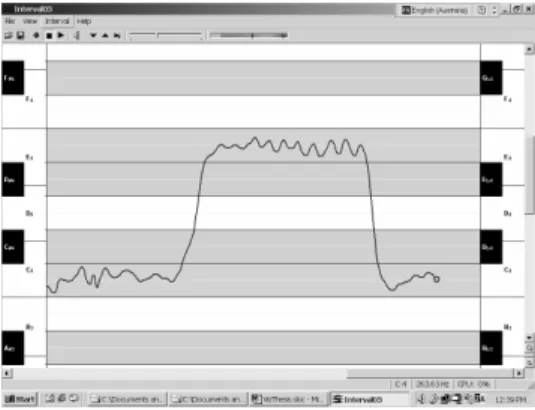
Figure 4. Visual feedback mode – Grid screen design (prototype: Sing&See™) showing a 3-note sequence with target 3-notes C4, E4, and C4, and a linear pitch trace of the singer’s sung
sequence indicating that all 3 notes were sung at the correct pitch.
Figures 4 and 5 present the feedback screens for each of the experimental groups. The two figures show the screen display for the same sung sequence. At the end of a simple 1–3–1 interval, the singer has sung C4, E4, and C4. In the Grid group’s screen design (Fig. 4), the sung sequence is tracked by a pitch trace line traversing two (originally green-coloured) target pitch areas. Using this visual feedback screen, participants in the Grid group had targets to aim for, validation when these targets were met, a sound and space context within which to place the targeted pitches, and a means of seeing where their voice pitch has been, as a way of helping them to target future pitches. The Grid screen design is based on a prototype for the pitch display of Sing&See™, specialised software which shows a visualisation of acoustic information about a singer’s voice in (near) real-time on a computer screen (Callaghan, Thorpe & van Doorn, 2004; Callaghan, Thorpe, van Doorn & Wilson,
2003; Thorpe, Callaghan & van Doorn, 1999).
In the Keyboard group’s screen design (Fig. 5), only the last note’s key (the C4) has darkened (originally turned bright red) to show its accuracy. The fact that the E4 was sung previously in the same 1–3–1 interval has disappeared; the current pitch is the only one reflected in the display.
Figure 5. Visual feedback mode – Keyboard screen design showing real-time visual feedback for right/wrong pitch accuracy in a keyboard display.
The Keyboard screen design was based on a piano, and showed real-time visual feedback for right/wrong pitch accuracy in a keyboard display. Any sung note changed the colour of the corresponding piano key pale red, but only while it was being sung. Targeted pitches were indicated by green-coloured keys (e.g. the light-shaded E4 in Fig. 5) which, when sung correctly, turned bright red. Participants in the Keyboard group had immediate feedback about what pitch was currently being sung, but they did not have any history of what notes had been sung previously. Degree of accuracy was implicit in the number of keys between the target and sung note. The Control group was required to learn the same singing patterns as the experimental groups. During intervention, the exercise patterns were played to them by the computer, and they received no visual feedback on their pitch accuracy. They were presented with a static screen, similar to that used for the Keyboard group, but with the pitch response deactivated so no information about their singing accuracy was available.
Pitch measurement
In order to accurately assess the difference in pitch error between participants, errors were measured in cents (100 cents equals one semitone) rather than in Hertz (Hz). The tolerance of accuracy was a half-semitone, with boundaries set at half-way between the exact frequencies of each note. In other words, participants singing anything less than a half-semitone above or below the target pitch were credited with having sung that pitch. A half-semitone is a perceptible difference to most untrained singers, male or female, with high or low voices. Results were collated and expressed in Hertz.
Equipment
All sessions were undertaken in a soundproof room of the Speech Laboratory at the School of Communication Sciences and Disorders, University of Sydney. Equipment included a computer (Dell Optiplex GX150 Celeron processor) with flat-screen monitor and speakers (Juster SP-691), an external USB Audio Interface (Roland UA-30), a head-mounted condenser microphone (AKG MicroMic C 420), a DAT tape machine (Sony ZA5ES Digital Audio Tape Deck), a mixing console (Behringer Eurorack MX 602A 6-Channel, 2-Bus) and a synthesizer (Roland E-36 Intelligent Keyboard) which served as a piano. Every test sequence was recorded with the participant standing, with the computer screen at a height of 120cm from the floor, and therefore easily seen by standing adults of average height.
Procedure
Each participant was given a single one-hour session conducted by the same researcher, a trained and experienced singing teacher. The overall procedure consisted of a pre-session questionnaire, a singing lesson (including pre-test, intervention and post-test measurements), and a post-session questionnaire. All participants provided written informed consent before participating in the experiment. All sessions were scripted to maintain consistency between the sessions.
Each session began with a pre-session questionnaire which covered areas including demographic information, amount of singing training, spoken-voice training, musical training, and number of musical instruments played.
The singing tasks commenced with physical then vocal warm-ups. These were used to assess the approximate vocal range, level of singing skill and musicianship of the participant. The researcher then chose the most appropriate of the three exercise patterns, and began teaching it to the participant. This enabled the researcher to determine the participant’s optimum pitch range for this activity. Once this range was established by agreement, and the participant indicated readiness, the first test pattern (five interval sequences in upward semitone increments) was performed and recorded for measurement of their baseline performance. Patterns were sung on the vowel sound of the participant’s choice: either /u/ (as in ‘pool’) or /ɑ/ (as in ‘part’); the vowel remained the same for all tests in the session.
Participants in the experimental groups then practised scales, single notes or songs, using the visual feedback, while the Control group practised the same tasks without visual feedback. At the end of the practice session all participants were again tested with the same five exercise patterns used at baseline. This measurement reflected their performance during training (intervention condition). All participants then completed a short post-session questionnaire which included questions about their preferred learning style using Gardner’s Multiple Intelligences Theory (Gardner, 1983). Gardner’s theory posits the existence of a number of distinct forms of intelligence,
possessed by all individuals in varying degrees. His initial research gave seven primary forms of intelligence: linguistic, musical, logical-mathematical, spatial, bodily-kinaesthetic, intrapersonal (i.e., insight, metacognition) and interpersonal (i.e., social skills). He has subsequently added an eighth (naturalist). Gardner suggested that learning and teaching should focus on the particular intelligences of each person, since the different intelligences represent not only different domains of content but also learning modalities. Although broad in nature, these general indicators of learning style preference may signpost the profile of singing students most likely to gain benefit from interactive, visually-based instructional feedback systems. The questionnaire also included questions about health and physical capabilities (handedness, colour blindness, history of vocal problems, history of ear/hearing problems, nicotine and caffeine intake, current medication). For the two experimental groups, there were also four open-ended questions asking the participant how they perceived their interactions with the real-time visual feedback.
After completing the questionnaire, the participants were asked to sing the test exercise patterns again (the post-test measurement).
Results
Visual feedback and improvement
The first analysis addressed the question of the effect of real-time visual feedback on pitch accuracy. Figure 6 shows the mean pitch error for each group at baseline and post-test. From this graph it can be seen that both the Grid and Keyboard groups improved in their pitch accuracy at post-test, while the Control group showed no change in performance. The mean improvement in pitch for the Grid group was 8.1 Hz (SD=5.2), and for the Keyboard group was 7.9 Hz (SD= 8.4). The Control group performance changed by less than 1 Hz (SD=8.1) between baseline and post-test. The distribution of pitch for each group at baseline and post-test was not normally distributed. The statistical analysis therefore used the difference score, calculated by subtracting the mean pitch error of each participant at post-test from their mean performance at baseline. This gave a difference score based on the amount of change in performance between baseline and post-test. The absolute pitch error was used in this analysis. That is, a note 40Hz below the target or 40 Hz above the target was given an error value of 40Hz in both instances. Q-Q Plots of the difference scores for each group showed these scores were close to a straight line (representing normal distribution), with the exception of one outlier in the Control group and Keyboard group at baseline. These results were treated as normally distributed.
Figure 6. Mean F0 error (in Hz) at baseline and at post-test for each group: Outcomes of
performance after feedback.
This difference score between pre-test and post-test was therefore analysed using a One-Way Analysis of Variance. This analysis showed that there is an overall significant difference between the groups on changes in pitch accuracy between baseline and post-test (F2,42= 5.909 p=0.005).
Two planned contrasts were then carried out to investigate which groups produced the significant difference in performance at post-test. The first contrast compared performance of the Grid and Keyboard groups, to investigate whether there was a difference in performance as a result of the type of visual feedback. The result shows no significant difference in performance between the two visual feedback groups, indicating that the different styles of visual feedback (Grid or Keyboard) had a similar impact on performance (t=0.837; p=0.407).
A second contrast compared the experimental groups to the Control group to determine if feedback changed performance. The result shows that the groups who received visual feedback demonstrated significantly greater improvement in pitch between baseline and post-test than the Control group, indicating that feedback did facilitate learning to sing the correct pitch (t= -3.334; p=0.002).
The effect of visual feedback
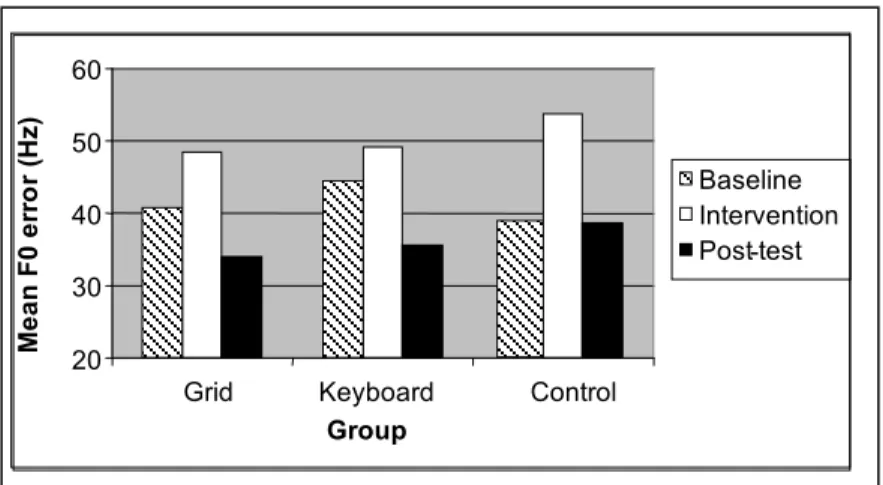
The study further examined the impact of concurrent visual feedback upon the rate and quality of learning. Visual feedback was offered to the two experimental groups during training. Figure 7 shows the mean pitch error based on measurements of F0 for each group at baseline, intervention and post-test. The graph shows that all three groups performed more poorly in terms of pitch accuracy during the intervention phase. The mean difference in pitch accuracy between performance at baseline and
20 30 40 50
Grid Keyboard Control
Group
M
e
a
n
F
0
e
rr
o
r
(H
z)
intervention was -7.7 Hz for the Grid group, -4.7 Hz for the Keyboard group and -15 Hz for the Control group. That is, all groups showed a mean decrement in their performance at intervention relative to performance at baseline.
Figure 7. Mean pitch error (in Hz) for each group at baseline, intervention and post-test.
Effect of feedback on performance at intervention was analysed using a repeated measure ANOVA based on comparing the three groups at baseline and intervention using their mean F0 error score. The results show a significant main effect for time (baseline and intervention) F2,42=24.820; p= 0.0001), and a significant interaction effect for group and time (F2,42= 5.909; p=0.005). This interaction was investigated in a post-hoc analysis using a Dunnett t test which compared the pitch error differences between baseline and intervention for the Control group and for each treatment group. The result shows that the Control group, which received no visual feedback at intervention, had a significantly greater performance decrement between baseline and intervention than the Keyboard group. There was no significant difference between the performances of the Grid group and the Control group (see Table 2).
Table 2. Results of Dunnett t test: Comparing pitch error differences between baseline and intervention for the Control group and the two treatment groups.
Group Group Mean Difference
Standard Error
Significance (* p=0.05)
Grid Control 7.10256 5.06043 .142 (NS) Keyboard Control 10.15348 5.06043 .046*
Novice versus advanced singers
Novice singers performed the Skill Level 1 (Fig. 1) exercise pattern, while the more musically-experienced advanced singers sang exercise patterns for either Skill Levels 2 or 3 (Figs. 2, 3). The number of participants in each skill category (novice versus
20 30 40 50 60
Grid Keyboard Control Group
M
e
a
n
F
0
e
rr
o
r
(H
z)
Baseline Intervention Post-test
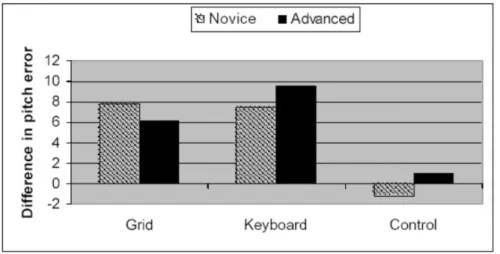
advanced) was too small for statistical analysis. Figure 8 shows the mean difference in pitch accuracy between baseline and post-test for Keyboard, Grid and Control groups, with participants divided into novice versus advanced singers. The results showed that both the novice and advanced participants in the Grid and Keyboard groups improved in their pitch accuracy between baseline and post-test (see Figure 8). The novices, who were given the simplest (three-note) patterns, showed greater accuracy improvement between baseline and post-test in the Keyboard group but not in the Grid group (see Figure 8).
In the Control group, the pitch accuracy of the novice and advanced participants changed by 1 Hz between baseline and post-test.
Figure 8. Mean difference in pitch accuracy (in Hz) between baseline and post-test; results for novice and advanced singers, divided into Grid, Keyboard and Control groups.
Discussion
Visual feedback and its impact on pitch skill acquisition
Results show that participants in both the Keyboard and Grid groups achieved a significant improvement in pitch accuracy after training with concurrent augmented visual feedback; the pitch accuracy performance of the Control group, which did not receive visual feedback, showed no change between baseline and post-test. These results indicate that real-time visual feedback to the learner about the outcome of their attempt to produce the target pitch promotes acquisition of the neuromuscular skills underlying the task of singing the correct pitch. The results also showed no significant difference between the pitch accuracy improvement achieved by the Grid and
Keyboard groups. The finding suggests that the different types of feedback contained in these visual displays did not produce differences in the amount and rate of learning. The failure of the Control group to show any significant improvement or change in pitch accuracy performance as a result of the inherent feedback available to them through practice and listening to their own performance suggests that, in the current task conditions, augmented feedback is necessary for skill acquisition, especially in the short time frame available for research sessions. This is in accordance with the findings of Ryan, Blakeslee & Furst (1986); Lehmann (1997); Barry & Hallam (2002); Creelman (2003); Welch et al. (2005).
Impact of screen display and skill level
Despite disparity between the two styles of visual feedback offered to the two experimental groups, the amount of improvement in pitch accuracy of these two groups differed by less than 1 Hz. This result indicates that the assimilability of workable information provided by the two different interactive visual feedback screens was similar, even though the visual analogues of pitch were different.
Fig. 8 shows that participants with more musical experience (advanced skill levels) achieved a higher mean difference using the Keyboard display, while novice singers achieved a higher mean difference using the Grid display.
People with some singing or musical tuition would be more likely to be familiar with the piano keyboard and have a practical appreciation of its pitching arrangement. Further, the interactive Keyboard display gave information about the pitch accuracy of each note only as it was being sung. Once a note had been sung, no information about it remained on-screen. This meant that, in navigating from one pitch to the next, the singer had no visual history of their performance. Another likely explanation of the better performance of advanced singers with the keyboard display is that they needed less coaching and found extra information a hindrance in executing a task (pitch matching) to which they were already accustomed by training (Steinhauer & Preston Grayhack, 2000; Welch, 1985b; Wulf & Prinz, 2001).
In the current study, participants were recruited opportunistically; skill level was measured but not used as an inclusion criterion. The numbers of participants from each skill level and feedback mode were varied, precluding statistical analysis. Although results suggest that the difference in feedback mode may interact with singing and musical background, and that people with some singing and music tuition may do better with the Keyboard feedback display, these questions cannot be examined here, and should be investigated further in a future study.
Decrement of performance at intervention
The use of concurrent augmented visual feedback raises the question of why all three groups in the study showed a marked decrement in pitch accuracy during the intervention. According to Posner & Snyder (1975), performance on two simultaneous tasks would be expected to be worse than when performing a single task; the performance decrement for both the Grid and Keyboard groups followed this expectation. Ivry (1996) argues that how a learner allocates their resources is affected by a range of factors, including the complexity of the task, the instructions given to them, and their skill level. In the current study, the level of task difficulty was adjusted for each individual to ensure that participants did not perform at ceiling. At the intervention phase, performance was therefore affected when participants shifted their attentional resources to the visual feedback because of task demands. Difficulties associated with learning to sing are highlighted by Mithen & Parsons (2008), who studied the acquisition of singing skills over a year, and found significant frontal lobe activity in the early stages of learning to sing, suggesting a high executive attentional load for the learner.
This decrement in performance by the Grid and Keyboard groups at intervention is consistent with the effects of an increased cognitive load (Sweller, 1994). The provision of concurrent feedback imposes a heavier information processing load on participants for the period of intervention than that demanded by immediate feedback (which is presented immediately after the completion of a relevant action).
In contrast, the Control group had only inherent auditory and kinaesthetic feedback during their hour’s practical singing training, which resulted in a pitch accuracy performance change of 0.06 Hz between baseline and post-test. At intervention, the Control group showed the highest mean decrement in performance of the three groups. These results from the Control group were unexpected. Cumming & Hall (2002), in a study of neuromuscular skill acquisition by competitive athletes, found that an hour’s practice is sufficient to produce improvement. The lack of skill acquired by the Control group between pre- and post-intervention, and the large performance decrement at intervention, suggest that the uninformative display screen interfered with the ability of the Control group to learn solely from their auditory and kinaesthetic feedback. That is, during the intervention phase of the experiment, the Control group assumed that their non-interactive display screen was relevant to the task, and therefore directed some attentional resources to it, thus diverting some of their attention away from listening to themselves and perceiving their performances kinaesthetically, i.e., away from their inherent feedback (Schmidt & Lee, 1999) and towards visual display, searching for non-existent information. Perhaps it is the case that the added extraneous cognitive load resulted in the Control group having less processing space for enabling the execution of the singing task. This could explain why the Control group showed no improvement by the end of the experimental session. Alternatively, the visual feedback offered to the Grid and Keyboard groups may have helped motivate them to practise and learn, while the lack of visual feedback for the Control group may have made boredom and loss of motivation
factors in their poor performance. These hypotheses need to be explored in a further study.
Verbal versus visual feedback
The basis of traditional singing teaching is a master-apprentice model utilising mostly aural/oral methods (Callaghan, 2000). Much of the feedback offered to students is verbal, although teachers who model by demonstration also give visual cues from their body movements. Thus, the traditional basis of singing pedagogy offers not only knowledge of results (KR) (verbal information about pitch accuracy, timbre, offset/onset, and similar pedagogic concerns) but also knowledge of performance (KP) – ‘Verbalised (or verbalisable) postmovement information about the nature of the movement pattern’ (Schmidt & Lee, 1999: 325). Teachers commonly correct students after their performance, giving them advice about improving body movements in order to enhance their output – their sung tone.
One way in which the findings of the current research may impinge upon standard practices by singing teachers in the future is their consideration in conjunction with the results of research by Magill, Chamberlin & Hall (1991). Magill et al. discuss two opposing views regarding the role of verbal knowledge of results during learning: one opinion holds that verbal KR assists skill learning by adding vital information to available sensory feedback, while the other opinion is that verbal KR is not only redundant in the presence of visual feedback, but hampers learning. Results from four experiments conducted by Magill et al. show that ‘…visual feedback provided sufficient information to the learner to enable performance improvements during practice, maintain the acquired level of performance over a 24-hour period, and generalise performance to novel stimulus speed conditions’ (1991: 485). Could this be extrapolated to suggest that singing teachers who use visual feedback as part of their pedagogic strategies are well advised to speak a lot less? This is in line with Nisbet’s (2003) analysis of singing studio practice. In recognising the major role of motor learning in vocal skill development, Nisbet warns singing teachers against talking too much and doing too little during instructional sessions, instead advocating lesson conditions which permit students to attend to and build up the essential implicit memory needed to develop their singing skills.
Future directions
In summary, the present study has established:
• that visual feedback helps learner singers to improve their pitch accuracy, and
• that the immediate effects of concurrent visual feedback lead to a performance decrement, but eventually produce enhanced capability.
Questions that are raised as a consequence of these findings include:
• Is visual feedback equally effective for those participants whose learning styles are not predominantly visual-spatial as for those whose learning styles are?
• Is practice alone sufficient to improve and consolidate pitch matching skills?
• What is the relationship between singing experience and type of visual feedback?
Since the current investigation only looked at immediacy in learning, a similar study, but within a longer time frame, would be useful in determining the effectiveness of learning. A longitudinal structure would give participants an opportunity to re-visit their interactions with the visual feedback over a period of time in order to test the degree of their retention of learned benefits.
References
Banton, L.J. (1995). The role of visual and auditory feedback during the sight-reading of music. Psychology of music, 23, 3-16.
Barry, N.H. & Hallam, S. (2002). Practice. In: R. Parncutt & G. McPherson(Eds.), The science and psychology of music performance: Creative Strategies for Teaching and Learning (pp. 151-165). New York: Oxford University Press.
Callaghan, J. (2000). Singing and voice science. San Diego, CA: Singular Publishing Group. Callaghan, J., Thorpe, W., & van Doorn, J. (2004). The science of singing and seeing. In: R.
Parncutt, A. Kessler & F. Zimmer (Eds.), Proceedings of the Conference on Interdisciplinary Musicology (CIM04), Graz/Austria, 15-18 April, 2004. <http://gewi.uni-graz.at/~cim04/>.
Callaghan, J., Thorpe, W., van Doorn, J., & Wilson, P. (2003). Sing and see. In: L.C.R. Yip, C.C. Leung, & W.T. Lau (Eds.), Curriculum innovation in music (pp. 75-80). Hong Kong: Department of Creative Arts, Hong Kong Institute of Education.
Callaghan, J., & Wilson, P.H. (2004). How to sing and see: Singing pedagogy in the digital era. Sydney: Cantare Systems.
Creelman, J. (2003). Influence of mental practice on development of voluntary control of a novel motor acquisition task. Perceptual and Motor Skills, 97(1), 319-337.
Cumming, J. & Hall, C. (2002). Deliberate imagery practice: The development of imagery skills in competitive athletes. Journal of Sports Sciences, 20, 137-145.
Gardner, H. (1983). Frames of mind. New York: Basic Books.
Gordon, E.E. (1993). Learning sequences in music: Skills, content and patterns. A music learning theory. Chicago, IL: G.I.A. Publications.
Ivry, R. (1996). Representational issues in motor learning: Phenomena and theory. In: H. Heuer & S.W. Keele (Eds.), Handbook of perception and action: Volume 2: Motor skills (pp. 263-330). London: Academic Press.
Lehmann, A.C. (1997). The acquisition of expertise in music; efficiency of deliberate practice as a moderating variable in accounting for sub-expert performance. In: I. Deliege & J. Sloboda (Eds.), Perception and cognition of music (pp. 161-187). Hove: Psychology Press.
Magill, R.A., Chamberlin, C.J., & Hall, K.G. (1991). Verbal knowledge of results as redundant information for learning an anticipation timing skill. Human Movement Science, 10(4), 485-507.
Mithen, S., & Parsons, L. (2008). The diva within: Singing in the brain. New Scientist, 197(2644), 23rd February, 38-39.
Mürbe, D., Pabst, F., Hofmann, G. & Sundberg, J. (2002). Significance of auditory and kinesthetic feedback to singers’ pitch control. Journal of Voice, 16(1), 44-51.
Nisbet, A. (2003). Singing teachers talk too much. In: B. Bartlett (Ed.), Reimagining practice: Researching change, 3 (pp. 8-17). Nathan Queensland, Australia: Griffith University, School of Cognition, Language and Special Education.
Posner, M.I., & Snyder, C.R.R. (1975). Facilitation and inhibition in the processing of signals. In: P.M. Rabbitt & S. Dormic (Eds.), Attention and performance, 5 (pp. 669-682). San Diego, CA: Academic Press.
Ryan, E.D., Blakeslee, T., & Furst, D.M. (1986). Mental practice and motor skill learning: An indirect test of the neuromuscular feedback hypothesis. International Journal of Sport Psychology,17(1), 60-70.
Schmidt, R.A., & Lee, T. (1999). Motor control and learning: A behavioral emphasis. Champaign, IL: Human Kinetics Publishers.
Shea, C.H., & Wulf, G. (1999). Enhancing motor learning through external-focus instructions and feedback. Human Movement Science, 18(4), 553-571.
Steinhauer, K., & Preston Grayhack, J. (2000). The role of knowledge of results in performance and learning of a voice motor task. Journal of Voice, 14(2), 137-145.
Sweller, J. (1994). Cognitive load theory, learning difficulty, and instructional design. Learning and Instruction, 4, 295-312.
Thorpe, C.W., Callaghan, J., & van Doorn, J. (1999). Visual feedback of acoustic voice features: New tools for the teaching of singing. Australian Voice, 5, 32-39.
Welch, G.F. (1985a). A schema theory of how children learn to sing in tune. Psychology of Music, 13(1), 3-18.
_________ . (1985b). Variability of practice and knowledge of results as factors in learning to sing in tune. Bulletin of the Council for Research in Music Education, 85, 238-247. Welch, G.F., Howard, D.M., Himonides, E., & Brereton, J. (2005). Real-time visual feedback
in the singing studio: An innovatory action-research project using new voice technology. Music Education Research, 7(2), 225-249.
Wulf, G, Höß, M., & Prinz, W. (1998). Instructions for motor learning: Differential effects of internal versus external focus of attention. Journal of Motor Behaviour, 30, 169-179. Wulf, G., & Prinz, W. (2001). Directing attention to movement effects enhances learning: A