Equality at work:
The continuing challenge
REPORT OF THE DIRECTOR-GENERAL
Global Report under the follow-up to the ILO Declaration
on Fundamental Principles and Rights at Work
INTERNATIONAL LABOUR CONFERENCE
100th Session 2011
The designations employed in ILO publications, which are in conformity with United Nations practice, and the presentation of mater ial therein do not imply the expression of any opinion whatsoever on the part of the International Labour Office concerning the legal status of any country, area or territory or of its authorities, or concerning the delimitation of its frontiers.
The responsibility for opinions expressed in signed articles, studies and other contributions rests solely with their authors, and publication does not constitute an endorsement by the International Labour Office of the opinions expressed in them.
Reference to names of firms and commercial products and processes does not imply their endorsement by the International Labour Office, and any failure to mention a particular firm, commercial product or process is not a sign of disapproval.
ILO publications can be obtained through major booksellers or ILO local offices in many countries, or direct from ILO Publications, International Labour Office, CH-1211 Geneva 22, Switzerland. Catalogues or lists of new publications are available free of charge from the above address, or by email: [email protected]. Visit our web site: www.ilo.org/publns.
ISBN 978-92-2-123091-5 (print) ISBN 978-92-2-123092-2 (web PDF) ISSN 0074-6681
Contents
Executive summary . . . ix
List of abbreviations . . . xvii
Introduction . . . 1
Part I. An evolving picture: Capturing the trends . . . 5
The impact of the global economic crisis on non-discrimination in employment and occupation . 5
Impact on migrant workers . . . 5
The crisis and women workers . . . 6
Poverty and discrimination . . . 7
Responding to the crisis . . . 9
Stimulus packages . . . 9
Preventing harmful effects of fiscal consolidation . . . 10
Institutional capacity to deal with non-discrimination . . . 11
Monitoring the impact of policies and measures . . . 12
Measuring discrimination . . . 13
Recent legal developments . . . 14
Ratification of core Conventions . . . 14
Legislative trends . . . 14
Remaining challenges . . . 15
Discrimination based on multiple grounds . . . 16
Addressing multiple discrimination . . . 17
Part II. From principles to practice . . . 19
Discrimination based on sex . . . 19
Promoting gender equality through gender mainstreaming . . . 19
Affirmative action . . . 20
Persistence in gender pay gaps . . . 21
Means to narrow the gender pay gap . . . 22
Maternity and paternity status . . . 24
Balancing work and family responsibilities . . . 25
Girls’ access to education . . . 26
Complaints of sexual harassment . . . 27
Discrimination based on race and ethnicity . . . 27
Alarming trends worldwide . . . 27
Little progress for people of African descent . . . 28
Indigenous peoples: The case of Latin America . . . 31
Policies and measures targeting indigenous peoples . . . 32
Europe and the Roma people . . . 33
Discrimination based on nationality and the case of migrant workers . . . 34
Manifestations of discrimination in employment . . . 35
Working conditions . . . 35
Measures aimed at limiting migration and expelling migrant workers . . . 36
Integration versus assimilation . . . 37
Xenophobia and violence . . . 37
Limited awareness of rights . . . 39
Legal developments and proactive measures . . . 39
Diversity policies . . . 39
Discrimination based on religion . . . 40
Increasing visibility of religious discrimination . . . 40
Manifestation of religion in the workplace . . . 40
Freedom not to disclose one’s religion . . . 41
Managing a religiously diverse workplace . . . 41
Discrimination based on political opinion . . . 42
Legislative measures . . . 42
Discrimination based on social origin . . . 43
Caste-based discrimination . . . 43
Legislative and policy developments . . . 44
Discrimination based on HIV status . . . 44
Marginalization of persons living with HIV and AIDS . . . 45
HIV testing and screening . . . 45
Recent legal developments and remaining gaps . . . 46
Role of the social partners . . . 46
Discrimination based on disability . . . 46
Pervasive inequalities in employment . . . 46
Limited access to education and vocational training . . . 47
Failure to provide reasonable accommodation . . . 47
Recent efforts to provide adequate legal protection . . . 48
Enhancing the employability of persons with disabilities . . . 48
Discrimination based on age . . . 49
An increase in age-related complaints . . . 49
Measures to achieve equality for older workers . . . 49
The situation of younger workers . . . 50
Discrimination based on sexual orientation . . . 51
Progress on anti-discrimination measures . . . 51
Trade unions taking action . . . 51
Discrimination based on genetics . . . 52
Legislative developments . . . 52
Discrimination based on lifestyle . . . 53
Discrimination based on body weight . . . 53
CONTENTS
Part III. The ILO’s response . . . 57
Decent work for all . . . 57
Promoting action on non-discrimination . . . 58
Better design and enforcement of legislation . . . 59
Gender equality . . . 59
Equal remuneration for men and women . . . 62
Reconciling work and family responsibilities . . . 63
Equality with respect to race and ethnicity . . . 63
Protecting migrant workers . . . 64
Equal opportunities for persons with disabilities . . . 65
Age discrimination . . . 65
Part IV. Towards an action plan . . . 67
Promoting the relevant ILO instruments . . . 67
Developing and sharing knowledge on the elimination of discrimination in employment and occupation . . . 68
Developing the institutional capacity of ILO constituents to effectively implement non-discrimination at work . . . 69
T
he global economic and financial crisis, which has predictably turned into a major employment crisis, forms the background to the third Global Report on discrimination. The aim of the Report is to provide a dynamic picture of trends over the last four years and present some findings, conclusions and recommendations for future action by the ILO and its constituents.This Report contains both good and bad news about recent worldwide trends regarding discrimin-ation in employment and occupdiscrimin-ation. On the posi-tive side, there is more legislation, there are more institutional initiatives, and, in general, a growing awareness of the need to overcome discrimination at work. However, capacity does not keep pace with the political will, and a prolonged economic down-turn exposes structural weaknesses and even aggra-vates structural discrimination. Furthermore, the agenda of discrimination at work is continuously di-versifying, and new challenges arise where old ones remain at best only partially answered.
Weathering the effects of the global crisis
This Report shows that discrimination continues to be persistent and multifaceted. A major area of con-cern is access to jobs. The proportion of workers who are vulnerable to poverty is on the increase again, reversing the positive trends noted over the last few years. Discrimination has also become more varied, and discrimination on multiple grounds is becoming the rule rather than the exception. Such trends have been witnessed by equality bodies, which have re-ceived an increased number of complaints of work-place discrimination.
In times of crisis, inequality, insecurity and the danger of exclusion are fed by direct or indirect
discrimination. Attitudes are influenced, and it be-comes more difficult to strengthen policies and legis-lation against discrimination. Discrimination occurs as a result of actions by employers, national legis-lation and practice, social and cultural factors, and different perceptions of the causes of economic and social troubles. And yet, the link between non-dis-crimination and social stability is particularly im-portant at a time of economic adversity.
Different economies and sectors of the economy have been affected in different ways. Workers in more stable employment relationships are naturally less affected by the crisis than those in temporary or precarious employment. The risk is especially acute for the low-skilled, older and migrant workers, as well as those workers – including university gradu-ates – who are looking for their first job.
The employment of women has been seriously affected in several countries by the impact of the crisis on export sectors. Earlier downturns have re-vealed a similar impact on the employment and income of women as many have been pushed into in-formal employment. Despite this, in many developed market economy countries the crisis has not had a disproportionate impact on women’s employment that could be attributed to discrimination. It is also too early to draw conclusions from available data on the wage gap, and the trends so far discerned appear to be contradictory. What is clear is that institutional solutions, such as equal remuneration mechanisms, are helpful at least for those in employment whose jobs are not immediately threatened.
Measures that have been adopted in order to mitigate the effects of the crisis, in particular aus-terity packages, have on occasion indirectly and inadvertently increased discrimination against cer-tain groups of workers. Growth and unemployment concerns are naturally important, and concerns
Executive summary
new policies for continual training for older workers and quotas for women in managerial positions. Such policies have been implemented at the enterprise and national levels.
R at i f ic at ions of t he t wo f u nd a ment a l Conventions in this area – the Equal Remuneration Convention, 1951 (No. 100), and the Discrimination (Employment and Occupation) Convention, 1958 (No. 111) – stand at 168 and 169 respectively, out of a total of 183 ILO member States. That makes them the fifth and fourth most ratified ILO Conventions. When ratification levels are over 90 per cent, the target of universal ratification is attainable.
New ombudsman offices dealing specifically with discrimination on several grounds have been established in six European countries. Enforcement mechanisms include effective labour inspectorates, specialist courts or ombudsman authorities, ade-quate protection against victimization, the avail-ability of effective remedies, and a fair allocation of the burden of proof. They also call for adequate awareness of rights on the part of workers who may suffer discrimination – which means all workers – as well as readily accessible complaints procedures. In many countries, equality bodies have significantly contributed to a better implementation of laws and policies against discrimination at work; in others, they have faced serious constraints in fulfilling their mandate.
The bad news: Capacity constraints
Having laws and institutions to prevent discrimin-ation at work and offer remedies is not enough; keeping them functioning effectively is a challenge, especially in troubled times. Many of the institutions are faced with a shortage of human and financial resources, inadequate policy coherence at the na-tional and local levels, and insufficient synergy and cooperation with other relevant institutions. Labour inspectors, judges, public officials and other compe-tent authorities encounter a lack of knowledge and inadequate institutional capacity when they attempt to identify and address discrimination cases. This prevents victims of discrimination from submitting their claims successfully.
During economic downturns, there is a tendency to give lower priority to policies that are targeted against discrimination and promote awareness of workers’ rights. Austerity measures and cutbacks in the budgets of labour administrations and inspection services, and in funds available to specialized bodies dealing with non-discrimination and equality, can about discrimination can easily take second place
to short-term economic and employment policies or budgetary decisions which affect both public and private institutions dealing with discrimination.
In many developing countries, transfer pro-grammes that are targeted at the poor provide income support on condition that children attend school and that they and their parents visit health centres. These measures may, however, have only a limited impact on poverty reduction if they do not also address factors of economic vulnerability such as ethnic, racial and gender discrimination.
The fundamental right of non-discrimination in employment and occupation for all women and men needs to be at the core of policies for recovery and of action to reduce poverty in order to achieve more sustainable growth and fairer societies. The right response includes legislation, institution building, awareness raising, voluntary action by the social part-ners, and a change in attitudes through education.
The good news: Trends in anti-discrimination legislation and policies
In spite of the crisis and the prevailing policy envir-onment, there have continued to be positive advances in anti-discrimination legislation and policies. These concern both the amount and the content of new legislation. Thus, in the middle of a hardening global climate, laws on equality and non-discrimination at work cover an increasingly broad set of grounds for discrimination and stipulate more comprehensive protection.
For instance, rapid advances have been made with legislation to prohibit discrimination on the basis of disability and age. Race and sex continue to be the two grounds of discrimination which are spe-cifically included in almost all legislation for equality and against discrimination at work. However, less progress has been made in obtaining explicit mention of other grounds for discrimination, such as national extraction, social origin and political opinion.
In Europe, anti-discrimination legislation has been consolidated, and definitions of discrimination and the allocation of the burden of proof have been brought into line with European Union directives. Around the world, new laws have been introduced or existing legislation amended to eliminate discrimin-ation based on age, maternity and marital status, dis-abilities, lifestyle and genetic predisposition. Existing legislation has been complemented by family-friendly policies relating, for example, to parental leave, ma-ternity protection and breastfeeding, as well as other
EXECUTIVE SUMMARy
Flexible and negotiated arrangements on working schedules, job sharing and teleworking are gradu-ally being introduced as an element of more family-friendly policies, which can reduce the structural disadvantages experienced by workers with family responsibilities.
Maternity and paternity protection
Discrimination related to pregnancy and maternity is still common. The access of women to certain jobs can be restricted on the basis of their reproductive role. Several equality bodies worldwide have even wit-nessed increased discrimination against women on grounds of maternity. Specific cases concern dismissals for pregnancy and nursing, failure to grant time for nursing, withholding of pre- and postnatal benefits, denial of promotion, and refusal to allow workers to return to posts occupied before maternity leave.
At the same time, new legal provisions are being introduced to protect women against dismissal and discrimination due to pregnancy, marital status, family responsibilities or maternity leave. Many countries provide women with paid leave if they have a miscarriage or stillbirth or suffer from some other abnormal condition. There are increasing provisions for paternity leave. However, groups such as part-time workers or those in export processing zones may not be able to benefit from such improvements.
Sexual harassment
Sexual harassment occurs on every continent and in different types and categories of occupations. Surveys show that it is a significant problem in workplaces. Women who are most vulnerable to sexual harass-ment are young, financially dependent, single or divorced, and migrants. Men who experience harass-ment tend to be young, gay and members of ethnic or racial minorities. Experiences in many countries have shown that effective action against sexual har-assment in the workplace requires a combination of legal frameworks, stronger enforcement, adequately funded institutions and greater awareness.
Race and ethnicity
In line with previous Global Reports on discrimin-ation at work, it is important to emphasize that the need to combat racism is as relevant today as it ever was. Although some progress has been made, there seriously compromise the ability of existing
institu-tions to prevent the economic crisis from generating more discrimination and more inequalities.
The value of available data is often limited be-cause of differences in definitions of discrimination at work in different countries. Data are typically collected through ad hoc research or situation tests, but seldom in a systematic way. In particular, inter-national comparisons are at best scant and sketchy.
The lack of reliable data makes it difficult to monitor and assess the impact of measures that have been taken. If statistics are meagre or unreliable, the extent of discriminatory practices will remain largely unknown. Among the serious capacity constraints is an inadequate commitment by governments to put into place human, technical and financial re-sources to improve data collection at the national level. Taking this important but complex first step will significantly contribute to the identification of problems and the measures needed to tackle them.
Gender equality
Significant progress has been made in recent decades in advancing gender equality in the world of work. National policies and legislative frameworks have im-proved, but major challenges remain. Women con-tinue to suffer discrimination in terms of the jobs available to them, their remuneration, benefits and working conditions, and access to decision-making positions. Recent data show that 829 million women live in poverty worldwide, while the equivalent figure for men is 522 million.
Women’s wages are on average 70–90 per cent of men’s. The gender pay gap still exists despite ad-vances in education, and women continue to be over-represented in low-income jobs. A significant proportion of this pay gap is explained by occupa-tional and sectoral segregation.
Reconciling work and family responsibilities
The availability of affordable childcare facilities out-side the family is a precondition for many women and men to engage fully in working life and earn their living. A lack of such services places workers with family responsibilities at a disadvantage and reduces the range of jobs accessible to them. The lack of adequate paid leave can also render sectors of the labour market inaccessible or unattractive for workers with family responsibilities. These are eve-ryday examples of structural discrimination.
create a job-rich recovery; and an active role for em-ployers’ and workers’ organizations in leading debate and action in the right direction and ensuring that racism and violence remain unacceptable.
Religion
Over the last four years, there appears to have been a rise in the number of women and men experiencing discrimination on religious grounds. This trend is reflected in the number of cases of religious dis-crimination referred to equality commissions. Where systemic religious discrimination exists, it usually concerns all aspects of life and is not limited to em-ployment and occupation. Nevertheless, over the last four years, religious discrimination in employ-ment appears to have increased and is combined with anxieties over labour migration in a context of eco-nomic and social insecurity.
Political opinion
The right to hold and express political opinions is inextricably linked to freedom of expression. Discrimination on the basis of political opinion tends to take place in the public sector, where loyalty to the policies of the authorities in power can be a factor in access to employment. In some countries legislation requires that job applicants satisfy certain political prerequisites in order to have access to public service jobs. However, individual complaints relating to ter-mination of employment can be difficult to prove.
Some political parties are closely linked with an ethnic, linguistic or religious identity. In such cases any discrimination based on political opinion may coincide with discrimination on other grounds. Discrimination on grounds of political opinion may also be combined with anti-union discrimination. This typically involves trade union members being ac-cused of engaging in unacceptable political activities.
Social origin
Discrimination on the basis of social origin persists where rigid social stratification prevails. One example of this is caste-based discrimination in South Asia. Even in open societies, where social mobility is more common, there are large differences in educational attainment. Such differences undermine equality of opportunity in employment and advancement for various social categories.
are still many areas where achievements are lacking or insufficient. What is called for is a mix of legal, policy and other instruments, including guaranteed access to effective remedies for all victims. Barriers impeding equal access to the labour market need to be dismantled. This concerns, in particular, people of African and Asian descent, indigenous peoples and ethnic minorities, and above all women within these groups. Labelling certain groups in a stereo-typical way can have a significant damaging effect.
Migrant workers
In many countries migrant workers make up 8 to 20 per cent of the labour force, and in certain regions the figure is significantly higher. Research shows consistently that they face widespread pervasive dis-crimination in access to employment, and many en-counter discrimination when employed. Migrant workers have also been particularly affected by the economic crisis, with reduced employment or migra-tion opportunities and increased xenophobia, a de-terioration in working conditions and even violence. Unfair working conditions are faced by migrants in both developed and developing countries.
Some countries exclude migrant workers from social insurance programmes. Others only allow access for migrants to short-term programmes, such as health care, but deny them long-term portable benefits such as old-age pensions. Countries may allow access to long-term benefits but not permit portability between countries, which in turn discourages return migration.
In some cases, discriminatory tendencies have re-cently been aggravated by hostile political discourse, and there is a risk that this may lead to exclusion, re-jection and expulsion of migrant workers. Social ten-sions and hardening attitudes towards migrants – as with any social group – can result in systematic and widespread discrimination. Populist policies can foster greater xenophobia and discrimination di-rected towards migrants.
There is a need for prompt and comprehensive responses to emerging trends in discourse and policies which can harm existing and future efforts to ensure equality of treatment and employment opportunities for all. With increased economic insecurity for the entire population, minorities and foreign or foreign-born workers run the risk of becoming scapegoats.
The remedies needed include strengthening anti-discriminatory measures that have been identified by the United Nations conferences; attention to political rhetoric to avoid stigmatization and xenophobic acts; macro- and microeconomic policies to maintain and
EXECUTIVE SUMMARy
Age discrimination
Countries are increasingly making efforts to enact legislation against discrimination on the basis of age. Awareness of age discrimination appears to have in-creased. According to a survey carried out by the European Commission in November 2009, 58 per cent of Europeans considered that age discrimin-ation was widespread in their country, compared with 42 per cent the year before. A total of 64 per cent of those surveyed expected that the economic crisis would lead to more age discrimination in the labour market.
Legislation as well as policies at the national and enterprise levels can play a major role in overcoming stereotypes concerning older workers. A number of countries have carried out large-scale government-sponsored information campaigns to overcome the reluctance to retain and hire older workers.
As for young people, their difficulties in the labour market cannot all be attributed to discrimin-ation, although they do face hurdles to employment. As recent developments have shown, this can be par-ticularly explosive in situations where young people are unable to find suitable employment after com-pleting their education or training. While this is more of a general economic and employment policy question, it is important to avoid any unintended dis-criminatory measures when promoting jobs for the growing number of young people who try to enter the labour market, whether they are coming from the “high end” of education systems or trying to enter the labour market without qualifications.
Sexual orientation
Violence, harassment, discrimination at work, exclu-sion, stigmatization and prejudice are sometimes faced by lesbian, gay, bisexual and transgender persons in or seeking employment. Homosexuality remains crimi-nalized in a number of countries. Some studies put the salary gap between gay and non-gay employees at 3 to 30 per cent. Same-sex partners do not always acquire the same benefits as married couples, and the right to include partners in health insurance plans and other work-related benefits may not be guaranteed.
The European Union’s Charter of Fundamental Rights, which strengthens and expands the non-dis-crimination provisions of the Employment Equality Directive 2000/78/EC, is the first international human rights instrument to completely prohibit discrimin-ation based on sexual orientdiscrimin-ation. It entered into force with the ratification of the Lisbon Treaty in 2009.
Persons with disabilities
Work-related discrimination against persons with disabilities ranges from limited access to education, vocational training and rehabilitation, to marked dif-ferences in wages between workers with disabilities and the rest of the workforce as well as exclusion from certain jobs. About 10 per cent of the world’s population, or some 650 million people, suffer from physical, sensory, intellectual or mental impairments of one form or another, and over 470 million of these are of working age. Available statistics show that their employment rate is low compared with non-disabled persons.
The United Nations estimates that 80 per cent of persons with disabilities in developing coun-tries live in poverty, many of them in rural areas. According to the World Bank, 20 per cent of the world’s poor suffer from some form of disability. An important advancement in terms of disability legis-lation was the entry into force in 2008 of the United Nations Convention on the Rights of Persons with Disabilities.
HIV/AIDS
Since the majority of people living with HIV are em-ployed, the workplace remains a key arena for the fight against the pandemic and its effects. Preventing stigmatization and discrimination in employment is also a way of alleviating poverty and respecting the human rights of all individuals.
Discrimination against persons with HIV can take place through mandatory testing of workers, or testing under conditions which are not genuinely voluntary or do not guarantee the confidentiality of test results. A study commissioned by the ILO in East Asia revealed that some employers conducted tests which formally were voluntary but in prac-tice denied employment to anyone who refused to participate.
In June 2010, the International Labour Conference adopted the HIV and AIDS Recommendation, 2010 (No. 200). The new Recommendation is the first international labour standard on HIV and AIDS. It contains protections against discrimination in recruit-ment and terms and conditions of employrecruit-ment, and prohibits termination of employment on the basis of real or perceived HIV status.
Action by the ILO
Over the last four years, several programmes have been developed and activities implemented at the global, regional and national levels. Non-discrimination has been included as a priority in the Decent Work Country Programmes (DWCPs) of 36 countries. Particular attention has been paid to equal remuneration, the elimination of racial discrimin-ation and better enforcement of legisldiscrimin-ation in general.
Promoting the rights of vulnerable groups, such as workers with HIV/AIDS or disabilities and indi-genous peoples, are among the major areas of focus. Technical cooperation projects have included aware-ness raising, capacity building, information gathering and sharing, research, and training. The emphasis has been on providing advisory services and practical materials for capacity development.
With ILO support, more equality policies and action plans have been adopted and implemented at the national and workplace levels over the past four years. The work of bringing national legislation into line with the relevant ILO Conventions has con-tinued. ILO tools have been used more regularly; judges have increasingly referred to ILO Conventions in their case reviews; and constituents are more aware of their rights.
Looking ahead
This Global Report has tried to give a picture of both progress and shortcomings. There is a distinct positive message that there is a growing system of legislation and institutional arrangements which would not have come about without an increased level of general awareness and political acceptance of the need to combat discrimination at work. This progress is rooted in the fundamental principles and rights at work and reflects a constant endeavour to translate them into reality, to monitor them, and to enhance the collective and individual means of exer-cising these rights.
Nevertheless, it has to be noted that by far the biggest challenge to the effective realization of these rights comes from the external economic and social context. This has been affected, in some places seri-ously, both by adverse macroeconomic developments and by the effects of pervasive poverty and a lack of sustainable growth. In a worst-case scenario, this could threaten the achievements of several decades.
As we see in some current political discourse, in particular where populist solutions are advocated, economically adverse times open up new space for
Lifestyle
In some regions and countries, discrimination based on lifestyle has emerged as a topical issue, especially in relation to smoking and obesity (which could also be regarded as health issues). The issue is still concen-trated around a limited number of mainly industrial-ized countries, and further monitoring and research will certainly shed light on emerging patterns so that appropriate guidance and interventions by govern-ments and the social partners can be designed.
Action by employers’ and workers’ organizations
Discrimination must be addressed at the national level, where governments need to act and political, legislative and administrative interventions and social dialogue are required to ensure equality at work. Action is also required at the workplace level, with the direct involvement of the social partners. Many employers have successfully turned diversity into an asset and promoted both productivity and innov-ation, and human resources policies are increasingly embracing considerations of non-discrimination.
Preventing discrimination in practice contrib-utes to the retention of knowledgeable and high-performing staff. This is also important for the reputation of a company or establishment. A policy of non-discrimination sends a clear signal that re-cruitment decisions are based on the competencies required to do a job. This is a sound business decision that is also in the interests of workers. Employers’ and workers’ organizations should share their experiences and study the available information on good practices in this regard.
The International Organisation of Employers (IOE) and its members have continued to support efforts to combat discrimination at the workplace. They have provided leadership and advocacy, of-fering practical guidance to national employers by drafting codes, promoting good practices, arranging training and providing guidance materials.
The International Trade Union Confederation (ITUC) gives priority to defending the rights of workers who are most vulnerable to discrimination, including women, migrants, and racial or ethnic minorities, through its Decent Work Decent Life Campaign. A new campaign, launched in 2008, fur-ther promotes gender equality in national policies on the basis of the Equal Remuneration Convention 1951, (No. 100). Altogether 102 trade unions from 64 countries have participated in this campaign.
EXECUTIVE SUMMARy
universal ratification and application of the two fundamental ILO Conventions on equality and non-discrimination; (b) development and sharing of knowledge on the elimination of discrimination in employment and occupation; (c) development of the institutional capacity of ILO constituents to more effectively implement the fundamental right of non-discrimination at work; and (d) strengthening of international partnerships with major actors on equality.
discrimination in general, including discrimination at work. This tide will not be turned by ILO in-terventions alone. The ILO’s constituents should be playing a key role in strategic interventions that maintain the shared will to advance the non-discrim-ination agenda, as well as the legislative and institu-tional basis of action against discrimination, through data generation and knowledge sharing as well as capacity building at all levels.
In the light of all this, four priority areas are proposed for future action: (a) promotion of the
CEACR Committee of Experts on the Application of Conventions and Recommendations CELADE Latin American and Caribbean Demographic Centre
DWCP Decent Work Country Programme
EEOC Equal Employment Opportunity Commission (United States) EPZ export processing zone
HALDE Haute Autorité de Lutte contre les Discriminations et pour l’Egalité (France) HIV/AIDS human immunodeficiency virus/acquired immune deficiency syndrome IILS International Institute for Labour Studies
IMF International Monetary Fund
IOE International Organisation of Employers ITUC International Trade Union Confederation LGBT lesbian, gay, bisexual and transgender MNE multinational enterprise
OECD Organisation for Economic Co-operation and Development PLHIV persons living with HIV
UNDP United Nations Development Programme
UNESCO United Nations Educational, Scientific and Cultural Organization
List of abbreviations
1. The elimination of discrimination at work has been a cornerstone of the ILO’s mandate since its in-ception in 1919. Its paramount importance is echoed in the 1944 Declaration of Philadelphia, the 1998 ILO Declaration on Fundamental Principles and Rights at Work, the 2008 ILO Declaration on Social Justice for a Fair Globalization, and the 2009 ILO Global Jobs Pact.
2. Clarity of concept helps us to understand the problem and to tackle it efficiently. Article 1 of the Discrimination (Employment and Occupation) Convention, 1958 (No. 111), defines discrimination as “any distinction, exclusion or preference made on the basis of race, colour, sex, religion, political opinion, national extraction or social origin, which has the effect of nullifying or impairing equality of oppor-tunity or treatment in employment or occupation”, and allows for additional grounds to be included after consultation with national workers’ and employers’ organizations. The Equal Remuneration Convention, 1951 (No. 100), provides for “equal remuneration for men and women workers for work of equal value”.
3. Discrimination in employment and occupation can occur in many different settings and can take many forms. It can relate to hiring, promotion, job assignment, termination, compensation, working conditions and even harassment. Discrimination is direct when rules, practices and policies exclude or give preference to certain individuals just because they belong to a particular group, for example, job advertisements which indicate that only men should apply. Discrimination is indirect when apparently neutral norms and practices have a disproportionate
and unjustifiable effect on one or more identifiable groups. An example is requiring applicants to be of a certain height, which could disproportionately ex-clude women and members of some ethnic groups. Structural discrimination is inherent or institution-alized in social patterns, institutional structures and legal constructs that reflect and reproduce discrimin-atory practices and outcomes. These may include dif-ferential or inferior conditions of training for ethnic minorities.1
4. Two earlier Global Reports on the theme of equality were produced under the follow-up to the 1998 Declaration, presenting a dynamic global pic-ture related to the elimination of discrimination in employment and occupation. The first of these, Time for equality at work, stressed that the workplace – be it a factory, an office, a farm or the street – was a strategic entry point for freeing society from dis-crimination.2 It highlighted the high economic,
social and political costs of tolerating discrimination at work, and argued that the benefits stemming from more inclusive workplaces surpassed the cost of re-dressing discrimination.
5. The second, Equality at work: Tackling the chal-lenges, highlighted the fact that despite encouraging developments in the fight against long-recognized forms of discrimination at the workplace, problems still persisted. Moreover, other forms based on fac-tors such as age, disability, migrant status, HIV and AIDS, sexual orientation, genetic predisposition and unhealthy lifestyles, had become more evident. To make the fight against all forms of discrimination at the workplace more effective, the Report advocated,
Introduction
1. ILO: Equality at work: Tackling the challenges, Global Report under the follow-up to the ILO Declaration on Fundamental Principles
and Rights at Work, Report I(B), International Labour Conference, 96th Session, Geneva, 2007, paras 28, 29, 31.
2. ILO: Time for equality at work, Global Report under the follow-up to the ILO Declaration on Fundamental Principles and Rights at
Report on discrimination, it also reviews develop-ments in combating discrimination in employment and occupation by measuring discrimination through data collection and testing; by evaluating identified “good practice” measures; and by reviewing the ef-fectiveness of national equality bodies.
9. Part II, From principles to practice, highlights recent trends and developments in discrimination on different grounds. Specific attention is paid to discrimination based on sex, race and ethnicity and the situation of migrant workers, a group con-sidered to suffer the highest incidence of discrimin-ation. Other long-recognized grounds, including religion and social origin, as well as new trends in discrimination based on age, sexual orientation, real or perceived HIV status and disabilities, are also dis-cussed. Discrimination based on political opinion is addressed for the first time in this Global Report. Reference is also made to emerging issues related to discrimination based on lifestyle and genetic predis-position. It outlines the role of governments in dem-onstrating political commitment and providing an enabling environment, reviews action taken by em-ployers’ and workers’ organizations, and provides a critical review of legal frameworks and policies at both the national and enterprise levels against dis-criminatory practices.
10. Part III, The ILO’s response, reviews ILO as-sistance to member States for the elimination of dis-crimination in employment and occupation since the adoption by the Governing Body of the 2007 tech-nical cooperation priorities and action plans.5 It
high-lights programmes and activities undertaken by both ILO field offices and headquarters units at the na-tional, regional and global levels which have achieved positive results and could be regarded as good prac-tices and provide lessons for the future.
11. Building on the assessment of the impact of different programmes and activities carried out by the ILO over the past four years, Part IV, Towards an action plan, recommends priority themes and areas, and appropriate strategies for future action by the ILO and its constituents in line with the ILO’s Decent Work Agenda.
among other things, better enforcement of legislation as well as non-regulatory initiatives by governments and enterprises, and enhancement of social partners’ capacity to address and overcome discrimination.3
6. Over the past few years, the world has expe-rienced the worst economic crisis since the Great Depression, a crisis that has resulted in widespread job losses and social hardship. The ILO has esti-mated that globally 22 million more jobs will be needed in 2011 to restore pre-crisis employment rates.4 Experience from earlier crises suggests that
the risk is especially acute for low-skilled, migrant and older workers. young people, who are dispropor-tionately hit by unemployment, will face still greater difficulties in obtaining decent work. There are some indications that the proportion of people of working age who do not participate in the labour market at all has started to increase.
7. This Report, the third Global Report on non-discrimination, builds on the findings, conclusions and recommendations of the first two. It reviews pro-gress and challenges with respect to various grounds of discrimination and proposes priority areas for future action, informed by lessons learned from pre-vious and ongoing programmes and activities. It does so against the background of a slow and uncer-tain recovery from a global economic and financial crisis which has led to a deep employment crisis. The Report therefore addresses discrimination in the con-text of broader developments as regards inequality and vulnerability.
8. The Report is divided into four parts. Part I, An evolving picture: Capturing the trends, provides a general overview of the impact of the crisis on cer-tain groups of workers who are more vulnerable to discrimination, with a focus on the ILO’s response and particularly on the Global Jobs Pact. It highlights progress on the ratification and implementation of the fundamental ILO standards addressing discrimin-ation – the Equal Remunerdiscrimin-ation Convention, 1951 (No. 100), and the Discrimination (Employment and Occupation) Convention, 1958 (No. 111) – and con-siders general trends in key areas over the past four years. Building on the findings of the second Global
3. ILO: Equality at work: Tackling the challenges, op. cit., p. ix.
4. International Institute for Labour Studies (IILS): World of Work Report 2010: From one crisis to the next? (ILO, Geneva, 2010), p. 17. 5. See ILO: Follow-up to the ILO Declaration on Fundamental Principles and Rights at Work: Technical cooperation priorities and action
plans regarding the elimination of discrimination in employment and occupation, Report of the Committee on Technical Cooperation,
An evolving picture: Capturing the trends
the global nature of the crisis, returning home may not have been a viable option this time, as equal or greater job displacement has taken place in the mi-grant workers’ countries of origin.3 Migrants tend to
experience job losses before other individuals partly because they are widely employed in sectors – like construction and tourism – which are most immedi-ately affected by economic downturns.4
14. Many countries have lowered their quotas for economic migrants. Australia, for example, de-creased its cap of 133,500 skilled migrants in 2008 to 108,100 in 2009.5 In Thailand, the registration of
700,000 foreign workers was delayed in a bid to keep jobs for Thai workers. In Italy, some employers aban-doned applications they had filed when the business outlook was better. In 2008, about 10,000 employers (5.6 per cent of processed applications) withdrew re-quests they had filed in December 2007.6 Similarly,
some trade unions in Poland called for restrictions on the entry of workers from outside the European Union (EU), mainly from Ukraine, Belarus and China, in order to make room for returning Polish workers expected to lose their jobs in other EU coun-tries. The anxiety about migrant workers created by the crisis was revealed by a Financial Times/Harris poll, which found that over 50 per cent of United kingdom nationals wanted to apply restrictions on access to the British labour market to workers from fellow EU Member States.7 In Ireland, the
Government has increased restrictions on both the
The impact of the global economic crisis on non-discrimination in employment and occupation
12. Discrimination on various grounds can be ex-acerbated in times of economic uncertainty. There may be a tendency for governments to give lower priority to action against discrimination during pe-riods of economic downturn.1 Whatever has been
the social impact of the financial crisis, post-crisis recovery strategies and measures must not ignore the principles of non-discrimination and equality. This is a challenging context, in which it is of the utmost importance for governments and other economic and social actors to reaffirm their commitment to main-taining and strengthening non-discrimination pol-icies and institutions.
Impact on migrant workers
13. According to a recent ILO study, migrant workers have been particularly affected by the crisis, with more situations of discrimination in access to employment and migration opportunities, increased xenophobia and violence, and worsened conditions of work, among other factors.2 These have added to the
existing situations of inequality and discrimination against migrant workers. In previous downturns, a certain number of migrants returned home. Given
Part I
1. ILO: Global employment trends for youth, special issue on the impact of the global economic crisis on youth (Geneva, Aug. 2010),
p. 10.
2. See I. Awad: The global economic crisis and migrant workers: Impact and response (Geneva, ILO, 2009). 3. IOE: Trends in the workplace survey 2009, p. 31.
4. ibid.
5. OECD: International Migration Outlook: SOPEMI 2009, p. 36.
6. OECD: International Migration Outlook: SOPEMI 2009 – Special focus: Managing labour migration beyond the crisis, p. 31.
groups that fared better were generally concentrated in jobs requiring higher levels of education.10
The crisis and women workers
17. Female employment has been seriously affected in several countries by the particular impact of the crisis on export sectors.11 The African textile industry,
for example, with a 90 per cent female low-skilled and low-educated workforce, has experienced cuts as a result of import contraction in foreign markets.
18. Past crises have revealed a similar dispropor-tionate impact on the employment of women in developing countries. In the 1990s crisis in Asia, women’s incomes declined steeply compared to men’s as a result of contractions in sectors that employed more women. Increased competition for casual and domestic work placed a downward pressure on women’s wages as many women had little choice but to enter into informal employment following eco-nomic contraction. A United Nations report indi-cates that the current crisis is following a similar pattern, partly as a result of attitudes that give prefer-ence to male employment by promoting the image of the male breadwinner. When jobs are scarce, women entry of work permit holders and their rights and
en-titlements once they arrive.8
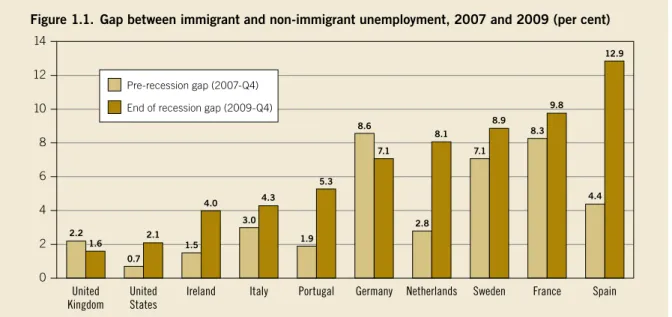
15. A study on the impact of the crisis on em-ployment gaps between immigrant and native-born workers has shown large variations between coun-tries.9 In Spain, for example, the gap widened greatly,
while in Germany it actually narrowed. In most major immigrant-receiving countries for which data were available, unemployment increased faster among immigrants than among natives between late 2007 and late 2009. In some cases, the unemployment gap opened up where it had previously been negligible (for example, in the United States), while in others, immigrants both entered and left the recession with much higher jobless rates (see figure 1.1).
16. Not all situations of inequality can be at-tributed to acts of direct discrimination. The con-sequences of crisis on migrant workers have been harshest in the sectors and countries most severely af-fected by the crisis. For example, in countries where construction had been the engine of growth in pre-vious years, migrant workers have suffered the big-gest loss of employment. Similarly, certain immigrant groups have been hit harder than others, for instance, Pakistanis and Bangladeshis in the United kingdom and Hispanics in the United States. By contrast,
Figure 1.1. Gap between immigrant and non-immigrant unemployment, 2007 and 2009 (per cent)
Source: Eurostat, Current Population Survey (United States) and Quarterly National Household Survey (Ireland). 0
2 4 6 8 10 12 14
United
Kingdom UnitedStates Ireland Italy Portugal Germany Netherlands Sweden France Spain 2.2
1.6 0.7
2.1 1.5
4.0 3.0
4.3
1.9 5.3
8.6 7.1
2.8 8.1
7.1 8.9
8.3 9.8
4.4 12.9
Pre-recession gap (2007-Q4) End of recession gap (2009-Q4)
8. D. Papademetiou, M. Sumption and A. Terrazas: Migration and immigrants two years after the financial collapse: Where do we stand?, BBC World Service, Migration Policy Institute, 2010, p. 92.
9. ibid., pp. 10, 20. 10. ibid., p. 10.
11. This and the following paragraphs are based on International Trade Union Confederation (ITUC): Gender in(equality) in the labour
AN EVOLVING PICTURE: CAPTURING THE TRENDS
22. Recent data show that 829 million people living in poverty in the world are women, compared to 522 million men.18 With women’s wages equal to
only 70 to 90 per cent of men’s for work of equal value, non-discrimination in remuneration should be a core component of measures aimed at both gender equality and reducing poverty.
Poverty and discrimination
23. In 2009, the number of workers worldwide in poverty was estimated to be between 1.48 and 1.59 billion. These figures reflect a likely increase in the number of such vulnerable workers by between 41.6 and 109.5 million during the period 2008–09. They also show that the global financial and eco-nomic crisis is likely to have had a severe impact on many millions of women and men around the world. Before the crisis, the proportion of workers in em-ployment vulnerable to poverty was on a downward trend in all regions. Some evidence suggests that in the period 2007–08, the global number of workers in vulnerable employment decreased for the first time, by around 10.5 million people, to just below half of all workers (49.5 per cent).19 That trend may now be
reversed.
24. Living in poverty is not only about low in-comes. It also means a vicious cycle of diminished health, reduced working capacity, bad working and living conditions, low productivity and reduced life expectancy. Combined with illiteracy, hunger, child labour and early parenthood, the pervasive effect of poverty can be transferred from parents to their chil-dren. Globally, this phenomenon appears to affect certain groups disproportionately. In some coun-tries, women register higher levels of poverty 20 and
households headed by females are more likely to be poor. Similarly, indigenous peoples, tribal groups and people of African descent are also over-repre-sented among the poor. The world’s population of indigenous peoples, for instance, is about 300 to 370 encounter tougher competition in access to jobs,
in-creasing the influence of existing and persistent bar-riers to their employment.
19. The same UN report also noted that newly unemployed women who must earn incomes to support their families turn to precarious forms of employment in the informal economy, often with harsh working conditions. A 2009 study in Thailand found that 80 per cent of surveyed street vendors in the country reported higher levels of competition since the beginning of the economic crisis.12 It is
im-portant that governments remain proactive and pro-tect women in the informal sector, but the priority given to narrowing the gender pay gap or to public awareness campaigns for gender equality at the work-place is likely to be adversely affected in an envir-onment of budget cuts and crisis response.
20. In developed market-economy countries, the crisis has not had a clear disproportionate impact on the employment of women that could be attributed to discrimination. In the United States, for example, from December 2007 to April 2010, women lost only 46 jobs for every 100 jobs lost by men, and an ILO study showed that female migrant workers are con-centrated in sectors that have either expanded during the crisis or have not been affected.13 In the United
kingdom, there was also a greater decline in em-ployment rates for men than for women during the second and third quarters of 2008.14
21. Similarly, data on the wage gap have yet to evolve in any clear or definitive direction. In the United kingdom, for example, the 2008 Annual Survey of Hours and Earnings showed that the gender pay gap had increased from 12.5 per cent in 2007 to 12.8 per cent in 2008, based on stronger growth in men’s hourly earnings.15 However, the trend was
reversed the following year as the gender pay gap decreased to 12.2 per cent in 2009.16 In the United
States, the gender pay gap (by median wage) in-creased, with women’s wages declining from 80.2 per cent of men’s in 2007 to 79.9 per cent in 2008, com-paring full-time wage and salaried workers.17
12. A. Ellis, D. kirkwood and D. Malhotra: Economic opportunities for women in the East Asia and Pacific region (Washington, DC, World Bank, 2010), p. 68.
13. United States Congress: Understanding the economy: Working mothers in the Great Recession, report by the US Congress Joint Eco-nomic Committee (Washington, DC, May 2010), p. 1; I. Awad, op. cit., pp. 41, 43.
14. ITUC: Gender in(equality) in the labour market, op. cit., p. 36.
15. United kingdom Office for National Statistics: First release, 2008 Annual Survey of Hours and Earnings, 14 Nov. 2008, p. 6. 16. United kingdom Office for National Statistics: 2009 Annual Survey of Hours and Earnings, 12 Nov. 2009, p. 4.
17. ILO: Global wage report: Update 2009 (Geneva, 2009), para. 12.
18. ILO: Gender equality at the heart of decent work, Report VI, International Labour Conference, 98th Session, Geneva, 2009, para. 58. 19. ILO: Global employment trends (Geneva, Jan. 2010), p. 18.
20. The simple disaggregation of poverty counts by sex will lead to underestimates of gender gaps in poverty because poor women might also be found in some non-poor households. Second, the gender gap in poverty may appear larger in some countries which have a higher proportion of households with over-representation of women.
27. The already dire labour market prospects for young workers appear to have worsened as a conse-quence of the crisis. There were a record 81 million unemployed young people in the world at the end of 2009, and a record 1 per cent annual increase in youth unemployment, compared to a 0.5 per cent change in the adult rate, between 2008 and 2009.27
young women and men have been disproportionately harmed since the onset of the crisis, and if similar patterns are experienced as in past recessions, it could take around 11 years for youth employment to return to pre-recession levels.28 Unemployed young people
encountering the crisis environment may lose hope of obtaining employment and detach themselves from the labour market altogether, leaving a legacy of a “lost generation”.29
28. The impact of wage discrimination on poverty has been demonstrated and quantified by a number of recent studies. In 2008, one such study 30 analysed
the effects of gender discrimination on poverty in Brazil between 1992 and 2001, using data obtained from the National Household Survey.31 The results
show that, when gender discrimination is elimi-nated, the percentage of poor people tends to de-cline by an average of 10 per cent. Results were even more striking among the most vulnerable segments of the population, such as members of households headed by black women who lack a formal employ-ment contract or are not trade union members. Similar conclusions have been drawn from other re-search in developed countries. For example, an EU study 32 shows that, despite the very low employment
rates among women living in low-income house-holds, removing wage discrimination of working women would substantially reduce poverty in most EU countries. That impact varies widely across the EU; it is larger for countries with the highest levels of wage discrimination (where about 10 per cent of the poor would be assisted out of poverty) and million. They make up 15 per cent of the world’s
poor and about one third of the world’s 900 mil-lion extremely poor rural people.21 In South Asia,
Dalit communities also register dramatically high levels of poverty. In India, the poverty rate for Dalits (65.8 per cent) is almost twice the rate for the rest of the population (33.3 per cent).22
25. The disproportionate impact of poverty on these groups is not a simple coincidence. It has its origins in structural discrimination based on one or a combination of grounds such as sex, race, colour, ethnicity or religion.23 This situation is often a
result of social exclusion and exploitation, such as forced labour or child labour in its worst forms. Discrimination in employment and occupation emerges as a crucial factor in causing and exacer-bating poverty. Not only can discrimination substan-tially shrink wage and other incomes; people affected by it often register lower participation levels and em-ployment rates. Once in emem-ployment, low incomes that result from wage discrimination and occupa-tional segregation in poorly remunerated activities prevent individuals from working their way out of poverty. Discrimination in employment and occupa-tion can also result in long-term poverty by limiting access to assets and services.
26. The crisis has resulted in severe job losses in high-income economies. At the beginning of 2010, 14 million jobs were still needed to restore employ-ment to pre-crisis levels.24 At the same time, larger
numbers of workers are signalling their wish to emi-grate for work. In the case of Ireland, for example, 100,000 people are predicted to leave the country over the coming four years.25 Persons with disabilities
have seen a decrease in job opportunities. In Japan, for example, the number of dismissed workers with disabilities increased on a quarter-to-quarter basis for five consecutive months from November 2008 to March 2009.26
21. International Fund for Agricultural Development: Fact Sheet, 2007, p. 1.
22. S. Alkire and M.E. Santos: Acute multidimensional poverty: A new index for developing countries, OPHI Working Paper No. 38 (Oxford, OPHI, July 2010), p. 127.
23. ILO: Working out of poverty, Report of the Director-General, International Labour Conference, 91st Session, Geneva, 2003, p. 34. 24. International Institute for Labour Studies (IILS): World of work report 2010: From one crisis to the next? (ILO, Geneva, 2010), p. 3. 25. M. Savage: “Economic crash to drive 100,000 out of Ireland”, The Independent, 18 Nov. 2010.
26. Ministry of Health, Labour and Welfare: Employment measures in post-financial crisis Japan, July 2009, p. 30. 27. ILO: Global employment trends for youth, op. cit., pp. 1, 4, 5.
28. IILS: World of work report 2010, op. cit., p. 2. 29. ILO: Global employment trends for youth, op. cit., p. 1.
30. R.C. Santos Simão and S.E. Monsueto: “The impact of gender discrimination on poverty in Brazil”, in CEPAL Review 95 (Aug. 2008), p. 141.
31. In studies of this type, the methodology is based on an estimation of counterfactual distribution of per capita household income based on a hypothetical scenario in which the labour market pays equal wages to men and women in accordance with their qualifica-tions.
32. C. Gradín, C. del Río and O. Cantó: “Gender wage discrimination and poverty in the EU”, in Feminist Economics, 12 May 2010, p. 100.
AN EVOLVING PICTURE: CAPTURING THE TRENDS
for women and men who are more vulnerable to discrimination, including youth at risk, low-wage, low-skilled, informal economy and migrant workers. Furthermore, it calls on countries to enact policies that promote core international labour standards, such as equal remuneration for work of equal value and elimination of discrimination in employment, in order to reduce gender inequality and discrimin-ation at the workplace.34 These objectives were
en-dorsed by the leaders of the G20 at the Pittsburgh Summit in 2009, when they committed their na-tions to adopting key elements of the general frame-work of the Global Jobs Pact to advance the social dimension of globalization. They also called on international institutions to consider the goals of the Global Jobs Pact in their crisis and post-crisis analysis and policy-making activities.35 Similarly,
G20 labour ministers emphasized the importance of following the Pact’s guidelines for strong, sustain-able and balanced global growth.36 The ILO is
co-operating actively with several countries which have reflected the Pact in their stimulus packages and re-covery measures.
Stimulus packages
32. While the crisis had the effect of increasing vulnerability for many workers, the stimulus meas-ures designed to bring about recovery have not always contributed to correcting the disparities. With the goal of economic recovery in mind, many coun-tries have focused their stimulus packages on sectors that have endured significant damage from the crisis. In many cases these were male-dominated sectors of employment. While stimulus measures have been credited for averting a deeper crisis and helping to jump-start the economy, prioritization of responding to the fiscal effects of the crisis has resulted in na-tional resources not always being distributed rela-tively equally among all sectors of the labour market. Responses may have resulted in the indirect exclusion of vulnerable groups from the benefits of stimulus measures. Those groups include young people, ethnic minorities and women, who are often under-repre-sented in the targeted industries.
33. In Germany, two recovery packages initiated by the Government have targeted sectors comprising a smaller in those with the lowest levels of wage
dis-crimination (where only between 2 and 4 per cent of the poor would cross the poverty threshold). However, the study underlined the fact that the impact of wage discrimination on poverty is critical in all EU countries for paid working women and their households.
29. There is a crucial link between poverty eradi-cation, employment and equality. This is reflected in the slow but progressive acceptance of the need to rethink poverty reduction strategies and to shift from a one-dimensional approach based on income levels to a multidimensional strategy that effectively addresses the underlying causes of persistent high poverty and economic insecurity. Some countries have started to align their income-generating icies in poor areas with social policies. Those pol-icies may still be ineffective in reducing poverty if they do not take into consideration the effects of discrimination in employment and occupation. In many developing countries, transfer programmes targeted at the poor are designed to provide income support and are made conditional on keeping chil-dren in school and/or visits by mothers and chilchil-dren to health centres. However, these measures may have only a limited impact on poverty reduction if they do not at the same time address the deter-minants of economic vulnerability, including the ethnic, racial and gender discrimination that keep wages at a low level.33
Responding to the crisis
30. A job-rich recovery, with macro- and micro-economic policies supporting employment and growth, is essential in the current context. However, non-discrimination efforts can all too easily be un-dermined by short-term measures taken to alleviate difficult fiscal conditions. Non-discrimination laws and policies, equality institutions and political com-mitment, have been hard won over a number of dec-ades; care should be taken to protect them. Lessons should have been learned from the experiences of the last century.
31. In June 2009, the ILO adopted the Global Jobs Pact, a centrepiece of its response to the crisis. The pact emphasizes the need to enhance support
33. United Nations: Retooling global development, World Economic and Social Survey 2010, UN Department of Economic and Social Affairs (2010), p. 36.
34. ILO: Recovering from the crisis: A Global Jobs Pact, International Labour Conference, 98th Session, Geneva, 2009, Part II(9)(2) and (9)(7).
35. Leaders’ Statement, Pittsburgh G20 Summit, 24–25 Sep. 2009.
the International Institute for Labour Studies has emphasized the need for further measures targeted at vulnerable groups such as young people, and for employment-oriented social protection.39 The
Institute’s World of work report 2010 expands on the Global Jobs Pact, which calls on national govern-ments to develop income support systems, provide skills development programmes and improve en-forcement of non-discrimination rights in order to help vulnerable groups to recover from the crisis and prevent increased poverty and social hardship, while at the same time stabilizing the economy and pro-moting employability.40
Preventing harmful effects of fiscal consolidation
36. In the aftermath of the financial crisis, global attention has increasingly been paid to reducing large budget deficits and public debts in many countries. yet many have urged caution in formulating fiscal consolidation policies – defined by tax increases and cuts in government spending – since the measures in-volved could jeopardize recovery efforts, propel coun-tries into deeper recession and exacerbate inequalities in the workforce.41 A joint ILO–IMF paper in 2010
warned that a premature consolidation push could damage macroeconomic growth and subsequently lead to even larger deficits and debts.42 Nevertheless,
fiscal consolidation plans have already been initi-ated in countries with particularly severe deficits, including Greece, Latvia and Ukraine. The Trade Union Advisory Committee to the Organisation for Economic Co-operation and Development (OECD) has estimated a total resource gap of US$372 billion per year from 2012 to 2014 if deficit reduction plans proposed by the OECD to its member countries are implemented.43
37. Certain groups may be particularly susceptible to the bulk of the effects of fiscal consolidation meas-ures, as austerity policies in many countries could take the form of cuts in the welfare programmes that assist lower-income workers in access to employment 78 per cent male and 22 per cent female workforce.37
The automotive industry, construction, laboratory and medical technologies, and financial intermediation, are all male-dominated sectors that have received significant financial support from the Government. While the packages have been successful in benefiting men in the targeted sectors, reducing their employ-ment decline, a 2010 study has indicated that the neglect of female-dominated sectors, including most prominently the services sectors, poses a long-term risk to women’s employment. As a consequence, a decline in female employment remains a long-term possibility, which could be harmful to national econ-omies since female employment in the services sector was previously fuelling national employment.
34. In the United States, the stimulus package appears to have had a mixed impact on vulner-able groups in society. While 10 per cent of rural infrastructure grants must be targeted to counties with persistent poverty, and the Home Investments Partnership Program in the stimulus package calls for equitable distribution of resources between urban and rural communities, with a prioritized focus on areas with severe economic problems, a 2009 Ohio State University report notes that the substantial funding given to infrastructure projects could dis-advantage racial minorities and women. African Americans represent 13 per cent of the population and women make up half of the population, but they hold only 6 per cent and 9.4 per cent of construction jobs respectively.38
35. In order to protect all segments of society equally and prevent further marginalization of vul-nerable groups, national governments should ensure that the disproportionate effects of stimulus meas-ures are considered when they are developed and that any disproportionate effects of policies are moni-tored and corrected, thereby halting growing eco-nomic inequalities. With the aim of stimulating job creation and surmounting the crisis, in addition to calling for financial reform and sustainable job cre-ation through the promotion of a closer link between wages and productivity gains in surplus countries,
37. Information in this paragraph is based on European Industrial Relations Observatory On-line: “Gender impact of recovery packages investigated”, 2010, p. 1.
38. Ohio State University kirwan Institute for the Study of Race and Ethnicity: Preliminary report of the impact of the economic stimulus
plan on communities of color, 25 Feb. 2009 update, pp. 1–2.
39. ILO: “World of work report 2010: ILO says long ‘labour market recession’ worsens social outlook in many countries”, press release, 30 Sep. 2010.
40. ILO: Recovering from the crisis: A Global Jobs Pact, op. cit., pp. 6–7.
41. Global Unions Group: A financial transactions tax for job creation and development goals, statement by Global Unions to G20 Finance Ministers and the 2010 spring meetings of the IMF and the World Bank, Washington, DC, 23–25 Apr. 2010, pp. 3–5.
42. ILO–IMF: The challenges of growth, employment and social cohesion, discussion document for a joint ILO–IMF conference in cooper-ation with the office of the Prime Minister of Norway, 13 Sep. 2010, p. 8.