Children
Children
in hazardous work
What we know
What we need to do
International Programme on the Elimination of Child Labour
(IPEC)
Copyright © International Labour Organization 2011
First published 2011
Publications of the International Labour Office enjoy copyright under Protocol 2 of the Universal Copyright Convention. Nevertheless, short excerpts from them may be reproduced without authorization, on condition that the source is indicated. For rights of reproduction or translation, application should be made to ILO Publications (Rights and Permissions), International Labour Office, CH-1211 Geneva 22, Switzerland, or by email: pubdroit@ ilo.org. The International Labour Office welcomes such applications.
Libraries, institutions and other users registered with reproduction rights organizations may make copies in accordance with the licences issued to them for this purpose. Visit www.ifrro.org to find the reproduction rights organization in your country.
International Programme on the Elimination of Child Labour (IPEC)
Children in hazardous work: What we know, what we need to do
ISBN 978-92-2-124918-4
Also available in French: Enfants dans les travaux dangereux. Ce que nous savons Ce que nous devons faire (ISBN 978-92-2-224918-3), Geneva, 2011, in Spanish: Niños en trabajos peligrosos. Lo que sabemos, lo que debemos hacer (ISBN 978-92-2-324918-2), Geneva, 2011.
child labour / hazardous work / working conditions / occupational health / occupational safety / labour inspection / ILO Convention / comment / developed countries / developing countries
13.01.2
ILO Cataloguing in Publication Data
Funding for design and production of the report was provided by the United States Department of Labor. This publication does not necessarily reflect the policies of the United States Department of Labor, nor does mention of trade names, commercial products, or organizations imply endorsement by the United States Government.
The designations employed in ILO publications, which are in conformity with United Nations practice, and the presentation of material therein do not imply the expression of any opinion whatsoever on the part of the International Labour Office concerning the legal status of any country, area or territory or of its authorities, or concerning the delimitation of its frontiers.
The responsibility for opinions expressed in signed articles, studies and other contributions rests solely with their authors, and publication does not constitute an endorsement by the International Labour Office of the opinions expressed in them.
Reference to names of firms and commercial products and processes does not imply their endorsement by the International Labour Office, and any failure to mention a particular firm, commercial product or process is not a sign of disapproval.
ILO publications and electronic products can be obtained through major booksellers or ILO local offices in many countries, or direct from ILO Publications, International Labour Office, CH-1211 Geneva 22, Switzerland. Catalogues or lists of new publications are available free of charge from the above address, or by email: [email protected]
Visit our web site: www.ilo.org/publns
Photocomposed in Switzerland JMB
Contents
Acknowledgements. . . . vii
Executive summary . . . . ix
Facts . . . . xiii
A gold strike, of sorts. . . xv
Part I. Why give priority to children in hazardous work? 1 Some definitions . . . . 3
What is a child? . . . 3
What is child labour? . . . 3
What is hazardous work by children? . . . 3
1. The legal foundation . . . . 5
The hazardous work list . . . 5
The occupational safety and health Conventions . . . 5
2. The number of children in danger. . . 7
Uneven progress . . . 7
Regional distribution of children in hazardous work. . . 8
Sex distribution of children in hazardous work . . . 8
Sectoral distribution of children in hazardous work . . . 9
Injuries and illnesses . . . 9
3. The health danger. . . 13
Some basic principles about hazardous work . . . 13
Why children are at greater risk . . . 14
Challenges in understanding children’s risks. . . 15
The cost to society of hazardous work . . . 15
4. The best way to reach the target. . . 17
Part II. Knowledge and practice: What have we learned? 19 5. The evidence base on hazardous work by sector . . . . 21
Crop agriculture . . . 21
Fishing and aquaculture. . . 25
Children in hazardous work
vi
Manufacturing . . . 30
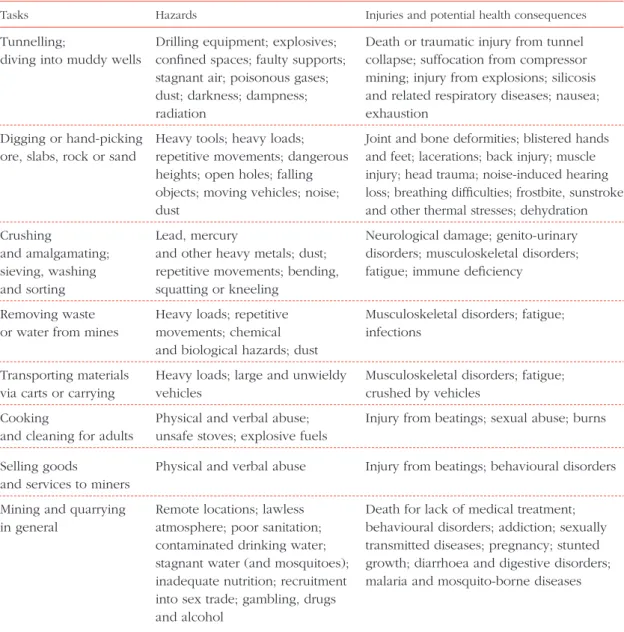
Mining and quarrying . . . 32
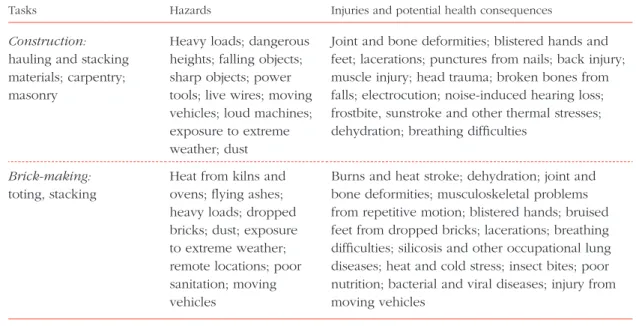
Construction and associated industries . . . 36
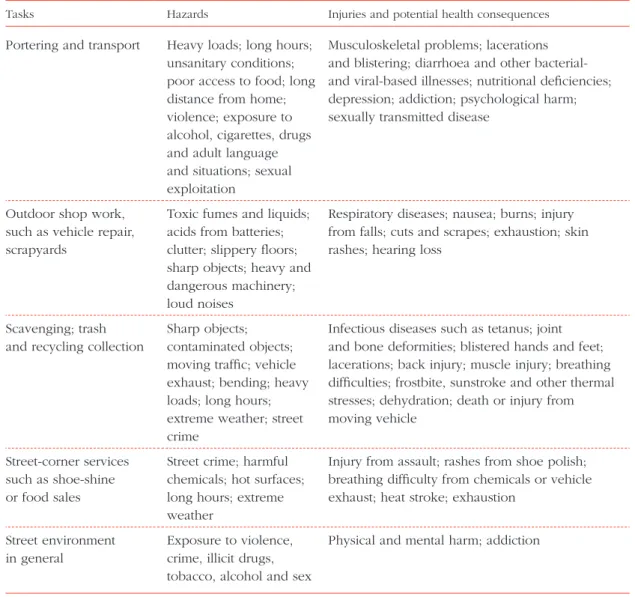
Service sector and street work . . . 38
6. Solutions with potential to go big . . . . 41
Leadership by government . . . 41
Leadership by employers . . . 48
Leadership by trade unions . . . 52
Leadership by the community. . . 56
Part III. How to achieve fundamental change in hazardous child work 59 7. Integrating action and policy. . . . 61
Viewing working children within the context of the life cycle . . . 62
Adolescents as a critical target group . . . 62
Younger children and girls have priority . . . 63
A framework for sustainable change . . . 64
Conclusion: Yes, but what can I do? 67 Key ways forward . . . . 69
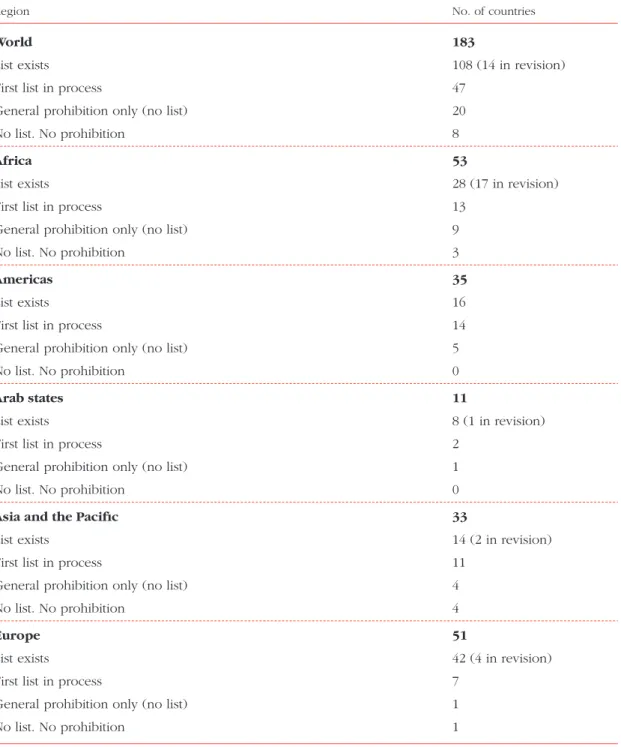
Appendix I. Countries with hazardous work lists. . . . 73
Appendix II. Star tools. . . 75
Safe Work for Youth toolbox . . . 75
OSH education: Youth@Work . . . 76
Local partnering in agriculture: WIND . . . 76
EU-OSHA’s Safe Start campaign . . . 77
Useful links . . . 78
Other resources on hazardous work . . . 78
Training resources for employers . . . 79
Acknowledgements
With this report, the ILO draws attention to the large numbers of children still in hazardous work and acknowledges the efforts of the many organizations and individuals who are seeking viable, sustainable solutions to this problem.
Although work on this issue is not new, collaborative activities have been increasing over the last three years. In 2009, ILO and WHO established the Joint Technical Committee on Young Work-ers and Child Labour to promote enquiry into the health impacts of work on young people. An information-sharing network, Safe Work for Youth, which now has over 100 members, was cre-ated to share tools and good practices and to serve as a forum for discussion on how the occu-pational health challenges of young people can best be addressed. Several interagency meetings have been convened to examine the state of knowledge on hazardous work of children and good practices in dealing with it. These have helped to further strengthen ties among those active on the issue and to develop a common platform of understanding.
This report, Children in hazardous work: What we know, what we need to do, is a tangible prod-uct of this group concern and group effort. Although IPEC bears ultimate responsibility for its content, it grows out of this common platform.
This report was prepared by Susan Gunn, ILO, in conjunction with Richard Rinehart and Christopher Wanjek. Additional text was provided by Nadèche Andrianasolo (consultant), Saeed Awan (CIWCE-Pakistan), Laura Brewer (ILO-SKILLS), Mariela Buonomo (ILO-Youth Employment Programme), Sule Caglar (ILO-Turkey), Philippe Gousenbourger (ITUC-Brussels), Yoshi Kawakami (ILO Safe-Work), Sanjiv Kumar (Government of India), Sue Longley (IUF), Andrews Tagoe (GAWU) and Yuka Ujita (ILO SafeWork), in addition to numerous IPEC colleagues in headquarters and the field. During both the planning and review process, valuable inputs and comments were received from a wide range of colleagues within and beyond the ILO.
Special thanks go to Halshka Graczyk (consultant), who prepared the background review of research literature, and to David Parker, who generously made available his stirring photographs for this publication. We thank also Susan Wilburn and Ruth Etzel (WHO) and Marilyn Fingerhut (WHO Collaborating Centre network) for their support for this entire enterprise.
Executive summary
Children in hazardous work are in many respects the silent majority within child labour. Although they appear in photos, when it comes to action they are often eclipsed by forms of child labour that have captured the public eye, such as child soldiers or trafficked children, or they are sub-sumed within general child labour efforts. Still too few policies or programmes are geared to the special needs of children who do hazardous work.
There are solid reasons for giving this issue urgent attention: (1) the scale of the problem – esti-mates place the current total of children in hazardous work at 115 million; (2) the recent rise in haz-ardous work among older children – an increase of 20 per cent within 4 years; and (3) the growing evidence that adolescents suffer high rates of injury at work, in comparison with adult workers. There are also sound reasons to believe that it is in the area of hazardous work that major pro-gress can be made in eliminating child labour. This report shows that there has been some real success in removing younger children from hazardous work, as well as in reducing the number of girls caught in this worst form of child labour. This suggests that efforts are paying off. Hazardous work of children has been highlighted in recent ILO policy directives, such as the Global Plan of Action on Child Labour which set 2016 as the target date for elimination of the worst forms of child labour. The Hague Global Conference on Child Labour in 2010 also called for more focus on hazardous work.
Against this background the ILO has been reviewing what is known about the problem and examining “good practices” in dealing with it. This report offers a summary of this knowledge and practice and proposes how we might move forward.
The report is divided into three parts. The first provides a general overview of the issue. It dis-cusses hazardous work of children in terms of how it is defined (Chapter 1), how many children are affected (Chapter 2), and why, from a health and a legal standpoint (Chapters 3 and 4, respec-tively), children require special protection.
The second part considers the research evidence regarding the problem and positive initiatives in addressing it. The research summary (Chapter 5) looks at the scientific data with respect to seven sectors: crop agriculture, fishing, domestic service, manufacturing, mining and quarrying, construction, and street and service industries. These were selected not because they are neces-sarily the “worst”, but in order to demonstrate the importance of knowing and understanding the risks inherent in an industry, the importance of conducting a “risk assessment” as to how the risks manifest themselves in a particular situation or locality, and the importance of using this informa-tion to identify which activities are age appropriate and which are not.
In this part the report warns that children’s lives are being lost or shortened by being exposed to hazardous work. Many people simply do not realize how vulnerable children are to toxic chemi-cals, to extreme temperatures, to repetitive mind-numbing tasks, to isolation or to denigration, threats and violence.
Also within this part, Chapter 6 presents a sampling of concrete activities that have potential for ad-dressing hazardous work of children on a wider scale. They are offered for consideration as potential models because each embodies an approach that has been used successfully in a variety of coun-tries. They approach the problem of hazardous work of children from different angles and under the leadership of different parties: the government, trade unions, employers and the community.
Children in hazardous work
xii
The third and final part gathers the threads from the previous parts together into a conceptual framework that aims to show what a coordinated, comprehensive effort to stop hazardous work of children should look like. Instead of seeing child labour as a problem specific to a rather narrow age group, it urges that we take a life-cycle approach. This involves a stronger focus on ensuring that education and training policies prepare children for work life so as to achieve an effective school-to-work transition. It also requires that when adolescents move into the labour force there are adequate safeguards for their safety and health.
The report stresses that addressing hazardous work by children is not only a technical issue. Major and sustainable progress requires public policies that address the root causes of child la-bour: tackling poverty, ensuring children have access to education and providing a social protec-tion floor which protects the vulnerable.
Although the number of children in hazardous work is large, some of the most dangerous types of child work are concentrated in specific localities, specific occupations, specific tasks and spe-cific age groups. Focusing energies on these pockets could go a long way towards generating the momentum needed to make progress. However, the report also warns that the scale of the problem could increase in many countries due to demographic changes, as youthful population bulges move into adolescence.
Overall, the report makes the case for children in hazardous work being made a priority for action over the next 5 years. It calls for specific action on three fronts:
Making a renewed effort to ensure that all children are in school, at least until the minimum age of employment;
Strengthening workplace safety and health for all workers, but with specific safeguards for youth between the minimum age of employment and the age of 18;
Providing the crucial legal foundation for action against hazardous child work, with the sup-port of workers and employers.
FACTS
The problem is serious:
Hazardous work is one of the worst forms of child labour.
More than half (53 per cent) of the 215 million child labourers worldwide do hazardous work.
Hazardous work is increasing among older children, aged 15–17. Within four years (2004–08), it jumped 20 per cent – from 52 million to 62 million. Boys outnumber girls by two to one in this age group.
Children have higher rates of injury and death at work than adults, as shown by data from indus-trialized countries.
But there is a strong basis for hope:
Progress is being made. For younger children (aged 5–14) in hazardous work, rates came down 31 per cent between 2004 and 2008; for girls they are down by 24 per cent.
There are 173 countries that have committed themselves to tackling hazardous work of children “as a matter of urgency” by ratifying the ILO’s Worst Forms of Child Labour Convention, 1999 (No. 182).
A gold strike, of sorts
There’s a certain gold-mining operation in West Africa where, the local people say, the danger runs high but the pay is not bad. True, the work is hard and dangerous: the tunnels and shafts have rickety support structures (if any) and can collapse at any time; no one has ever thought of a safety plan should poisonous or flammable gases escape from underground pockets; there is no protective gear, many work in bare feet with bare hands. In short, the working conditions are deplorable and accidents are a daily occurrence. The living conditions are tough too. Water is scarce; there is no clinic; there are no toilets; there are no police.
The miners see little sunlight, slipping down narrow shafts before the dawn and surfacing only occasionally through the course of the long day. Others face quite the opposite, as they work unprotected under a hot sun, smashing rocks into pebbles and then grinding them down to sand. The hazard they know about is the stifling dust that you can never seem to get out of your lungs; the hazard they don’t know so much about is the effect mercury has on the brain. They use mer-cury to separate the gold from the crushed ore.
Mines such as this one produce a fifth of the world’s gold according to UN estimates. 1 They also produce gems for our jewellery and rare minerals for our cell phones. They are generally remote and unofficial but often highly organized. The doubling of world-market gold prices in recent years has made such gold prospecting all the more attractive to the abject poor, and all the more dangerous.
Not unexpectedly, a sizeable percentage of the workers drawn to these gold, gem and mineral mines and stone quarries are children – both girls and boys: children digging, hauling, crushing, breathing in dust; children kneading mercury into crushed ore with their bare hands; children ne-gotiating a meagre price for flecks of gold from gun-toting buyers; children without decent food or clean water; children losing their chance at an education.
Many of us possess romantic notions of childhood, a time that is to be reserved for innocence, wonder and discovery. And many others argue from a practical perspective that childhood and the formal transition to work is a modern social construct that takes on different meanings in dif-ferent cultures. Yet, universally, we agree there’s something wrong with the above scenario, be it in a gold mine, a sugarcane field, a garment factory, a timber operation, a construction site or a garbage heap. When we allow children to be placed in such a situation, we surrender a bit of our humanity.
Yes, these children are poor, and what pittance they earn can help support their families. Yes, a child’s need to work reflects a larger problem of a failed or sometimes corrupt infrastructure that doesn’t offer affordable schooling. Yes, some children are quite mature for their age and seem-ingly can handle the physical and mental stress that manual labour can entail. Yes, some work is a form of education that can teach valuable life skills. But no child should be rubbing mercury into gold and vaporizing the resulting amalgam.
Let’s look at the facts. Consider the adverse effects on a young body from working in the afore-mentioned goldmine. Mercury, a neurodevelopmental toxicant, impairs cognitive and motor skills. Acute exposure to mercury – acute, as in breathing in mercury fumes – can result in profound
1
M.M. Veiga and R.F. Baker: Protocols for environmental and health assessment of mercury released by artisanal and small-scale gold miners (Vienna, GEF/UNDP/UNIDO, 2004).
Children in hazardous work
xvi
problems of the central nervous system, leading to delirium and suicide. 2 In the gold-mining areas, a child can be exposed to mercury in many ways: through the skin when mixing it into the ore-bearing sand; by inhaling the fumes when it is being burned off over the fire (the most toxic and easily absorbed form); by ingesting it as residue on hands during meals or from food grown in contaminated soil. One research study showed that child miners had higher levels of toxic met-als in comparison with adults even when they had less contact with the metmet-als. 3
What does this mean in terms of health? In one study, children working in a gold mine similar to that described were found to have alarming levels of mercury in their blood, urine and hair. Neu-rological tests comparing these children with a non-exposed control group were “striking”, the study found, with the mercury-exposed children needing twice as long to perform basic cognitive and reflex tests 4. Moreover, even the children simply living at the mine exhibited higher mercury body burdens than children living further away, implying the broader, community-wide health threat imposed by the hazardous work conditions. 5
Gram for gram, children breathe more air, consume more food and drink more water than adults do, partly as a result of the faster metabolism needed to support their growing bodies. An infant breathes twice as much air per kilogram of body weight as an adult. Therefore, absorption of toxi-cants is proportionally higher. Heavy loads can cause lifelong deformities and handicaps, such as crippled feet, bent backs or dislocated shoulders. And the heavy but invisible load of being responsible for supporting the rest of the family has effects still unmeasured on a young person’s capacity for learning … and for joy.
Until now, the psychological, social and intellectual impact of hazardous work such as mining on children has not received much attention. We sometimes assume that if children don’t complain, they are managing alright. Yet children are often unwilling to speak out for fear they will lose their job or appear stupid, making them vulnerable to all kinds of exploitation. When children work side-by-side with adults in the mines, they are subject to verbal and physical abuse, if not wholesale fraud and deceit. The freewheeling lifestyle which is so common in remote and un-regulated mines exposes them to alcohol abuse, gambling, prostitution and crime. Schools are non-existent; the only trade learned is how to survive in a near lawless environment.
If not mercury in this mine, then manganese or lead in a smelter elsewhere. If not armed buyers of gold, then the beatings by an aggressive factory boss elsewhere. If not mine dust, then silica from quarry work elsewhere. If not loud and dangerous machines here, then unwieldy tractors and exposed blades on farm equipment elsewhere.
If not at a workplace where the hazards are easy to see, then in the myriad small-scale industries such as shoe-making, leather tanning, garment sweatshops, automobile battery recycling, metal plating or woodworking, where the health impacts may appear only years later.
Often these jobs are so visible – as in selling flowers in the middle of a busy intersection – that they become invisible, blended into the cacophony of urban life.
The cost is not just to this child’s future, but to the society as a whole. The nation suffers along-side the worker, as a poorly qualified workforce leads to lower productivity, lower profits, lower investment, lower wages and the perpetuation of the cycle of poverty.
2
Inorganic mercury. Environmental Health Criteria 118 (Geneva, UNEP-ILO-WHO, 1991). First draft prepared by Dr. L. Friberg, Karolinska Institute, Sweden.
3
C.L.N. Banza et al.: “High human exposure to cobalt and other metals in Katanga, a mining area of the Democratic Re-public of Congo”, in Environmental Research (2009), Vol. 109, No. 6, pp. 745–752.
4
S. Bose-O’Reilly et al.: “Mercury as a serious health hazard for children in gold mining areas”, in Environmental Research
(2008), Vol. 107, pp. 89–97. 5
A gold strike, of sorts
“There’s nothing that can be done”, some say about the ubiquity of workplace hazards children face. “It’s just the way things are.” But we know this is not true. It may be the way things are now, but times are changing. This document is a testament to the fact that there’s plenty that can be done.
PART I
Why give priority to children in hazardous work?
Hazardous work deserves priority attention because:
many children are at risk right now; they cannot wait for gradual changes;
almost all countries have made a commitment to take urgent action by ratifying the ILO’s Minimum Age Convention, 1973 (No. 138) and/or the Worst Forms of Child Labour Convention, 1999 (No. 182);
the progress achieved with younger children indicates that with intensive efforts, we might be able to do the same for those remaining.
Some definitions
We start off this report by defining key terms that will be used within it and, at the same time, give a glimpse of some of the historical background to the issue.
i
What is a child?
Age 18 is the dividing line between childhood and adulthood according to the major ILO child la-bour Conventions, Nos. 138 and 182, and the United Nations Convention on the Rights of the Child (CRC). 6 Although many cultural traditions and personal characteristics could argue for a higher or lower age, in first crafting and then in ratifying these Conventions the international community has determined that persons under 18 are children and have the right to special protection.
i
What is child labour?
Within this protected realm of childhood, ILO Convention No. 138 marks out minimum ages for different types of employment:
age 15 for ordinary work; age 18 for hazardous work; age 13 for light work.
When ratifying, countries have the option to designate a higher age (e.g. 16) or, in the case of developing nations, an age lower by 1 year than the standard (e.g. 14 as the minimum age for regular work and 12 for light work). The notion of setting a minimum age for work has existed since the first decade of the twentieth century.
Child labour, then, is simply work done by children who are younger than the designated mini-mum age in one or another of these categories. This is the general rule, however, Convention No. 138 is somewhat flexible, in that it allows for some exceptions (artistic performances, super-vised apprenticeships, etc.). 7
Protection against child labour extends over most productive activities undertaken by children, whether or not there is a formal employment relationship or an employer as such (e.g. as in self- employment), whether paid or unpaid, for a few hours or full time, casual or regular, seasonal or year-round, legal or illegal. Productive work within the family falls within this category, such as unpaid family work for home-based manufacturing, family businesses or family farms. Fetching water or firewood for the household’s consumption also comes under the category of productive activities. Especially pertinent to this discussion is that health, along with education, is one of the defining characteristics of each of these categories. For example, the text includes numerous references and qualifications concerning health, such as “consistent with the fullest physical and mental development of young persons”, “on condition that the health, safety and morals of the young persons concerned are fully protected” and “work which is not likely to be harmful to their health or development”.
i
What is hazardous work by children?
ILO Convention No. 182, which defines the worst forms of child labour (WFCL), goes a step further by including hazardous work as one of the four worst forms. This Convention, which
6
The CRC allows for a few exceptions. 7
Children in hazardous work
4
requires immediate action, (paragraph ‘d’ below) does not allow exceptions and prohibits chil-dren from being engaged in these types of work:
(a) all forms of slavery or practices similar to slavery, such as the sale and trafficking of children, debt bondage and serfdom and forced or compulsory labour, including forced or compulsory recruitment of children for use in armed conflict;
(b) the use, procuring or offering of a child for prostitution, for the production of pornography or for pornographic performances;
(c) the use, procuring or offering of a child for illicit activities, in particular for the production and trafficking of drugs as defined in the relevant international treaties;
(d) work which, by its nature or the circumstances in which it is carried out, is likely to harm the health, safety or morals of children.
Since the passage of Convention No. 182 in 1999 and the subsequent swift ratification by most ILO member States (173 out of 183 having ratified by the time of publication), substantial atten-tion has been given to the first three of the worst forms, including trafficking.
Sadly, what receives less attention – an area harder to define, some argue – is the fourth element from Convention No. 182, referring to work that harms the health, safety and morals of children. The Convention itself does not define what this includes, instead leaving it to the countries to do so in the form of what we commonly call the “hazardous work list”. But the ILO’s Worst Forms of Child Labour Recommendation, 1999 (No. 190), the non-binding guidelines that accompany Convention No. 182, gives some indication as to what work should be prohibited. It urges mem-ber States to give consideration to:
work that exposes children to physical, emotional or sexual abuse;
work underground, under water, at dangerous heights or in confined spaces;
work with dangerous machinery, equipment and tools, or that involves the manual handling or transport of heavy loads;
work in an unhealthy environment, which may, for example, expose children to hazardous substances, agents or processes or to temperatures, noise levels, or vibrations damaging to their health;
work under particularly difficult conditions such as work for long hours or during the night or work that does not allow for the possibility of returning home each day.
The legal foundation
It is helpful to think of hazardous work of children in terms of two distinct age groups: the younger children who are under the minimum age for work and should be in school, and the older children who are of legal working age. Generally speaking, if the very young are in hazardous work, they are the priority for action. If what they do is likely to put their health or development at risk, the only option in the case of younger children is to remove them from the work, while for older children there is a choice: either they may be removed from the hazardous situation, or the risks may be reduced through improvement in working conditions such that the work is no longer likely to put their health at risk.
The phrase “likely to jeopardise the health” (Convention No. 138) or “likely to harm the health” (Convention No. 182) or “likely to be hazardous” (CRC) is significant. It means that it is not neces-sary to prove through research or other means that the work will definitely result in illness or injury or some other negative consequence but, instead, that there is a substantial threat of its doing so.
i
The hazardous work list
When countries ratify Convention No. 182 and Convention No. 138, they commit themselves to determining work to be prohibited to persons under 18 years of age. Article 4 of Convention No. 182 says:
1. The types of work referred to under Article 3(d) [work which, by its nature or the circumstances in which it is carried out, is likely to harm the health, safety or morals of children] shall be determined by national laws or regulations or by the competent authority, after consultation with the organiza-tions of employers and workers concerned, taking into consideration relevant international stand-ards, in particular Paragraphs 3 and 4 of the Worst Forms of Child Labour Recommendation, 1999. 2. The competent authority, after consultation with the organizations of employers and workers
concerned, shall identify where the types of work so determined exist.
3. The list of the types of work determined under paragraph 1 of this Article shall be periodically examined and revised as necessary, in consultation with the organizations of employers and workers concerned.
For short, we refer to this as the “hazardous work list”. This list is extremely important because, once enacted into law, it forms the basis for a wide range of activities – advocacy, services, poli-cies and enforcement – that can protect children and youth from exploitation and provide a clear rule on what children above designated ages can or cannot do.
A crucial element written into the two Conventions is the requirement for tripartite consultation. When employers, workers’ organizations and government all sit together to examine the ques-tions “what work is hazardous?”, “where is it found?”, “which should have priority for action?”, it launches a process for addressing child labour that is nationally owned and led.
i
The occupational safety and health Conventions
Here we are focusing on children, but neither is hazardous work acceptable for adult workers. The ILO Conventions on occupational safety and health (OSH) 8 and on labour inspection,9 and
8
Occupational Safety and Health Convention, 1981 (No. 155), Promotional Framework for the Occupational Safety on Health Concention, 2006 (No. 187).
9
Labour Inspection Convention, 1947 (No. 81), or Labour Inspection (Agriculture), 1969 (No. 129).
Children in hazardous work
6
important sectors such as agriculture, offer protection for all workers … in fact, nearly half of all ILO instruments deal directly or indirectly with OSH issues. The ILO Constitution itself sets forth the principle that workers should be protected from sickness, disease and injury arising from their employment.
These standards promote basic principles, such as assessment of occupational risks or hazards, and promotion of a culture of prevention that includes information, consultation and training that are valid for workers of all ages. 10 It has long been recognized that action against child labour can be action for decent work for adults.
People everywhere care about children. Where adults may not see their way clear to protect themselves, they often try to make the extra effort to protect their children. In the case of hazard-ous work, where economic necessity or deeply ingrained tradition blocks attempts to improve conditions for adult workers, it is sometimes the call to stop child labour that can be the entry point to change. Eliminating hazardous work of children can help improve safety and health of all workers – the ultimate goal.
In summary:
Children can be in “child labour” up to the age of 18 – not 15 as many people assume – be-cause work in hazardous conditions or doing hazardous tasks makes it a worst form of child labour.
But hazardous work is also an indicator of child labour for younger children as well, and makes them the number-one priority for action.
The “hazardous work list” is a good foundation stone for virtually all work on this issue.
10
The number of children in danger
In this chapter, we look at the numbers. Are many children involved? Where? Girls or boys? We also look at the statistics that are currently available on accidents, injuries, illnesses and deaths of children at work. Unfortunately, the statistics are all too few given the gravity of the problem; and we call on governments, universities and donors to give priority attention to filling this major gap in our knowledge about hazardous work of children.
i
Uneven progress
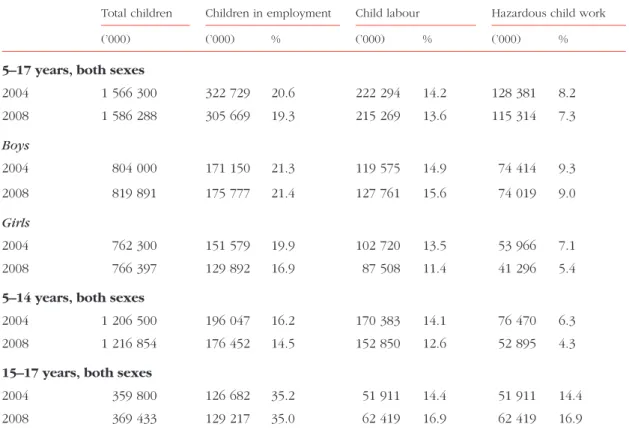
The total number of children in hazardous work is 115 million (2008 estimates, table 2.1). This is over 7 per cent of all children aged 5–17. The proportion varies significantly by age group. While less than one-third of younger children in employment (those aged 5–14) are now in hazardous work, almost half of all children aged 15–17 who are in employment are in work classed as hazardous! Table 2.1 Estimates of various forms of children’s work, 2004 and 2008
Total children Children in employment Child labour Hazardous child work
(’000) (’000) % (’000) % (’000) %
5–17 years, both sexes
2004 1 566 300 322 729 20.6 222 294 14.2 128 381 8.2
2008 1 586 288 305 669 19.3 215 269 13.6 115 314 7.3
Boys
2004 804 000 171 150 21.3 119 575 14.9 74 414 9.3
2008 819 891 175 777 21.4 127 761 15.6 74 019 9.0
Girls
2004 762 300 151 579 19.9 102 720 13.5 53 966 7.1
2008 766 397 129 892 16.9 87 508 11.4 41 296 5.4
5–14 years, both sexes
2004 1 206 500 196 047 16.2 170 383 14.1 76 470 6.3
2008 1 216 854 176 452 14.5 152 850 12.6 52 895 4.3
15–17 years, both sexes
2004 359 800 126 682 35.2 51 911 14.4 51 911 14.4
2008 369 433 129 217 35.0 62 419 16.9 62 419 16.9
Source: IPEC: Global child labour development: Measuring rends from 2004 to 2008 (Geneva, ILO, 2008).
Progress in reducing the worst forms of child labour has been uneven. Of greatest concern is an alarming 20 per cent increase in hazardous work of children in the 15–17-year age group, a rise from 51.9 million to 62.4 million children between 2004 and 2008. 11 This translates to 10.5 million more adolescents working in dangerous jobs or conditions in only 4 years.
11
IPEC: Accelerating action against child labour (Geneva, ILO, 2010), p. 5.
Children in hazardous work
8
Within the younger age group, however, there has been a rapid decline in the number of chil-dren engaged in hazardous work. In 2000, an estimated 111.3 million chilchil-dren aged 5–14 were in hazardous work. By 2004, this had been reduced to 76.5 million, and by 2008, down to 53 mil-lion. In other words, within 8 years, the number was cut in half. The 2008 global estimates show that, for the first time, there were more 15–17-year-olds in hazardous work than 5–14-year-olds, whereas in the first global estimates (2000) it was the reverse.
i
Regional distribution of children in hazardous work
The number and proportion of children in hazardous work vary by region (table 2.2). The largest number is in Asia and the Pacific. However, the largest proportion of children in hazardous work relative to the overall number of children in the region is sub-Saharan Africa. 12
Table 2.2 By region, the number and percentage of children aged 5–17 engaged in hazardous work, 2008
Region Total children
(’000)
Hazardous work (’000)
Incidence rate (%)
World 1 586 288 115 314 7.3
Asia and the Pacific 853 895 48 164 5.6
Latin America and the Caribbean 141 043 9 436 6.7
Sub-Saharan Africa 257 108 38 736 15.1
Other regions 334 242 18 978 5.7
Source: IPEC: Global child labour development: Measuring trends from 2004 to 2008 (Geneva, ILO, 2008).
i
Sex distribution of children in hazardous work
Most of the decline in the total numbers of children in hazardous work has been in the number of girls (table 2.3). Younger boys are showing only a slight decrease; among older boys there is an increase.
Table 2.3 Trends in all forms of child employment by sex
Sex Child population Children in
employment
Child labour Hazardous work
2004 2008 2004 a 2008 2004 a 2008 2004 a 2008
Both sexes
Number (’000) 1 566 300 1 586 288 322 729 305 669 222 294 215 269 128 381 115 314 Incidence
(% of age group)
100.0 100.0 20.6 19.3 14.2 13.6 8.2 7.3 % change
(2004–08)
– 1.3 – –5.3 – –3.2 – –10.2
Boys Number (’000) 804 000 819 891 171 150 175 777 119 575 127 761 74 414 74 019 Incidence
(% of age group)
100.0 100.0 21.3 21.4 14.9 15.6 9.3 9.0 % change
(2004–08)
– 2.0 – 2.7 – 6.8 – –0.5
12
2. The number of children in danger
Sex Child population Children in
employment
Child labour Hazardous work
2004 2008 2004 a 2008 2004 a 2008 2004 a 2008
Girls Number (’000) 762 300 766 397 151 579 129 892 102 720 87 508 53 966 41 296 Incidence
(% of age group)
100.0 100.0 19.9 16.9 13.5 11.4 7.1 5.4 % change
(2004–08)
– 0.5 – –14.3 – –14.8 – –23.5
Note: a 2004 estimates have been retrospectively adjusted
Source: IPEC: Global child labour development: Measuring trends from 2004 to 2008 (Geneva, ILO, 2008).
Boys outnumber girls in hazardous work across all age groups. Over 60 per cent of children in hazardous work are boys, in both the 12–14 and 15–17 years age groups. Among boys of all ages, there was hardly any change in the percentage involved in hazardous work between 2004 and 2008. It remained at around 9 per cent, 13 whereas for girls it declined by 24 per cent (from 54 to 41 million), i.e. 5.4 per cent of girls aged 5–17 were in hazardous work in 2008. 14
i
Sectoral distribution of children in hazardous work
Hazardous work is highest in agriculture, which comprises fishing, forestry, livestock herding and aquaculture, in addition to subsistence and commercial farming. Fifty-nine per cent of children in hazardous work aged 5–17 are in this sector, in comparison with 30 per cent in services and 11 per cent in industry. While boys are more likely to work in agriculture and industry, girls out-number boys in services. Approximately two-thirds of children in hazardous work between 5 and 17 years old work as unpaid family workers; of the remaining, 28 per cent are in paid employ-ment and 7 per cent are self-employed. 15
Progress has been slow in agriculture, in part because these children, spread out over the rural areas of the world, are the hardest to reach. But farming, fishing and livestock herding have many hazards and create more injuries and illnesses than what we hear about. Given the large numbers of children in this sector, agriculture must be a priority for the elimination of hazardous work. 16
i
Injuries and illnesses
One of the reasons why we do not feel the full brunt of hazardous work of children is because we have not been seeing data and reports on the accidents and injuries that result from this work. For the developing world, there have been virtually no statistics on occupational injuries and illnesses for children. Even for the industrialized countries, work-related injuries and illnesses are system-atically under-reported, but they give us an inkling of what the toll must be in the countries that do not have the same protections that others take for granted: safety regulations and enforcement, health services close by, and mandatory reporting and surveillance systems.
In the United States, just in the 15–17-year age group, 374 children died at work in a 10-year pe-riod, 1998–2007 (a fatality rate of 2.9 deaths per 100,000 full-time equivalents) and an estimated 13
Ibid. 14
Ibid. 15
IPEC/SIMPOC calculations based on IPEC (2008, op. cit). 16
IPEC: Accelerating action against child labour (Geneva, ILO 2010), p. 5.
Children in hazardous work
10
598,000 children sustained work-related injuries and illnesses severe enough to be treated in hospital emergency departments (an injury/illness rate of 4.2 per 100 full-time equivalents). 17 If you take a larger group – all child workers under 18 years – the average number of injuries per year in the United States is estimated to be 158,000. 18 If you take just one state (North Carolina, in which a careful review of 20 years of records was undertaken), more than one child dies every year as the result of work. 19
These numbers might sound low, but it is the risk relative to that for other groups, the compari-sons, that counts: these data show that the rate of injury for children aged 15–17 is nearly twice that of workers 25 years and older. 20
Looking deeper into these figures we see another alarming fact. The rates of injury are much higher for migrants and ethnic minorities than for the dominant population. For example, His-panic child workers in the United States had twice the number of deaths as the non-Hispanic workers, a rate of 6.3 deaths per 100,000 worker deaths. 21
European data also show that young workers, aged 15–24, have higher accident rates than adults. For example, in 2003, 4.7 per cent of young workers had an occupational accident with more than 3 days lost, in comparison with an average for the older working population of only 3.3 per cent. 22A recent study of 3,687 working adolescents in Denmark found that nearly half of these young workers reported that their work was heavy or psychologically demanding – two factors that are associated with an increased risk of experiencing an occupational injury – and that the incidence of work accidents was nearly twice as high among adolescents as among the adult work force in terms of incidents per number of working hours. 23
In terms of work-related fatalities, European youth also have higher rates than older workers, ac-counting for 8.9 per cent of all fatal occupational accidents in 2002. Agriculture had the highest incidence rate for fatal accidents among young European workers, followed by construction and transport. Over 30 per cent of accidents on farms involved children and adolescents. 24
Overall, across Europe, the European Agency for Safety and Health at Work (EU-OSHA) con-cluded, “young workers are at least 50 per cent more likely to be hurt at work than older people [and] more likely to suffer from an occupational illness”. 25
There are a few other countries in the world that have been systematically collecting injury and illness data on children in hazardous work. Brazil is one of these. Through its innovative national health worker surveillance system, in the 3-year period 2007–09 it documented 2,676 workplace injuries among those under 18 years – a rate comparable with that of the United States and
17
CDC: “Occupational injuries and deaths among younger workers – United States, 1998–2007”, in Morbidity and Mortality Weekly Report (MMWR) (23 April 2010), Vol. 59, No. 15, pp. 449–455.
18 Ibid. 19
K.J. Rauscher et al.: “Work-related fatalities among youth ages 11–17 in North Carolina, 1990–2008”, in American Journal of Industrial Medicine (2011), Vol. 54, pp. 136–142.
20
Ibid. 21
CDC: “Occupational injuries and deaths among younger workers – United States, 1998–2007”, in Morbidity and Mortality Weekly Report (MMWR) (23 April 2010), Vol. 59, No. 15, pp. 449–455.
22
OSH in figures: Young workers – Facts and figures (Institute for Occupational Safety and Health, for the European Agency for Safety and Health at Work, 2006).
23
K. Rasmussen et al.: “Incidence of work injuries amongst Danish adolescents and their association with work environment factors”, in American Journal of Industrial Medicine (2000), Vol. 54, pp. 143–152.
24
OSH in figures: Young workers – Facts and figures (Institute for Occupational Safety and Health, for the European Agency for Safety and Health at Work, 2006).
25 Ibid.
2. The number of children in danger
Europe. 26 It is noteworthy that as its reporting system has improved, more accidents, injuries and illnesses associated with work are coming to light.
Similarly, during one year (2008) Chile reported 1,124 work-related accidents or illnesses among adolescents between the ages of 15 and 17. More detailed data from 2009 showed that 93 per cent of these adolescents had suffered a work-related health event which required, on average, 6.5 days for treatment or recovery. Agriculture was responsible for the greatest proportion of these (32 per cent), followed by hotels and restaurants (22 per cent) and trade (12 per cent). Of the estimated 100,000 child labourers in the country, 39 per cent work in unacceptable condi-tions, more than 44 per cent do not attend school, while almost 38 per cent work more than 49 hours per week. One-third of all working adolescents work during the night. 27
An older but well-analysed review of injury data from the Philippines estimated that 23.8 per cent of all economically active children suffered an injury during one year – a total of 882,440 work-place injuries. Interestingly, the survey showed that night work, heavy work and exposure to physical hazards each increased the odds of workplace injury by 40 per cent. Children working in agriculture had a five times greater risk of non-fatal injury in comparison with children work-ing in other industries and that the use of tools in the workplace was the risk factor most often responsible for the injury. Within a 12-month reference period, roughly 637,000 childhood agri-cultural injuries occurred, for an incidence rate of 0.08 injuries per 100 person-hours worked or 56.8 injuries per 100 full-time equivalents. 28
A consultation among researchers specializing in hazardous child labour met in Turin in early 2011 to recommend a course of action for filling current information gaps. They confirmed that, apart from the specific examples cited above, data on the impact of work on children’s health were extremely inadequate and that better estimates were needed based on exposure and out-come data and on the risk of both injury and disease as a result of exposure. Such information would have practical use in that it could be used to:
support the development/revision of the hazardous work list; raise the profile of the problem of hazardous child work;
guide those working in specific occupational sectors and industries.
As a result of this meeting, the ILO launched an important new study in April 2011 to examine more closely the relationship between children’s exposure to work hazards and the occurrence of work-related injuries, particularly in developing countries. This study, using data from a large number of specialized child labour surveys conducted during the last ten years by the ILO, will be a first step in calculating global estimates of work-related injury rates by children.
26
CDC: “Occupational injuries and deaths among younger workers – United States, 1998–2007”, in Morbidity and Mortality Weekly Report (MMWR) (23 April 2010), Vol. 59, No. 15, pp. 449–455.
27
IPEC: Crecer protegido. Manual para la proteccion del adolescente trabajador (Santiago, ILO, 2009), p. 18. 28
C. Castro: Measuring hazardous work and identifying risk factors for non-fatal injuries among children working in Philippine agriculture (Washington, DC, 2010), unpublished document.
The health danger
Hazardous work cannot be acceptable for children because of basic biology. Children are not simply smaller adults, they are physically and mentally different (box 3.1); and regardless of cul-tural perceptions or social construct, the transition to biological adulthood extends past puberty well into the late teen years. This is the foundation for the argument against hazardous work of children … the rationale for why it is classed as a “worst form of child labour [that] requires im-mediate and comprehensive action”. 29
In this chapter we give an overview of some of the basic concepts in occupational safety and health as this is the language we need in order to understand each other when we discuss haz-ardous work.
i
Some basic principles about hazardous work
A hazard is anything with the potential to do harm. A risk is the likelihood of potential harm from that hazard actually occurring. Consider common workplace hazards: an object (knife blade, tall ladder), a solvent (benzene), a material (asbestos), an energy source (electricity), a physical environment (wet floor), a psychological environment (intimidation), a task (weld-ing), a general practice (tobacco grow(weld-ing), a condition of work (excessive hours). The poten-tial harm from some of these hazards is obvious, such as cuts from blades and blindness from welding. Other times, the hazards are obscured or take a long time to be felt. For example, many young farm workers don’t know that when they harvest wet tobacco leaves they will be absorbing nicotine through their skin. A 16-year-old shoe-maker may not know that the glue he uses contains benzene or that it can lead to leukaemia and death by age 30. The dangers associated with psychosocial hazards are known least of all. Stress, long hours, fast-paced work, isolation, intimidation – to name a few – can all cause interior wounds, wounds that are not quick to heal.
29
Preamble to Worst Forms of Child Labour Convention, 1999 (No. 182).
3
Box 3.1 Children are not little adults
Children have thinner skin, so toxics are more easily absorbed.
Children breathe faster and more deeply, so can inhale more airborne pathogens and dusts. Children dehydrate more easily due to their larger skin surface and because of their faster breathing. Children absorb and retain heavy metals (lead, mercury) in the brain more easily.
Children’s endocrine system (which plays a key role in growth and development) can be disrupted by chemicals. Children’s enzyme systems are still developing so are less able to detoxify hazardous substances.
Children use more energy when growing and so are at higher risk from metabolized toxins. Children require more sleep for proper development.
Children in hazardous work
14
A crucial fact to remember is that almost all work carries some risk. However, work in the pres-ence of hazards is not necessarily hazardous work. A child over minimum age can work (1) if the hazard can be actually removed, (2) if the child can be separated sufficiently from the hazard so as not to be exposed, or (3) if the risk associated with that hazard can be minimized. The ILO speaks of this as “identifying hazards and reducing risks”. In its guidelines for employers, it encourages them “to reduce the risks for all workers, adolescents and adults, through improved workplace safety and health. This will reduce the likelihood that young workers are at risk from hazardous situations. In addition, an employer can determine whether workers below the age of 18 (but above the minimum age) are engaged in tasks where the risks from hazards are high. The employer can then reduce those risks as a way of eliminating hazardous work of children.” 30 The challenge is to know where to draw the line. When has the risk been minimized enough? When is the work hazard no worse than, say, the hazards in sports? When, in a vocational training or apprenticeship situation, is instruction and supervision adequate?
i
Why children are at greater risk
Some ask whether adult standards can be used as a guide. The rules for adults take into account health and safety risks, but not developmental risks. They have value only as a warning. Logically, if something is off-limits for an adult, such as radiation or asbestos, it is obviously so for youth. Children’s bodies, minds and judgement are still developing, even in the late teens; their reproductive systems and brain functions are particularly susceptible to any hazard that interferes with that process. Adolescence is the last period of rapid cell growth. Exposure to pesticides, neurotoxicants, endo-crine disruptors, allergens or carcinogens during this critical period can be dangerous.
Adolescent bodies absorb a higher dose of toxicants because of their relatively higher rate of breathing and metabolism per unit of body weight; and they can react more strongly to these toxicants than adults.
Approximately 15–20 per cent of a person’s height is acquired between the ages of 10 and 20, about half during a 2-year period of rapid growth. It is at this time that damage to bones, joints, ligaments and muscles is especially likely and when physical strain and repetitive movements can cause stunting, spinal injury and other lifelong deformities and disabilities. 31
There is as yet no good solid research on this, but experience suggests that it is young people’s psy-chological and behavioural characteristics that often put them at risk, and it is their psypsy-chological 30
ILO-ACT/EMP and IOE: Eliminating child labour. Guide 2: How employers can eliminate child labour (Geneva, ILO, 2007), pp. 12–13.
31
T. Morse et al.: “Trends in work-related musculoskeletal disorder reports by year, type, and industrial sector: a capture-recapture analysis”, in American Journal of Industrial Medicine (2004), Vol. 48, No. 6, pp. 40–49.
Box 3.2 Children’s risk is increased because they:
lack work experience, and may not make well-informed judgements;
have a desire to perform well – children are willing to go the extra mile without realizing the risks; learn unsafe behaviours from adults;
might not be carefully trained or supervised;
lack status and find it difficult to speak out about their rights;
3. The health danger
health and development which may be most affected (box 3.2). This is of great concern because psychological damage is often slow to manifest itself and hardest for those without explicit training to pick up. Young people are anxious to please; they may be impetuous and act without thinking, are sometimes impatient and move quickly, and lack experience; they are often reluctant to speak out on their own behalf; and they seldom have an organization or individual to represent them. Many of the jobs that are accessible to children are the ones that require – and offer – little formal training and frequently lack adequate adult supervision, which adds to the risks.
i
Challenges in understanding children’s risks
Why have research and policies on hazardous work of children been lagging behind? It may be because many people assume that children don’t work or that the work they do is not so danger-ous. Or perhaps they feel that it is not necessary to know about the effects of work on children’s health, but simply to concentrate on getting younger children out of work.
What is important to remember – and hardest to judge – is that a child in hazardous work is not subject to just one risk factor, but usually to several. Hazardous work often (but not always) occurs along with poverty. When she is malnourished and carries heavy loads, she is exhausted and her risk of illness increases. When he is growing rapidly and working for hours in the hot sun, his risk of injury increases. In addition, the child who is scolded for lack of attention or beaten for a mistake pushes herself or himself even harder … and the risk of an accident in-creases even more.
Do we need to do more research? Don’t we already know that chemicals, long working hours and exploitive situations are bad for adults and therefore bad for children? Yes, we know that being exposed to lead is dangerous (as when children dismantle car batteries for a living), but it is not until someone shines the light on it that we make the connection between the work and the fact that the child can’t seem to learn in school. Although large-scale studies would seem a luxury, it is these that help policy-makers justify pushing the issue higher up the priority list. Information is the crucial element in advocacy. Research is needed 32 to:
obtain a profile of occupational risks to children so that awareness campaigns, training and prevention strategies can be adjusted to meet the real needs;
assess the gender differences in these risks, as well as the risks for young migrant workers, indigenous people and other ethnic minorities; and
target risk-reduction policies and programmes to the sectors where young workers are most at risk.
i
The cost to society of hazardous work
If a child contracts a chronic illness, loses an eye or suffers an amputation by age 18, it is far more costly to society than if an adult worker contracts the same illness or suffers the same injury at, say, age 50. The young person has lost over 30 years of productivity and has not had a chance to reimburse the investment in her training, and it is likely her family would have incurred costs for medical care over that period as well.
Low-grade exposures to pesticides, heavy metals such as lead or mercury, or chronic fatigue may not result in measurable costs, but may render the young worker more vulnerable to other physical or psychological stressors, and ultimately with less energy with which to contribute to the nation’s growth.
32
OSH in figures: Young workers – Facts and figures (Institute for Occupational Safety and Health, for the European Agency for Safety and Health at Work, 2006).
Children in hazardous work
16
Take, for example, the case of lead. Lead exposure poses a serious risk for the developing brain and nervous system and has been linked to impaired cognitive function and adverse neurobehavioural effects. An analysis of 24 studies of childhood lead exposure concludes that lead impairs children’s neurological functioning and IQ at blood levels under 10 μg/dl and 5.8 IQ points can potentially be lost for each 10 μg/dl increase in blood lead. 33 This impact persists in early childhood and adolescence. 34 Box 3.3 illustrates the economic costs of lead exposure.
33
H.L. Needleman and C.A. Gatsonis: “Low-level lead exposure and the IQ of children. A meta-analysis of modern studies”, in Journal of the American Medical Association (1990), Vol. 263, No. 5, pp. 673–678.
34
D.C. Bellinger et al.: “Low-level lead exposure, intelligence and academic achievement: A long-term follow-up study”, in
Pediatrics (1992), Vol. 90, No. 6, pp. 855–861.
Box 3.3 The economic costs of lead exposure to child labourers
Researchers have developed a method to quantify, in economic terms, the magnitude of the problem of lead exposure in child workers. This model determined that the loss of 1 IQ point corresponded to an overall reduction in lifetime earnings of 2.4 per cent. Based on the estimate of 4 μg/dl increase in blood lead levels causing a 1 point IQ drop and working on the assumption that there is not a threshold blood lead level for cognitive effects, each 1 μg/dl of blood lead concentration is associated with a 0.25 point decrease in IQ. This finding has important implications not only for young workers and livelihood, but also for the future productivity of developing nations.
Source: Landrigan, P.J. et al. 2002. “Environmental pollutants and disease in American children: estimates of morbidity, mortality, and costs for lead poisoning, asthma, cancer, and developmental disabilities”, in Environmental Health Perspectives, Vol. 110, No. 7, pp. 721–728.
The best way to reach the target
In 2006, the ILO Governing Body set 2016 as the target for when its 183 member States should have freed themselves from the worst forms of child labour. The Governing Body was con-cerned that the urgency spelled out in Convention No. 182 was being ignored and the fervour that fired the member States to ratify this Convention at such an unprecedented rate had dissipated.
Therefore, the Government of the Netherlands, in cooperation with the ILO, offered to host a conference in The Hague in May 2010 that would assess global progress in reaching the 2016 target. The over-500 delegates from 97 countries who attended decided that there needed to be a re-energized campaign against the worst forms of child labour, and they proposed a roadmap that laid out the steps to be taken to ensure that the 2016 target was met (box 4.1). They concluded that focusing on hazardous work of children could make a large impact at this critical juncture because hazardous work of children is in fact a measure that is often used as a proxy for the worst forms of child labour. 35
The Hague delegates emphasized how we have a clear moral obligation to eliminate hazardous work of children, to protect those most needing our protection. They spoke of it as a significant impediment to the realization of children’s rights and the associated Millennium Development Goals, particularly those related to education, gender equality and HIV/AIDS.
But besides ethics, they also noted the economics. Hazardous work of children degrades the human capital of a nation. Therefore, elimination of hazardous work of children can yield high social and economic returns because it contributes to households breaking out of the cycle of poverty and helps countries advance human development. 36 But to do this, the delegates stressed, requires public policies that focus on the issue: education policies that ensure accessibility and
35
IPEC: Accelerating action against child labour (Geneva, ILO, 2010), p. 5. 36
IPEC: Roadmap for achieving the elimination of the worst forms of child labour by 2016, Conference Report (Geneva, ILO, 2010), p. 2.
4
Box 4.1 The Hague Roadmap
Some guiding principles:
Governments are mainly responsible for enforcing the right to education and eliminating the worst forms of child labour; social partners and other civil society and international organizations have important roles in promoting and supporting such action.
Governments’ responsibility should be assumed at the highest level and should include due attention to the most vulnerable children and the conditions that create their vulnerability.
In a globalized economy, government responsibility includes policy attention to child labour issues in international supply chains.
The potential vulnerability of children in the context of migration flows needs attention.
Children in hazardous work
18
quality of schools, and pro-employment policies (including labour inspection) that support de-cent work for adults and children of working age.
In summary, the international community has laid out its “instructions”:
in 1999 calling for urgency in eradicating the worst forms of child labour (Convention No.182); in 2006 setting 2016 as the target for completing this work (ILO Governing Body);
in 2010 laying out the steps for achieving it (The Hague Roadmap). They could not be more clear.
PART II
Knowledge and practice: What have we learned?
In the following section, we look at the knowledge base derived from research on hazardous work of children, and at positive examples of addressing it, drawn from project evaluations. As noted ear-lier, this review of research and experience is not intended to “prove” that specific work is hazardous or that certain interventions are effective. Rather, its purpose is to emphasize that hazardous condi-tions and tasks can have a profound effect on children’s immediate well-being and on their long-term health and productivity; and at the same time, to demonstrate that the situation is not hopeless. Something can be done.
Chapter 5 examines several sectors in which children work in hazardous conditions. We are not sug-gesting that these are the worst; they are just examples. By explaining the tasks that children typically do in a sector and presenting some of the particularly convincing research evidence on the health impacts, we hope to show that there are many dangers, some of them hidden.
Bear in mind that these are by no means the only sectors with noteworthy hazards. Every sector can have tasks or conditions that should be made “off-limits” to young people. At the same time, most sectors – but not all – have tasks that are safe enough for young workers of legal age to do. But it is important to remember that a job can involve multiple hazards that interact with each other, and that time pressure and fatigue can increase the risk in all industries.
The evidence base on hazardous work
by sector
i
Crop agriculture
Agriculture is the sector with the most child labourers. It is also the sector with the most potential for decent work for rural children and young adolescents who have reached the legal minimum age of employment. Although we must keep in mind that work in field and tree crops has a number of serious risks for children, one must not assume that these risks make the whole industry off-limits to children of all ages. Indeed, many types of farm work can be positive for children, providing them with experience and technical skills. Because of the numbers involved and the value of the indus-try to the family as well as to the national economy, it is absolutely crucial to discern which tasks, which working conditions, which products and which tools are hazardous and to help parents and policy-makers alike to take the necessary steps to protect children from those hazards.
The scope, the hazards
Is the family farm a safe place to work? Can a child combine chores on the farm with school? What was true years ago, may not be so now. With globalization, the profile of child work in crop agriculture is rapidly changing. Subsistence farmers in developing countries are adopting the chemicals used by big plantations, but they may have little training in their use and product warning labels may not be in a language they understand. 37 In developed countries, the greatest danger is in the use of motorized equipment (tractors, loaders, chainsaws), and although ado-lescents may know the dangers, their lack of judgement and impatience may lead them to take risks. Where outgrowers are producing for the international market (e.g. sugar, bananas, flowers, cocoa, tobacco, tea, coffee), child workers may be exposed to toxic substances particular to that industry, such as methyl bromide, a particularly toxic pesticide used in flower production; 38 or be expected to use sharp tools, which, although traditional, are being used at an industrial pace, as in cocoa production; or encounter injuries or illnesses from the plants themselves, as when harvesting the sharp leaves of sisal.
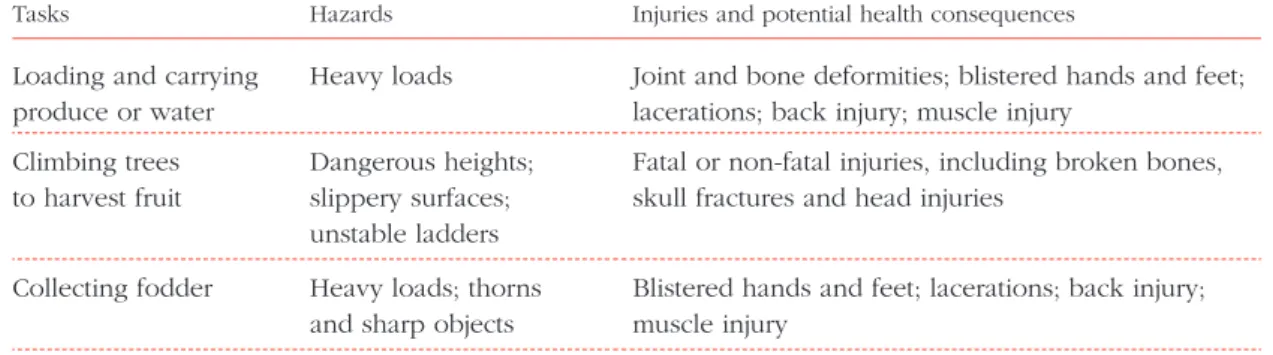
Table 5.1 Selected list of common tasks, hazards and potential consequences in crop agriculture
Tasks Hazards Injuries and potential health consequences
Loading and carrying produce or water
Heavy loads Joint and bone deformities; blistered hands and feet; lacerations; back injury; muscle injury
Climbing trees to harvest fruit
Dangerous heights; slippery surfaces; unstable ladders
Fatal or non-fatal injuries, including broken bones, skull fractures and head injuries
Collecting fodder Heavy loads; thorns and sharp objects
Blistered hands and feet; lacerations; back injury; muscle injury
37
L. Goldmann et al.: Childhood pesticide poisoning: Information for advocacy and action (Châtelaine, UNEP, 2004). 38
IPEC: Ecuador: Trabajo infantil en la floricultura, Rapid Assessment No. 35 (Geneva, ILO, 2000).