Sharif University of Technology
Scientia IranicaTransactions D: Computer Science & Engineering and Electrical Engineering www.scientiairanica.com
A novel low complexity multiuser detector based on
modied genetic algorithm in direct sequence-code
division multiple access communication systems
A. Zahedi
a;, H. Bakhshi
b, S. Jafari
c, H.R. Abdolmohammadi
dand M.R. Rajati
e a. Department of Electrical Engineering, Science and Research Branch, Islamic Azad University, Hesarak, Tehran, P.O. Box14778-93855, Iran.
b. Department of Electrical Engineering, Shahed University, Persian Gulf Freeway, Tehran, P.O. Box 33191-18651, Iran. c. Department of Biomedical Engineering, Amirkabir University of Technology, Tehran, P.O. Box 15875-4413, Iran. d. Department of Electrical Engineering, Iran University of Science & Technology, Tehran, P.O. Box 16846-13114, Iran.
e. Institute of Signal and Image Processing, Department of Electrical Engineering, University of Southern California, Los Angeles, CA 90089, USA.
Received 20 June 2012; received in revised form 14 November 2012; accepted 21 January 2013
KEYWORDS Direct Sequence-Code Division Multiple Access (DS-CDMA); Maximum likelihood; Multi-user detection; Genetic algorithm; High dimensional optimization.
Abstract. In this paper, we present an ecient evolutionary algorithm for Multiuser Detection (MUD) problem in Direct Sequence-Code Division Multiple Access (DS-CDMA) communication systems. The optimum detector for MUD is the Maximum Likelihood (ML) detector, but its complexity is very high, and involves an exhaustive search to reach the best tness of the transmitted and received data. Thus, there has been much interest in suboptimal multiuser detectors with less complexity and reasonable performance. The proposed algorithm is a modied Genetic Algorithm (GA) which reduces the dimension of the search space, and provides a suitable framework for future extension to other optimization problems, especially for high dimensional ones. This algorithm is compared with ML and two famous model-free optimization methods: Particle Swarm Optimization (PSO) and Ant Colony Optimization (ACO) algorithms, which have been used for MUD in DS-CDMA. The simulation results show that the performance of this algorithm is close to the optimal detector; it has very low complexity, and it works better in comparison to other algorithms.
c
2013 Sharif University of Technology. All rights reserved.
1. Introduction
In a DS-CDMA system, the signal is received and detected by a Matched Filter Bank (MFB), which constitutes the conventional detector. This type of receiver is unable to optimally recover the signal, when the channel is contaminated by Additive White Gaussian Noise (AWGN), and suers from at or frequency selective fading; because the DS-CDMA signal is aected by Multiple Access Interference (MAI)
*. Corresponding author. Tel.: +98 9183371809 E-mail address: [email protected] (A. Zahedi)
and also by the Near-Far Ratio (NFR) [1]. In fact, the signature signals of dierent users are not completely orthogonal to each other, and cross correlation among these signals results in multiple access interference. Therefore, the conventional matched lter detector, as in single user communication, is no longer eective and causes many problems [2]. In 1986, Verdu in [3] proposed the optimum multiuser detector (OMUD), which consists of a bank of matched lters followed by a Maximum Likelihood Sequence Estimator (MLSE). The MLSE detector generates a maximum likelihood sequence, ^b, which is associated with the transmit-ted sequence, as presentransmit-ted in Figure 1 [1]. Vector
Figure 1. Baseband DS/CDMA block diagram, receiver with MUD [1].
b is estimated in order to maximize the sequence transmission probability, given that r(t) is received, where r(t) is extended for all messages, considering all the transmitted messages with the same transmission probability [1]. The OMUD has a computational complexity which grows exponentially with the number of users. Thus, since CDMA systems could potentially have a large number of users, OMUD is unfeasible to implement them. Therefore, many researches have focused on sub-optimum detectors with less complexity and a performance which is almost as high as OMUD. Alternative detectors for OMUD include Decorrelator detector proposed by Verdu in [3] and MMSE detector recommended by Poor and Verdu in [4]. These algo-rithms have reasonable computational complexity, and their performance is comparable to that of the optimum receiver, but they yield a degraded communication system in the sense of BER [5].
Much eort has been devoted to the development of suboptimal detectors with reasonable computational complexity. Generally, the MUD problem is a Nonde-terministic Polynomial (NP)-time complete problem, so iterative algorithms and optimum tools are used for its solution. Kechriotis and Manolakos [6,7] pro-posed implementation of Hopeld neural network for the optimal CDMA multiuser detection, and in [8] generalized regression neural network has been ap-plied. A multistage joint detector is proposed in [9,10] to perform suboptimal maximum likelihood multiuser detection. A multistage detector is proposed in [11] by Varanasy and Azhang. Honig et al. [12] also introduced a blind adaptive interference suppression technique. In [13] a blind multiuser detector, using support vector machine, was applied. The rst GA-based multiuser detector (GA-MUD) was proposed by Juntti et al. [14] which assumes a synchronous CDMA system model communicating over an AWGN channel. To improve the convergence rate of GA, Ergun and Hacioglu used a multistage multiuser detector as a part
of GA procedure in [15]. In [16], Hanzo et al. showed that the convergence of GA is aected by the type of GA operations and the associated system parameters, and GA is not inherently slow.
For better implementation of multiuser detec-tion, some novel techniques such as Particle Swarm Optimization (PSO) [17-21], Space-Time Linear Dis-persion [22] and Simulated Annealing [23] have been used recently. In addition, ant colony-based MUD for suboptimal detection is applied in [24-26]. We compare our proposed algorithm with the algorithm in [24], and also with PSO algorithm [20], and we show that the performance of the proposed method is better, and it is more ecient in a high dimensional space and for a system with a large number of users. These algorithms are compared in the sense of complexity as well.
Although genetic algorithm is a strong method in global search, it is known that many kinds of genetic algorithms are not guaranteed to nd the global optimum exactly; especially when they encounter large scale problems [27]. It may be a source of inspiration to think about a size reducing algorithm to overcome the so-called \curse of dimensionality". Our proposed algorithm, which is based on a modied genetic algo-rithm, reduces the problem of curse of dimensionality. The remainder of this paper is organized as follows: Section 2 describes our CDMA system model; Section 3 highlights the algorithm used to implement our proposed detector. The simulation results are presented in Section 4, while Section 5 provides com-parison of the complexities associated with our algo-rithm and other methods. Finally, some conclusions are drawn in Section 6.
2. System model
We use the equations presented in [1] to describe a DS-CDMA system. We can consider a multiuser detection as an optimization problem. Based on [28],
the objective function for this problem is dened as (Log Likelihood Function (LLF)) [1]:
f(B) = BTr BTRB; (1)
where r is the received signal, B is the bit sequence with I bits, and R is the cross correlation matrix. The complete sequence for all K users can be obtained through optimization of Eq. (1), resulting [1]:
^ B = arg
(
max[f(B)]
B2f 1;+1gIK
)
: (2)
OMUD attempts to nd the best vector of data bits, but because of high complexity and unfeasible imple-mentation, it is an inecient method for multiuser detection. Because the optimization associated with OMUD is high dimensional, the dimension of the search space needs to be restricted; hence, all suboptimal algorithms try to nd a solution following an objective function, which is able to improve the performance of multiuser detection. These attempts try to reduce the complexity of OMUD and maximize the DS-CDMA mean performance, with K active users. Most eorts concentrate on approaching the performance of ML al-gorithm with less complexity and reliable applicability along with the least possible error. In the next section, we propose our algorithm to achieve this goal and compare our algorithm with other ecient algorithms available in the literature.
3. Proposed algorithm
It is well-known in the evolutionary computation liter-ature that basic genetic algorithms (and even many other modied evolutionary algorithms) have some deciencies in solution of large scale optimization problems. It is worthwhile to devise a dimension reducing algorithm to surmount the so-called \curse of dimensionality". One of the most important features of genetic algorithms is their ability to nd the global optimum of a cost function [29-31]. Many of the modications performed on the conventional GA's have targeted this issue [32]. It is trivial that the optimiza-tion algorithm performs better when the number of parameters is fewer. Thereby, decomposition of a large scale problem into small sub-problems is of substantial interest. Such ideas are strong motivations for intro-ducing a novel GA which tries to simplify optimization problems and decompose them into simpler problems, since the probability of nding the solution reduces when the number of parameters increases. To elaborate more, consider the following example [32]:
F (~x) = 0:5 + sin2j~xj 0:5e 0:2j~xj;
~x = (x1; x2; ; xl) ; (3)
in which ~x is the vector of parameters of the problem. Obviously, the global minimum of the cost function is located in ~x = 0 and its value is 0. First, consider ~x = x1. As shown in Figure 2, in order to reach the
global optimum, it is necessary for an individual to be placed in the best region, which is highlighted in Figure 2. This region occupies a ratio of L1
L of the
search space, which is a signicant part of the space. There are many precise tools which can assist GA to reach this global optimum easily.
Now, consider the following situation:
~x = (x1; x2) : (4)
The function is illustrated in Figure 3. Observe that the portion of the search space occupied by the attraction domain of the global optimum is propor-tional to L1
L
2
rather than L1
L. Since LL1 < 1, this
fact directly causes a reduction in the chance of nding the global optimum. When the number of parameters proliferates, the chance decreases exponentially.
Figure 2. The function F (~x) in ~x = x1 [32].
This fact is rstly realized by a naive idea, i.e. neglecting some of the parameters of problem in the optimization procedure. However, in reality, the algorithm allows every parameter to change. The main dierence of the algorithm with conventional GA's is that in each iteration, the algorithm is performed over a subset of parameters, while the other parameters are kept constant. In the next iteration, dierent set of parameters are selected to be constant. The set of changeable parameters are chosen according to a proce-dure described in the sequel. With a sucient number of repetitions, one can make sure that an appropriate searching strategy is selected for the whole search space which reduces the dimension of parameters in each iteration of the conventional genetic algorithm. It is heuristically justiable to initialize the algorithm by a \suciently good" solution which is determined by classic detectors, such as the conventional sign detector. Next, let us take a closer look at the objective function. Considering Eq. (1); the objective function is comprised of two terms: BTr and BTRB. For
maximizing the BTr part, considering the fact that
each element of B can only take the values of either 1 or -1, it is enough for each element of B to be either 1 or -1, according to the sign of corresponding member in r. Since the BTRB term is a square matrix, if the
non-diagonal elements were small, it would practically be equal to BTB. In this case, it is indierent if
the values of elements of B are either 1 or -1. The main problem is that in most cases, some non-diagonal matrix elements are not considerably small and cannot be assumed as negligible. Because the matrix R is symmetric, these elements add terms of type 2RijBiTBj
to the objective function. In this case, if Rijis negative,
the fact that BT
i and Bj bear the same sign helps
to increase the value of the objective function, and if Rij is positive, their dierence in sign helps this fact.
In other words, the problem variables are no longer independent, and their interaction is inuential. The variable showing more interaction with other variables is considered to be a more signicant variable. We propose the following criterion as below:
idk= K
X
j=1
abs (Rkj) ; (5)
where K is the number of transmitted bits (assuming BPSK modulation). Any element of B for which id takes a higher value is a more signicant and eec-tive variable, since it has high interaction with other variables, and inuences the convergence of algorithm more. As discussed, a number of variables (say M) are selected for optimization in the proposed algorithm, and the rest (K M) are kept constant at the previous value. As we discussed, those variables with lower id are more likely to be at their optimal value, provided
by the conventional detector (initial value). Thus, it is better to take advantage of a probabilistic algorithm for selection of M, so that the variables with higher id are more likely to be selected. Accordingly, the Roulette Wheel algorithm can be used in each iteration for selection of variables with a probability proportional to their id value. However, we take advantage of a method with less computational cost. This is done through selection of a random number for each variable, having uniform distribution between zero and the id corresponding to that variable. Then, the M variables possessing larger random numbers are picked out. This action, on one hand, makes all the variables likely to be selected, and on the other hand, makes those variables with higher id more likely to be chosen. In the next step, a chromosome is created using these M variables, and the conventional genetic algorithm is performed on it once. Subsequently, the best response is saved as the new values of these M variables, and this process continues again for the other set of variables. This process repeats until the selection of all variables. After several iterations, all variables are converged to their optimal value. The parts of this conventional genetic algorithm are as follows.
3.1. Fitness function evaluation
In each generation, the tness values are computed for each chromosome. The tness function is determined by Eq. (1).
3.2. Selection
In order to preserve better chromosomes (solutions) to yield better ospring, we employ the truncated selec-tion scheme, through retaining only some of the parent chromosomes in the population, which possess larger tness values, and reproduce them in the mating pool from which the two parent chromosomes are randomly selected for the following crossover step [29,31]. 3.3. Crossover
The bits of the parent vectors are then exchanged using the uniform crossover process in order to produce two osprings. The process of uniform crossover invokes a crossover mask, which is a sequence consisting of randomly generated 1s and 0s [29,31]. Figure 4 illustrates an example of the crossover process. 3.4. Mutation
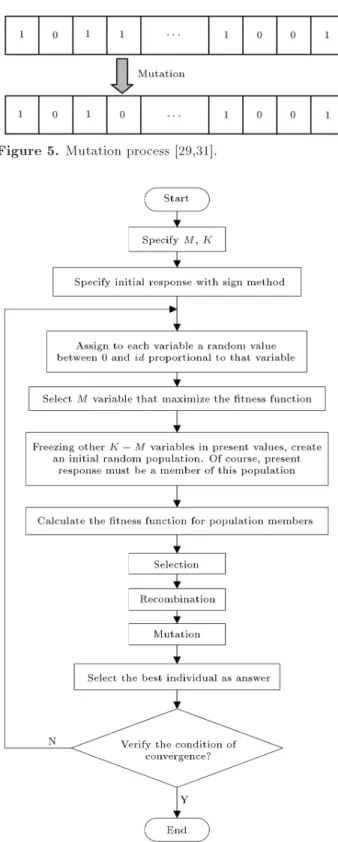
The mutation process [29,31] refers to the alteration of the value attributed to a bit in the ospring from 1 to -1 or vice versa, with a probability pm. Here, we set
pm = 1=K, such that, on average, only one bit in each individual is mutated. Figure 5 displays an example of this process.
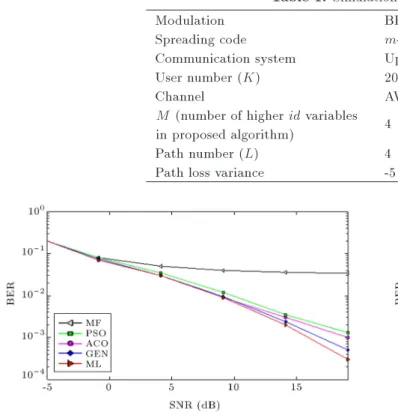
The owchart of the proposed algorithm is pro-vided in Figure 6.
The algorithm seems to have another advantage. Fine tuning algorithms for GA's such as Tabu search
Figure 5. Mutation process [29,31].
Figure 6. The owchart of proposed algorithm.
and other types of local search are more ecient in escaping from the local minima when the dimension of the search space is low. Thereby, this algorithm is more likely to perform better when combined with ne-tuning algorithms.
4. Numerical results
In this section, the performance of the algorithm de-scribed in Section 3 is compared with two optimization-based algorithms, PSO and ACO, considering BER as the main gure of merit. The convergence of each algorithm versus optimization parameters is also provided. It is assumed that the communication system is asynchronous DS-CDMA MUD, over slow Rayleigh fading AWGN channel. The numerical results were obtained based on the averaging of 1000 simulation runs; these results were attained in identical systems and channel conditions in order to provide fair com-parison to other algorithms. Our results are presented in form of examples. In all examples, the simulation parameters are as shown in Table 1.
The spread sequences are selected as Pseudo-Noise (PN) m-sequence; the number of active asyn-chronous users in the system is K = 20 and we set M = 4; the processing gain is N = 63. In all examples, it was assumed that the phases, amplitudes, channel gains and random delays of all users are perfectly known in the receiver, and users' power is:
E " L
X
l=1
a(i)k;l2
#
= 1; for k = 1; 2; ; K: (6) In all simulations, the population of PSO, ACO and the proposed genetic algorithm has been selected as 20, and the iteration has been chosen as 100 for all methods.
Each simulation is presented as an example. In these examples, as will be seen, our proposed method is more eective and better in comparison to the two other algorithms presented before.
Example 1. In this example, the main parameter of each communication system, BER, is discussed. In Figure 7, the BER of the proposed algorithm is compared with the two other algorithms, and also with the comprehensive search in the space of parameters known as ML and the worst case detector as Matched lter. It is revealed that although in low SNR there is no main dierence among the methods, the proposed genetic algorithm in high SNR converges to optimum MUD, and the BER of this method is less than ACO and PSO methods. The proposed algorithm has better performance since it decomposes the MUD problem to several simpler problems, and causes better conver-gence and less BER. Figure 7 shows the unsuitability of the matched lter form, MUD.
Table 1. Simulation parameters.
Modulation BPSK
Spreading code m-sequence with 63 chips Communication system Uplink asynchronous CDMA
User number (K) 20
Channel AWGN with slow Rayleigh fading
M (number of higher id variables in proposed algorithm) 4
Path number (L) 4
Path loss variance -5 dB
Figure 7. BER of the proposed algorithm in comparison to other methods versus SNR.
Figure 8. BER of the proposed algorithm versus number of users in comparison to other methods. SNR is xed at 12 dB.
Example 2. In Figure 8, the eect of the increasing number of users on BER is analyzed for the classic algorithms and optimization-based techniques such as ACO and the proposed genetic algorithm. From this gure, the BER of the proposed algorithm does not considerably increase with the increasing user numbers. This simulation is done for SNR=12 dB.
Example 3. In Figure 9, the proposed algorithm, with dierent population sizes, is implemented, and the numerical results are depicted. It is observed that with the population size 30, the algorithm converges to optimum MUD. Of course, this fact happens also
Figure 9. BER of the proposed genetic algorithm versus number of generations in dierent population sizes, p = 10; 20; 30. SNR is xed at 15 dB.
Figure 10. BER versus the number of iterations in proposed algorithm and ACO, PSO, ML and Matched Filter methods; SNR=7 dB.
for population sizes 20 and 10, but with delay in convergence. As could be observed in the gure, after approximately 70 iterations, the proposed algorithm operates very well, and the convergence of this case is quite satisfactory. This simulation is carried out with SNR=15 dB.
Example 4. In Figure 10, BER versus the number of iterations is illustrated, and it is revealed that the pro-posed algorithm converges faster and more accurately in comparison to ACO and PSO, because the proposed approach reduces the probability of being trapped in
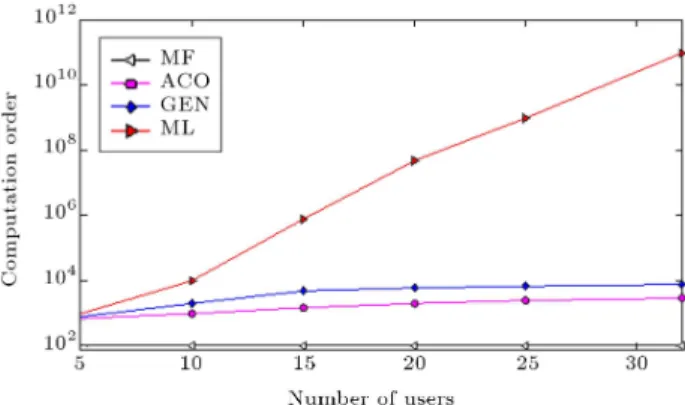
Figure 11. Computation order of the proposed method versus the number of users; comparison to ACO, ML and Matched lter methods.
the local minimum. This property is very important, as the complexity of calculations is decreased to a great extent, and noticeably, the cost of the detector and hardware is minimized. ACO and PSO algorithms are very ecient and applicable in MUD, and this gure shows that our algorithm is comparable with these algorithms, and even in some cases, it works better, and its convergence is faster with lower complexity. This simulation is conducted in SNR=7 dB.
5. Computational complexity
A common form in order to compare algorithms' complexities can be done through the O notation, which means the order of magnitude associated with the algorithm complexity. But, comparing algorithms with only O can be insucient. In order to express the complexity of the analyzed algorithms, it is essential to determine which instructions are carried out and how many times they are processed [1]. If the number of transmitted bits is I and the number of users is K, complexity is in the order of (KI)2 as most genetic
algorithms [11]. This relation is because both the number of Generations and the number of Populations are proportional to KI, and the complexity of genetic algorithms is proportional to the product of these two parameters. For OMUD, the number of operations increases exponentially with the number of users, i.e. 2KI.
Figure 11 shows that the complexity associated with our proposed algorithm is much less than ML and is comparable with ACO. Of course, because of the decomposition in our proposed algorithm and repeti-tion of the calcularepeti-tions for the parameters of modied Genetic Algorithm, the complexity is increased a little and it is more than the ACO complexity.
6. Conclusions
In this paper, multiuser detection based on the modi-ed genetic algorithm was implementmodi-ed, and through
presentation of a new search method, the desirable optimization method was achieved. When compared with sub-optimal algorithms, such as ACO and PSO, the new algorithm shows better performance, and in some cases, rapidly approaches the optimal ML algorithm. This algorithm is quite ecient with good initial guesses and ne tuning of parameters, and shows acceptable performance. The present paper is novel from two viewpoints: First, we have invented a new modied genetic algorithm which is powerful against high dimension problems. This is very important, since we know that the curse of dimensionality is the main cause of failure in large scale optimization problems. Second, we have dened a way to nd more important variables in DS-CDMA systems, i.e. we have proposed that users with higher cross-correlation have more important role in the nal tness function. The proposed method presents the selection criteria of more important parameters that inuence the conver-gence of the genetic algorithm. So the optimization procedure should be applied rst to them and then to others. In the eld of evolutionary computation there are no powerful analytical studies on algorithms. However, that is a very dicult work. We suggest interested and capable readers to try that on the current method.
References
1. Ciriaco, F., Abrao, T. and Jeszensky, P.J.E. \DS-CDMA multiuser detection with evolutionary algo-rithms", Journal of Universal Computer Science, 12(4), pp. 450-480 (2006).
2. Proakis, J.G., Digital Communications, 3rd Ed., McGraw-Hill, Singapore (1995).
3. Verdu, S. \Minimum probability of error for asyn-chronous Gaussian multiple access channels", IEEE Trans. Inform. Theory, 32, pp. 85-96 (1986).
4. Poor, V.H. and Verdu, S. \Probability of error in MMSE multiuser detection", IEEE Trans. Inform. Theory, 43, pp. 50-60 (1997).
5. Lupas, R. and Verdu, S. \Linear multiuser detectors for synchronous code division multiple-access chan-nels", IEEE Trans. Inform. Theory, 35, pp. 123-136 (1989).
6. Kecheriotis, G.I. and Manolakos, E.S. \Hopeld neural network implementation of the optimal CDMA mul-tiuser detector", IEEE Trans. Neural Networks, 7, pp. 131-141 (1996).
7. Kecheriotis, G.I. and Manolakos, E.S \A hybrid digi-tal signal processing-neural network CDMA multiuser detection scheme", IEEE Trans. Circuits System, 43, pp. 96-104 (1996).
8. Rajabpour, M., Razzazi, F. and Bakhshi, H. \adaptive multiuser detection in DS-CDMA systems using gener-alized regression neural network", IEEE International
Symposium on Operations and Management, pp. 462-465 (2012).
9. Guo, Z. and Letaief, K.B. \An eective multiuser receiver for DS-CDMA systems", IEEE Journal. Sel. Areas Commun., 19, pp. 1019-1028 (2001).
10. Fang, H., Gunawan, E., Guan, Y. and Zheng, L. \Improved two-stage CMA-based blind receivers for joint equalization and multiuser detection", IET Com-munications Journal, 9(6), pp. 1131-1136 (2012).
11. Varnasi, M.K. and Azhang, B. \Multistage detection in synchronous code-division multiple-access communica-tions", IEEE Trans. Commun., 38, pp 509-519 (1990).
12. Honig, M., Madhow, U. and Verdu, S. \Blind multiuser detection", IEEE Trans. Inform. Theory, 41, pp. 944-960 (1995).
13. Kao, J.W.H., Berber, S.M. and Kecman, V. \Blind multiuser detector for chaos-based CDMA using sup-port vector machine", IEEE Transactions on Neural Networks, 21(8), pp. 1221-1231 (2010).
14. Juntti, M.J., Schlosser, T. and Lilleberg, J.O. \Ge-netic algorithms for multiuser detection in synchronous CDMA", In Proc. IEEE Int. Sympos. on Information Theory, p. 492 (1997).
15. Ergun, C. and Hacioglu, K. \Multiuser detection using a genetic algorithm in CDMA communications systems", IEEE Trans. Commun., 48, pp. 1374-1383 (2000).
16. Hanzo, L., Yang, L.L., Kuan, E.L. and Yen, K., Single and Multi-Carrier CDMA: Multi-User Detec-tion, Space-Time Spreading, SynchronizaDetec-tion, Stan-dards and Networking, IEEE Press/Wiley, Piscataway, NJ (2003).
17. Lu, Z. and Yan, S. \Multiuser detector based on particle swarm algorithm", In Proc. IEEE 6th CSSET, 2, pp. 783-786 (2004).
18. Zhao, Y. and Zheng, J. \Multiuser detection employing particle swarm optimization in space-time CDMA systems", In Proc. ISCIT2005, pp. 940-942 (2005).
19. El-Mora, H.H., Sheikh, A.U. and Zerguine, A. \Ap-plication of particle swarm optimization algorithm to multiuser detection in CDMA", In Proc. IEEE 16th ISPIMRC, pp. 2522-2526 (2005).
20. Guo, Z., Xiao, Y. and Lee, M.H. \Multiuser detection based on particle swarm optimization algorithm over multipath fading channels", IEICE Trans. Commun., 2, pp. 421-424 (2007).
21. Xiazhi, L., Dawei, F. and Tianshuang, Z. \multi-user detection of DS-CDMA based on PSO-ICA", IEEE International Conference on Image and Signal Processing, pp. 2490-2493 (2011).
22. Xiao. P., Wu, J., Sellathurai, M., Ratnarajah, T. and Strom, E.G. \Iterative multiuser detection and decoding for DS-CDMA system with space-time linear dispersion", IEEE Transactions on Vehicular Technol-ogy, 58(5), pp. 2343-2353 (2009).
23. Yanping, L., Hengshan, Z., Deqian, M. and Xiaoming, C. \Adaptive IA-TCNN multiuser detector based on simulated annealing of optimization", Journal of En-ergy Procedia, 17(A), pp. 588-594 (2012).
24. Chong, X., Maunder, R.G., Yang, L.L. and Hanzo, L. \Near-optimum multiuser detectors using soft-output ant-colony-optimization for the DS-CDMA uplink", IEEE Signal Processing Letters, 16, pp. 137-140 (2009).
25. Zhao, N., Xianwang, L. and Wu, Z. \A hybrid ant colony optimization algorithm for optimal multiuser detection in DS-UWB system", Expert Systems with Applications, 39(5), pp. 5279-5285 (2012).
26. Filho, J.C.M, Souza, R.N. and Abrao, T. \Ant colony input parameters optimization for multiuser detection in DS-CDMA systems" J. of Expert Systems with Applications, 39(17), pp. 12876-12884 (2012).
27. Nelles, O., Nonlinear System Identication, Springer (2001).
28. Verdu, S., Multiuser Detection, Cambridge University Press, Cambridge, U.K. (1998).
29. Haupt, R.L. and Haupt, S.E., Practical Genetic Algo-rithms, 2nd Ed., John Wiley & Sons Inc. (2004).
30. Sivanandam, S.N. and Deepa, S.N., An Introduction to Genetic Algorithms, Springer-Verlag, Heidelberg, Berlin (2008).
31. Goldberg, D. and Reading, M., Genetic Algorithm in Search Optimization and Machine Learning, Addison-Wesley (1989).
32. Jafari, S., Abdolmohammadi, H.R., Nazari, M.E. and Shayanfar, H.A. \A new approach for global opti-mization in high dimension problems", IEEE Power and Energy Society General Meeting - Conversion and Delivery of Electrical Energy in the 21st Century, pp. 1-7 (2008).
Biographies
Abdulhamid Zahedi was born in Kermanshah, Iran, in 1983. He received his BS degree in Electrical Engineering from Amirkabir University of Technology, Iran, in 2005 and his MS degree from Shahed Uni-versity, Iran, in Communication Engineering, in 2008. Now, he is Ph.D. candidate in Electrical Engineering in Science and Research branch of Tehran, Islamic Azad university, Iran. His interest elds of research are multiuser detection and wireless teletion, specially CDMA and MIMO-OFDM communica-tions.
Hamidreza Bakhshi received his BS degree in Elec-trical Engineering from Tehran University of technol-ogy, Iran, in 1993 and his MS degree from Tarbiat Modarres University, Iran, in Communication Engi-neering in 1996. He began his PhD in 1997 in Tarbiat Modarres University in Iran, and received his PhD
degree in 2001. Currently, he is the faculty of Shahed University in Electrical Engineering department. His interest elds are wireless telecommunication, array antenna, CDMA and MUD and MIMO-OFDM com-munications.
Sajad Jafari was born in Kermanshah, Iran, in 1983. He received his BS and MS degrees in Biomedical En-gineering, in 2005 and 2008, from Amirkabir University of Technology, Tehran, Iran. Currently, he is pursuing his PhD degree in Biomedical Engineering at Amirkabir University of Technology. His research interests include articial intelligence, optimization, pattern recognition and especially chaotic signals and systems.
Hamid Reza Abdolmohammadi was born in Khomein, Iran, in 1983. He received his BS degree from Amirkabir University of Technology, Tehran, Iran, in 2005, and his MS degree from Iran University of Science and Technology, Tehran, Iran, in 2008, all in Electrical Engineering. He is currently pursuing his
PhD degree in Electrical Engineering Department at Iran University of Science and Technology, Tehran. His research interests include operation and economics of power systems, and articial intelligence.
Mohammad Reza Rajati was born in Kermanshah, Iran, in 1984. He received his BS degree in Electrical Engineering (major option in Systems and Control) from Amirkabir University of Technology, Tehran, Iran, in 2005. He received his Master's degree in Mechatron-ics Engineering from K. N. Toosi University of Technol-ogy, Tehran, Iran, in 2008. He is currently pursuing his PhD degree in the Signal and Image Processing Insti-tute, Department of Electrical Engineering, University of Southern California, Los Angeles, USA, where he is an Annenberg Fellow. His main research interests fall in the area of omputational Intelligence, with more focus on fuzzy logic and Computing with Words and their applications to decision making, control systems and signal processing. He is also interested in classical systems and control theory.
![Figure 1. Baseband DS/CDMA block diagram, receiver with MUD [1].](https://thumb-us.123doks.com/thumbv2/123dok_us/8393275.2230034/2.892.145.719.149.402/figure-baseband-ds-cdma-block-diagram-receiver-mud.webp)
![Figure 2. The function F (~x) in ~x = x 1 [32].](https://thumb-us.123doks.com/thumbv2/123dok_us/8393275.2230034/3.892.479.822.539.812/figure-function-f-x-x-x.webp)