R E S E A R C H
Open Access
Effect of continuous positive airway
pressure on long-term cardiovascular
outcomes in patients with coronary artery
disease and obstructive sleep apnea: a
systematic review and meta-analysis
Xiao Wang
1†, Ying Zhang
2†, Zhimin Dong
2, Jingyao Fan
1, Shaoping Nie
1*and Yongxiang Wei
3*Abstract
Background:Obstructive sleep apnea (OSA) is highly prevalent in patients with coronary artery disease (CAD) and is associated with recurrent cardiovascular risk. However, whether treatment with continuous positive airway pressure (CPAP) reduces this risk remains unclear. We performed a systematic review and meta-analysis to assess the effect of CPAP on long-term cardiovascular outcomes in patients with concomitant CAD and OSA.
Methods:We searched the PubMed, EMBASE, and Cochrane library from their inceptions to October 7, 2017. We included observational studies and randomized controlled trials (RCTs) that described the association of CPAP treatment with cardiovascular events in patients with CAD and OSA. The primary outcome of interest was major adverse cardiovascular event (MACE), including all-cause or cardiovascular death, myocardial infarction, stroke, repeat revascularization, or hospitalization for heart failure. Outcomes data were pooled using random effects models and heterogeneity assessed with the I2statistic.
Results:We identified 9 studies (2 RCTs and 7 observational studies) with 1430 participants. The median follow-up duration was from 36 to 86.5 months. Treatment with CPAP was associated with a significantly lower risk of MACE in 6 observational studies (RR 0.61, 95% CI: 0.39–0.94,P= 0.02), but this was not reproduced in 2 RCTs (RR 0.57, 95% CI: 0.32–1.02,P= 0.06). Similarly, CPAP significantly reduced the risk of all-cause death (4 observational studies) and cardiovascular death (3 observational studies), which were also not confirmed in RCTs.
Conclusions:The use of CPAP in patients with CAD and OSA might prevent subsequent cardiovascular events, which was only demonstrated in observational studies, but not in RCTs. The value of CPAP therapy as second prevention for CAD needs further investigation.
Keywords:Continuous positive airway pressure, Coronary artery disease, Meta-analysis, Obstructive sleep apnea
* Correspondence:[email protected];[email protected] †Equal contributors
1Emergency & Critical Care Center, Beijing Anzhen Hospital, Capital Medical
University, 2 Anzhen Road, Chaoyang District, Beijing 100029, China
3Department of Otolaryngology Head & Neck Surgery, Beijing Anzhen
Hospital, Capital Medical University, 2 Anzhen Road, Chaoyang District, Beijing 100029, China
Full list of author information is available at the end of the article
Background
Obstructive sleep apnea (OSA) is highly prevalent in patients with cardiovascular diseases. Compared to the general population, OSA is more common in patients with coronary artery disease (CAD), with a reported prevalence of 38% to 65% [1]. Observational studies have shown OSA was associated with increased risk of subse-quent cardiovascular events in various subsets of CAD patients [2–6]. Continuous positive airway pressure (CPAP) is recommended for symptomatic patients with OSA, but multiple observational studies [7–13] and randomized controlled trials (RCTs) [14,15] have shown inconsistent results of CPAP therapy in reducing cardio-vascular events in patients with established CAD. More-over, there is no meta-analysis focusing on patients with concomitant CAD and OSA and evaluating the role of CPAP in preventing recurrent adverse events. Therefore, we conducted a systematic review and meta-analysis to assess whether adding CPAP therapy would improve long-term cardiovascular outcomes in patients with CAD and OSA.
Methods Search strategies
This meta-analysis was conducted in accordance to the Preferred Reporting Items for Systematic Review and Meta-Analysis (PRISMA) statement [16]. The searches included the PubMed, EMBASE, and Cochrane library from their inceptions to October 7, 2017, without language restrictions. We used Medical Subject Heading terms “Continuous Positive Airway Pressure”,
“Sleep Apnea Syndromes”, “Myocardial Ischemia”, and related text words including CPAP, sleep apnea, and coronary disease. We also checked the reference lists of all included studies, relevant review articles, and con-ference abstracts manually for potential citations. An example search strategy is presented in Additional file1: Table S1.
Study selection and eligibility criteria
Two authors (X.W. and Y.Z., both cardiologists) assessed the eligibility of articles by initially screening the titles and abstracts. Articles that reported the impact of CPAP versus standard therapy (control group) among patients with OSA and CAD were considered for inclusion. Each full-text article was then reviewed in duplicate by these authors. Studies that were not performed in patients with CAD, studies that did not report on outcomes of interest (cardiovascular events), and studies with less than 1-year follow-up were excluded. Any disagreement was resolved by consensus through referral to a third reviewer (S.N.).
Data extraction and validity assessment
Data extraction was performed independently and in duplicate by two reviewers (X.W. and Y.Z.) using a stan-dardized electronic form, and verified by a senior author (S.N.). Any discrepancies were resolved by consensus. We recorded the following information: study design, location, and time span, number of participants, inclu-sion criteria for OSA, demographic characteristics, methods of OSA assessment, duration and completeness of follow-up, cardiovascular events, and potential con-founders included in adjusted analysis.
The potential risk of bias of RCTs was appraised according to the Cochrane Collaboration guidelines [17]. The quality items included random sequence generation, allocation sequence concealment, blinding of partici-pants and personnel, blinding of outcome assessment, incomplete outcome data, selective reporting, and other sources of bias, which were each classified as low, unclear, or high.
The quality of observational studies was evaluated using the Newcastle-Ottawa Scale for cohort studies [18]. A quality score was calculated according to a max-imum of one star for each item upon selection (4 items: representativeness of the exposed cohort, selection of the non-exposed cohort, ascertainment of exposure, demonstration that outcome was not present at study start), comparability (2 items: controls for the most im-portant factor and any additional factor), and outcomes (3 items: assessment, duration, and adequacy of follow-up) categories.
The primary outcome of interest was major adverse cardiovascular events (MACE), defined as a composite of all-cause or cardiovascular death, myocardial infarction (MI), stroke, repeat revascularization, or hospitalization for heart failure. Secondary endpoints included all-cause death, cardiovascular death, MI, stroke, and repeat revas-cularization. Definitions of events were in accordance to guidelines during each study period. Endpoints were assessed at the longest follow-up.
Data synthesis and analysis
Results
Study selection and characteristics
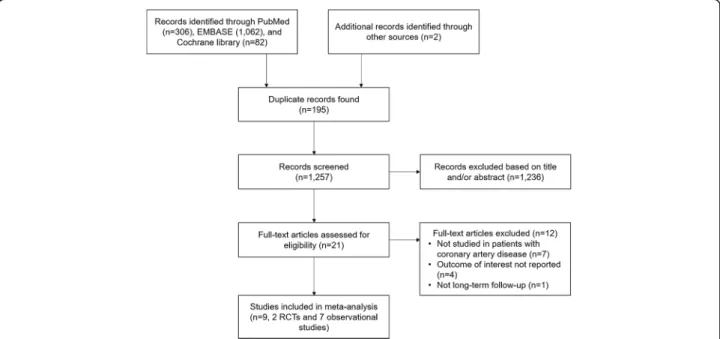
The literature search yielded 1452 citations of which 21 were retained for full-text review (Fig. 1). We subse-quently excluded 12 studies, of which 7 studies did not specify patients with CAD, and 4 studies did not report on the outcomes of interest, and 1 study had less than 1-year follow-up.
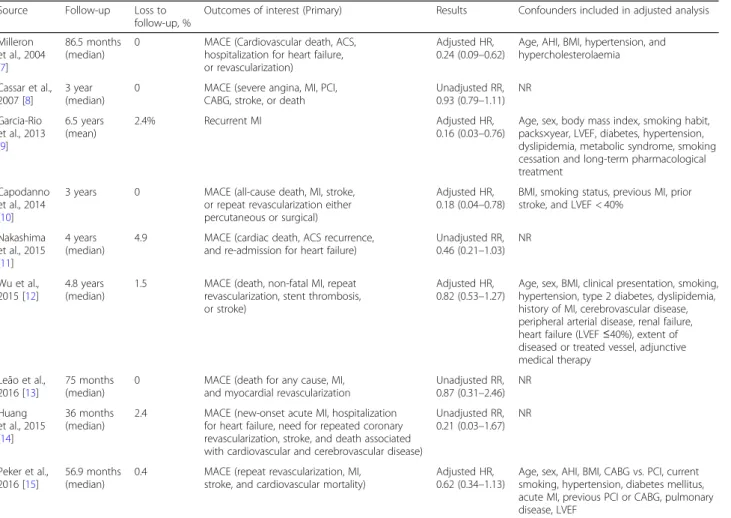
Finally, a total of 9 studies [7–15] with 1430 participants were included in this meta-analysis. Study characteristics are listed in Tables1and2. Seven studies were prospect-ive cohort [7, 9–11, 13], 2 studies were retrospective cohort [8, 12], and 2 studies were RCTs [14, 15]. All studies enrolled patients with CAD and OSA. OSA was assessed primarily by overnight polysomnography in 7 studies [7–9, 11, 12, 14, 15], and by validated portable diagnostic devices in 2 studies [10,13]. The definition of OSA was based on standardized assessment of apnea-hypopnea index (AHI) in all studies, with AHI≥15 as cut-off value in most studies [7,8,10,12,14,15]. In 2 studies, either CPAP (84% to 98%) or upper airway surgery (2% to 16%) was used, and effect measures were assessed for the entire modality [7, 8], whereas patients were exclusively treated with CPAP in others studies. Two retrospective cohort identified those who refused CPAP therapy or were not adherent to CPAP as untreated group [8,12], whereas the others considered all patients receiving CPAP as being treated regardless of adherence. CPAP adherence data were available in 2 cohort studies [7, 9] (5.7 h [7] and 6. 1 h [9] per night) and in 2 RCTs (4.5 h per night in Huang’s study [14] and 4.4 to 6.9 h per night during 6 years follow-up in Peker’s study [15]).
The median duration of follow-up was from 36 months to 86.5 months, and a small proportion of patients were lost to follow-up (up to 4.9%). Most of the studies reported adjusted risk estimates for the primary end-point except 3 cohort studies [8,11,13] and 1 RCT [14], thus contributing to potential bias.
The 2 RCTs were open-label study and did not include blinding of participants and personnel to the intervention, but all did blinded assessment of cardiovascular outcomes [14,15] (Additional file1: Table S2). All the observational studies except 1 retrospective cohort [8] showed moderate-to-high quality (Newcastle-Ottawa Scale score >
6) (Additional file1: Table S3).
Association of CPAP with MACE
Eight studies (6 observational studies and 2 RCTs) with 1307 patients reported outcome of MACE. Treatment with CPAP was associated with a significantly lower risk of MACE in 6 observational studies (RR 0.61, 95% CI: 0. 39–0.94, P = 0.02). However, this result was not con-firmed in 2 RCTs (RR 0.57, 95% CI: 0.32–1.02, P= 0.06) (Fig. 2). There was evidence of statistical heterogeneity for the composite endpoint in the observational studies (Q statisticP= 0.01; I2= 66%). We further did subgroup analysis and showed that the decreased risk of MACE remained significant in 4 prospective cohort studies (RR 0.39, 95% CI: 0.21–0.74, P = 0.003; I2 = 34%), but was not significant in 2 retrospective cohort studies (RR 0. 92, 95% CI: 0.78–1.07, P = 0.29; I2 = 0%), and the heterogeneity was attenuated in both subgroups (Additional file1: Figure S1).
Association of CPAP with all-cause and cardiovascular death
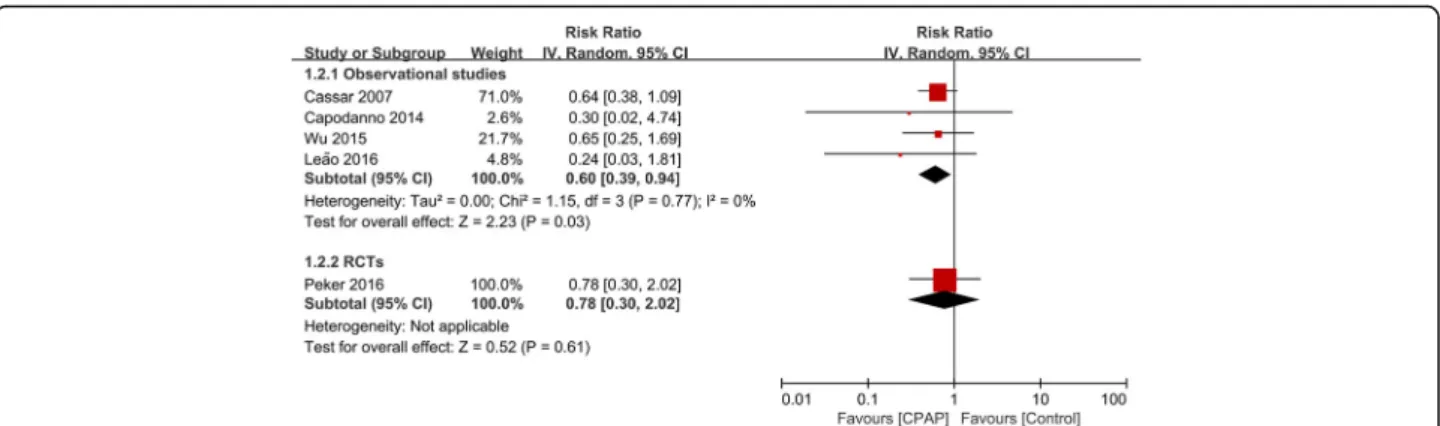
There were 5 studies (1080 participants) that reported outcomes of all-cause death. CPAP significantly reduced the risk of all-cause death in 4 observational studies (RR 0.60, 95% CI 0.39–0.94, P = 0.03; I2 = 0%). However, the only RCT did not show significant risk reduction (RR 0.78, 95% CI 0.30–2.02, P = 0.61) (Fig. 3).
Cardiovascular death was evaluated in 5 studies with 866 participants. Similarly, CPAP therapy signifi-cantly reduced the risk of cardiovascular death in 3 observational studies (RR 0.28, 95% CI 0.12–0.68, I2 = 0%), which were also not reproduced in 2 RCTs (RR 0.41, 95% CI 0.12–1.41, I2= 0%) (Fig. 4).
Association of CPAP with individual cardiovascular events
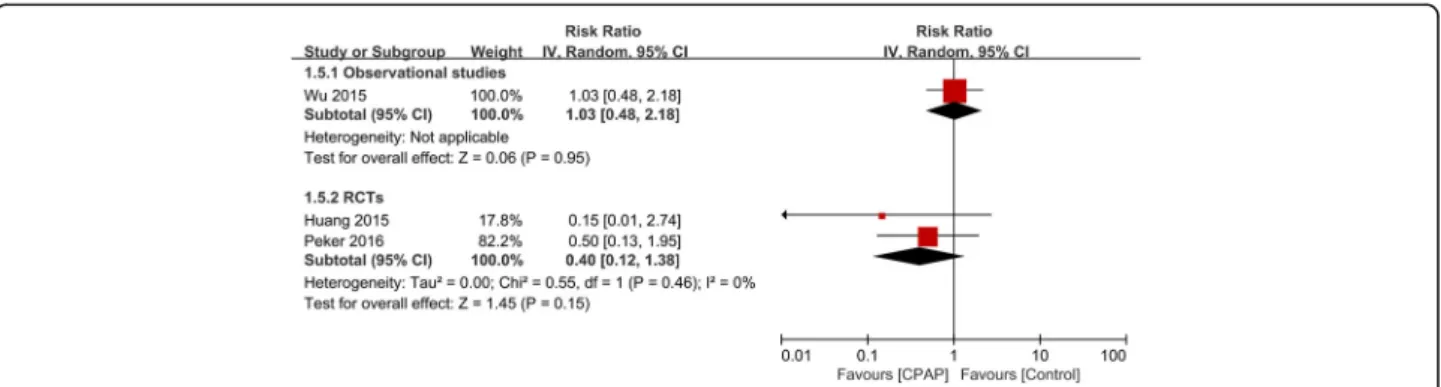
We also evaluated the effect of CPAP on outcomes of MI in 5 studies (3 observational and 2 RCTs; 781 par-ticipants), stroke in 3 studies (1 observational and 2 RCTs; 612 participants), and repeat revascularization in
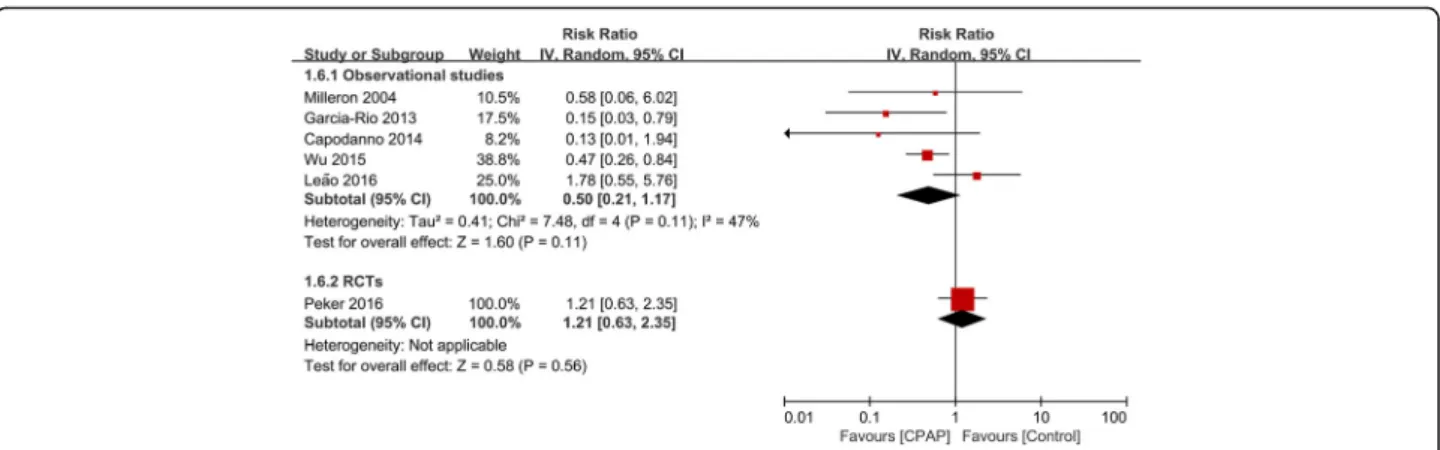
6 studies (5 observational and 1 RCTs; 886 partici-pants). There was no association of CPAP with all indi-vidual cardiovascular events in both observational studies and RCTs (Figs.5,6, and7).
Discussion
In the present meta-analysis, the associations of CPAP use with risk reduction of composite cardiovascular events, all-cause and cardiovascular death in patients with concomitant CAD and OSA were only demon-strated in observational studies, but not RCTs. There were also no significant associations between CPAP treatment with individual cardiovascular outcomes. Based on these results, there is still no clear evidence to prescribe CPAP with the purpose of preventing future cardiovascular events in patients with OSA and established CAD.
OSA was linked to a series of cardiovascular risk factors and outcomes. CPAP is effective in reversing upper airway obstruction and hypoxemia. Randomized trials have demonstrated that CPAP treatment improves cardiovascular surrogate endpoints, such as blood
Table 1Study design and clinical characteristics of included studies
Source Study design, location, years Number of participants Main inclusion criteria Mean age (Years)
Male (%) Mean BMI
(kg/m2) Mean AHI(events/h) Mean ESS(points) OSA assessment
Milleron et al., 2004 [7]
Prospective cohort, single-center in France, 1991–1999
54 AHI≥15 57.3 98.1 28.3 31.2 NR Polysomnography
Cassar et al., 2007 [8]
Retrospective cohort, single-center in US, 1992–2004
371 AHI≥15 64.0 87.6 34.1 44.2 NR Polysomnography
Garcia-Rio et al., 2013 [9]
Prospective cohort, single-center in Spain, 2003–2005
123 AHI≥5 58.0 86.2 27.3 21.7 8.5 Polysomnography
Capodanno et al., 2014 [10]
Prospective cohort, single-center in Italy, 2008
129 AHI≥15 68.3 80.6 27.3 22.4 7 Portable diagnostic device
Nakashima et al., 2015 [11]
Prospective cohort, single-center in Japan, 2003–2009
95 AHI≥20 71.0a 77.0a NR NR NR Polysomnography
Wu et al., 2015 [12]
Retrospective cohort, single-center in China, 2002–2012
295 AHI≥15 55.1 84.4 29.7 42.8 NR Polysomnography 72.1%, Portable diagnostic device 27.9%
Leão et al., 2016 [13]
Prospective cohort, single-center in Portugal, NR
46 AHI≥5 63.5 82.6 27.8 30.6 8.8 Portable diagnostic device
Huang et al., 2015 [14]
RCT, parallel, single-center in China, 2009–2012
73 AHI≥15, ESS < 15
62.4 82.2 27.7 28.5 8.8 Polysomnography
Peker et al., 2016 [15]
RCT, parallel,
single-center in Sweden, 2005–2010
244 AHI≥15, ESS < 10
66.0 84.1 28.5 28.8 5.5 Polysomnography
AHIapnea-hypopnea index,BMIbody mass index,ESSEpworth Sleepiness Scale,NRnot reported,OSAobstructive sleep apnea,RCTrandomized controlled trial
a
Table 2Study groups, outcomes, results, and risk of bias
Source Follow-up Loss to follow-up, %
Outcomes of interest (Primary) Results Confounders included in adjusted analysis Milleron
et al., 2004 [7]
86.5 months (median)
0 MACE (Cardiovascular death, ACS, hospitalization for heart failure, or revascularization)
Adjusted HR, 0.24 (0.09–0.62)
Age, AHI, BMI, hypertension, and hypercholesterolaemia Cassar et al.,
2007 [8]
3 year (median)
0 MACE (severe angina, MI, PCI, CABG, stroke, or death
Unadjusted RR, 0.93 (0.79–1.11)
NR Garcia-Rio
et al., 2013 [9]
6.5 years (mean)
2.4% Recurrent MI Adjusted HR, 0.16 (0.03–0.76)
Age, sex, body mass index, smoking habit, packs×year, LVEF, diabetes, hypertension, dyslipidemia, metabolic syndrome, smoking cessation and long-term pharmacological treatment
Capodanno et al., 2014 [10]
3 years 0 MACE (all-cause death, MI, stroke, or repeat revascularization either percutaneous or surgical)
Adjusted HR, 0.18 (0.04–0.78)
BMI, smoking status, previous MI, prior stroke, and LVEF < 40%
Nakashima et al., 2015 [11]
4 years (median)
4.9 MACE (cardiac death, ACS recurrence, and re-admission for heart failure)
Unadjusted RR, 0.46 (0.21–1.03)
NR
Wu et al., 2015 [12]
4.8 years (median)
1.5 MACE (death, non-fatal MI, repeat revascularization, stent thrombosis, or stroke)
Adjusted HR, 0.82 (0.53–1.27)
Age, sex, BMI, clinical presentation, smoking, hypertension, type 2 diabetes, dyslipidemia, history of MI, cerebrovascular disease, peripheral arterial disease, renal failure, heart failure (LVEF≤40%), extent of diseased or treated vessel, adjunctive medical therapy
Leão et al., 2016 [13]
75 months (median)
0 MACE (death for any cause, MI, and myocardial revascularization
Unadjusted RR, 0.87 (0.31–2.46)
NR Huang
et al., 2015 [14]
36 months (median)
2.4 MACE (new-onset acute MI, hospitalization for heart failure, need for repeated coronary revascularization, stroke, and death associated with cardiovascular and cerebrovascular disease)
Unadjusted RR, 0.21 (0.03–1.67)
NR
Peker et al., 2016 [15]
56.9 months (median)
0.4 MACE (repeat revascularization, MI, stroke, and cardiovascular mortality)
Adjusted HR, 0.62 (0.34–1.13)
Age, sex, AHI, BMI, CABG vs. PCI, current smoking, hypertension, diabetes mellitus, acute MI, previous PCI or CABG, pulmonary disease, LVEF
ACSindicates acute coronary syndrome,AHIapnea-hypopnea index,BMIbody mass index,CABGcoronary artery bypass graft,CPAPcontinuous positive airway pressure,HRhazard ratio,LVEFleft ventricular ejection fraction,MACEmajor adverse cardiovascular events,MImyocardial infarction,NRnot reported,
PCIpercutaneous coronary intervention,RRrisk ratio
pressure [14,19] and insulin resistance [20]. However, in the trials evaluating MACE, no significant beneficial effects of CPAP were shown in patients with OSA [15, 21,22]. In the most recently SAVE (Sleep Apnea Cardio-vascular Endpoints) trial that randomized 2717 partici-pants with coronary or cerebrovascular disease and moderate-to-severe OSA, CPAP did not result in a lower rate of the composite cardiovascular events at a median follow-up of 3.7 years [21]. Furthermore, several meta-analyses of randomized trials also showed no effect of CPAP therapy on MACE for OSA with or without cardiovascular morbidities [23–25]. However, the study populations of included studies are diverse, from general population to patients with severe CAD (such as MI), thus precluding definitive conclusions.
To the best of our knowledge, the present meta-analysis is the first attempt to focus on a relatively homogenous group of patients with established CAD. Our findings suggested adding CPAP as a secondary pre-vention for patients with CAD and concomitant OSA might be beneficial in the long-term follow-up, but this was only shown in observational studies, and not verified
in RCTs. The enrolled studies in the prospective and retrospective cohorts were usually conducted more than 10 years ago and had a wide range of follow-up, there-fore they do not represent contemporary medical and interventional therapy. Also, the results could be under-powered due to a relatively small sample size and varia-tions in study populavaria-tions and definivaria-tions of events. The negative results of RCTs were mainly derived from the RICCADSA (Randomized Intervention With CPAP in Coronary Artery Disease and Sleep Apnea) trial, which enrolled 224 patients with OSA and revascularized CAD. There is no significant difference in the composite endpoint of repeat revascularization, MI, stroke, or cardiovascular death between CPAP and untreated OSA patients [15]. It should be noted that CPAP therapy tended to be associated with a reduced risk of MACE in the 2 RCTs (RR 0.57, 95% CI: 0.32–1.02), although there was no significant difference. Due to the small number of included RCTs, this result should be interpreted with caution. In the RICCADSA trial, adjusted on-treatment analysis exhibited better outcomes among patients who were adherent to CPAP therapy (≥4 h per night). In
Fig. 3Forest plot of the risk estimates for all-cause death in patients treated with continuous positive airway pressure (CPAP) compared to control
addition, patients in the RICCADSA trial were heteroge-neous with variable risk profiles, including both percutaneous coronary intervention (PCI) and CABG, and both acute or elective PCI, thus attenuating the anticipated treatment effect. In case of second preven-tion of CAD patients, the treatment effects of CPAP are still needed to be evaluated in a high-risk group with homogenous CAD populations (ACS, MI, or PCI, etc.).
In the contemporary era, with the extensive use of lipid-lowering and blood pressure lowering agents, antiplatelet therapy, and drug-eluting stents, treat-ment of OSA with CPAP might not add more bene-fits for CAD patients based on current evidence. As OSA is highly prevalent and is associated with sub-sequent cardiovascular risk, we should still pay more attention to this condition when assessing patients with CAD in clinical practice. Whether increased compliance to CPAP or novel treatment options can lead to better cardiovascular outcomes needs further investigation.
Study limitations
First, we observed significant statistical heterogeneity in the outcome measure of MACE in the observational
studies, which could be partly explained by different study design, small sample size, and study quality according to whether adjustment for confounders was performed. We did subgroup analysis based on prospect-ive or retrospectprospect-ive cohorts, and the heterogeneity was attenuated in both subgroups. Second, the study popula-tion varies across studies, from general CAD patients to MI with or without revascularization (PCI or CABG). The treatment effects of CPAP need to be further investigated in more homogenous patients. Third, there are significant differences in the definitions of the use and adherence of CPAP, which could impact the treat-ment effects compared to the control group. Fourth, there are not enough studies (less than 10) to test for publication bias for the primary endpoint. Fifth, the risk estimates of individual cardiovascular events could be underpowered due to a small number of included studies and variations in events definition.
Conclusions
Compared to standard therapy alone, the use of CPAP in patients with OSA and concomitant CAD was associated with a reduced risk of major cardiovascular
Fig. 5Forest plot of the risk estimates for myocardial infarction in patients treated with continuous positive airway pressure (CPAP) compared to control
events, all-cause and cardiovascular mortality, which was only observed in observational studies, but not in RCTs. There is a need for large-scale RCTs to further explore the value of CPAP therapy as a second preven-tion in a high-risk and homogenous CAD populapreven-tion.
Additional file
Additional file 1:Supplemental Material. (DOCX 353 kb)
Abbreviations
ACS:Acute coronary syndrome; AHI: Apnea-hypopnea index; AMI: Acute myocardial infarction; BMI: Body mass index; CABG: Coronary artery bypass grafting; CAD: Coronary artery disease; CI: Confidence interval;
CPAP: Continuous positive airway pressure; HR: Hazard ratio; MACE: Major adverse cardiovascular event; MI: Myocardial infarction; NR: Not reported; OSA: Obstructive sleep apnea; PCI: Percutaneous coronary intervention; PRISMA: Preferred Reporting Items for Systematic Review and Meta-Analysis; RCTs: Randomized controlled trials; RICCADSA: Randomized Intervention With CPAP in Coronary Artery Disease and Sleep Apnea; RR: Risk ratio; SAVE: Sleep Apnea Cardiovascular Endpoints; STEMI: ST-segment elevation myocardial infarction
Acknowledgements
Not applicable.
Funding
This study was funded by grants from International Science & Technology Cooperation Program of China (2015DFA30160), Beijing Municipal Science & Technology Commission (Z141100006014057), National Natural Science Foundation of China (81600209), Beijing Municipal Administration of Hospitals’ Youth Program (QML20160605), Beijing Municipal Administration of Hospitals Incubating Program (PX2016048), and Beijing Municipal Organization Department (2016000021469G194).
Availability of data and materials
Data are available from the authors upon request.
Authors’contributions
SN and YW conceived the study. XW, SN, and YW designed the study. XW, YZ, and SN conducted the literature search and data extraction. XW and YZ performed the meta-analysis. XW, YZ, ZD, and JF interpreted the data. XW and YZ wrote the draft of the manuscript, and all authors critically revised the manuscript and approved the final manuscript.
Ethics approval and consent to participate
Not applicable.
Consent for publication
Not applicable.
Competing interests
The authors declare that they have no competing interests.
Publisher’s Note
Springer Nature remains neutral with regard to jurisdictional claims in published maps and institutional affiliations.
Author details
1
Emergency & Critical Care Center, Beijing Anzhen Hospital, Capital Medical University, 2 Anzhen Road, Chaoyang District, Beijing 100029, China.
2Cardiovascular Center, Beijing Tongren Hospital, Capital Medical University,
Beijing, China.3Department of Otolaryngology Head & Neck Surgery, Beijing
Anzhen Hospital, Capital Medical University, 2 Anzhen Road, Chaoyang District, Beijing 100029, China.
Received: 11 December 2017 Accepted: 27 March 2018
References
1. Javaheri S, Barbe F, Campos-Rodriguez F, Dempsey JA, Khayat R, Javaheri S, et al. Sleep apnea: types, mechanisms, and clinical cardiovascular consequences. J Am Coll Cardiol. 2017;69(7):841–58.
2. Lee CH, Sethi R, Li R, Ho HH, Hein T, Jim MH, et al. Obstructive sleep apnea and cardiovascular events after percutaneous coronary intervention. Circulation. 2016;133(21):2008–17.
3. Xie J, Sert Kuniyoshi FH, Covassin N, Singh P, Gami AS, Wang S, et al. Nocturnal hypoxemia due to obstructive sleep apnea is an independent predictor of poor prognosis after myocardial infarction. J Am Heart Assoc. 2016;5(8):e003162.
4. Mazaki T, Kasai T, Yokoi H, Kuramitsu S, Yamaji K, Morinaga T, et al. Impact of sleep-disordered breathing on long-term outcomes in patients with acute coronary syndrome who have undergone primary percutaneous coronary intervention. J Am Heart Assoc. 2016;5(6):e003270. 5. Lee CH, Khoo SM, Chan MY, Wong HB, Low AF, Phua QH, et al. Severe
obstructive sleep apnea and outcomes following myocardial infarction. J Clin Sleep Med. 2011;7(6):616–21.
6. Yumino D, Tsurumi Y, Takagi A, Suzuki K, Kasanuki H. Impact of obstructive sleep apnea on clinical and angiographic outcomes following percutaneous coronary intervention in patients with acute coronary syndrome. Am J Cardiol. 2007;99(1):26–30.
7. Milleron O, Pilliere R, Foucher A, de Roquefeuil F, Aegerter P, Jondeau G, et al. Benefits of obstructive sleep apnoea treatment in coronary artery disease: a long-term follow-up study. Eur Heart J. 2004;25(9):728–34.
9. Garcia-Rio F, Alonso-Fernandez A, Armada E, Mediano O, Lores V, Rojo B, et al. CPAP effect on recurrent episodes in patients with sleep apnea and myocardial infarction. Int J Cardiol. 2013;168(2):1328–35.
10. Capodanno D, Milazzo G, Cumbo M, Marchese A, Salemi A, Quartarone L, et al. Positive airway pressure in patients with coronary artery disease and obstructive sleep apnea syndrome. J Cardiovasc Med (Hagerstown). 2014;15(5):402–6.
11. Nakashima H, Kurobe M, Minami K, Furudono S, Uchida Y, Amenomori K, et al. Effects of moderate-to-severe obstructive sleep apnea on the clinical manifestations of plaque vulnerability and the progression of coronary atherosclerosis in patients with acute coronary syndrome. Eur Heart J Acute Cardiovasc Care. 2015;4(1):75–84.
12. Wu X, Lv S, Yu X, Yao L, Mokhlesi B, Wei Y. Treatment of OSA reduces the risk of repeat revascularization after percutaneous coronary intervention. Chest. 2015;147(3):708–18.
13. Leao S, Conde B, Fontes P, Calvo T, Afonso A, Moreira I. Effect of obstructive sleep apnea in acute coronary syndrome. Am J Cardiol. 2016;117(7):1084–7. 14. Huang Z, Liu Z, Luo Q, Zhao Q, Zhao Z, Ma X, et al. Long-term effects of
continuous positive airway pressure on blood pressure and prognosis in hypertensive patients with coronary heart disease and obstructive sleep apnea: a randomized controlled trial. Am J Hypertens. 2015;28(3):300–6. 15. Peker Y, Glantz H, Eulenburg C, Wegscheider K, Herlitz J, Thunstrom E. Effect
of positive airway pressure on cardiovascular outcomes in coronary artery disease patients with nonsleepy obstructive sleep apnea. The RICCADSA randomized controlled trial. Am J Respir Crit Care Med. 2016;194(5):613–20. 16. Moher D, Liberati A, Tetzlaff J, Altman DG, Group P. Preferred reporting
items for systematic reviews and meta-analyses: the PRISMA statement. BMJ. 2009;339:b2535.
17. Higgins JPT, Green S, editors. Cochrane Handbook for Systematic Reviews of Interventions Version 5.1.0 [updated March 2011]. London: The Cochrane Collaboration; 2011. Available fromhttp://handbook.cochrane.org. 18. Wells G, Shea B, O’Connell D, Peterson J, Welch V, Losos M, et al. The
Newcastle-Ottawa Scale (NOS) for assessing the quality of nonrandomised studies in meta-analyses.http://www.ohri.ca/programs/clinical_ epidemiology/oxford.asp.
19. Martinez-Garcia MA, Capote F, Campos-Rodriguez F, Lloberes P, Diaz de Atauri MJ, Somoza M, et al. Effect of CPAP on blood pressure in patients with obstructive sleep apnea and resistant hypertension: the HIPARCO randomized clinical trial. JAMA. 2013;310(22):2407–15.
20. Martinez-Ceron E, Barquiel B, Bezos AM, Casitas R, Galera R, Garcia-Benito C, et al. Effect of continuous positive airway pressure on glycemic control in patients with obstructive sleep apnea and type 2 diabetes. A randomized clinical trial. Am J Respir Crit Care Med. 2016;194(4):476–85.
21. McEvoy RD, Antic NA, Heeley E, Luo Y, Ou Q, Zhang X, et al. CPAP for prevention of cardiovascular events in obstructive sleep apnea. N Engl J Med. 2016;375(10):919–31.
22. Barbe F, Duran-Cantolla J, Sanchez-de-la-Torre M, Martinez-Alonso M, Carmona C, Barcelo A, et al. Effect of continuous positive airway pressure on the incidence of hypertension and cardiovascular events in nonsleepy patients with obstructive sleep apnea: a randomized controlled trial. JAMA. 2012;307(20):2161–8.
23. Yu J, Zhou Z, McEvoy RD, Anderson CS, Rodgers A, Perkovic V, et al. Association of positive airway pressure with cardiovascular events and death in adults with sleep apnea: a systematic review and meta-analysis. JAMA. 2017;318(2):156–66.
24. Abuzaid AS, Al Ashry HS, Elbadawi A, Ld H, Saad M, Elgendy IY, et al. Meta-analysis of cardiovascular outcomes with continuous positive airway pressure therapy in patients with obstructive sleep apnea. Am J Cardiol. 2017;120(4):693–9.
25. Guo J, Sun Y, Xue LJ, Huang ZY, Wang YS, Zhang L, et al. Effect of CPAP therapy on cardiovascular events and mortality in patients with obstructive
sleep apnea: a meta-analysis. Sleep Breath. 2016;20(3):965–74. • We accept pre-submission inquiries
• Our selector tool helps you to find the most relevant journal • We provide round the clock customer support
• Convenient online submission • Thorough peer review
• Inclusion in PubMed and all major indexing services • Maximum visibility for your research
Submit your manuscript at www.biomedcentral.com/submit