International Journal of Emerging Technology and Advanced Engineering
Website: www.ijetae.com (ISSN 2250-2459, ISO 9001:2008 Certified Journal, Volume 6, Issue 9, September 2016)
Factors Affecting Quality in Construction
K. S. Shobana
1, D. Ambika
2 1PG Scholar, 2Assistant Professor, Department of Civil Engineering, Kongu Engineering College, Erode, India.
Abstract— Development of construction industry plays an important role in the development of any country. It depends on the quality of construction industry. Quality is one of the critical factors in the success of construction projects. The level of success of construction industry greatly depends on the quality performance. Improving quality in construction is one of the important tasks which need to be performed immediately. This research is carried out to identify the factors that have adverse effect on the construction projects. A questionnaire was developed based on identified factors which is taken based on literatures to take opinion from construction experts. The construction experts who have given their responses are engineers and the site supervisors. After their feedback a statistical analysis tool has been used to analyse the responses collected from the construction experts. The analyses used here are mean, variance, reliability and rotated component matrix which has done using SPSS (Statistical Package for Social Science). Using these analyses the most significant factors that affect quality in construction can be ranked. These ranked factors can be improved to attain good quality in construction.
Keywords — Quality, SPSS, Questionnaire, Experts.
I. INTRODUCTION
The definition of quality depends on the point of view of the people defining it; some view it as conformance to specification. Some view it as performance to standards or value paid for the price. For construction projects quality is nothing but the satisfaction of customers and fulfilling of their requirements within a specified budget. [4] Quality is involved in every stage and every aspect of construction.[17] Construction projects and quality are inseparable parts of each other. The modern construction world requires construction companies to guaranty the quality of their product to their clients. [5]. The quality is a key function in all infrastructure development environment like cost and time.[14] It becomes one of the vital factors in any construction project. In construction projects lack of quality results in delays, cost overrun and unsafe structure. [13]. Quality is one of the critical factors in the success of construction projects. Quality of construction projects and project success, can be regarded as the fulfilment of expectations (i.e. the satisfaction) of the project participants.[1] The construction industry in India has been struggling with quality issues for many years.[9] A significant amount of the budget is spent each year on infrastructure and other development projects. The quality outcomes of the projects are not according to required standards, faulty construction takes place.
Consequently additional efforts are required for removal of defects and maintenance work. [6].
II. STATEMENT OF RESEARCHERS
Dr. Abdulsalam Zidan(2013), briefs his research on factors affecting design quality in construction. Poor design is the main factor that reduces the overall performance of the construction project. The main factors are insufficient overall design time, method of selecting the designer, lowest price offer, lack of documentation and changes in client requirements.[2]
Adnan Enshassi, Sherif Mohamed et al, (2009), The objective of this paper is to identify the factors affecting the performance of local construction projects; and their relative importance. The most important factors agreed by the owners, consultants, and contractors as the main factors affecting the performance of construction projects were: material prices, availability of resources as planned through project duration, average delay because of closures leading to materials shortage, availability of personnel with a high experience and qualifications, quality of equipment and raw materials in project and Leadership skills for project managers.[3]
David arditi and H. Murat gunaydin (1998), These people carried out a study to identify the factors that affect process quality. Generic factors that affect process quality are, management Commitment to continuous quality improvement, management leadership in promoting high process quality, quality training of all personnel, efficient teamwork to promote quality issues at the corporate level, and effective cooperation between parties taking part in the project. Industry specific factors are, Drawings and specifications that are consistent, designers and contractors that are selected on merit, communication practices between the parties that are effective and Inspection of quality on the construction site.[8]
John E. Shively (1990), this study is carried out to identify the specific actions that firms take to ensure quality in their organizations. From the study it is identified that the firms taking more care in the following areas for assuring the quality are, Goals and Objectives, Organizational Structure, Public Relations Practices, Office Environment and Technical Sources, professional and technical staff, Professional Development and Employee Advancement.[10]
International Journal of Emerging Technology and Advanced Engineering
Website: www.ijetae.com (ISSN 2250-2459, ISO 9001:2008 Certified Journal, Volume 6, Issue 9, September 2016) From the study the critical success factors obtained
were: project manager’s competence; top management’s support; monitoring and feedback by project participants; interaction among project participants; and owners’ competence. The factors that adversely affected the quality performances of projects were: conflict among project participants; hostile socio-economic environment; harsh climatic condition; PM’s ignorance & lack of knowledge; faulty project conceptualization; and aggressive competition during tendering.[11]
III. OBJECTIVE OF THE STUDY
The main objective of the research is to study and analyse the factors influencing quality in construction and to achieve good quality construction.
IV. METHODOLOGY
Various literatures related to the research are reviewed. Based on the review, the factors affecting quality are identified which helps to frame a questionnaire. Questionnaire survey is conducted among civil engineers of various companies and these survey responses are analysed using SPSS software.
V. IDENTIFIED FACTORS
From various reviews several quality affecting factors are identified which becomes the base to frame the questionnaire. The identified factors are,
Design codes & standards, Financial issues,
Customer satisfaction, Planning and scheduling, Materials and equipments, Human resources, Coordination, Inspection, Risk,
Method of execution and Type of organization.
VI. QUESTIONNAIRE DESIGN
A questionnaire is a research instrument consisting of a series of questions and other prompts for the purpose of gathering information from respondents. The respondents were asked to give their responses against a five-point Likert scale. The typical form of this scale is to ask participants to specify their level of agreement or disagreement with a statement. Another version used in the research was a Likertscale as
1. Strongly Disagree 2. Disagree
3. Moderate 4. Agree
5. Strongly Agree
The Likert scale has proven to be very useful in measuring whether people have a positive or negative attitude towards an object or a statement, and is therefore suitable for this study.
VII. DATA COLLECTION
The designed questionnaire is surveyed among 150 engineers out of which 139 responses were received. Therefore the response rate is 93%. The collected responses from questionnaire survey were subjected to statistical analysis using SPSS software and the results were obtained and conclusions were drawn out of it.
VIII. DATA ANALYSIS
A. Reliability analysis
The data were collected independently from respondents from different organizations. So it is important to check the validity and reliability of collected data. Cronbach's alpha is the most common measure of reliability. It is commonly used when multiple Likert questions is in a questionnaire. For this reason a reliability test was conducted using SPSS software. Table I shows the reliability of data. As the value of alpha is 0.880, so data is highly reliable.
B. Principal Component Analysis
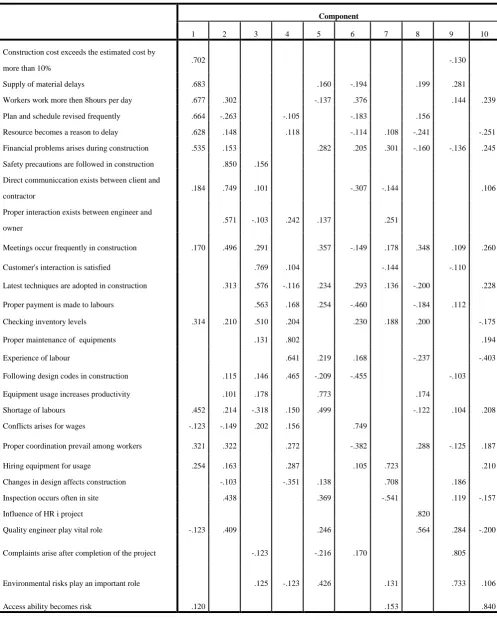
Principal components analysis (PCA) is a variable-reduction technique that has many similarities for factor analysis. Its aim is to reduce a larger set of variables into a smaller set of variables, which account for most of the variance in the original variables. Rotated component matrix is one form of principal component analysis. Rotated component matrix shows how attitudes are interrelated to each other. It is a variable reduction technique. Here the observed variables are divided into group of smaller variables called components. It reduces time to analyse the variables in the questionnaire. Table II shows the rotated component matrix for the responses.
TABLE I
RELIABILITY STATISTICS
Cronbach's Alpha Cronbach's Alpha
Based on Standardized
Items
N of
Items
International Journal of Emerging Technology and Advanced Engineering
[image:3.595.48.546.157.777.2]Website: www.ijetae.com (ISSN 2250-2459, ISO 9001:2008 Certified Journal, Volume 6, Issue 9, September 2016)
TABLE II
ROTATED COMPONENT MATRIX
Component
1 2 3 4 5 6 7 8 9 10
Construction cost exceeds the estimated cost by
more than 10%
.702 -.130
Supply of material delays .683 .160 -.194 .199 .281
Workers work more then 8hours per day .677 .302 -.137 .376 .144 .239
Plan and schedule revised frequently .664 -.263 -.105 -.183 .156
Resource becomes a reason to delay .628 .148 .118 -.114 .108 -.241 -.251
Financial problems arises during construction .535 .153 .282 .205 .301 -.160 -.136 .245
Safety precautions are followed in construction .850 .156
Direct communiccation exists between client and
contractor
.184 .749 .101 -.307 -.144 .106
Proper interaction exists between engineer and
owner
.571 -.103 .242 .137 .251
Meetings occur frequently in construction .170 .496 .291 .357 -.149 .178 .348 .109 .260
Customer's interaction is satisfied .769 .104 -.144 -.110
Latest techniques are adopted in construction .313 .576 -.116 .234 .293 .136 -.200 .228
Proper payment is made to labours .563 .168 .254 -.460 -.184 .112
Checking inventory levels .314 .210 .510 .204 .230 .188 .200 -.175
Proper maintenance of equipments .131 .802 .194
Experience of labour .641 .219 .168 -.237 -.403
Following design codes in construction .115 .146 .465 -.209 -.455 -.103
Equipment usage increases productivity .101 .178 .773 .174
Shortage of labours .452 .214 -.318 .150 .499 -.122 .104 .208
Conflicts arises for wages -.123 -.149 .202 .156 .749
Proper coordination prevail among workers .321 .322 .272 -.382 .288 -.125 .187
Hiring equipment for usage .254 .163 .287 .105 .723 .210
Changes in design affects construction -.103 -.351 .138 .708 .186
Inspection occurs often in site .438 .369 -.541 .119 -.157
Influence of HR i project .820
Quality engineer play vital role -.123 .409 .246 .564 .284 -.200
Complaints arise after completion of the project -.123 -.216 .170 .805
Environmental risks play an important role .125 -.123 .426 .131 .733 .106
International Journal of Emerging Technology and Advanced Engineering
Website: www.ijetae.com (ISSN 2250-2459, ISO 9001:2008 Certified Journal, Volume 6, Issue 9, September 2016)
IX. QUALITY INFLUENCING FACTORS
Based on the values of rotated component matrix, the variables are divided as ten categories. These ten variables are categorized as seven categories relevantly according to their sub categories. The seven major categories are
1. Resources.
2. Interaction and communication. 3. Inventory and payment. 4. Standards and experience. 5. Labours.
6. Inspection and monitoring. 7. Quality and risk
A. Resources
[image:4.595.352.515.237.366.2]Resources are the important source in construction. Resources generally include materials, manpower, money and machinery. Based on these resources questionnaire is framed. The analysis of the responses for the resources is mentioned in Fig 1.
Fig 1. Responses for Resources
B. Interaction and Communication
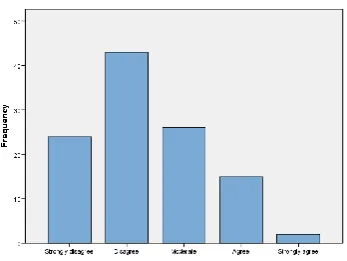
Interaction is required between engineer, owner and contractor to complete the work effectively. Interaction and communication in this research includes safety precautions, occurrence of weekly meetings, interaction between owner and engineers. The frequency distribution of respondents for this category is shown in Fig 2.
Fig 2. Responses for interaction & communication
C. Inventory and Payment
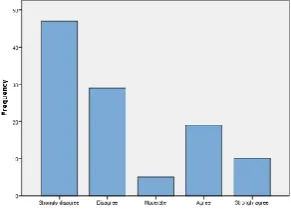
[image:4.595.77.255.380.520.2]Inventory is required to be managed in order to maintain the stock level of resources. The level of success of construction depends mostly on materials and manpower. Proper payment to workers makes them to work continuously. Regarding these factors questionnaire is discussed. Fig 3 describes the frequency distribution of the respondents for this factor.
Fig 3. Responses for inventory & Payment
D. Standards and Experience
Standards and experience include the codal provision references for construction and the experience of the labours. Based on the experience of the worker, the standard of the work may vary. From the opinion of the experts, the frequency distribution is given in Fig 4.
Fig 4. Responses for standards & experience
E. Labours
[image:4.595.351.516.465.595.2] [image:4.595.79.253.621.751.2]International Journal of Emerging Technology and Advanced Engineering
[image:5.595.74.259.142.288.2]Website: www.ijetae.com (ISSN 2250-2459, ISO 9001:2008 Certified Journal, Volume 6, Issue 9, September 2016)
Fig 5.Responses for Labours
F. Inspection and Monitoring
Inspection and monitoring is done for all type of works to get the perfect output. Similarly good quality construction is achieved only by means of proper inspection and monitoring. The frequency distribution of responses for inspection and monitoring is given in Fig 6.
Fig 6. Responses for Inspection & Monitoring
G. Quality and Risks
[image:5.595.92.238.379.488.2]Risk is one of the major factors affecting quality. Risk may be at different areas such as environmental, transportation, procurement, material handling, etc. All these risks need to be over taken in order to achieve best output. Fig 7 describes the frequency distribution of the respondents.
Fig 7. Responses for Quality & Risks
X. RESULTS AND DISCUSSION
The earlier chart graph revealed that the most affecting factors the affect are resources, interaction & communication, inventory and payment, standards and experience, labours, quality and risk, inspection & monitoring. The mean value for all these factors are analysed and these values are ranked. This value gives the order of the major and song thet affects the quality in construction.
TABLE III
RANKING MEAN VALUES
S.No Factors Mean value Rank
1 Resources 3.28 3
2 Interaction & Communication 2.35 5
3 Inventory & Payment 2.25 7
4 Standards & experience 2.43 4
5 Labours 3.68 1
6 Inspection & Monitoring 2.24 6
7 Quality & Risks 3.34 2
XI. CONCLUSION
[image:5.595.91.242.597.708.2]International Journal of Emerging Technology and Advanced Engineering
Website: www.ijetae.com (ISSN 2250-2459, ISO 9001:2008 Certified Journal, Volume 6, Issue 9, September 2016) XII. RECOMMENDATIONS
The following recommendations are made based on the results and discussions of the study. These recommendations are very helpful to attain the best quality in construction.
1. All the labours in the construction industry need coordination to complete the work within the prescribed time and to achieve quality which also reduces conflicts.
2. Risks may or may not be predicted in construction but the works should be planned accordingly in any situational case to improve quality.
3. Resources play a major role in the field of construction whereas these should be pre-planned to achieve quality.
4. Codal provision should be checked and monitored by the supervisors to avoid flaws and also the experience of the workers determines the quality of the job.
5. Interaction between the worker, owner and engineer should be proper to attain the output as desired which determines the customer satisfaction.
6. Inspection and monitoring must be done to avoid mistakes in construction and to rectify it if it attains at the earlier stages of construction.
7. Inventory level should be monitored to avoid shortage of materials during the work.
REFERENCES
[1] Abas.M, Khattak.S.B, Hussain.I, Maqsood.S, Ahmad.I,(2015),
‘Evaluation of Factors affecting the Quality of Construction Projects’, Technical Journal, University of Engineering and Technology (UET) Taxila, Pakistan, Vol.20, pp.115-120.
[2] Dr. Abdulsalam Zidan, (2013), ‘Factors Affecting Design Quality
in Construction Industry in Syria’, Damascus University Journal, Vol.29, pp.47-48.
[3] Adnan Enshassi., SherifMohamed.,&SalehAbushaban. (2009)
‘Factors Affecting the performance of Construction Projects in the Gaza Strip’ Journal of civil engineering and management., Vol.15, pp.269–280.
[4] N. Ahzahar.N, Karim.N.A, Hassan.S.H, Eman.J, (2011), ‘A Study
of Contribution Factors to Building Failures and Defects in Construction Industry’, Elsevier, Vol.20, pp.249-255.
[5] Arunmozhi.S, Suguna.K, Raghunath.K.P, (2015), ‘A study on
quality performance in building construction projects’, International journal of engineering sciences & management, Vol.5, pp.31-36.
[6] Ashok Kumar.D, ‘Study of Quality Management in Construction
Industry’, (2015), International Journal of Innovative Research in Science, Engineering and Technology, Vol.3, pp.36-43.
[7] Czajkowska A., Kadłubek M. (2015), ‘Management of factors
affecting quality of processes in construction enterprises’, Polish journal of management studies, Vol.11, pp.28-38
[8] David Arditi.,& H. Murat Gunaydin. (1998), ‘Factors that affect process Quality in the life cycle of building projects’, Journal of Constr. Eng. Manage, ASCE.,Vol.124, pp.194-203.
[9] John Wanberg, S.M., Christofer Harper., Matthew R. Hallowell,
A.M and Sathyanarayanan Rajendran, A.M, (2013), ‘Relationship between Construction Safety and Quality Performance’, Journal of construction engineering & management, Vol.139, pp.1-10
[10] John E. Shively(1990), ‘Survey of Quality-assurance procedures
within consultant industry’, Journal of Manage. Eng., Vol.6, pp. 378-387.
[11] K. N. Jha.,& K. C. Iyer. (2006), ‘Critical Factors Affecting Quality Performance in Construction Projects’ Total Quality Management,Vol.17(9), pp.1155–1170.
[12] P. E. Love, and Heng Li,(2000) ‘Quantifying the causes and costs
of rework in construction," Construction Management & Economics vol.18, pp. 479-490.
[13] Olatunji S. O, Oke A. E, Owoeye L. C, (2014), ‘Factors affecting
performance of construction professionals in Nigeria’, International journal of engineering and advanced technology, Vol.3, pp.76-84
[14] Priyanka.V, Ambika.D, (2014), ‘Study on factors influencing
construction process performance’, International Journal of Advan ced Research in Civil, Structural, Environmental and Infrastructur e Engineering and Developing, Vol.2, pp.85-89
[15] Shri. B.S. Patil , Dr. P.B. Ullagaddi, Dr. D.G. Jugati, (2011), ‘Factors affecting the cost and quality of construction’, International Referred Research Journal, Vol. II, pp.1-3.
[16] Tengan Callistus, Anzagira Lee Felix, Kissi Ernest, Balaara
Stephen, Anzagira Che Andrew, (2014), ‘Factors Affecting Quality Performance of Construction Firms in Ghana: Evidence from Small–Scale Contractors’, Civil and environmental research, IISTE, Vol.6, pp.18-23
[17] Teena Joy, (2014), ‘A study on factors influencing quality of construction projects’, International journal of innovative research and development, Vol.3, pp.384-387
[18] Yunna Wu., Yong Huang., Shuo Zhang and Yan Zhang, (2014),