HOW FAR WILL YOU GO? CHARACTERIZING ONLINE SEARCH STOPPING BEHAVIORS USING INFORMATION SCENT AND NEED FOR COGNITION
Wan-Ching Wu
A dissertation submitted to the faculty at the University of North Carolina at Chapel Hill in partial fulfillment of the requirements for the degree of Doctor of Philosophy in the School of
Information and Library Science.
Chapel Hill 2014
iii
ABSTRACT
Wan-Ching Wu: How far will you go? Characterizing online search stopping behaviors using Information Scent and Need for Cognition
(Under the direction of Diane Kelly)
This research sought to explain online searchers’ stopping behaviors when interacting with search engine result pages (SERPs) using the theories of Information Scent and Need for Cognition (NFC). Specifically, the problems addressed were how: (1) information scent level, operationalized as the number of relevant documents on the first SERP, (2) information scent pattern, operationalized as the distribution of relevant and non-relevant results on the first SERP, and (3) NFC, a person’s tendency to engage in and enjoy effortful cognitive activities measured by the Need for Cognition scale, impacted a person’s search stopping behaviors. The two search stopping behaviors that were examined were query stopping, or the point at which a person decides to issue a new query, and task stopping, or the point at which a person decides to end the search task. A laboratory experiment was conducted with 48 participants, who were asked to gather information for six open-ended search tasks.
The results showed significant effects of Information Scent and NFC on search stopping behaviors. When there were more relevant results on the first SERP, participants examined more documents and explored deeper in the search results list; when relevant results were found at the top of the SERP, participants left the SERP after viewing only the first few results. Participants with lower NFC searched deeper but reformulated queries less frequently during a task.
iv
v
ACKNOWLEDGEMENTS
When I was asked to give a speech after I was announced a doctor my head went blank. I was full of excitement and had not decided what I should feel for being done. Honestly, two weeks after my defense I stilled dreamed of not passing my defense. Now it has sunk in but my feelings are still beyond words can describe.
My American experience was almost entirely derived from my experience at Chapel Hill, and my Chapel Hill experience was a story about life at Manning Hall. It was difficult at first, I remember pondering every word before I said it and being self-conscious in the presence of other people. Just when I am about to feel comfortable about being myself, the one who is fun, direct and sometimes silly, I am also going to leave UNC. I can't describe how thankful I am to my advisor, Dr. Diane Kelly, the most compatible mentor and colleague I can ever hope for. I look up to her in every respect and for a long time the first thing I woke up in the morning was to check whether I got emails from her. I am not the most confident person in the world, actually far from confident, which prevented me from realizing my strengths in research. Diane knew that I needed to be cued to answer questions which I had rehearsed in my mind a million times but just did not have the courage to share in public, and she never hesitated in giving me
vi
principled woman role model in another environment. Collaborating with Dr. Jaime Arguello and Dr. Robert Capra enriched my research experience and strengthened my mind. Their creative thinking forced me to think out of box, their extraordinary patience cultivated new skill sets in me, and their relentless encouragement helped me become a brave person in the face of challenges. I feel honored to have the opportunity to work on several projects with them and have them serve on my committee. I am also extremely grateful for Dr. Barbara Wildemuth and Dr. Nick Belkin’s thought-provoking comments during my oral COMPs, proposal and defense. Their words had motivated me to rethink about my dissertation topic through different lenses and will continue to move me toward extending the current findings.
Despite my tendency to hide myself behind my laptop, friends at SILS manage to get me out to enjoy life like a real person. Thank you for being insistent, patient, supportive, diverse and fun. What you have done for you have way exceeded what I can ever be able to do for you. I am especially thankful for Angela Murillo, who has been a good friend from the beginning to the end, and who has provided unconditional support both in my academic and personal life.
Moreover, this dissertation cannot possibly be completed without the help from Kathy Brennan, Rachael Clemens, Annie Chen, Anita Crescenzi, Ashlee Edwards, Oscar Guerra, Heejun Kim, Debbie Maron, Angela Murillo, Gabriele Paetsch, Leslie Thompson, Emily Vardell, Chris Wiesen and Chih-Da Wu, who played the role of document assessors, pilot subjects, statistics consultants and editors. Working with you was an enjoyment and I sincerely hope you felt the same. SILS and the Royster fellowship have generously provided me with financial support, without which I would not be able to sustain my life at UNC and would not have the
vii
Lastly, there are always two men behind a successful PhD student (Wu, 2014). My father has always stood by me for whatever choices I make in life. He is the silent force who keeps me up and the humble person I want to honor with my achievements. I hope with the attainment of my PhD degree he can finally feel he has fulfilled his responsibility as a father and begin
viii
TABLE OF CONTENTS
Chapter I. Introduction ...1
Chapter II. Literature review ...8
2.1 Search stopping behavior ...8
2.1.1 Task stopping ...8
2.1.1.1 Evaluation measures ...9
2.1.1.2 Notions of enough information ...11
2.1.1.3 Cognitive stopping rules ...17
2.1.2 Query stopping ...20
2.1.3 Summary ...22
2.2 Information scent...23
2.2.1 Summary ...30
2.3 Need for cognition ...32
2.3.1 Consequences of NFC on information processing ...37
2.3.1.1 Type of information sought or considered ...37
2.3.1.2 Extent of information processing ...40
2.3.2 Summary ...45
ix
Chapter IV. Methods ...51
4.1 Overview ...51
4.2 Manipulation of information scent level ...54
4.3 Manipulation of information scent pattern ...55
4.4 Measurement of need for cognition...58
4.5 Tasks ...59
4.5.1 Overview ...59
4.5.2 Task development and evaluation from the previous work ...60
4.5.3 Task selection ...61
4.5.4 Task adaptation ...64
4.6 Documents ...66
4.7 Experimental search system ...67
4.8 Search behavior measures ...69
4.9 Recruitment ...71
4.10 Procedure ...71
4.11 Pilots ...73
4.12 Data Analysis ...73
4.12.1 Quantitative data analysis ...73
4.12.2 Qualitative data analysis ...74
x
5.1 Participants ...76
5.2 Tasks ...76
5.3 Manipulation check ...77
5.4 Overview ...78
5.5 Query stopping ...83
5.6 Task stopping ...90
5.6.1 Effect of task length on task stopping ...90
5.6.2 Effect of task length and order of treatments on task stopping ...93
5.6.3 Effects of first treatment and NFC on task stopping ...101
5.6.4 The last treatment prior to task stopping ...107
5.6.5. Relationships among pre-task expectations, search behavior measures and post-task evaluations. ...108
5.6.6 Predicting post-task evaluations. ...109
5.6.7 Search stopping behavior patterns prior to task stopping. ...111
5.7 Query and task stopping strategies ...116
5.7.1 Query stopping strategies. ...117
5.7.1.1 Properties of the search results ...117
5.7.1.2 Properties of the queries ...122
5.7.1.3 Properties of the search tasks. ...123
xi
5.7.1.5 Summary. ...127
5.7.2 Task stopping strategies ...128
5.7.2.1 Content ...128
5.7.2.2 Goal ...133
5.7.2.3 How they felt. ...133
5.7.2.4 Study constraints. ...134
5.7.2.5 Summary. ...135
5.7.3 Pagination-prone searches ...135
5.7.4 Search styles ...135
5.8 Summary of results ...137
Chapter VI. Discussion ...141
6.1 Query stopping ...141
6.1.1 First impression determined clicking ...141
6.1.2 The higher the scent, the greater the number of interactions ...142
6.1.3 Distribution of scent mattered, but not as much as ISL ...143
6.1.4 Search forward vs. search deeper ...144
6.1.5 Moderating effects of NFC on query stopping ...145
6.1.6 The non-paginating behavior ...148
6.2 Task stopping ...149
xii
6.2.2 Predicting task stopping ...152
6.2.3 Task stopping rules: old vs. new ...154
Chapter VII. Conclusion and future work...157
Appendices ...165
Appendix A. The first three queries ...165
Appendix B. Entry questionnaire ...167
Appendix C. Instruction sheet ...169
Appendix D. Pre-task questionnaire ...170
Appendix E. Post-task questionnaire ...171
Appendix F. Exit questionnaire ...172
Appendix G. Recruitment email ...173
Appendix H. Example log file ...174
Appendix I. Example query-level search behavior data file ...175
Appendix J. Example task-level search behavior data file ...176
Appendix K. Estimates of parameters in GEE models ...177
Appendix L. Task-level search behavior measures for tasks with four or more query submissions ...179
xiii
LIST OF FIGURES
Figure
1. Illustration of information scent at the snippet level and at the SERP level……… 31
2. Self-reported task difficulty of analyze and evaluate tasks. The labels indicate SD. (H=Health; S&T=Science & Technology;
E=Entertainment)……… 63 3. An example search result summary generated by Bing API
by submitting “Tatto art”………... 68 4. A landing page of the experimental search system……… 69
5. A search engine result page of the experimental search system……… 69
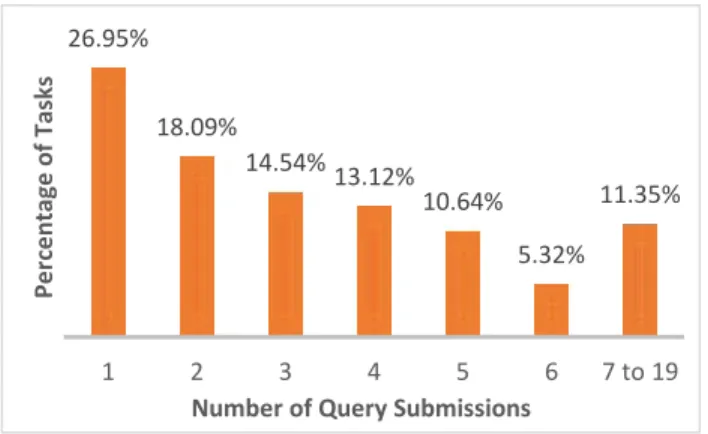
6. Percentage of tasks where various numbers of queries were observed………….. 78
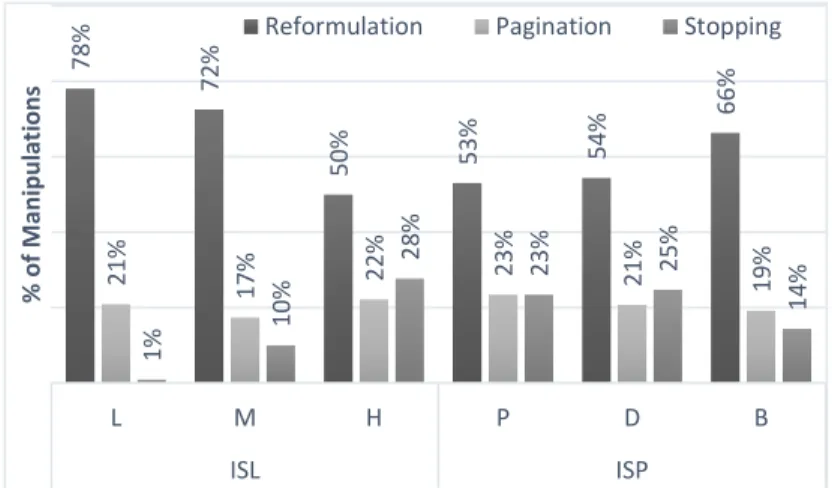
7. Reformulation, pagination and stopping by treatment
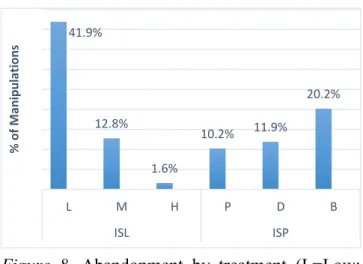
(L=Low; M=Medium; H=High; P=Persistent; D=Disrupted; B=Bursting) ……. 80 8. Abandonment by treatment (L=Low; M=Medium;
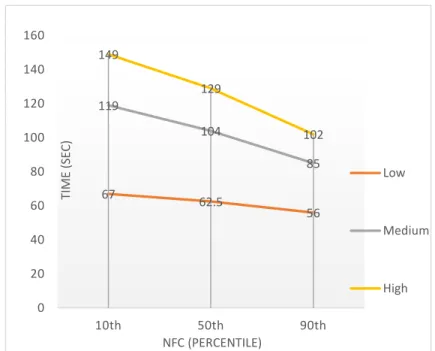
H=High; P=Persistent; D=Disrupted; B=Bursting). ………. 81 9. Interaction effect between ISL and NFC on time. ……… 86
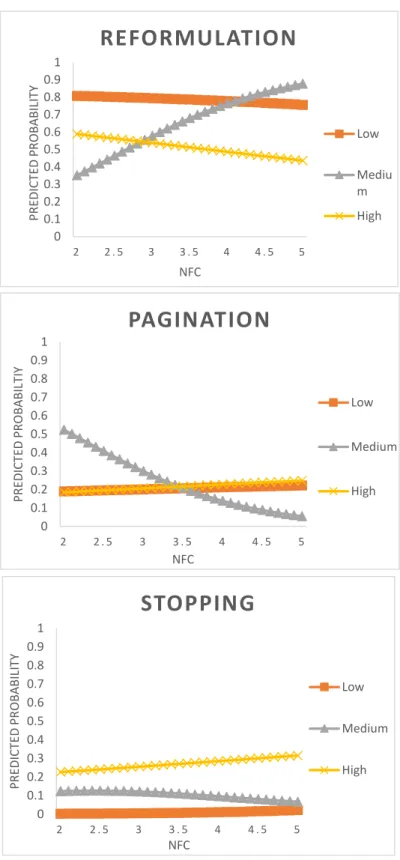
10. Predicted probability of reformulation (top), pagination (medium)
and stopping (bottom) by ISL and NFC……… 88 11. Predicted probability of reformulation (top), pagination (medium)
and stopping (bottom) by ISL and NFC………. 88 12. Predicted probability of reformulation (top), pagination (medium)
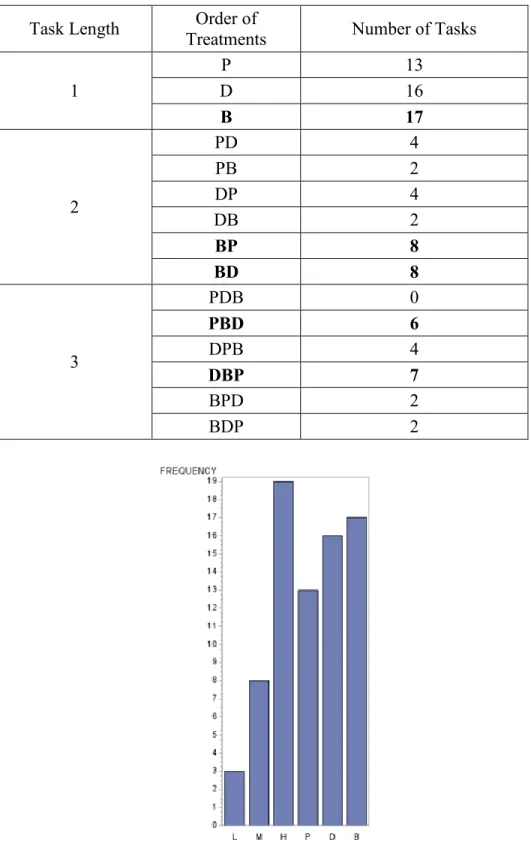
and stopping (bottom) by ISL and NFC…..………... 88 13. Number of tasks by treatment when task length=1
xiv
14. Number of tasks by ISL treatment order (Left) and by ISP treatment order (Right) when task length=2
(L=Low; M=Medium; H=High; P=Persistent;
D=Disrupted; B=Bursting)………. 96
15. Number of tasks by ISL treatment order (Left) and by ISP treatment order (Right) when task length=2
(L=Low; M=Medium; H=High; P=Persistent; D=Disrupted;
B=Bursting) ………...……… 96
16. Number of task by ISL treatment order (Left) and by ISP treatment order (Right) when task length=3
(L=Low; M=Medium; H=High; P=Persistent; D=Disrupted;
B=Bursting) ………...……… 97
17. Number of task by ISL treatment order (Left) and by ISP treatment order (Right) when task length=3
(L=Low; M=Medium; H=High; P=Persistent; D=Disrupted;
B=Bursting) ………...……… 97
18. Interaction effect between the first ISL treatment and NFC on DeepestRankClick (Top), NumPred (Middle), and NumNonRele
(Bottom) and DeepestRankClick………...………... 105 19. Interaction effect between the first ISL treatment and NFC on
DeepestRankClick (Top), NumPred (Middle), and NumNonRele
(Bottom) and DeepestRankClick ………... 105 20. Interaction effect between the first ISL treatment and NFC on
DeepestRankClick (Top), NumPred (Middle), and NumNonRele
(Bottom) and DeepestRankClick………...………. 105 21. Interaction effects between first ISP treatment and NFC on
NumPagination (Left) and DeepestRankHover (Right) ……… 106 22. Interaction effects between first ISP treatment and NFC on
NumPagination (Left) and DeepestRankHover (Right) ……… 106 23. RP frequency by unique participant IDs (Each color represents
xv
LIST OF TABLES
Tables
1. Manipulation of information scent level and
information scent pattern………...………... 51
2. Search result evaluation flow ………...………... 53
3. All rotations for information scent level treatments………. 53
4. All rotations for information scent pattern treatments………... 54
5. Two examples of documents placement in relation to information scent level treatments……….………. 55
6. Two examples of documents placement in relation to information scent level treatments………...………... 55
7. Two examples of documents placement in relation to information scent pattern treatments………..………... 58 8. Two examples of documents placement in relation to information scent pattern treatments………...…………..……... 58
9. Interaction signals of analyze and evaluate tasks………...…... 63
10. Study tasks………...………..………...……... 66
11. Latin square design of task order………...………. 67
12. Search behaviors at the task level………...………. 78
13. Search behavior measures (M, SD) by ISL (The highest mean for each measure is bolded to facilitate comparisons)………... 82
14. Search behavior measures (M, SD) by ISP (The highest mean for each measure is bolded to facilitate comparisons) ……….. 82
15. Results for ISL treatments (Wald X2, significance) ………... 84
16. Results for ISP treatments (Wald X2, significance) ………... 85
xvi
(ISL; the highest mean for each measure was bolded for
comparison)………. 91
18. Task-level search behavior measures by task length (ISP; the highest mean for each measure was bolded for
comparison)………. 92
19. Number of tasks by task length and order of ISL treatments……….. 93 20. Number of tasks by task length and order of ISP treatments……….. 95 21.
One-query ISL tasks (the highest mean for each measure
is bolded) ………... 98 22. One-Query ISP Tasks (the highest mean for each measure
is bolded) ……… 99
23. Two-query ISL tasks (the highest mean for each measure
Is bolded) ………... 100 24. Two-query ISP tasks (the highest mean for each measure
is bolded)………. 100
25. Three-query ISL tasks (the highest mean for each measure
is bolded)………. 101
26. Three- query ISP tasks (the highest mean for each measure
is bolded)…..………...…… 102
27. Search behavior measures at the task level by the first
treatment in a task……… 103
28. Number of tasks by the last ISL treatment in a task and
task length……… 107
29. Significant predictors of post-task evaluations in ISL tasks (“+” indicates positive relationship between a
continuous predictor and a criterion; “-“ indicates negative relationship between a continuous predictor and a
criterion) ………...………....………...…………... 110 30. Significant predictors of post-task evaluations in ISP
tasks (“+” indicates positive relationship between a
continuous predictor and a criterion; “-“ indicates negative relationship between a continuous predictor and a
xvii
31. One-SERP RPs………...………....………...…….. 112 32. Two-SERP RPs………...………... 113 33. Three- or more-SERP RPs………...………... 114 34. Unique number of participants exhibiting each RP and
average number of tasks exhibiting a RP by each unique
1
Chapter I. Introduction
During information search, a person needs to make a series of decisions. First, the person decides on an initial query to submit. After this, the person makes another decision about
whether or not to click on search results returned by the system. Each time a search result is clicked and reviewed, the person further determines whether to continue reviewing other search results in the current returned set, or to refine the query to retrieve a different list of search results. At some point, the person decides to terminate searching.
For Web search tasks that require a single answer, such as navigation and fact-finding, people often stop when they have found an answer to their question. However, for tasks that do not have obvious end-points, it is unclear when and how people decide to stop searching. One thing that complicates this decision is that it is often not easy to assess if the retrieved results represent the best search outcome for a particular information need (Mansourian & Ford, 2007). As a result, over-acquiring information, obtaining excessive information, and under-acquiring information, not obtaining sufficient information, often occur (Connolly & Thorn, 1987). While over-acquiring and under-acquiring information can both be costly, under-acquiring, in
particular, may lead to serious consequences for certain tasks; for instance, missing critical information during a health information search can potentially lead to mental and physical disadvantages.
2
making. For example, a recent study showed that search engines favored different news outlets and advertisements (Alam & Downey, 2014). It was found that Google had a tendency to rank articles from smaller news outlets that were specialized or politically opinionated relatively higher in the results than Bing, while Bing ranked articles from larger US media and television news outlets higher than Google. The researchers also observed that both search engines ranked content containing their company’s own advertisements higher than advertisements from competitors. These findings suggest that if searchers only view highly ranked search results, the information they gain can potentially be biased by the search engine.
3
reason why individuals stop searching (e.g., Zach, 2005), only a few of them have systematically quantified how much information is considered enough (e.g., Dostert & Kelly, 2009). This observation suggests a need to examine the topic of search stopping behavior with a different approach.
This dissertation research conceptualizes search stopping behavior in open-ended search tasks in two types: query stopping, the point at which a person stops interacting with current search results and issues another query, and task stopping, the point at which a person stops gathering information for a task. A theory-driven research framework is proposed to explain these two types of search stopping behaviors. Two theories, information scent (Pirolli & Card, 1999) and need for cognition (Cacioppo & Petty, 1982) are incorporated to guide the arguments and research design of this work.
Information scent is the subjective perception of the value and cost of information sources from proximal cues, such as search result snippets representing the page content (Chi et al., 2001). A central tenet of information scent is that navigational behaviors are guided by the information scent distributed by the immediately available proximal cues, which has been applied by researchers to investigate search result evaluation (e.g., Woodruff, Rosenholtz, Morrison, Faulring, and Pirolli, 2002; Loumakis et al., 2001; Card et al., 2001). For example, Loumakis et al. (2001) investigated how the information scent associated with images on SERPs impacted evaluation behavior. They found that when images were added to text snippets,
regardless of image quality, participants were more confident they could find an answer.
4
can be used to predict the amount of interaction searchers engage in at a website. Card et al. (2001) observed that if a participant started with a web page with high information scent, he or she would visit more web pages at the site. They also found that as the information scent of web pages declined, there was a tendency for the participant to leave the site or return to a previously visited page. These findings suggest that information scent can possibly be used to explain search stopping behaviors. In this work, it is proposed that the initial search result page can be viewed as a surrogate for the entire set of results retrieved for a query, and thus be used to examine how the characteristics of information scent of the initial SERP influence search stopping behaviors.
5
information, NFC may impact how deep a person goes in the search results list before they submit a new query and how many queries a person enters before deciding to stop searching.
The motivation for studying the relationship between Need for Cognition and search stopping behaviors is also informed by recent research about personality-based design in the human-computer interaction (HCI) research, which assumes that people with different personality traits will respond differently to design cues and interact in different ways with systems (Nov et al., 2013). While many studies have investigated the effect of individual differences such as cognitive styles, gender and age on search behavior (e.g., Ford, Miller & Moss, 2001), the relationship between personality and search behavior has received relatively less attention. Moreover, information retrieval (IR) evaluation measures such as rank-biased precision (RBP) (Moffat & Zobel, 2008) and discounted cumulative gain (DCG) (Järvelin & Kekäläinen, 2002) include parameters that can potentially be tuned based on individual user characteristics. However, no research has been done to investigate potential characteristics that might impact a person’s persistence with respect to examining a search results list.
In this dissertation, the following research questions are addressed:
1. What is the relationship between the information scent level of the first SERP and search stopping behaviors?
2. What is the relationship between the information scent pattern of the first SERP and search stopping behaviors?
3. What is the relationship between NFC and search stopping behaviors? 4. How can we model task stopping using interaction signals?
6
This work conceptualizes search stopping behaviors by differentiating query stopping from task stopping in order to study multiple stopping points during iterative open-ended search tasks. The results reveal a variety of factors that affect when searchers reformulate, which have not been discussed in previous work, and factors affecting when searchers stop gathering information, including previously reported factors as well as newly discovered factors. Two distinct search stopping strategies are identified: searching deeper, examining search results ranked lower, and searching forward, issuing multiple queries. Even though pagination was not common in the study, this research discovers search scenarios that often lead to examining multiple search engine result pages for a single query submission. This research builds on
existing knowledge of stopping behavior and contributes to the definition and characterization of search stopping behaviors specifically in the context of search engine result pages.
This work adopts a top-down, theoretical approach to explain search stopping behaviors and applies a controlled laboratory experimental design to examine causal relationships between theories and search behavior measures. The use of search behavior measures allow for
quantification of “the feelings of enough” and enable systematic comparisons under different treatments, which is beneficial for translating the findings to practice.
This work extends the applicability of information scent from explaining Web navigation and relevance judgment to explaining search stopping behaviors. The findings of this dissertation show that information scent cannot only be operationalized at the individual search result snippet level, it can also be operationalized at the SERP level and that it influences how searchers
7
deeper by manipulating the distribution of relevant results on the first SERP to maintain a continuous information scent.
The study shows how Need for Cognition, a personality trait, affects one’s search stopping behaviors. A person’s tendency to enjoy cognitive activities is related to the way he or she searches for information and therefore influences when stoppings take place. Unlike previous research which demonstrated a positive relationship between NFC and the extent of information processed, this research shows that NFC manifests itself in different search strategies: searching deeper and searching forward. A person with lower NFC tends to search deeper while a person with higher NFC prefers to search forward. These findings suggest that in the context of online searching, higher NFC is not associated with higher amount of information sought; instead, higher NFC is related to a lower persistence with search result exploration and a higher
8
Chapter II. Literature Review
This chapter reviews previous work related to search stopping behaviors, information scent, and need for cognition. This review first examines studies relevant to search stopping behaviors, followed by studies that use information scent to study search behaviors. Lastly, research about the relationship between Need for Cognition and information processing is presented along with a discussion of its relationship to search stopping behaviors.
2.1 Search Stopping Behaviors
Stopping behavior is generally used to refer to when a person has enough information to complete his or her task. Terms such as search stopping behavior, search persistence and search termination have also been used in the literature. However, no formal definition has been given. While many external reasons contribute to the termination of a search task such as interruptions and technology breakdowns, this section primarily focuses on natural stopping points (Zach, 2005), or stopping resulting from the perception that an information need has been met. In this dissertation work, search stopping behaviors is used as an umbrella term to cover both task stopping and query stopping. Task stopping is the point at which a person stops gathering information for a task and query stopping is the point at which a person stops interacting with current search results and issues another query.
9
2.1.1.1 Evaluation measures.Early task stopping research was closely related to research regarding IR evaluation measures and task stopping was mostly characterized through the
quantity of relevant documents and/or non-relevant documents retrieved by searchers. As early as 1968, an IR measure called expected search length was proposed to evaluate system
performance (Cooper, 1968). Expected search length was used to indicate the number of non-relevant documents a searcher was willing to look through to obtain a target number of non-relevant documents; a system with a shorter expected search length was considered more effective than another system with a longer expected search length. In addition, Cooper believed that for any type of search request, specific or exhaustive, there was always a corresponding desired quantity of relevant documents. That is to say, a searcher would grow satisfied with search output when a certain number of relevant results had been found, but this number was contingent on search request type. Similar to expected search length, Blair (1980) proposed the concept of the futility point, the maximum number of documents searchers were willing to examine to find useful documents. Even though neither study intended to investigate task stopping, the two measures provide ways to characterize search stopping points.
10
researchers demonstrated that expected search length could be approximated using each of the three stopping rules by considering the size of the retrieval set, the number of relevant documents in the set, the number of relevant documents a searcher wished to obtain, and the number of irrelevant documents a searcher would tolerate.
Using a somewhat different perspective, Brookes (1980) distinguished between the accretion of documents and accumulation of information. Brookes observed that relevant documents retrieved later were more likely to be redundant with previously viewed documents and thus the amount of information gained does not grow at the same rate as the number of relevant documents retrieved does, which suggests that it is the perceived amount of information gained rather the objective number of relevant documents retrieved that affects one’s stopping decision. However, all these studies assumed that people stopped searching when they felt they had reached a threshold, which was considered to be either a quantifiable or subjective sense of enough. This sense of enough could come from obtaining enough good information, tolerating too much bad information, or both.
In addition to considering the relationship between the amount of information
encountered during the search process and stopping, Kantor (1987) also considered a searcher’s a resilience to repeated failures. Kantor suggested that a searcher is constantly monitoring the search process; encountering a relevant document increases the searcher’s estimated probability of finding another relevant document. Moreover, a person who expects 50% chance of retrieving a relevant document is more resistant to seeing an irrelevant document than a person who
11
succeed in finding satisfactory documents, the more likely he or she is to tolerate non-relevant documents.
Contrary to the dominating view that people terminate searching after reaching a certain threshold, Bates (1984) argued that it was a fallacy to assume the existence of a high-quality n-item set to be retrieved regardless of topic; a searcher believing in this fallacy stops searching immediately once a desired number of results are obtained without considering whether these represent the best results. She maintained that rather than operating under this fallacy, the number of search results needed before stopping depended on task type. She suggested that searchers should distinguish among high recall search, high precision search and brief search tasks, where high recall searches call for everything relevant to a topic, high precision searches retrieve typical but not all documents on a topic, while brief searches aim to retrieve a few documents to approximate search before engaging in a more comprehensive search. That is to say, task type can be a critical factor when predicting when a searcher stops.
2.1.1.2 Notions of enough information.Many researchers have approached the task stopping problem using Herbert Simon’s theories of bounded rationality and satisficing (Simon, 1955). Bounded rationality theory argues that because of time and cognitive constraints, it is impossible for human beings to consider all existing outcomes before making a choice. Rather than stopping after exhaustively considering all available information, the theory suggests that human beings will engage in satisficing or “a decision making process through which an
12
met and ends when performance, or effort, exceeds needs. In other words, satisficing search is “thermostatic”; a searcher constantly monitors the search process in order to determine when the information obtained is just good enough (March, 1994).
Agosto (2002) explored young people’s decision making in the context of information seeking on the Web and bounded rationality and satisficing to understand the constraints and strategies she observed. Reduction and termination were two satisficing strategies participants used to address information overload while using the Web for homework purposes. Reduction meant that participants evaluated a subset of available sites on the Web until a satisfying outcome was found. For example, participants returned to known sites, relied on site synopses, and used indexing categories of search engines to filter out non-relevant Websites. They terminated searches when they found an acceptable site, felt physical discomfort, felt bored, faced time limits, or noticed repetition of information.
Mansourian and Ford (2007) analyzed search persistence and failure of academic staff, research staff and students from four Biology-related departments using the framework
developed by Agosto (2002). The researchers identified the same satisficing behaviors as those identified by Agosto (2002). In addition, they categorized the behaviors they observed according to search impact and search depth.
13
resources were available or the amount of relevant information was good enough to satisfy information needs. In the Damaging Zone whether search performance would be adversely affected depended on the abundance of overall relevant information. If the number of relevant documents was high, missing a few did not matter much; yet if the overall number was low, missing a few might lead to search failure. Finally, the Disastrous Zone described situations where missing a large portion of highly relevant information led to loss one could not afford.
Search depth was classified according to two dimensions: the searcher’s degree of search effort and the searcher’s awareness of information likely to be missed. The Perfunctory Search described times when a searcher was not aware of missing information and he or she did not attempt to expend much effort searching for information. In the Minimalist Search category, a searcher was aware of missing information but he or she did not feel motivated to expend much effort to fill the gap because the easily retrieved information was good enough to meet the searcher’s goal. Nervous Search happened when a searcher was not sure whether he or she had missed important information and thus was unsure about when to stop. Extensive Search took place when one knew that missing information would lead to disastrous consequences and searched thoroughly to avoid missing any information. Searches fell into the last zone mostly when working on literature reviews. While Mansourian and Ford (2007) did not necessarily address stopping rules in information seeking, their work provided insight into how effort and outcomes relate to task stopping.
14
citations required by instructors, (2) when they wrote the required number of pages, (3) when they finished answering all questions, or (4) when time was pressing. They also relied on qualitative criteria to determine when to stop searching, including having found accurate
information, having obtained sufficient information, having understood the concept well enough to write the assigned report, and retrieving the same information across several sources.
Similarly, faculty members referred to criteria such as searching every possible synonym and every combination of query terms, identifying representative or cutting-edge information, finding the same information repeatedly, searching exhaustively from all information sources, addressing colleagues’ feedback or journal reviewers’ comments, and meeting publishers’ requirements to determine when to stop searching information for their research and teaching duties.
A longitudinal study conducted by Warwick, Rimmer, Blandford, Gow and Buchanan (2009) also revealed the application of satisficing strategies in fulfilling course requirements. When students were given the opportunity to choose research questions to work on, they often chose ones with which they were familiar. When they searched for information online, they usually applied familiar tactics such as using terms from assignment descriptions to conduct keyword searches. However, they often gave up if their initial searches did not work.
15
determinants of how much information historians could obtain. Because accessing information at archives was costly, historians made good use of finding aids to help them decide which
collections would yield the greatest returns.
Similar criteria observed in academic environments have also been identified in professional environments. Zach (2005) investigated how senior art administrators in fine arts museums and symphony orchestras determined when to stop searching in their day-to-day jobs. It was found that feelings of enough, time constraints and task type, were three main reasons given for terminating information gathering with the feelings of enough being identified the most frequently. While many stopping rules have been identified previously in other studies, no
administrator in this study applied any predetermined rules to make stopping decisions. They mostly stopped either because they felt satisfied with the information obtained or when they were forced to stop because of time constraints. Even though task type influenced when art
administrators stopped exploring, art administrators essentially stopped when they felt they could complete the task, even if they knew they missed some information.
16
but once the structure was established, the assessments became easier. Nevertheless, the
framework was fluid and changeable because information needs evolved over time. For example, during the drafting process they began to anticipate the reactions of their audience and used the anticipated reactions to determine if more information was needed. Toward the end of the task, they used their colleagues’ feedback to determine whether there was potentially missing relevant information. Like many other studies, time constraints also appeared to be an important theme that affected when to stop seeking information. Participants admitted that they often had to cut corners to complete tasks on time. Ultimately, Berryman observed that assessments of enough information in the workplace are subject to the dynamic and complex environments in which people operate. Political climate, the interplay between multiple collaborators, the unfamiliarity of topics and the lack of task structure all increase the difficulty of determining when enough information has been obtained.
While the investigations of task stopping among academics and professionals have added to our understanding of reasons people stop searching at work, all of them were based on self-report data. So far only two studies have modeled or quantified online task stopping. Toms and Freund (2009) studied actions preceding end points in online information search to determine which behaviors could be used to predict stopping. Participants were asked to complete three assigned tasks from a set of 12 tasks developed for the INEX (Initiation for the Evaluation of XML Retrieval) 2007 Interactive Track on the Wikipedia corpus. Toms and Freund identified three major patterns of actions before participants ended their searches. The most prevalent stopping pattern included issuing a query, examining results and then viewing a page; the second most frequent stopping pattern involved a person viewing more results on the second and
17
observed that participants tended to revisit and reassess previously visited pages as a means to determine whether one had enough information, which is similar to Cooper’s (1973) satiation rule discussed earlier.
Dostert and Kelly (2009) conducted a lab study about task stopping and investigated how accurately searchers were able to estimate recall rates of their own searches. They found that participants stopped searching most frequently based on intuition, which corresponds to the satisfice strategy of “feelings of good enough” reported by Zach (2005). Moreover, participants reported that they also stopped when they noticed a repetition of articles or a decrease in relevant articles. In terms of participants’ ability to assess recall rates, Dostert and Kelly showed that when participants stopped they believed they had found 51-60% of relevant information, but in reality they had only identified 7.35%, which shows that searchers overestimate their ability to retrieve available information online. So far, this study has been the first attempt to quantify the feelings of good enough in a controlled laboratory experiment.
2.1.1.3 Cognitive Stopping Rules. While not many studies in information science explicitly address the topic of how much information is enough (Prabha et al., 2007), stopping rules have been investigated extensively in decision sciences and cognitive psychology, mostly in the context of choice tasks (Browne, Pitts and Wetherbe, 2007). This research has found that decision makers rely on cognitive stopping rules, or heuristics to make judgments of information sufficiency.
18
when the sufficiency of information reaches a predetermined level; (3) difference threshold: stop when not learning anything new; and (4) representational stability: stop when a stable mental model is formed.
Browne and Pitts (2004) and Pitts and Browne (2004) later investigated the use of these rules by systems analysts. System analysts were asked to gather requirements until they had enough information to draw diagrams to design an online grocery shopping system. During the task, analysts engaged in a think-aloud protocol. These data were coded according to the characteristics of the stopping rules identified in Nickles, Curley and Benson (1995). Browne and Pitts found that more experienced analysts tended to use the mental list and magnitude threshold rules, while less experienced analysts applied the difference threshold and
representational stability rules. These results suggest that inexperienced problem solvers are more likely to adopt heuristics that had face validity and are easy to apply. The application of different stopping rules resulted in varying degrees of quantity, depth, and quality of information. Mental list and difference threshold rules led to the identification of more system requirements than the magnitude threshold rule and greater depth of requirements than the representational stability and magnitude threshold rules. Moreover, difference threshold rule elicited more quality requirements than the magnitude threshold rule. The analysts stopped after eliciting requirements from 57% of the categories considered important.
19
showed that for well-structured tasks, more participants used the mental list and single criterion rules; while for poorly-structured tasks, more participants terminated search based on the magnitude threshold and representational stability rules. The researchers suggested that when tasks are more complex such as interpreting models, figures, and forms of artistic expressions, or when searchers are new to the tasks, searchers find information until they achieve the gist of the situation (magnitude threshold rule) or when their mental model of a situation is no longer
changing (representational stability rule); however, when tasks have low complexity and are easy to decompose into discrete elements, the mental list stopping rule and single criterion rule play the major roles in triggering task stopping.
Two studies replicated a classic consumer choice experiment in the search engine environment to examine how retrieval size affected satisfaction. Oulasvirta, Hukkinen and Schwartz (2009) and Chiravirakul and Payne (2014) investigated how “the paradox of choice”, or how a large number of options leads to poorer choices and less satisfaction with the choice, applied to search results. While the two studies did not set out to investigate either task stopping or query stopping, their findings demonstrated relationships between the size of the returned result set and when participants stopped evaluating results. In Oulsavirta et al. (2009),
20
Payne (2014) replicated the study and had participants conduct real searches on an experimental system with no time limits to increase the ecological validity of the original experiment. They found the opposite effect of retrieval size on satisfaction, albeit not-significant; participants preferred the 24-item list more than the 6-item list. In cases where participants were allowed to reformulate their own queries, participants reformulated more often in the smaller set than in the larger set. In the group where participants were allowed to reformulate, where query stoppings were observed, participants also viewed significantly more snippets before they made their final choice in the smaller set than in the larger set. While the second study improved the study design to align with real online search scenarios, it is still doubtful whether it is appropriate to
conceptualize an information search problem as a choice problem. While in a choice task one has to compare and contrast among options in order to derive a final selection, in a search scenario one is often not required to decide on the best result among all documents.
2.1.2 Query stopping. Most previous work on search stopping behavior has focused on
information seeking tasks, in which information gathering involves interactions with systems and human beings, rather than studying information search tasks, where actions are restricted to interactions with information search systems (Saracevic, 2010). Most past research has also constrained stopping behavior to that which occurs at the conclusion of a task, namely, task stopping, rather than investigating the various query stopping points that might occur throughout the search session.
21
move on to a new query, while the action of clicking on the next button at the bottom of a search result page (referred to as pagination in this study), represents a desire to continue evaluating the results retrieved for a query. Search depth, or the rank of lowest search result a searcher
examines, might also be used to indicate a searcher’s persistence with respect to a query.
Query reformulation has been a popular search strategy in Web searching. Spink, Jansen, and Ozmultu (2000) analyzed Excite search logs and found that users typically entered 2.84 queries per session, and reformulated their queries in about two-thirds of the sessions. Jansen and Spink (2006) analyzed nine search engine logs from 1997 to 2002 and found that there was an increase in query reformulations. Jansen, Booth and Spink (2009) analyzed search logs collected from 2005 and found that about 40% of query occurrences were reformulations, yet it was unclear how these reformulations were connected to user sessions. Recently, Hassan, Shi, Craswell and Ramsey (2013) used clicks and query reformulations as indicators of search satisfaction. The researchers found query reformulations were a strong indicator of possible task difficulty and task failure. Moreover, queries associated with unsuccessful tasks were often more similar to one another than queries associated with successful tasks. These findings provide useful perspectives for using search behavior to understand query stopping.
Log analyses have also provided descriptive data about the extent to which searchers examine SERPs. Search logs from the Excite search engine showed that people typically
22
Recent studies were able to demonstrate search depth at a finer level of granularity by collecting mouse hover and eye tracking data. Cutrell and Guan’s eye tracking study reported that people examined the first eight results before they re-issued another query (Cutrell & Guan, 2007). Lorigo et al. (2008) examined participants’ scan paths as they carried out search tasks. They found that on average participants scanned only 3.2 distinct search results for each query with some participants revisiting the same results multiple times. Using cursor movements, Huang, White, and Dumais (2011) observed that people re-queried after inspecting only the top four results. Another experimental study motivated by Search Economy Theory found that search depth was affected by query cost (Azzopardi, Kelly, & Brennan, 2013). Participants who used an interface that required more time to enter a query, entered significantly fewer queries and went to greater depths in the search results list than participants who used a standard search interface. These results suggest that certain aspects of the search interface can impact search behavior and also provide a theoretical explanation for this behavior. Overall, this research regarding query reformulation, pagination and search depth indicates that online searchers rarely evaluate results beyond the first SERP when using standard search interfaces.
2.1.3 Summary. Early research on IR measures attempted to estimate the number of
documents a searcher needed with regard to a query submission. Some work developed stopping rules and simulated stopping points mathematically to address the issues. However, since the studies equate query stopping for a single query submission with task stopping, the rules found in this literature are more useful for understanding task stopping than query stopping.
Studies from the past decade have seen progress in accumulating criteria for task
23
empirical search data from laboratory experimental studies, marking the initial accomplishments in systematically predicting and identifying task stopping. Among studies where cognitive stopping rules were investigated, only three studies attempted to discover stopping rules for search tasks and validate these rules in online search tasks (Brown & Pitts, 2004; Pitts & Brown 2004; Browne, Pitts, & Wetherbe, 2007). These studies provided useful criteria for task stopping. Yet research is still needed to investigate how these cognitive stopping rules are applied while interacting with search engines.
Laboratory and log-based studies shed light into search depth, pagination and query reformulation, which described the evolution and status quo of query stopping. While these studies did not set out to investigate query stopping, they revealed insights into the profiles of modern search behaviors and indicated that most online searchers only viewed results on the first SERP. However, these studies did not explain why most searchers did not examine results beyond the first ten results.
This dissertation work sought to address the gap in our understanding of search stopping behaviors by distinguishing between query stopping and task stopping, by identifying the use of existing stopping rules and exploring other stopping rules in the SERP environment, and by explaining search stopping behaviors with theories of information scent and need for cognition.
2.2 Information Scent
What information consumes is rather obvious: it consumes the attention of its recipients. Hence a wealth of information creates a poverty of attention, and a need to allocate the attention efficiently among the overabundance of information resources that enrich the information people process.
24
Determining where to allocate attention during information seeking is a tough decision, especially in a world where information is made readily available by the Internet. To address the constant information overload experienced in modern life, understanding the interactions
between information seekers and information systems has great value in facilitating effective information search. During the past two decades, Information Foraging Theory (Pirolli & Card, 1999) has been used to explain how information seekers select, navigate and switch between information sources. The core of the theory is made by an analogy between information seeking behavior and animal foraging behavior: while animals use environmental cues to identify the most fruitful places to forage, human beings are guided by information scent, or “the imperfect, subjective perception of the value and cost of information sources from proximal cues” (Chi et al., 2001, p. 491). Proximal cues are “imperfect information at intermediate locations” (Pirolli & Card, 1999, p. 646) “whose trail leads to information of interest” (Pirolli, 1997, p.3). Search result snippets, anchor text, Uniform Resource Locators (URLs) and thumbnails are some examples of proximal cues from which information scent can be obtained.
25
An analogous scenario in Information Foraging Theory to the food-seeking scenario in Optimal Foraging Theory may be observed when a searcher looks for information in a specific subject domain. Information relevant to the searcher’s interest area can be found in file drawers, libraries, online bibliographic databases and in other online sources. The searcher needs to navigate between information patches, or information sources, to find information; for example, he or she may start by browsing personal bookshelves, searching online databases, consulting a physical library. Just like an animal forages for food, an information seeker forages for
information; therefore an information seeker is called an informavore in Information Foraging Theory. But how does an informavore decide whether to stay within a single patch or move between patches? How does he or she determine when to switch to another information resource?
Informavores make foraging decisions based on comparing the profitability associated with each information patch to another. In order to determine the profitability of each
26
information gained, the searcher may switch to another patch, by, for example, reformulating his or her query.
In order to understand how information scent guides Web surfing, Pirolli and his colleagues first conducted a survey to find out what activities people engage in on the Web (Morrison, Pirolli, & Card, 2001) by inserting a survey question into the GVU Tenth WWW Searcher Survey (Kehoe, Pitkow, Sutton, & Agrawal, 1999). They used the Critical Incident Technique and presented participants with the following statement: “Please try to recall a recent instance in which you found important information on the World Wide Web; information that led to a significant action or decision. Please describe that incident in enough detail so we can
visualize the situation.” The analysis of the collected responses showed that a major purpose of using the Web was to sense-make through finding specific pieces of information. Based on the Web activity descriptions derived from the study, Card et al. (2001) developed two
representative search tasks - City and Antz - to study Web navigation in the laboratory
environment. In the City task participants were asked to imagine themselves being the Chair of Comedic events for a university; they were asked to figure out a date of an event that was going to take place on campus and look for a photograph of the event to put on the advertisement. In the other task, participants were asked to find a Website where one could purchase the set of four “Antz” movie posters depicting the princess, the hero, the best friend, and the general.
27
Card et al. (2001) found that participants spent more time searching and exploring on the Antz than on the City task. Moreover, the average information scent of pages visited for the Antz task was lower than that for the City task, suggesting that under conditions of strong information scent, searchers moved directly to the target information.
Card et al. (2001) also found a higher frequency of within-site than between-site transitions for both search tasks. From the WBGs they mapped, it was observed that as the information scent of Web pages encountered at a site declined, there was a tendency for participants to leave the site or return to a previously visited page. More importantly, they
identified a relationship between the information scent first encountered on a site and the number of pages visited at the site; if a person started with a high information scent Web page, he or she visited more Web pages at the site.
28
applicability of the theory of information scent to predict navigation behavior and stopping in the context of usability evaluations.
Information scent has also been used to understand relevance assessment behavior. Loumakis, Stumpf, and Grayson (2011) investigated the relationship between the information scent of images on SERPs and people’s relevance assessments. Three types of search snippets were compared: text-only, image-only, and text + image snippets. Overall, text + image snippets led to the highest information scent. The results showed that images had their own distinct scent. When images were added to text snippets, participants were more confident they could find an answer regardless of image quality, which suggested that images contributed positively to the overall information scent of the SERP. However, adding images to text snippets did not actually enhance search effectiveness and search efficiency.
The same conclusion was made in another study where the snippets were manipulated in a similar way. Woodruff, Rosenholtz, Morrison, Faulring, and Pirolli (2002) compared
navigation behavior when participants used three snippet types - enhanced thumbnails (a snippet which combined both plain thumbnails and text summaries), plain thumbnails alone, and text summaries alone - to search for different types of information. They found that for some
29
In addition to images, Kammerer et al. (2009) found that by adding source cues to search result snippets, such as the label “Science/Institutions” to signify the authoritativeness of the content, searchers paid less attention to commercial search results and selected more results from authoritative sources than when source cues were not available. However, participants were provided 30 results to “select” from rather than to “search;” therefore, the effect of information scent on search behaviors such as reformulation and pagination remains unclear.
Information scent appears to affect the perceived credibility of news articles as well. Sundar, Knobloch-Westerwick, and Hastall (2007) investigated the impact of three types of information scent cues – source credibility, recency and number-of-related-articles – on
perceived message credibility. Each subject was presented with 12 news items differing in high and low source credibility, six levels of number of related articles, and three levels of recency and asked to evaluate the news site after reviewing all items. The effects of these cues on perceived credibility were not straightforward: when a news article was attributed to a high credibility source, how recently the article was published or how many related articles there were did not matter; however, if a news article was distributed by a low credibility source, it received the highest message credibility ratings when the other two cues were at their highest.
Katz and Byrne (2003) applied information scent to explain a searcher’s choice between a search function and a menu browsing function while locating a product on a Website. It was hypothesized that when menus had poor information scent, operationalized by poor labeling, searchers would prefer to use a search function over browsing. Subjects were instructed to decide how to locate specific products on sixteen customized commercial sites that differed in
30
subjects browsed higher scent menus even in the presence of a search function suggests that providing a search function should not preclude careful labeling of product categories. Their results may also imply that in the context of search engine usage, a SERP with high information scent can potentially attract more interactions with results (similar to Website browsing) while a SERP with low information scent causes searchers to reformulate (similar to using the search function on a Website).
Information scent has also been applied to model navigation paths on specific software applications. Lawrence, Bellamy, Burnett, and Rector (2008) presented a model to predict how programmers navigated code for software maintenance tasks. Programmers were predicted to visit the source code revealing the highest scent. Their model turned out to predict debugging behavior close to expert programmers’ real debugging behavior, and most importantly, the scent- modeled navigation paths were indistinguishable from historical navigation paths. The
researchers suggested that scent-based indicators should be added to existing software tools to enhance the usage of navigation history to discover source code relationships.
31
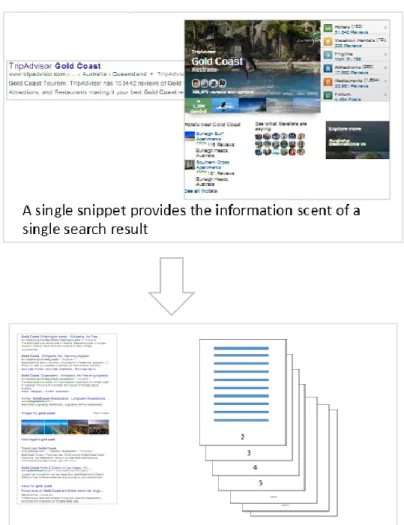
regarded as a type of information patch (Pirolli, 2007, p. 52), it is reasonable to hypothesize that the initial search results one encounters on the first SERP can be used to model query stopping. Information scent can perhaps be treated as an attribute of the search results in one’s immediate virtual environment, the first SERP. Moreover, by the same analogy that an information scent of a single proximal cue provides estimation of the quality of a single distal information object as shown in the relevance behavior studies, information scent obtained from collective proximal cues may suggest the quality of collective distal information objects as well (Figure 1) .
32
2.3 Need for Cognition
There are a number of theories in the psychological research about how human beings process information. While most research has focused on situational factors that determine when people engage in effortful information processing and when they think heuristically (Kahneman, Slovic, & Tversky, 1982), a common source of variance has been attributed to individual
differences. Many studies in information science have investigated the effect of individual differences such as demographic variables on search behavior (e.g., Ford, Miller, & Moss, 2001; Morahan-Martin, 1998; Borgman, 1989; Borgman, Hirsh, & Walter, 1995). Others discussed the differences in search strategies between experts and novices (Rieh, 2002). Still others examined the effect of cognitive styles (e.g. Field dependent vs. field independent, Palmquist & Kim, 2000; imager vs. verbalizer, Ford, Miller, & Moss, 2001; wholist vs. analytic, Wang, Hawk, & Tenopir, 2000) on search behavior and search result evaluation styles (Economical vs. exhaustive, Aula, Majaranta & Räihä, 2005; breadth-first vs. depth-first, Klöckner et al., 2004). However,
empirical work investigating the effect of personality differences on search behavior is uncommon.
Personality, a “relatively stable emotional, motivational, interpersonal, and attitudinal characteristics of the individuals distinguished from abilities” (Pocius, 1991), has been studied extensively in behavioral sciences and social sciences but has not yet been discussed in depth in the search behavior literature. When it comes to the issue of how stable personality traits
33
main predictor of behavior; and the interactionist approach emphasizes the joint contribution of personality and situation in determining behavior.
In HCI and IR research, personality has been treated as a moderator of the relationship between the situational factors and the behavioral measures of interest in several studies, reflecting the interactionist approach (e.g. Nov et al., 2013; Jozsa et al., 2012). According to Mischel and Shoda’s (1995) theory, this means personality accounts for behavior in predictive patterns across situations (e.g., in situation A one does X, in situation B one does Y). For example, Nov et al. (2013) found that users’ extroversion level moderates the relationship between the user interface of audience size and user contribution, and users’ emotional stability moderates the relationship between the effectiveness of social anchors and user contribution. Jozsa et al. (2012) studied the interaction between Myers-Briggs personality preference and language (native vs. foreign) on search behavior. They found the Thinking-Feeling dimension was significantly associated with the success rate on the foreign language task but not the native language task; Feelers tended to achieve better results than Thinkers by spending more time and effort to find suitable Webpages.
There are two IR measures, Discounted Cumulative Gain (DCG) (Järvelin & Kekäläinen, 2002) and Rank-Biased Precision (RBP) (Moffat & Zobel, 2008) that have parameters that can be tuned based on characteristics of the searcher, although no research has been conducted to determine what types of characteristics might be represented by this parameter or what appropriate values might be for this parameter. For example, with DCG it is believed that
34
higher. DCG has a parameter to represent characteristics of the searcher, which Järvelin and Kekäläinen (2002) call searcher persistence. A small value of the persistence parameter (b=2) is used to represent an impatient searcher for whom the lower ranks of documents are not likely to be assessed; and the persistent parameter discounts late documents to a greater extent than earlier documents. Whereas for patient searchers who are more likely to access lower ranks of
documents, a large value, b>100, is applied so that later documents are weighted almost equally to earlier relevant documents. While formal guidelines do not exist about the choice of b values, the authors suggested 2 as the value for b and many experiments have applied b=2 by default. Nevertheless, the authors admitted that the choice of the base is arbitrary. They believed “either the evaluation scenario should advise the evaluator of the base or a range of bases could be tried” (Järvelin & Kekäläinen, 2002, pp. 439-440).
Similarly, in another measure, RBP, different p values represent different levels of searcher persistence, and thus different ways in which ranked lists can be used. Values closer to 1 indicate highly persistent searchers who examine many documents before terminating
35
Zhang, 2007), but no controlled laboratory user studies have been conducted to investigate the relationship between real search stopping behavior and these persistence parameters.
A literature search in personality psychology suggests that Need for Cognition (NFC), a personality trait that describes a person’s tendency to enjoy and engage in the process of
information processing, bears a close relationship with search stopping behaviors and can possibly be used to inform the persistence parameters. Awareness that individuals differ in their motivation to engage in effortful thinking can be traced back to early history in personality and social psychology, when the first empirical studies about Need for Cognition were conducted by Cohen, Stotland, and Wolfe (1955) and Cohen (1957). Cohen et al. (1955) described Need for Cognition (NFC) as “a need to understand and make reasonable the experiential world” (p. 291). Cohen and his colleagues (1955, 1957) conducted two empirical studies in which it was found that individuals who had high NFC preferred structured information to ambiguous information (Cohen et al., 1955), and they were generally more likely to organize, elaborate, and evaluate information they were exposed to than individuals who had low NFC (Cohen, 1957). Yet during this time there were no instruments to produce NFC scores; participants were classified into high or low NFC only by their reactions to a hypothetical situation and ordering of statements about five needs by importance.
36
conceptualized NFC somewhat differently. They proposed NFC as “a stable individual
difference in people’s tendency to engage in and enjoy effortful cognitive activity” (Cacioppo, Petty, Feinstein, & Jarvis, 1996, p. 198).
Cacioppo and Petty (1982) characterized individuals with low NFC as chronic cognitive misers, and individuals with high NFC as chronic organizers. Both chronic cognitive misers and chronic organizers have a need to make sense of the world, but they exhibit variations in terms of attitudes and behaviors. Chronic organizers tend to actively seek, think about, and reflect on information to make sense of the stimuli and relationships among stimuli in their world while chronic cognitive misers tend to rely on others’ opinions (e.g., experts and celebrities) and heuristics to arrive at mental models of the world. Moreover, compared to chronic cognitive misers, chronic organizers often exhibit more positive attitudes toward tasks or stimuli that require effortful thinking (e.g., tests and reading) than non-intellectual stimuli (e.g., sports and pets). In terms of problem solving strategies, chronic organizers are more likely to apply
technologies that involve effortful thinking. Because of the greater extent of effortful information processing, chronic organizers tend to accumulate a wider array of topical knowledge than
chronic cognitive misers.
37
2.3.1 Consequences of NFC on information processing. Considerable research about
NFC has prevailed in fields of social psychology, personality psychology, behavioral medicine, education, journalism, marketing and law (Cacioppo et al., 1996). Much of the literature was developed based on the hypothesis that individuals who differ in terms of NFC also differ in terms of their tendency to seek detailed information (Cacioppo et al., 1996). Studies found that individuals with high NFC showed higher motivation to process information, recalled more information, paid more attention to argument quality than peripheral cues, generated more task-related and thoughtful responses, possessed more knowledge, performed better on cognitive tasks, and reacted more positively to complex rules (Cacioppo et al., 1996). Studies investigating how NFC affects information seeking, processing and evaluation in both online and offline contexts, especially with an emphasis on the type and amount of information sought or considered are discussed in the following sections.