Mapping between Dependency Structures and Compositional Semantic
Representations
Max Jakob
1,3, Mark´eta Lopatkov´a
1, Valia Kordoni
2,31Institute of Formal and Applied Linguistics, Charles University in Prague, Czech Republic
2German Research Centre for Artificial Intelligence (DFKI GmbH), Saarbr¨ucken, Germany
3Department of Computational Linguistics, Saarland University, Saarbr¨ucken, Germany
[email protected], [email protected], [email protected]
Abstract
This paper investigates the mapping between two semantic formalisms, namely the tectogrammatical layer of the Prague Dependency Treebank 2.0 (PDT) and (Robust) Minimal Recursion Semantics ((R)MRS). It is a first attempt to relate the dependency-based annotation scheme of PDT to a compositional semantics approach like (R)MRS. A mapping algorithm that converts PDT trees to (R)MRS structures is developed, associating (R)MRSs to each node on the dependency tree. Furthermore, composition rules are formulated and the relation between dependency in PDT and semantic heads in (R)MRS is analyzed. It turns out that structure and dependencies, morphological categories and some coreferences can be preserved in the target structures. Moreover, valency and free modifications are distinguished using the valency dictionary of PDT as an additional resource. The validation results show that systematically correct underspecified target representations can be obtained by a rule-based mapping approach, which is an indicator that (R)MRS is indeed robust in relation to the formal representation of Czech data. This finding is novel, as Czech, with its free word order and rich morphology, is typologically different than languages analyzed with (R)MRS to date.
1.
Introduction
This paper introduces a method for mapping between de-pendency structures and compositional semantic represen-tations. Recent studies of natural language processing have shown a clear and steady shift of focus from pure syntac-tic analyses to more semansyntac-tically informed structures. As a result, we have seen an emerging interest in parser eval-uation, for instance, based on more theory-neutral and se-mantically informed representations, such as dependency structures, like the ones of the Prague Dependency Tree-bank (PDT; Hajiˇc (2006)). Moreover, various existing pars-ing systems are nowadays also adapted to provide semantic information in their outputs. The obvious advantage in such an approach is that one can derive more fine-grained repre-sentations which are not typically available from shallow semantic parsers (e.g., modality and negation, quantifiers and scopes, etc.). To this effect, various semantic repre-sentations have been proposed and used in different parsing systems. One of them is Robust Minimal Recursion Seman-tics (RMRS; Copestake (2007a)), which we focus on in the work reported in this paper. Generally speaking, semantic representations like the ones of RMRS should be capable of embedding dependency structure information, which is so important nowadays for parser evaluation. However, it is proven to be non-trivial to map even basic dependency information among different compositional semantic rep-resentations. This becomes a barrier to both sides, i.e., to compositional semantic based approaches and to depen-dency structure approaches, making the cross-fertilization of systems and resources using different semantic represen-tations very difficult.
In this paper, we present an approach towards mapping be-tween dependency and compositional semantic representa-tions. More specifically, we map Prague Dependency Tree-bank dependency annotations to Robust Minimal Recursion
Semantics structures. Evaluation results show that the map-ping from PDT to RMRS structures is reliable and benefi-cial to deep parsing in general. Finally, the shown map-ping of a dependency based annotation onto RMRS makes the PDT and its backbone theoretical linguistic formalism available to a bigger community of NLP researchers. This endeavor is also novel in that it explores the capability of RMRS to represent typologically different languages, in this case, a free word order language with a rich morphol-ogy, like Czech.
Other works address similar problems of mapping be-tween different formalisms, involving either RMRS or PDT. These works include the projection of German de-pendencies to RMRS (Spreyer and Frank, 2005) and the mapping of generic logical forms in frame-like notation onto Minimal Recursion Semantics structures (Allen et al., 2007). The reverse approach is taken by ˇZabokrtsk´y et al. (2008) in that they try to represent language data other than Czech in the PDT annotation scheme.
2.
Source and target representations
2.1. Dependency Representation
struc-t-ln94210-39-p1s1
root
člověk
ACT n.denot
mladý
RSTR adj.denot
#Neg
RHEM atom
choditenunc
PRED v
divadlo
DIR3basic n.denot
často
THO
adv.denot.grad.neg
.
.
Figure 1: Tectogrammatical tree for the sentence string “Mlad´ı lid´e nechod´ı do divadel ˇcasto.” (English “Young people don’t go to the theater frequently.”)
ture – its nodes represent individual lexical nodes and their morphological categories and edges represent syntactic re-lations – serves as an input for the developed mapping. An example tree is shown in figure 1. Furthermore, knowledge about valency for Czech words contained in the valency dictionary of the PDT (Hajiˇc et al., 2003) is incorporated in the target representation.
2.2. Compositional Semantic Representation
Because of its underspecifiability, Minimal Recursion Se-mantics (MRS; Copestake et al. (2005)) has been widely used in many deep and shallow processing systems. The main assumption behind MRS is that the interesting lin-guistic units for computational semantics are the elemen-tary predications(EPs), which are single relations with as-sociated arguments. Robust Minimal Recursion Semantics (RMRS; (Copestake, 2007a)) is a variant of the MRS for-malism that attempts to formalize a semantic description that can be used by both deep and shallow processing tech-niques. Therefore, it is possible in RMRS to underspecify and to dynamically add predicate arguments.
RMRS is the target representation of the mapping presented here. An RMRS structure consists of a quadruplehhook, EP bag, arguments set, handle constraintsi1 (Copestake,
2007b). The first element is thehookof the structure. It is important during the semantic composition of complex RMRSs. The second element is the EP bag. It is a set of predicates that describes the lexical and some relational semantic information contained in a sentence. The third el-ement is a set of arguments, that belong to the individual elements of theEPbag. The last element is a set of han-dle constraintsthat specify certain scopal relations of the elements in theEPbag.
(R)MRS itself is a formalism, not a semantic theory (Copestake et al., 2005). PDT adopts the Functional Gener-ative Description (FGD; Sgall et al. (1986)) as its theoret-ical background. The task is to adapt the abstraction level and annotation features of PDT and to attempt to represent them in the RMRS formalism.
1
Variable equalities are directly resolved in this project.
3.
Mapping
We introduce a practical task to map the dependency-based annotation scheme of the tectogrammatical layer of PDT onto the RMRS formalism. The target representation incor-porates knowledge about tree structure and dependency re-lations, morphological categories, as well as certain gram-matical coreferences (control structures, complex predi-cates and some types of reciprocity). Other tectogrammati-cal information, such as textual coreference and topic-focus articulation, has no correspondence in the target represen-tation yet. Furthermore, certain constructions are skipped due to their linguistic complexity that exceeded the range of this basic research.
The developed approach constructs RMRS structures for each node of a tectogrammatical tree. These so called node-RMRSs represent the semantics of the subtrees rooted at the respective nodes. The node-RMRS of the root node captures the semantics of the complete sentence. A node-RMRS is created in two steps. The first step initializes the lexical and morphological information, using the attributes of the current node. The second step assembles more com-plex structures by combining multiple node-RMRSs. It makes use of the explicit dependency relation in the tec-togrammatical tree, as well as to a special relation in the case of valency modifications in coordinations (see section 3.3.).
3.1. node-RMRS Initialization
The core element of each node-RMRS is thelexicalEP. It is created and added to theEPbag during the initialization step. LexicalEPs represent the lexical units of the sentence, carrying the tectogrammatical lemma of nodes, its semantic part-of-speech and potentially the index of a valency frame (as additional sense distinction) in the relation name. Mor-phological categories are mapped to features of variables that are introduced for ARG0 (the first argument of anEP). In English (R)MRS structures, this is typical done for per-son, number and gender, as well as tense, aspect and mood. For Czech, we need to extend the number of these features due to its rich morphology.
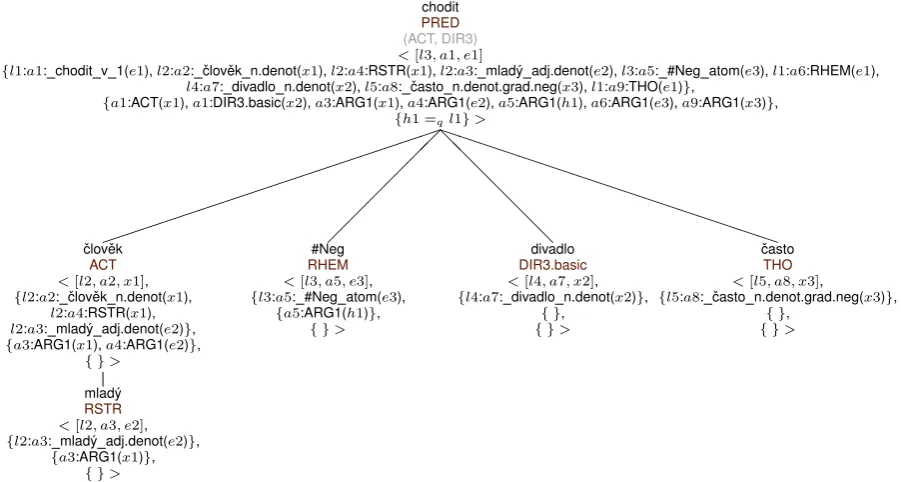
The elements of the hook feature of a node-RMRS, namely top label, top anchor and index variable (Copestake, 2007b), are initialized to the label, anchor and ARG0 of the lexical EP. Quantifiers are introduced for nominal objects, including the typical constraint for the restriction hole. The body remains unconstrained. Examples (1) and (2) show the initialized node-RMRSs for the nodes for chodit(‘to go’) andˇclovˇek(‘man’) in figure 2. There is a conflict in the typical naming of quantifier restrictions and the RSTR functor in PDT. To guarantee that arguments and EPs named RSTR always carry the meaning of the functor, we were forced to rename the quantifier restriction in this project.
(1) <[l1, a1, e1],
{l1:a1: chodit v 1(e1[...,tense:sim,verbmod:ind])}, { },
chodit
PRED
(ACT, DIR3) <[l3, a1, e1]
{l1:a1: chodit v 1(e1),l2:a2: ˇclov ˇek n.denot(x1),l2:a4:RSTR(x1),l2:a3: mlad´y adj.denot(e2),l3:a5: #Neg atom(e3),l1:a6:RHEM(e1),
l4:a7: divadlo n.denot(x2),l5:a8: ˇcasto n.denot.grad.neg(x3),l1:a9:THO(e1)},
{a1:ACT(x1),a1:DIR3.basic(x2),a3:ARG1(x1),a4:ARG1(e2),a5:ARG1(h1),a6:ARG1(e3),a9:ARG1(x3)},
{h1 =ql1}>
@ @ @ @ @ @
P P P P P P P P P P P P P P P P P
ˇclov ˇek
ACT
<[l2, a2, x1],
{l2:a2: ˇclov ˇek n.denot(x1),
l2:a4:RSTR(x1),
l2:a3: mlad´y adj.denot(e2)},
{a3:ARG1(x1),a4:ARG1(e2)},
{ }>
mlad´y
RSTR
<[l2, a3, e2],
{l2:a3: mlad´y adj.denot(e2)},
{a3:ARG1(x1)},
{ }>
#Neg
RHEM
<[l3, a5, e3],
{l3:a5: #Neg atom(e3),
{a5:ARG1(h1)},
{ }>
divadlo
DIR3.basic
<[l4, a7, x2],
{l4:a7: divadlo n.denot(x2)},
{ },
{ }>
ˇcasto
THO
<[l5, a8, x3],
{l5:a8: ˇcasto n.denot.grad.neg(x3)},
{ },
{ }>
Figure 2: Tree of figure 1 including node-RMRSs. Valency positions of the frame-bearing words are shown as a set of functors in round brackets. Quantifiers and variable features are omitted for clarity.
(2) <[l2, a2, x1],
{l2:a2: ˇclovˇek n.denot(x1[gender:anim,number:pl]),
l6:a10:udef q(x1)},
{a10:RESTRICTION(h2),a10:BODY(h3)}, {h2 =q l2}>
For nouns governing adjectives, the same nominal variable must be used (as in ˇclovˇek, ‘man’ and mlad´y, ‘young’). Therefore, we re-use parts of the governing hook infor-mation in the dependent node-RMRS. The composition of more complex node-RMRSs is outlined next.
3.2. node-RMRS Composition
The initialized node-RMRSs, containing the lexical EPs, are combined to build more complex structures. This proce-dure includes the adding of additional arguments, EPs and constraints. The concrete details depend on the generalized semantic part-of-speech of the involved nodes. Further-more, we distinguish valency modification, optional free modification and coordination. Most importantly, in this composition step, theEPbag, argument set and handle con-straints of the dependent node-RMRS are joined together with those of the governing node-RMRS.
3.2.1. Valency Modification
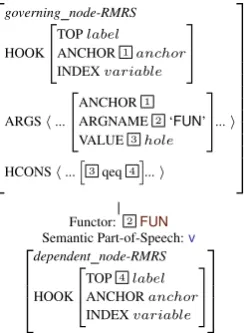
Certain tectogrammatical nodes, namely verbs and some types of nouns and adjectives, have annotated valency frames. These frames are registered in the PDT valency lexicon (Hajiˇc et al., 2003) that stores all obligatory and optional valency modifications for the above mentioned Czech words. Each valency frame consists of several va-lency slots, characterized by a functor, i.e., label for a type of valency modification. Using this information, it is possi-ble to determine valency modifications in tectogrammatical trees.
Valency modifications are labeled with six functors: ACT, PAT, ADDR, EFF, ORIG and MAT. Theoretically, the
whole set of valency modifications must be registered in the PDT valency lexicon. It may, however, be the case that one of these functors occurs in the data without be-ing present in the respective governbe-ing valency frame. This incomplete annotation can, in this case, be overcome by the capability of RMRS to dynamically add arguments to EPs. The named functors are always correctly treated as va-lency modifications. In addition to vava-lency modifications, valency frames also store information on obligatory free modifications. They are treated exactly in the same way as valency modifications and together make up the arguments ofEPs.
Depending on the semantic part-of-speech of the dependent node, valency modification works in different ways. In fact, four types ought to be distinguished based on the general-ized semantic part-of-speech of eithern,adj,v, oradv. In general, an argument relation is created that has the depen-dent functor as its name. Moreover, it is attached to the lexicalEPof the governing node-RMRS by anchor equality and it contains the index variable of the dependent node-RMRS (verbs being an exception). This argument relation is added to the arguments set of the governing node-RMRS. Figures 3, 4 and 5 illustrate examples of the behavior of va-lency modifications with different parts-of-speech at the de-pendent nodes. In figure 1, the modifications with the ACT and the DIR1.basic functor are both valency modifications.
3.2.2. Optional Free Modification
a
CONJ
<[l1, a1, e1],
{l1:a1: a CONJ(e1),l2:a2: ˇr´ıdit v(e2),l5:a5: kontrolovat v(e3),l3:a3:named(x1),l4:a4: skupina n.denot(x2)}
{a1:L-HANDLE(l2),a1:L-INDEX(e2),a1:R-HANDLE(l5),a1:R-INDEX(e3),a2:ACT(x1),a2:PAT(x2),a5:ACT(x1),a5:PAT(x2),a3:CARG(‘StB’)},
{ }>
@ @ @ @ @ @
P P P P P P P P P P P P P P P P P
StB
ACT
<[l3, a3, x1],
{l3:a3:named(x1)},
{a3:CARG(‘StB’)},
{ }>
ˇr´ıdit
PRED M (ACT, PAT) <[l2, a2, e2],
{l2:a2: ˇr´ıdit v(e2),
l3:a3:named(x1),
l4:a4: skupina n.denot(x2)},
{a2:ACT(x1),a2:PAT(x2),
a3:CARG(‘StB’)},
{ }>
kontrolovat
PRED M (ACT, PAT) <[l5, a5, e3],
{l5:a5: kontrolovat v(e3),
l3:a3:named(x1),
l4:a4: skupina n.denot(x2)},
{a5:ACT(x1),a5:PAT(x2),
a3:CARG(‘StB’)},
{ }>
skupina
PAT
<[l4, a4, x2],
{l4:a4: skupina n.denot(x2)},
{ },
{ }>
Figure 7: Tree of figure 8 including node-RMRSs. Valency positions of the frame-bearing words are shown as a set of functors in round brackets. Quantifiers and variable features are omitted for clarity.
t-ln94207-69-p2s1C
root
StB
ACT n.denot
řídit
PRED M v
a
CONJ coap
kontrolovat
PRED M v
skupina
PAT n.denot
_ _
Figure 8: Tectogrammatical tree for the sentence string “StB ˇr´ıdila a kontrolovala skupinu.” (English “The StB (State Security)commanded and controlled the group.”)
the governing lexicalEPby creation of a new argument re-lation. In figure 8, the node forStBmust therefore be pro-cessed in the composition step of both node-RMRSs for the ˇr´ıditnode and thekontrolovatnode. That means we need to refine the method of determining the dependent nodes that are relevant for the composition step. Additionally to the direct dependents, valency modifications that are not in the subtree under the current node have to be included as well (but excluded when processing the coordination node). Fur-thermore, if these kind of valency modifications are them-selves joined under a coordination (cf., the sentence string of figure 8 starting with “The StB and others commanded ...”), the coordination node-RMRS has to be processed for composition for the simple fact that there is only a single slot to be filled. Lastly, if the valency modification in the described position is an adverb (a scopal EP), the handle constraint must be introduced to outscope the coordination node. Otherwise, both member nodes’ top would be up-dated to the same label, which would result in the coordi-nation node not linking distinct structures.
3.4. Control Structures
In control structures (and similarly in complex predicates and some types of reciprocity) in PDT, one node points to another node in the same sentence and thus inherit some of
its features. This is annotated using coreference links. For RMRS structures, shared nominal variables in two different verbalEPs is the correct treatment of this phenomenon. In order to provide this variable identity, the hook of the node with the coreference link is inherited from the antecedent node that the grammatical coreference points to. Figures 9 and 10 present an example. The#Cornode inherits the hook of the node-RMRS forpozornost(‘attention’), result-ing in variablex1being shared by the actor slots of both verbsdok´azat(‘can’) andvytvoˇrit(‘to create’).
3.5. Algorithm
The general procedure of the mapping algorithm is shown as algorithm 1. The node-RMRSs are constructed in a top-down recursive approach, storing previously computed structures in a table to avoid re-computations. First, coref-erence links are resolved (steps 1-3) to deal with structures described in the last section. The lexical EPs, and gener-alized quantifiers if appropriate, are introduced in the ini-tialization (step 4). The relevant nodes for composing the RMRS for the subtree rooted at the current node are cal-culated with respect to the complex interplay between de-pendency, coordination edges and valency (step 5). The cycle (steps 6-10) composes more complex node-RMRSs by means of valency modification, optional free modifica-tion or coordinamodifica-tion and propagates allEPs, arguments and constraints up to the higher tree level. The last step (11) adds elided optional valency arguments to the current lexi-calEP, which is important for the interconversion between MRS and RMRS. To obtain the RMRS structure for the complete tectogrammatical tree, theget node-RMRS func-tion is called with the root node. Several details are omitted for simplicity.
4.
Evaluation
mapped 44580 90.19 %
skipped 4851 9.81 %
valid 40004 80.93 %
Precision 40004/44580 89.74 % Recall 40004/49431 80.93 %
Table 1: Precision and Recall for structurally valid MRSs
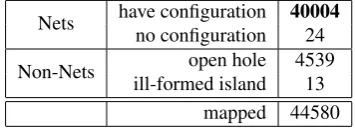
Nets have configuration 40004 no configuration 24
Non-Nets open hole 4539
ill-formed island 13 mapped 44580
Table 2: Result totals of produced MRSs
enthetic clauses (PAR functor) at the root. The lack of a main verb explains their structural incompleteness. Ill-formed island fragments lack a certain constraint structure. However, Flickinger et al. (2005) admit that – among ill-formed island structures – there are special cases that make them “legitemate non-nets”. The ill-formed islands pro-duced in this mapping all fall into this case. The source trees all have coreferences links from a node to one of its own ancestor nodes. The last two observations put the in-validity of the non-net structures in question.
The overall performance is regarded to be very satisfactory. It gives rise to the notion that the two involved formalisms are basically compatible and the mapping is feasible. Cur-rent efforts are being made to investigate the re-mapping of the RMRS structures to PDT trees, which would enable the creation of PDT-style trees from the big amount of avail-able RMRS data. Furthermore, there is still a number of attributes and phenomena that is lost or skipped during the mapping. We plan to further extend the research.
5.
Conclusion
In this paper, we have presented a study of mapping be-tween PDT-like dependency structures and semantic struc-tures in the form of (R)MRS. The experiment results show that there can indeed be a reliable mapping from depen-dency structures to compositional semantic representations. It is also important to realize that such kind of mapping will also enable us to enrich deep (HPSG) syntactic and seman-tic annotations with fine-grained dependencies from valu-able manually created resources, like PDT. The outcome enriched semantic structures can eventually be helpful for applications like question answering and information ex-traction, for instance, in the future.
6.
Acknowledgements
The authors acknowledge support from the Erasmus Mundus Program through the European Masters Program in Language and Communication Technologies (LCT). The work on this project was also partially supported by the grant of M ˇSMT ˇCR No. MSM0021620838.
7.
References
James Allen, Myroslava Dzikovsk, Mehdi Manshadi, and Mary Swift. 2007. Deep Linguistic Processing for Spoken Dialogue Systems. InProceedings of the ACL Workshop on Deep Linguistic Processing, pages 49–56, Prague, Czech Republic, June.
Ann Copestake and Dan Flickinger. 2000. Open source grammar development environment and broad-coverage English grammar using HPSG. In Proceedings of the 2nd International Conference on Language Resources and Evaluation (LREC 2000), pages 591–598, Athens, Greece.
Ann Copestake, Dan Flickinger, Carl Pollard, and Ivan A. Sag. 2005. Minimal Recursion Semantics: An In-troduction. Research on Language and Computation, 3(4):281–332.
Ann Copestake. 2007a. Applying Robust Semantics. In Proceedings of the 10th Conference of the Pacific Asso-cation for Computational Linguistics (PACLING), pages 1–12, Melbourne, Australia.
Ann Copestake. 2007b. Semantic composition with (Ro-bust) Minimal Recursion Semantics. InProceedings of the ACL Workshop on Deep Linguistic Processing, pages 73–80, Prague, Czech Republic, June.
Dan Flickinger, Alexander Koller, and Stefan Thater. 2005. A new well-formedness criterion for semantics debug-ging. In Stefan M¨uller, editor, Proceedings of the 12th International Conference on HPSG.
Jan Hajiˇc, Jarmila Panevov´a, Zdeˇnka Ureˇsov´a, Alevtina B´emov´a, Veronika Kol´aˇrov´a, and Petr Pajas. 2003. PDT-VALLEX: Creating a Large-coverage Valency Lex-icon for Treebank Annotation. In Proceedings of The Second Workshop on Treebanks and Linguistic Theories, volume 9 of Mathematical Modeling in Physics, En-gineering and Cognitive Sciences, pages 57–68. Vaxjo University Press.
Jan Hajiˇc, Jarmila Panevov´a, Eva Hajiˇcov´a, Petr Sgall, Petr Pajas, Jan ˇStˇep´anek, Jiˇr´ı Havelka, Marie Mikulov´a, Zdenˇek ˇZabokrtsk´y, and Magda ˇSevˇc´ıkov´a-Raz´ımov´a. 2006. Prague Dependency Treebank 2.0. http://ufal.mff.cuni.cz/pdt2.0/.
Jan Hajiˇc. 2006. Complex Corpus Annotation: The Prague Dependency Treebank. In M´aria ˇSimkov´a, editor, In-sight into the Slovak and Czech Corpus Linguistics. Veda, Bratislava, Slovakia.
Petr Sgall, Eva Hajiˇcov´a, and Jarmila Panenov´a. 1986. The Meaning of the Sentence in Its Semantic and Pragmatic Aspects. Academia/Reidel Publishing, Prague, Czech Republic/Dordrecht, Netherlands.
Kathrin Spreyer and Anette Frank. 2005. Projecting RMRS from TIGER Dependencies. In Stefan M¨uller, editor,Proceedings of the 12th HPSG Conference, pages 354–363, Lisbon, Portugal.


![Figure 9: Tectogrammatical subtree for the substring “[...]vhodn´a pozornost dok´aˇze vytvoˇrit prostˇred´ıaCONJcoap [...]” (EnglishrezervovanostAPP“[...] appropriate attention can create an environment ofn.denot.neg[...]”)](https://thumb-us.123doks.com/thumbv2/123dok_us/1067497.1133803/6.595.308.537.267.469/tectogrammatical-substring-vytvorit-prostred-iaconjcoap-englishrezervovanostapp-appropriate-environment.webp)