Is this about me?
Responding to subtle discrimination – beyond an individual versus
group perspective
Proefschrift ter verkrijging van
de graad van Doctor aan de Universiteit Leiden, op gezag van Rector Magnificus prof.mr. P.F. van der Heijden,
volgens besluit van het College voor Promoties te verdedigen op donderdag 26 maart 2009
klokke 15 uur door Katherine Stroebe geboren te Marburg (an der Lahn)
Promotor: Prof. Dr. N. Ellemers Copromotor: Dr. M. Barreto
Referent: Prof. Dr. R. Spears (University of Cardiff, UK) Overige Leden: Dr. C. Van Laar (Universiteit Leiden)
Dr. D. Scheepers (Universiteit Leiden)
Prof. Dr. T. Postmes (Universiteit Groningen) Prof. Dr. J. Dovidio (Yale University, US)
The research conducted in this dissertation was made possible by grant 016-025-021 awarded by the Dutch National Science Foundation (NWO)
Cover painting: Thomas Eggerer “Trinity”, 2005
Acrylic on canvas 188 x 127 cm
Contents
page
1. Introduction 5 2. When searching hurts: The role of information search in
reactions to subtle discrimination
37
Study 2.1. 43
Study 2.2. 52
General Discussion 59
3. For better or for worse: The congruence of personal and group outcomes on targets’ responses to discrimination
65
Study 3.1. 69
Study 3.2. 76
General Discussion 86
4. Is the world a just place? Countering the negative consequences of pervasive discrimination by affirming the world as just
93
Study 4.1. 97
Study 4.2. 103
General Discussion 115
5. Summary and Discussion 121
R
References 147
SSamenvatting (Summary in Dutch) 159
A
Acknowledgements 169
C
Chapter 1 Introduction
Introducing subtle discrimination
When I was at the post office,, a white male was waiting to be served by an African American post office assistant. His number was called but he was slow approaching the counter so the assistant jokingly said: “Sorry, can’t help you, you are too late”. The white male got very angry at the assistant and became increasingly rude in his communication. The African American assistant came to the assistant who was serving me and said: “Will you take over this customer, this is not going to work out anymore”. I was left wondering whether the white male was just nasty and could not appreciate a joke, or had responded the way he did because of the ethnicity of the post office assistant. Clearly the post office assistant interpreted the behavior in the form of prejudice, but I was not sure. To me this was the clearest demonstration I had ever had of how ambiguous discrimination can be.
(personal experience)
This example of an unpleasant interaction that is tinted by possible underlying prejudice illustrates how unclear it can be to targets of discrimination (and to those observing the interaction), whether the negative treatment they receive is due to their individual behaviors, such as a mistimed joke, or due to the group-based prejudice of another. This ambiguity for members of stigmatized groups regarding the causes of their personal outcomes is illustrative of the kind of
of the perpetrator or, not necessitating actual interaction, in unjustified negative personal treatment (i.e. not being invited for a job interview or accepted for a job). These types of expression can create considerable ambiguity concerning whether the (negative) personal treatment received is due to one’s personal deservingness (such as lack of ability/interpersonal skills) or due to one’s membership of a devalued group and the prejudice of another.
It is this ambiguity concerning whether treatment is individually or group based that will be the focus of this thesis. Specifically I will consider how individuals ‘switch’ from an individual level focus in which one’s personal characteristics are most salient to a group level focus in which one’s group membership is considered a possible cause of one’s personal outcomes. I will focus on the following two
questions: When do targets of prejudice perceive a situation to be discriminatory? How do these ambiguous situations influence targets’ psychological well-being? Below I first outline in more detail what constitutes subtle discrimination. I then present a working model to show the processes underlying responses to subtle discrimination. This working model will also be used as a framework to review prior research in this area and introduce the studies conducted in this dissertation.
Subtle discrimination
The historical development of expressions of discrimination from more blatant to more subtle forms of discrimination means that for members of
stigmatized groups it can be very unclear how to attribute their personal outcomes. Crocker and Major (1989) have defined this attributional ambiguity as the
uncertainty whether the cause of one’s personal outcomes can be attributed to personal deservingness (i.e., lack of personal ability, another’s disliking of oneself) or to the social prejudices that others have against one’s group. Not only is this an unpleasant emotional state to be in – given the strong evidence that individuals dislike uncertainty (Gao & Gudykunst, 1990; Kagan, 1972) – it can also lead to misinterpretations of situations. Indeed members of stigmatized groups may both miss instances of discrimination or over-interpret situations as due to discrimination. An early experiment by Kleck and Strenta (1980) showed how strong and
negatively than a ‘non-stigmatized’ control group. In this case participants who thought they had a stigma were very focused on their group membership and possible negative treatment on the basis thereof. Clearly the opposite can occur such that individuals are so focused on individual level characteristics of the situation that they do not realize they are being treated on the basis of to their group membership and attribute their failure to personal inadequacies instead of their devalued group membership. Both over and under attributing situations to discrimination can have negative consequences for well-being, albeit in different ways. Below I further discuss possible determinants of this ‘individual’ versus ‘group’ level focus on perceptions of discrimination.
Situations that are attributionally ambiguous can have negative
consequences for group member’s well-being (i.e., self esteem) both at an individual and at a group level: They can have negative consequences for personal self esteem when individuals blame negative treatment that can in fact be attributed to their group membership on themselves. When a situation is attributed to discrimination, this can have negative consequences for collective self esteem (i.e., one’s feelings with respect to one’s group, Luhtanen & Crocker, 1992) as group members realize that their own group is devalued by others. In fact, situations that are ambiguous can threaten well-being both at the individual and the group level, precisely because group members are experiencing uncertainty concerning whether to blame
themselves or their group membership for their personal outcomes. Indeed, as pointed out by Crocker and Major (1998), paradoxically it may in some ways be less threatening to experience more old-fashioned and blatant forms of discrimination as opposed to modern and subtle discrimination: At least when discrimination is blatant it is clear to targets how to attribute the cause of their negative treatment (see also Cihangir, Barreto, & Ellemers, 2009).
In sum, attributionally ambiguous discrimination can be misleading concerning group members’ perceptions of discrimination, they may either fail to perceive discrimination when it occurs, or misattribute personal treatment to the prejudice of another when this is not the cause of their outcomes. Furthermore, this ambiguity concerning the causes of personal outcomes can have rather negative consequences for personal well-being as group members may feel threatened at an individual and/or group level. In studying these processes it is important to look at their determinants. Above I pointed out that individuals may be focused on more individual (i.e., attributing negative treatment to personal characteristics,
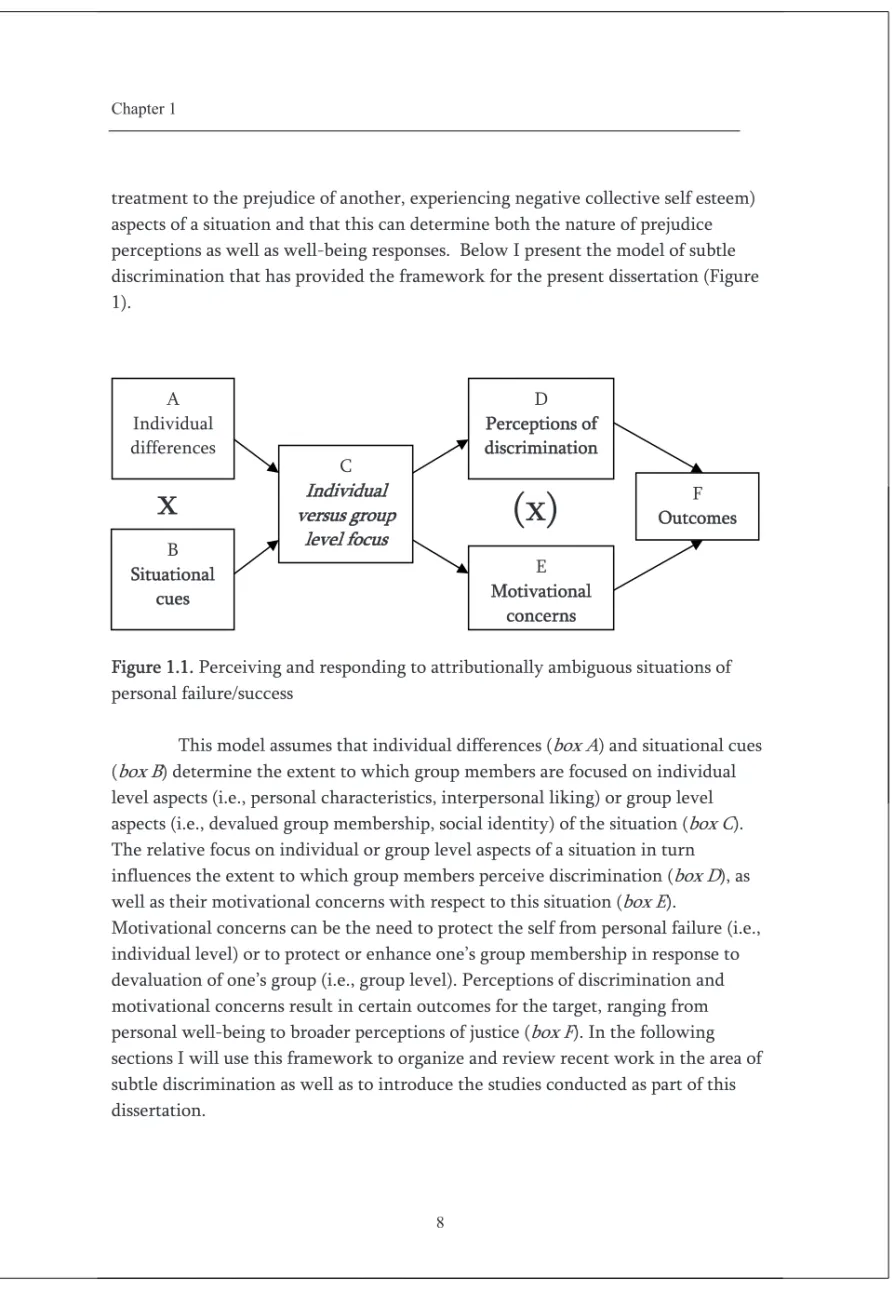
treatment to the prejudice of another, experiencing negative collective self esteem) aspects of a situation and that this can determine both the nature of prejudice perceptions as well as well-being responses. Below I present the model of subtle discrimination that has provided the framework for the present dissertation (Figure 1).
Figure 1.1. Perceiving and responding to attributionally ambiguous situations of personal failure/success
This model assumes that individual differences (box A) and situational cues (box B) determine the extent to which group members are focused on individual level aspects (i.e., personal characteristics, interpersonal liking) or group level aspects (i.e., devalued group membership, social identity) of the situation (box C). The relative focus on individual or group level aspects of a situation in turn influences the extent to which group members perceive discrimination (box D), as well as their motivational concerns with respect to this situation (box E).
Motivational concerns can be the need to protect the self from personal failure (i.e., individual level) or to protect or enhance one’s group membership in response to devaluation of one’s group (i.e., group level). Perceptions of discrimination and motivational concerns result in certain outcomes for the target, ranging from personal well-being to broader perceptions of justice (box F). In the following sections I will use this framework to organize and review recent work in the area of subtle discrimination as well as to introduce the studies conducted as part of this dissertation.
C Individual versus group
level focus
D Perceptions of discrimination
E Motivational
concerns A
Individual differences
x
(x)
B Situational
cues
A. Individual Characteristics Stigma consciousness
Research by Mendoza Denton and Pinel indicates that members of low status groups can differ in the extent to which they are likely to perceive discrimination against their race and gender respectively (Mendoza-Denton, Downey, Purdie, Davis, & Pietrzak, 2002; Pinel, 1999). Mendoza Denton and colleagues developed a scale of race rejection sensitivity and provided evidence that ethnic minority members who score highly on this scale were more likely to perceive interaction partners and personal treatment as (racially) prejudiced (Mendoza-Denton et al., 2002). Similarly, Pinel’s stigma consciousness scale (1999) measures the extent to which members of minority groups are attentive to signs of gender discrimination. In a series of studies Pinel showed that people high in stigma consciousness were more likely to report past experiences of discrimination and expect future discrimination. Recent research by Kaiser and colleagues indicates that individuals who are high in stigma consciousness are in fact more attentive to prejudice related cues at a subconscious level (Kaiser, Vick, & Brook, 2006). In a similar vein, research by Inman and Baron (1996) indicates that members of disadvantaged groups (i.e., women) are more likely than members of privileged groups (i.e., men) to perceive discrimination against other disadvantaged groups (i.e., African Americans). Note that this is not necessarily due to differing positions of men versus women with respect to African Americans: In this context both men and (White) women could be considered privileged with respect to African Americans. The explanation given here is that women, having personally experienced
discrimination, are more able to recognize prejudice in their encounter with others than men who have little experience of discrimination.
Therefore, group members can be more attentive to discrimination when they are chronically aware of stigma (i.e. high in rejection sensitivity, stigma consciousness) and/or themselves have had many past experiences of discrimination. Obviously these aspects can not always be separated and the extent to which group members are chronically aware of their stigma may be highly related to the extent to which they have experienced discrimination in the past.
Social categorization and group identification
environment gives meaning to and enables individuals to process their environment. Individuals can give meaning to their environment at different levels of abstraction such as at a purely individual level (i.e., inter-individual comparisons) or at an intermediate level (i.e., intergroup comparisons). One of the focuses of this dissertation is to consider the relative influence of determinants that focus individuals on ‘individual level aspects’ of a situation, with no reference to group membership (i.e., individual level), as opposed to factors that increase the salience of one’s group membership (i.e., intermediate or, in this dissertation, ‘group’ level). This concept will be discussed in more detail in section C of the introduction. As will also become clear in the course of this introduction, this may influence both the extent to which individuals perceive a situation as discriminatory as well as their motivational concerns. I consider the individual versus group level focus a cognitive factor that determines how people categorize their environment.
By contrast, research in the area of subtle discrimination has mainly focused on a more ‘emotional’ component of individual’s group membership (Branscombe, Schmitt, & Harvey, 1999; see also Stroebe, Lodewijkx & Spears, 2005), the extent to which they identify with their group. According to Social Identity Theory (Tajfel & Turner, 1979) people vary in the extent to which group membership is personally and emotionally meaningful to them. In consequence, some members identify more with the group(s) they belong to than others. Studies looking at the relation between group identification and perceptions of and appraisals of situations as discriminatory have indicated that the more group members identify with their group, the more likely they are to perceive and appraise situations as discriminatory (e.g., Eccleston & Major, 2006; Operario & Fiske, 2001). These studies indicate that in considering targets’ propensity to perceive discrimination, it is important to consider how central the group is to the self. It is likely that high identifiers are more attentive to discrimination cues than low identifiers – in other words, they are more focused on group level aspects of their surroundings1.
Turning back to Self Categorization Theory and my definition of the individual versus group level focus I assume that social identification may aid, but is not a prerequisite for prejudice perceptions. Rather the salience of cognitive categories should be sufficient to enhance prejudice perceptions.
B. Situational cues
characteristics of the other person group members are interacting with but also more generally by the nature of the situation or the type of information offered in any given situation. For example, information that already offers some kind of
categorization (i.e. salaries of men versus women) may elicit a stronger group level focus than information that does not do this (i.e., salaries of a number of individuals with no special reference to gender). Situational cues may interact with individual differences to enhance, or inhibit, the extent to which individuals perceive discrimination and influence their motivational responses. For example, an individual who is high in stigma consciousness may be more likely to perceive discrimination when processing information containing evidence of discrimination (see also Crosby, Clayton, Alksnis, & Hemker 1986).
Characteristics of the perpetrator.
Surprisingly little research considers how differences in perpetrator attitudes and behavior influence targets’ responses to possible discrimination. Research mainly stems from the area of interethnic interactions, considering, for example, how implicit and explicit attitudes of a perpetrator influence interethnic interactions (Dovidio, Kawakami, & Gaertner, 2002). Interestingly, the main finding of this research is that perpetrator’s implicit racial attitudes, rather than their explicit behaviors, are determinant of target’s perceptions of, and well-being during, interethnic communication. Thus research by Dovidio and colleagues (2002) revealed that White Americans’ score on an implicit measure of prejudice influenced the extent to which they were perceived as biased during interethnic interactions by both the African American communication partner as well as observers of the situation. By contrast, explicit reports of prejudice by White Americans did not influence perceptions of bias on the side of the target or observer. This research indicates that targets of discrimination are able to pick up very subtle cues of prejudice and that it is the implicit intergroup attitudes on the side of the perpetrator that can cue a target to group level aspects of a situation.
At a more explicit level, research indicates that the reasons given to targets for the negative treatment they receive (that can be attributed to the prejudice of another) can determine the extent to which targets perceive situations as
explicit reason (i.e., you received this treatment because of your gender). Similarly, the extent to which a perpetrator’s behavior is perceived as intended to discriminate and/or harmful to the target influences the extent to which targets (and observers) attribute negative treatment to discrimination (Swim, Scott, Sechrist, Campbell, & Stangor, 2003). This research indicates that more explicit information on attitudes or underlying reasons for perpetrator’s behaviors can influence the extent to which targets attribute the behavior of the perpetrator to discrimination.
In sum, the (little) research that has considered the influence of
perpetrators’ attitudes and perceived behavior (both explicit and implicit) on targets’ perceptions of prejudice reveals how perceptive targets can be to the prejudice of others, even when it is not explicit, but at the same time, how easily they can be deflected from perceiving, or making attributions to discrimination. It is important to note that in contrast to the research by Dovidio and colleagues (2002), the studies just reviewed are more ‘explicit’ in two ways: Firstly, they actually inform targets (to a greater or lesser extent) that a situation may be discriminatory, secondly, they explicitly ask (rather than implicitly measuring) the extent to which targets felt this situation could be attributed to discrimination. This means that one cannot be sure whether targets are actually deflected from perceiving a situation as discriminatory, or are wary of attributing/reporting a situation as discriminatory. It highlights the importance of considering both more subtle ways of providing cues concerning whether a situation is discriminatory (one of the foci of the second chapter of this dissertation) as well as designing implicit measures of prejudice.
Nature of situation
on group-based disadvantage, such as activities taking place to uncover or address group disadvantage (e.g., women’s rights movements).
Information format
The way information is formatted can also make individual or group level aspects of a situation more salient. A number of studies have considered the role of information format in influencing perceptions of discrimination. The basic idea underlying these studies is that people may make information processing errors when provided with information indicative of discrimination because they are not aware of the fact that categorization or systematic treatment on the basis of group membership is taking place. For example, in order to recognize that indeed women receive lower salaries than men in a certain company, it is necessary to compare the salaries of a group of women to a group of men. This requires what I would define as a group level focus: A focus on differences between, as opposed to within, groups. A number of studies have revealed that individuals who were asked to judge salaries and not given information that focused them on possible discrimination were less likely to perceive discrimination indicating that men received higher salaries than women when provided with case-by case information of male and female salaries. Individuals provided with aggregate salary information that allowed direct comparisons of salaries of males versus females as a group were more likely to perceive discrimination (Cordova, 1992; Crosby et al., 1986; Rutte & Messick, 1996). This research indicates that the way in which information about discrimination is presented influences the processing of information and the ease with which group based discrimination is perceived.
or against their group (see also the perception of discrimination section). These studies indicate that it may be important to consider how people process
information about discrimination not only with regard to other ingroup members but also when concerning themselves personally.
When focusing on how targets process information individual level aspects of a situation (that are unrelated to group membership) such as the extent to which information is personally threatening, may also influence search behavior and ultimately the likelihood of perceiving discrimination. Research by Blanton and colleagues (Blanton, George, & Crocker, 2001) asked people to evaluate satisfaction with pay rate and revealed that whether people were focused on potential changes (i.e., focus on future pay compensation) or not (i.e., focus on past payment) determined the types of social comparisons people made. In fact this research revealed that people who could not change their personal outcomes made more within as opposed to between group comparisons. Supposedly, within group comparisons were less threatening, given that participants were less likely to realize they had received less payment in the past than comparable outgroup members when they did not compare themselves to other outgroup members. This study highlights the necessity of - when focusing on individuals’ personal experiences of discrimination - also considering individual and situational differences that may influence how targets process information. Indeed this is addressed in Chapter 2 of this dissertation.
C. Individual versus group level focus
How people respond to situations in which it is ambiguous whether they are being treated on the basis of group membership or personal characteristics is, in my view, largely influenced by the extent to which individual or group level aspects of the situation are more salient to individuals. The salience thereof is determined by individual and situational characteristics (sections A and B). In essence I see the distinction between individual and group level focus as a cognitive process
intermediate level, individuals are focused on similarities to other ingroup members and differences between the own group and other relevant outgroups. Drawing a parallel to the area of subtle discrimination, my definition of individual level focus implies that individuals are focused on aspects of the situation that relate to
themselves such as making interpersonal comparisons and/or dealing with (possible) personal failure. Given the individualistic nature of many situations of
discrimination that targets are likely to experience (see nature of situation section) it is not surprising that targets confronted with discrimination are (in first instance) likely to focus on individual level aspects of the situation (see also Barreto et al., 2009). For individuals with a ‘group level focus’ aspects of their (devalued) group membership such as the treatment of other ingroup members or the implications of their group membership for their personal future are salient. This is not to say that having an individual level focus precludes perceiving discrimination.
D. Perceptions of discrimination
Above I have discussed indicators that may determine the extent to which individuals are focused on group level aspects of a situation (i.e., stigma
consciousness, identification, information format). In most cases these determinants of group level focus also increase attendance to prejudice cues, and perceptions of discrimination and are therefore more or less directly linked to this concept. Yet it is important to note that motivational factors (see section E) may also determine the extent to which people perceive discrimination. In the area of subtle discrimination perceptions of and attributions to discrimination are generally seen as
interchangeable concepts. Yet, there is some evidence (although see Chapter 5 of this dissertation) that attributions to discrimination may be the result of
discrimination by presenting discrimination information via personal outcomes of other ingroup and outgroup members (see Chapter 2).
At a more abstract level, a considerable amount of work has focused on differences between ‘perceptions’ of individual versus group level discrimination. Although this work in fact measures attributions to discrimination, it is considered in this section because the processes that determine the direction of these
attributions have been shown to be cognitive (i.e., differences in the frames of reference people have). Nevertheless it is the case that within these cognitive frames of reference different motivational processes may take place (see Postmes,
Branscombe, Spears, & Young, 1999).
An early study of Crosby (1984) revealed that although working women reported being aware that women workers generally do not receive the rewards they deserve and are discriminated against, they did not report personal experiences of discrimination. This finding demonstrates that whereas at a more abstract level (treatment of one’s group) group members may perceive unjust treatment, this need not necessarily translate to perceptions of individual level injustice. Why do targets perceive group level discrimination but not discrimination at an individual level? Building on the work of Crosby, numerous studies have found that although members of low status groups recognize discrimination against their group as a whole, they fail to report instances of personal discrimination (D.M.Taylor, Wong-Rieger, McKirnan & Bercusson, 1982; D.M.Taylor, Wright, & Porter, 1994). This person-group discrimination discrepancy (D.M.Taylor, Wright, Moghaddam, & Lalonde, 1990) has since been reported across many disadvantaged groups, including women, African Americans and Inuits (see D.M.Taylor, Wright, & Porter, 1994 for a review).
Much research has focused on possible explanations for these differences between reports of personal as opposed to group level discrimination. The initial and for a long time most prominent explanations centered on possible motivational processes (Crosby, 1984;). Motivational explanations assume that perceiving
discrimination at a personal level is threatening to members of disadvantaged groups and that therefore lower reports of personal level rather than group level
discrimination stem from the need to deny personal discrimination to protect the self (Crosby, 1984). Although not contesting that motivational processes take place, two lines of work provide strong support that the direction of peoples’ attributions is largely determined by cognitive aspects, namely peoples’ frames of reference
when group members make judgments of personal discrimination they think at a different categorization level and make different social comparisons than when making judgments of group discrimination. Specifically, both papers argue that in making personal judgments of discrimination people are focusing on their personal identity and using an interpersonal frame of reference. This means that peoples’ judgments of personal discrimination are likely to be influenced by interpersonal comparisons by which group members assess their standing with respect to other individuals. In contrast, when making judgments of group discrimination, group members categorize at a group level and assess the standing of their group with respect to other groups. In support of this idea, both Kessler et al. (2000) and Postmes et al. (1999) in two very different series of studies (field versus laboratory) showed that whether group members made interpersonal versus intergroup comparisons differentially predicted levels of perceived personal and group discrimination respectively. In further support of differentiating between personal versus social identities, Postmes and colleagues also provided evidence that factors feeding into group level categorization, such as group identification, only
differentially influenced attributions to group level but not to personal level discrimination.
This research underlines the importance of considering the reference groups individuals use when asked to make judgments of discrimination. Yet it is important to note that the levels of abstraction at which people make judgments of group discrimination may differ. Measures of group discrimination in the above research are referring to discrimination against one’s group within society in general (as opposed to within a certain context). In more specific contexts (i.e., within an organization, sports club etc.) perceiving group discrimination may involve assessing whether other group members in one’s direct environment (i.e., one’s company) are receiving similar outcomes to oneself. Here people are more inclined to consider their individual outcomes with respect to others (i.e., individual level focus). In order to perceive discrimination, it will be necessary to adopt a group level focus in this context and to pay attention to whether outgroup members’ outcomes differ from those of the ingroup. I focus on this question in Chapter 3 of this dissertation. E. Motivational concerns
perceive relatively more threat at an individual as opposed to group level, will determine motivational concerns with respect to discrimination. Motivational concerns are studied by examining the level or domain in which targets feel the strongest need to buffer themselves from threat. Below I will outline three motivations and argue that the motivation to self protect is largely triggered by an individual level focus, whereas the motivation to protect social identity is triggered by a group level focus. New is the system motivation (see Chapter 4) which, as will be discussed below, is more abstract than an individual or group level focus. Motivation to self protect
When situations of subtle discrimination make personal failure and possible lack of personal ability very salient, peoples’ self views can be threatened. In consequence, people may be motivated to self-protect to be able to maintain a more positive view of themselves. Different research findings in various areas of social psychology provide support for the idea that people have a very strong and inherent need to defend and maintain positive self views. For example, research in the area of self affirmation indicates that when people experience threat in a certain domain, affirming the self both in the same or different domains can reduce threat to the self (Steele & Liu, 1983; see Tesser 2000 for a review). Similarly, social comparison research indicates that when people have a strong need to self protect they make downward rather than (threatening) upward comparisons to close others (e.g., Aspinwall & Taylor, 1993; Pyszcynski, Greenberg, & La Prelle, 1983).
Evidence for these mechanisms to protect the individual self have also been found in the area of subtle discrimination. In 1989 Crocker and Major proposed the
somewhat controversial and counter-intuitive idea that being able to attribute a negative personal outcome to the prejudice of another may be self-protective because it buffers targets’ personal self esteem from the experience of personal failure. As discussed earlier, many situations of discrimination can be very
attributions to discrimination are seen as more external than attributions to lack of personal ability. Considering the consequences of this attribution process for psychological well-being and drawing on emotion theory, Crocker and Major (1989) argue that the effects of discounting protect self esteem and decrease levels of self-directed negative affect (i.e., depression) in response to personal failure.
Early support for the discounting hypothesis was provided by two studies of Crocker and colleagues (1991) revealing that women (Study 1) and African
Americans (Study 2) who were placed in an attributionally ambiguous situation experienced less negative self-directed well-being (i.e., lower depressed affect, higher self esteem) when they could attribute the negative treatment of another to prejudice as opposed to lack of personal ability. Further evidence for the underlying role of attributions in these self-protective processes was provided by a later scenario study of Major and colleagues (2003a) indicating that people who could attribute personal failure to discrimination as opposed to personal deservingness made less internal and more external attributions. Importantly, the extent to which people could discount their personal ability in causing failure (i.e., in favor of
discrimination) mediated people’s self-directed well-being responses. People who could discount personal failure in favor of discrimination reported lower levels of depressed emotions.
So far I have only discussed how attributions to discrimination can be self-protective with respect to the effects of personal failure. One of the questions also considered within this approach, and further elaborated in the present dissertation (see chapters 2 and 3) concerns situations in which members of stigmatized groups experience personal success. Research in the area of attribution theory has revealed that just as people prefer to attribute personal failure externally, they also like to attribute personal success internally. Yet, because situations of attributional
the (positive) well-being effects of positive feedback (Crocker et al., 1991, Study 2; Hoyt, Aguilar, Kaiser, Blascovich, & Lee, 2007).
In sum research on the discounting approach provides evidence that responses to situations that provide indications of discrimination can be motivated by the need to self-protect. In the case of personal failure, attributions to
discrimination can serve to self protect from attributing this failure to the self. In the case of personal success, attributions to discrimination may actually counter the possibility to self enhance by attributing success internally. When considering discrimination as potentially self-protective it is important to keep in mind that the situations studied in line with the discounting hypothesis are by nature likely to focus targets on individual failure and their personal outcomes. For example many of the studies employed in this area consider interpersonal evaluation settings such as study progress tests or job selection procedures (i.e., Crocker et al., 1991; Major et al., 2003a). This means that individuals may be relatively more focused on averting the negative consequences of experiencing failure rather than on the negative implications of being devalued on the basis of their group membership. In
consequence they may adopt an individual (not group level) focus to understand the situation. As will be discussed later on, situations in which individuals have more of a group level focus and are aware of the (negative) future implications of their devalued group membership may carry less potential to protect targets from personal failure by making attributions to prejudice. In this case the self-protective aspects of attributing failure to prejudice are countered by the negative consequences of perceiving one’s group membership as devalued (see below section ‘motivation to protect one’s social identity’).
The idea that perceiving discrimination is always self-protective and, specifically, that an attribution to discrimination should be seen as relatively external to the self has been contested by a number of researchers. It forms the basis of the second motivational process I discuss below.
Motivation to protect one’s social identity
The discounting approach has been countered by those who argue that attributing situations to discrimination is also harmful to the self (Branscombe et al., 1999; Schmitt & Branscombe, 2002a, b). In line with social identity theory
Branscombe and colleagues have posited that attributing a situation to
the self, namely one’s social self or group-based self (Schmitt & Branscombe, 2002b). In response to the Discounting Hypothesis, Schmitt and Branscombe (2002b) showed that with respect to purely external attributions for personal failure, an attribution to discrimination was perceived as both internally and externally caused. Note that in this case internally caused did not mean that targets felt they personally caused their failure, rather they perceived their outcome as partially due to
something in themselves, namely their group membership.
Perceiving discrimination is not only considered harmful because it threatens people’s social identity, but also because it makes people aware of the negative implications of being a member of a devalued group. Indeed, it provides a future perspective of not being judged on the basis of one’s individual abilities and personal strengths, but rather on the basis of an (in many cases) irrelevant
characteristic of the self, one’s group membership. In line with this idea, Branscombe and colleagues (1999) argue that the more structural and pervasive group members experience discrimination to be, the more negative are the consequences for personal well-being when making attributions to discrimination (Branscombe et al., 1999). Two lines of research provide some initial evidence for this assumption. One line considers the extent to which group members are structurally as opposed to not structurally disadvantaged, assuming that structural disadvantage is related to perceiving discrimination as pervasive. In a number of studies Schmitt and colleagues (Schmitt & Branscombe, 2002b; Schmitt,
Branscombe, Kobrynowicz, & Owen, 2002c) showed that attributions to
discrimination were negatively related to well-being for members of disadvantaged (i.e., women) but not for members of advantaged (i.e., men) groups. Unfortunately, these studies cannot separate the severity of reported discrimination (less for men) from their group’s status. Therefore it is difficult to judge whether it is the low status and structural disadvantage that explains well-being effects or the fact that women know better what it is like to experience discrimination, and therefore give a more realistic response to situations of discrimination.
A second line of research has measured or manipulated the pervasiveness of discrimination (Branscombe et al., 1999; Schmitt, Branscombe, & Postmes, 2003). This research provides support that discrimination that is perceived as pervasive is negatively related to well-being. One of the few studies to manipulate the
Research studying effects of pervasiveness of discrimination on well-being provides initial evidence that the extent to which discrimination is perceived as pervasive may be an important moderator in determining whether the experience of discrimination is likely to be relatively self protective (i.e., averting failure) versus harmful. Although the studies discussed above do not show direct evidence for the self-protective potential of incidental discrimination, they do suggest that situations that are perceived as more incidental may have more potential to be protective of the individual self than those in which individuals are also aware of the negative consequences of discrimination for their future. Here the negative implications of discrimination are likely to cancel out the self-protective properties of attributions to discrimination. I test this idea in Chapter 4 of the present dissertation.
Given this relatively strong evidence that attributions to discrimination are also harmful at a ‘group level’, because they threaten people’s social identities and make salient the possibility of future disadvantage, it is likely that group members are motivated to protect their social identity. Indeed research on social identity theory has shown that people have a strong need to maintain a positive view of the groups they are a member of (Tajfel, 1981; Tajfel & Turner, 1979). When social identities are threatened, group members will be motivated to re-establish a positive view of their group. In the area of subtle discrimination, research indicates that one way in which group members cope with the threat to social identity posed by discrimination, is to seek support of other group members and to increase identification with their group. Referred to as the rejection identification model (RIM, Branscombe et al., 1999), the idea is that (increased) identification with one’s group in the face of discrimination which represents the exclusion from an
outgroup, can buffer group members from the negative consequences of discrimination and feelings of exclusion. Initial evidence for this argument was provided by a study showing that the negative consequences of attributions to discrimination for well-being were countered when group members identified highly with their group (Branscombe et al., 1999). Therefore, high identification with one’s group can serve as a source of strength in response to discrimination (see also Jetten, Branscombe, Schmitt, & Spears, 2001; Redersdorff, Martinot, &
Branscombe, 2004).
central to the self. A study that measured identification and manipulated
discrimination indicated that group members who identified highly with their group experienced more negative well-being in response to discrimination than low identifiers (McCoy & Major, 2003). Although these findings may seem equivocal with those of the RIM, it is important to distinguish between determinants of an individual versus group level focus, and determinants of perceptions of
discrimination, versus (motivational) responses thereto. It is possible that participants who identified highly in the McCoy and Major study (2003) also perceived more discrimination than low identifiers (the relation between
identification and perceptions of discrimination was not reported in this work). This does not preclude the option that group members who face pervasive discrimination further increase levels of identification to cope with this social identity threat. System motivations
Research on people’s worldviews, frequently focusing on system legitimizing or system justifying beliefs, indicates that people have a strong
underlying need to view the world as a place that functions on the basis of principles of fairness and equality (e.g., Lerner & Simmons, 1966). Situations that challenge these principles by being inherently unjust and unfair can be experienced as very threatening by individuals. Discrimination, especially, as I argue in the present dissertation (Chapter 4), discrimination that is perceived as pervasive and inherent in society, may be particularly threatening to people’s worldviews. Below I will consider evidence indicating that discrimination threatens people’s worldviews, as well as discussing individual and situational differences that can make certain individuals particularly vulnerable to these ‘worldview threats’. I conclude by considering ways in which individuals can be motivated to cope with these threats.
they are to the experience of discrimination. These studies do have an important limitation: The use of individual difference measures does not allow one to draw conclusions concerning the causal relation between perceptions of discrimination and peoples’ worldviews and thus how perceptions of discrimination influence worldviews. In Chapter 4 of this dissertation I address this by studying whether and under which circumstances discrimination actually threatens people’s worldviews, specifically peoples’ beliefs in the world as being just.
I argue that in studying threats to worldviews it is important to focus on how targets perceive discrimination and that a factor that may increase vulnerability to the threat to one’s worldviews lies in the extent to which people experience
discrimination as pervasive and thus structural within society. Prior research has indicated that the experience of discrimination as pervasive, as opposed to more incidental and rare, has negative consequences for targets’ well-being. Explanations for the negative effects of pervasive discrimination so far have centered around targets’ personal fear of encountering future negative treatment and outcomes on the basis of their group membership, which can lead to feelings of helplessness and depression (Schmitt et al., 2003; Schmitt & Branscombe, 2002a). Causes that are seen as more stable and/or global, such as discrimination that is perceived as pervasive, are likely to increase proneness to depression (Abramson, Metalsky, & Alloy, 1989). In the present dissertation I propose and show that another potential reason why perceptions of pervasive discrimination have such negative consequences for well-being may be because only discrimination that is perceived as pervasive threatens these core elements in the way people (want to) think about the world as being just. Discrimination that is perceived as more incidental and rare by contrast can be dismissed as an unusual aberration in a world that is basically just whereas being structurally disadvantaged in a pervasive and enduring way on the basis of group membership is more likely to threatens peoples’ beliefs in the world as just.
(1) show enhanced ideological support for the status quo (2) use complementary stereotypes to bolster the system or (3) blame the victim of injustice (Jost & Banaji, 1994; Kay, Jost, Mandisozda, Sherman, Petrocelli, & Johnson, 2007, Lerner & Miller, 1978). Additionally, although nowadays receiving less attention in the area of system legitimization which assumes that people will try to legitimize rather than change the status quo (i.e., being disadvantaged on the basis of one’s group
membership), I will discuss a fourth option: (4) addressing injustice. I discuss these four options in more detail below.
Enhanced ideological support for the status quo refers to the fact that people may increase their support for a system in response to threats to this system (Kay et al., 2007). Within the area of subtle discrimination, research has not necessarily indicated enhanced ideological support for the status quo but a number of studies have provided evidence that targets of discrimination who endorse (i.e., were primed with) meritocracy beliefs or the belief in individual mobility are less likely to report injustice in the form of discrimination than people who did not endorse these beliefs (Major, Gramzow, McCoy, Levin, Schmader, & Sidanius, 2002a; McCoy & Major, 2007). Explanations of these results focus on the fact that these individuals are legitimizing the system by under-reporting discrimination. Alternatively, one might argue that people who are primed with meritocracy beliefs or who are high endorsers of meritocracy beliefs may be more likely to blame themselves for negative personal outcomes that can be attributed to discrimination - given their belief that one is responsible for one’s individual achievements.
Therefore one cannot be sure whether people who endorse meritocracy beliefs and report less injustice are doing so because they feel more threatened by the injustice of discrimination (i.e., threat to their system legitimizing beliefs) or because the nature of their beliefs is focusing them on their individual achievements (i.e., an individual level focus) rather than on unjust behaviour due to discrimination. In the latter case individuals would not be reporting this injustice (i.e., discrimination) because they do not perceive it.
targets of discrimination (and stereotyping) may increase self and ingroup stereotyping as a means of system justification (McCoy & Major, 2007): Targets of discrimination who were primed with a meritocracy as opposed to a neutral prime engaged in more self and group stereotyping. The authors reasoned that for those individuals who received a meritocracy prime, the experience of discrimination was more threatening to system legitimizing beliefs, thus increasing the need to justify the system by confirming stereotypes indicative of low status. Note that here individuals are in fact engaging in ‘coping strategies’ that although protective of their system justifying beliefs, may be harmful at both an individual and group level by undermining both one’s self view (i.e., self stereotyping) and one’s view of one’s group (i.e., group stereotyping). This indicates that discrimination may affect different domains – not only in reference to the self or one’s group membership, but also at the level of system justifying beliefs that are not necessarily linked to self motivated processes (see Chapters 4 and 5).
Regarding the motivation to deal with system threats by derogating the victim of injustice, numerous studies in the area of just world beliefs have provided evidence for this phenomenon (e.g., Lerner & Simmons, 1966; see Lerner & Miller, 1978, for a review). Seeing others as deserving of their fate rather than as recipients of unjust treatment can help individuals to preserve the idea of the world as a just place. This need is so strong that individuals will even blame victims of rape for their fate as a means of re-establishing the world as just. Within the area of subtle discrimination victim derogation has thus far not been studied. There is some research considering high status members’ responses to evidence of discrimination of a low status group. This research indicates that Caucasian Americans (i.e., high status group members) who endorsed system legitimizing beliefs blamed African Americans more for their discrimination than low endorsers (Kaiser, Dyrenforth, & Hagiwara, 2006). In the present dissertation I considered victim derogation as a means for studying the causal processes underlying responses to discrimination (Chapter 4). I argue that if discrimination threatens people’s worldviews, being able to derogate a victim of injustice should help re-establish the world as just. Targets of discrimination are given the opportunity to re-establish the world as just by
derogating a victim of injustice (in a domain unrelated to discrimination). I study whether this opportunity for victim derogation has the potential to reduce the threat posed to system justifying beliefs by (pervasive) discrimination.
justifying the status quo and therefore the system, rather than on changing the actual status quo by challenging the system. Within research on just world beliefs, one way of reducing threat to just world beliefs (by reinstating justice) is to compensate the victim of injustice (Lerner & Simmons, 1966; Lerner & Miller, 1978). Although at a lower level this changes the status quo (i.e., for the victim), it does not address the source of injustice or challenge or change the system at a higher level. Yet, in studying discrimination I believe it is essential to focus on when and how targets of discrimination whose worldviews are threatened, are likely to address the source of injustice or even challenge the system supporting this injustice. Research so far has mainly focused on responses to those who voice that they have been discriminated against (Czopp & Monteith, 2003; Kaiser & Miller, 2001). Research in the area of tokenism indicates that targets may be more likely to address injustice when the system is completely closed (i.e., there is no access possible to the high status group). Those who achieve a token position (i.e., individual success in the face of their disadvantaged group membership) are unlikely to address the disadvantage of their group (Ellemers, 2001; Wright & Taylor, 1999). Focusing on the type of situation individuals may encounter when they face discrimination, these situations are likely to create the illusion of individual mobility in which positive individual achievements are possible, as long as one works hard enough for them (Barreto et al., 2009; McCoy & Major, 2007). This may even imply that members of devalued groups need not perceive situations of discrimination as unjust. A first step in studying to what extent individuals are likely to address injustice lies in considering these perceptions of injustice (see also following section). In the present dissertation I focus on processes that may indicate readiness to address injustice by considering individual level perceptions of injustice not only with regard to the self but also with respect to the disadvantaged position of one’s group. Furthermore, I study the circumstances under which targets are likely to perceive and respond to injustice against their group (chapters 3 and 4).
extent discriminatory it is unlikely that the motivational concerns described above will arise. Alternately, some have argued that individuals may be motivated to make attributions to discrimination (Crocker & Major, 1989; Sechrist et al., 2004). This again raises the question of whether attributions to discrimination can be considered equivalent to actual perceptions of discrimination. In other words individuals may perceive a situation to be discriminatory to the same extent, yet differ in their reports of (i.e., attributions to) discrimination due to their underlying motivations. I come back to the distinction between perceptions and attributions in Chapter 5. Certainly, more research is needed to determine the (possible) interplay between perceptions of discrimination and motivational concerns.
F. Outcomes
The discussion of motivational concerns provided indications that discrimination can differentially affect personal well-being depending on the underlying motives affected by the experience of discrimination. Below I discuss contextual versus more global indicators of the outcomes individuals and their groups may experience as a consequence of discrimination. I will focus on indicators relevant to this dissertation such as general and specific well-being measures and perceptions of justice. I do not address indicators such as possible
performance/achievement measures and collective action tendencies in the research conducted in this dissertation because I was primarily interested in studying the question of how and under which circumstances discrimination negatively (or positively) affects targets’ well-being. I do see well-being measures as a possible indicator of targets’ (future) performance and collective action tendencies and certainly these variables warrant future attention (see also discussion of this dissertation).
Well-being
In considering the consequences of discrimination for the well-being of stigmatized group members, studies so far have mainly focused on self esteem and health indicators.
members of stigmatized groups are at a higher risk of depression, hypertension, coronary heart disease and stroke (Nazroo, Jackson, Karlsen, & Torres, 2000; Krieger, 1990). Indications that discrimination may play a role in causing these reduced health effects are provided by evidence revealing that members of stigmatized groups may have less access to healthcare (Williams & Rucker, 1996). Also, from a stress-coping perspective (Lazarus & Folkman, 1984), those who experience frequent discrimination are suffering frequent stressful events that form a threat to individual health – although the impact of discrimination on health is likely to be moderated by people’s appraisals and coping mechanisms with respect to discrimination (Landrine, Klonoff, Corral, Fernandez, & Roesch, 2006; Lazarus & Folkman, 1984). In part due to the difficulty of testing causal relations and the necessity of
conducting longitudinal studies, I do not focus on health indicators in this dissertation.
Self esteem. An early review by Crocker and Major (1989) noted that although members of stigmatized groups face frequent and pervasive discrimination this is not reflected in levels of global personal self esteem. Indeed numerous studies have shown that African Americans have personal self esteem that is equal to or even higher than that of Caucasian Americans (Hoelter, 1983; Porter & Washington, 1979). Similarly women generally do not report lower levels of self esteem than men (Hoelter, 1983). Although discrimination therefore does not seem to have long term effects on individuals global self esteem, the experience of discrimination may lead to situational variations in (state) personal self esteem (see Heatherton & Polivy, 1991). As reviewed above (section D), being able to attribute personal failure to discrimination may protect personal self esteem. In my research (see Chapter 4), I find evidence that attributions to discrimination can also be negatively related to personal self esteem. This is in line with self esteem research that stresses the necessity of keeping in mind contextual variations in self esteem (e.g., Morse & Gergen, 1970). Take the example of the job applicant who is applying for a job and sees another very competent job applicant – research indicated that this temporarily lowered the self esteem of the applicant (Morse & Gergen, 1970). This contextual approach is fitting if one views self esteem as a measure of self efficacy that indicates to what extent one feels competent and in control over one’s environment.
being a member of a devalued group may be a barrier in achieving successful personal outcomes (i.e., when discrimination is perceived as pervasive).
Affect. When focusing on situational indicators of well-being it is important to also consider affect. The experience of injustice is frequently related to anger (see Miller, 2001 for a review). In the area of subtle discrimination research by Hansen and Sassenberg (2006) has stressed the necessity of distinguishing between self versus other-directed indicators of anger. Whereas prejudice in general is likely to elicit anger (towards the perpetrator), the experience of self-directed anger may depend on the extent to which individuals also attribute this discrimination internally. Research in the area of subtle discrimination stresses the necessity of focusing on more self-directed affective responses such as depression (Barreto & Ellemers, 2005; Major et al., 2003a; Vorauer & Kumhyr, 2001).Whereas other-directed emotions are focused on factors external to the self (i.e., other’s personality, prejudice of another), self-directed emotions have been shown to be influenced by experiences that affect the self (i.e., personal loss, personal failure, negative future implications of discrimination for the self, see also Chapter 4 of this dissertation). This distinction is important because discrimination need not necessarily affect overall emotional well-being but may, as outlined, differentially influence emotion measures (see also Chapter 4).
Perceptions of injustice
Although one might think that perceiving discrimination is equivalent to perceiving injustice, this need not be the case. For one, targets of discrimination may report discrimination yet differ in the extent to which they find discrimination unjust. For example, research considering responses of individuals who are
discriminated against on the basis of their obesity indicates that these targets report perceiving discrimination but may to some extent find their treatment justified3
discrimination has focused on the extent to which both targets and observers of discrimination are likely to report instances of discrimination and shows that the likelihood thereof is surprisingly low (Czopp & Monteith, 2003; Kaiser & Miller, 2001). Possibly this is because there is no direct relation between the
perception/experience of discrimination and perceptions of injustice: As mentioned above, the experience of personal injustice is not necessarily related to perceived unjust treatment against one’s group as a whole. Yet, in order to engage in collective action against this injustice with fellow group members it may be essential that group members translate personal injustice to group level injustice, or alternatively, that they perceive group level injustice even when they do not experience personal injustice (see Chapter 5). Indeed Miller (2001) points out the necessity of
distinguishing experiences of personal injustice from ‘victimless’ crimes against others, such as other members of one’s group. Although perceptions of group injustice are likely to raise somewhat less strong emotional responses, they nevertheless can induce strong ‘moralistic and punitive impulses’. Drawing on Heider (1958), Miller points out that injustice at a group level is seen as an
infringement of a moral contract, the ‘ought forces’ of a community. As also pointed out in early work on just world beliefs (e.g., Lerner & Miller, 1978), people have a need to view the world as stable and orderly in order to be able to commit to long term goals and engage in meaningful interactions with their environment. Injustice at a group level (even if not experienced personally), is likely to be perceived as a breach of this moral contract that needs to be punished. In studying the broader effects of perceptions of subtle discrimination it may be very important to consider to what extent perceptions of personal discrimination (and injustice) are related to perceptions of injustice at a group level, against members of one’s group. In the area of subtle discrimination no research I am aware of has considered the extent to which targets perceive injustice at a group level in response to (personal)
discrimination. I address this question in Chapter 3 and at a more abstract level the relation between discrimination and just world beliefs in Chapter 4.
Conclusions
membership and the prejudice of another. How do targets recognize and cope with these types of situations? The present model considers how individual and
situational determinants can increase the extent to which individual or group level aspects of a situation are salient. The extent to which people have an individual versus group level focus can in turn have consequences both for perceptions of and (motivated) responses to discrimination. When focused more on individual level aspects people may fail to recognize prejudice as a cause of their personal outcomes. A group level focus may increase perceptions of discrimination. From a motivational perspective, the focus of individuals on protecting the self from failure (i.e.,
individual level focus) or protecting one’s view of one’s group (i.e., group level focus) can determine responses to discrimination.
The present dissertation
The studies conducted in this dissertation address different parts of this model and answer a number of questions raised by the model. All studies share the idea that individuals can be focused on more individual or group level aspects of a situation – and that this focus may influence responses to subtle discrimination. In Chapter 2, I consider how factors enhancing individual level focus such as the self relevance and nature of personal outcomes affect information processing and responses to subtle discrimination. In Chapter 3, I consider the relative influence of personal outcomes (individual level focus) and group outcomes (group level focus) on the extent to which individuals attribute situations to discrimination. I also focus on well-being responses. In Chapter 4, I move beyond an individual versus group level focus, contrasting the need to self protect by making attributions to
discrimination with the extent to which experiences of discrimination form a threat to peoples’ worldviews.
Below I outline in a more detail the questions addressed by the separate chapters. Chapter 2: How do individual level motivations influence information search and well-being in the face of subtle discrimination? – an individual level focus on subtle discrimination
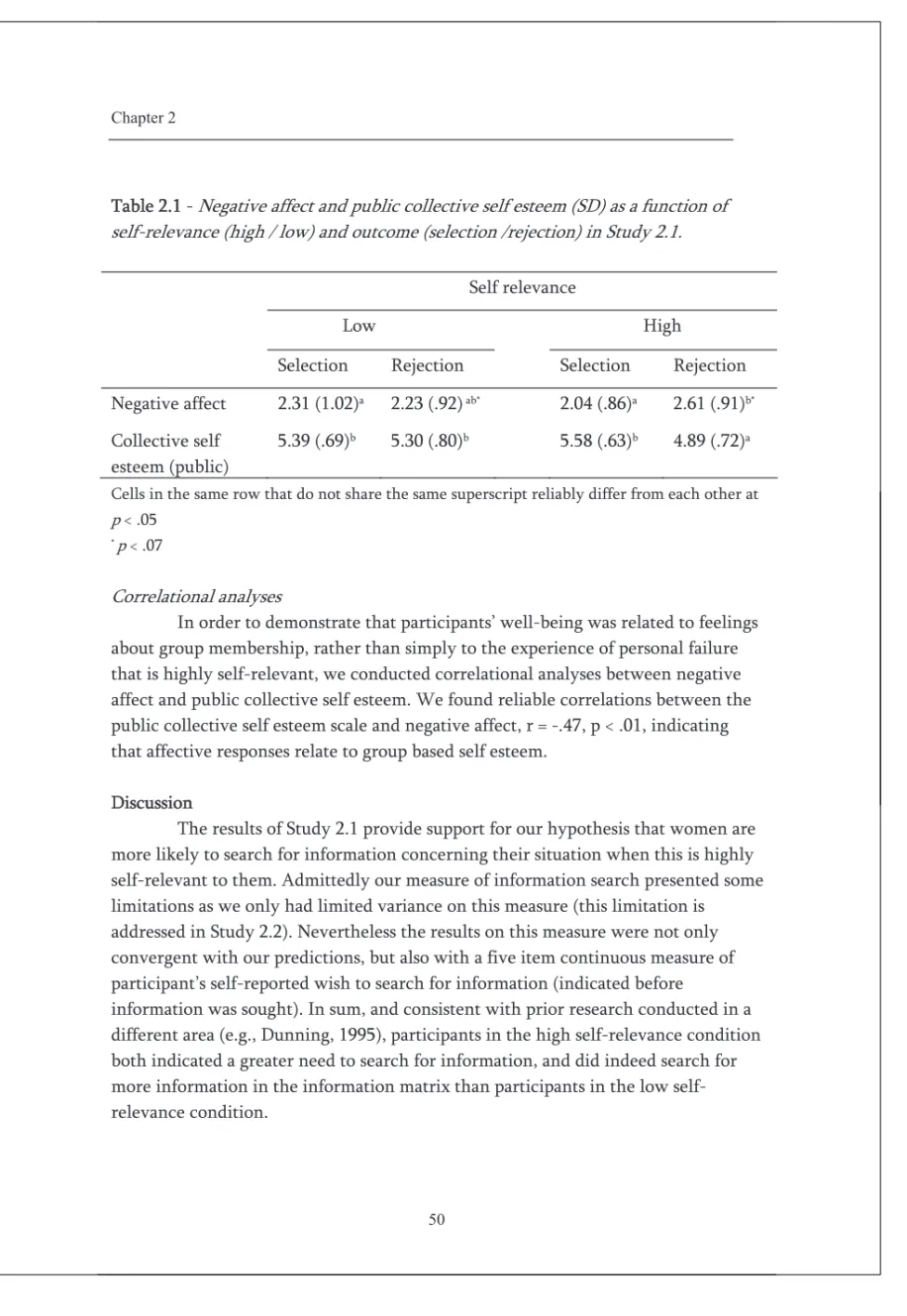
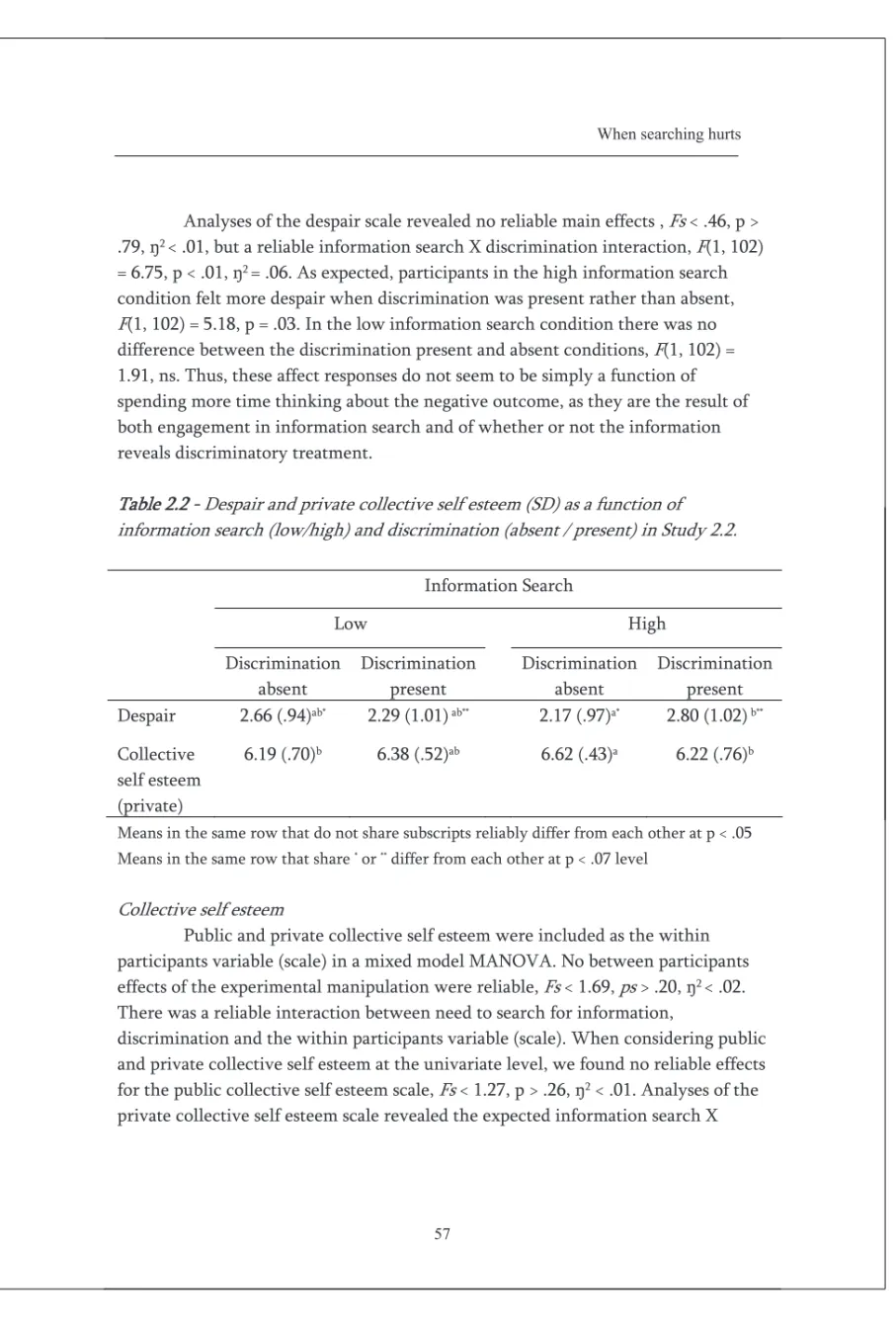
information (Study 2.2) encourage or block information search in situations in which it is ambiguous whether or not targets are being discriminated against. In my paradigm the information sought provided the only indication of discrimination to targets. This research builds on prior research in the area by considering information search from a target’s perspective. As outlined earlier, research on information format thus far only considered observers’ responses to instances of discrimination. The present study allows us to study to what extent people are motivated to search for information that can provide evidence of discrimination when dealing with personal outcomes that differ in the extent to which they are relevant to the self. Although self relevance may increase a focus on the self, and thus inhibit perceptions of discrimination (which require also having a group level focus), research in the area of information processing has indicated that the more self-relevant situations are, the more individuals engage in information search, to some extent regardless of the negative implications for the self (Dunning, 1995). I also consider to what extent information about and the discovery of discrimination are harmful or self-protective for well-being. Furthermore, I focus more in depth on the processes underlying responses to discrimination that is harmful for well-being: Do people suffer from the fate of their group, or rather from the negative consequences of their group membership for the self?
Chapter 3: To what extent does the nature of personal outcomes (individual level focus) versus the fate of one’s group (group level focus) determine attributions to discrimination, perceptions of injustice and well-being? – an individual and group level focus on subtle discrimination
suffer or profit from their group membership and do they, independently of their personal fate and motivations, perceive injustice against their group? In other words, how does the knowledge of outcomes of one’s group influence individuals’
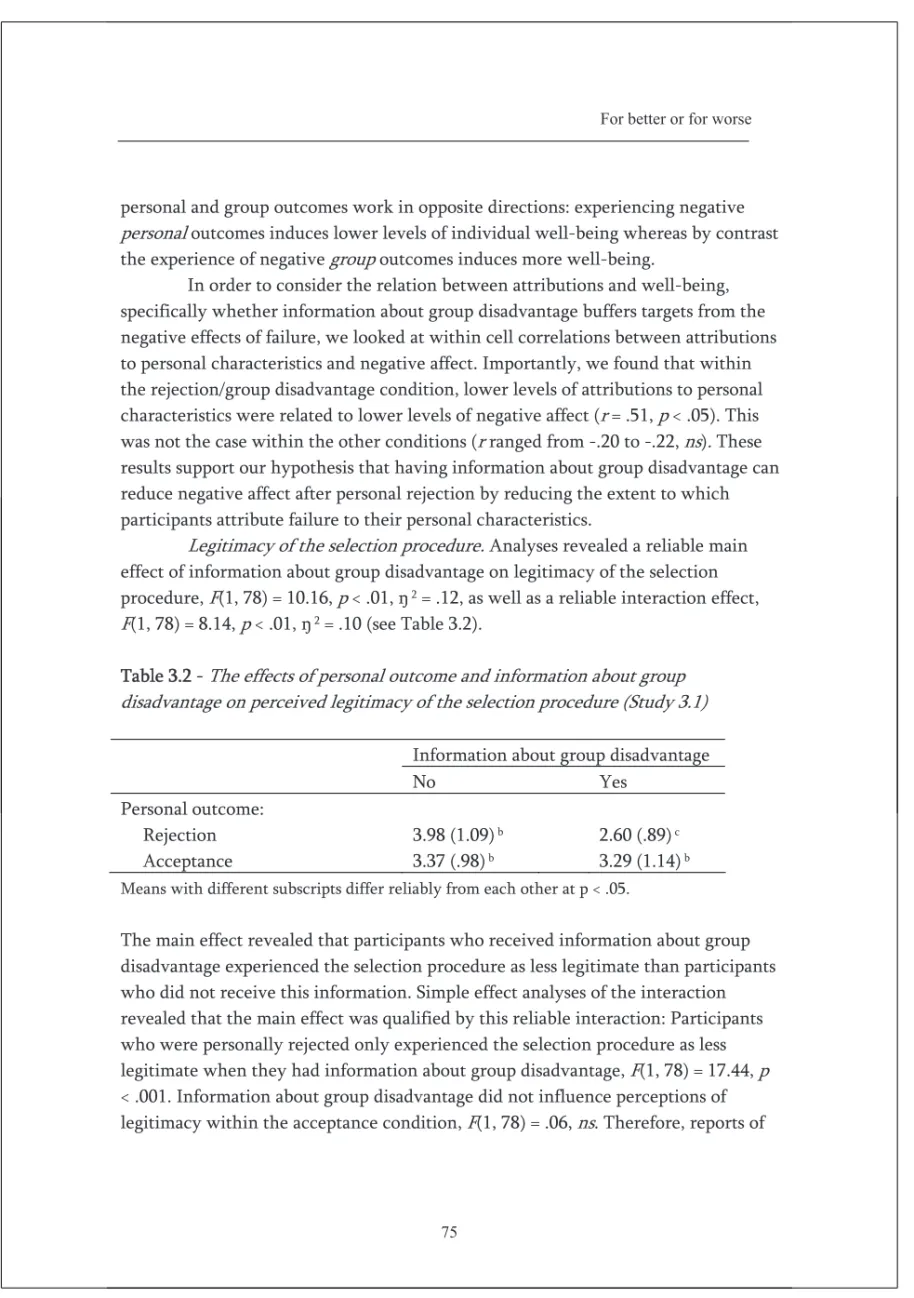
psychological well-being? The second question this research addressed was to what extent attributions to discrimination are motivated by the need to self-protect, or are merely the result of information processing. In other words, if people discount personal failure in favor of discrimination (i.e., the discounting hypothesis), do they make these attributions to protect the self, or because information about prejudice provides clear indications that not personal ability but prejudice is causing one’s personal outcomes? In the former case this would mean that individuals only discount personal outcomes in favor of a group outcome when experiencing personal failure but not success.
Chapter 4: Integrating motivational approaches: Countering the negative
consequences of pervasive discrimination by affirming the world as just – beyond an individual versus group level focus
The present chapter considers conditions under which perceptions of discrimination may buffer against or exacerbate the adverse effects of negative treatment on targets’ psychological well-being as well as exploring the underlying mechanisms for this effect. As such it aims to integrate seemingly conflicting findings in the area of subtle discrimination: Research has indicated that perceptions of discrimination can sometimes protect psychological well-being by allowing targets to attribute negative personal treatment and outcomes externally (e.g., to the prejudice of another) rather than internally (e.g., self-blame) (e.g., Crocker et al., 1991; Major et al., 2003a). Yet there is also evidence that perceiving discrimination is harmful to well-being because it signals devaluation of part of the self, the group self, as well as implying negative future treatment on the basis of one’s group membership (e.g., Branscombe et al., 1999; Schmitt et al., 2002c). In this fourth chapter we study the role of the pervasiveness of discrimination as a moderator of these processes. Although prior research has suggested pervasiveness of
convenient external attribution for failure and is relatively unlikely to occur again in the future. By contrast, discrimination that is perceived as pervasive may be
harmful in part (but see below) because it implies future negative treatment and outcomes on the basis of one’s group membership, which can lead to feelings of helplessness and depression (Abramson et al., 1989; Schmitt & Branscombe, 2002a; Schmitt et al., 2003).
Importantly, in contrast to prior research that has manipulated discrimination that is contextually pervasive in the sense that the number of prejudiced persons in the specific context differed (see Schmitt et al., 2003), we manipulated discrimination that was personally experienced but differed in the extent to which it was likely to occur in the future (i.e., temporal pervasiveness: rare versus recurrent). In our view this covered the essence of discrimination as being threatening – as opposed to self-protective - when it provides targets with a negative perspective for the future.
A further aim of this chapter was to examine the processes underlying responses to pervasive discrimination. Prior explanations of the negative
consequences of discrimination for well-being have largely focused on the fact that it implies future negative treatment and outcomes on the basis of one’s group membership which can lead to perceptions of barriers to one’s success and to consequent feelings of helplessness and depression (Abramson et al., 1989; Schmitt & Branscombe, 2002a; Schmitt et al., 2003). In this chapter I propose that attributing a situation to discrimination when this discrimination is perceived to be pervasive may not only be threatening because it has negative (future) implications for the self, but also because it threatens peoples’ worldviews, such as the belief that the world functions on the basis of principles of equality and fairness. I study this idea by giving individuals the opportunity (or not) of affirming the world as just.
Footnotes
1. I refer to identification as an individual difference level determinant of
perceptions of and responses to discrimination. Research indicates that perceiving discrimination can also influence levels of identification (Branscombe et al., 1999). 2. One might say that whereas cognitive aspects determine the direction of people’s attributions, the magnitude of these attributions may be determined by motivational factors operating at these different levels (see Postmes et al., 1999).
search in reactions to
subtle discrimination
1
As the blatant expression of prejudice is sanctioned in present society (Dovidio, Kawakami, & Gaertner, 2002), expressions of prejudice have become more subtle and implicit (Major, Quinton, & McCoy, 2002b; Swim, Cohen, & Hyers, 1998). As a result, women often fail to recognize prejudicial attitudes and
discriminatory treatment (Barreto & Ellemers, 2005). Yet, in order to achieve social change and improve the status of women it is essential to recognize and report discrimination.
Why would women fail to perceive they are discriminated against? According to research by Crosby and colleagues, failure to perceive gender
discrimination at the individual level may be due to lack of group-level information (Crosby, Clayton, Alksnis, & Hemker, 1986; Rutte, Diekmann, Polzer, Crosby, & Messick, 1994). Women typically only have information about individual cases of discrimination (e.g. their own treatment), whereas inferring discrimination may require the comparison of a larger number of cases (e.g., the treatment of other women and men members). Consequently, in many situations these inferences require an active search for additional information. Yet, we also know that elaborate information processing does not always occur (Eagly & Chaiken, 1993; Fiske & Taylor, 1991). Thus, when studying perceptions of gender discrimination it is important to consider to what extent its targets are motivated to search for and process the necessary information to discover discrimination in the first place. The first aim of the present research is to study conditions under which women are motivated to actively search for information about the cause of the treatment they receive, when placed in a situation in which it is ambiguous whether or not they are victims of discrimination. We focus on settings in which the relevance of individual characteristics seems primary (i.e., in evaluation settings in which women