N
ORMALW
INNERS: T
HES
TRATEGIES OFS
TRONGC
ANDIDATESEllen Gutman Galantucci
A dissertation submitted to the faculty of the University of North Carolina at Chapel Hill in partial fulfillment of the requirements for the degree of Doctor of Philosophy in the Department of Political Science.
Chapel Hill 2015
Approved by:
James A. Stimson
John H. Aldrich
Virginia H. Gray
Michael B. MacKuen
c 2015
ABSTRACT
ELLEN GUTMAN GALANTUCCI: Normal Winners: The Strategies of Strong Candidates.
(Under the direction of James A. Stimson)
Much research has focused on what challengers do to win an election. Little research
has been dedicated to exploring the behavior of candidates who are expected to win their
elections. Candidates who find themselves in close races are likely to act differently than
candidates in landslide elections because, as Kahn and Kenney (1997) suggest, voters
eval-uate candidates differently based on the intensity of the election. What things do candidates
who are expected to easily win their elections discuss?
By content analyzing websites of candidates for the U.S. House, Senate, and state
gov-ernorships from 2008, I find that candidates who are expected to win their elections are
likely to act in ways that will not draw attention to the election. They are less likely to
discuss controversial issues or mention their opponents than candidates in close races or
those expected to lose. Alternatively, they focus on valence issues and constituent service.
The same is true for their advertisements. Expected winners air fewer ads than candidates
in competitive elections and the ones they do air tend to have less controversial content.
In addition to the content differences between expected winners and competitive
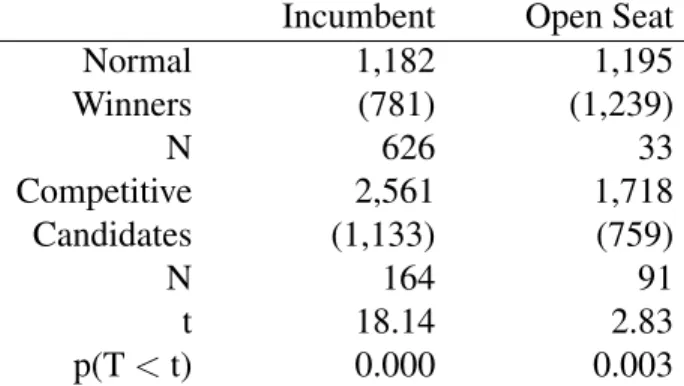
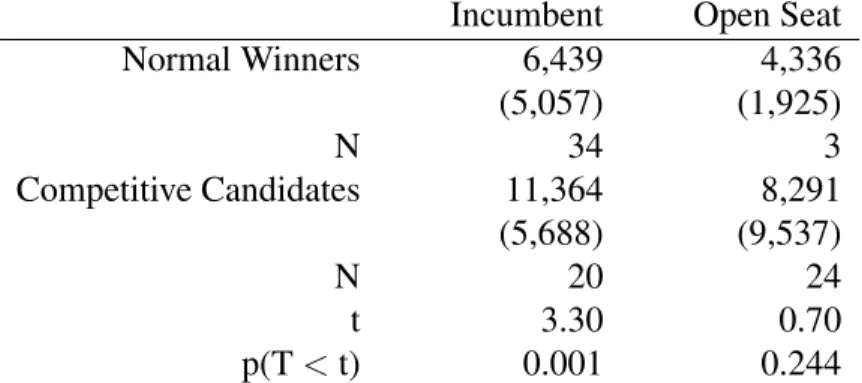
can-didates, the spending patterns are much different. When an incumbent faces a quality
challenger, he or she is likely to spend significantly more money than an incumbent who
does not face a quality challenger. The two most common theories for the reasons the
in-cumbents spend so little are that they want to avoid raising funds in the future (Jacobson
2004) and that they want to save a war chest for future elections (Sorauf 1988, Goldenberg,
can-expend as much effort to raise funds as other candidates, so that cannot possibly explain
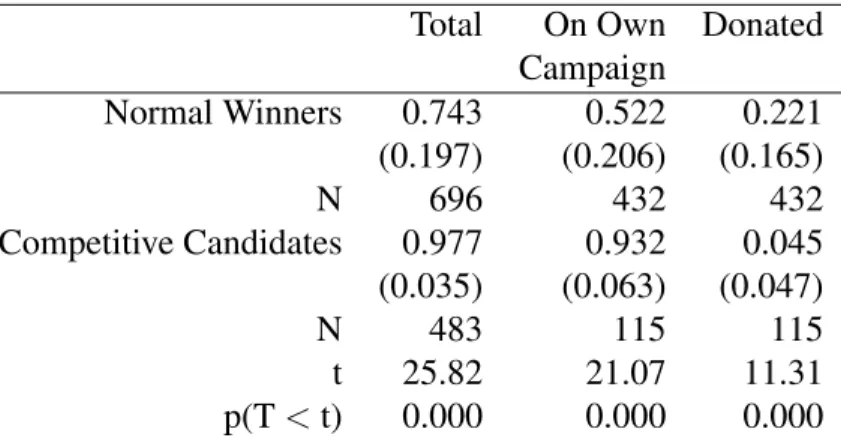
the decisions of these candidates. I also find that expected winners are willing to donate
large sums of money to other candidates, parties, and committees, leaving them with fairly
small war chests, so that cannot explain their behavior either. Instead, I find that expected
To Rob, for always being there for me.
ACKNOWLEDGMENTS
This dissertation would not have been possible without the love and support of my
family and friends. I am forever grateful for your encouragement throughout the process
of writing this. My husband, Rob, has kept me sane over the last couple years and I will
forever be grateful. My parents, Sharon and Dennis, have always supported me and made
me believe I could accomplish anything if I worked hard.
I am very appreciative of the time my dissertation committee spent helping me to finish
writing this. Thank you for all of the expertise you have provided to me. In particular,
thank you to Jim Stimson for reading this so many times and providing detailed feedback
each and every time.
I thank my colleagues and students at High Point University. Working at HPU while
finishing graduate school is one of the best decisions I have ever made. In particular, thank
you to Ali Yanus for your encouragement and friendship over the last eight years.
This dissertation would not exist without Jeff Bernstein, my unbelievable mentor at
Eastern Michigan University. Thank you for seeing my potential and encouraging me to
TABLE OF CONTENTS
1 INTRODUCTION . . . 1
2 A THEORY OF CANDIDATE STRATEGY . . . 9
3 VALENCE OVER VALUE: A LACK OF INFORMATION ON THE NET . . . 22
4 THE STRATEGY OF LIMITED SPENDING . . . 56
LIST OF TABLES
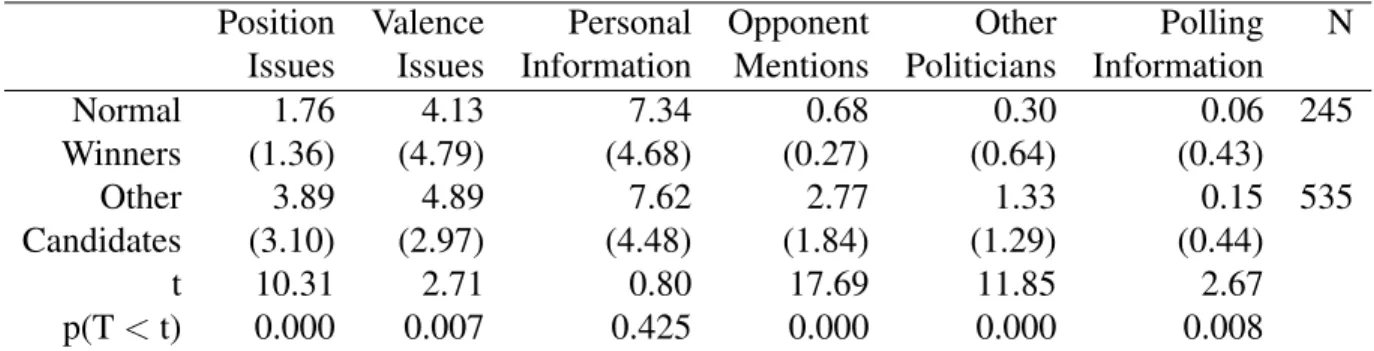
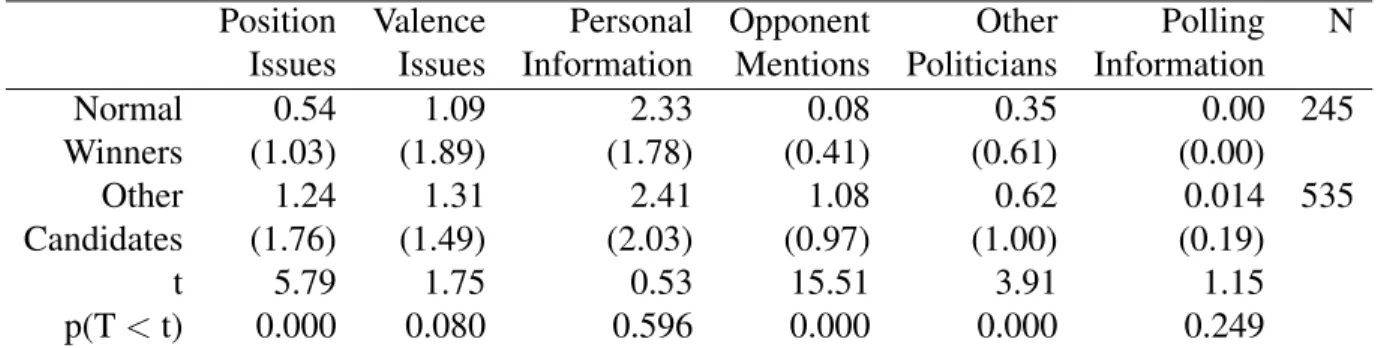
3.1 Average Difference in Overall Website Content, by Candidate Type . . . 52
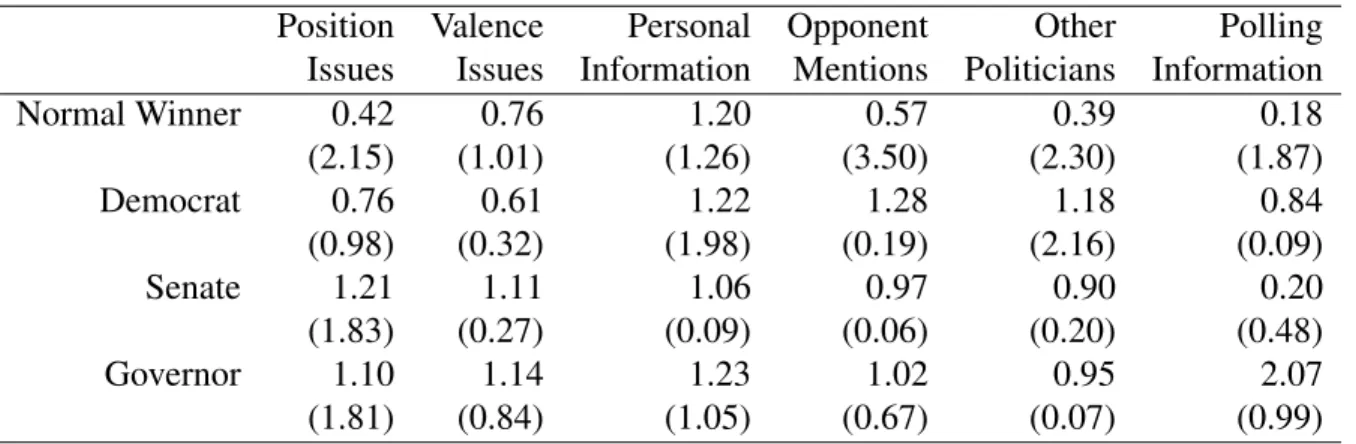
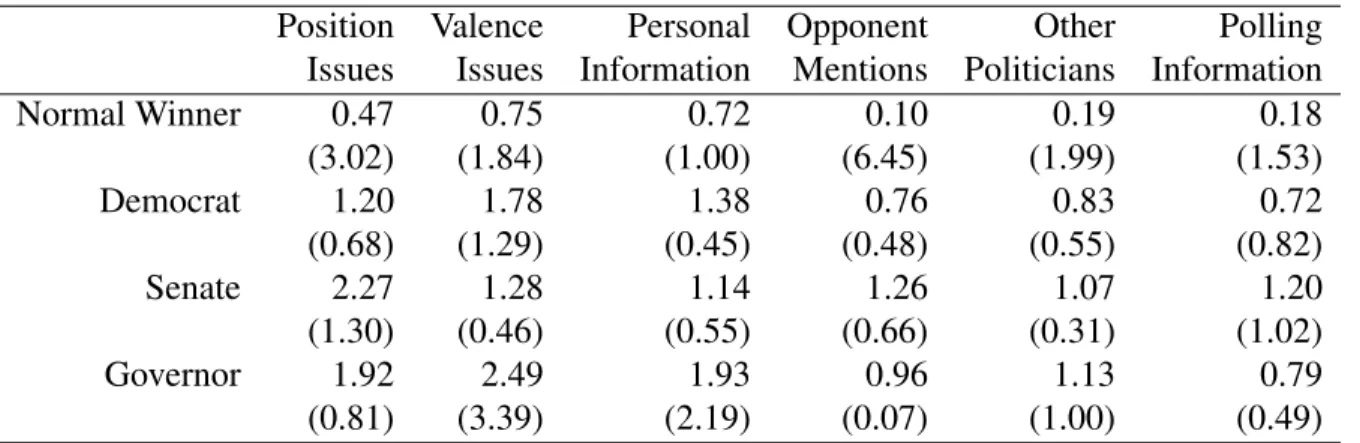
3.2 Types of Issues Discussed through Full Website. . . 53
3.3 Average Difference in Homepage Content, by Candidate Type . . . 54
3.4 Types of Issues Discussed on Homepage . . . 55
4.1 Average Spending in House, by Type of Candidate, in Thousands of Dollars . 79 4.2 Average Spending in Senate, by Type of Candidate, in Thousands of Dollars . 80 4.3 Average Spending in House, by Type of Candidate, in Thousands of Dollars . 81 4.4 Portion of Funds Spent on Self and Donated, by Type of Candidate . . . 82
4.5 Total Dollars in Thousands Spent by Candidates by Type of Expense . . . 83
4.6 Percentage Spent by Candidates by Type of Expense . . . 84
5.1 Average Number of Ads By Type of Candidate . . . 103
5.2 Portion of Ads Focusing on Each Area, by Type of Candidate . . . 104
5.3 Total Number of Ads Focusing on Each Area, by Type of Candidate . . . 105
5.4 Proportion of Ads Discussing Issues, by Type of Candidate . . . 106
5.5 Average Number of Ads Discussing Issues, by Type of Candidate . . . 107
5.6 Focus of Television Ads by Type of Candidate: Total Number of Ads . . . 108
5.7 Content of Ads By Type of Candidate: Total Number of Ads . . . 109
LIST OF FIGURES
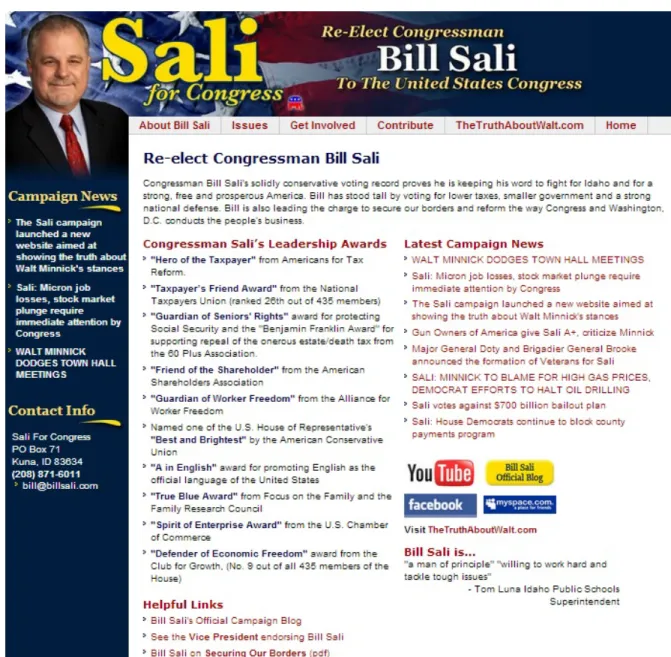
3.1 Bill Sali’s 2008 Website . . . 50
1 INTRODUCTION
In 2008, the citizens of the United States went to the polls in early November to vote in
national elections, just like they do every two years. The people needed to make many
im-portant decisions regarding the election that would effect the future of our country. Would
they choose to vote for Barack Obama or John McCain for the presidency? Did they prefer
the Democrat or the Republican for the House of Representatives? Who should be their
new governor or senator? Was it even worth their time to vote? And how would they make
these important decisions?
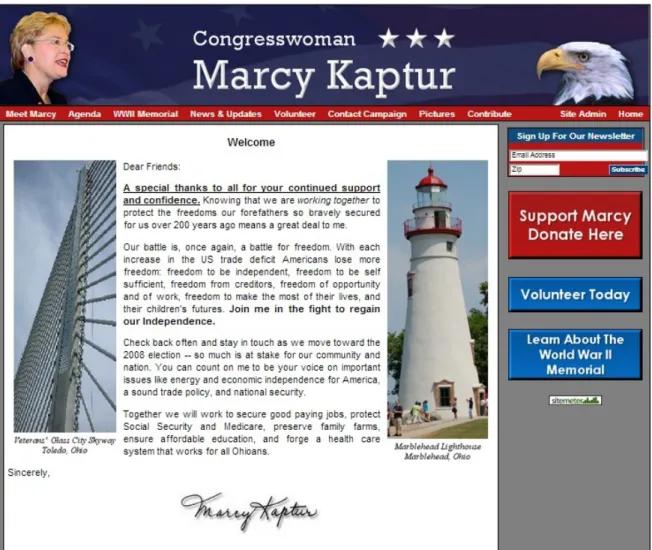
In northwestern Ohio, voters found themselves making a familiar choice for the House
of Representatives. They would have the choice between the incumbent, Marcy Kaptur,
who had held the seat for two and a half decades, and the challenger, Republican Bradley
Leavitt, who had also challenged Kaptur in 2006. Kaptur used the same strategy as she had
in the previous election. She spent under a quarter of a million dollars campaigning, not
including donations she made to other candidates. She did not run a single televised
adver-tisement. She sent a few fliers to voters in her district but they did not provide voters much
information about her plans for the next two years (The Center for Responsive Politics).
When the election day came, the result was the same as it had been two years prior: Kaptur
won with about 75% of the vote. How was it possible that a candidate could put nearly no
Two years later, Kaptur faced a much more well financed candidate than she had in
2008, Republican Rich Iott. Iott raised and spent nearly two million dollars on his challenge
against Kaptur. He also had the country leaning in his direction - he was a Tea Party favorite
in an election in which Republicans would take over many previously Democratic seats.
While Kaptur changed her strategy slightly, she did not stray too far from her 2008 plan.
She spent less than a third of the total amount of money that was spent by her opponent.
She ran a few television ads this time, but they still did not tell voters much about her;
her primary message for voters was that she “supports the troops” (Center for Responsive
Politics, Wisconsin Advertising Project). She won the 2010 election by about 20% of the
vote. While it was not the 50% she won by in 2008, her strategy was still working. How
could a candidate spend so little compared to her opponent, hardly campaigning at all, and
still win so easily?
About 2,000 miles west of Ohio, a very different election was occurring in 2008.
Re-publican Bill Sali, a freshman in the House of Representatives, was also running for
reelec-tion. Republican Butch Otter had left the seat in 2006 to run for governor and Sali won a
close primary and a close general election to replace him. The 2006 election had been a
hard fought battle but running for reelection should have been easier for Sali. After all, the
First District of Idaho was heavily Republican. John McCain would win the district with
over 60% of the vote that year; George W. Bush had received nearly 70% four years earlier.
And the Cook Political Report had labeled the election “Solid Republican.”
Sali began the election with force and purpose. He pegged his opponent, Walt Minnick,
Idahoans will find out who the real Minnick is. An environmental extremist.” (Warren
2008) Sali explained to voters that his opponent would “increase taxes” once in office by
referencing a statement Minnick had made more than a decade before, though Sali was
misrepresenting Minnick’s actual views (Idaho Statesman 2008). Voters in Idaho should
have liked what Sali was telling them; they did not want their taxes raised nor did they
like extremists. Additionally, Sali was an incumbent Republican. All arrows should have
pointed to an easy reelection victory. As the election approached, Sali lost ground, with
pollsters predicting either candidate could potentially win. Then, on November 4th, Walt
Minnick defeated Bill Sali by just over 4,000 votes. How could such a candidate possibly
lose his reelection campaign?
Both Marcy Kaptur and Bill Sali “should” have easily won their elections. They were
both incumbents running in districts that largely favored their party. However, they took
very different approaches and strategies. Kaptur spent very little time campaigning and told
voters almost nothing about her legislative plans for after the election. Sali, on the other
hand, spent much more time and effort campaigning. He met with constituents, told voters
why they should avoid his opponent, and discussed his plans for his time in Washington
following the election. So how can it be that Sali lost the election and Kaptur won so
easily? Why would voters support the candidate they rarely saw but oppose the candidate
who was honest with them about his goals and plans for his time in office, most of which
seemed to align with the views of the district?
But Kaptur and Sali are not the only candidates that devise surprising campaign
been in office for two and a half decades, easily maintaining his seat. He raised a moderate
amount of money compared to many other candidates and spent about $200,000 on his
campaign. At the end of the election, rather than saving any money he had left over, he
donated nearly $400,000 to others as he had spent on his own campaign, with the primary
recipient of his donation being the Democratic Congressional Campaign Committee
(Cen-ter for Responsive Politics). Why would a candidate choose to give more money away than
he spent on his own election? Why would Levin choose to donate so much money rather
than saving it for a future election?
A discussion of the different strategies these candidates took and the rationale behind
them is the main focus of this dissertation. I seek to explain why candidates choose the
electoral strategies that they do. In doing so, I hope to explain more than just what
incum-bents do when running for reelection or how they react to strong challengers. I will look at
different types of incumbents and challengers and consider what they might do in the face
of certain opponents. It will not be a story of incumbents who face quality versus weak
challengers, as many have studied (Jacobson and Kernell 1983, Jacobson 1989, Epstein
and Zemsky 1995). It will be about candidates who “should” win their elections versus
candidates who are not expected to win. It will also consider the strategies of candidates in
close “races,” who often take different strategies than expected winners and losers.
Much of the literature discussing candidate strategy focuses on incumbency as the
pri-mary factor that determines success. While many incumbents running for election will
win their seat again, incumbency has no guarantees. Within research that examines
held some previous elected office, and non-quality or weak challengers, who have never
held an elected office (Jacobson and Kernell 1983, Jacobson 1989, Epstein and Zemsky
1995). Others have attempted to create indices with additional criteria to determine the
quality of a challenger for office. These include information such as previous attempts
to run for Congress, even if they were unsuccessful, a candidate’s “celebrity status,” and
any previously held non-elected public office. These measures do perform better than the
dichotomous quality measure in predicting candidate behavior (Krasno and Green 1988).
However, incumbency and quality of challenger are certainly not the only factors weighing
into the decisions of these candidates when they choose strategies.
There are many instances in which the quality of challengers does not predict candidate
behavior successfully. Quality challengers who have won elected office previously still
rarely beat incumbents; less than 20% actually defeat the incumbents and win their
elec-tions (Epstein and Zemsky 1995). While 20% is better than the 4% success rate of weak
challengers, it certainly does not explain much about most elections. It does not give a clear
picture of what incumbents are doing in these elections and why they might be choosing the
strategies that they do. While some nuanced measures of the quality of challengers yield
slightly better results (Krasno and Green 1988), it appears from this research that
incum-bency and the quality of the challenger are not the only important factors in determining the
outcome of an election. These studies do not examine the strategies of the candidates once
the election season is in full swing nor do most consider outside factors influencing the
election, such as the coattails of a presidential election. They do not account for the swings
victory who were not expected to be successful when only looking at “quality.” Therefore,
I take a different approach by looking at candidates’ expectations of winning. While the
quality of the challenger is important, many other factors are as well. With the belief that
candidates make decisions based on their expectations of winning rather than one aspect of
their opponents, I look at the influence of such expectations on their strategies.
The question of whether campaigns really matter has also been debated in political
science for many years (Finkel 1993, Key 1966, Campbell et al. 1960, Holbrook 1996).
After all, many elections are highly predictable; the outcome of such elections can often be
predicted long before the candidates have even filed to run (Fair 1978, Brody and Sigelman
1983, Lewis-Beck and Rice 1992, Holbrook 1996, Wlezien and Erikson 1996, Norpoth
1996, Campbell and Garand 2000, Campbell 2000, Hibbs 2000). Does that mean that an
examination of candidates’ strategies is worthless as it does not matter what they do?
I contend that the reason campaigns seem not to matter is because expected winners
choose strategies that will guide them to victory. These strategies are carefully considered
at every step of the electoral process. Expected winners make decisions which will prevent
their opponents from becoming relevant in the election so that the events throughout the
campaign season prevent the election from becoming anything other than predictable. In
other words, the reason campaigns seem not to matter much of the time is because
candi-dates tend to take smart, strategic decisions that help to ensure repeated success.
Plan of this dissertation
Chapter 2 outlines a theory of the strategies that expected winners take in their elections.
goals as well as why they might avoid engaging their opponents. It will present a definition
of “normal winners,” which are candidates expected to win their elections, and discuss
the ways such candidates attempt to prevent their opponents from becoming visible and
relevant in their elections. They are expected to avoid discussing all controversial issues
and do everything they can to keep people from paying close attention to the candidates
and the choice they will have to make on election day.
Chapter 3 will include the first empirical test of this theory. Hundreds of websites from
the 2008 congressional and gubernatorial elections will be tested to determine whether the
patterns outlined in Chapter 2 hold. Normal winners, on average, are found to discuss fewer
controversial issues on their websites, discuss their opponents less frequently, and are even
less likely to mention their party affiliation than other candidates
Chapter 4 looks at the ways candidates spend their campaign funds. The conventional
wisdom is that incumbents in safe elections spend little money because they would prefer
not to raise money (Jacobson 2004) or because they want to keep a war chest (Goldenberg,
Traugott, and Baumgartner 1986, Goidel and Gross 1994, Hersch and McDougall 1994,
Box-Steffensmeier 1996, Hogan 2001) is challenged. The fundraising activities and
ex-penditures of normal winners reveal that, even when expected to win easily, they continue
to ask for donations and then give large sums of money to their party or other candidates
rather than saving it in a war chest. Since neither of these theories holds, it seems expected
winners make the choice to refrain from spending all of the their money as a strategic plan
to avoid making the election more competitive.
strategies of candidates. Many normal winners do not air ads during their elections and
the ones who do tend to present very little information to voters. Like with their websites,
normal winners tend to avoid discussing controversial issues and their opponents, instead
preferring to focus on themselves and noncontroversial issues, like their support of safety
2 A THEORY OF CANDIDATE STRATEGY
Many different aspects of candidates and elections factor into the campaign decisions of
those seeking office. While many researchers have examined the specific factors, I seek to
look at the overall picture of the election and determine candidate strategies based on their
judgment of the election. We need to move beyond looking at the specific factors and look
for a new method of judging campaign strategies that will provide an explanation as to how
the expectations that candidates have about how their likelihood of winning will influence
their decisions throughout the election season. How can we differentiate between different
types of elections in a way that will allow an investigation into the strategies candidates
pursue?
What Is a “Race?”
Elections can take many different forms. Some are very competitive while others,
bar-ring any particularly unusual circumstances, can be predicted long in advance. On each
election day, voters go to the polls to decide between different candidates in different
“races.” We generally use the word race to describe all of these contests but many cases,
elections are not competitive enough to really be considered races.
So what is a race? First, it must have two or more candidates competing for the
is predetermined. While there are certainly uncontested elections, most meet this
require-ment.
A second criterion for an election to be considered a race is that either side could win.
This means that an unknown candidate in the contest against a seasoned veteran does not
make it a race; in most cases, these candidates are not viable. Often, even major party
can-didates do not really have a chance in many constituencies. A heavily Republican area will
almost never elect a Democrat; extenuating circumstances would need to exist to make the
Democrat a possible winner of the election. Despite that, both parties will put a candidate
in nearly every electoral contest. Therefore, a race must not just have two candidates but
must have two candidates who each have the potential to win.
Third, an electoral contest is only a race if some people have not made their decision
about which candidate to choose. If all voters have already chosen between the candidates,
the second criterion is not met because both candidates do not have a chance of winning. If
no one can be persuaded by the candidates, their strategies do not matter. If there is nothing
that candidates can do to influence the votes of the people, the contest is predetermined and
not really a race.
My fundamental thesis is that normal winners will do whatever they can to prevent their
elections from becoming races. In all of the things that normal winners can control, they
will attempt to avoid the election becoming close. All of the specifics in this essay are
How Often Do Races Occur?
These qualifications are fairly hard to meet. In many constituencies, one candidate wins
with a large portion of the vote and voters were not even aware of the other candidate(s) in
the contest. In most election years, at least 90 percent of candidates running for reelection
for the House of Representatives win. Well over half of these incumbents amass more than
60 percent of the two-party vote. Even when an open seat is contested, close to half of the
winners get more than 60 percent of the two-party vote (Jacobson 2004).
One reason so many of these candidates win by such large margins is because of a
general lack of knowledge about challengers. When asked to name the candidates in an
upcoming election for the House, only about half of voters can recall the name of the
in-cumbent candidate; less than 20 percent can name the challenger in most years (Jacobson
2004). While the case of House elections may be more extreme than some other
elec-tions, such as gubernatorial or Senate elecelec-tions, even fewer people know the names of the
challengers in many state and local races.
This implies that real races are not very common. If almost no one in the district knows
the name of one of the candidates, that candidate has little to no chance of winning. For the
most part, people have already decided which way to vote.
This leaves three different types of elections. Some elections are uncontested. While
this situation is the favorite of candidates since it guarantees victory, there is little that a
candidate can do to ensure that no other candidates enter the race. Second, many elections
are competitive races, in which either candidate could win. These elections are difficult to
somewhere in the middle: an expected winner has competition but the other candidate is
not a serious threat. When expected winners do have a competitor, there may be things that
can be done to prevent the opponent from becoming serious. While this scenario is not as
ideal as having no opponent at all, it is much easier to be successful than elections with
competitive opponents.
Elections that are won easily can help to lay the groundwork for future elections. Why
would anyone want to challenge a candidate who is nearly guaranteed success? If expected
winners can make it look as though they can win any election by large majorities, strong
potential challengers may choose to avoid running, as failure is a near certainty. By making
decisions that will help to ensure easy success, these candidates may help to create careers
as politicians, not just single terms. This prevents serious challenges in the future and helps
to keep the officials in office for the long-term.
What can a candidate do to ensure that an opponent stays non-competitive? If the
normal, expected winner can set the tone of the election, there may be opportunities to
prevent a non-serious opponent from becoming more competitive. What strategy might
such a candidate take to keep the election easy to win?
Theories of Candidate Strategy
To be able to develop a theory of candidate strategy, it is necessary to assume that
candidates want to win their elections. While it is possible that some candidates have other
goals in running, such as a third party candidate who wants to bring attention to a specific
issue, it appears that candidates try to win their elections. Between the time, money, and
Most elections have an expected, “normal” outcome, in which the voting patterns of
voters continue from one election to the next. Many voters are partisans, who will vote for
the same party in each electoral contest. There may be short-term forces that change the
portion of the vote one party’s candidate receives, but one candidate is still usually expected
to win. For example, if a Democrat has won the last three elections with 70% of the vote,
even if the country is hostile toward Democrats in the next election, that candidate is still
likely to win. He or she may only receive 60% of the vote, but that will still be more than
enough to secure victory. The underlying party affiliation of voters is enough to make the
election predictable, and therefore “normal” (Converse 1966). Such elections will have one
“normal winner,” who is expected to win on election day. Any opponents to this expected
winner are “normal losers,” because they are projected to be soundly defeated. “Race”
candidates are those in elections with no clear expected winner and loser.
In normal elections, expected winners are often able to gather support even from
mem-bers of the opposing party. While some will continue to support their party’s candidate,
others will vote for the candidate that they know will win. If the voters of a district are 60%
Democratic, a Democratic normal winner is likely to receive even more of the vote than the
party affiliation shows. When a Republican candidate becomes competitive, Republican
voters are likely to switch their support to this candidate rather than the Democrat. When
the election stays non-competitive, the normal winner is likely to continue to pull these
votes from the other side. These elections are ideal for normal winners; they help make
success easy in the election. What can a normal winner do to keep pulling these votes from
Many events outside of the hands of the candidates can influence the choices that voters
make, such as a presidential election influencing the views of voters on candidates for
lower offices. But many things are within the control of normal winners. As much as
normal winners can, they are expected to choose strategies that will allow them to win as
easily as possible. Assuming they have some control over the tenor of the election, normal
winners are expected to do everything they can to avoid the election becoming a race. What
are the things a normal winner can do to prevent a “race?”
Discussing Issues
Candidates have the ability, to some degree, to create an image of themselves in the
minds of voters. They have the opportunity to create a message for voters which includes
information about their policy beliefs, specific plans, and agendas if elected to office. Or,
they can be ambiguous with their messages, leaving out many of the details of their goals
and opinions. Candidates have some ability to choose how much they will talk about issues
throughout their campaigns. They can choose to tell voters their plans for their time in
office, or they can avoid discussing such matters. While candidates may not have complete
control over their ability to discuss issues (if a reporter asks a pointed question, candidates
cannot always completely evade the issue), they do in many outlets, such as advertisements.
What would normal winners be expected to do in such circumstances?
One way for normal winners to avoid having their elections turn into races may be to
avoid discussing position issues. Position issues are inherently controversial and at least
two sided (Stokes 1966). If a normal winner starts publicly discussing a position issue,
normal loser to express him or herself and cause voters to start paying more attention to the
election. Because some voters will disagree with the point of view of the normal winner on
position issues, they may begin to question whether they support this candidate overall. At
that point, some voters may begin to turn to the normal loser when they otherwise would
not have noticed this second candidate, creating a closer election than would otherwise be
expected.
A complete lack of issues throughout the election could be problematic, however. If
voters notice that candidates do not appear to tell them anything about their views, it could
hurt their electoral chances. While some research has shown that discussing few issues can
increase the appeal of candidates to voters (Downs 1957), others have found that it can hurt
the chances of some candidates (Shepsle 1972). If normal winners are concerned about
the possibility of becoming too vague and ambiguous on issues and losing supporters as a
result, they may choose to discuss valence issues as an alternative to position issues.
Valence issues do not provide normal losers the same opportunity to become involved
in the public debate. According to Stokes (1966), valence issues are issues “on which
parties or leaders are differentiated not by what they advocate but by the degree to which
they are linked in the public’s mind with conditions or goals or symbols of which almost
everyone approves or disapproves.” Whereas position issues may invite normal winners
into the discussion, valence issues, about which nearly everyone agrees, do not invite the
normal loser to participate. There is no need to contest claims of support for motherhood
and apple pie. We all support America, education, and the troops. If a normal winner says
opposes it. Valence issues can help to keep the amount of debate between the candidates
minimal, which could prevent a race from occurring.
In the parts of their campaigns normal winners can control, some may choose not to
explain their views on any issues as all. However, when they do discuss issues, they are
expected to primarily discuss valence issues rather than position issues.
Talking to Opponents
In some elections, the candidates will frequently discuss and debate the issues and the
facts of the election. Many candidates will tell voters how much their opponents will hurt
America or that they are lying about how they will vote on issues. The candidates may also
participate in organized debates, in which voters can compare and contrast the plans of the
competitors.
When such discussions happen, it may become easier for voters to compare the
candi-dates. When the candidates are not speaking to each other, it is like they are running the
100 meter dash on opposite sides of the track. It is hard to tell the differences between their
speeds because they are so far apart. The same is true for politicians; if the candidates are
not comparing themselves or debating, it may be difficult for voters to see the differences
between them.
Normal winners are unlikely to want voters to see these differences. If voters can
compare the candidates because they are talking to or about each other, it means they are
paying attention to the views of both candidates and the normal winner is taking positions
on issues. When voters are comparing the candidates, it means voters could choose either
race situation by making it difficult for voters to see the differences between them and their
opponents.
Another potential problem for normal winners in this situation is simply that the normal
losers become more visible to voters. In many cases, normal losers are nearly invisible,
with nearly no name recognition and much less knowledge by voters of their opinions on
issues than for their opponents. However, when normal winners are talking to or about
normal losers, it helps bring attention to these candidates, which they were unlikely to have
otherwise. Normal winners would not be expected to do things that would bring recognition
to their opponents so they are unlikely to discuss their opponents whenever possible.
The discussion of horse race polls may also bring attention to the normal loser. If polls
are released that claim the election is close, regardless of whether or not it is true, it can
make the contest appear to be close to voters. Since voters do not conduct their own public
opinion polls, they tend to believe the polls released by campaigns. If voters believe that
the contest is a race, it can lead them to pay attention to the normal loser, who they might
otherwise ignore. Therefore, normal winners are likely to make it appear as though they
are winning easily and by large margins. They are likely to avoid discussing horse race
polling that gives the appearance that a race is occurring, especially if the polls that say the
election is close. It draws attention to the election and gives credibility to the normal loser
which can make the election appear to be a race.
Relationships with other Politicians
Beyond their opponents, normal winners may not want to be tied to other politicians.
can be similar to discussions of issues. Other politicians can be controversial and, whether
positive or negative, discussing them can cause the election to change and create a
contro-versy that normal winners are likely to try to avoid. Even the most loved politician is not
loved by everyone and has the potential to create controversy if associated with a candidate.
The problem of association for normal winners is that other politicians have views,
some of which are well known. For example, if a candidate compares him or herself to
President Barack Obama, voters may begin to assume the candidate has the same views as
the president on everything. Even in places throughout the country where Obama is
pop-ular, voters may dislike some of the things he has done in office. If voters start believing
the normal winner agrees with the things they dislike about Obama, it could hurt the
can-didate’s chances of success because now voters have started to pinpoint his or her opinions
and can judge accordingly. The accuracy of those assessments may even be wrong, but
voters still feel like they know the candidates and may start to judge the candidates based
on their issue positions, which would not have occurred otherwise.
Personal Information
Many candidates choose to discuss their personal lives and histories with voters. Haynes,
Flowers, and Gurian (2002), drawing on Scammell (1998), discuss this as a possible
strat-egy of campaigning. Scammell discusses two types of campaign strategies: competitive
positioning, in which candidates define themselves based on where they are in relation to
other candidates, such as with polling, and substantive positioning, in which candidates
define themselves by the issues. Hanyes, et al. introduce a third: neutral or nonstrategic
events, personal information, and other forms of information that are disseminated by every
campaign but are not about issues or the other candidates.
Based on the name, it is pretty obvious that this is viewed by the authors as necessary
but not a way to win elections. However, focusing on these aspects of a candidate can
be quite strategic. It allows candidates to talk about something, so it appears as though
they have something to say, but not talk about anything that could create a race. Personal
information is very unlikely to anger any voters and can help to make a candidate seem
more relatable.
Campaign Spending
Another way for normal winners to avoid races is to limit spending. Though normal
winners generally have the ability to raise large quantities of money, if they spend all of
that money, they might attract attention to the contest. Using money to advertise could
cause people to pay attention to the election that would have otherwise ignored it. When
candidates spend large sums of money on their contests, they are more likely to lose
(Ja-cobson 2004). While it is commonly believed that spending is the effect of a close race, in
that candidates spend more reactively when they have a more difficult election, some
can-didates may believe the opposite: spending a lot of money causes a close election. When
candidates are spending more money in an election, it is usually because they are
advertis-ing more. When candidates advertise more, voters may start payadvertis-ing more attention to their
message. When people start paying attention to an otherwise largely ignored election, it
can turn the contest into a race. In order to prevent this from happening, normal winners
Turnout
Some citizens will choose to vote in every election; others will sit out each year. A third
group exists which will choose to vote some of the time. This group can be influenced by
the tone of the elections that are occurring. High turnout may occur because people are
generally excited about one or more contests on the ballot.
Certainly, some candidates have little ability to influence turnout. In a presidential
election year, for example, most of the other contests on the ballot will not motivate people
to get to the polls if the presidential election has not already done so. In other years,
however, some candidates lower on the ballot may have the ability to manipulate turnout.
If high turnout occurs because people are paying attention to a particular election with
a normal winner in the race, then something has gone wrong for that candidate. In this
situation, people are paying attention to a contest that would normally be largely ignored,
which means it has turned into a race. Since normal winners want to avoid turning the
election into a race, they should not encourage a high turnout election.
This does not mean that candidates will stop their mobilization efforts on election day.
Candidates will certainly want to encourage their supporters to get to the polls and
partic-ipate. However, they will not spend their energy prior to election day encouraging a high
turnout election.
Conclusion
Candidates can change their strategies throughout an election. As the situation dictates,
they can attempt to become more or less visible to voters. They can choose the number of
matters or policy issues. If normal losers becomes more active in elections and start to gain
traction with voters, the normal winners can respond as they see fit.
Normal winners never want to help normal losers to become well recognized and active
in an election. If a normal loser can gain attention independently, as happens in some
elections, the normal winner can do little about it other than change strategy and respond.
If normal winners can control the tone and content of elections, at least to some degree,
the pieces of their campaigns should reveal the strategies they choose to take in an effort
to understand how they attempt to hold back their competitors. Through examining several
aspects of candidates’ strategies, it will be possible to test these theories of limited content
3 VALENCE OVER VALUE: A LACK OF INFORMATION ON THE NET
In 2006, Ohio’s 18th congressional district needed a new representative. Republican
Bob Ney, who had held the seat since 1995, had been implicated in relationship to the Jack
Abramoff lobbying scandal and several Democrats vied for his seat. Ney ran for reelection
initially but dropped out in August, leaving Democrat Zack Space and Republican State
Senator Joy Padgett as the top contenders for the seat.
The election was expected to be close from the beginning. Like much of Ohio, the 18th
district was split nearly in half. The voters had narrowly chosen President Bush over his
opponents in 2000 and 2004 but the Republican name had been tarnished by the actions of
Ney. Additionally, the country as a whole was leaning more Democratic. President Bush’s
approval rating was in decline and the Democrats were pushing to take back the House of
Representatives from the Republicans.
Knowing that the election would be close, Space went on the offensive. He filled his
website with information about his positions on issues. He discussed the need for
improv-ing medical research by usimprov-ing stem cells, sayimprov-ing “This nation can, and should lead the way
in researching this, the most promising medical development we have seen in decades.”
He promoted the “need to provide health care to every American” and outlined his plan
committed to securing the goals of independence, freedom, and democracy in Iraq” (Space
2006).
He also frequently discussed his opponents on his website. When Ney was still
attempt-ing to be reelected, Space linked in an article called “Ney Runs To The Border To Escape
Failures On Illegal Immigration” and explained that voters were ready to “fire” Ney. After
Ney withdrew from the election and was replaced with Padgett, Space linked to the
arti-cle “Ney’s Handpicked Replacement ‘Flattered’ To Be Chosen By Corrupt Congressman.”
Throughout the election season, Space continued to explain his position on issues and why
voters should avoid his opponent (Space 2006). The election was expected to be close.
While many elections can be predicted in advance, polling firms shied away from making a
prediction on the 18th district. For the months leading up to the election, even into
Novem-ber, the race was considered to be a toss-up (Cook Political Report). After using a strategy
in which he openly discussed his positions and ideals, Space ended up winning soundly
with 62% of the vote.
The 2008 election for Space was a bit different. He was an incumbent this time and
Barack Obama was running for the presidency. President Bush’s approval ratings were at
an all time low. Space was likely to maintain his hold on his seat, with projections saying
that he would defeat his Republican opponent (Cook Political Report). Space took a very
different approach to campaigning this time around.
Space’s website was designed completely differently, with one key section missing:
issues. He no longer used his website to explain his position on stem cells or Iraq. In fact,
to articles but very few provided information about Space as a politician. There was a small
amount of information in the articles, such as that he planned to “attend [an] NRA Banquet
in Zanesville” and his opinion that NAFTA was “irresponsible” but the bulk of the articles
explained that he had been endorsed by groups like seniors and veterans and that he would
provide “sensible leadership” for his district (Space 2008).
The expectations about the outcome of the election were much different in 2008 than
in 2006. Now, Space was considered a normal winner; his election was not expected to be
a close race. He altered his campaign to reflect his change of standing, limiting the amount
of information provided to voters. Rather than discussing positions, he discussed being a
“Friend of [the] Farm Bureau.” His strategy appeared to be much different than two years
prior. In the end, he successfully defeated Republican Fred Dailey by 20% of the vote.
In 2010, Space found himself in an election that was different than the two prior. This
time, the Republicans would have the advantage nation-wide. In his district, with a majority
of voters tending to favor the Republican party, he could face a strong challenge. Early in
the election, his seat was considered leaning Democratic, but that was changed to toss up
about two months before the election (Cook Political Report). While the situation was
different than 2006 because Space was now an incumbent, the outcome was just as much
in question. What would Space’s strategy be this time around?
While the overall format of Space’s website in 2010 was the same as 2008, the
informa-tion within it had changed. The news secinforma-tion was still the best source of informainforma-tion about
the campaign on the website but nearly every article was now dedicated to Space’s
on his own campaign, rather than his opponent. This time, he chose a strategy more like he
had in 2006 and used his website to attack his opponent. He had stories like “New TV ad:
The Gibbs plan for positions he can’t outsource? Fill them with illegal immigrants.” He
claimed “Gibbs’ campaign to deceive voters reaches new low” and “Go-Along Bob Gibbs
chooses: Blind loyalty to party leaders...again!” Nearly half of Space’s stories referred to
his opponent as “Go-Along Bob Gibbs” in the title.
In total, Space included 36 articles that attacked Gibbs for his political views,
fundrais-ing activities, and relationship with the Republican party between August and election day.
In contrast, he included just four articles that focused on his own candidacy; three that
described endorsements he had received from the NRA and veterans groups and a single
article that focused on his vision for American and Ohio which was little more than the text
of a television ad he ran at the end of October. It provided just two paragraphs about his
goals to “transform Southeastern and East Central Ohio” if reelected (Space 2010).
On November 2, 2010, Space was defeated by Gibbs, who received 54% of the vote.
From the beginning, the election was expected to be close. As a result, Space seemed to
take a very different strategy than he had two years earlier. He started his attack on Gibbs
shortly after the Republican primary, much like he had done against his opponents in 2006.
Alternatively, his 2008 focused on his own campaign and goals. Why did he make this
change between the elections? Why did he shift the focus of his campaign efforts? How
might the information on websites like Space’s help to explain the strategy candidates use
throughout their elections?
based on the information on his website. If normal winners do choose strategies that reflect
their beliefs about their chances of winning, websites could provide a place to examine
the strategy that is used. By looking at their websites, it can be determined whether
nor-mal winners avoid discussing position issues and their opponents in this element of the
campaign and discuss valence issues and personal information instead.
In this chapter, I examine the use of campaign websites to provide information to
vot-ers about the goals and ideals of candidates. These websites are all campaign websites, not
official political websites. Members of Congress, governors, and many other elected
repre-sentatives have official websites that are provided by the national, state, or local government
for the officials to provide information to citizens. Those tend to have standard formats and
the types of information can be limited. While politicians may hope that the information
on such websites attracts voters to their cause, they are limited in their control over the
content. They cannot include campaign information or any other information that exists
outside the official duties of the job. Additionally, only already established politicians have
official websites, making it difficult to judge the strategies of challengers and open seat
candidates. Therefore, only campaign websites, which allow much more discretion by the
candidates, are used.
What value can campaign websites have in a search for candidate strategy? How can
they provide insight into the expectations candidates have about their elections?
Campaign Websites
Examining the strategy of political candidates can be difficult as very few parts of
to a question, it can provide a glimpse of the candidate candidly; however, it does not say
much about the overall strategy. When candidates run television advertisements, it shows
a bit about the strategies of candidates; however, the time is usually limited to 30 to 60
seconds and not much can be said during that time. Websites are one of the best places to
look for a complete strategy by the candidates.
One reason websites provide a good explanation of candidates’ strategies is that they
have essentially unlimited space; candidates can choose exactly how much of their message
they want to provide to voters. If they want voters to know pages worth of information
about a topic, they can include all of that information. If they want voters only to know a
little about their thoughts, only that information needs to be included. Candidates can also
post links to outside material, pictures from the campaign trail, and text of speeches that
are not possible in most other outlets. While other campaign materials like television ads
are important to consider, as will be done in Chapter 5, websites provide a more complete
picture of candidates due to the amount of available space.
Second, the material has not been spun by the media. While candidates can link to news
articles on their websites that have been interpreted by reporters, they can choose exactly
which articles to include. The issues and biographies they include are in their own words
(or, often, the words of a campaign staffer that have been approved by the candidate). The
message goes directly to the reader with no middleman interpreting it. Many of the other
parts of campaigns are spun before they reach voters. While the contents of websites can
also be spun and used by the news, the exact text on websites has not been touched by
Finally, nearly every candidate has a website. Even for local elections, most candidates
create a website to promote their message since the costs are minimal. Many candidates
choose not to send out mailers to voters and others choose not to create television ads
(Kahn & Kenney 1999). Many elections see very little coverage in the media. Using
those materials can therefore be hard to analyze as the strategies of candidates with little
advertising or news coverage cannot be determined. However, campaign websites do not
face these challenges since nearly all candidates create them.
Of course, analyzing campaign strategies based on websites also creates some
chal-lenges. One problem with candidates’ websites is that the average voters does not look
at them. Many voters choose not to research the goals and views of candidates; many of
those who do inquire about the candidates are likely to use information that is provided to
them through the local newspaper or television, not information that requires time spent
searching on the internet. However, candidates know that voters can visit their websites
and prepare the materials in a way that will attract the support of those voters.
Candidates also know that journalists may visit their websites for information.
Web-sites offer quotable material to journalists without the need to conduct formal interviews,
which can be time consuming or difficult to schedule. They provide the exact positions
candidates take on issues, in the candidates’ own words, which makes it easier to identify
those positions to voters. They also provide journalists information about which issues
candidates believe are important in the election. Because websites require minimal effort
on the behalf of journalists and journalists have little time to devote to most elections, they
candidates publish online to reach well beyond the individuals who actually viewed the
material. Therefore, it is a useful place to look when trying to determine the strategy of
political candidates.
To think a little more about the strategies candidates take in their campaigns, it is
im-portant to consider the potential types of information on candidates’ websites.
Political Issues
Political candidates have the option to discuss as many or as few political issues as they
desire on their websites. Some outline clear plans for their time in office by explaining the
issues that are important to them and the ways they plan to achieve their goals. Mary Bono
Mack, a Republican from California’s 45th congressional district, is one such candidate
who explained her vision very clearly on her 2008 campaign website by taking a position
on energy policy. Her website’s home page included a picture of two children looking at
windmills. Under the picture, the website read,
Congresswoman Mary Bono Mack has a plan to lower fuel costs and reduce
our dependence on foreign oil. Bono Macks comprehensive energy solution
will expand and diversify Americas energy portfolio, creating new American
energy sources and promoting a more secure energy future. This includes
in-creasing domestic exploration of fossil fuels in an environmentally sensitive
manner; bringing more refineries online; expanding clean energy sources like
nuclear power; increasing renewable energies such as wind, solar, and
geother-mal; investing in alternative energy options to power our lives; and encouraging
grow, and Bono Macks plan would help meet these needs both now and into
the future, helping keep our economy strong for our children. (Bono Mack
2008)
Mack has clearly explained her views on energy policy and what she would like to
accomplish.
Candidates may also choose to discuss valence issues on their websites. These are
issues with little room to disagree; they include things Americans generally all want. Jon
Huntsman included several valence issues on his website in his reelection campaign for
governor of Utah in 2008. He wrote,
Utahns elected business leader and former United States diplomat Jon
Hunts-man as governor in November 2004. Governor HuntsHunts-man is working to breathe
new life into Utah by bolstering economic development, enriching public
ed-ucation, maintaining unparalleled quality of life, and enhancing confidence in
public service. (Hunstman 2008)
He has not told voters anything about how he plans to achieve such goals. What will
he do to increase economic development? How will he pay for the costs associated with
improving the public education system? Voters are left with little information about the
actual positions of Huntsman, only knowing that he has lofty goals. He has provided no
details on how he plans to achieve them.
Candidates have the option to discuss one or both types of issues. Or, they can choose
respond. However, in the case of a normal winner, the candidate is already ahead. Voters
have largely tuned out the election and decided on their preferred candidate. The election
is not a competitive race, and the normal winner would like to keep it that way. Because of
that, normal winners would be expected to avoid discussing position issues. They have the
potential to alienate voters that would otherwise vote for the candidate. If a voter liked Mary
Bono Mack prior to visiting her website but finds out her views are different than those of
the voter, it may encourage the voter to learn about her challenger. It may also provide
an opening for the challenger to become more visible to voters by publicly discussing the
same issue as Mack, making the election more competitive than it would have otherwise
been. If normal winners have a goal of avoiding competitive races, they are not expected
to discuss position issues when possible.
At the same time, candidates often cannot avoid talking about issues completely. If a
normal winner says nothing about issues, voters may notice and question their beliefs. The
ambiguity may cause voters to question whether the candidate actually stands for anything
since they have no idea of what he or she wants to achieve in office (Shepsle 1972).
How-ever, since valence issues require no position taking and are liked by virtually everyone,
there is no downside to a normal winner discussing such issues. There is no other side of
the issue that voters may prefer that will cause them to switch their support to the normal
loser. These have very little potential to make the election more competitive. Therefore,
when normal winners want to avoid elections becoming more competitive races but feel
Personal Information
Many candidates also discuss their personal history, education, family, and careers on
their websites. Jill Long Thompson, Democratic candidate for governor of Indiana in 2008,
discussed some of her background on her website. This included,
Jill Long Thompson, 54, grew up on the family farm outside of Larwill in
Whitley County. She lives with her husband Don Thompson, a commercial
airline pilot, in Marshall County on a farm near Argos. Most recently, Long
Thompson served as CEO and Senior Fellow at the National Center for Food
and Agricultural Policy. Jill Long Thompson was the first in her family to
grad-uate from college. She earned an M.B.A. (1978) and Ph.D (1984) in Business
from Indiana University, and a B.S. in Business from Valparaiso University
(1974). (Long Thompson 2008)
This was just a small portion of the personal information about Thompson on her
web-site, where she also discussed her previous employment and that she is a “fighter for
work-ing families.”
When candidates choose the personal information to include on their websites, they
never choose anything that would offend any voters, even though such information may
exist. Candidates never discuss cheating on their spouses or their addictions to drugs and
alcohol on their website; candidates only focus on the positive information about their
past. Voters would be very unlikely to judge a candidate like Thompson negatively because
such information could alienate voters or make the election more competitive so there is
no reason to expect that normal winners would avoid discussing their history. Therefore,
normal winners are expected to discuss personal information freely on their websites.
Discussions of Opponent(s) and other Politicians
Candidates can also discuss their opponents and other politicians. Some candidates
choose to include extended information about their opponents on their websites.
Jim Russell, a Republican challenger for the House of Representatives from New York,
frequently discussed his opponent on his 2008 campaign website. He wrote,
Fornearly twenty yearsnow, this Congressional District has been represented
bymulti-millionaire Nita Lowey,who has votedagainst immigration
con-trol and in favor of affirmative action. She voted for NAFTA, which has
put millions of American citizens out of work, and she voted to increase the
number of visas for foreign technical workers. Nita Lowey’s policies have
contributed toward the decline of theAmerican middle class while agreedy
global eliteprofits byequalizing our wageswith those of third-world
work-ers.” He continued, “Nita Lowey says that we shouldn’t be dependent on
foreign oil, but yet she co-sponsored the Arctic Wilderness Act which has
prevented any oil exploration or drillingin the vast Arctic National Wildlife
Refuge. No candidate cares more about ourenvironmentthan I do, but the fact
remains that in 2006only 6%of America’s domestic energy supply came from
renewable sources,while58% came from oil and natural gas.We must
but, although multi-millionaire Lowey might not know it,Americans need
re-lief NOW from the ever-increasing prices of gasoline and home heating oil,
especially during these economic hard times. Therefore,I support the
imme-diate limited and careful utilization of our domestic oil reserves. (Russell
2008, emphasis in original)
While the website does contain some information about Russell’s positions on issues, it
is only in comparison to his opponent. Rather than simply presenting his views to
encour-age voters to choose him, he tells voters both why they should vote for him and why they
should not vote for Lowey.
Similarly, Bill Haas, challenging Todd Akin for a House seat in Missouri in 2008, talked
about the outgoing president. In addition to comparing himself to his opponent, he chose
to compare himself and Akin to President Bush in an attempt to encourage voters to favor
him. His website read,
So if you’re tired of Bush’s politics, tired of GOP politics, and tired of business
as usual in Congress, vote for Bill Haas for US Congress, and help me get
elected by your financial contribution and recommending me to others. You
will be removing one of the most conservative of Bush’s favorite congressmen,
and getting a real good one in return. (Haas 2008)
He hoped that the voters would choose him on the grounds that he would work in
opposition to the policies that were unpopular at the time, though he told voters little other
One other form of a politician talking about his or her opponent comes in the form
of discussing tracking polls or candidates’ chances of winning the election. Bob Lord,
running for Congress in Arizona, included a discussion of the party affiliation of voters on
his 2008 campaign website in the hopes the election would appear to be very close. His
website read,
Congressional District 3’s voter registration numbers have changed
substan-tially since 2006 and are setting the stage for an increasingly competitive race
in November, statistics show. Since October 2006, 71 percent of new voters
in the district registered for a party other than Republican. Only 29 percent of
new voters registered as Republican. The raw numbers show exactly 34,647
new registrants out of a total of 48,499 have chosen to register for any other
party than Republican. (Lord 2008)
Lord was a Democrat challenging a Republican incumbent. He attempted to
demon-strate that the election would be close by explaining that most of the new voters in the
district would support him, rather than the Republican incumbent. He hoped this
informa-tion would help voters to see the elecinforma-tion was very close and encourage them to start paying
more attention to both candidates.
Normal losers tend to have nearly no name recognition among voters. Normal winners
are more likely to be known by name by constituents. When a normal winner decides to
discuss his or her opponent, it may lead voters to begin to recognize the name of a candidate
could cause the election to become a more competitive race than it would have been without
the attention. Normal winners are expected to avoid engaging their opponents.
Normal winners also would be expected to avoid discussing other politicians in most
cases. Even popular politicians are disliked by some voters. And unpopular politicians
retain some supporters, even at their lowest approval ratings. By comparing themselves or
their opponents to other politicians, normal winners risk encouraging voters to think about
both candidates differently and assume they hold the views of the mentioned politicians.
If normal winners do compare themselves or their opponents to other politicians, it has
the potential to attract some new voters. However, it also has the potential to cause voters
to dislike them if the voters feel strongly in support or opposition to the other politicians.
That could cause voters to think more positively about the normal loser and, with these new
supporters, the normal loser may become a more competitive opponent. Normal winners
would be expected to avoid such behaviors. When possible, normal winners are predicted
not to discuss other politicians in relation to themselves or their opponents.
Finally, polls remind voters that an election is happening. While the voters may realize
they need to vote soon, they may not think about the fact that there is another candidate
in the election that they need to consider. Even if a poll says that the normal winner is
going to win by a landslide, it could still encourage voters to think about the contest and
remember there is more than one candidate in the election. When voters begin to notice the
other candidate(s) in the election, the election could become more competitive. Therefore,
normal winners are not expected to discuss polls on their websites.
have the goal of avoiding their elections becoming competitive races. They are expected to
avoid discussing position issues, their opponents, other politicians, and polling information.
However, they are expected to freely discuss valence issues and personal information as
they are unlikely to increase competition in the election.
Data
All of these above expectations are contingent upon candidates controlling the form
of speech. One of the best places to examine expectations about the types of information
candidates discuss when they have complete control of the language is their campaign
websites. Campaign websites are one of the most open forums for candidates to discuss
exactly what they believe their candidacy means for voters.
To analyze websites, images of candidates’ websites from 2008 are used. These
web-sites are available from the Library of Congress and archive.org’s Wayback Machine. These
two organizations have archived millions of websites by taking “snapshots,” which are
pic-tures of websites, over the last decade. These snapshots are taken of websites regularly; the
Wayback Machine takes snapshots of many news websites close to once an hour. Almost
all national political candidates’ websites are available from one or both of these sources.
For this analysis, nearly all candidates’ websites for the House of Representatives, Senate,
and governorships are included. In most cases, snapshots of candidates’ websites are taken
about once a week in the months leading up to an election. By September, campaigns are
in full swing and nearly all candidates have websites that display the strategy that they are
taking. Therefore, the first available snapshot after September 1 is used.
Democrat and a Republican were running were used; where there is no candidate from one
of the major parties, the strategy of normal winners may be a little different than elections
with both. While there may be a third party candidate in these elections, a major party
candidate’s risk of losing the election is even lower when only competing against third
party candidates so they may not be as concerned with sticking to the strategy of avoiding
controversial issues. While normal winners are extremely likely to win, there is always a
risk that voters could turn on them; that risk is much diminished when only one of the major
parties has a candidate in the election. All third party candidates are also excluded because
not a single third party candidate was successful in the 2008 election nor was any even
in close contention. The most successful third party candidate did not receive even 25%
of the vote total, making all third party candidates normal losers. Additionally, the theory
outlined rests on the assumption that all candidates want to win their elections. However,
this may not always be true for third party candidates, who may have other goals in mind
(Canon 1993), so they are not used to this analysis.
There are a few elections that had a candidate from both major parties that have been
left out of the dataset because one of the websites was not available through either of the
sources. In almost all cases, the normal loser, despite being a major party candidate, lost so
badly that snapshots were never taken of his or her website or no website was ever created.
For example, Charles Hargrave’s website was not accessible from the Library of Congress
or the Wayback Machine. The Republican in California’s 9th congressional district earned
less than 10% of the vote in 2008.