Improving Biofeedback for the Treatment of Fecal Incontinence
in Women: Implementation of a Standardized Multi-site
Manometric Biofeedback Protocol
Alayne D. Markland, DO, MSc1, J. Eric Jelovsek, MD, MMEd2, William E. Whitehead, PhD3, Diane K. Newman, DNP4, Uduak U. Andy, MD5, Keisher Dyer, MD6, Ingrid Harm-Ernandes, DPT7, Sara Cichowski, MD8, Jeannine McCormick, CRNP1, Charles Rardin, MD9, Gary Sutkin, MD10, Amanda Shaffer, ANP11, Susan Meikle, MD, MSPH12, and on behalf of the Pelvic Floor Disorders Network
1Department of Medicine, Division of Gerontology, Geriatrics and Palliative Care, University of
Alabama at Birmingham, Birmingham, AL & the Birmingham Veterans Affairs Medical Center, Geriatric Research, Education, and Clinical Center
2Obstetrics, Gynecology & Women’s Health Institute, Cleveland Clinic, Cleveland, OH
Alayne D. Markland, DO, MSc (Corresponding author), University of Alabama at Birmingham, 700 19th Street South, Birmingham, AL 35294, [email protected], Fax: 205-558-4749.
Disclosures/Conflicts:
Name Y/N Conflict
Alayne D. Markland N
Uduak U. Andy Y Research Support- Pelvalon Inc Sara Cichowski Y Research Support-Pelvalon Inc Keisher Dyer Y Research Support- Pelvalon Inc Ingrid Harm-Ernandes N
J. Eric Jelovsek N Jeannine McCormick N Susan Meikle N Diane K. Newman N
Charles Rardin Y Research Support- Pelvalon Inc Gary Sutkin N
Amanda Shaffer N
William E. Whitehead Y Research support – Salix Pharmaceuticals; Consultant – Ferring Pharmaceuticals
Author Contributions to Manuscript:
• Concept design, methods, data analysis, manuscript writing: ADM, UUA, KD, IH-E, JEJ, SM, DKN, AS,
WEW
HHS Public Access
Author manuscript
Neurogastroenterol Motil
. Author manuscript; available in PMC 2018 January 01.Published in final edited form as:
Neurogastroenterol Motil. 2017 January ; 29(1): . doi:10.1111/nmo.12906.
A
uthor Man
uscr
ipt
A
uthor Man
uscr
ipt
A
uthor Man
uscr
ipt
A
uthor Man
uscr
3Department of Medicine (Division of Gastroenterology and Hepatology), and Department of
Obstetrics and Gynecology (Division of Urogynecology) University of North Carolina at Chapel Hill, Chapel Hill, NC
4Department of Surgery, Division of Urology, University of Pennsylvania Perelman School of
Medicine, Philadelphia, PA
5Department of Obstetrics and Gynecology, University of Pennsylvania Perelman School of
Medicine, Philadelphia, PA
6Department of Obstetrics and Gynecology Kaiser Permanente, San Diego, CA
7Department of Obstetrics and Gynecology, Duke University Medical Center, Durham, NC
8Departments of Obstetrics and Gynecology and Surgery, University of New Mexico Health
Sciences Center, Albuquerque, NM
9Department of Obstetrics and Gynecology, Alpert Medical School of Brown University,
Providence, RI
10Department of Obstetrics, Gynecology and Reproductive Sciences, University of Pittsburgh
Medical Center, Pittsburgh, PA
11RTI International, Research Triangle Park, NC
12The Eunice Kennedy Shriver National Institute of Child Health and Human Development,
National Institutes of Health, Bethesda, MD
Abstract
Background—Standardized training and clinical protocols using biofeedback for the treatment of fecal incontinence are important for clinical care. Our primary aims were to develop,
implement, and evaluate adherence to a standardized protocol for manometric biofeedback to treat fecal incontinence.
Methods—In a Pelvic Floor Disorders Network (PFDN) trial, participants enrolled from eight PFDN clinical centers across the United States. A team of clinical and equipment experts developed biofeedback software on a novel tablet computer platform for conducting standardized anorectal manometry with separate manometric biofeedback protocols for improving anorectal muscle strength, sensation, and urge resistance. The training protocol also included education on bowel function, anal sphincter exercises, and bowel diary monitoring. Study interventionists completed online training prior to attending a centralized, standardized certification course. For the certification, expert trainers assessed the ability of the interventionists’ to perform the protocol components for a paid volunteer who acted as a standardized patient. Post-certification, the trainers audited interventionists during trial implementation to improve protocol adherence.
Key Results—Twenty-four interventionists attended the in-person training and certification, including 46% advanced practice registered nurses (11/24), 50% (12/24) physical therapists, and 4% physician assistants (1/24). Trainers performed audio audits for 88% (21/24), representing 84 audited visits. All certified interventionists met or exceeded the pre-specified 80% pass rate for the audit process, with an average passing rate of 93%.
A
uthor Man
uscr
ipt
A
uthor Man
uscr
ipt
A
uthor Man
uscr
ipt
A
uthor Man
uscr
Conclusions & Inferences—A biofeedback protocol can be successfully imparted to experienced pelvic floor health care providers from various disciplines. Our process promoted high adherence to a standard protocol and is applicable to many clinical settings.
Keywords
Fecal incontinence; randomized placebo controlled trial; anorectal manometry; manometry-assisted biofeedback; anal sphincter exercises; urge resistance training; factorial design; pelvic floor disorders; treatment fidelity
BACKGROUND
Fecal incontinence (FI) is the unintentional loss of solid or liquid stool. FI has a reported prevalence ranging from 7 to 15% in community-dwelling women; however, these numbers may underestimate the actual prevalence as women often fail to discuss, and providers neglect to ask about, this embarrassing condition.1 Women with FI limit time away from home and avoid social situations, which results in a loss of self-respect and confidence.2,3
The three most common contributing causes of fecal incontinence are (1) weakness of the pelvic floor muscles due to structural or neurological injuries, (2) deficits in the ability to perceive rectal filling, sometimes referred to as rectal hyposensitivity and (3) inability to delay defecation sometimes referred to as rectal hypersensitivity or urge fecal
incontinence.4,5 Diarrhea is also a well-established risk factor which may interact with these three physiological deficits to precipitate or exacerbate FI.1,4
The first line therapeutic options for FI typically include behavioral therapy, medications and dietary changes.4,5 The American College of Gastroenterology and the American
Gastroenterological Association both recommend biofeedback for the treatment of FI.6 However, a conference held at the National Institutes of Health entitled “Developing a Clinical Research Agenda for Fecal Incontinence” found that randomized controlled trials of biofeedback have yielded inconsistent results and concluded that “research is needed to standardize the treatment protocols and the training of biofeedback therapists.”4
Biofeedback treatment protocols for FI include efforts to strengthen pelvic floor muscles, and many also include techniques for increasing the ability to sense rectal filling.7–11 However, the details of when and how sensory training should be combined with strength training have not been examined, and only one recent study evaluated the effectiveness of sensory and urge resistance training.8 The purpose of this article is to describe a
standardized biofeedback with anal exercises treatment protocol that was developed and validated for a specific multicenter clinical trial.12 We will refer to this protocol as the ‘biofeedback protocol’ hence forward.
The aims of this article are: (1) to describe the rationale and theoretical background for the biofeedback protocol, (2) to provide a general description of the biofeedback training and biofeedback protocol supplemented with access to online curriculum and training resources, (3) to describe evaluation efforts for biofeedback protocol adherence, and (4) to describe monitoring the fidelity of the interventionists to the biofeedback protocol over time in the
A
uthor Man
uscr
ipt
A
uthor Man
uscr
ipt
A
uthor Man
uscr
ipt
A
uthor Man
uscr
clinical trial, Controlling Anal Incontinence by Performing Anal Exercises With Biofeedback or Loperamide (CAPABLe) Study (NCT02008565).
METHODOLOGY
Study Overview
The protocol and study methods for the CAPABLe study are published elsewhere.12 Eligible participants are randomized to one of four groups in a two-by-two factorial design: 1) usual care (educational pamphlet) with oral placebo, 2) oral loperamide at a minimum dose of 2 mg taken orally every other day to a maximum of 8 mg daily with usual care (educational pamphlet), 3) anal sphincter exercise training with anorectal manometry-assisted
biofeedback with usual care (educational pamphlet) plus oral placebo and 4) combination oral loperamide with anal sphincter exercise training with manometry-assisted biofeedback with usual care (educational pamphlet). The study population consists of adult women with at least monthly FI over the last 3 months that is bothersome enough to seek and desire treatment. Women with predominant extremes of stool consistency on the Bristol Stool Form are excluded since patients with constipation are not candidates for potentially constipating agents such as loperamide and patients with chronic watery diarrhea may have a variety of causes for their diarrhea that need to be treated such as infectious etiologies.12 The purpose of this article is to describe the biofeedback training and biofeedback protocol in sufficient detail that it can be used by other investigators who utilize biofeedback for fecal
incontinence. All biofeedback study measures, tasks, and the biofeedback protocol manual of procedures are in the Supplementary Materials.
Principles of the Biofeedback Protocols
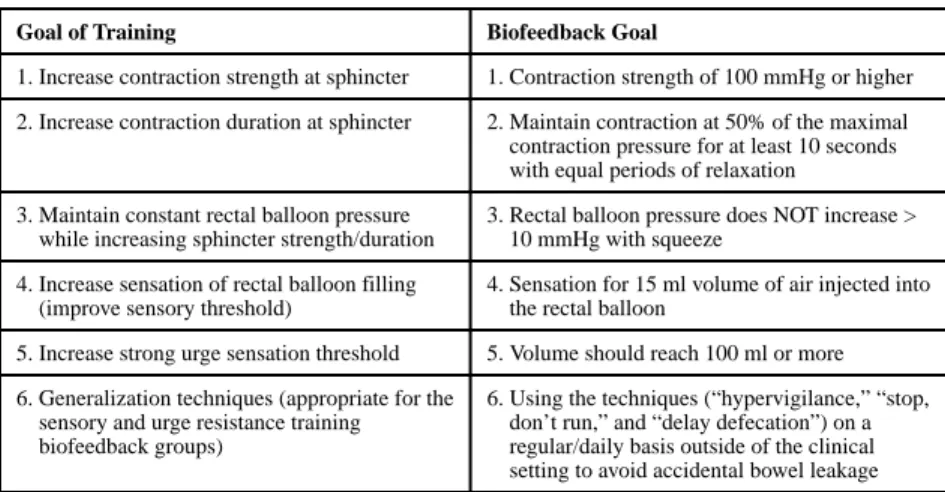
Because the behavioral training techniques for the three physiological deficits (sphincter muscle weakness, hyposensitivity, and hypersensitivity) differ, we developed separate clinical decision algorithms and accompanying training protocols for each (Table 1). We also collaborated with an equipment manufacturer to develop customized software which would guide interventionists through each protocol using on-screen prompts (Figure 1) and provide a summary for each training session showing the best response achieved during each biofeedback protocol to facilitate comparisons across sessions. The session report shows the “best” response rather than the average response because performance is expected to improve during biofeedback training.
Biofeedback Protocols: Components
Biofeedback protocol treatments occur over six 1–2 hour sessions spaced approximately two weeks apart to allow the participant time to practice new skills and to build strength through daily practice, results of which are captured on a bowel accident and symptom diary (bowel diary). Although there is some individualization of training sessions based on differences among participants in physiological deficits and rates of change, each visit includes the following components (see Supplementary Table 1 for details).
1. Review the daily bowel diary with participant and provide motivational feedback to continue home exercise plan.
A
uthor Man
uscr
ipt
A
uthor Man
uscr
ipt
A
uthor Man
uscr
ipt
A
uthor Man
uscr
2. Perform anorectal manometry (ARM) examination. The ARM findings should be compared to previous sessions and motivational feedback should be provided. The ARM data, in combination with the bowel diary, guide the interventionist on whether to employ sensory training or urge resistance training; see Table 1.
3. Perform manometric biofeedback protocols using on-screen prompts for instructions. All participants receive strength training. Sensory training and/or urge resistance training is added based on the ARM findings and bowel diary (Table 1):
a. Strength training to improve maximum squeeze pressure, squeeze duration, and ability to isolate (i.e., to squeeze pelvic floor muscles without simultaneously increasing rectal pressure).
b. Sensory training (only if there is evidence of
hyposensitivity) to decrease the threshold for perception of rectal balloon distention.
c. Urge resistance training (only if there is evidence of hypersensitivity) to increase the participant’s tolerance for larger rectal balloon distensions without experiencing an intolerably strong urge to defecate.
4. At the conclusion of the session, instructions for home practice are given and include an exercise prescription, a daily exercise record for the participant to record exercises, a 7-day bowel diary, and a behavioral instructional handout for generalization at home. An interventionist log is used to record the key components of the bowel diary, ARM values, biofeedback goals, and exercise record activity. This facilitates providing feedback to the patient on their progress.
Important concepts underlying biofeedback training that were used to develop the protocol are shaping, generalization, and weaning. These techniques are included in other
biofeedback protocols and are the basis of biofeedback therapy.11 Shaping is a technique for teaching a new motor skill gradually, through successive approximations. Initially the goal is set at a level the subject can achieve 50% to 75% of the time, and as performance improves, the goal is adjusted upward. Generalization involves the use of prescribed home practice program to ensure that skills learned during treatment visits can be applied when needed at home and work. Examples are preventing leakage by “squeezing before you sneeze”, becoming “hypervigilant” to notice any rectal sensations and squeezing even if unsure, and “stop, don’t run” to the toilet when an urge sensation is felt to allow time for squeezing pelvic floor muscles and relaxing abdominal wall muscles. Weaning refers to eliminating dependence on the equipment and the interventionist’s verbal guidance by having the participant practice squeezing without feedback on some squeezes.
The interventionist is trained to assume a coaching role, encouraging and guiding the participant to meet the goals for the biofeedback protocol (Table 2). The goals set for the
A
uthor Man
uscr
ipt
A
uthor Man
uscr
ipt
A
uthor Man
uscr
ipt
A
uthor Man
uscr
biofeedback protocol are based on current clinical trial evidence and expert opinion.7–11 Visual feedback provided by the computer monitor is supplemented by frequent verbal feedback (Figure 1). Verbal feedback takes the form of praise for successes, encouragement when the participant’s effort approaches but falls just short of the goal, and supportive comments when they fail to reach the goal and seem discouraged. In addition to this verbal feedback, the interventionist should remind the participant how their squeeze and sensory efforts compare to prior visits and how improvements in their squeeze and sensory efforts relate to their goal of eventually achieving continence. The interventionist prescribes a home exercise program and an exercise log based on the session results.
Biofeedback Training and Certification Process
Prior to participation in the centralized training, trainees were required to review the manual of procedures, complete 7 e-learning modules, and review demonstration videos (Table 3). Set-up and use of the Medspira MCOMPASS system at their respective institutions was also required.
The in-person certification was a 3 day program which included a “train-the-trainer” day, a training day for trainees, and then a certification day. The “train the trainer” day was focused on final confirmation of the protocol among the development team and all evaluators and set up of training stations. The second day included education, demonstration, practice,
simulation and feedback with the use of standardized patient volunteers in the Cleveland Clinic Simulation and Advanced Skills Center led by the CAPABLe principal investigator. The trainees were divided into small groups of 3–4 and rotated through five training stations using a valid and reliable skills training format.13–15 At each station, each trainee had the opportunity to practice and develop skills with the standardized patients (Supplemental Table 2). At the completion of all 5 stations there was an hour of open practice allowed for the trainees.
The final day of the in-person certification began with a question and answer session. Then, each trainer was assigned to a room with live video streaming and recording capabilities, to allow for auditing of the certification process. A standardized patient was provided for each room. One trainer assessed each trainee in a 1:1 (assessor:trainee) ratio using a checklist (Supplemental Table 2). Assessment checklists were developed using valid and reliable Procedure-Based Assessment (PBA) format.17–19 Each item on the list was scored with N (not observed), D (development required) or S (satisfactory– no prompting or intervention required). A pass rate of 80% was required for certification. Trainees who were unable to successfully complete the testing were offered re-testing with a different trainer the same day. Trainees who failed evaluation by two different evaluators were required to attend a second in-person training session.
After the in-person training session, the assessors gathered feedback on the training from the interventionists for three educational domains: 1) meeting training objectives, 2) satisfaction with the quality of education provided, and 3) confidence in professional ability to complete the protocol. The survey included 4 response options: “strongly agree,” “agree,” “disagree,” and ‘strongly disagree.” The percentage of survey participants who reported “agreed/ strongly agreed” were reported.
A
uthor Man
uscr
ipt
A
uthor Man
uscr
ipt
A
uthor Man
uscr
ipt
A
uthor Man
uscr
Centralized Quality Monitoring and Auditing Process
Quality monitoring of the certified interventionists occurred for the first (baseline) and third visits (4-week) from at least two CAPABLe study participants early in the study (first 3 months) and later in the study (after the first year). All visits were recorded with digital audio recording devices. Each site selected two participants for auditing purposes. Auditors included behavioral psychology, physical therapy, nursing, and physician expertise in the treatment of fecal incontinence. Encrypted recordings of the intervention session, electronic copies of the anorectal manometry and biofeedback session summary data generated by the equipment were sent to the auditors. Supporting documents for the audit included the bowel diary, the exercise prescription, the exercise record, the anorectal manometry case report form, the equipment summary report, and the interventionist log. A checklist based on the in-person certification checklists was created for the audit (Supplemental Table 3). The auditors set a minimum pass-rate of 80% (0–100% completion of checklist items) for the auditing process. Interventionists who passed the audit received written feedback.
Interventionists who did not reach the 80% pass rate had 1:1 teleconferences set up with the auditor/trainer for remediation.
RESULTS
The PFDN consists of a single data coordinating center and 8 clinical centers. Centralized training was done at the Cleveland Clinic due to the availability of training facilities. Trainers were picked from the PFDN clinical sites based on personal expertise and either development of or familiarity with the biofeedback protocol. The 6 trainers included a clinical psychologist, 3 physicians, an advanced practice registered nurse, and a physical therapist. All had prior experience with pelvic floor therapy for incontinence. All trainers attended the first in-person certification for the first 18 trainees and 3 trainers attended a second certification with 6 trainees in attendance.
Twenty-four interventionists attended the in-person training and certification. Each clinical site had at least two interventionists including 46% (11/24) advanced practice registered nurses, 50% (12/24) physical therapists, and 4% (1/24) physician assistants. Interventionists completed a majority of the online training modules (98%), Table 3. Eight percent (2/24) did not pass the initial centralized certification process and one subsequently passed after re-certification. Incorrect equipment usage during the certification limited the passing rate for the 2 individuals. After the in-person training, interventionists completed an anonymous survey. From those responding to the survey (20/24 or 83% response rate), 95% agreed or strongly agreed that training objectives were met, 85% were satisfied with the quality of the education, and 95% were confident in their professional ability to complete the protocol.
Audio audits were completed for 88% (21/24) of the certified interventionists with study visits. Two certified interventionists did not see any CAPABLe participants and one did not pass the certification process. Auditors reviewed 84 study visits; 80% (67/84) had complete audio files, 15% (13/84) had incomplete audio, and 5% (4/84) were missing audio files. Supporting documents available for the audited visits included the biofeedback summary report (95%), the anorectal manometry case report form (91%), the bowel diary (82%), the
A
uthor Man
uscr
ipt
A
uthor Man
uscr
ipt
A
uthor Man
uscr
ipt
A
uthor Man
uscr
exercise records/log (86%), and the interventionist log (91%). All certified interventionists met or exceeded the audit process for the audited study visits with an average score of 93%.
DISCUSSION
The CAPABLe protocol is a rigorous, multicenter trial of first-line treatments for FI,12 including unique behaviorally-based manometric biofeedback clinical protocols addressing each of the major physiologic deficits currently implicated in FI. Specifically, while the strength training component of biofeedback has been fairly well studied, the sensory training to maximize perception of rectal filling and/or tolerance for urge sensations has been more variably described.7,8 The ability to separate these aspects of the biofeedback intervention, and to adapt the clinical protocol to the specific deficits of that individual patient by an algorithm, offers the potential for maximizing consistency and reproducibility as well as effectiveness. The centralized training protocol, certification process, and auditing process, as well as the new computer tablet design with on-screen support and prompts, all serve to enhance the internal validity as well as the reproducibility of the biofeedback interventions in this multicenter design.
The centralized training, certification of interventionists using standardized patients, and auditing of the anorectal manometry evaluation and biofeedback training further enhances both the internal and external validity for this intervention. Previous randomized controlled trials of biofeedback for the treatment of FI yielded conflicting results,5 and this is
sometimes attributed to variability in the training of interventionists.4 A limitation could be the use of specialized academic medical centers, but generalization of this training protocol is feasible for many types of clinicians caring for patients with FI in a variety of clinical settings. We also found limited clinical trial evidence to support specific goals for the three biofeedback protocols for strength and sensitivity training. However, we utilized the best available evidence and expert opinion to develop our comprehensive biofeedback protocol.7–11
We realize that using 8 separate clinical centers to perform standardized anorectal
manometry and manometric biofeedback introduces protocol adherence difficulties. Despite geographic diversity, all interventionists received standardized, centralized training in order to minimize variations in protocol performance and measurement. We did not have the ability to give the interventionists live, real-time feedback on their manometry. Instead, we collected a subsample of the data and audited it for outliers using a standardized checklist (Supplemental Table 3), derived from the items included in interventionist certification. Interventionists were given written feedback when feasible. Another limitation was not using an external auditor to review the manometry and biofeedback tracings for internal consistency. Contracting an external auditor would have provided us with blinded adjudication of our data. However, our internal audits were quite comprehensive and included all components of the visits: audio files, bowel diaries, exercise prescriptions, exercise records, interventionist logs, electronic tracings of the anorectal manometry and biofeedback sessions, and the manometry case report forms.
A
uthor Man
uscr
ipt
A
uthor Man
uscr
ipt
A
uthor Man
uscr
ipt
A
uthor Man
uscr
Centralized training including on-line modules and in-person certification of interventionists of multiple disciplines using standardized patients, and auditing of the biofeedback study visits further enhances both the internal and external validity for an evidence-based multicomponent biofeedback protocol.
Supplementary Material
Refer to Web version on PubMed Central for supplementary material.
Acknowledgments
Full listing per PFDN guidelines will be submitted upon final acceptance
Funding: Supported by grants from the Eunice Kennedy Shriver National Institute of Child Health and Human Development (U10 HD054215, U10 HD041261, U10 HD041261, U10 HD054214, U10 HD041267, U10 HD069025, U10 HD069010, U10 HD069006, U01 HD069031) and the National Institutes of Health Office of Research on Women’s Health.
References
1. Bharucha AE, Dunivan G, Goode PS, et al. Epidemiology, Pathophysiology, and Classification of Fecal Incontinence: State of the Science Summary for the National Institute of Diabetes and Digestive and Kidney Diseases (NIDDK) Workshop. Am J Gastroenterol. 2015 Jan; 110(1):127– 136. [PubMed: 25533002]
2. Boreham MK, Richter HE, Kenton KS, et al. Anal incontinence in women presenting for gynecologic care: prevalence, risk factors, and impact upon quality of life. Am J Obstet Gynecol. 2005 May; 192(5):1637–1642. [PubMed: 15902170]
3. Norton NJ. The perspective of the patient. Gastroenterology. 2004 Jan; 126(1 Suppl 1):S175–S179. [PubMed: 14978658]
4. Whitehead WE, Rao SS, Lowry A, et al. Treatment of Fecal Incontinence: State of the Science Summary for the National Institute of Diabetes and Digestive and Kidney Diseases Workshop. Am J Gastroenterol. 2015 Jan; 110(1):138–146. [PubMed: 25331348]
5. Norton C, Cody JD. Biofeedback and/or sphincter exercises for the treatment of faecal incontinence in adults. Cochrane Database Syst Rev. 2012; 7:CD002111.
6. Bharucha AE, Rao SS. An update on anorectal disorders for gastroenterologists. Gastroenterology. 2014 Jan; 146(1):37–45. e32. [PubMed: 24211860]
7. Bols EM, Berghmans BC, Hendriks EJ, et al. A randomized physiotherapy trial in patients with fecal incontinence: design of the PhysioFIT-study. BMC Public Health. 2007; 7:355. [PubMed: 18096041]
8. Bols E, Berghmans B, de Bie R, et al. Rectal balloon training as add-on therapy to pelvic floor muscle training in adults with fecal incontinence: A randomized controlled trial. Neurourol Urodyn. 2012 Jan; 31(1):132–138. [PubMed: 22038680]
9. Bartlett L, Sloots K, Nowak M, Ho YH. Biofeedback for fecal incontinence: a randomized study comparing exercise regimens. Dis Colon Rectum. 2011; 54(7):846–856. [PubMed: 21654252] 10. Schwandner T, Konig IR, Heimerl T, et al. Triple target treatment (3T) is more effective than
biofeedback alone for anal incontinence: the 3T-AI study. Dis Colon Rectum. 2010; 53(7):1007– 1016. [PubMed: 20551752]
11. Heymen S, Scarlett Y, Jones K, Ringel Y, Drossman D, Whitehead WE. Randomized controlled trial shows biofeedback to be superior to pelvic floor exercises for fecal incontinence. Diseases of the Colon & Rectum. 2009; 52:1730–1737. [PubMed: 19966605]
12. Jelovsek JE, Markland AD, Whitehead WE, Barber MD, Newman DK, Rogers RG, Dyer K, Visco A, Sung VW, Sutkin G, Meikle SF, Gantz MG. Pelvic Floor Disorders Network. Controlling anal incontinence in women by performing anal exercises with biofeedback or loperamide (CAPABLe) trial: Design and methods. Contemp Clin Trials. 2015; 44(Sept):164–174.
A
uthor Man
uscr
ipt
A
uthor Man
uscr
ipt
A
uthor Man
uscr
ipt
A
uthor Man
uscr
13. Martin JA, Regehr G, Reznick R, et al. Objective structured assessment of technical skill (OSATS) for surgical residents. Br J Surgery. 1997; 84(2):273–278.
14. Faulkner H, Regehr G, Martin J, Reznick R. Validation of an objective structured assessment of technical skill for surgical residents. Acad Med. 1996 Dec; 71(12):1363–1365. [PubMed: 9114900]
15. Reznick R, Regehr G, MacRae H, Martin J, McCulloch W. Testing technical skill via an innovative "bench station" examination. Am J Surg. 1997 Mar; 173(3):226–230. [PubMed: 9124632] 16. Beard JD, Jolly BC, Newble DI, Thomas WE, Donnelly J, Southgate LJ. Assessing the technical
skills of surgical trainees. Br J Surg. 2005; 92(6):778–782. [PubMed: 15810048]
17. James K, Cross K, Lucarotti ME, Fowler AL, Cook TA. Undertaking procedure-based assessment is feasible in clinical practice. Ann R Coll Surg Engl. 2009; 91(2):110–112. [PubMed: 19317934] 18. Marriott J, Purdie H, Crossley J, Beard JD. Evaluation of procedure-based assessment for assessing
trainees’ skills in the operating theatre. Br J Surg. 2011; 98(3):450–457. [PubMed: 21254025] 19. Jelovsek JE, Kow N, Diwadkar GB. Tools for the direct observation and assessment of
psychomotor skills in medical trainees: a systematic review. Med Education. 2013; 47:650–673.
A
uthor Man
uscr
ipt
A
uthor Man
uscr
ipt
A
uthor Man
uscr
ipt
A
uthor Man
uscr
Key Points
• Our goal was to develop novel biofeedback protocols to improve standardization of clinical care for fecal incontinence in a multicenter clinical trial
• Separate biofeedback protocols addressed the three most common causes for fecal incontinence: sphincter weakness, rectal
hyposensitivity, and urge fecal incontinence (hypersensitivity)
• Centralized training along with the use of standardized patient models was an effective method for teaching biofeedback protocols
• Auditing of the biofeedback visits revealed high adherence to the biofeedback protocols
A
uthor Man
uscr
ipt
A
uthor Man
uscr
ipt
A
uthor Man
uscr
ipt
A
uthor Man
uscr
Figure 1.
Biofeedback Software with Onscreen Protocol Prompts From a Tablet Computer Device* *http://medspira.com/products/mcompass/anorectal-manometry/
A
uthor Man
uscr
ipt
A
uthor Man
uscr
ipt
A
uthor Man
uscr
ipt
A
uthor Man
uscr
A
uthor Man
uscr
ipt
A
uthor Man
uscr
ipt
A
uthor Man
uscr
ipt
A
uthor Man
uscr
ipt
Table 1Biofeedback Protocol Components and Actions Based on Study Measures
Biofeedback
Protocol Bowel Diary ARM finding Action for Interventionist
Strength Training
Bowel accidents occur with or without urge
Squeeze pressure is < 100 mmHg
• Provide positive guidance on using pelvic floor muscle exercises at home to improve strength.
• Implement strength training biofeedback protocol at the first visit.
Squeeze duration at 50% of maximal squeeze pressure for <10 seconds
• Encourage pelvic floor muscle exercises at home.
• Set realistic weekly goals to reach a 10 second squeeze with equal periods of muscle rest at above 50% of the maximal contraction strength by the end of the study visits.
• Employ strength training biofeedback protocol.
Rectal pressure increases >10 mmHg when squeezing
• Identify this as something that increases the risk of FI.
• Employ strength training biofeedback protocol but focus on isolating the sphincter muscles by keeping rectal pressure below 10 mmHg during squeezes.
Sensory Training One or more bowel accidents that are larger than just staining and that occurred without any warning
Abnormally high threshold for first sensation on ARM (> 15 ml)
• Provide positive guidance that sensory perception can be modified in future study visits by employing sensory training biofeedback protocol.
Urge Resistance Training
One or more bowel accidents that are preceded by a strong sense of urgency
Abnormally low maximum tolerable volume on ARM (< 100 ml)
A
uthor Man
uscr
ipt
A
uthor Man
uscr
ipt
A
uthor Man
uscr
ipt
A
uthor Man
uscr
ipt
Table 2
Overall Goals of the Biofeedback Protocol
Goal of Training Biofeedback Goal
1. Increase contraction strength at sphincter 1. Contraction strength of 100 mmHg or higher 2. Increase contraction duration at sphincter 2. Maintain contraction at 50% of the maximal contraction pressure for at least 10 seconds with equal periods of relaxation
3. Maintain constant rectal balloon pressure while increasing sphincter strength/duration
3. Rectal balloon pressure does NOT increase > 10 mmHg with squeeze
4. Increase sensation of rectal balloon filling (improve sensory threshold)
4. Sensation for 15 ml volume of air injected into the rectal balloon
5. Increase strong urge sensation threshold 5. Volume should reach 100 ml or more 6. Generalization techniques (appropriate for the
sensory and urge resistance training biofeedback groups)
A
uthor Man
uscr
ipt
A
uthor Man
uscr
ipt
A
uthor Man
uscr
ipt
A
uthor Man
uscr
ipt
Table 3
Certification Electronic Learning (e-Learning) Modules and Assessment
eLearning Modules Content Completion
Rate, N = 24
Study Protocol Overview: CAPABLe
• Protocol background
• Primary and Secondary Outcomes
• Masking
• Study Flow
24 (100%)
Anorectal Anatomy and Physiology Overview
• Pelvic floor anatomy
• Anorectal anatomy
• Defecation process
24 (100%)
Biofeedback Background Principles and Protocol Overview
• Biofeedback terminology
• Biofeedback principles
• Protocol goals
24 (100%)
Anorectal Manometry • Catheter set up and proper use
• Equipment set up and use
• Data acquisition from reports
• Troubleshooting
22 (92%)
Biofeedback Equipment Overview
• Catheter set up and proper use
• Equipment set up and use
• Protocol determination
• Data acquisition from reports
• Troubleshooting
24 (100%)
Bowel Diary Review • Education on completion
• Interpretation of findings/symptoms
• Application to protocol
23(96%)
Exercise Prescription and Record
• Use of biofeedback data to guide prescription
• Exercise goal attainment
• Instruction on recording exercises
24 (100%)
Video Demonstration • Equipment set-up
• Participant interaction
• Participant education
• Anorectal manometry
• Biofeedback protocols
24 (100%)