The physics of spreading processes in multilayer
net-works
Manlio De Domenico1∗, Clara Granell2, Mason A. Porter3, and Alex Arenas1∗
1Departament d’Enginyeria Inform`atica i Matem`atiques, Universitat Rovira i Virgili, 43007
Tar-ragona, Spain
2Carolina Center for Interdisciplinary Applied Mathematics, Department of Mathematics,
Univer-sity of North Carolina, Chapel Hill, NC 27599-3250, USA
3Oxford Centre for Industrial and Applied Mathematics, Mathematical Institute, University of
Oxford, OX2 6GG, UK; CABDyN Complexity Centre, University of Oxford, Oxford OX1 1HP,
UK; and Department of Mathematics, University of California, Los Angeles, California 90095,
USA
Corresponding authors: [email protected], [email protected]
The study of networks plays a crucial role in investigating the structure, dynamics, and
func-tion of a wide variety of complex systems in myriad disciplines. Despite the success of
tradi-tional network analysis, standard networks provide a limited representation of complex
sys-tems, which often include different types of relationships (i.e., “multiplexity”) among their
constituent components and/or multiple interacting subsystems. Such structural complexity
has a significant effect on both dynamics and function. Throwing away or aggregating
avail-able structural information can generate misleading results and be a major obstacle towards
attempts to understand complex systems. The recent “multilayer” approach for modeling
networked systems explicitly allows the incorporation of multiplexity and other features of
realistic systems. On one hand, it allows one to couple different structural relationships by
encoding them in a convenient mathematical object. On the other hand, it also allows one to
couple different dynamical processes on top of such interconnected structures. The
result-ing framework plays a crucial role in helpresult-ing achieve a thorough, accurate understandresult-ing of
complex systems. The study of multilayer networks has also revealed new physical
phenom-ena that remain hidden when using ordinary graphs, the traditional network representation.
Here we survey progress towards attaining a deeper understanding of spreading processes on
multilayer networks, and we highlight some of the physical phenomena related to spreading
processes that emerge from multilayer structure.
Introduction
Networks provide a powerful representation of interaction patterns in complex systems1–3. The structure of social relations among individuals, interactions between proteins, food webs, and many other situations can be represented using networks. Until recently, the vast majority of studies fo-cused on networks that consist of a single type of entity, with different entities connected to each other via a single type of connection. Such networks are now calledsingle-layer(ormonolayer) networks. The idea of incorporating additional information — such as multiple types of interac-tions, subsystems, and time-dependence — has long been pointed out in various fields, such as sociology, anthropology, and engineering, but an effective unified framework for the mathematical treatment of such multidimensional structures, which are usually calledmultilayer networks, was developed only recently4, 5.
ecology7, neuroscience8, and numerous other areas. The potential of multilayer networks for rep-resenting complex systems more accurately than was previously possible has led to an explosion of work on the physics of multilayer networks.
A key question concerns the implications of multilayer structures on the dynamics of com-plex systems, and several papers about interdependent networks — a special type of multilayer network — revealed that such structures can change the qualitative behaviors in a significant way. For example, several studies have provided insights on percolation properties and catastrophic cascades of failures in multilayer networks9–15. These findings helped highlight an important chal-lenge: How does one account for multiple layers of connectivity in a consistent mathematical way? An explosion of recent papers has developed the field of multilayer networks into its modern form, and there is now a suitable mathematical framework16, novel structural descriptors17–21, and tools
from fields (such as statistical physics22, 23) for studying these systems. Many studies have also
started to highlight the importance of analyzing multilayer networks, instead of relying on their monolayer counterparts, to gain new insights about empirical systems (see, e.g.,24, 25).
It has now been recognized that the study of multilayer networks is fundamental for en-hancing understanding of dynamical processes on networked systems. An important example are spreading processes, such as flows (and congestion) in transportation networks26, 27, and
informa-tion and disease spreading in social networks28–32. For instance, when two spreading process are
addi-tional examples, see various reviews and surveys4, 5, 10, 28, 34–36 on multilayer networks and specific topics within them.
A multilayer framework allows a natural representation of coupled structures and coupled dynamical processes. In this article, after we give a brief overview on representing multilayer networks, we will focus on spreading processes in which multilayer analysis has revealed new physical behavior. Specifically, we will discuss two cases: (i) a single dynamical process, such as continuous or discrete diffusion, running on top of a multilayer network; and (ii) different dynam-ical processes, in which each one runs on top of a given layer, but they are coupled by a multilayer structure.
Structural representation of multilayer networks
a significant impact on dynamical systems (e.g., of spreading processes or coupled oscillators) that are coupled through multilayer networks. Moreover, intra-layer edges and inter-layer edges encode relationships in fundamentally different ways, and they thereby represent different types of physical functionality. For example, in a metropolitan transportation system 6, 37, intra-layer
edges account for connections between the same type of node (e.g., between two different subway stations), whereas inter-layer edges connect different types of nodes (e.g., between a certain sub-way station and an associated bus station). In some cases, inter-layer edges and intra-layer edges may even be measured using different physical units. For instance, an intra-layer edge in a multi-layer social network could represent a friendship between two individuals on Facebook, whereas an inter-layer edge in the same network could represent the transition probability of an individual switching from using Facebook to use Twitter.
The rich variety of connections in a typical multilayer network can be mathematically rep-resented by the components mjβiα of a 4th-order tensorM, called multilayer adjacency tensor16,
encoding the relationship between any node i in layer α and any node j in layer β in the sys-tem (wherei, j ∈ {1,2, . . . , N}andα, β ∈ {1,2, . . . , L},N denotes the number of nodes in the network andLdenotes the number of layers).
Once the connectivity of the nodes and layers are encoded in a tensor, one can define novel measures to characterize the multilayer structure. However, this is a delicate process, as naively generalizing existing concepts from monolayer networks can lead to qualitatively incorrect or non-sensical results4. An alternative way of generalizing concepts from monolayer networks to
insightful, and it will facilitate further development of the mathematics of complex systems.
Studies of structural properties of multilayer networks include descriptors to identify the most “central” nodes according to various notions of importance16–20and quantify triadic relations
such as clustering and transitivity16, 19, 21. Significant advances have been achieved to reduce the
structural complexity of multilayer networks38, to unveil mesoscale structures (e.g., communities
of densely-connected nodes) 39–42, and to quantify intra-layer and inter-layer correlations43–45 in
empirical networked systems.
The structural properties of multilayer networks depend crucially on how layers are coupled together to form a multilayer structure. Inter-layer edges provide the coupling and help encode structural and dynamical features of a system, and their presence (or absence) produces fascinat-ing structural and dynamical effects. For example, in multimodal transportation systems, in which layers represent different transportation modes, the weight of inter-layer connections might encode an economic or temporal cost to switching between two modes6, 46. In multilayer social networks,
inter-layer connections allow models to tune, in a natural way, an individual’s self-reinforcement in opinion dynamics47. Depending on the relative importances of intra-layer and inter-layer connec-tions, a multilayer network can act either as a system of independent entities, in which layers are structurally decoupled, or as a single-layer system, in which layers are indiscernible in practice. In some multilayer networks, one can even derive a sharp transition between these two regimes48, 49.
Single and coupled dynamics on multilayer networks
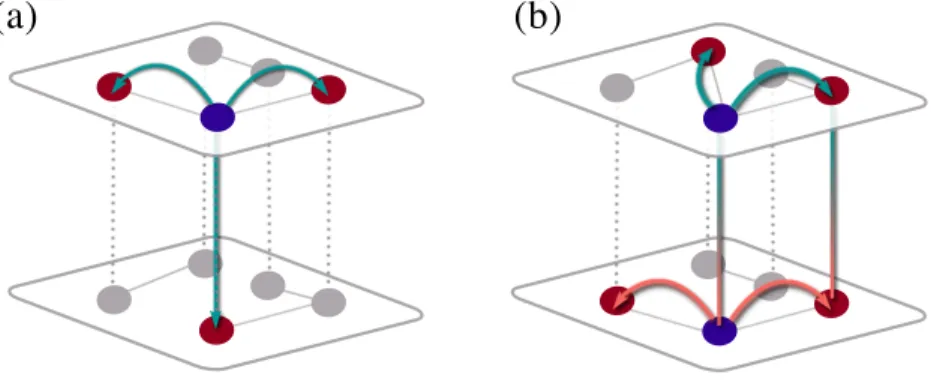
(see Fig. 2b).
Single dynamics. In this section, we analyze physical phenomena that arise from a single dy-namical process on top of a multilayer structure. The behavior of such a process depends both on intra-layer structure (i.e., the usual considerations in networks) and on inter-layer structure (i.e., the presence and strength of interactions between nodes on different layers).
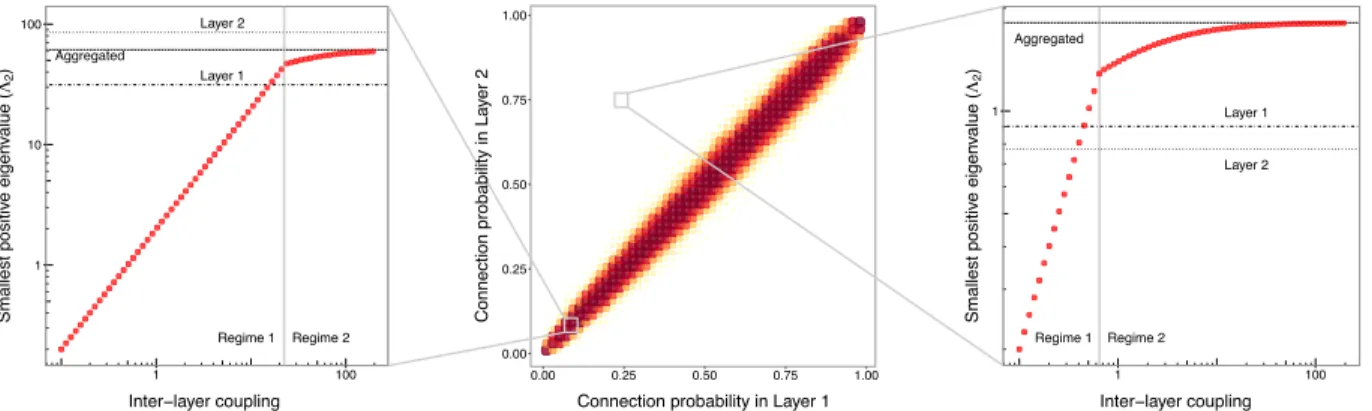
One of the simplest types of dynamics is a diffusion process (either continuous or discrete). The physics of diffusion, which has been analyzed thoroughly in multiplex networks50, 51 reveals an intriguing and unexpected phenomenon: diffusion can be faster in a multiplex network than in any of the layers considered independently50.
One can understand diffusion in multiplex networks in terms of the spectral properties of a Laplacian tensor (in particular, we consider the type of Laplacian that is known in graph theory as the “combinatorial Laplacian”52), obtained from the adjacency tensor of a multilayer network,
that governs the diffusive dynamics. One first “flattens”53 — without loss of information, pro-vided one keeps the layer labels — the Laplacian tensor16 into a special lower-order tensor called “supra-Laplacian matrix”. The supra-Laplacian matrix has a block-diagonal structure, where di-agonal blocks encode the associated Laplacian matrices corresponding to each layer separately and off-diagonal blocks encode inter-layer connections. The supra-Laplacian matrix was initially presented in the literature as a matrix for a multilayer network that includes both intra-layer edges and inter-layer edges50.
small values of the inter-layer coupling, the multilayer structure slows down the diffusion; for large values, the diffusion speed converges to the mean diffusion speed of the superposition of layers. In many cases, the diffusion in the superposition is faster than that in any of the separate layers. These findings are a direct consequence of the emergence of more paths between every pair of nodes due to the multilayer structure. The transition between the two regimes is a structural transition48, a
characteristic of multilayer networks that can also arise in other contexts54, 55.
The above phenomenology can also occur in discrete processes. Perhaps the most canonical examples of discrete dynamics are random walks, which are used to model Markovian dynamics on monolayer networks and which have yielded numerous insights over the last several decades56, 57. In a random walk, a discretized form of diffusion, a walker jumps between nodes through available connections. In a multilayer network, the available connections include layer switching via an inter-layer edge, a transition that has no counterpart in monolayer networks and which enriches random-walk dynamics39, 46, 49. An important physical insight of the interplay between multilayer
structure and the dynamics of random walkers is “navigability”46, which we take to be the mean fraction of nodes that are visited by a random walker in a finite time, which (similar to the case of continuous diffusion) can be larger than the navigability of an aggregated network of layers. In terms of navigability, multilayer networks are more resilient to uniformly random failures than their individual layers, and such resilience arises directly from the interplay between the multilayer structure and the dynamical process.
multiplex network can induce congestion even when a system would remain decongested in each layer independently27.
Coupled dynamics.
Coupled dynamical processes are a second archetypical family of dynamics in which mul-tilayer structure plays a crucial role. Thus far, the most thoroughly studied examples are coupled spreading processes, which are crucial for understanding phenomena such as the spreading dy-namics of two concurrent diseases in two-layer multiplex networks31, 35, 62–64and spread of disease coupled with the spread of information or behavior28–30, 32, 65, 66. We illustrate two basic effects: (i) two spreading processes can enhance each other (e.g., one disease facilitates infection by the other31), and (ii) one process can inhibit the spread of the other (e.g., a disease can inhibit infection
by another disease31 or the spreading of awareness about a disease can inhibit the spread of the
disease30). Interacting spreading processes also exhibit other fascinating dynamics, and multilayer
networks provide a natural means to explore them28.
The above phenomenology is characterized by the existence of a curve of critical points that separate endemic and non-endemic phases of a disease. This curve exhibits a crossover between two different regimes: (i) a regime in which the critical properties of one spreading process are independent of the other, and (ii) a regime in which the critical properties of one spreading process do depend on those of the other. The point at which this crossover occurs is called a “metacritical” point.
properties of the two processes.
Conclusions and perspectives
In most natural and engineered systems, entities interact with each other in complicated patterns that include multiple types of relationships and/or multiple subsystems, change in time, and incorporate other complications. The theory of multilayer networks seeks to take such features into account to improve our understanding of such complex systems.
In the last few years, there have been intense efforts to generalize traditional network theory by developing and validating a framework to study multilayer systems in a comprehensive fashion. The implications of multilayer network structure and dynamics are now being explored in fields as diverse as neuroscience25, 67, 68, transportation6, 37, ecology7, granular materials69, evolutionary game theory 36, and many others. For instance, in ecological networks, different layers might encode different types of interaction — e.g. trophic and non-trophic — or different spatial patches (or different temporal snapshots), where the same interaction may or may not appear7. In human
brain networks, different layers might encode functional connectivity corresponding to specific frequency bands, with inter-layer connections encoding cross-frequency interactions68. In gene
interaction networks, layers might correspond to different genetic interactions (e.g., suppressive, additive, or based on physical or chemical associations)38, 70. In financial networks, layers might represent different interdependent networks of entities71— e.g., banking networks and commercial firms — or different trade relationships among legal entities, ranging from individuals to countries. Despite considerable progress in the last few years4, 5, much remains to be done to obtain a deep
Recent efforts have revealed fundamental new physics in multilayer networks. The richer types of spreading and random-walk dynamics can lead to enhanced navigability, induced conges-tion, and the emergence of new critical properties. Such new phenomena also have a major impact on practical goals such as coarse-graining networks to examine mesoscale features and evaluating the importance of nodes — two goals that date to the beginning of investigations of networks1, 3, 72.
For multilayer networks to achieve their vast potential, there remain crucial problems to address. For example, from a structural point of view, it is much easier to measure edge weights reliably for intra-layer edges than for inter-layer edges. Moreover, inter-layer edges not only play a different role from intra-layer ones, but they also play different roles in different applications, and the re-search community is only scratching the surface of the implications of their presence and the new phenomena to which they lead. For example, how to infer or impose inter-layer edges (and their associated meaning) is a major challenge in many applications of social networks, where an inter-layer connection could exploit the fact of changing from a social platform to another in time as the probability of switching. This can be even more complicated in many types of biological networks (e.g., when considering protein and genetic interactions). We know that different layers are not independent of each other, but it is much more difficult to quantify and measure the weights of the dependencies in a meaningful way. Another major challenge is to understand the propagation of dynamical correlations, due to network structure, across different layers, which affects not only spreading processes but dynamical systems more generally.
Although our manuscript only addresses physical phenomena related to spreading processes, other dynamical processes also pose extremely fascinating questions73. One important example
and more. Additionally, one can build on diffusion dynamics to study reaction–diffusion systems in multilayer networks78, 79.
A particularly promising approach in network theory that will have a major impact on future studies of multilayer networks is the analysis of network structure that arises from latent geomet-rical spaces80–82. Observed connectivity in networks often depends on space83 — either through
explicit constraints or by influencing the existence probability and weights of edges — and thus on the distance in that space. Either or both of the latent space (e.g., people with connections on more layers can lead to a higher probability of observing an edge between them84) and an associ-ated observed network connections can have a multilayer structure. Such explicit use of geometry also allows the possibility of incorporating more continuum types of analyses to accompany the traditional discrete approaches to studying networks. We thus assert that techniques from both ge-ometry and statistics will be crucial for scrutinizing dynamical processes on multilayer networks.
The study of multilayer networks is in its infancy, and new emergent physical phenomena that arise from the interaction of such networks and the dynamical processes on top of them are waiting to be discovered.
Contributions
All of the authors wrote the paper and contributed equally to the production of the manuscript.
Competing financial interests
Acknowledgements
All authors were funded by FET-Proactive project PLEXMATH (FP7-ICT-2011-8; grant # 317614) funded by the European Commission. MDD acknowledges financial support from the Spanish pro-gram Juan de la Cierva (IJCI-2014-20225). CG acknowledges financial support from a James S. McDonnell Foundation postdoctoral fellowship. AA acknowledges financial support from the ICREA Academia, the James S. McDonnell Foundation, and FIS2015-38266. MAP acknowledges a grant (EP/J001759/1) from the EPSRC. The authors acknowledge help from Serafina Agnello on the creative design of figures.
References
1. Newman, M. E. J. Networks: An Introduction(Oxford University Press, Inc., New York, NY, USA, 2010).
2. Boccaletti, S., Latora, V., Moreno, Y., Chavez, M. & Hwang, D.-U. Complex networks: Structure and dynamics. Physics Reports424, 175–308 (2006).
3. Wasserman, S. & Faust, K. Social Network Analysis: Methods and Applications. Structural Analysis in the Social Sciences (Cambridge University Press, Cambridge, UK, 1994).
4. Kivel¨a, M.et al. Multilayer networks. Journal of Complex Networks2, 203–271 (2014).
5. Boccaletti, S.et al. The structure and dynamics of multilayer networks. Physics Reports544, 1–122 (2014).
7. Pilosof, S., Porter, M. A. & K´efi, S. Ecological multilayer networks: A new frontier for network ecology. arXiv:1511.04453(2015).
8. Bullmore, E. & Sporns, O. The economy of brain network organization. Nature Reviews Neuroscience13, 336–349 (2012).
9. Buldyrev, S. V., Parshani, R., Paul, G., Stanley, H. E. & Havlin, S. Catastrophic cascade of failures in interdependent networks. Nature464, 1025–1028 (2010).
10. Gao, J., Buldyrev, S. V., Stanley, H. E. & Havlin, S. Networks formed from interdependent networks. Nature Physics8, 40–48 (2012).
11. Baxter, G. J., Dorogovtsev, S. N., Goltsev, A. V. & Mendes, J. F. F. Avalanche collapse of interdependent networks. Physical Review Letters109, 248701 (2012).
12. Son, S.-W., Bizhani, G., Christensen, C., Grassberger, P. & Paczuski, M. Percolation theory on interdependent networks based on epidemic spreading. EPL (Europhysics Letters)97, 16006 (2012).
13. Bianconi, G. & Dorogovtsev, S. N. Multiple percolation transitions in a configuration model of a network of networks. Physical Review E89, 062814 (2014).
14. Min, B., Yi, S. D., Lee, K.-M. & Goh, K.-I. Network robustness of multiplex networks with interlayer degree correlations. Physical Review E89, 042811 (2014).
15. Hackett, A., Cellai, D., G´omez, S., Arenas, A. & Gleeson, J. P. Bond percolation on multiplex networks. Physical Review X6, 021002 (2016).
16. De Domenico, M.et al. Mathematical formulation of multi-layer networks. Physical Review X3, 041022 (2013).
18. Halu, A., Mondragon, R. J., Panzarasa, P. & Bianconi, G. Multiplex pagerank. PloS ONE8, e78293 (2013).
19. Battiston, F., Nicosia, V. & Latora, V. Structural measures for multiplex networks. Physical Review E89, 032804 (2014).
20. De Domenico, M., Sol´e-Ribalta, A., Omodei, E., G´omez, S. & Arenas, A. Ranking in inter-connected multilayer networks reveals versatile nodes.Nature Communications6, 6868–6868 (2015).
21. Cozzo, E.et al. Structure of triadic relations in multiplex networks. New Journal of Physics
17, 073029 (2015).
22. Bianconi, G. Statistical mechanics of multiplex networks: Entropy and overlap. Physical Review E87, 062806 (2013).
23. Menichetti, G., Remondini, D., Panzarasa, P., Mondrag´on, R. J. & Bianconi, G. Weighted multiplex networks. PLoS ONE9, 1–8 (2014).
24. Cardillo, A.et al.Emergence of network features from multiplexity.Scientific Reports3, 1344 (2013).
25. Braun, U.et al.Dynamic reconfiguration of frontal brain networks during executive cognition in humans. Proceedings of the National Academy of Sciences of the United States of America
112, 11678–11683 (2015).
26. Morris, R. G. & Barthelemy, M. Transport on coupled spatial networks. Physical Review Letters109, 128703 (2012).
28. Wang, Z., M. A. Andrews, Z.-X. W., Wang, L. & Bauch, C. T. Coupled disease–behavior dynamics on complex networks: A review. Physics of Life Reviews15, 1–29 (2015).
29. Funk, S. et al. Nine challenges in incorporating the dynamics of behaviour in infectious diseases models. Epidemics10, 21–25 (2015).
30. Granell, C., G´omez, S. & Arenas, A. Dynamical interplay between awareness and epidemic spreading in multiplex networks. Physical Reviews Letters111, 128701 (2013).
31. Sanz, J., Xia, C.-Y., Meloni, S. & Moreno, Y. Dynamics of interacting diseases. Physical Review X4, 041005 (2014).
32. Lima, A., De Domenico, M., Pejovic, V. & Musolesi, M. Disease containment strategies based on mobility and information dissemination. Scientific Reports5, 10650 (2015).
33. G´omez-Gardenes, J., Reinares, I., Arenas, A. & Flor´ıa, L. M. Evolution of cooperation in multiplex networks. Scientific Reports2, 620 (2012).
34. Lee, K.-M., Min, B. & Goh, K.-I. Towards real-world complexity: An introduction to multi-plex networks. The European Physical Journal B88, 48 (2015).
35. Salehi, M.et al. Spreading processes in multilayer networks. IEEE Transactions on Network
Science and Engineering2, 65–83 (2015).
36. Wang, Z., Wang, L., Szolnoki, A. & Perc, M. Evolutionary games on multilayer networks: A colloquium. The European Physical Journal B88, 1–15 (2015).
37. Gallotti, R., Porter, M. A. & Barthelemy, M. Lost in transportation: Information measures and cognitive limits in multilayer navigation. Science Advances2, e1500445 (2016).
39. Mucha, P. J., Richardson, T., Macon, K., Porter, M. A. & Onnela, J.-P. Community structure in time-dependent, multiscale, and multiplex networks. Science328, 876–878 (2010).
40. Gauvin, L., Panisson, A. & Cattuto, C. Detecting the community structure and activity patterns of temporal networks: A non-negative tensor factorization approach. PLoS ONE 9, 1–13 (2014).
41. De Domenico, M., Lancichinetti, A., Arenas, A. & Rosvall, M. Identifying modular flows on multilayer networks reveals highly overlapping organization in interconnected systems.
Physical Review X5, 011027 (2015).
42. Peixoto, T. P. Inferring the mesoscale structure of layered, edge-valued, and time-varying networks. Physical Review E92, 042807 (2015).
43. Min, B., Do Yi, S., Lee, K.-M. & Goh, K.-I. Network robustness of multiplex networks with interlayer degree correlations. Physical Review E89, 042811 (2014).
44. Reis, S. D.et al. Avoiding catastrophic failure in correlated networks of networks. Nature Physics10, 762–767 (2014).
45. Nicosia, V. & Latora, V. Measuring and modeling correlations in multiplex networks.Physical Review E92, 032805 (2015).
46. De Domenico, M., Sol´e-Ribalta, A., G´omez, S. & Arenas, A. Navigability of interconnected networks under random failures. Proceedings of the National Academy of Sciences of the United States of America111, 8351–8356 (2014).
48. Radicchi, F. & Arenas, A. Abrupt transition in the structural formation of interconnected networks. Nature Physics9, 717–720 (2013).
49. Radicchi, F. Driving interconnected networks to supercriticality.Physical Review X4, 021014 (2014).
50. G´omez, S. et al. Diffusion dynamics on multiplex networks. Physical Review Letters 110, 028701 (2013).
51. Sole-Ribalta, A. et al. Spectral properties of the laplacian of multiplex networks. Physical Review E88, 032807 (2013).
52. Chung, F. R. K. Spectral Graph Theory (American Mathematical Society, Providence, RI, 1997), 2nd edn.
53. Kolda, T. G. & Bader, B. W. Tensor Decompositions and Applications. SIAM Review 51, 455–500 (2009).
54. Bazzi, M.et al. Community detection in temporal multilayer networks, with an application to correlation networks. Multiscale Modeling and Simulation: A SIAM Interdisciplinary Journal
14, 1–41 (2016).
55. Taylor, D., Myers, S. A., Clauset, A., Porter, M. A. & Mucha, P. J. Eigenvector-based centrality measures for temporal networks. arXiv:1507.012661507.01266(2015).
56. Aldous, D. & Fill, J. A. Reversible Markov Chains and Random Walks on Graphs (2002). Unfinished monograph, recompiled 2014, available at http://www.stat.berkeley.
edu/˜aldous/RWG/book.html.
58. Guimer`a, R., D´ıaz-Guilera, A., Vega-Redondo, F., Cabrales, A. & Arenas, A. Optimal network topologies for local search with congestion. Physical Review Letters89, 248701 (2002).
59. Zhao, L., Lai, Y.-C., Park, K. & Ye, N. Onset of traffic congestion in complex networks.
Physical Review E71, 026125 (2005).
60. Echenique, P., G´omez-Garde˜nes, J. & Moreno, Y. Dynamics of jamming transitions in com-plex networks. EPL (Europhysics Letters)71, 325 (2005).
61. Tan, F., Wu, J., Xia, Y. & Chi, K. T. Traffic congestion in interconnected complex networks.
Physical Review E89, 062813 (2014).
62. Dickison, M., Havlin, S. & Stanley, H. E. Epidemics on interconnected networks. Physical
Review E85, 066109 (2012).
63. Cozzo, E., Banos, R. A., Meloni, S. & Moreno, Y. Contact-based social contagion in multiplex networks. Physical Review E88, 050801 (2013).
64. Ferraz de Arruda, G., Cozzo, E., P., P. T., Rodrigues, F. A. & Moreno, Y. Epidemic spreading in interconnected networks: A continuous time approach. arXiv:1509.07054(2015).
65. Funk, S., Gilad, E., Watkins, C. & Jansen, V. A. A. The spread of awareness and its impact on epidemic outbreaks. Proceedings of the National Academy of Sciences of the United States of
America106, 6872–6877 (2009).
66. Granell, C., G´omez, S. & Arenas, A. Competing spreading processes on multiplex networks: awareness and epidemics. Physical Review E90, 012808 (2014).
68. De Domenico, M., Sasai, S. & Arenas, A. Mapping multiplex hubs in human functional brain network. Frontiers in NeuroscienceIn Press. DOI: 10.3389/fnins.2016.00326(2016).
69. Papadopoulos, L., Puckett, J., Daniels, K. E. & Bassett, D. S. Evolution of network architec-ture in a granular material under compression. arXiv:1603:08159(2016).
70. Nicosia, V. & Latora, V. Measuring and modeling correlations in multiplex networks. Phys.
Rev. E92, 032805 (2015). URLhttp://link.aps.org/doi/10.1103/PhysRevE.
92.032805.
71. Bargigli, L., Di Iasio, G., Infante, L., Lillo, F. & Pierobon, F. The multiplex structure of interbank networks. Quantitative Finance15, 673–691 (2015).
72. de Sola Pool, I. & Kochen, M. Contacts and influence. Social Networks1, 5–51 (1978–1979).
73. Porter, M. A. & Gleeson, J. P. Dynamical systems on networks: A tutorial. Frontiers in Applied Dynamical Systems: Reviews and Tutorials4(2016).
74. Sorrentino, F. Synchronization of hypernetworks of coupled dynamical systems. New Journal of Physics14, 033035 (2012).
75. Tang, Y., Qian, F., Gao, H. & Kurths, J. Synchronization in complex networks and its applica-tion — A survey of recent advances and challenges. Annual Reviews in Control38, 184–198 (2014).
76. Zhang, X., Boccaletti, S., Guan, S. & Liu, Z. Explosive synchronization in adaptive and multilayer networks. Physical Review Letters114, 038701 (2015).
78. Asllani, M., Busiello, D. M., Carletti, T., Fanelli, D. & Planchon, G. Turing patterns in multiplex networks. Physical Review E90, 042814 (2014).
79. Kouvaris, N., Hata, S. & Diaz-Guilera, A. Pattern formation in multiplex networks. Scientific Reports5, 10840 (2015).
80. Krioukov, D., Papadopoulos, F., Kitsak, M., Vahdat, A. & Bogu˜n´a, M. Hyperbolic geometry of complex networks. Physical Review E82, 036106 (2010).
81. Brockmann, D. & Helbing, D. The hidden geometry of complex, network-driven contagion phenomena. Science342, 1337–1342 (2013).
82. Wu, Z., Menichetti, G., Rahmede, C. & Bianconi, G. Emergent Complex Network Geometry.
Scientific Reports5, 10073+ (2015).
83. Barthelemy, M. Spatial networks. Physics Reports499, 1–101 (2011).
84. Abraham, I., Chechik, S., Kempe, D. & Slivkins, A. Low-distortion inference of latent similarities from a multiplex social network. In Proceedings of the Twenty-Fourth Annual
ACM-SIAM Symposium on Discrete Algorithms, SODA ’13, 1853–1883 (Society for
(a) (b) (c)
Figure 1: Multilayer networks. (a) An edge-colored multigraph, in which nodes can be connected
by different types (i.e., colors) of interactions. In this example, there are no inter-layer edges. (b) A
multiplex network, which consists of an edge-colored multigraph along with inter-layer edges that
connect entities with their replicas on other layers. (c) An interdependent network, in which each
layer contains nodes of a different type (circles, squares, and triangles) and includes inter-layer
edges to nodes in other layers; in this case, inter-layer edges can occur either between entities and
Single dynamics Coupled dynamics
(a)
(b)
Figure 2: Dynamical processes on multilayer networks. (a) Schematic of a single type of
dy-namical process running on all layers of a multiplex network. (Arcs of the same color represent
the same dynamical process.) (b) Schematic of two dynamical processes, each of which is running
Layer 1 Layer 2 Aggregated 1 10 100 1 100 Inter−layer coupling Smallest positi ve eige nv alue ( Λ2 ) Layer 1 Layer 2 Aggregated 1 1 100 Inter−layer coupling Smallest positi ve eige nv alue ( Λ2 ) 0.00 0.25 0.50 0.75 1.00
0.00 0.25 0.50 0.75 1.00 Connection probability in Layer 1
Connection probability
in L
ay
er 2
Regime 1 Regime 2 Regime 1 Regime 2
Figure 3: Single dynamics on a multilayer network. The speed of diffusion dynamics in a
multilayer network is characterized by the second smallest eigenvalue Λ2 of a Laplacian tensor.
We consider a pair of coupled Erd˝os–R´enyi (ER) networks in which we independently vary the
probabilitiesp1, p2 ∈ [0,1]to connect two nodes within the same layer between. The condition50
to observe faster diffusion in the multilayer network than diffusion in each layer separately is
Λ2multiplex ≥ max{Λ2layer1,Λlayer2 2}. In the central panel, we see that the condition is satisfied when
the two layers have similar edge-connection probabilities (i.e., p1 ≈ p2). We set the inter-layer
connections between each node and its replica in the other layer to a weightω ∈ [0.1,110]. In the
left panel, we show the behavior ofΛ2 as a function of the inter-layer coupling weightω. A sharp
change in the value of theΛ2 separates two different regimes that correspond to different structural
0 0.05 0.1 0.15 0.2 0.25
λ2
0 0.05 0.1 0.15 0.2 0.25
λ1
0 0.1 0.2 0.3 0.4 0.5 0.6
Incidence
0 0.05 0.1 0.15 0.2 0.25
λ1
Figure 4: Coupled dynamics on multilayer networks. Two (left) reciprocally-enhanced
and (right) reciprocally-inhibited disease-spreading processes of susceptible–infected–susceptible
(SIS) type. We compute these diagrams for multiplex networks formed by two layers of
5000-node Erd˝os–R´enyi graphs of 5000 with mean intra-layer degreehki= 7. The colors in the figure
represent the prevalence levels of the diseases at a steady state of Monte-Carlo simulations. Note
the emergence of a curve of critical points (at a “metacritical point”) in which the spreading in one