
Fuzzy logic controller for robot navigation in environment with obstacles and dead-end traps
33
0
0
Full text
(2) PM. IG. H. T. U. FUZZY LOGIC CONTROLLER FOR ROBOT NAVIGATION IN ENVIRONMENT WITH OBSTACLES AND DEAD-END TRAPS. R. By. ©. C. O. PY. MOHSEN SHAYESTEGAN. Thesis Submitted to the School of Graduate Studies, Universiti Putra Malaysia, in Fulfilment of the Requirements for the Degree of Master of Science April 2013.
(3) COPYRIGHT. U. PM. All material contained within the thesis, including without limitation text, logos, icons, photographs and all other artwork, is copyright material of Universiti Putra Malaysia unless otherwise stated. Use may be made of any material contained within the thesis for non-commercial purposes from the copyright holder. Commercial use of material may only be made with the express, prior, written permission of Universiti Putra Malaysia.. ©. C. O. PY. R. IG. H. T. Copyright © Universiti Putra Malaysia.
(4) Abstract of thesis presented to the Senate of Universiti Putra Malaysia in fulfilment of the requirement for the degree of Master of Science FUZZY LOGIC CONTROLLER FOR ROBOT NAVIGATION IN ENVIRONMENT WITH OBSTACLES AND DEAD-END TRAPS. MOHSEN SHAYESTEGAN. T. Chairman: Mohammad Hamiruce Marhaban, PhD. U. April 2013. PM. By. H. Faculty: Engineering. IG. The intelligent mobile robot should be capable enough to assimilate the information from the surrounding environment, process the obtained information, and move. R. toward the target while it avoids the obstacles. The robot‟s motion should be based upon the motion which has been programmed by the humans. This movement. PY. should not endanger the robot itself so that the planning of the robot‟s motion provides an important aspect of the automated systems. This study aims to allow the. O. robot to move safely without colliding with obstacles to reach a specified position in an unknown environment. To achieve the aim of the study, a fuzzy controller was. C. proposed and employed in intelligent mobile robot navigation strategies within. ©. unknown environments. A modified virtual target method with switching command was integrated to solve the local minimum problem. Then, a fuzzy controller with fewer numbers of rules was proposed based upon the Braitenberg‟s strategy for faster navigation of mobile robot in an unknown environment. A memorizing strategy with virtual target approach was also integrated to solve the multiple dead end trap problem. These fuzzy controllers have four inputs (one target angle and i.
(5) three obstacle distance), two outputs (left and right speed) and less than 20 rules. For simplicity, membership functions consisting of triangular functions, S-type and Ztype are selected by trial-and-error based on experimentation. The suggested fuzzy rules control the speed of the robot according to the information about the target. PM. angle and distances from the obstacles. This combined method which uses a new. kind of switching strategy significantly results in resolving the problem of poor performance to detect collision and dead end trap in local navigation. This is an. U. advantage beyond the pure fuzzy logic controller and the switching strategy. In this. T. study, dead cycle traps may have any type of shape such as U-shape dead ends traps, G-shape, snail shape and recursive U-shape. A virtual mobile robot, E-puck robot in. H. WEBOTS simulator was used to evaluate the performance of the proposed method.. IG. Few features such as time travelling, distance travelling of the output responses were analyzed. By using the proposed controller, mobile robot can make logical. R. trajectories toward the target position, finds best paths out of dead cycle traps,. PY. avoids any types of obstacles in environment, and adjusts its speed efficiently to enhance its performance to obstacle avoidance. Comparisons are made between proposed fuzzy logic and Motlagh fuzzy controller [14]. Comparative results among. O. these controllers indicate the superiority of the proposed fuzzy method with the. C. ability to navigate safely with shorter path travelling even in dynamic environment. Finally, several trap situations designed by previous researchers were adopted to. ©. evaluate the performance of the proposed approach. The simulation results were presented to verify the effectiveness of the proposed architectures in most dead end trap environments. Generally, in the static environment, navigation time and navigation distance has been reduced about 40% and 50% by using the proposed. ii.
(6) method. In addition, the robot has moved 35% more safely in the dynamic. ©. C. O. PY. R. IG. H. T. U. PM. environment.. iii.
(7) Abstrak tesis yang dikemukakan kepada Senat Universiti Putra Malaysia sebagai memenuhi keperluan untuk ijazah Master Sains. Oleh MOHSEN SHAYESTEGAN. T. Pengerusi: Mohammad Hamiruce Marhaban, PhD. U. April 2013. PM. PENGAWAL LOGIK SAMAR UNTUK NAVIGASI ROBOT DI DALAM PERSEKITARAN BERHALANGAN DAN PERANGKAP BUNTU. H. Fakulti: Kejuruteraan. IG. Robot pintar bergerak seharusnya memiliki kebolehan untuk mengumpul dan memahami maklumat daripada persekitaran, memperoses maklumat tersebut, dan. R. bergerak ke sasaran dan dalam masa yang sama mengelak sebarang halangan.. PY. Pergerakan robot sepatutnya adalah berpandukan kepada laluan yang telah diaturkan oleh pengguna, iaitu manusia, dan yang pentingnya, pergerakan robot ini tidak membahayakan dirinya sendiri. Faktor ini menjadikan perancangan pergerakan robot. O. sebagai satu aspek yang sangat penting di dalam sistem automatic. Justeru, kajian ini. C. mensasarkan supaya robot bergerak ini mampu bergerak dengan selamat tanpa. ©. melanggar sebarang halangan dalam usaha untuk tiba ke lokasi yang telah ditetapkan dalam suasana persekitaran yang asing. Untuk mencapai sasaran ini, kontroler samar telah dicadangkan dan digunakan di dalam strategi navigasi pintar robot bergerak dalam persekitaran yang asing. Kaedah sasaran maya yang telah diubahsuai berserta dengan perintah beralih telah diintegrasikan bagi menyelesaikan masalah minimum setempat. Kemudian, kontroler samar dengan bilangan peraturan yang telah. iv.
(8) dikurangkan telah dicadangkan berasaskan kepada strategi Braitenberg untuk navigasi robot bergerak yang lebih pantas. Strategi menghafal berserta dengan pendekatan sasaran maya juga telah diintegrasikan bagi menyelesaikan masalah perangkap buntu berbilang. Kontroler-kontroler samar ini terdiri daripada empat. PM. input (satu untuk sudut sasaran dan tiga untuk jarak halangan), dua output (kelajuan. kiri dan kanan), dan kurang daripada 20 peraturan. Bagi tujuan meringkaskan. strategi ini, fungsi-fungsi keahlian yang terdiri daripada S-type dan Z-type dipilih. U. melalui teknik cuba jaya secara eksperimentasi. Peraturan-peraturan samar yang. T. telah dicadangkan ini berfungsi untuk mengawal kelajuan robot berdasarkan maklumat berkenaan dengan sudut sasaran dan jarak-jarak halangan. Kaedah. H. gabungan ini yang menggunakan strategi peralihan yang baru menghasilkan. IG. keputusan yang ketara dalam menyelesaikan masalah pencapaian yang lemah di dalam mengesan perlanggaran dan perangkap buntu di dalam navigasi setempat. Ini. R. merupakan satu kelebihan yang melampaui kontroler logik samar yang asal dan juga. PY. strategi peralihan tersebut. Di dalam kajian ini, perangkap-perangkap pusingan buntu dianggap memiliki pelbagai bentuk termasuk perangkap buntu berbentuk U, G, ular, dan rekursi berbentuk U. Sebuah robot maya, E-puck di dalam simulator. O. WEBOTS telah digunakan untuk menilai pencapaian kaedah yang dicadangkan. C. tersebut. Beberapa ciri seperti masa dan jarak perjalanan dari gerak balas output telah dianalisa. Dengan menggunakan kontroler yang telah dicadangkan, robot. ©. bergerak mampu menentukan trajektori-trajektori logical ke posisi sasaran, mencari laluan terbaik untuk keluar dari perangkap-perangkap pusingan buntu, mengelak sebarang halangan di persekitaran, dan menyelaraskan kelajuannya secara berkesan bagi meningkatkan pencapaiannya di dalam mengelak halangan. Perbandingan telah dibuat di antara logik samar yang telah dicadangkan dan kontroler samar Motlagh. v.
(9) [14]. Hasil perbandingan ke atas keputusan-keputusan simulasi menunjukkan kelebihan kaedah yang telah dicadangkan itu dari segi kebolehan bernavigasi secara selamat dengan laluan perjalanan yang lebih pendek walaupun di dalam suasana yang dinamik. Akhir sekali, beberapa situasi perangkap yang telah direkabentuk. ini.. Keputusan-keputusan. simulasi. telah. dikemukan. PM. oleh pengkaji-pengkaji sebelum ini telah digunakan bagi menilai pencapaian kaedah bagi. mengesahkan. keberkesanan rekabentuk-rekabentuk yang dicadangkan di dalam suasana yang. U. penuh dengan perangkap-perangkap buntu. Secara umumnya, di dalam persekitaran. T. yang static, masa dan jarak navigasi telah berkurangan sebanyak 40% dan 50% dengan menggunakan kaedah yang dicadangkan. Tambahan pula, robot telah. ©. C. O. PY. R. IG. H. bergerak 35% lebih selamat di dalam persekitaran yang dinamik.. vi.
(10) ACKNOWLEDGEMENTS. In the name of Allah, the most Gracious, the most Merciful. First and foremost, I would like to express my gratitude to Allah, for giving. PM. guidance and ability to complete this thesis.. Many people are responsible for the quality of my thesis. There are too many. U. persons involved to name them all. Here I would like to express my sincere thanks. T. to my supervisor Associate Prof. Mohammad Hamiruce Marhaban for directing my research throughout my studies. Thank you for your support, useful comments and. H. encouragement. Thanks and appreciation is extended to the members of the. IG. supervisory committee Dr. Suhaidi Shafie.. R. My special thanks to Dr. Hadi Salehi and Arash Toudeshki for their editorial help in. PY. proofreading this manuscript and for his supportive comments.. My greatest thanks go to my parents and my wife who love me, trust me and support. O. me whenever, I need. With their love and thoughtfulness during these years, I could. ©. C. have the strong faith to face the difficulties and walk through the tough times.. vii.
(11) I certify that a Thesis Examination Committee has met on 12 April 2013 to conduct the final examination of Mohsen Shayestegan on his thesis entitled “Fuzzy Logic Controller for Robot Navigation in an Environment with Obstacles and Dead End Traps” in accordance the Universities and University colleges Act 1971 and the Constitution of the Universiti Putra Malaysia [P.U. (A) 106] 15 March 1998. The Committee recommends that the student be awarded the Master of Science.. PM. Members of the Thesis Examination Committee were as follows:. T. R. IG. Khairulmizam b. Samsudin, PhD Lecturer Faculty of Engineering Universiti Putra Malaysia (Internal Examiner). H. Raja Mohd Kamil Bin Raja Ahmad, PhD Senior Lecturer Faculty of Engineering Universiti Putra Malaysia (Internal Examiner). U. Izhal b. Abdul Halin, PhD Senior Lecturer Faculty of Engineering Universiti Putra Malaysia (Chairman). C. O. PY. Mohd Rizal Arshad, PhD Associate Professor Faculty of Engineering Universiti Sains Malaysia Malaysia (External Examiner). ©. SEOW HENG FONG, PhD Professor and Deputy Dean School of Graduate Studies Universiti Putra Malaysia Date:. viii.
(12) This thesis was submitted to the Senate of Universiti Putra Malaysia and has been accepted as fulfilment of the requirement for the degree of Master of Science. The members of the Supervisory Committee were as follows:. PM. Mohammad Hamiruce Marhaban, PhD Associate Professor Faculty of Engineering Universiti Putra Malaysia (Chairman). C. O. PY. R. IG. H. T. U. Suhaidi Shafie, D.Eng Senior Lecturer Faculty of Engineering Universiti Putra Malaysia (Member). ©. BUJANG BIN KIM HUAT, PhD Professor and Dean School of Graduate Studies Universiti Putra Malaysia Date:. ix.
(13) DECLARATION. ©. C. O. PY. R. IG. H. T. U. PM. I declare that the thesis is my original work except for quotations and citations which have been duly acknowledged. I also declare that it has not been previously, and is not concurrently, submitted for any other degree at Universiti Putra Malaysia or at any other institution.. MOHSEN SHAYESTEGAN Date: 12 April 2013. x.
(14) TABLE OF CONTENTS. Page i iii v vi vii xi xii. U. PM. ABSTRACT ABSTRAK ACKNOWLEDGEMENTS APPROVAL DECLARATION LIST OF TABLES LIST OF FIGURES. H. 7 8 9 12 13 16 20 23 33. METHODOLOGY 3.1 Introduction 3.2 The E-puck Robot 3.2.1 Hardware and Software a) Programming Environments for the E-puck 3.3 The Overall Structure of Methodology 3.4 Proposed Approach 3.4.1 Switching command Strategy 3.5 Reactive Obstacle Avoidance 3.6 Fuzzy Controller Rules reduction by Braitenberg strategy 3.6.1 Fuzzy Behavior a) Goal Seeking b) Obstacle Avoidance. 34 34 35 37 38 40 45 49 50 53 54 55. PY O ©. C. 3. 1 2 4 4 6. LITERATURE REVIEW 2.1 Introduction 2.2 WEBOTS Software 2.3 E-puck Robot Localization 2.4 Braitenberg Strategy 2.5 Motion Planning for a Mobile Robot 2.6 Mobile Robot Navigation Using Sensors 2.7 Mobile Robot Navigation in Dynamic Environment 2.8 Mobile Robot Navigation in Static Environment 2.9 Summary. R. 2. INTRODUCTION 1.1 Overview 1.2 Problem Statement 1.3 Aim and Objectives 1.4 Scope of Work 1.5 Outline of Chapters. IG. 1. T. CHAPTER. xi.
(15) 3.7 Multiple Dead Cycle Problem 3.7.1 Limitation of Proposed Switching Command Strategy 3.7.2 Proposed Second Approach for Multiple Dead End Traps 3.8 Summary RESULTS AND DISCUSSION 4.1 Introduction 4.2 Fuzzy Performance Comparison in clutter and Dynamic Environment 4.2.1 Dynamic Environment 4.3 Performance of Fuzzy Controller with First Switching Command in Dead End Trap 4.4 Escaping Algorithm Performance Comparison 4.5 Summary. 69 71 78. CONCLUSIONS AND FUTURE WORK 5.1 Conclusions 5.2 Suggestion for Future Studies. 80 81. 61. T. ©. C. O. PY. R. IG. REFERENCES APPENDICES BIODATA OF STUDENT LIST OF PUBLICATIONS. H. 5. U. PM. 4. 56 56 57 60. xii. 61 65. 83 92 93 94.
(16) LIST OF TABLES. Table. Page Parameters of odometery. 2.2. The comparison of well-known local minimum escaping methods 32. 3.1. If-then fuzzy rules. 3.2. If-then fuzzy rules. 4.1. Simulation results comparison between the fuzzy controller developed by 17 rules, fuzzy Braitenberg controller developed by 11 rules and Motlagh fuzzy method in clutter environment. U. T. 63. 68. Simulation results comparison in dynamic environment when the obstacle is coming from the right or left side of the robot to cross the robot trajectory. 69. Simulation results comparison between the fuzzy Braitenberg controller developed by second switching command and Motlagh fuzzy method in G-shape and snail shape obstacle. 78. H. Simulation results comparison in dynamic environment when the obstacle is in front of the robot. ©. C. O. PY. 4.4. 51. IG. 4.3. 43. R. 4.2. 12. PM. 2.1. xiii.
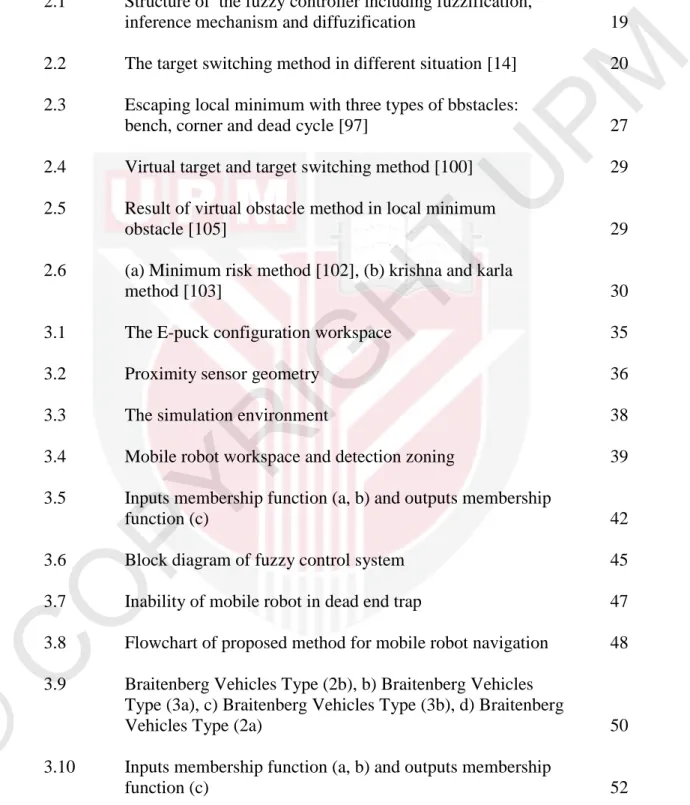
(17) LIST OF FIGURES Figure. The target switching method in different situation [14]. 20. 2.3. Escaping local minimum with three types of bbstacles: bench, corner and dead cycle [97]. 27. 2.4. Virtual target and target switching method [100]. 29. 2.5. Result of virtual obstacle method in local minimum obstacle [105]. 29. (a) Minimum risk method [102], (b) krishna and karla method [103]. T. 30. 3.1. The E-puck configuration workspace. 35. 3.2. Proximity sensor geometry. 36. 3.3. The simulation environment. 38. 3.4. Mobile robot workspace and detection zoning. 39. PY. IG. H. U. 2.2. 2.6. 3.5. Inputs membership function (a, b) and outputs membership function (c). 42. Block diagram of fuzzy control system. 45. O. 3.6. 3.7. Inability of mobile robot in dead end trap. 47. 3.8. Flowchart of proposed method for mobile robot navigation. 48. 3.9. Braitenberg Vehicles Type (2b), b) Braitenberg Vehicles Type (3a), c) Braitenberg Vehicles Type (3b), d) Braitenberg Vehicles Type (2a). 50. Inputs membership function (a, b) and outputs membership function (c). 52. 3.11. Block diagram of fuzzy control system. 52. 3.12. Angular difference between the robot and the target. 54. C ©. 19. PM. Structure of the fuzzy controller including fuzzification, inference mechanism and diffuzification. R. 2.1. Page. 3.10. xiv.
(18) Target seeking behavior. 55. 3.14. Several different cases of sensed environment. 56. 3.15. Difficult scenario for obstacle detection. 56. 3.16. Trapped mobile robot in multiple dead end trap. 57. 3.17. Algorithm of proposed method for mobile robot navigation. 59. 4.1. Robot path travelling by proposed fuzzy Braitenberg (path1), proposed fuzzy (path2) and Motlagh fuzzy (path3) in clutter environment. 62. U. Robot path travelling by proposed fuzzy Braitenberg (Path1), Proposed fuzzy (Path2) and Motlagh fuzzy (Path3) in dynamic Environment. C. 4.7. ©. 4.8. 4.9. 4.10. 4.11. 66. 67. 70. Comparison of the Krishna and Karla‟s method [128] (a), minimum risk method [127] (b) and proposed fuzzy method with first switching strategy(c). 72. O. 4.6. 64. An Example of Robot Navigation in Dead Cycle Obstacle (a), Robot path travelling (b), Robot angle (c), and distance and angle error (d), during the it‟s travelling path. PY. 4.5. Speed control, position of robot and target distance by proposed fuzzy Braitenberg (a), proposed fuzzy method (b) and Motlagh fuzzy method(c) in dynamic environment. R. 4.4. IG. H. 4.3. Speed control, position of robot and target distance by proposed fuzzy Braitenberg (a), proposed fuzzy method (b) and Motlagh fuzzy method(c) in clutter environment. T. 4.2. PM. 3.13. Comparison of virtual obstacle method [105] (a), and proposed fuzzy method with first switching strategy(b). 72. Comparison of memory state method (a), and proposed fuzzy method with first switching strategy(b). 73. Robot travelling path in multiple U-shape by second proposed Algorithm. 74. Comparison of the Motlagh method (a), and the proposed method (b): Case 1. 75. Comparison of the motlagh method (a), and the proposed method (b): Case 2. 76. xv.
(19) CHAPTER 1 INTRODUCTION. 1.1. Overview. PM. Intelligent mobile robots due to their automatic mobility have a wide range of possible applications in a large variety of domains such as industrial factories,. U. hospitals, military services and even the offices. The capabilities of these. autonomous mobile robots include lawn mowing, cleaning of the carpets, automatic. T. driving, intelligent delivery agents, rendering assistance to the crippled, discovery. H. and map creation to clean-up environment. Such capabilities can even allow the autonomous mobile robots to carry out specialized duties such as chemical handling. IG. in industrial areas or in some environments that were inaccessible or very dangerous for human beings. They could also be helpful in some emergency situations and. R. risky operations such as fire extinguishing. In some cases, there may be dangerous. PY. tasks that require collective efforts to be commonly accomplished by multiple robots. Such dangerous tasks that require collective efforts from the autonomous. O. robots include seeking and rescuing survivors after an earthquake or other major. C. disasters.. ©. The motion planning and control of robots is regarded as one of the major problems being encountered in construction of robot control strategies from task specifications given in an intelligent human-like language. The problem in robot navigation system can be grouped into two sub problems including the goal seeking and obstacle avoidance. There is a possibility to adapt the robot‟s behavior to any unknown and. 1.
(20) complex environment without further human intervention. Furthermore, the intelligent mobile robots are able to extract the information from any unknown environment, use their saving knowledge to recognize, perform and adjust themselves within any given environment [1-13]. Navigation of an autonomous. PM. mobile robot is still an open problem of research and there are yet various unsolved problems which perhaps need either an improvement in the present theories or create. U. a new method totally.. T. 1.2 Problem Statement. H. In order to mobile robot navigation, it is complicated to be used by mathematical. IG. approaches or conventional controllers due to inaccurate data and uncertainty. Due to nonlinearity of the system, it is computationally intensive and has complex. R. stability problems. In addition, the system does not have accurate models due to. PY. uncertainty and lack of perfect knowledge. Furthermore, the ambiguous measurements do not necessarily have stochastic noise models. According to the above-mentioned problems, the fuzzy controllers are strong because they have this. O. capability to cover a wider range of operating conditions and can perform with noise. C. and disturbances in different complex environments.. ©. Thus, a fuzzy logic method becomes more attractive in this research as a controller for mobile robot navigation because it is tolerant to nonlinearity and uncertainty. A lot of studies have used fuzzy logic approach to deal with the existing mobile robot navigation problems. Some do not consider the relative distance between the robot and the obstacles for input of controller, but only the obstacles orientations relative to the robot direction are defined [14- 16]. These methods showed poor response to. 2.
(21) dynamic obstacles. In addition, in static environment if a robot equipped with low range sensory, it does not take an immediate action to prevent from collision and it causes long time and path navigation. In some fuzzy controllers [14; 17; 18; 19], the outputs are forward velocity and steering control, which have poor performance to. PM. detect collision. In addition, the large number of fuzzy rule is not applicable for small robots because of small memory size. Therefore, for applicability of the controller for all different sizes of the robots, much less rules are needed, while. U. some conventional methods need a large number of rules [20, 21].. T. For most mobile robot navigations, a robot may be trapped inside a U-shaped object. H. if it does not memorize the place it has previously visited. The problem of trapping the robot inside a concave obstacle is called the dead cycle or local minimum. IG. problem. It was discovered in some studies that this problem cannot be simply resolved through such method. In the recent years, different trap escape approaches. R. have been designed to solve the local minimum problem. The studies of Wang and. PY. Liu [22], Krishna and Karla [23] and Wang and Liu [24] shown two major problems of these approaches include complicated computing and more trajectories travelling. O. toward reaching the target position. Furthermore, there are many previous approaches to minimum avoidance in local navigation which are usually a. C. combination of fuzzy logic with other techniques like virtual target [14, 25, 26].. ©. These algorithms showed their major weakness when they reached the target with long path and time travelling in multiple dead end traps such as G-shape and snail shape obstacles.. 3.
(22) Hence, the research problem in this study can be stated in a way that there is a drawback in fuzzy controller caused by large number of rules and considering the obstacles orientations for input of fuzzy and the outputs are forward velocity and steering control, which may cause poor performance to detect collision of obstacles. PM. and path navigation. In addition, a major problem in dead end trap strategies is long path travelling of mobile robot toward target position and weakness in multiple dead. U. end traps.. T. 1.3 Aim and Objectives. H. The aim of this study is to endow the mobile robot with human-like capability to. IG. navigate in an unknown and complex environment while avoiding obstacles and. following:. R. trapping areas but reaching a goal safely. The main objectives of this study are as the. PY. 1) To design fuzzy controller with less numbers (less than 20) of rules for obstacle avoidance and designing a simple algorithm to escape from the dead end trap. O. without required complicated calculations and changing the fuzzy control rules.. C. 2) To develop the switching strategy to escape from multiple dead end traps with. ©. shorter path.. 1.4 Scope of the Work The main contribution of this study is on resolving the problem of long path navigation by fuzzy logic controller. The robot used to implement the system is an E-puck, with an array of eight infrared sensors. The robot is not used physically and 4.
(23) only simulation tests are performed by using the WEBOTS simulator software. The simulation model focused on the control of the robot and its capability to detect obstacle which in turn helps it toward reaching the goal position. The surface of environment in simulator is flat because the robot is a two-wheeled differential robot. PM. and is very small. Furthermore, the objects utilized as obstacle only have standard. shapes because the virtual robot is equipped with low range sensors and the robot. with low range sensors is not capable to safe navigate with the irregular objects. The. U. scope of the research is set to develop a simulation model for mobile robot. T. navigation by using the MATLAB programmer in WEBOTS software. The main reasons are that the MATLAB is popular and has standardized programming. H. environment. MATLAB is incorporated with many research valuable toolboxes such. IG. as WEBOTS which is seen as professional robotics software. In this simulator the user can specifies both the graphical and the physical properties of the objects. R. include the shape, dimensions, position and orientation, colors, mass, friction factor,. PY. as well as the spring and damping constants [27]. Moreover, this software tools allow researchers to focus on the most interesting parts of their robotics projects and hence achieve more advanced results and reducing the amount of time and hardware. O. spent in developing mobile robotics applications [27]. Unlike the MATLAB,. C. mathematical model of robot should not be derived each time in WEBOTS for an accurate simulation run. The reason is powerful open dynamics engine of WEBOTS. ©. for a precise simulation. Therefore, only physical properties such as coefficients of friction, dimension, inertia matrix, and mass, should be specified. Afterwards, WEBOTS will define the other aspects. That is why simulations with WEBOTS can be faster than real robots (almost 300 times) [28].. 5.
(24) 1.5 Outline of the Chapters This thesis is organized in five main chapters. The first chapter comprises a brief introduction to the work undertaken, introduction to the problem, and the approach. PM. taken for the study. The second chapter includes background of the problem with analysis to the related works and the comparisons between different approaches. The. third chapter contains the analysis of the fuzzy logic used to describe mobile robot. U. navigation and the control law. A brief introduction to local minimum problem and algorithms which were used to escape were given at the end of this chapter.. T. Moreover, this chapter includes the Braitenberg fuzzy approach and the new. H. approach to the multiple traps with an effective algorithm called location memorize. In chapters four the implementation of the algorithms in WEBOTS environment,. IG. various simulation scenarios, comparisons between the fuzzy controllers and results for the motion planning will be discussed as well. Lastly, chapter five presents the. ©. C. O. PY. R. conclusion of the study and offers recommendations for future works.. 6.
(25) REFERENCES J.C. Latombe, “Robot motion planning,” Dordrecht: Kluwer Academic Publishers, 1991.. [2]. C. K. Yap, “Algorithmic motion planning,” in NJ: Lawrence Erlbaum, 1987, pp. 95–143.. [3]. W. W. Grey, “The living brain,” in Oxford, England: W.W. Norton, 1953.. [4]. T.L. Anderson and M. Donath, “Animal Behavior as a Paradigm for Developing Robot Autonomy,” Robotics and Autonomous Systems, vol. 6, no. 1, pp. 145–168, 1990.. [5]. V. Braitenberg, “Vehicles: Experiments in synthetic psychology,” in Cambridge: MIT Press, 1984, pp. 1–28.. [6]. M. Maeda, Y. Maeda, and S. Murakami, “Fuzzy drive control of an autonomous mobile robot,” Fuzzy Sets and Systems, vol. 39, no. 2, pp. 195– 204, Jan. 1991.. [7]. R. Brooks, “A robust layered control system for a mobile robot,” IEEE Journal of Robotics and Automation, vol. 2, no. 1, pp. 14–23, 1986.. [8]. R. Arkin, “Behavior-based robotics,” in Camberige: The MIT Press, 1998.. [9]. R. Brooks, “A robust layered control system for a mobile robot,” IEEE Journal of Robotics and Automation, vol. 2, no. 1, pp. 14–23, 1986.. PY. R. IG. H. T. U. PM. [1]. [10] D.B. Leake, “Artificial intelligence,” Van Nostrand Scientific Encyclopedia, Ninth Edition, New York: Wiley, 2002.. O. [11] C.R. Gallistel, “The organization of learning,” in Camberige: The MIT Press, 1990.. ©. C. [12] D. R. Parhi, “Navigation of Mobile Robots Using a Fuzzy Logic Controller,” Journal of Intelligent and Robotic Systems, vol. 42, no. 3, pp. 253–273, Mar. 2005.. [13] D. R. Parhi, “Navigation of Mobile Robots Using a Fuzzy Logic Controller,” Journal of Intelligent and Robotic Systems, vol. 42, no. 3, pp. 253–273, Mar. 2005. [14] O. R. E. Motlagh, T. S. Hong, and N. Ismail, “Development of a new minimum avoidance system for a behavior-based mobile robot,” Fuzzy Sets and Systems, vol. 160, no. 13, pp. 1929–1946, Jul. 2009.. 83.
(26) [15] R. Braunstingl, P. Sanz, and J. M. Ezkerra, “Fuzzy Logic Wall Following of a Mobile Robot Based on the Concept of General Perception,” in International Conference on Avanced Robotics, 1995, pp. 367–376.. PM. [16] X. Yang, M. Moallem, and R. V Patel, “A layered goal-oriented fuzzy motion planning strategy for mobile robot navigation.,” IEEE transactions on systems, man, and cybernetics. Part B, Cybernetics : a publication of the IEEE Systems, Man, and Cybernetics Society, vol. 35, no. 6, pp. 1214–24, Dec. 2005. [17] K. R. S. Kodagoda, W. S. Wijesoma, and E. K. Teoh, “Fuzzy Speed and Steering Control of an AGV,” IEEE Transactions on Control Systems Technology, vol. 10, no. 1, pp. 112–120, 2002.. T. U. [18] L. K. Doitsidis., V. P, and N. C. Tsourveloudis, “Fuzzy logic based autonomous skid steering vehicle navigation,” in Proceedings of the IEEE International Conference on Robotics, Automation, 2002, no. May 2002, pp. 2171–2177.. IG. H. [19] H. Seraji and A. Howard, “Behavior-Based Robot Navigation on Challenging Terrain : A Fuzzy Logic Approach,” IEEE Transactions on Robotics and Automation, vol. 18, no. 3, pp. 308–321, 2002.. R. [20] A. F. Scott and C. Yu, “Cooperative multi-agent mapping and exploration in Webots®,” in 2009 4th International Conference on Autonomous Robots and Agents, 2009, pp. 56–61.. PY. [21] O. Obe and D. I, “Fuzzy control of autonomous mobile robot,” U.P.B. Sci. Bull., Series C, vol. 72, no. 3, pp. 173–186, 2010.. O. [22] M. Wang and J. N. K. Liu, “Fuzzy Logic based robot path planning in unknown environment,” in Proceedings International Conference on Machine Learning and Cybernetics, 2005, vol. 1, no. August 2005, pp. 18– 21.. ©. C. [23] M. Wang and J. N. K. Liu, “Fuzzy Logic based robot path planning in unknown environment,” in Proceedings International Conference on Machine Learning and Cybernetics, 2005, vol. 1, no. August 2005, pp. 18– 21. [24] M. Wang, J.N.K. Liu, “Fuzzy logic-based real time robot navigation in unknown environment with dead ends,” Robotics and Autonomous Systems, vol. 56, 2008, pp. 625-643.. [25] W. L. Xu and S. K. Tso, “Sensor-based fuzzy reactive navigation of a mobile robot through local target switching,” IEEE Transactions on Systems, Man and Cybernetics, Part C, vol. 29, no. 3, pp. 451–459, 1999.. 84.
(27) [26] A. Zhu and S. X. Yang, “A fuzzy logic approach to reactive navigation of behavior-based mobile robots,” in Proceedings of IEEE International Conference on Robotics and Automation, 2004, pp. 5045–5050. [27] O. Michel, F. Rohrer, N. Heiniger, “Cyberbotics' Robot Curriculum,” Created on Wikibooks, the Open Content Textbooks Collection,2010.. PM. [28] P. Mandic and M. Lazarevic, “An Application Example of Webots in Solving Control Tasks of Robotic System,” FME Transactions, vol. 41, pp. 153–162, 2013.. U. [29] O. Michel, “Webots TM : Professional Mobile Robot Simulation,” International Journal of Advanced Robotic Systems, vol. 1, no. 1, pp. 39–42, 2004.. T. [30] H. Shahbazi, K. Jamshidi, and H. A. Monadjemi, “Sensor-Based Programming of Central Pattern Generators in Humanoid Robots,” International Journal of Advanced Robotic Systems, vol. 10, no. 192, p. 1, 2013.. IG. H. [31] R. Siegwart, I. R. Nourbakhsh, and D. Scaramuzza, “Introduction to Autonomous Mobile Robots second edition,” in Camberige: MIT Press, 2004.. R. [32] F. Rohrer, “Transfer a webots controller of the rat‟s life contest from simulation to reality,” no. March 2008. pp. 1–119, 2008.. PY. [33] P. Musilek, “Principles of autonomous mobile robot control,” Neural Networks World, vol. 3, pp. 249-260, 1993. [34] R. Brooks, “A robust layered control system for a mobile robot,” IEEE Journal of Robotics and Automation, vol. 2, no. 1, pp. 14–23, 1986.. O. [35] R. Arkin, “Behavior-based robotics,” in Camberige: The MIT Press, 1998.. ©. C. [36] D. Zhu and J. Latombe, “New Heuristic Algorithms for Efficient Hierarchical Path Planning,” IEEE Transaction on Robotics and Automation, vol. 7, no. 1, pp. 9–20, 1991.. [37] P. Khosla and R. Volpe, “Superquadratic Artificial Potentials for Obstacle Avoidance and Approach,” in Proceedings of the IEEE International Conference on Robotics and Automation, 1998, no. 1988. [38] R.A. Jarvis, J.C. Byrne, “Robot navigation: Touching, seeing and knowing,” in Proceedings of the 1st Australian Conference on Artificial Intelligence,1986. [39] A. Zelinsky, “Navigation by learning,” in Proceedings lEEE/RSJ Inernational Workshop on Robots and Its Applications, 1989, pp. 331–338.. 85.
(28) [40] A. Saffiotti, “An overview of quadtrees, octrees and related hierarchical data structures,” NATO ASI Series, Theoretical Foundations of Computer Graphics and Cad, vol. F40, pp. 51–68, 1998. [41] C. Seshadri and A. Ghosh, “Optimum path planning for robot manipulators amid static and dynamic obstacles,” IEEE Transactions on Systems, Man and Cybernetics, Part C, vol. 23, pp. 576–584, 1993.. PM. [42] Z. X. Li and T. D. Bui, “Robot path planning using fluid model,” Journal of Intelligent and Robotic Systems, vol. 21, pp. 29–50, 1998. [43] E. G. Gilbert and C. J. Ong, “Robot path planning with penetration growth distance,” Journal of Robotic Systems, vol. 15, no. 2, pp. 57–74, 1998.. U. [44] K. Jiang, L. D. Seneviratne, and S. W. E. Earles, “Time-optimal smooth-path motion planning for a mobile robot with kinematic constraints,” Robotica, vol. 15, pp. 547–553, 1997.. H. T. [45] A. Pruski and S. Rohmer, “Robust Path Planning for Non-Holonomic Robots,” Journal of Intelligent and Robotic Systems, vol. 18, pp. 329–350, 1997.. IG. [46] M. Y. Kim and H. Cho, “Three-dimensional map building for mobile robot navigation environments using a self-organizing neural network,” Journal of Robotic Systems, vol. 21, no. 6, pp. 323–343, Jun. 2004.. PY. R. [48] J. Meyer and D. Filliat, “Map-based navigation in mobile robots . II . A review of map-learning and path-planning strategies .,” Cognitive Systems Research, vol. 4, pp. 283–317, 2003. [49] O. Khatib, “Real-time obstacle avoidance for manipulators and mobile robots,” in Proceedings of the IEEE International Conference on Robotics and Automation, 1985, pp. 500–505.. ©. C. O. [50] Y. Koren, “Potential field methods and their limitations for mobile robot navigation,” in Proceedings of IEEE International Conference on Robotics and Automation, 1991, no. April, pp. 1398–1404. [51] K. Al-sultan and M. Aliyu, “A New Potential Field-Based Algorithm for Path Planning,” Journal of Intelligent and Robotic Systems, vol. 17, pp. 265–282, 1996. [52] J. Borenstein and Y. Koren, “The Vector Field Histogram-Fast Obstacle Avoidance for Mobile Robots,” IEEE Journal of Robotics and Automation, vol. 7, no. 3, pp. 278–288, 1991. [53] I. Ulrich and J. Borenstein, “VFH+: reliable obstacle avoidance for fast mobile robots,” in Proceedings of the 1998 IEEE International Conference on Robotics and Automation, 1998, no. May, pp. 1572–1577.. 86.
(29) [54] I. Ulrich and J. Borenstein, “VFH *: Local Obstacle Avoidance with LookAhead Verification,” in Proceedings of the IEEE International Conference on Robotics and Automation, 2000, no. April, pp. 2505–2511. [55] D. Fox, W. Burgard, and S. Thrun, “The dynamic window approach to collision avoidance,” IEEE Robotics and Automation Magazine, vol. 4, no. 1, pp. 23–33, 1997.. PM. [56] O. Brock and O. Khatib, “High-speed navigation using the global dynamic window approach,” in Proceedings 1999 IEEE International Conference on Robotics and Automation, 1999, vol. 1, no. May 1999, pp. 341–346.. U. [57] A. Saffiotti, “The uses of fuzzy logic in autonomous robot navigation,” Soft Computing, vol. 1, pp. 180–197, 1997. [58] H. Li and S. X. Yang, “A Behavior-Based Mobile Robot With a Visual,” IEEE Transactions on Mechatronics, vol. 8, no. 3, pp. 390–400, 2003.. H. T. [59] P.S. Lee, L.L. Wang, L. L, “Collision avoidance by fuzzy logic control for automated guided vehicle navigation,” Journal of Robotic Systems, vol. 11, no. 8, pp.743–760, 1994.. IG. [60] W. L. Xu and S. K. Tso, “Real-time self-reaction of a mobile robot in unstructured environments using fuzzy reasoning,” Engineering Applications of Artificial Intelligence, vol. 9, no. 5, pp. 475–485, Oct. 1996.. PY. R. [61] W.L. Xu, S.K. Tso, “Sensor-based fuzzy reactive navigation of a mobile robot through local target switching,” IEEE Transactions on Systems, Man and Cybernetics, Part C, vol.29, no. 3, pp. 451–459, 1999. [62] A. Saffiotti, “Fuzzy logic in autonomous robotics: behavior coordination,” in Proceedings of the Sixth IEEE International Conference on Fuzzy Systems, 1997, pp. 573–578.. ©. C. O. [63] A. Saffiotti, E.H. Ruspini, K. Konolige, “Using fuzzy logic for mobile robot control,” in Practical Applications of Fuzzy Technologies. Kluwer Academic Publisher, pp. 185–206, 1999. [64] X. Yang, M. Moallem, and R. V. Patel, “A novel intelligent technique for mobile robot navigation,” in Proceedings of 2003 IEEE Conference on Control Applications, 2003, pp. 674–679. [65] A. Fujimori, M. Teramoto, P. N. Nikiforuk, and M. M. Gupta, “Cooperative Collision Avoidance between Multiple Mobile Robots,” Journal of Robotic Systems, vol. 17, no. 7, pp. 347–363, 2000. [66] A. Fujimori, Y. Ogawa, and P. N. Nikiforuk, “A modification of cooperative collision avoidance for multiple mobile robots using the avoidance circle,” Journal of Systems and Control Engineering, vol. 216, no. 3, pp. 291–299, 2002. 87.
(30) [67] L. Zeng and G. M. Bone, “Mobile Robot Collision Avoidance in Human Environments,” International Journal of Advanced Robotic Systems, vol. 10, pp. 1–14, 2013. [68] M. Hamani and A. Hassam, “Mobile Robot Navigation in Unknown Environment Using Improved APF Method,” in The 13th International Arab Conference on Information Technology ACIT, 2012, pp. 453–458.. PM. [69] S. Nurmaini, “Development mobile robot control architecture with integrated planning and control on low cost microcontroller,” Journal of Theoretical and Applied Information Technology, vol. 35, no. 1, pp. 100–111, 2012.. U. [70] R. A. Conn and M. Kam, “Robot motion planning on N-dimensional star worlds among moving obstacles,” IEEE Transactions on Robotics and Automation, vol. 14, no. 2, pp. 320–325, 1998.. T. [71] P. Vadakkepat, K. C. Tan, and M. L. Wang, “Evolutionary artificial potential fields and their application in real time robot path planning,” in Proceedings of the Congress on Evolutionary Computation, 2000, pp. 256–263.. IG. H. [72] S. S. Ge and Y. J. Cui, “Dynamic Motion Planning for Mobile Robots Using Potential Field Method,” Autonomous Robots, vol. 13, pp. 207–222, 2002.. R. [73] M. Mucientes, R. Iglesias, C. V Regueiro, and S. Barro, “Fuzzy temporal rules for mobile robot guidance in dynamic environments,” IEEE Transactions on Systems, Man, and Cybernetics-Part C: Applications and Reviews, vol. 21, no. 3, pp. 391–398, 2001.. PY. [74] F. Abdessemed, K. Benmahammed, and E. Monacelli, “A fuzzy-based reactive controller for a non-holonomic mobile robot,” Robotics and Autonomous Systems, vol. 47, no. 1, pp. 31–46, May 2004.. O. [75] M. Cao and E. Hall, “Fuzzy Logic Control for an Automated Guided Vehicle,” Intelligent Robots and Computer Vision XVII: Algorithms, Techniques and Active Vision., vol. 3522, no. 1, pp. 303–312, 1998.. ©. C. [76] R. Rashid, I. Elamvazuthi, M. Begam, and M. Arrofiq, “Differential drive wheeled mobile robot (WMR) control using fuzzy logic techniques,” in International Conference on Mathematical/Analytical Modelling and Computer Simulation, 2010, pp. 51–55. [77] V. Raudonis and R. Maskeliunas, “Trajectory based fuzzy controller for indoor navigation,” in IEEE 12th International Symposium on Computational Intelligence and Informatics (CINTI), 2011, no. 3, pp. 69–72. [78] S. K. Pradhan, D. R. Parhi, and A. K. Panda, “Fuzzy logic techniques for navigation of several mobile robots,” Applied Soft Computing, vol. 9, no. 1, pp. 290–304, Jan. 2009.. 88.
(31) [79] T. S. Li, S. Chang, and W. Tong, “Fuzzy Target Tracking Control of Autonomous Mobile Robots by Using Infrared Sensors,” IEEE on Fuzzy Systems, vol. 12, no. 4, pp. 491–501, 2004. [80] E. Bicho and G. Schoner, “The dynamic approach to autonomous robotics demonstrated on a low-level vehicle platform,” Robotics and Autonomous Systems, vol. 21, pp. 23–35, 1997.. PM. [81] X. Yang, R. V. Patel, and M. Moallem, “A Fuzzy–Braitenberg Navigation Strategy for Differential Drive Mobile Robots,” Journal of Intelligent and Robotic Systems, vol. 47, no. 2, pp. 101–124, Sep. 2006.. U. [82] L. Capozzo, G. Attolico, G. Cicirelli, I. Elaborazione, and V. Amendola, “Building low cost vehicles for simple reactive behaviors,” in Proceedings of the IEEE International Conference on Systems, Man, and Cybernetics, 1999, pp. 675–680.. H. T. [83] J. Molina, A. Sanchis, A. Berlanga, and P. Isasi, “Evolving connection weight between sensors and actuators in robots,” in IEEE International Symposium on Industrial Electronics, 1997, pp. 686–690.. IG. [84] C. Braitenberg, S. Wienecke, and Y. Wang, “Basement structures from satellite-derived gravity field: South China Sea ridge,” Journal of Geophysical Research, vol. 111, pp. 1–15, 2006.. R. [85] S. . Rahmati and F. Farhadnia, “A novel method for controlling multi-agent robot,” Journal of Applied Sciences, vol. 11, no. 14, pp. 2627–2633, 2011.. PY. [86] M. Faisal, R. Hedjar, M. Al, and K. Al-Mutib, “Fuzzy Logic Navigation and Obstacle Avoidance by a Mobile Robot in an Unknown Dynamic Environment,” International Journal of Advanced Robotic Systems, vol. 10, pp. 1–7, 2013.. ©. C. O. [87] K. Im, S. Oh, and S. Han, “Evolving a modular neural network-based behavioral fusion using extended VFF and environment classification for mobile robot navigation,” IEEE Transactions on Evolutionary Computation, vol. 6, no. 4, pp. 413–419, 2002. [88] K.B. Abdallah, Z. Qi-dan, “A Fuzzy Logic Behavior Architecture Controller for a Mobile Robot Path Planning in Multi-obstacles Environment,” vol. 5, no. 14, pp. 3835–3842, 1999.. [89] M. Boujelben, C. Rekik, and N. Derbel, “Hierarchical fuzzy controller for a nonholonomic mobile robot,” in Preprints of the 20th Mediterranean Conference on Control & Automation, 2012, pp. 341–347. [90] T. S. Hong, D. Nakhaeinia, and B. Karasfi, “Application of Fuzzy Logic in Mobile Robot Navigation,” in Fuzzy Logic Controls, Concepts, Theories and Applications, 2012, pp. 21–36.. 89.
(32) [91] N. Kubota, T. Morioka, F. Kojima, and T. Fukuda, “Learning of mobile robots using perception-based genetic algorithm,” Measurement, vol. 29, no. 3, pp. 237–248, Apr. 2001.. PM. [92] M. J. Er and C. Deng, “Online tuning of fuzzy inference systems using dynamic fuzzy Q-learning.,” IEEE transactions on systems, man, and cybernetics. Part B, Cybernetics : a publication of the IEEE Systems, Man, and Cybernetics Society, vol. 34, no. 3, pp. 1478–89, Jun. 2004. [93] J. Barraquand and J.-C. Latombe, “A Monte-Carlo algorithm for path planning with many degrees of freedom,” in Proceedings., IEEE International Conference on Robotics and Automation, 1990, pp. 1712–1717.. U. [94] S. Carpin and G. Pillonetto, “Robot motion planning using adaptive random walks,” in International Conference on Robotics and Automation, 2003, pp. 14–19.. H. T. [95] H. Chang, “A new technique to handle local minima for imperfect potential field based motion planning,” in Proceedings of the IEEE International Conference on Robotics and Automation, 1996.. IG. [96] D. Lee and K. Sim, “Artificial immune network-based cooperative control in collective autonomous mobile robots,” in IEEE International Workshop on Robot and Human Communication, 1997, pp. 58–63.. R. [97] X. Yun and K. Tan, “A wall-following method for escaping local minima in potential field based motion planning,” in Proceedings of the IEEE International Conference on Advanced Robotics, 1997, pp. 421–426.. PY. [98] L. Chengqing, M. H. Jr, H. Krishnan, and L. S. Yong, “Virtual Obstacle Concept for Local-minimum-recovery in Potential-field Based Navigation,” in Proceedings of the IEEE International Conference on Robotics and Automation, 2000, no. April 2000, pp. 983–988.. ©. C. O. [99] M. G. Park and M. C. Lee, “Artificial potential field based path planning for mobile robots using a virtual obstacle concept,” in Proceedings of the IEEE/ASME International Conference on Advanced Intelligent Mechatronics, 2003, no. Aim 2003, pp. 735–740.. [100] W. L. Xu, S. K. Tso, and Y. H. Fung, “Fuzzy reactive control of a mobile robot incorporating a real/virtual target switching strategy,” Robotics and Autonomous Systems, vol. 23, no. 3, pp. 171–186, Apr. 1998. [101] W. L. Xu, “A virtual target approach for resolving the limit cycle problem in navigation of a fuzzy behaviour-based mobile robot,” Robotics and Autonomous Systems, vol. 30, no. 4, pp. 315–324, Mar. 2000.. [102] M. Wang and J. N. K. Liu, “Fuzzy logic-based real-time robot navigation in unknown environment with dead ends,” Robotics and Autonomous Systems, vol. 56, no. 7, pp. 625–643, Jul. 2008. 90.
(33) [103] K.M. Krishna and P. K. Kalra, “Perception and remembrance of the environment during real-time navigation of a mobile robot,” Robotics and Autonomous Systems, vol. 37, no. 1, pp. 25–51, Oct. 2001. [104] H.P. Huang and P.C. Lee, “A real-time algorithm for obstacle avoidance of autonomous mobile robots,” Robotica, vol. 10, pp. 217–227, 1992.. PM. [105] F.G. Pin, S.R. Bender, “Adding memory processing behavior to the fuzzy behaviorist approach: Resolving limit cycle problems in mobile robot navigation,” Intelligent Automation and Soft Computing, vol. 5, no. 1, pp. 31– 41, 1999.. U. [106] B. Magyar, Z. Forhecz, and P. Korondi, “Developing an efficient mobile robot control algorithm in the webots simulation environment,” in IEEE International Conference on Industrial Technology, 2003, pp. 179–184.. H. T. [107] L. Marin, M. Valles, A. Valera, and P. Albertos, “Implementation of a Bug Algorithm in the E-puck from a Hybrid Control Viewpoint,” in International Conference on Methods and Models in Automation and Robotics, 2010, pp. 174–179.. IG. [108] O. Michel, F. Rohrer, and N. Heiniger, “Cyberbotics ‟ Robot Curriculum,” Created on Wikibooks, the open content textbooks collection. pp. 1–121, 2010.. ©. C. O. PY. R. [109] J. Godjevac, “A learning procedure for a fuzzy system : application to obstacle avoidance,” in Proceedings International Symposium on Fuzzy Logic, 1995, pp. 142–148.. 91.
(34)
Figure
Related documents
Follow verification process to prevent outside entities from adjusting content Establish fluent communication process with staff to aid in verification process Promote special
The guidelines in § 3 rely on the total number of tasks in the system. Therefore, they result in a recalculation and change in allocation at the completion of every task.
I use a probit model to predict outcomes of spread bets and find that home teams are at a disadvantage for beating the spread, being the underdog increases a home team’s likelihood
Spectrum investors receive asset allocation, discretionary investment management and trade execution services with respect to the assets invested in the accounts (“the
An efficient intrusion detection system based on hypergraph - Genetic algorithm for parameter optimization and feature selection in support vector
Routers Communication Protocols Links DNS Servers Reactive Security Proactive Security Virus Scanner Misuse Detection Intrusion Detection System (IDS) Network
Biller Details on invoicing party Element 1..1 XML composite InvoiceRecipient Details on invoice recipient Element 1..1 XML.. composite OrderingParty In case the
Harper , 2014 WL 5487788, at *6 (“Section 121(a)(1) requires pre-suit notice ‘to each health care provider that will be a defendant.’ Section 121(c) provides that ‘[w]hen notice
